1
CERTIFICATE
I Altaf Nazeer (1318941008) certify that the project entitled “BRIEF
OVERVIEW ON E&M WORK FOR 10 UNDERGROUND STATION FOR
DMRC, ISO, QUALITY MANAGEMENT SYSTEM, DESIGN AND
DEVLOPEMENT, SAFTY, FIRE ENGINEERING FOR DMRC” is an authentic
record of my own work carried out at LARSEN & TOUBRO
CONSTRUCTION LIMITED- PT&D as requirements of project semester
for the award of degree of B.Tech. (Manufacturing Engineering), Central
Institute Of Plastics Engineering & Technology, Lucknow affiliated to
UPTU, under the guidance of MR. Aniruddha Kayet during 20th
January
to 20th
February’ 2016.
Altaf Nazeer
Certified that above statement made by the student is correct to the
best of our knowledge and belief.
Mr.M.S.Kanyal (Project Manager)
Mr.Aniruddha Kayet (Quality Manager)
Mr.Awadhesh (Site Engineer)
2
ACKNOWLEDGEMENT
I am very much thankful to LARSEN AND TOUBRO CONSTRUCTION
DIVISION for providing me such a great opportunity to internship in
India’s largest construction company.
I would like also like to acknowledge Mr. Awadhesh, Mr. Aniruddha
Kayet and Mr. M.S. Kanyal for patiently attending my queries and
providing me a kind support at every stage of my project.
It was really a pleasure working under such a healthy environment with
so many helpful and intelligent people around.
ALTAF NAZEER
3
4
5
ISO:
INTERNATIONAL ORGANISATION FOR
STANDERDISATION
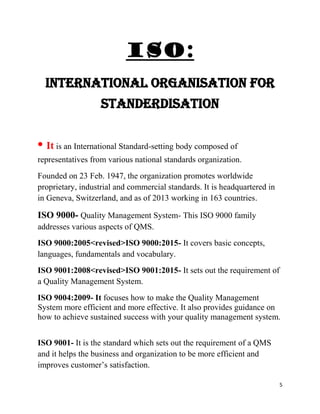
• It is an International Standard-setting body composed of
representatives from various national standards organization.
Founded on 23 Feb. 1947, the organization promotes worldwide
proprietary, industrial and commercial standards. It is headquartered in
in Geneva, Switzerland, and as of 2013 working in 163 countries.
ISO 9000- Quality Management System- This ISO 9000 family
addresses various aspects of QMS.
ISO 9000:2005<revised>ISO 9000:2015- It covers basic concepts,
languages, fundamentals and vocabulary.
ISO 9001:2008<revised>ISO 9001:2015- It sets out the requirement of
a Quality Management System.
ISO 9004:2009- It focuses how to make the Quality Management
System more efficient and more effective. It also provides guidance on
how to achieve sustained success with your quality management system.
ISO 9001- It is the standard which sets out the requirement of a QMS
and it helps the business and organization to be more efficient and
improves customer’s satisfaction.
6
Relationship between ISO 9001 and ISO 9004- ISO 9001 & ISO 9004
are Quality Management System Standards which have been designed to
complement each other but can also be used as independently.
ISO 9004 provides a wider focus on quality management
than ISO 9001 it addresses the need and expectations of all interested
parties and their satisfaction by the systematic and continual
improvement.
ISO Clauses of Quality
Management System
There are eight clauses of the Quality Management System:
• Introduction
• Scope
• Normative References
• Terms & Definition
•Quality Management System
•Management Responsibility
•Resource Management
•Product Realization
•Measurement Analysis and Improvement.
7
0- Introduction:
0.1-General: The adoption of QMS should be a strategic decision of
an organization’s quality system influenced by
-its organizational environment
-its varying need
-its particular objective
-product it provide
-its size and organizational structure
0.2-Process Approach: This international standard promotes the
adoption of a process approach when developing, implementing and
improving the effectiveness of a QMS to enhance the customer
satisfaction by meeting customer requirements.
All the processes can be done by a methodology known
as PDCA (Plan-Do-Check-Act).
Plan- Establish objectives and processes necessary to deliver results
according to customer requirement.
Do-Implement the processes
Check-Monitor and measure the processes product and report the
results.
Act-Take action continually improves process performance.
8
1-SCOPE:
Quality manual is required under volume1, Section 5, clause 5.1.1(1).
This document is structured in line with ISO 9001:2000/2008 approach
of quality management system. This Quality manual addresses all the
processes in Industrial Electrification BU of Power Transmission &
Distribution IC of L&T CONSTRUCTION and related to CE-09 Lot2.
1.1. PROJECT SCOPE
The scope of work is detailed in, the contract and requirement
specifications, including any variations or amendments which may have
been agreed in contract correspondence stated as below
Design Verification, Detail Engineering Manufacture, Supply,
Installation, Testing and
Commissioning of Electrical and Mechanical System Including Fire
and Hydraulic System for
Underground Stations of Delhi Mass Rapid Transport System
Project Phase-3 CE-09 Lot2.
The stations included in the package are as follows.
Kalkaji
Nehru place
G.K. Enclave
Chirag Delhi
Panchsheel Park
Hauz khas
IIT
R K Puram
Vasant Vihar
Munirka
9
1.2. PURPOSE
This Quality Manual assures that all the processes would function
systematically in accordance with L&T Vision and L&T-PT&D IC's
Quality policy and ISO requirements. This quality plan sets out the
methods of achieving and controlling the quality requirements and
compliance to contract requirements. All personnel engaged in the
contract works will comply with the requirements of this
Quality Plan.
The Quality Management System is being constantly
reviewed and continually improved. The
review of Quality management shall be carried at various levels and at
various phases. The Inputs for change comes from individual initiatives
of all interested parties (such as Employees, Customers,Vendors etc.,).
1.3. APPLICABILITY
This Quality Management System is applicable throughout the
projects of the Delhi Metro Rail Corporation with contract quality
requirements.
1.4. CONFIDENTIALITY
This Quality Manual is the property of Larsen & Toubro Limited,
PT&D IC& DMRC. No part of this manual shall be copied, reproduced,
disclosed, transferred or reduced to any form, including machine
readable form (or) otherwise without the consent in writing from the
concerned.
2-Normative References:
The following documents are used as a source of references-
-ISO 9000:2005-QMS-Funadamentals and Vocabulary.
-ISO 9001:2008-QMS-Requirement.
-ISO 9004:2009-A Quality Management Approach.
10
-Contract Document and Drawing prepared / issued by customer.
-Codes listed in drawings and specifications.
3-Terms and Definition:
Organization- Larsen & Toubro Limited, Power Transmission &
Distribution IC,
Supplier- Any person / firm or Company appointed by the customer
directly or through Larsen & Toubro Limited to provide product/service.
Third party inspection - A service provided by any recognized
independent agency employed by the Customer or by Larsen & Toubro
Limited to oversee inspections and tests for materials and/or work
Whenever required by the customer or his representative.
Authorized inspection agency - A service provided by any recognized
independent agency and
approved or employed by the customer for inspections and tests
whenever required by the customer or
his representative.
Quality - Degree to which a set of inherent characteristics of the product
or services fulfills requirements.
Quality Assurance - Part of Quality Management focused on providing
confidence that Quality requirements shall be fulfilled.
Quality Control - Part of Quality Management focused on fulfilling
Quality requirements.
11
Audit - A systematic, independent and documented process for
obtaining audit evidence and evaluating it objectively to determine the
extent to which audit criteria are fulfilled.
Quality Plan - A document specifying which procedures and associated
resources shall be applied by whom and when to a specific project,
product, process or contract.
Procedure - Specified way to carry out an activity or a process.
Inspection - Activities such as Measuring, Examining, Testing, Gauging
one or more characteristics of
a material, procedure, product or service and comparing this with the
specified requirements.
Corrective Action - An activity, the intention of which is to return the
non-conforming item or action
to a stage of conformity. It also covers the action taken to prevent further
recurrences of the nonconformity.
Concession - A formal approval by an appropriate agency, in this case
the Customer or his
authorized representative, to deviate from the specification or design
which does not affect the desired
final function.
Hold Point - A stage in the production cycle when inspection and /or
test are performed to determine
the acceptability of an item for further processing.
Witness point - A stage in the production cycle when a third party
inspector, contractor or company Representative witnesses any
inspection and or test to determine the acceptability of an item for
further processing.
12
Repair - The process of restoring a non-conforming condition such that
the item conforms to the original specified requirements, where such a
repair or restoration is acceptable.
Calibration - The comparison of two instruments, measuring devices or
gauges, one of which is of known accuracy and where applicable,
traceable to an internationally recognized standard.
Non-Destructive Examination - The means whereby the integrity or
conformity of an item can be assessed without resorting to destructive
analytical procedures.
Check - A stage in the production cycle, when a third party Inspector or
L&T representative performs a check or test to determine the
acceptability of the item for further processing.
Review - A stage in a construction cycle, when a third party Inspector or
L&T representative may verify records and or procedures and determine
the acceptability of the same.
Material Test Certificate - A document of test results either from
source of materials or from inhouse or independent agencies.
Chief Project Manager - A Manager from L&T's payroll will be
accountable for accomplishing the project. Objectives stated under
L&T's scope of work for the purpose of execution of the Metro Rail
Project. Please refer the PMP to view the organization structure.
4-Quality Management System:
The objective of this manual is to document, maintain, update,
implement and continual improvement in
13
Quality Management System to ensure that this project confirms to the
contractual requirement of customer.
4. 1. GENERAL REQUIREMENTS
L&T has a well-established Quality Management System (QMS) in
line with ISO9001-2008 and is constantly taking appropriate steps to
improve its efficiency and effectiveness.
Quality Management System is established, documented,
implemented, and maintained and its effectiveness is continually
improved in accordance with the requirement of ISO 9001. The Quality
Management System consist of different processes needed for the
Quality management System and their application throughout the project
has been identified.
Processes are monitored measured & analyzed regularly.
Necessary actions to achieve planned results and continual
improvement of the processes are implemented.
4. 2. DOCCUMENTATION REQUIREMENTS4.2.1 GENERAL
The Quality Management System documentation adopted by L&T-
PT&D IC includes the following:
a) Documented statements of quality policy and quality objectives.
b) Quality Manual.
c) Documented procedures required by the International standard.
d) Work Instructions/Distribution List.
e) Formats & records.
DOCUMENTATION
To ensure that all documents, drawings and data are maintained in a
controlled manner and reviewed and
authorized for use.
The procedures and the relevant clauses of the International standard
which are addressed by the
procedures are well established.
14
4.2.2 QUALITY MANUAL
This document is the quality manual of the project which covers the
design, manufacture, product delivery, installation, testing &
commissioning of the project. This manual covers the requirements of
ISO 9001:2008 international standards including justification for any
exclusion.
It makes reference to procedures and guidelines and outlines the
structure of the documentation used in the quality management system.
This quality manual also includes the description of the interaction
between the processes of the Quality management System.
4.2.3. CONTROL OF DOCUMENTS
The entire required documents are identified, reviewed and approved for
adequacy prior to issue by designated authorities. The document and
data control system to be followed with DMRC as described in detail as
per guidelines for document control. Document controller is responsible
for receiving, listing, filing, delivering and distribution of all documents
to the concerned.
Documents are reviewed and updated as required and re-approved by the
designated authority.
4.2.4. CONTROL OF RECORDS
L&T has established a procedure for control of records.
 Records are established and maintained to provide evidence of
conformity to requirements and of the effective operation of the
Quality Management System.
 Records are suitably numbered, indexed and filed for easy
retrieval.
 Records are protected from damage, loss and deterioration while
storage.
 Records are maintained in a manner that remains legible, readily
identifiable.
15
5. MANAGEMENT RESPONSIBILITY
Chief Project Manager
The nominated Chief Project Manager shall be responsible for ensuring that the
activities required for this project quality system are planned, implemented and
controlled and their progress monitored. His role is defined in L&T Project
Management department quality procedure which specifies key duties which
include, but are not limited to;
Assisting Project Management Committee
Timely completion of the Project
Completion within budget
Resource planning& Implementation of QMP and Work Methods
Liaison with customer, statutory and regulatory authorities
Monitoring & Review of Progress, process parameters & financials - CAPA for
variation
Best Practices identification, nurture and report.
Development of employees
Design Verification
Test and Commissioning, technical Assurance during Installation and
Certification
5. 2. CUSTOMER FOCUS
In this project, the Chief Project manager and his team will make sure that
customer requirements are identified and efforts will be made to enhance the
customer Satisfaction by meeting requirement related to price, quality & delivery.
5. 3. QUALITY POLICY
The Quality Policy is to provide Design, Supply, Installation and Maintenance
which meets or exceeds best industry practices.
5. 4. PLANNING
5.4.1 QUALITYU OBJECTIVE
To define quality objective which are measurable, consistent to L&T Quality
Policy and relevant to meet requirement for this project. Chief Project manager is
16
completely responsible to achieve the Quality Objectives with the support of
Quality Manager.
5. 6. MANAGEMENT REVIEW
The Management Review shall be undertaken at least once every months and the
results of the regular Internal Quality Audits of the Company Quality Manual and
this plan shall be taken into account.
5.6.2. REVIEW INPUT
The input to management review shall include information on
a) Results of audit
b) Customer feedback including customer complaints
c) Process performance & product conformity
d) Status of preventive & corrective action
e) Follow-up actions from previous management review
f) Changes that could improve QMS
g) Recommendations for improvement
5.6.3. REVIEW OUTPUT
The management review output shall include any decision and action related to
a) Improvement of the effectiveness of the quality management system and its
processes
b) Improvement of the product related to customer requirements,
c) Resource needs.
6. RESOURCES MANAGEMENT
6. 1. PROVISION OF RESOURCES
L&T has identified the key resources for its business processes that include
employees, Vendors, Subcontractors & Workmen. L&T determines and provides
adequate resources on a continual basis for:
Implementation and maintenance of Quality Management System
Continually improving the effectiveness of Quality Management System
Enhancing customer satisfaction by consistently meeting customer
requirements.
For smooth & effective operation & control of processes.
17
6. 2. HUMAN RESOURCES
6.2.1. GENERAL
L&T has established and maintains a procedure for Human Resources, which
ensures that the staff performing work affecting product quality is competent on
the basis of appropriate education training, skills and experience.
6.2.2. COMPETENCE, TRAINING AND AWARENESS
All Departments / Sections identify the training needs and inform the same to HR
and monitor adherence to identified needs every six months. Respective HOD’s
shall measure effectiveness of Training.
6. 3. INFRASTRUCTURE
L&T provides the required infrastructure needed to achieve Product quality
requirements at all offices and project sites. The management maintains and
ensures continuous availability of Buildings, office furniture and utilities.
.
6. 4. WORK ENVIRONMENT
The organization manages the work environment needed, to achieve conformity to
product requirements. Strict environment compliance standards are in place at all
levels in the organization. The activities under this include housekeeping, safety
management, and control of noise and dust.
7. PRODUCT REALIZATION
7. 1. PLANNING OF PRODUCT REALIZATION
The product in a typical project is attained by the complete synchronization&
coordination of processes at offices& project sites. The processes at offices include
Business Development, Design& Development, Supply Chain Management, and
Operations Monitoring& Support which are addressed in the established
procedures at offices.
7. 2. CUSTOMER RELATED PROCESS
7.2.1. REVIEW OF REQUIREMENT RELATED TO THE CUSTOMER
7.2.2. CUSTOMER COMMUNICATION
18
7. 3. DESIGN AND DEVELOPMENT
7.3.1. DESIGN AND DEVELOPMENT PROCESS
7.3.1.1 DESIGN AND DEVELOPMENT PLANNING.
7.3.1.2 DESIGN AND DEVELOPMENT INPUTS.
7.3.1.3. INPUTS AND OUTPUTS REVIEW.
7.3.1.4. DESIGN AND DEVELOPMENT REVIEW.
7.3.1.5. SITE SUPERVISION.
7.3.2. CONTROL OF DESIGN AND DEVELOPMENT CHANGES
The control of design and development changes will be in accordance with the
Processes specified in the change management plan/ procedure.
7. 4. PURCHASING
All purchasing requirements shall be checked by the Project Manager to
ensure that they meet the terms and conditions of the contract. This review will
take place during the raising of the electronic materials request, prior to being
released to purchasing for ordering.
7.4.1. PURCHASING PROCESS
7.4.1.1. EVALUATION OF SUB CONTRACTORS/ SUPPLIERS.
7.4.1.2. SUB CONTRACTORS/ SUPPLIERS PERFORMANCE EVALUATION.
7.4.1.3. RECORD OF EVALUATIONS.
7.4.1.4. RE EVALUATION.
7.4.2. PURCHASING INFORMATION
Requirements related to approval of product, procedure, processes and equipment
Requirement related to the qualification of the personnel, if any.
Inspection and test requirements
Purchasing documents are checked and approved for adequacy of specified purchase requirements prior to their
communication to the supplier.
7.4.3. VERIFICATION OF PURCHASED PRODUCTS
7.4.3.1. VERIFICATION
7.4.3.2. CUSTOMER VERIFICATION AT SUPPLIERS PERMISES
7.4.4. PURCHASE ORDERS.
7. 5. PRODUCT AND SERVICE PROVISIONS
7.5.1. CONTROL OF PRODUCTION AND SERVICE PROVISION.
7.5.2. VALIDATION OF PROCESS FOR PRODUCTION AND SERVICE
PROVISION.
7.5.3. IDENTIFICATION AND TRACEABILITY.
7.5.4. CUSTOMER PROPERTY.
7.5.5. PRESERVATION OF PRODUCTS.
7.5.5.1. HANDLING.
19
7.5.5.2. STORAGE.
7.5.5.3. PACKAGING.
7.5.5.4. PRESERVATION AND PROTECTION.
7. 6. CONTROL OF MONITORING AND MEASURING DEVICES
L&T-PT&D IC ensures that all the monitoring and measuring equipment used at project
sites are controlled and kept in good working condition with the calibration status.
8. MEASUREMENT, ANALYSIS AND IMPROVEMENT
8. 1. GENERAL REQUIREMENTS
Monitoring, measurement, analysis and improvement processes needed are
implemented to demonstrate the conformity of the project with specified
requirements.
8. 2. MONITORING AND MEASUREMENT
8.2.1. CUSTOMER SATISFACTION.
8.2.2. INTERNAL AUDIT.
8. 3. CONTROL OF NON-CONFORMITY PRODUCT
8. 4. ANALYSIS OF DATA
Data collected after monitoring and measurement of the different processes are
analyzed to demonstrate the suitability and effectiveness of the quality
management system and to evaluate where continual improvement in the
effectiveness of the quality management system can be made.
8. 5. IMPROVEMENT
8.5.1. CONTINUAL IMPROVEMENT.
8.5.2. CORRECTIVE ACTION.
8.5.3. PREVENTIVE ACTION.
20
QUALITY MANAGEMENT SYSTEM
What is a Quality Management System?
A quality management system is a way of defining how an organization
can meet the requirements of its customers and other stakeholders
affected by its work. Other ISO standards look at other types of
management systems, such as ISO 14001 for environmental
management or the upcoming ISO 45001 for occupational health and
safety management.
ISO 9001 is based on the idea of continual improvement. It is designed
to be flexible enough for use by many different types of organization, so
does not specify what the objectives relating to “ quality ” or “ meeting
customer needs ” should be. Instead, it requires organizations to define
these objectives themselves and continually improve their processes in
order to reach them. Once these targets have been attained , they must be
reassessed… in a quest for Continual improvement.
A good quality management system can bring benefits
to organizations of all sizes and all sectors.
What benefits will it bring to my business or
organization?
Implementing a quality management system will help you:
• Assess the overall context of your organization to define who is
affected by your work and what they expect from you. This will enable
21
you to clearly state your objectives and identify new business
opportunities.
• Put your customers first, making sure you consistently meet their
needs and enhance their satisfaction. This can lead to repeat custom, new
clients and increased business for your organization.
• Work in a more efficient way as all your processes Will be aligned
and understood by everyone in the business or organization. This
increases productivity and efficiency, bringing internal costs down.
• Meet the necessary statutory and regulatory requirements.
• Expand into new markets, as some sectors and clients require ISO
9001 before doing business.
• Identify and address the risks associated with your organization .
QUALITY MANAGEMENT PRINCIPLES
ISO 9001 BUILDS ON SEVEN QUALITY MANAGEMENT
PRINCIPLES
One of the definitions of a “principle” is that it is a basic belief, theory
or rule that has a major influence on the way in which something is
done. “Quality management principles” are a set of fundamental beliefs,
norms, rules and values that are accepted as true and can be used as a
basis for quality management. The QMPs can be used as a foundation to
guide an organization’s performance improvement. They were
developed and updated by international experts of ISO/TC 176, which is
responsible for developing and maintaining ISO’s quality management
standards.
22
The seven quality management principles are:
QMP 1 - Customer focus
QMP 2 - Leadership
QMP 3 - Engagement of people
QMP 4 - Process approach
QMP 5 - Improvement
QMP 6 - Evidence-based decision making
QMP 7 - Relationship Management .
The QMPs can be used as a foundation to guide an organization’s
performance improvement. They were developed and updated by
international experts of ISO/TC 176, which is responsible for developing
and maintaining ISO’s quality management standards.
23
SAFETY
1.0 Purpose
To describe the procedure for safe execution of Survey activity at
Electrical Substation projects.
2.0 Scope
This SOP is applicable to all L&T Employees, Sub contractors
and their employees. It shall be applicable to activities at site for
various projects of EHV SS & E & I, in all its domestic operation.

3.0 References
IMS Manual Rev.03, Dated 19.11.2014
The Electricity Act 2003 and The Electricity Rule 2005
Approved drawing
Project EHS Plan. Rev.03, Dated 19.11.2014
4.0 Responsibility
It shall be the responsibility of the line function (Construction
Manager / Section In charges/
Site Engineer / EHSO) to implement this Procedure.
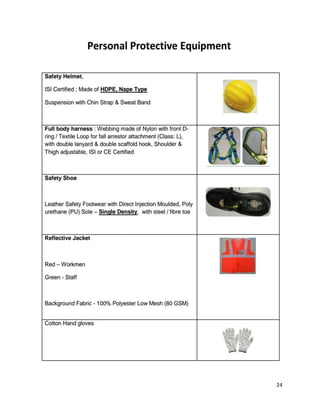
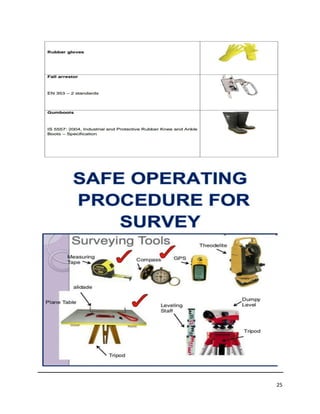
5.0 PPE to be used
-Safety Helmet,
-Full body harness
-Safety Shoe
-Reflective Jacket
-Cotton Hand Gloves
-Gumboots
24
25
26
MECHANICAL WORK FOR 10
UNDERGROUND STATIONS FOR DMRC
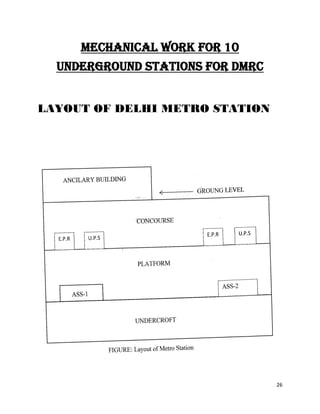
LAYOUT OF DELHI METRO STATION
27
ANCILARY BUILDING : It is on the ground level. This building
consist of air conditioning plants, fire pumps, water distribution
equipment, diesel generators for power backup and associated
electrical panels.
CONCOURSE : It is the first sector of underground level. It is the
sector where tickets are sold. It also contains helpdesk and
control room i.e., telecommunication room, UPS room, E.P.R ,
DB rooms and access machine etc.
PLATEFORM: It is the second sector of underground level. It is
the sector where the passengers board the train. It also contain
rooms like Auxiliary Sub Station (ASS), sewage and seepage
panel room, the rooms for treatment of sewage and seepage
water and DB rooms.
UNDERCROFT: It is the third and last sector of underground
level. It is the sector where all the cables and wires are present.
These wires are those which are used for signaling, cables
connected to LT and HT panels for power distribution.
28
SCOPE OF MECHANICAL WORKS
FIRE FIGHTING SYSTEM;
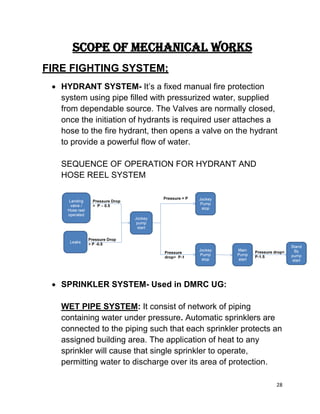
 HYDRANT SYSTEM- It’s a fixed manual fire protection
system using pipe filled with pressurized water, supplied
from dependable source. The Valves are normally closed,
once the initiation of hydrants is required user attaches a
hose to the fire hydrant, then opens a valve on the hydrant
to provide a powerful flow of water.
SEQUENCE OF OPERATION FOR HYDRANT AND
HOSE REEL SYSTEM
 SPRINKLER SYSTEM- Used in DMRC UG:
WET PIPE SYSTEM: It consist of network of piping
containing water under pressure. Automatic sprinklers are
connected to the piping such that each sprinkler protects an
assigned building area. The application of heat to any
sprinkler will cause that single sprinkler to operate,
permitting water to discharge over its area of protection.
29
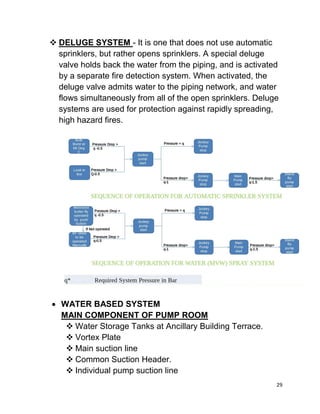
 DELUGE SYSTEM - It is one that does not use automatic
sprinklers, but rather opens sprinklers. A special deluge
valve holds back the water from the piping, and is activated
by a separate fire detection system. When activated, the
deluge valve admits water to the piping network, and water
flows simultaneously from all of the open sprinklers. Deluge
systems are used for protection against rapidly spreading,
high hazard fires.
 WATER BASED SYSTEM
MAIN COMPONENT OF PUMP ROOM
 Water Storage Tanks at Ancillary Building Terrace.
 Vortex Plate
 Main suction line
 Common Suction Header.
 Individual pump suction line
30
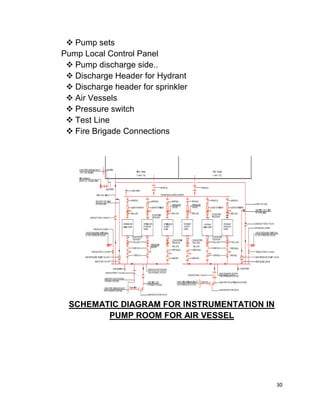
 Pump sets
Pump Local Control Panel
 Pump discharge side..
 Discharge Header for Hydrant
 Discharge header for sprinkler
 Air Vessels
 Pressure switch
 Test Line
 Fire Brigade Connections
SCHEMATIC DIAGRAM FOR INSTRUMENTATION IN
PUMP ROOM FOR AIR VESSEL
31
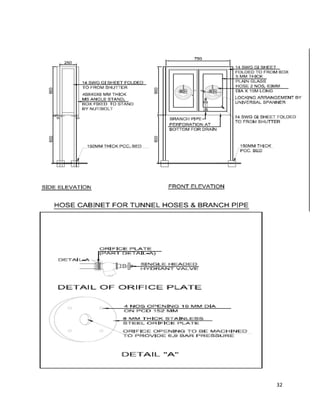
 HOSE REEL:- Fire hose reels are basically manually
operated first aid fire extinguishant. Fire hose reels are
located in the facility to fight the fire in the initial stages until
authorized personal or fire department authority take over.
THERE ARE BASICALLY TWO DIFFERENT TYPES OF
FIRE HOSE REELS.
 Manually operated fire hose reel
 Automatically operated fire hose reel.
32
33
MAIN COMPONENTS USED IN
MECHANICAL WORKS
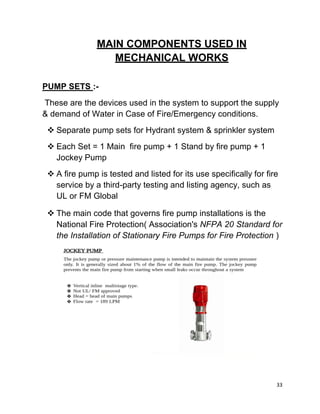
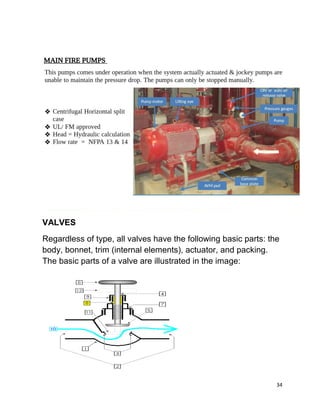
PUMP SETS :-
These are the devices used in the system to support the supply
& demand of Water in Case of Fire/Emergency conditions.
 Separate pump sets for Hydrant system & sprinkler system
 Each Set = 1 Main fire pump + 1 Stand by fire pump + 1
Jockey Pump
 A fire pump is tested and listed for its use specifically for fire
service by a third-party testing and listing agency, such as
UL or FM Global
 The main code that governs fire pump installations is the
National Fire Protection( Association's NFPA 20 Standard for
the Installation of Stationary Fire Pumps for Fire Protection )
34
VALVES
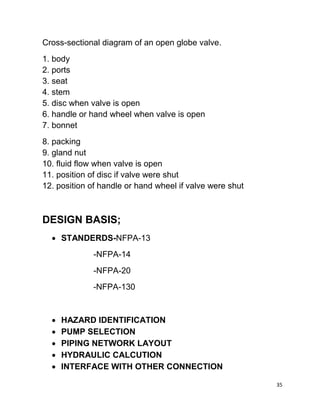
Regardless of type, all valves have the following basic parts: the
body, bonnet, trim (internal elements), actuator, and packing.
The basic parts of a valve are illustrated in the image:
35
Cross-sectional diagram of an open globe valve.
1. body
2. ports
3. seat
4. stem
5. disc when valve is open
6. handle or hand wheel when valve is open
7. bonnet
8. packing
9. gland nut
10. fluid flow when valve is open
11. position of disc if valve were shut
12. position of handle or hand wheel if valve were shut
DESIGN BASIS;
 STANDERDS-NFPA-13
-NFPA-14
-NFPA-20
-NFPA-130
 HAZARD IDENTIFICATION
 PUMP SELECTION
 PIPING NETWORK LAYOUT
 HYDRAULIC CALCUTION
 INTERFACE WITH OTHER CONNECTION
36
 FINAL LAYOUT.

PROJECT REPORT

  • 1.
    1 CERTIFICATE I Altaf Nazeer(1318941008) certify that the project entitled “BRIEF OVERVIEW ON E&M WORK FOR 10 UNDERGROUND STATION FOR DMRC, ISO, QUALITY MANAGEMENT SYSTEM, DESIGN AND DEVLOPEMENT, SAFTY, FIRE ENGINEERING FOR DMRC” is an authentic record of my own work carried out at LARSEN & TOUBRO CONSTRUCTION LIMITED- PT&D as requirements of project semester for the award of degree of B.Tech. (Manufacturing Engineering), Central Institute Of Plastics Engineering & Technology, Lucknow affiliated to UPTU, under the guidance of MR. Aniruddha Kayet during 20th January to 20th February’ 2016. Altaf Nazeer Certified that above statement made by the student is correct to the best of our knowledge and belief. Mr.M.S.Kanyal (Project Manager) Mr.Aniruddha Kayet (Quality Manager) Mr.Awadhesh (Site Engineer)
  • 2.
    2 ACKNOWLEDGEMENT I am verymuch thankful to LARSEN AND TOUBRO CONSTRUCTION DIVISION for providing me such a great opportunity to internship in India’s largest construction company. I would like also like to acknowledge Mr. Awadhesh, Mr. Aniruddha Kayet and Mr. M.S. Kanyal for patiently attending my queries and providing me a kind support at every stage of my project. It was really a pleasure working under such a healthy environment with so many helpful and intelligent people around. ALTAF NAZEER
  • 3.
  • 4.
  • 5.
    5 ISO: INTERNATIONAL ORGANISATION FOR STANDERDISATION •It is an International Standard-setting body composed of representatives from various national standards organization. Founded on 23 Feb. 1947, the organization promotes worldwide proprietary, industrial and commercial standards. It is headquartered in in Geneva, Switzerland, and as of 2013 working in 163 countries. ISO 9000- Quality Management System- This ISO 9000 family addresses various aspects of QMS. ISO 9000:2005<revised>ISO 9000:2015- It covers basic concepts, languages, fundamentals and vocabulary. ISO 9001:2008<revised>ISO 9001:2015- It sets out the requirement of a Quality Management System. ISO 9004:2009- It focuses how to make the Quality Management System more efficient and more effective. It also provides guidance on how to achieve sustained success with your quality management system. ISO 9001- It is the standard which sets out the requirement of a QMS and it helps the business and organization to be more efficient and improves customer’s satisfaction.
  • 6.
    6 Relationship between ISO9001 and ISO 9004- ISO 9001 & ISO 9004 are Quality Management System Standards which have been designed to complement each other but can also be used as independently. ISO 9004 provides a wider focus on quality management than ISO 9001 it addresses the need and expectations of all interested parties and their satisfaction by the systematic and continual improvement. ISO Clauses of Quality Management System There are eight clauses of the Quality Management System: • Introduction • Scope • Normative References • Terms & Definition •Quality Management System •Management Responsibility •Resource Management •Product Realization •Measurement Analysis and Improvement.
  • 7.
    7 0- Introduction: 0.1-General: Theadoption of QMS should be a strategic decision of an organization’s quality system influenced by -its organizational environment -its varying need -its particular objective -product it provide -its size and organizational structure 0.2-Process Approach: This international standard promotes the adoption of a process approach when developing, implementing and improving the effectiveness of a QMS to enhance the customer satisfaction by meeting customer requirements. All the processes can be done by a methodology known as PDCA (Plan-Do-Check-Act). Plan- Establish objectives and processes necessary to deliver results according to customer requirement. Do-Implement the processes Check-Monitor and measure the processes product and report the results. Act-Take action continually improves process performance.
  • 8.
    8 1-SCOPE: Quality manual isrequired under volume1, Section 5, clause 5.1.1(1). This document is structured in line with ISO 9001:2000/2008 approach of quality management system. This Quality manual addresses all the processes in Industrial Electrification BU of Power Transmission & Distribution IC of L&T CONSTRUCTION and related to CE-09 Lot2. 1.1. PROJECT SCOPE The scope of work is detailed in, the contract and requirement specifications, including any variations or amendments which may have been agreed in contract correspondence stated as below Design Verification, Detail Engineering Manufacture, Supply, Installation, Testing and Commissioning of Electrical and Mechanical System Including Fire and Hydraulic System for Underground Stations of Delhi Mass Rapid Transport System Project Phase-3 CE-09 Lot2. The stations included in the package are as follows. Kalkaji Nehru place G.K. Enclave Chirag Delhi Panchsheel Park Hauz khas IIT R K Puram Vasant Vihar Munirka
  • 9.
    9 1.2. PURPOSE This QualityManual assures that all the processes would function systematically in accordance with L&T Vision and L&T-PT&D IC's Quality policy and ISO requirements. This quality plan sets out the methods of achieving and controlling the quality requirements and compliance to contract requirements. All personnel engaged in the contract works will comply with the requirements of this Quality Plan. The Quality Management System is being constantly reviewed and continually improved. The review of Quality management shall be carried at various levels and at various phases. The Inputs for change comes from individual initiatives of all interested parties (such as Employees, Customers,Vendors etc.,). 1.3. APPLICABILITY This Quality Management System is applicable throughout the projects of the Delhi Metro Rail Corporation with contract quality requirements. 1.4. CONFIDENTIALITY This Quality Manual is the property of Larsen & Toubro Limited, PT&D IC& DMRC. No part of this manual shall be copied, reproduced, disclosed, transferred or reduced to any form, including machine readable form (or) otherwise without the consent in writing from the concerned. 2-Normative References: The following documents are used as a source of references- -ISO 9000:2005-QMS-Funadamentals and Vocabulary. -ISO 9001:2008-QMS-Requirement. -ISO 9004:2009-A Quality Management Approach.
  • 10.
    10 -Contract Document andDrawing prepared / issued by customer. -Codes listed in drawings and specifications. 3-Terms and Definition: Organization- Larsen & Toubro Limited, Power Transmission & Distribution IC, Supplier- Any person / firm or Company appointed by the customer directly or through Larsen & Toubro Limited to provide product/service. Third party inspection - A service provided by any recognized independent agency employed by the Customer or by Larsen & Toubro Limited to oversee inspections and tests for materials and/or work Whenever required by the customer or his representative. Authorized inspection agency - A service provided by any recognized independent agency and approved or employed by the customer for inspections and tests whenever required by the customer or his representative. Quality - Degree to which a set of inherent characteristics of the product or services fulfills requirements. Quality Assurance - Part of Quality Management focused on providing confidence that Quality requirements shall be fulfilled. Quality Control - Part of Quality Management focused on fulfilling Quality requirements.
  • 11.
    11 Audit - Asystematic, independent and documented process for obtaining audit evidence and evaluating it objectively to determine the extent to which audit criteria are fulfilled. Quality Plan - A document specifying which procedures and associated resources shall be applied by whom and when to a specific project, product, process or contract. Procedure - Specified way to carry out an activity or a process. Inspection - Activities such as Measuring, Examining, Testing, Gauging one or more characteristics of a material, procedure, product or service and comparing this with the specified requirements. Corrective Action - An activity, the intention of which is to return the non-conforming item or action to a stage of conformity. It also covers the action taken to prevent further recurrences of the nonconformity. Concession - A formal approval by an appropriate agency, in this case the Customer or his authorized representative, to deviate from the specification or design which does not affect the desired final function. Hold Point - A stage in the production cycle when inspection and /or test are performed to determine the acceptability of an item for further processing. Witness point - A stage in the production cycle when a third party inspector, contractor or company Representative witnesses any inspection and or test to determine the acceptability of an item for further processing.
  • 12.
    12 Repair - Theprocess of restoring a non-conforming condition such that the item conforms to the original specified requirements, where such a repair or restoration is acceptable. Calibration - The comparison of two instruments, measuring devices or gauges, one of which is of known accuracy and where applicable, traceable to an internationally recognized standard. Non-Destructive Examination - The means whereby the integrity or conformity of an item can be assessed without resorting to destructive analytical procedures. Check - A stage in the production cycle, when a third party Inspector or L&T representative performs a check or test to determine the acceptability of the item for further processing. Review - A stage in a construction cycle, when a third party Inspector or L&T representative may verify records and or procedures and determine the acceptability of the same. Material Test Certificate - A document of test results either from source of materials or from inhouse or independent agencies. Chief Project Manager - A Manager from L&T's payroll will be accountable for accomplishing the project. Objectives stated under L&T's scope of work for the purpose of execution of the Metro Rail Project. Please refer the PMP to view the organization structure. 4-Quality Management System: The objective of this manual is to document, maintain, update, implement and continual improvement in
  • 13.
    13 Quality Management Systemto ensure that this project confirms to the contractual requirement of customer. 4. 1. GENERAL REQUIREMENTS L&T has a well-established Quality Management System (QMS) in line with ISO9001-2008 and is constantly taking appropriate steps to improve its efficiency and effectiveness. Quality Management System is established, documented, implemented, and maintained and its effectiveness is continually improved in accordance with the requirement of ISO 9001. The Quality Management System consist of different processes needed for the Quality management System and their application throughout the project has been identified. Processes are monitored measured & analyzed regularly. Necessary actions to achieve planned results and continual improvement of the processes are implemented. 4. 2. DOCCUMENTATION REQUIREMENTS4.2.1 GENERAL The Quality Management System documentation adopted by L&T- PT&D IC includes the following: a) Documented statements of quality policy and quality objectives. b) Quality Manual. c) Documented procedures required by the International standard. d) Work Instructions/Distribution List. e) Formats & records. DOCUMENTATION To ensure that all documents, drawings and data are maintained in a controlled manner and reviewed and authorized for use. The procedures and the relevant clauses of the International standard which are addressed by the procedures are well established.
  • 14.
    14 4.2.2 QUALITY MANUAL Thisdocument is the quality manual of the project which covers the design, manufacture, product delivery, installation, testing & commissioning of the project. This manual covers the requirements of ISO 9001:2008 international standards including justification for any exclusion. It makes reference to procedures and guidelines and outlines the structure of the documentation used in the quality management system. This quality manual also includes the description of the interaction between the processes of the Quality management System. 4.2.3. CONTROL OF DOCUMENTS The entire required documents are identified, reviewed and approved for adequacy prior to issue by designated authorities. The document and data control system to be followed with DMRC as described in detail as per guidelines for document control. Document controller is responsible for receiving, listing, filing, delivering and distribution of all documents to the concerned. Documents are reviewed and updated as required and re-approved by the designated authority. 4.2.4. CONTROL OF RECORDS L&T has established a procedure for control of records.  Records are established and maintained to provide evidence of conformity to requirements and of the effective operation of the Quality Management System.  Records are suitably numbered, indexed and filed for easy retrieval.  Records are protected from damage, loss and deterioration while storage.  Records are maintained in a manner that remains legible, readily identifiable.
  • 15.
    15 5. MANAGEMENT RESPONSIBILITY ChiefProject Manager The nominated Chief Project Manager shall be responsible for ensuring that the activities required for this project quality system are planned, implemented and controlled and their progress monitored. His role is defined in L&T Project Management department quality procedure which specifies key duties which include, but are not limited to; Assisting Project Management Committee Timely completion of the Project Completion within budget Resource planning& Implementation of QMP and Work Methods Liaison with customer, statutory and regulatory authorities Monitoring & Review of Progress, process parameters & financials - CAPA for variation Best Practices identification, nurture and report. Development of employees Design Verification Test and Commissioning, technical Assurance during Installation and Certification 5. 2. CUSTOMER FOCUS In this project, the Chief Project manager and his team will make sure that customer requirements are identified and efforts will be made to enhance the customer Satisfaction by meeting requirement related to price, quality & delivery. 5. 3. QUALITY POLICY The Quality Policy is to provide Design, Supply, Installation and Maintenance which meets or exceeds best industry practices. 5. 4. PLANNING 5.4.1 QUALITYU OBJECTIVE To define quality objective which are measurable, consistent to L&T Quality Policy and relevant to meet requirement for this project. Chief Project manager is
  • 16.
    16 completely responsible toachieve the Quality Objectives with the support of Quality Manager. 5. 6. MANAGEMENT REVIEW The Management Review shall be undertaken at least once every months and the results of the regular Internal Quality Audits of the Company Quality Manual and this plan shall be taken into account. 5.6.2. REVIEW INPUT The input to management review shall include information on a) Results of audit b) Customer feedback including customer complaints c) Process performance & product conformity d) Status of preventive & corrective action e) Follow-up actions from previous management review f) Changes that could improve QMS g) Recommendations for improvement 5.6.3. REVIEW OUTPUT The management review output shall include any decision and action related to a) Improvement of the effectiveness of the quality management system and its processes b) Improvement of the product related to customer requirements, c) Resource needs. 6. RESOURCES MANAGEMENT 6. 1. PROVISION OF RESOURCES L&T has identified the key resources for its business processes that include employees, Vendors, Subcontractors & Workmen. L&T determines and provides adequate resources on a continual basis for: Implementation and maintenance of Quality Management System Continually improving the effectiveness of Quality Management System Enhancing customer satisfaction by consistently meeting customer requirements. For smooth & effective operation & control of processes.
  • 17.
    17 6. 2. HUMANRESOURCES 6.2.1. GENERAL L&T has established and maintains a procedure for Human Resources, which ensures that the staff performing work affecting product quality is competent on the basis of appropriate education training, skills and experience. 6.2.2. COMPETENCE, TRAINING AND AWARENESS All Departments / Sections identify the training needs and inform the same to HR and monitor adherence to identified needs every six months. Respective HOD’s shall measure effectiveness of Training. 6. 3. INFRASTRUCTURE L&T provides the required infrastructure needed to achieve Product quality requirements at all offices and project sites. The management maintains and ensures continuous availability of Buildings, office furniture and utilities. . 6. 4. WORK ENVIRONMENT The organization manages the work environment needed, to achieve conformity to product requirements. Strict environment compliance standards are in place at all levels in the organization. The activities under this include housekeeping, safety management, and control of noise and dust. 7. PRODUCT REALIZATION 7. 1. PLANNING OF PRODUCT REALIZATION The product in a typical project is attained by the complete synchronization& coordination of processes at offices& project sites. The processes at offices include Business Development, Design& Development, Supply Chain Management, and Operations Monitoring& Support which are addressed in the established procedures at offices. 7. 2. CUSTOMER RELATED PROCESS 7.2.1. REVIEW OF REQUIREMENT RELATED TO THE CUSTOMER 7.2.2. CUSTOMER COMMUNICATION
  • 18.
    18 7. 3. DESIGNAND DEVELOPMENT 7.3.1. DESIGN AND DEVELOPMENT PROCESS 7.3.1.1 DESIGN AND DEVELOPMENT PLANNING. 7.3.1.2 DESIGN AND DEVELOPMENT INPUTS. 7.3.1.3. INPUTS AND OUTPUTS REVIEW. 7.3.1.4. DESIGN AND DEVELOPMENT REVIEW. 7.3.1.5. SITE SUPERVISION. 7.3.2. CONTROL OF DESIGN AND DEVELOPMENT CHANGES The control of design and development changes will be in accordance with the Processes specified in the change management plan/ procedure. 7. 4. PURCHASING All purchasing requirements shall be checked by the Project Manager to ensure that they meet the terms and conditions of the contract. This review will take place during the raising of the electronic materials request, prior to being released to purchasing for ordering. 7.4.1. PURCHASING PROCESS 7.4.1.1. EVALUATION OF SUB CONTRACTORS/ SUPPLIERS. 7.4.1.2. SUB CONTRACTORS/ SUPPLIERS PERFORMANCE EVALUATION. 7.4.1.3. RECORD OF EVALUATIONS. 7.4.1.4. RE EVALUATION. 7.4.2. PURCHASING INFORMATION Requirements related to approval of product, procedure, processes and equipment Requirement related to the qualification of the personnel, if any. Inspection and test requirements Purchasing documents are checked and approved for adequacy of specified purchase requirements prior to their communication to the supplier. 7.4.3. VERIFICATION OF PURCHASED PRODUCTS 7.4.3.1. VERIFICATION 7.4.3.2. CUSTOMER VERIFICATION AT SUPPLIERS PERMISES 7.4.4. PURCHASE ORDERS. 7. 5. PRODUCT AND SERVICE PROVISIONS 7.5.1. CONTROL OF PRODUCTION AND SERVICE PROVISION. 7.5.2. VALIDATION OF PROCESS FOR PRODUCTION AND SERVICE PROVISION. 7.5.3. IDENTIFICATION AND TRACEABILITY. 7.5.4. CUSTOMER PROPERTY. 7.5.5. PRESERVATION OF PRODUCTS. 7.5.5.1. HANDLING.
  • 19.
    19 7.5.5.2. STORAGE. 7.5.5.3. PACKAGING. 7.5.5.4.PRESERVATION AND PROTECTION. 7. 6. CONTROL OF MONITORING AND MEASURING DEVICES L&T-PT&D IC ensures that all the monitoring and measuring equipment used at project sites are controlled and kept in good working condition with the calibration status. 8. MEASUREMENT, ANALYSIS AND IMPROVEMENT 8. 1. GENERAL REQUIREMENTS Monitoring, measurement, analysis and improvement processes needed are implemented to demonstrate the conformity of the project with specified requirements. 8. 2. MONITORING AND MEASUREMENT 8.2.1. CUSTOMER SATISFACTION. 8.2.2. INTERNAL AUDIT. 8. 3. CONTROL OF NON-CONFORMITY PRODUCT 8. 4. ANALYSIS OF DATA Data collected after monitoring and measurement of the different processes are analyzed to demonstrate the suitability and effectiveness of the quality management system and to evaluate where continual improvement in the effectiveness of the quality management system can be made. 8. 5. IMPROVEMENT 8.5.1. CONTINUAL IMPROVEMENT. 8.5.2. CORRECTIVE ACTION. 8.5.3. PREVENTIVE ACTION.
  • 20.
    20 QUALITY MANAGEMENT SYSTEM Whatis a Quality Management System? A quality management system is a way of defining how an organization can meet the requirements of its customers and other stakeholders affected by its work. Other ISO standards look at other types of management systems, such as ISO 14001 for environmental management or the upcoming ISO 45001 for occupational health and safety management. ISO 9001 is based on the idea of continual improvement. It is designed to be flexible enough for use by many different types of organization, so does not specify what the objectives relating to “ quality ” or “ meeting customer needs ” should be. Instead, it requires organizations to define these objectives themselves and continually improve their processes in order to reach them. Once these targets have been attained , they must be reassessed… in a quest for Continual improvement. A good quality management system can bring benefits to organizations of all sizes and all sectors. What benefits will it bring to my business or organization? Implementing a quality management system will help you: • Assess the overall context of your organization to define who is affected by your work and what they expect from you. This will enable
  • 21.
    21 you to clearlystate your objectives and identify new business opportunities. • Put your customers first, making sure you consistently meet their needs and enhance their satisfaction. This can lead to repeat custom, new clients and increased business for your organization. • Work in a more efficient way as all your processes Will be aligned and understood by everyone in the business or organization. This increases productivity and efficiency, bringing internal costs down. • Meet the necessary statutory and regulatory requirements. • Expand into new markets, as some sectors and clients require ISO 9001 before doing business. • Identify and address the risks associated with your organization . QUALITY MANAGEMENT PRINCIPLES ISO 9001 BUILDS ON SEVEN QUALITY MANAGEMENT PRINCIPLES One of the definitions of a “principle” is that it is a basic belief, theory or rule that has a major influence on the way in which something is done. “Quality management principles” are a set of fundamental beliefs, norms, rules and values that are accepted as true and can be used as a basis for quality management. The QMPs can be used as a foundation to guide an organization’s performance improvement. They were developed and updated by international experts of ISO/TC 176, which is responsible for developing and maintaining ISO’s quality management standards.
  • 22.
    22 The seven qualitymanagement principles are: QMP 1 - Customer focus QMP 2 - Leadership QMP 3 - Engagement of people QMP 4 - Process approach QMP 5 - Improvement QMP 6 - Evidence-based decision making QMP 7 - Relationship Management . The QMPs can be used as a foundation to guide an organization’s performance improvement. They were developed and updated by international experts of ISO/TC 176, which is responsible for developing and maintaining ISO’s quality management standards.
  • 23.
    23 SAFETY 1.0 Purpose To describethe procedure for safe execution of Survey activity at Electrical Substation projects. 2.0 Scope This SOP is applicable to all L&T Employees, Sub contractors and their employees. It shall be applicable to activities at site for various projects of EHV SS & E & I, in all its domestic operation. 3.0 References IMS Manual Rev.03, Dated 19.11.2014 The Electricity Act 2003 and The Electricity Rule 2005 Approved drawing Project EHS Plan. Rev.03, Dated 19.11.2014 4.0 Responsibility It shall be the responsibility of the line function (Construction Manager / Section In charges/ Site Engineer / EHSO) to implement this Procedure. 5.0 PPE to be used -Safety Helmet, -Full body harness -Safety Shoe -Reflective Jacket -Cotton Hand Gloves -Gumboots
  • 24.
  • 25.
  • 26.
    26 MECHANICAL WORK FOR10 UNDERGROUND STATIONS FOR DMRC LAYOUT OF DELHI METRO STATION
  • 27.
    27 ANCILARY BUILDING :It is on the ground level. This building consist of air conditioning plants, fire pumps, water distribution equipment, diesel generators for power backup and associated electrical panels. CONCOURSE : It is the first sector of underground level. It is the sector where tickets are sold. It also contains helpdesk and control room i.e., telecommunication room, UPS room, E.P.R , DB rooms and access machine etc. PLATEFORM: It is the second sector of underground level. It is the sector where the passengers board the train. It also contain rooms like Auxiliary Sub Station (ASS), sewage and seepage panel room, the rooms for treatment of sewage and seepage water and DB rooms. UNDERCROFT: It is the third and last sector of underground level. It is the sector where all the cables and wires are present. These wires are those which are used for signaling, cables connected to LT and HT panels for power distribution.
  • 28.
    28 SCOPE OF MECHANICALWORKS FIRE FIGHTING SYSTEM;  HYDRANT SYSTEM- It’s a fixed manual fire protection system using pipe filled with pressurized water, supplied from dependable source. The Valves are normally closed, once the initiation of hydrants is required user attaches a hose to the fire hydrant, then opens a valve on the hydrant to provide a powerful flow of water. SEQUENCE OF OPERATION FOR HYDRANT AND HOSE REEL SYSTEM  SPRINKLER SYSTEM- Used in DMRC UG: WET PIPE SYSTEM: It consist of network of piping containing water under pressure. Automatic sprinklers are connected to the piping such that each sprinkler protects an assigned building area. The application of heat to any sprinkler will cause that single sprinkler to operate, permitting water to discharge over its area of protection.
  • 29.
    29  DELUGE SYSTEM- It is one that does not use automatic sprinklers, but rather opens sprinklers. A special deluge valve holds back the water from the piping, and is activated by a separate fire detection system. When activated, the deluge valve admits water to the piping network, and water flows simultaneously from all of the open sprinklers. Deluge systems are used for protection against rapidly spreading, high hazard fires.  WATER BASED SYSTEM MAIN COMPONENT OF PUMP ROOM  Water Storage Tanks at Ancillary Building Terrace.  Vortex Plate  Main suction line  Common Suction Header.  Individual pump suction line
  • 30.
    30  Pump sets PumpLocal Control Panel  Pump discharge side..  Discharge Header for Hydrant  Discharge header for sprinkler  Air Vessels  Pressure switch  Test Line  Fire Brigade Connections SCHEMATIC DIAGRAM FOR INSTRUMENTATION IN PUMP ROOM FOR AIR VESSEL
  • 31.
    31  HOSE REEL:-Fire hose reels are basically manually operated first aid fire extinguishant. Fire hose reels are located in the facility to fight the fire in the initial stages until authorized personal or fire department authority take over. THERE ARE BASICALLY TWO DIFFERENT TYPES OF FIRE HOSE REELS.  Manually operated fire hose reel  Automatically operated fire hose reel.
  • 32.
  • 33.
    33 MAIN COMPONENTS USEDIN MECHANICAL WORKS PUMP SETS :- These are the devices used in the system to support the supply & demand of Water in Case of Fire/Emergency conditions.  Separate pump sets for Hydrant system & sprinkler system  Each Set = 1 Main fire pump + 1 Stand by fire pump + 1 Jockey Pump  A fire pump is tested and listed for its use specifically for fire service by a third-party testing and listing agency, such as UL or FM Global  The main code that governs fire pump installations is the National Fire Protection( Association's NFPA 20 Standard for the Installation of Stationary Fire Pumps for Fire Protection )
  • 34.
    34 VALVES Regardless of type,all valves have the following basic parts: the body, bonnet, trim (internal elements), actuator, and packing. The basic parts of a valve are illustrated in the image:
  • 35.
    35 Cross-sectional diagram ofan open globe valve. 1. body 2. ports 3. seat 4. stem 5. disc when valve is open 6. handle or hand wheel when valve is open 7. bonnet 8. packing 9. gland nut 10. fluid flow when valve is open 11. position of disc if valve were shut 12. position of handle or hand wheel if valve were shut DESIGN BASIS;  STANDERDS-NFPA-13 -NFPA-14 -NFPA-20 -NFPA-130  HAZARD IDENTIFICATION  PUMP SELECTION  PIPING NETWORK LAYOUT  HYDRAULIC CALCUTION  INTERFACE WITH OTHER CONNECTION
  • 36.