PROJECT OVERVIEW
Name of Project:            FUN WITH THE PERIODIC TABLE                                                                    Duration: 10 weeks
Subject/Course: CHEMISTRY                                        Teacher(s): JENNY NARSICO                                 Grade Level: 10TH

Other subject areas to      Chemistry, Math, Art
be included, if any:


Project Idea
Summary of the issue,
challenge, investigation,   In this project, you are challenge to create a GAME that will both entertain and teach people about the periodic table. How the
scenario, or problem:       game is played, whether on a table, with cards, on a computer, or with equipment that only you might choose is up to you. You
                            might want to emphasize some aspects of the periodic table over the others, such as why the elements are grouped the way they are,
                            how atomic masses are determined. Or you may choose to focus on some types of information related to the table like the history of
                            the discovery of atomic structure, how the elements combine to form compounds and why some are radioactive.
Driving Question            Why elements are arranged the way they are in the periodic table?

Content and Skills          ACTIVITY No. 1: Organizing a store
Standards to be
addressed:                  Students will be categorizing different items in a grocery stores and determine where to place those new
                            items that are not accounted for. They will take into consideration the bases of categorizing these
                            grocery items.

                            ACTIVITY No. 2: Elements and their properties

                            Students will investigate the elements and their properties by conducting experiments that test their
                            reactivity with acids, conductivity, physical and chemical properties.

                            ACTIVITY NO. 3: Atoms and their masses

                            Students will investigate how masses of the elements are determined by comparing the masses of two
                            elements they will recover in a single replacement reaction experiment.

                            ACTIVITY No. 4: Atoms are indivisible

                            Students will analyze the properties of cathode radiations by J.J Thomson and the discovery of the
                            nucleus by Rutherford. They will use the gas discharge tubes to identify the different energy levels out
                                                                                                                                © 2008 Buck Institute for Education   1
side the nucleus and examine Bohr’s model of the hydrogen atom and the proposal of the different
atomic structures.

ACTIVITY No. 5: How electrons determine chemical behavior

Students will investigate atoms that have more than one electron and learn about valence electrons.
How valence electrons influence the arrangement of the elements in the periodic table and how they
influence the chemical properties and reactivity of elements.

ACTIVITY No. 6: How atoms interact with each other

Students will learn the stability rule of elements and the creation of compounds. They will gain insights
on chemical bonding, writing of chemical formula and nomenclature of compounds.


                                             T+A    E                                                    T+A        E


                                                                                  © 2008 Buck Institute for Education   2
21st Century Skills           Collaboration;                               Other:
to be explicitly taught and
assessed (T+A) or that
will be encouraged (E) by
                              Team work – student demonstrate
project work, but not         willingness to align his/her personal
taught or assessed:           goals to the goals of others when
                              appropriate, approaches conflict from
                              win-win perspective, and derives
                              personal satisfaction from achieving
                              group goals.

                              Ethics – students demonstrate ethical
                              behavior and work responsibly and
                              collaboratively with others in the context
                              of the classroom, school and the larger
                              community through engagement in
                              classroom/public discourse and
                              participation in service learning.

                              Time management – Prior to beginning
                              work, student reflects upon possible
                              courses of action and their likely
                              consequences, sets objectives related to
                              the larger goal;, and establishes
                              benchmarks for monitoring progress.
                              While working on the projects, student
                              adjusts time and resources to allow for
                              completion of a quality product.

                              Presentation

                              Research Skill – Student can efficiently
                              browse, search, navigate online to
                              access relevant information.

                              Game Board - Students demonstrate
                              creativity in choosing a particular                   © 2008 Buck Institute for Education   3
Presentation Audience:
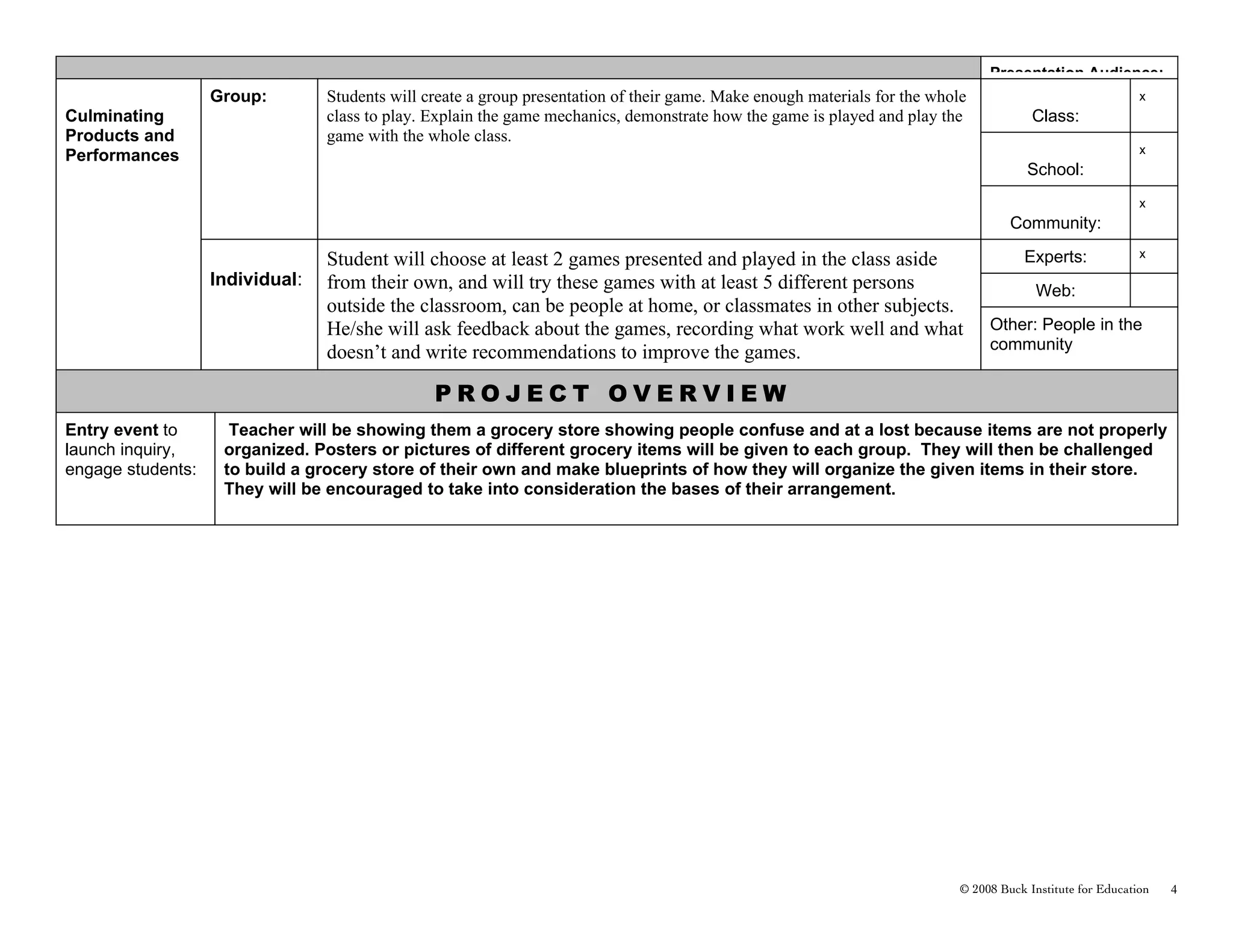
                   Group:        Students will create a group presentation of their game. Make enough materials for the whole                                x
Culminating                      class to play. Explain the game mechanics, demonstrate how the game is played and play the              Class:
Products and                     game with the whole class.
                                                                                                                                                             x
Performances
                                                                                                                                        School:
                                                                                                                                                             x
                                                                                                                                     Community:
                                                                                                                                       Experts:              x
                                 Student will choose at least 2 games presented and played in the class aside
                   Individual:   from their own, and will try these games with at least 5 different persons                               Web:
                                 outside the classroom, can be people at home, or classmates in other subjects.
                                 He/she will ask feedback about the games, recording what work well and what                     Other: People in the
                                                                                                                                 community
                                 doesn’t and write recommendations to improve the games.

                                                PROJECT OVERVIEW
Entry event to       Teacher will be showing them a grocery store showing people confuse and at a lost because items are not properly
launch inquiry,     organized. Posters or pictures of different grocery items will be given to each group. They will then be challenged
engage students:    to build a grocery store of their own and make blueprints of how they will organize the given items in their store.
                    They will be encouraged to take into consideration the bases of their arrangement.


                                                                                                                            © 2008 Buck Institute for Education   4
Assessments                      Quizzes/Tests                                        x   Practice Presentations                                           x
               Formative
              Assessments        Journal/Learning Log                                 x   Notes                                                            x
                 (During
                 Project)        Preliminary Plans/Outlines/Prototypes                x   Checklists                                                       x
                                 Rough Drafts                                         x   Concept Maps


                                 Online Tests/Exams                                   x   Other:

                                 Written Product(s), with rubric:                     x   Other Product(s) or Performance(s), with rubric:                 x
               Summative         __________________________________________________       __________________________________________________
              Assessments
              (End of Project)   Oral Presentation, with rubric                       x   Peer Evaluation                                                  x
                                 Multiple Choice/Short Answer Test                    x   Self-Evaluation

                                 Essay Test                                               Other:
                                                                      .


Resources     On-site people, facilities:       Internet/web. Or online games. Samples of game board like Bingo board,
Needed                                                                     puzzle board, etc.
              Equipment:                        For the Experiments: Teachers will be providing the laboratory apparatus,
                                                                       and chemicals to be used.
              Materials:                        For the Game making: Students will have the freedom to choose their own
                                                                              materials.
              Community resources:            Online/web, library, game stores.

Reflection                       Journal/Learning Log                                 x   Focus Group                                                      x
Methods        (Individual,
              Group, and/or      Whole-Class Discussion                               x   Fishbowl Discussion
              Whole Class)
                                 Survey                                                   Other: Making recommendation base from the
                                                                                          feedback given by people in the community.


                                                                                                                     © 2008 Buck Institute for Education       5
PROJECT TEACHING AND LEARNING GUIDE
Project:                                                  Course/Semester:


         Knowledge and Skills Needed By Students                 Scaffolding / Materials/ Lessons To Be Provided
      to successfully complete culminating products and            by the project teacher, other teachers, experts,
    performances, and do well on summative assessments                     mentors, or community members
Elements names and chemical symbol                            Students will be given time to examine the names and
                                                              chemical symbols of elements in the periodic table.
                                                             Looking for similarities and differences in the chemical
                                                              symbol of elements with names starting in the same letter
                                                              and state what rule is applied assigning the symbol.
Elements physical and chemical properties.                    Students conduct experiments to test the reaction of each
                                                              sample of elements with acids and the oxides they form.
                                                             Electrical conductivity and attraction to magnet.


Atoms and their masses                                        Students will perform two different single replacement
                                                              reactions and comparing the masses of elements
                                                              recovered from such reaction. They will also compare
                                                             masses of the same elements and their relative
                                                              abundance.


Electrons and how they influence chemical behavior            Students will work on the electrical discharge tubes to
                                                              study atomic orbital and valence electrons, how they
                                                             affect and determine atom’s chemical behavior.


How atoms interact with each other                            Students will
                                                          


                                                                                                © 2008 Buck Institute for Education   6
PROJECT       CALENDAR
Project:                         Start Date:

     MONDAY   TUESDAY     WEDNESDAY            THURSDAY               FRIDAY
                        Project Week One


                        Project Week Two


                        Project Week Three


                                                          © 2008 Buck Institute for Education   7
Project Week Four


                    © 2008 Buck Institute for Education   8
© 2008 Buck Institute for Education   9

Project planning forms_0210revised

  • 1.
    PROJECT OVERVIEW Name ofProject: FUN WITH THE PERIODIC TABLE Duration: 10 weeks Subject/Course: CHEMISTRY Teacher(s): JENNY NARSICO Grade Level: 10TH Other subject areas to Chemistry, Math, Art be included, if any: Project Idea Summary of the issue, challenge, investigation, In this project, you are challenge to create a GAME that will both entertain and teach people about the periodic table. How the scenario, or problem: game is played, whether on a table, with cards, on a computer, or with equipment that only you might choose is up to you. You might want to emphasize some aspects of the periodic table over the others, such as why the elements are grouped the way they are, how atomic masses are determined. Or you may choose to focus on some types of information related to the table like the history of the discovery of atomic structure, how the elements combine to form compounds and why some are radioactive. Driving Question Why elements are arranged the way they are in the periodic table? Content and Skills ACTIVITY No. 1: Organizing a store Standards to be addressed: Students will be categorizing different items in a grocery stores and determine where to place those new items that are not accounted for. They will take into consideration the bases of categorizing these grocery items. ACTIVITY No. 2: Elements and their properties Students will investigate the elements and their properties by conducting experiments that test their reactivity with acids, conductivity, physical and chemical properties. ACTIVITY NO. 3: Atoms and their masses Students will investigate how masses of the elements are determined by comparing the masses of two elements they will recover in a single replacement reaction experiment. ACTIVITY No. 4: Atoms are indivisible Students will analyze the properties of cathode radiations by J.J Thomson and the discovery of the nucleus by Rutherford. They will use the gas discharge tubes to identify the different energy levels out © 2008 Buck Institute for Education 1
  • 2.
    side the nucleusand examine Bohr’s model of the hydrogen atom and the proposal of the different atomic structures. ACTIVITY No. 5: How electrons determine chemical behavior Students will investigate atoms that have more than one electron and learn about valence electrons. How valence electrons influence the arrangement of the elements in the periodic table and how they influence the chemical properties and reactivity of elements. ACTIVITY No. 6: How atoms interact with each other Students will learn the stability rule of elements and the creation of compounds. They will gain insights on chemical bonding, writing of chemical formula and nomenclature of compounds. T+A E T+A E © 2008 Buck Institute for Education 2
  • 3.
    21st Century Skills Collaboration; Other: to be explicitly taught and assessed (T+A) or that will be encouraged (E) by Team work – student demonstrate project work, but not willingness to align his/her personal taught or assessed: goals to the goals of others when appropriate, approaches conflict from win-win perspective, and derives personal satisfaction from achieving group goals. Ethics – students demonstrate ethical behavior and work responsibly and collaboratively with others in the context of the classroom, school and the larger community through engagement in classroom/public discourse and participation in service learning. Time management – Prior to beginning work, student reflects upon possible courses of action and their likely consequences, sets objectives related to the larger goal;, and establishes benchmarks for monitoring progress. While working on the projects, student adjusts time and resources to allow for completion of a quality product. Presentation Research Skill – Student can efficiently browse, search, navigate online to access relevant information. Game Board - Students demonstrate creativity in choosing a particular © 2008 Buck Institute for Education 3
  • 4.
    Presentation Audience: Group: Students will create a group presentation of their game. Make enough materials for the whole x Culminating class to play. Explain the game mechanics, demonstrate how the game is played and play the Class: Products and game with the whole class. x Performances School: x Community: Experts: x Student will choose at least 2 games presented and played in the class aside Individual: from their own, and will try these games with at least 5 different persons Web: outside the classroom, can be people at home, or classmates in other subjects. He/she will ask feedback about the games, recording what work well and what Other: People in the community doesn’t and write recommendations to improve the games. PROJECT OVERVIEW Entry event to Teacher will be showing them a grocery store showing people confuse and at a lost because items are not properly launch inquiry, organized. Posters or pictures of different grocery items will be given to each group. They will then be challenged engage students: to build a grocery store of their own and make blueprints of how they will organize the given items in their store. They will be encouraged to take into consideration the bases of their arrangement. © 2008 Buck Institute for Education 4
  • 5.
    Assessments Quizzes/Tests x Practice Presentations x Formative Assessments Journal/Learning Log x Notes x (During Project) Preliminary Plans/Outlines/Prototypes x Checklists x Rough Drafts x Concept Maps Online Tests/Exams x Other: Written Product(s), with rubric: x Other Product(s) or Performance(s), with rubric: x Summative __________________________________________________ __________________________________________________ Assessments (End of Project) Oral Presentation, with rubric x Peer Evaluation x Multiple Choice/Short Answer Test x Self-Evaluation Essay Test Other: . Resources On-site people, facilities: Internet/web. Or online games. Samples of game board like Bingo board, Needed puzzle board, etc. Equipment: For the Experiments: Teachers will be providing the laboratory apparatus, and chemicals to be used. Materials: For the Game making: Students will have the freedom to choose their own materials. Community resources: Online/web, library, game stores. Reflection Journal/Learning Log x Focus Group x Methods (Individual, Group, and/or Whole-Class Discussion x Fishbowl Discussion Whole Class) Survey Other: Making recommendation base from the feedback given by people in the community. © 2008 Buck Institute for Education 5
  • 6.
    PROJECT TEACHING ANDLEARNING GUIDE Project: Course/Semester: Knowledge and Skills Needed By Students Scaffolding / Materials/ Lessons To Be Provided to successfully complete culminating products and by the project teacher, other teachers, experts, performances, and do well on summative assessments mentors, or community members Elements names and chemical symbol Students will be given time to examine the names and chemical symbols of elements in the periodic table.  Looking for similarities and differences in the chemical symbol of elements with names starting in the same letter and state what rule is applied assigning the symbol. Elements physical and chemical properties. Students conduct experiments to test the reaction of each sample of elements with acids and the oxides they form.  Electrical conductivity and attraction to magnet. Atoms and their masses Students will perform two different single replacement reactions and comparing the masses of elements recovered from such reaction. They will also compare  masses of the same elements and their relative abundance. Electrons and how they influence chemical behavior Students will work on the electrical discharge tubes to study atomic orbital and valence electrons, how they  affect and determine atom’s chemical behavior. How atoms interact with each other Students will  © 2008 Buck Institute for Education 6
  • 7.
    PROJECT CALENDAR Project: Start Date: MONDAY TUESDAY WEDNESDAY THURSDAY FRIDAY Project Week One Project Week Two Project Week Three © 2008 Buck Institute for Education 7
  • 8.
    Project Week Four © 2008 Buck Institute for Education 8
  • 9.
    © 2008 BuckInstitute for Education 9