Unit Plan: Mass


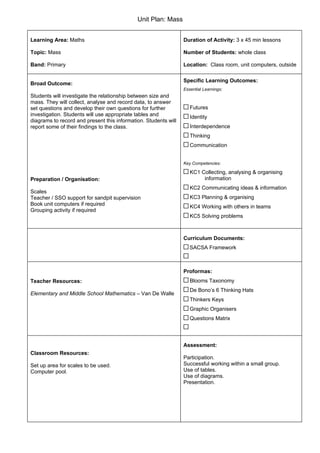
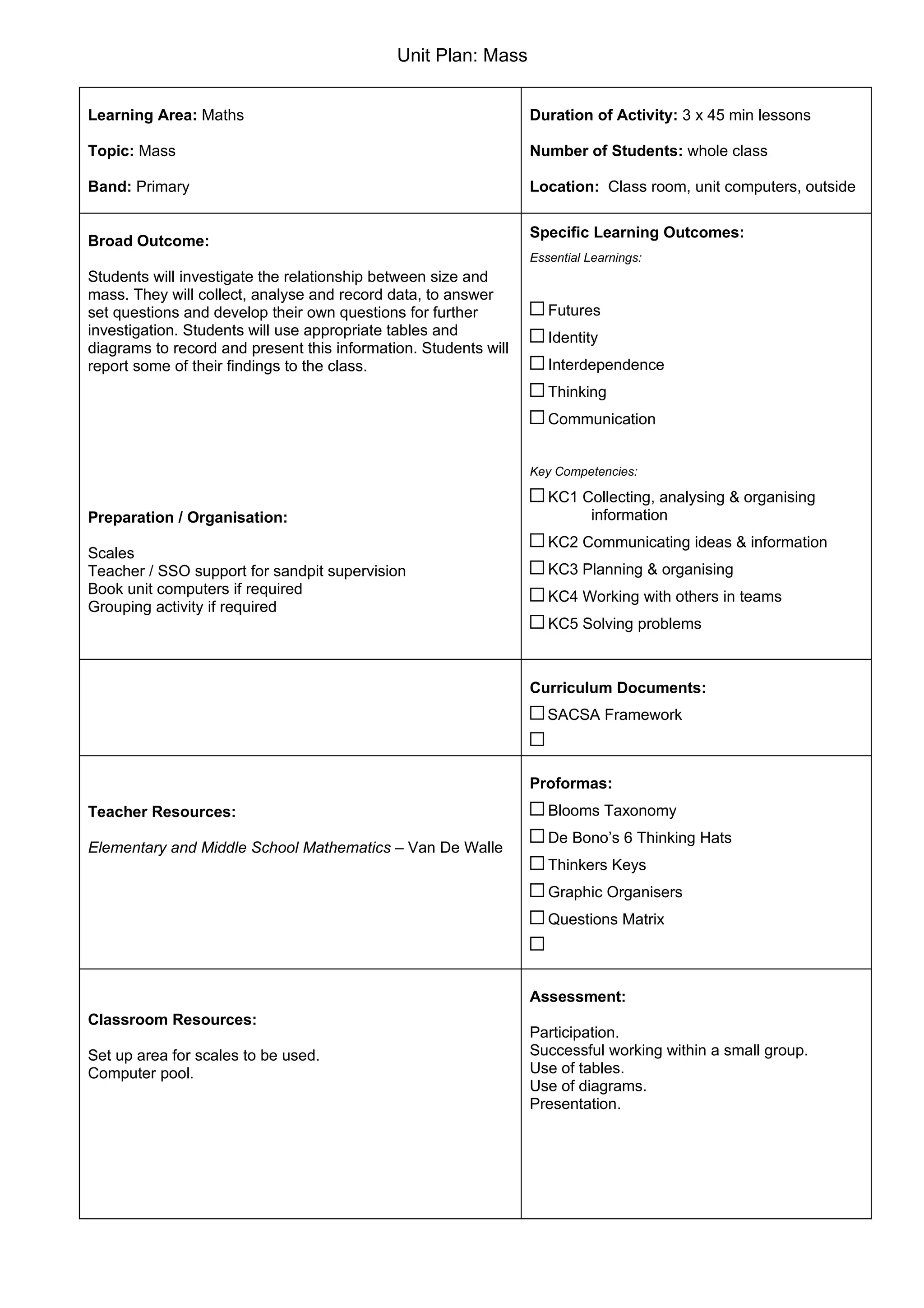
Learning Area: Maths                                             Duration of Activity: 3 x 45 min lessons

Topic: Mass                                                      Number of Students: whole class

Band: Primary                                                    Location: Class room, unit computers, outside

                                                                 Specific Learning Outcomes:
Broad Outcome:
                                                                 Essential Learnings:
Students will investigate the relationship between size and
mass. They will collect, analyse and record data, to answer
set questions and develop their own questions for further           Futures
investigation. Students will use appropriate tables and             Identity
diagrams to record and present this information. Students will
report some of their findings to the class.                         Interdependence
                                                                    Thinking
                                                                    Communication


                                                                 Key Competencies:

                                                                    KC1 Collecting, analysing & organising
Preparation / Organisation:                                              information
                                                                    KC2 Communicating ideas & information
Scales
Teacher / SSO support for sandpit supervision                       KC3 Planning & organising
Book unit computers if required                                     KC4 Working with others in teams
Grouping activity if required
                                                                    KC5 Solving problems


                                                                 Curriculum Documents:
                                                                    SACSA Framework


                                                                 Proformas:
Teacher Resources:                                                  Blooms Taxonomy
                                                                    De Bono’s 6 Thinking Hats
Elementary and Middle School Mathematics – Van De Walle
                                                                    Thinkers Keys
                                                                    Graphic Organisers
                                                                    Questions Matrix


                                                                 Assessment:
Classroom Resources:
                                                                 Participation.
Set up area for scales to be used.                               Successful working within a small group.
Computer pool.                                                   Use of tables.
                                                                 Use of diagrams.
                                                                 Presentation.
Notes / Running Sheet

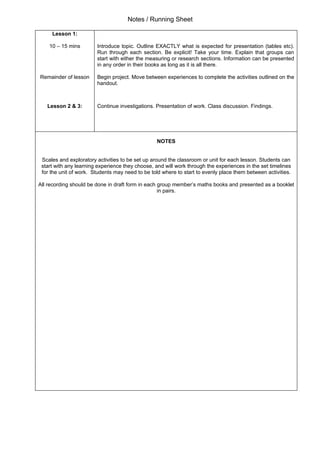
     Lesson 1:

    10 – 15 mins        Introduce topic. Outline EXACTLY what is expected for presentation (tables etc).
                        Run through each section. Be explicit! Take your time. Explain that groups can
                        start with either the measuring or research sections. Information can be presented
                        in any order in their books as long as it is all there.

Remainder of lesson     Begin project. Move between experiences to complete the activities outlined on the
                        handout.


   Lesson 2 & 3:        Continue investigations. Presentation of work. Class discussion. Findings.


                                                  NOTES


 Scales and exploratory activities to be set up around the classroom or unit for each lesson. Students can
 start with any learning experience they choose, and will work through the experiences in the set timelines
 for the unit of work. Students may need to be told where to start to evenly place them between activities.

All recording should be done in draft form in each group member’s maths books and presented as a booklet
                                                   in pairs.
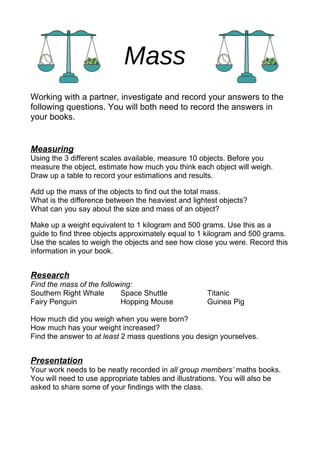
Mass
Working with a partner, investigate and record your answers to the
following questions. You will both need to record the answers in
your books.


Measuring
Using the 3 different scales available, measure 10 objects. Before you
measure the object, estimate how much you think each object will weigh.
Draw up a table to record your estimations and results.

Add up the mass of the objects to find out the total mass.
What is the difference between the heaviest and lightest objects?
What can you say about the size and mass of an object?

Make up a weight equivalent to 1 kilogram and 500 grams. Use this as a
guide to find three objects approximately equal to 1 kilogram and 500 grams.
Use the scales to weigh the objects and see how close you were. Record this
information in your book.


Research
Find the mass of the following:
Southern Right Whale       Space Shuttle            Titanic
Fairy Penguin              Hopping Mouse            Guinea Pig

How much did you weigh when you were born?
How much has your weight increased?
Find the answer to at least 2 mass questions you design yourselves.


Presentation
Your work needs to be neatly recorded in all group members’ maths books.
You will need to use appropriate tables and illustrations. You will also be
asked to share some of your findings with the class.

Mass Unit Plan

  • 1.
    Unit Plan: Mass LearningArea: Maths Duration of Activity: 3 x 45 min lessons Topic: Mass Number of Students: whole class Band: Primary Location: Class room, unit computers, outside Specific Learning Outcomes: Broad Outcome: Essential Learnings: Students will investigate the relationship between size and mass. They will collect, analyse and record data, to answer set questions and develop their own questions for further Futures investigation. Students will use appropriate tables and Identity diagrams to record and present this information. Students will report some of their findings to the class. Interdependence Thinking Communication Key Competencies: KC1 Collecting, analysing & organising Preparation / Organisation: information KC2 Communicating ideas & information Scales Teacher / SSO support for sandpit supervision KC3 Planning & organising Book unit computers if required KC4 Working with others in teams Grouping activity if required KC5 Solving problems Curriculum Documents: SACSA Framework Proformas: Teacher Resources: Blooms Taxonomy De Bono’s 6 Thinking Hats Elementary and Middle School Mathematics – Van De Walle Thinkers Keys Graphic Organisers Questions Matrix Assessment: Classroom Resources: Participation. Set up area for scales to be used. Successful working within a small group. Computer pool. Use of tables. Use of diagrams. Presentation.
  • 2.
    Notes / RunningSheet Lesson 1: 10 – 15 mins Introduce topic. Outline EXACTLY what is expected for presentation (tables etc). Run through each section. Be explicit! Take your time. Explain that groups can start with either the measuring or research sections. Information can be presented in any order in their books as long as it is all there. Remainder of lesson Begin project. Move between experiences to complete the activities outlined on the handout. Lesson 2 & 3: Continue investigations. Presentation of work. Class discussion. Findings. NOTES Scales and exploratory activities to be set up around the classroom or unit for each lesson. Students can start with any learning experience they choose, and will work through the experiences in the set timelines for the unit of work. Students may need to be told where to start to evenly place them between activities. All recording should be done in draft form in each group member’s maths books and presented as a booklet in pairs.
  • 3.
    Mass Working with apartner, investigate and record your answers to the following questions. You will both need to record the answers in your books. Measuring Using the 3 different scales available, measure 10 objects. Before you measure the object, estimate how much you think each object will weigh. Draw up a table to record your estimations and results. Add up the mass of the objects to find out the total mass. What is the difference between the heaviest and lightest objects? What can you say about the size and mass of an object? Make up a weight equivalent to 1 kilogram and 500 grams. Use this as a guide to find three objects approximately equal to 1 kilogram and 500 grams. Use the scales to weigh the objects and see how close you were. Record this information in your book. Research Find the mass of the following: Southern Right Whale Space Shuttle Titanic Fairy Penguin Hopping Mouse Guinea Pig How much did you weigh when you were born? How much has your weight increased? Find the answer to at least 2 mass questions you design yourselves. Presentation Your work needs to be neatly recorded in all group members’ maths books. You will need to use appropriate tables and illustrations. You will also be asked to share some of your findings with the class.