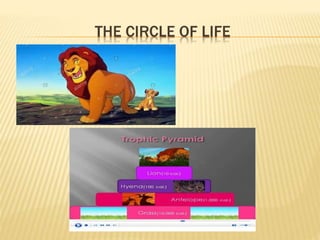
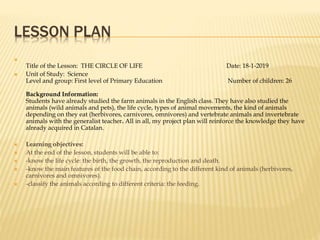
THE CIRCLE OF LIFE
LESSON PLAN

Title of the Lesson: THE CIRCLE OF LIFE Date: 18-1-2019
 Unit of Study: Science
Level and group: First level of Primary Education Number of children: 26
Background Information:
Students have already studied the farm animals in the English class. They have also studied the
animals (wild animals and pets), the life cycle, types of animal movements, the kind of animals
depending on they eat (herbivores, carnivores, omnivores) and vertebrate animals and invertebrate
animals with the generalist teacher. All in all, my project plan will reinforce the knowledge they have
already acquired in Catalan.
 Learning objectives:
 At the end of the lesson, students will be able to:
 -know the life cycle: the birth, the growth, the reproduction and death.
 -know the main features of the food chain, according to the different kind of animals (herbivores,
carnivores and omnivores).
 -classify the animals according to different criteria: the feeding.
 Language objective/s:
 1. Language of learning: vocabulary related to the topic (animals); grammar structures.
 2. Language for learning: vocabulary used for presenting or reporting; vocabulary related to
classroom management.
 3. Language through learning: language that comes out in the process.
 Communication:
 Language of learning: key vocabulary.
 Kind of animals according to the environment in which they live: wild animals, pets, sea animals, farm
animals.
 Food chain (the concept).
 Land food chain and marine food chain.
 Classification of animals according to food: herbivores, carnivores and omnivores.
 Verbs:
 To be born, to grow, to reproduce, to die.
 To eat plants/ to eat meat/ to eat plants and meat.
 Can live
 Live in water/live on land/swim.
 Have/have got
 Main structures
 It’s a/It’s an + (the name of the animal).
 Subject + to be+ attribute A goat is an herbivore.
 Subject + verb+ Direct Complement:
- Herbivores eat plants.
- Carnivores eat meat (insects and all animals).
- Omnivores eat plants and animals.
 Language for learning.
 Language to participate in the debates (for instance, when talking about the circle of life “I agree with
you”).
 Language to understand the goal of the activity, for instance, reading a sentence: “Look and write if the
animals are herbivores, carnivores or omnivores”.
 Language through.
 Questions that come up through the lessons. “Is the horse a carnivore animal? Is it a land animal or a sea
animal?”
 Language to carry out worksheets and to encourage the pupils: “Can you repeat, please? Be careful! Try
again! Very good.”
 Competencies involved:
 -Linguistic and audio-visual.
 -Information handling and digital competence.
 -Personal.
 -Knowledge of and interaction with the natural world.
 Competencies involved:
 -Linguistic and audio-visual.
 -Information handling and digital competence.
 -Personal.
 -Knowledge of and interaction with the natural world.
 Assessment:
 Assessment criteria
 Can the students?
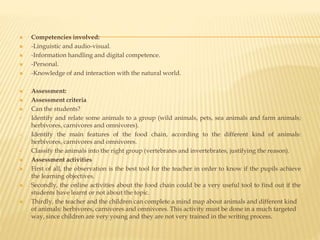
 Identify and relate some animals to a group (wild animals, pets, sea animals and farm animals;
herbivores, carnivores and omnivores).
 Identify the main features of the food chain, according to the different kind of animals:
herbivores, carnivores and omnivores.
 Classify the animals into the right group (vertebrates and invertebrates, justifying the reason).
 Assessment activities
 First of all, the observation is the best tool for the teacher in order to know if the pupils achieve
the learning objectives.
 Secondly, the online activities about the food chain could be a very useful tool to find out if the
students have learnt or not about the topic.
 Thirdly, the teacher and the children can complete a mind map about animals and different kind
of animals: herbivores, carnivores and omnivores. This activity must be done in a much targeted
way, since children are very young and they are not very trained in the writing process.
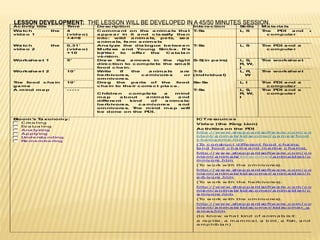
LESSON DEVELOPMENT: THE LESSON WILL BE DEVELOPED IN A 45/50 MINUTES SESSION.
Ac tivity title Time De sc ription Inte ra c tion Skills Ma te ria ls
Wa tc h the
vide o 1
4
(vide o)
+4=8
Comme nt on the a nima ls tha t
a ppe a r in it a nd c la ssify the n
into: wild a nima ls, pe ts, se a
a nima ls, fa rm a nima ls
T- Ss L, S The PDI a nd a
c ompute r
Wa tc h the
vide o 2
0,31’
(vide o)
+10
Ana lyze the dia logue be twe e n
Mufa sa a nd Young Simba . It’s
be tte r to offe r the Ca ta la n
ve rsion.
T- Ss L, S The PDI a nd a
c ompute r
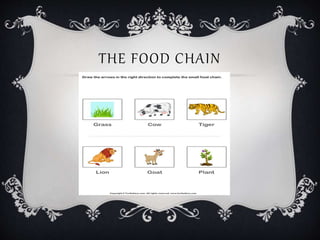
Workshe e t 1 5’ Dra w the a rrows in the right
dire c tion to c omple te the sma ll
food c ha in.
S- S(in pa irs) L, S,
R, W,
I
The workshe e t
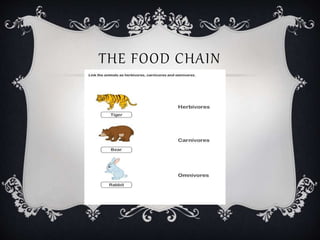
Workshe e t 2 10’ Write if the a nima ls a re
he rbivore s, c a rnivore s or
omnivore s.
T- S
(individua l)
L, R,
W
The workshe e t
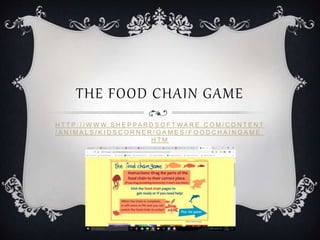
The food c ha in
ga me
10’ Dra g the pa rts of the food
c ha in to the ir c orre c t pla c e .
Ss- Ss L, I The PDI a nd a
c ompute r
A mind ma p - - - - -
Childre n c omple te a mind
ma p a bout a nima ls a nd
diffe re nt kind of a nima ls:
he rbivore s, c a rnivore s a nd
omnivore s. The mind ma p will
be done on the PDI.
T- Ss L, S,
R, W,
I
The PDI a nd a
c ompute r
Bloom's Ta xonomy:
C re a ting
Eva lua ting
Ana lyzing
Applying
Unde rsta nding
Re me mbe ring
ICT re sourc e s
Vide o (the King Lion)
Ac tivitie s on the PDI
http :/ / w w w .she p p a rd so ftw a re .c o m / c o
nte nt/ a nim a ls/ kid sc o rne r/ g a m e s/ fo o d
c ha ing a m e .htm
(To c o nstruc t d iffe re nt fo o d c ha ins,
la nd fo o d c ha ins a nd m a rine c ha ins).
http :/ / w w w .she p p a rd so ftw a re .c o m / c o
nte nt/ a nim a ls/ kid sc o rne r/ a nim a ld ie t/ o
m nivo re .htm
(To w o rk w ith the o m nivo re s).
http :/ / w w w .she p p a rd so ftw a re .c o m / c o
nte nt/ a nim a ls/ kid sc o rne r/ a nim a ld ie t/ h
e rb ivo re .htm
(To w o rk w ith the he rb ivo re s).
http :/ / w w w .she p p a rd so ftw a re .c o m / c o
nte nt/ a nim a ls/ kid sc o rne r/ a nim a ld ie t/ c
a rnivo re .htm
(To w o rk w ith the o m nivo re s).
http :/ / w w w .she p p a rd so ftw a re .c o m / c o
nte nt/ a nim a ls/ kid sc o rne r/ kid sc o rne r_g
a m e s.htm
(t o kno w w ha t kind o f a nim a ls is it:
a re p tile , a m a m m a l, a b ird , a fish, a nd
a m p hib ia n)
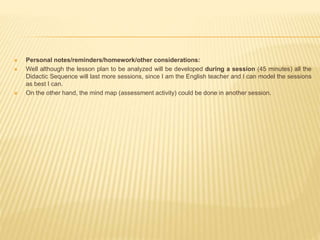
 Personal notes/reminders/homework/other considerations:
 Well although the lesson plan to be analyzed will be developed during a session (45 minutes) all the
Didactic Sequence will last more sessions, since I am the English teacher and I can model the sessions
as best I can.
 On the other hand, the mind map (assessment activity) could be done in another session.
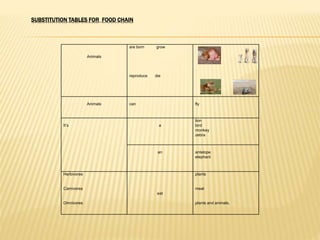
SUBSTITUTION TABLES FOR FOOD CHAIN
Animals
are born grow
reproduce die
Animals can fly
It’s a
lion
bird
monkey
zebra
an antelope
elephant
Herbivores
Carnivores
Omnivores
eat
plants
meat
plants and animals.
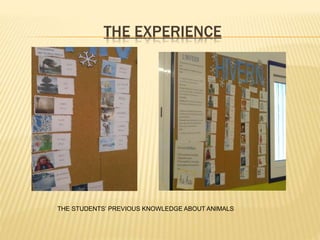
THE EXPERIENCE
THE STUDENTS’ PREVIOUS KNOWLEDGE ABOUT ANIMALS
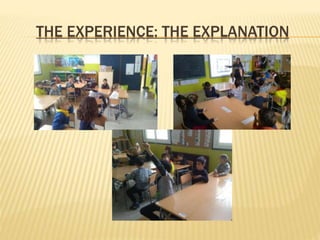
THE EXPERIENCE: THE EXPLANATION
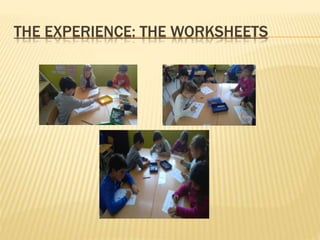
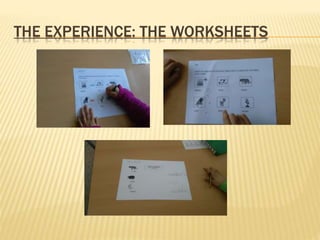
THE EXPERIENCE: THE WORKSHEETS
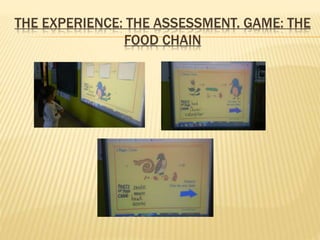
THE EXPERIENCE: THE ASSESSMENT. GAME: THE
FOOD CHAIN
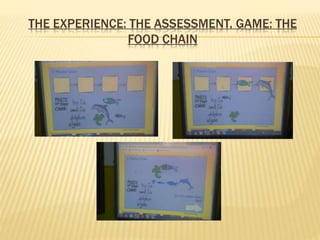
THE EXPERIENCE: THE ASSESSMENT. GAME: THE
FOOD CHAIN
THE EXPERIENCE: MY REFLECTIONS
 First of all, the experience of implementing a Lesson Plan, in first level, with my English pupils has been
very interesting and wonderful. The basic point of departure has been to profit the previous knowledge
of the pupils, since they were studying the animals with the generalist teacher and on the other hand I
had already worked with them the animal’s topic (we had studied the farm animals).
 Secondly, concerning to the practice, perhaps, I would have need more time because we have spent a
lot time talking about the circle of life and the kind of animals. It has been very profitable, though since it
was necessary to clarify all kind of animals, that is to say: wild animals- pets- sea animals-farm animals
in order to explain properly and to understand the food chain (some animals eat the others).
 Then I have used this concept to explain the type of animals depending on what they eat, that is to say,
herbivores, carnivores and omnivores.
 Thirdly, it has been difficult for the children the worksheet in which they had to write next to a photo if the
animal was a carnivore animal, an herbivore or an omnivore one. Well, although it’s true that the
majority of the pupils “can read”, only some students can “read” and realize at the same time if the
photo corresponds to a carnivore animal, to an herbivore or an omnivore animal. All in all, I had to write
the proper answer in the PDI and then they had to copy.
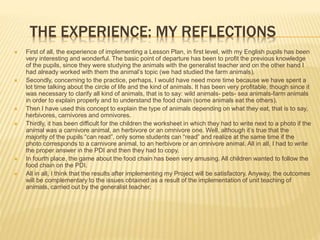
 In fourth place, the game about the food chain has been very amusing. All children wanted to follow the
food chain on the PDI.
 All in all, I think that the results after implementing my Project will be satisfactory. Anyway, the outcomes
will be complementary to the issues obtained as a result of the implementation of unit teaching of
animals, carried out by the generalist teacher.
THE CERCLE OF
LIFE
PROJECT
M Y P R O J E C T I S T O B E D E V E L O P E D I N F I R S T
L E V E L O F P R I M A RY E D U C A T I O N. T H E U N I T
B E L O N G S T O T H E F I E L D O F S C I E N C E .
H E R E YO U A R E T H E R E S O U R C E S I U S E D
D U R I N G T H E L E S S O N.
INTRODUCTION
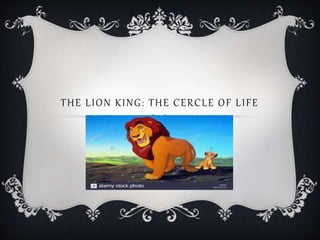
THE LION KING: THE CERCLE OF LIFE
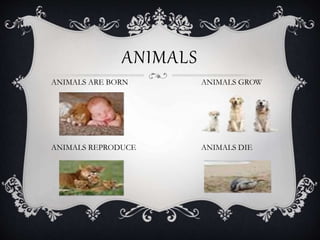
ANIMALS
ANIMALS ARE BORN ANIMALS GROW
ANIMALS REPRODUCE ANIMALS DIE
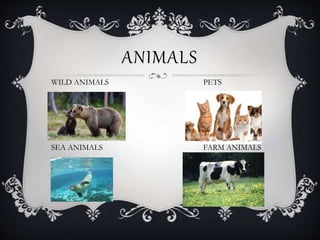
ANIMALS
WILD ANIMALS PETS
SEA ANIMALS FARM ANIMALS
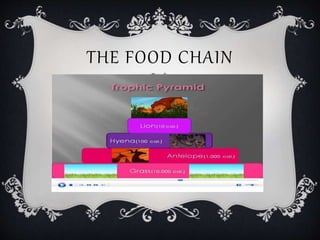
THE FOOD CHAIN
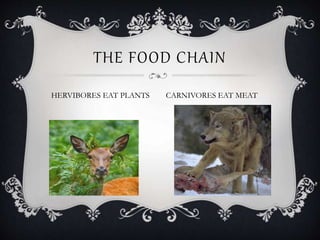
HERVIBORES EAT PLANTS
THE FOOD CHAIN
CARNIVORES EAT MEAT
THE FOOD CHAIN
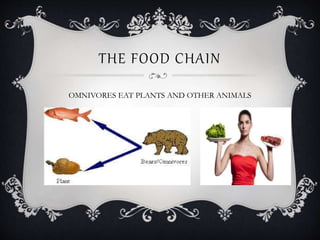
OMNIVORES EAT PLANTS AND OTHER ANIMALS
THE FOOD CHAIN
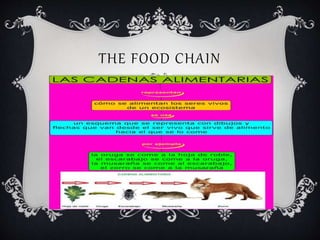
THE FOOD CHAIN
THE FOOD CHAIN
H T T P : / / W W W . S H E P PA R D S O F T W A R E . C O M / C O N T E N T
/ A N I M A L S / K I D S C O R N E R / G A M E S / F O O D C H A I N G A M E .
H T M
THE FOOD CHAIN GAME

Project plan Maria Pilar Cano

  • 1.
  • 2.
    LESSON PLAN  Title ofthe Lesson: THE CIRCLE OF LIFE Date: 18-1-2019  Unit of Study: Science Level and group: First level of Primary Education Number of children: 26 Background Information: Students have already studied the farm animals in the English class. They have also studied the animals (wild animals and pets), the life cycle, types of animal movements, the kind of animals depending on they eat (herbivores, carnivores, omnivores) and vertebrate animals and invertebrate animals with the generalist teacher. All in all, my project plan will reinforce the knowledge they have already acquired in Catalan.  Learning objectives:  At the end of the lesson, students will be able to:  -know the life cycle: the birth, the growth, the reproduction and death.  -know the main features of the food chain, according to the different kind of animals (herbivores, carnivores and omnivores).  -classify the animals according to different criteria: the feeding.
  • 3.
     Language objective/s: 1. Language of learning: vocabulary related to the topic (animals); grammar structures.  2. Language for learning: vocabulary used for presenting or reporting; vocabulary related to classroom management.  3. Language through learning: language that comes out in the process.  Communication:  Language of learning: key vocabulary.  Kind of animals according to the environment in which they live: wild animals, pets, sea animals, farm animals.  Food chain (the concept).  Land food chain and marine food chain.  Classification of animals according to food: herbivores, carnivores and omnivores.
  • 4.
     Verbs:  Tobe born, to grow, to reproduce, to die.  To eat plants/ to eat meat/ to eat plants and meat.  Can live  Live in water/live on land/swim.  Have/have got  Main structures  It’s a/It’s an + (the name of the animal).  Subject + to be+ attribute A goat is an herbivore.  Subject + verb+ Direct Complement: - Herbivores eat plants. - Carnivores eat meat (insects and all animals). - Omnivores eat plants and animals.
  • 5.
     Language forlearning.  Language to participate in the debates (for instance, when talking about the circle of life “I agree with you”).  Language to understand the goal of the activity, for instance, reading a sentence: “Look and write if the animals are herbivores, carnivores or omnivores”.  Language through.  Questions that come up through the lessons. “Is the horse a carnivore animal? Is it a land animal or a sea animal?”  Language to carry out worksheets and to encourage the pupils: “Can you repeat, please? Be careful! Try again! Very good.”  Competencies involved:  -Linguistic and audio-visual.  -Information handling and digital competence.  -Personal.  -Knowledge of and interaction with the natural world.
  • 6.
     Competencies involved: -Linguistic and audio-visual.  -Information handling and digital competence.  -Personal.  -Knowledge of and interaction with the natural world.  Assessment:  Assessment criteria  Can the students?  Identify and relate some animals to a group (wild animals, pets, sea animals and farm animals; herbivores, carnivores and omnivores).  Identify the main features of the food chain, according to the different kind of animals: herbivores, carnivores and omnivores.  Classify the animals into the right group (vertebrates and invertebrates, justifying the reason).  Assessment activities  First of all, the observation is the best tool for the teacher in order to know if the pupils achieve the learning objectives.  Secondly, the online activities about the food chain could be a very useful tool to find out if the students have learnt or not about the topic.  Thirdly, the teacher and the children can complete a mind map about animals and different kind of animals: herbivores, carnivores and omnivores. This activity must be done in a much targeted way, since children are very young and they are not very trained in the writing process.
  • 7.
    LESSON DEVELOPMENT: THELESSON WILL BE DEVELOPED IN A 45/50 MINUTES SESSION. Ac tivity title Time De sc ription Inte ra c tion Skills Ma te ria ls Wa tc h the vide o 1 4 (vide o) +4=8 Comme nt on the a nima ls tha t a ppe a r in it a nd c la ssify the n into: wild a nima ls, pe ts, se a a nima ls, fa rm a nima ls T- Ss L, S The PDI a nd a c ompute r Wa tc h the vide o 2 0,31’ (vide o) +10 Ana lyze the dia logue be twe e n Mufa sa a nd Young Simba . It’s be tte r to offe r the Ca ta la n ve rsion. T- Ss L, S The PDI a nd a c ompute r Workshe e t 1 5’ Dra w the a rrows in the right dire c tion to c omple te the sma ll food c ha in. S- S(in pa irs) L, S, R, W, I The workshe e t Workshe e t 2 10’ Write if the a nima ls a re he rbivore s, c a rnivore s or omnivore s. T- S (individua l) L, R, W The workshe e t The food c ha in ga me 10’ Dra g the pa rts of the food c ha in to the ir c orre c t pla c e . Ss- Ss L, I The PDI a nd a c ompute r A mind ma p - - - - - Childre n c omple te a mind ma p a bout a nima ls a nd diffe re nt kind of a nima ls: he rbivore s, c a rnivore s a nd omnivore s. The mind ma p will be done on the PDI. T- Ss L, S, R, W, I The PDI a nd a c ompute r Bloom's Ta xonomy: C re a ting Eva lua ting Ana lyzing Applying Unde rsta nding Re me mbe ring ICT re sourc e s Vide o (the King Lion) Ac tivitie s on the PDI http :/ / w w w .she p p a rd so ftw a re .c o m / c o nte nt/ a nim a ls/ kid sc o rne r/ g a m e s/ fo o d c ha ing a m e .htm (To c o nstruc t d iffe re nt fo o d c ha ins, la nd fo o d c ha ins a nd m a rine c ha ins). http :/ / w w w .she p p a rd so ftw a re .c o m / c o nte nt/ a nim a ls/ kid sc o rne r/ a nim a ld ie t/ o m nivo re .htm (To w o rk w ith the o m nivo re s). http :/ / w w w .she p p a rd so ftw a re .c o m / c o nte nt/ a nim a ls/ kid sc o rne r/ a nim a ld ie t/ h e rb ivo re .htm (To w o rk w ith the he rb ivo re s). http :/ / w w w .she p p a rd so ftw a re .c o m / c o nte nt/ a nim a ls/ kid sc o rne r/ a nim a ld ie t/ c a rnivo re .htm (To w o rk w ith the o m nivo re s). http :/ / w w w .she p p a rd so ftw a re .c o m / c o nte nt/ a nim a ls/ kid sc o rne r/ kid sc o rne r_g a m e s.htm (t o kno w w ha t kind o f a nim a ls is it: a re p tile , a m a m m a l, a b ird , a fish, a nd a m p hib ia n)
  • 8.
     Personal notes/reminders/homework/otherconsiderations:  Well although the lesson plan to be analyzed will be developed during a session (45 minutes) all the Didactic Sequence will last more sessions, since I am the English teacher and I can model the sessions as best I can.  On the other hand, the mind map (assessment activity) could be done in another session.
  • 9.
    SUBSTITUTION TABLES FORFOOD CHAIN Animals are born grow reproduce die Animals can fly It’s a lion bird monkey zebra an antelope elephant Herbivores Carnivores Omnivores eat plants meat plants and animals.
  • 10.
    THE EXPERIENCE THE STUDENTS’PREVIOUS KNOWLEDGE ABOUT ANIMALS
  • 11.
  • 12.
  • 13.
  • 14.
    THE EXPERIENCE: THEASSESSMENT. GAME: THE FOOD CHAIN
  • 15.
    THE EXPERIENCE: THEASSESSMENT. GAME: THE FOOD CHAIN
  • 16.
    THE EXPERIENCE: MYREFLECTIONS  First of all, the experience of implementing a Lesson Plan, in first level, with my English pupils has been very interesting and wonderful. The basic point of departure has been to profit the previous knowledge of the pupils, since they were studying the animals with the generalist teacher and on the other hand I had already worked with them the animal’s topic (we had studied the farm animals).  Secondly, concerning to the practice, perhaps, I would have need more time because we have spent a lot time talking about the circle of life and the kind of animals. It has been very profitable, though since it was necessary to clarify all kind of animals, that is to say: wild animals- pets- sea animals-farm animals in order to explain properly and to understand the food chain (some animals eat the others).  Then I have used this concept to explain the type of animals depending on what they eat, that is to say, herbivores, carnivores and omnivores.  Thirdly, it has been difficult for the children the worksheet in which they had to write next to a photo if the animal was a carnivore animal, an herbivore or an omnivore one. Well, although it’s true that the majority of the pupils “can read”, only some students can “read” and realize at the same time if the photo corresponds to a carnivore animal, to an herbivore or an omnivore animal. All in all, I had to write the proper answer in the PDI and then they had to copy.  In fourth place, the game about the food chain has been very amusing. All children wanted to follow the food chain on the PDI.  All in all, I think that the results after implementing my Project will be satisfactory. Anyway, the outcomes will be complementary to the issues obtained as a result of the implementation of unit teaching of animals, carried out by the generalist teacher.
  • 17.
  • 18.
    M Y PR O J E C T I S T O B E D E V E L O P E D I N F I R S T L E V E L O F P R I M A RY E D U C A T I O N. T H E U N I T B E L O N G S T O T H E F I E L D O F S C I E N C E . H E R E YO U A R E T H E R E S O U R C E S I U S E D D U R I N G T H E L E S S O N. INTRODUCTION
  • 19.
    THE LION KING:THE CERCLE OF LIFE
  • 20.
    ANIMALS ANIMALS ARE BORNANIMALS GROW ANIMALS REPRODUCE ANIMALS DIE
  • 21.
    ANIMALS WILD ANIMALS PETS SEAANIMALS FARM ANIMALS
  • 22.
  • 23.
    HERVIBORES EAT PLANTS THEFOOD CHAIN CARNIVORES EAT MEAT
  • 24.
    THE FOOD CHAIN OMNIVORESEAT PLANTS AND OTHER ANIMALS
  • 25.
  • 26.
  • 27.
  • 28.
    H T TP : / / W W W . S H E P PA R D S O F T W A R E . C O M / C O N T E N T / A N I M A L S / K I D S C O R N E R / G A M E S / F O O D C H A I N G A M E . H T M THE FOOD CHAIN GAME