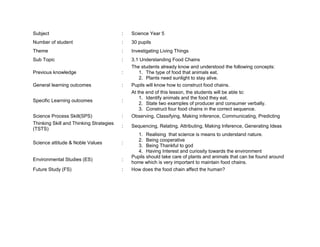
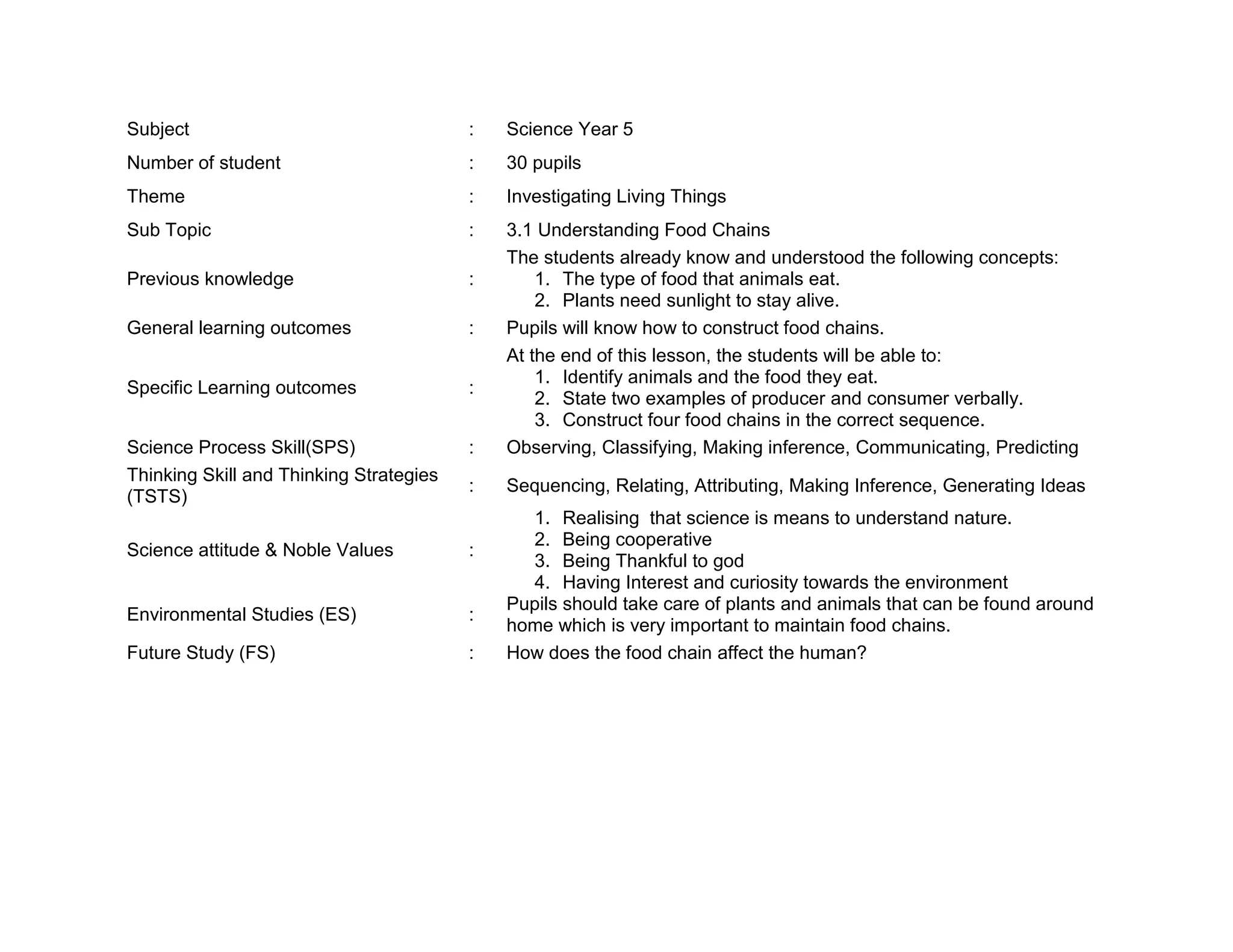
Subject:Science Year 5Number of student:30 pupilsTheme :Investigating Living ThingsSub Topic:3.1 Understanding Food ChainsPrevious knowledge:The students already know and understood the following concepts:The type of food that animals eat.Plants need sunlight to stay alive.General learning outcomes:Pupils will know how to construct food chains.Specific Learning outcomes:At the end of this lesson, the students will be able to:Identify animals and the food they eat.State two examples of producer and consumer verbally.Construct four food chains in the correct sequence.Science Process Skill(SPS):Observing, Classifying, Making inference, Communicating, Predicting Thinking Skill and Thinking Strategies (TSTS):Sequencing, Relating, Attributing, Making Inference, Generating IdeasScience attitude & Noble Values:Realising  that science is means to understand nature.Being cooperativeBeing Thankful to godHaving Interest and curiosity towards the environmentEnvironmental Studies (ES):Pupils should take care of plants and animals that can be found around home which is very important to maintain food chains.Future Study (FS):How does the food chain affect the human?
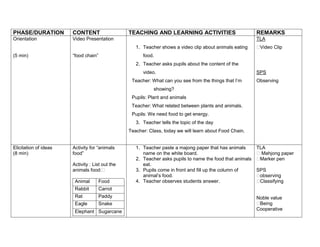
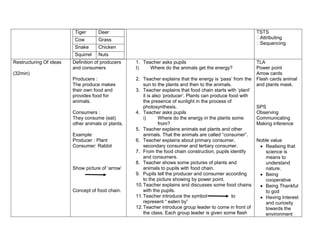
PHASE/DURATIONCONTENTTEACHING AND LEARNING ACTIVITIESREMARKSOrientation(5 min)Video Presentation“food chain”Teacher shows a video clip about animals eating food.Teacher asks pupils about the content of the video.Teacher: What can you see from the things that I’m showing?Pupils: Plant and animalsTeacher: What related between plants and animals.Pupils: We need food to get energy.Teacher tells the topic of the dayTeacher: Class, today we will learn about Food Chain.TLA˗Video ClipSPSObserving Elicitation of ideas(8 min)Activity for “animals food”Activity : List out the animals food:˗AnimalFoodRabbitCarrotRatPaddyEagleSnakeElephantSugarcaneTigerDeerCowGrassSnakeChickenSquirrelNutsTeacher paste a majong paper that has animals name on the white board.Teacher asks pupils to name the food that animals eat.Pupils come in front and fill up the column of animal’s food.Teacher observes students answer.TLA˗ Mahjong paper˗Marker penSPS˗observing˗ClassifyingNoble value˗Being CooperativeTSTS˗Attributing ˗SequencingRestructuring Of ideas(32min)Definition of producers and consumersProducers :The produce makes their own food and provides food for animals.Consumers :They consume (eat) other animals or plants.Example: Producer : PlantConsumer: RabbitShow picture of ‘arrow’Concept of food chain.Group activity: to understand the food chain in using an arrow (eaten by ) Example of masksTeacher asks pupilsWhere do the animals get the energy?Teacher explains that the energy is ‘pass’ from the sun to the plants and then to the animals.Teacher explains that food chain starts with ‘plant’ it is also ‘producer’. Plants can produce food with the presence of sunlight in the process of photosynthesis.Teacher asks pupilsWhere do the energy in the plants some from?Teacher explains animals eat plants and other animals. That the animals are called “consumer”.Teacher explains about primary consumer, secondary consumer and tertiary consumer.From the food chain construction, pupils identify and consumers.Teacher shows some pictures of plants and animals to pupils with food chain.Pupils tell the producer and consumer according to the picture showing by power point.Teacher explains and discusses some food chains with the pupils.Teacher introduce the symbol                  to represent “ eaten by”Teacher introduce group leader to come in front of the class. Each group leader is given some flash cards of animals and plants and some arrows. Student from a food chain according to the flash cards and arrows by groups.Pupils discuss in the group. Teacher guides pupils to do group work.Teacher asks group leader to present their group presentation.“ Class, teacher wants you to present your answer”Students present their answers.Teacher checks their answers.Teacher distributes some plants and animals mask to each group.Pupils in group from a food chain according to the plants and animals mask.Pupils wear the mask and act (eat the plant and animals)Teacher appreciates the pupils.TLAPower pointArrow cardsFlash cards animal and plants mask.SPSObservingCommunicatingMaking inferenceNoble valueRealising that science is means to understand nature.Being cooperativeBeing Thankful to godHaving Interest and curiosity towards the environmentTSTSSequencingGenerating ideasRelatingApplication of ideas(10 min)Work sheetQuestions about the food chainTeacher distributes worksheets to every student.Teacher plays the music; pupils start to write their answers on the paper. The pupils have stop writing when the music stops.Finally teacher discusses the answers with the pupils.TLA Worksheet SPSInferringTSTSSequencing Generating ideasRelating
Rancangan Pelajaran Harian

Rancangan Pelajaran Harian

  • 1.
    Subject:Science Year 5Numberof student:30 pupilsTheme :Investigating Living ThingsSub Topic:3.1 Understanding Food ChainsPrevious knowledge:The students already know and understood the following concepts:The type of food that animals eat.Plants need sunlight to stay alive.General learning outcomes:Pupils will know how to construct food chains.Specific Learning outcomes:At the end of this lesson, the students will be able to:Identify animals and the food they eat.State two examples of producer and consumer verbally.Construct four food chains in the correct sequence.Science Process Skill(SPS):Observing, Classifying, Making inference, Communicating, Predicting Thinking Skill and Thinking Strategies (TSTS):Sequencing, Relating, Attributing, Making Inference, Generating IdeasScience attitude & Noble Values:Realising that science is means to understand nature.Being cooperativeBeing Thankful to godHaving Interest and curiosity towards the environmentEnvironmental Studies (ES):Pupils should take care of plants and animals that can be found around home which is very important to maintain food chains.Future Study (FS):How does the food chain affect the human?
  • 2.
    PHASE/DURATIONCONTENTTEACHING AND LEARNINGACTIVITIESREMARKSOrientation(5 min)Video Presentation“food chain”Teacher shows a video clip about animals eating food.Teacher asks pupils about the content of the video.Teacher: What can you see from the things that I’m showing?Pupils: Plant and animalsTeacher: What related between plants and animals.Pupils: We need food to get energy.Teacher tells the topic of the dayTeacher: Class, today we will learn about Food Chain.TLA˗Video ClipSPSObserving Elicitation of ideas(8 min)Activity for “animals food”Activity : List out the animals food:˗AnimalFoodRabbitCarrotRatPaddyEagleSnakeElephantSugarcaneTigerDeerCowGrassSnakeChickenSquirrelNutsTeacher paste a majong paper that has animals name on the white board.Teacher asks pupils to name the food that animals eat.Pupils come in front and fill up the column of animal’s food.Teacher observes students answer.TLA˗ Mahjong paper˗Marker penSPS˗observing˗ClassifyingNoble value˗Being CooperativeTSTS˗Attributing ˗SequencingRestructuring Of ideas(32min)Definition of producers and consumersProducers :The produce makes their own food and provides food for animals.Consumers :They consume (eat) other animals or plants.Example: Producer : PlantConsumer: RabbitShow picture of ‘arrow’Concept of food chain.Group activity: to understand the food chain in using an arrow (eaten by ) Example of masksTeacher asks pupilsWhere do the animals get the energy?Teacher explains that the energy is ‘pass’ from the sun to the plants and then to the animals.Teacher explains that food chain starts with ‘plant’ it is also ‘producer’. Plants can produce food with the presence of sunlight in the process of photosynthesis.Teacher asks pupilsWhere do the energy in the plants some from?Teacher explains animals eat plants and other animals. That the animals are called “consumer”.Teacher explains about primary consumer, secondary consumer and tertiary consumer.From the food chain construction, pupils identify and consumers.Teacher shows some pictures of plants and animals to pupils with food chain.Pupils tell the producer and consumer according to the picture showing by power point.Teacher explains and discusses some food chains with the pupils.Teacher introduce the symbol to represent “ eaten by”Teacher introduce group leader to come in front of the class. Each group leader is given some flash cards of animals and plants and some arrows. Student from a food chain according to the flash cards and arrows by groups.Pupils discuss in the group. Teacher guides pupils to do group work.Teacher asks group leader to present their group presentation.“ Class, teacher wants you to present your answer”Students present their answers.Teacher checks their answers.Teacher distributes some plants and animals mask to each group.Pupils in group from a food chain according to the plants and animals mask.Pupils wear the mask and act (eat the plant and animals)Teacher appreciates the pupils.TLAPower pointArrow cardsFlash cards animal and plants mask.SPSObservingCommunicatingMaking inferenceNoble valueRealising that science is means to understand nature.Being cooperativeBeing Thankful to godHaving Interest and curiosity towards the environmentTSTSSequencingGenerating ideasRelatingApplication of ideas(10 min)Work sheetQuestions about the food chainTeacher distributes worksheets to every student.Teacher plays the music; pupils start to write their answers on the paper. The pupils have stop writing when the music stops.Finally teacher discusses the answers with the pupils.TLA Worksheet SPSInferringTSTSSequencing Generating ideasRelating