SCIENCE 4
Quarter 2 Week 8
The learners draw a simple food chain using living things from the Philippines
and label them as herbivores, carnivores, and omnivores.
1. Draw a food chain and a food web using living things from the Philippines.
2. Label organisms in the food chain as herbivores, carnivores, and omnivores.
3. Identify the relationships among the different trophic levels in a food chain.
4. Trace the flow of energy in an ecosystem
5. Explain the effect of human activities on the balance in a food chain/food
web
DAY
1
FOOD
CHAIN
Short Review
Cross It Out. Analyze the five sets of animals to identify which one does not
belong to the group. Cross out the word that has different food eaten.
1. dog, pig, bird, tiger
2. pig, goat, horse, cow
3. tiger, lion, cat, snake
4. cat, monkey, duck, deer
5. bear, frog, wolf, lizard
Lesson Purpose
Breakfast Meals.
• What did you have for breakfast today?
• What does eating breakfast do for our bodies?
• Where do you think the energy from the food come from?
• How does energy coming from the sun being transferred from one
organism to another?
Unlocking Content Area Vocabulary
Arrange the scrambled letters to form a meaningful word. Then define
each word.
1. CEPRORDU
2. RSEMCONUS
3. PORSEMOCED
4. AICHN OODF
5. DOFO BWE
Explicitation
“Jack en Poy”. The learners will play the modified game “Jack en Poy” and here are the
mechanics of this game.
Gameplay:
Students pair up and play "Jack en Poy" against each other. Instead of the traditional
"Rock, Paper, Scissors" gestures, pupils will use the assigned organisms for each
round.
Food Chain
Process Questions:
1. What organism were you assigned during the game, and what role does that
organism play in a food chain?
2. How will you relate the game to the concept of interaction between plants and
animals?
Food Chain
1. Can you identify the different organisms in the food chain?
2. How would you classify each organism based on its position in the food chain?
3. How are the organisms in the food chain interconnected?
4. What is a food chain?
5. What happens to the energy as it moves through the food chain? Can you explain
why energy decreases as it moves up the food chain?
6. What would happen to the food chain if one organism were removed?
7. Why is it important to have a balance in the number of producers, consumers, and
decomposers in an ecosystem?
http://eastjackson4thgrade.weebly.com/food-chains.html
Worked Example
A. Two is Better Than One!
Make a table with two columns. On the first column write the plants and on the
second column write the animals that can be found in the surrounding area of
Monfort Bat Cave.
Food Chain
The island of Samal, part of Davao del Norte Province, is off the coast of Mindanao.
In this island is the Monfort Bat Cave which is approximately 245 feet (75 meters)
long and has five entrances. Bats cover 75 % of its ceilings and walls. An estimated
1.8 million bats, the largest known population of Geoffroy’s rousette fruit bats in the
world, are overloading Monfort Bat Cave on the Philippines’ Samal Island
Worked Example
Food Chain
Geoffroy’s rousette fruit bats feed on fruits and nectar. Their role as pollinators and
seed dispersers is essential in sustaining Philippine forests, including such important
commercial fruits as durian. Each bat consumes 1 ½ to 3 times its body weight
nightly in fruit and nectar. This colony could consume 550 tons (500, 000 kg)of nectar
from durian and other trees, pollinating an incredible number of flowers.
Worldwide, cave-dwelling bats are in alarming decline due to human disturbance
and destruction of their cave roosts. In some areas, including Samal Island, bats are
captured and eaten by humans. Colonies like the one in Monfort Bat Cave are now
rare and in urgent need of protection. Their loss would endanger the health of
forests and human economies.
Worked Example
Food Chain
The bat’s colony should be able to survive natural predators-crows, rats, 10-ft (3
meters) phytons and occasional monitor lizards- just as bat populations do
elsewhere. Untamed dogs and cats, however, also seem to do bad hunting at
Monfort Bat Cave
Source: Bat Conservation International, www.batcon.org
B. The Kingdom!
Classify the animals living in the Monfort Bat Cave based on their feeding habits. Use
a table in sorting the animals.
C. Construction Site!
Food Chain
Create a simple food chain with at least three organisms representing the producer,
1st order consumer and 2nd order consumer
After the activity, ask the following process questions:
1. What is the significance of the Monfort Bat Cave on Samal Island?
2. How does the feeding behavior of Geoffroy’s rousette fruit bats contribute to the
local food chain in the Monfort Bat Cave?
3. Why are the population of bats declining? How do this affect the natural balance of
ecosystem?
4. Why is it crucial to consider the preservation of bat colonies for the overall health
and sustainability of the ecosystem's food chain?
Lesson Activity
Food Chain
Linking Life: From Plants to Predators!
A. Construct a food chain using the following organisms:
Eagle snake frog
Bird grass locust
B. Identify which organisms are the:
1. producers
2. primary consumer
3. secondary consumer
4. tertiary consumer
5. quaternary consumer
C. How many links are there in the food chain you have constructed?
Lesson Activity
Food Chain
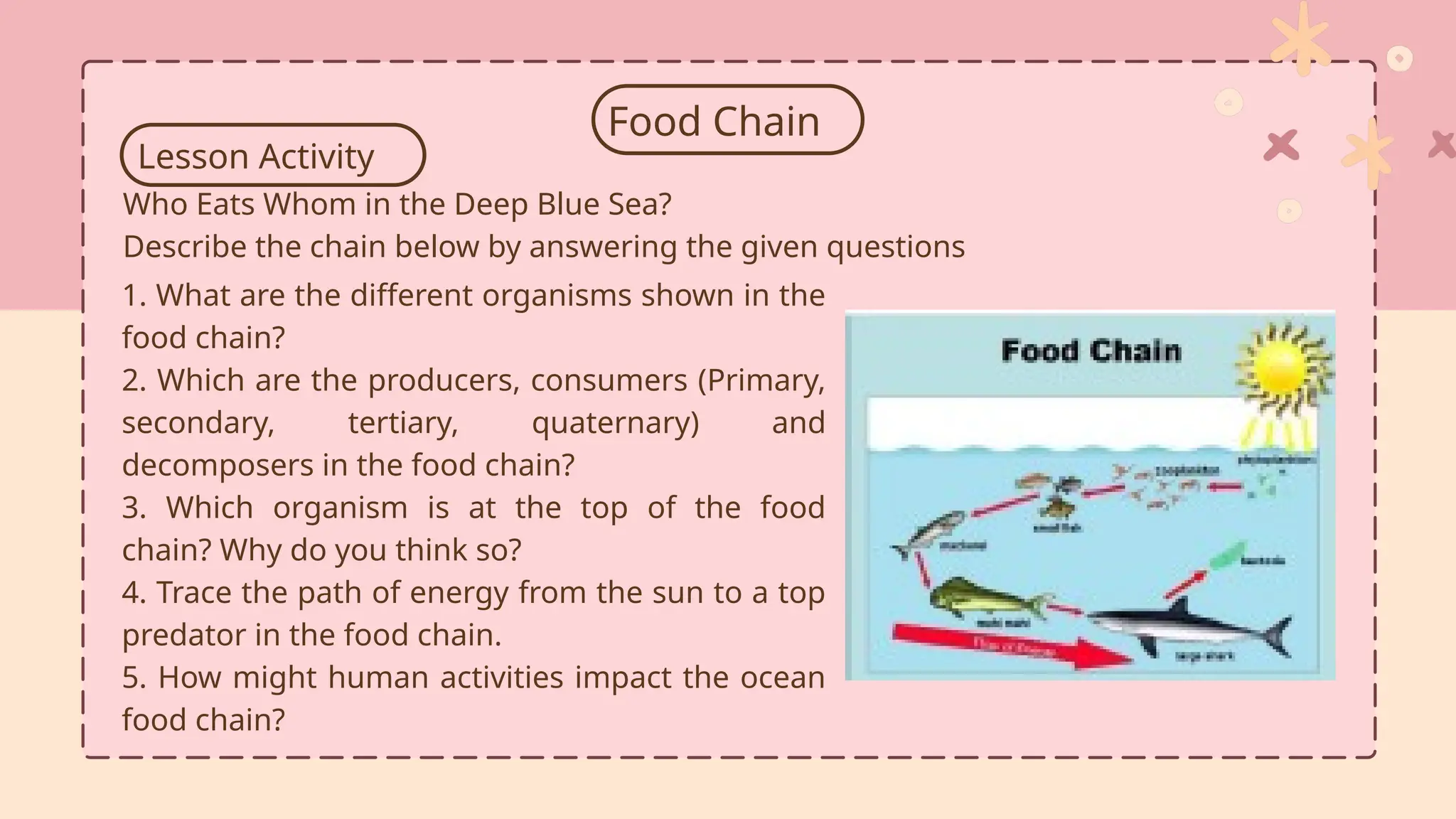
Who Eats Whom in the Deep Blue Sea?
Describe the chain below by answering the given questions
1. What are the different organisms shown in the
food chain?
2. Which are the producers, consumers (Primary,
secondary, tertiary, quaternary) and
decomposers in the food chain?
3. Which organism is at the top of the food
chain? Why do you think so?
4. Trace the path of energy from the sun to a top
predator in the food chain.
5. How might human activities impact the ocean
food chain?
Lesson Activity
Food Chain
Circle of Life: Animals on a Feeding Spree!
Create your food chain using pictures of animals.
Paste it on a paper plate. Illustrate how energy flows
in the food chain by showing the correct position of
the arrowhead where it is pointing.
Instructions:
Activity No. 1: Linking Life: From Plants to Predators!
A. Construct a food chain using the organisms inside the box.
B. Identify which organisms are the:
1. producers
2. primary consumer
3. secondary consumer
4. tertiary consumer
5. quaternary consumer
C. How many links are there in the food chain you have constructed?
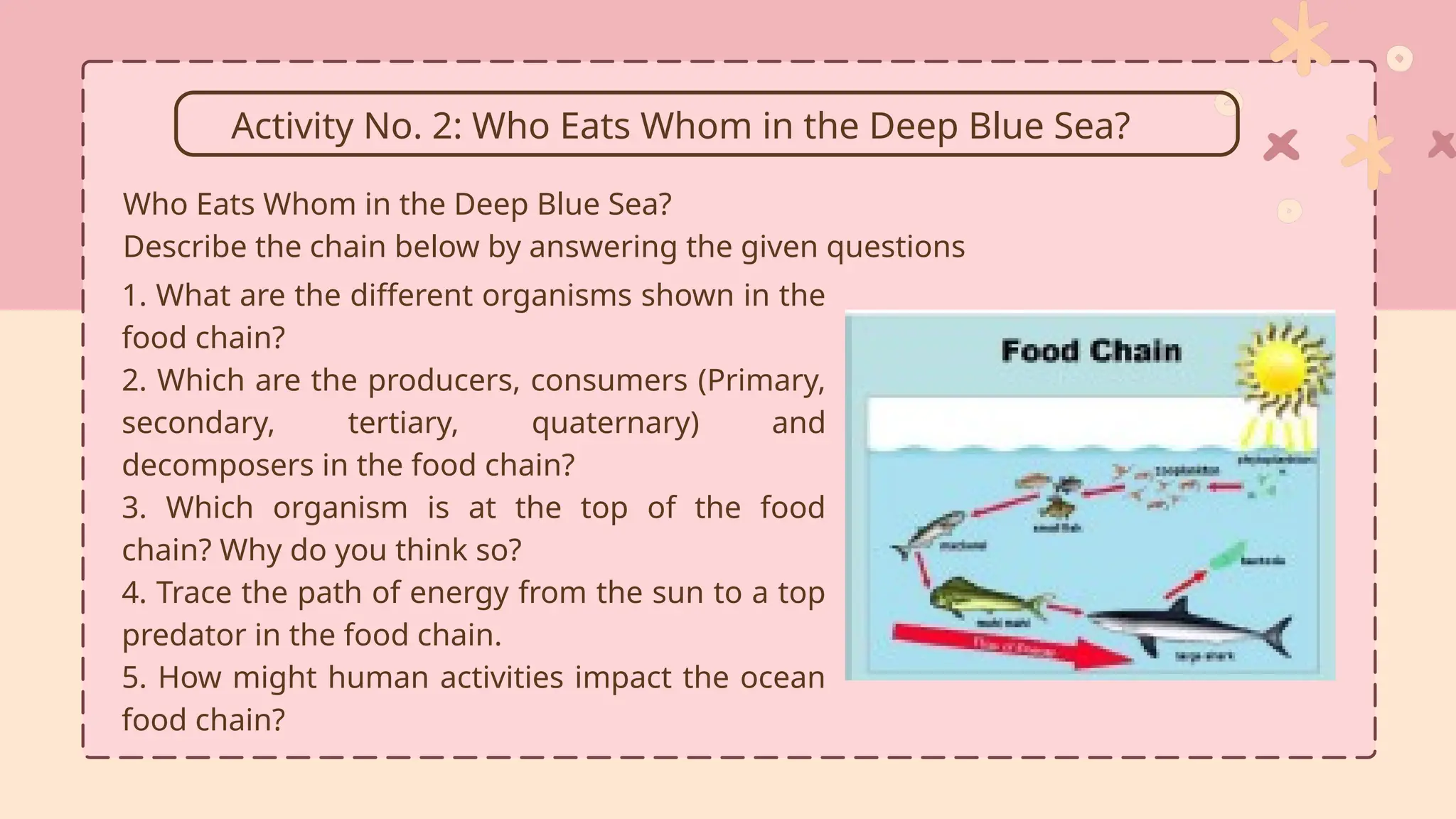
Who Eats Whom in the Deep Blue Sea?
Describe the chain below by answering the given questions
1. What are the different organisms shown in the
food chain?
2. Which are the producers, consumers (Primary,
secondary, tertiary, quaternary) and
decomposers in the food chain?
3. Which organism is at the top of the food
chain? Why do you think so?
4. Trace the path of energy from the sun to a top
predator in the food chain.
5. How might human activities impact the ocean
food chain?
Activity No. 2: Who Eats Whom in the Deep Blue Sea?
Activity No. 3: Circle of Life: Animals on a Feeding Spree!
Materials:
Paper plate, pictures of plants and animals found in the Philippines, ballpen or
pentel pen, scissors, glue or paste.
Instructions:
Create your food chain using pictures of animals.
Paste it on a paper plate. Illustrate how energy
flows in the food chain by showing the correct
position of the arrowhead where it is pointing.
DAY
2
FOOD
WEB
Explicitation
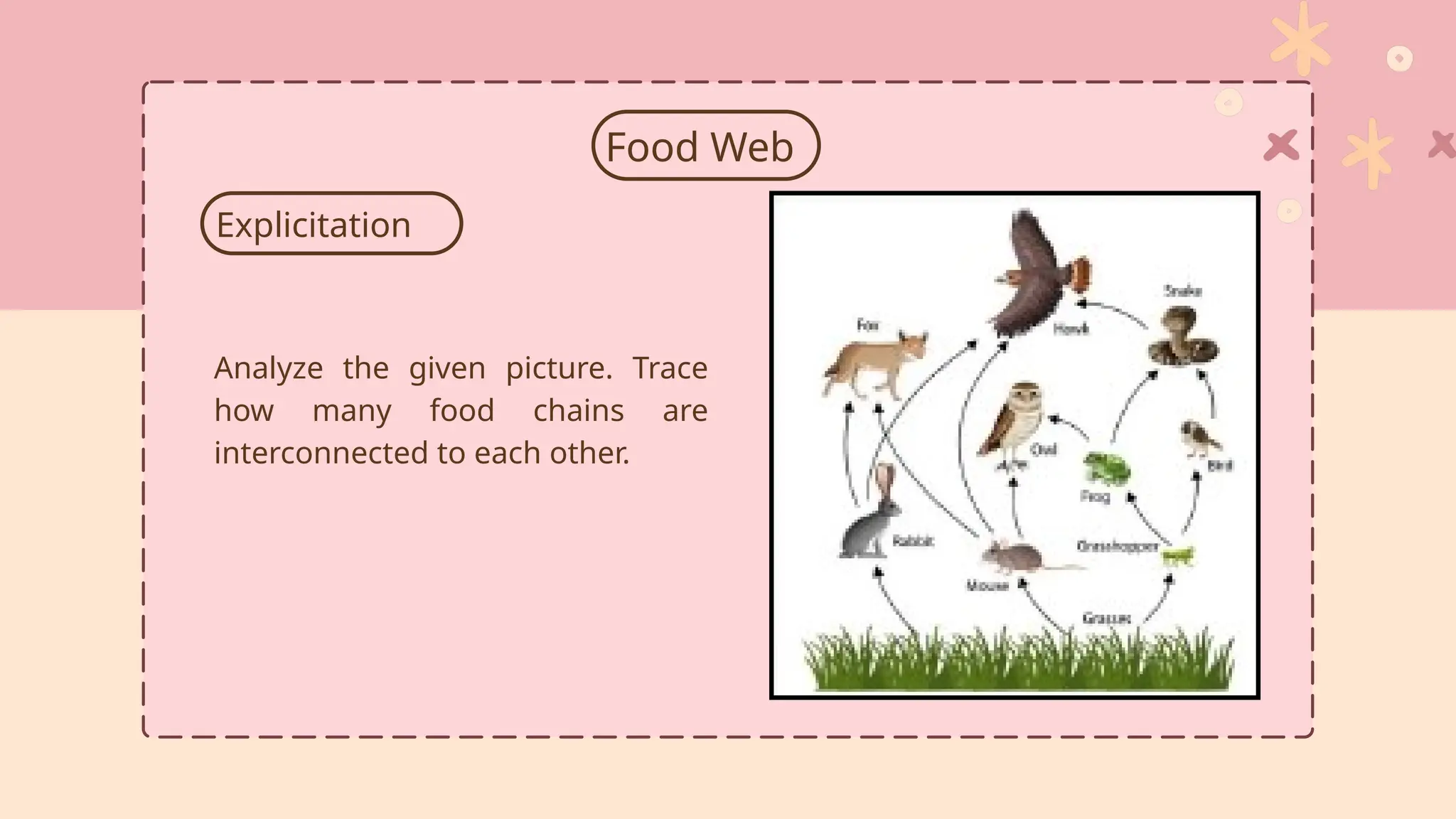
Food Web
Analyze the given picture. Trace
how many food chains are
interconnected to each other.
Process Questions:
1. What are the different organisms you see in the image? Can you group them
based on what they eat (producers, consumers, decomposers)? How many
producers? herbivores? carnivores?
2. Following the arrows, trace the path of energy from the sun to a top predator.
What happens to the energy at each level?
3. Decomposers are not explicitly shown in the image, but they play a crucial role.
Why are they important for the food web and the overall ecosystem?
4. Identify the food chains that compose the food web in the figure.
5. What do you think will happen if there is an excessive hunting of snakes?
6. What is the difference between a food chain and a food web?
Food Chain
Worked Example
Pass the Yarn, Pass the Bite! The class will pass out a sticker name tag and each
learner will pick one name of an animal. Then they will form a food chain using a
yarn. Then have them throw the yarn ball to a consumer of other groups that would
eat it.
Food Chain
Preparation:
1. Label each sticker with a different animal name representing different trophic
levels (herbivores, carnivores, omnivores). Include some decomposers if desired.
2. Divide the yarn into several pieces of varying lengths, representing different
energy levels transferred in the food chain.
3. Choose a starting point in your space and mark it as the "sun."
Activity:
1. Animal Selection: Have each student pick a sticker and wear it prominently.
2. Building the Web: Starting at the "sun," hand the ball of yarn to a student with a
herbivore sticker. This student holds onto the yarn, representing the energy received
from the sun.
3. Passing the Bite: Ask the herbivore student to identify a carnivore or omnivore that
would eat them. That student then holds the yarn from the herbivore, representing
the transfer of energy. Continue in this way, with students passing the yarn
according to who would eat them in the real food chain. You can use the different
colored yarn pieces to represent different energy levels transferred at each trophic
level.
4. Food Chain Loops: If the food web reaches a dead end (e.g., top predator with no
further consumers), have that student throw the yarn ball back to a lower trophic
level, creating a loop in the web. Explain how decomposers can break down dead
organisms and return nutrients to the system.
Activity:
Once the web is complete, gather everyone and discuss the activity. Ask the
following questions:
1. How does energy flow through the food chain?
2. What happens to the energy at each level?
3. How do the various organisms in the food web depend on each other for survival?
What happens if one species is removed from the food web?
4. Imagine a new predator is introduced to your food web. How might this disrupt
the existing relationships and energy flow? Can the other organisms adapt to this
change?
5. How might human activities like pollution or habitat destruction impact the
organisms involved?
Teen Titans, Assemble! Reconstruct a disrupted food web by analyzing the
relationships between different organisms in an ecosystem.
Materials:
1. Printed cards with images of organisms (plants, herbivores, carnivores,
decomposers)
2. Large sheet of paper or cardboard
3. Yarns or strings (optional)
4. Markers
5. Glue
Preparation:
1. Gather information: Research the different types of organisms found in a forest
ecosystem and their roles in the food web. Prepare pictures, cards, or descriptions of
various species.
2. Create the chaos: Scatter the organism pictures or cards randomly on the paper or
whiteboard. You can even hide some within the classroom for an extra challenge.
3. Prepare clues (optional): Create clue cards with hints about specific predator-prey
relationships within the forest ecosystem. These can be riddles, descriptions, or even
drawings
Activity:
1. Assemble the Titans: Divide students into groups, each representing a member of
the Teen Titans (Robin, Cyborg, Starfire, Raven, Beast Boy).
2. Briefing: Explain the scenario and the importance of restoring the forest's food
web. Briefly discuss the different types of organisms and their roles (producers,
herbivores, carnivores, decomposers).
3. Investigation: Each team starts by analyzing the scattered organisms. Encourage
them to discuss, research, and strategize how to connect the different species based
on their known food relationships.
Activity:
4. Reconstruction: Teams start building the food web by placing the organisms on
the paper or board and connecting them with yarn or lines, representing the energy
flow.
5. Clue Time (optional): If using clues, distribute them strategically to different teams.
Teams can use these clues to solve specific connections within the food web.
6. Presentation: Once their food web is complete, each team presents their work to
the class, explaining their reasoning and thought process.
Discuss the reconstructed food web as a class by asking the following questions:
1. How did you determine the role of each organism in the disrupted food web?
2. How did changes or disruptions in one part of the food web affect other
organisms?
3. Why do you think it's important to maintain a balanced food web in an ecosystem?
4. Which organisms do you think are the most crucial for the stability of the food
web, and why?
5. Can you give other examples that could disrupt the food web? How might these
disruptions impact the organisms in the ecosystem?
Lesson Activity
3.1. Food Frenzy
Research a specific ecosystem (e.g., a forest, grassland, or ocean) and create a
detailed food web diagram using paper or digital tools like drawing software.
After the presentation of all groups, answer the questions below:
During the presentations, did you notice any actions or solutions suggested for
helping to protect all organisms from environmental harm? What are some ideas you
remember?
3.2. Symphonies of Food Webs and Environmental Woes
In a group of three, create a song or poem about food webs and how environmental
problems like pollution and climate change affect them.
Instructions:
Activity No. 4: Food Frenzy
1. Research a specific ecosystem (e.g., a forest, grassland, farm, sea) and draw a
detailed food web diagram below. If you know how to use digital tools, use it in
creating the food web.
2. List down the food chains presented in the food web.
__________________________________________________________________________________________
__________________________________________________________________________________________
__________________________________________________________________________________________
______________________________________________________
Instructions:
Activity No. 4: Food Frenzy
3. Write in the proper column the names of the organisms in the food web.
Instructions:
Activity No. 5: Symphonies of Food Webs and
Environmental Woes
1. Form a group with three members then brainstorm ideas and key concepts you
want to include in your song or poem. This may include the roles of producers,
consumers, and decomposers in food webs.
2. Create a song or poem summarizing your learning about food webs and how
environmental issues affect them.
3. Perform your song or recite your poem in front of the class.
4. After the presentation of all groups, answer the questions below:
Processing Questions:
Activity No. 5: Symphonies of Food Webs and
Environmental Woes
1.During the presentations, did you notice any actions or solutions suggested for
helping to protect all organisms from environmental harm?
2.What are some ideas you remember?
__________________________________________________________________________________________
__________________________________________________________________________________________
__________________________________________________________________________________________
DAY
3
ENERGY
LEVELS
Explicitation
Energy Levels
Trophic Tower
• Markers or pens
• Large poster paper or whiteboard
• Images or illustrations of organisms representing
different trophic levels (producers, primary consumers,
secondary consumers, etc.)
• Tape or adhesive putty
Materials Needed:
Energy Levels
Each group will arrange their index cards on a large poster paper or
whiteboard to create a "Trophic Tower." Start with the producers at the
bottom of the tower and then add the primary consumers, secondary
consumers, and so on, stacking the index cards vertically to represent the
flow of energy.
Procedure:
Procedure:
1. How did you decide which organisms to include in your Trophic Tower?
2. Can you explain the significance of each trophic level in the ecosystem
represented by your tower?
How might changes in one trophic level affect the rest of the ecosystem
represented by your Trophic Tower?
Worked Example
Energy Levels
In the Philippine Forest, a Philippine eagle swoops down to catch a Philippine
tarsier, while a reticulated python lurks nearby, eyeing a Philippine deer
grazing on leaves, and a pitcher plant awaits its insect prey.
Philippine Forest Escapade
1. What are the organisms mentioned in the scenario. Make a trophic tower
then classify each organism into its respective trophic level (producer, primary
consumer, secondary consumer, etc.).
Worked Example
Energy Levels
2. Describe the flow of energy through the ecosystem based on the scenario.
Explain how energy is transferred between trophic levels. Predict how much
energy is transferred from one trophic level to the next.
3. Imagine if there was a decrease in the population of Philippine deer due to
habitat loss. How would this affect the energy flow in the ecosystem?
Lesson Activity
Energy Levels
1. Why do you think only some of the energy is transferred from one animal
to another? What happens to the rest?
Read the following scenarios and answer the questions about energy
transfer.
Follow-up questions:
Who Gets the Leftovers?
2. Why is it important for animals to share the energy they get from food?
Scenario 1: A plant captures 100 units of energy from the sun through
photosynthesis. A grasshopper eats the plant and gains 80 units of energy.
What happens to the remaining 20 units of energy?
Lesson Activity
Energy Levels
Who Gets the Leftovers?
Scenario 2: A snake eats a lizard that has 1000 units of energy. The snake
uses 60 units of its energy for breathing, moving, and digesting its food. How
much energy does the snake have left for other activities or growth?
Lesson Activity Be a Forest Hero!
Create an infographic or multimedia presentation to raise awareness about
the importance of maintaining balance and biodiversity in the Philippine
Forest ecosystem. Highlight the potential impacts of human activities and
actions individuals can take to support conservation efforts.
Energy Levels
Scoring:
• Content Relevance- Content is highly relevant, addressing the importance
of maintaining balance and biodiversity in the Philippine Forest
ecosystem with depth and clarity (5pts.).
• Information Accuracy- All information presented is accurate, supported by
credible sources, and relevant to the topic (5pts.).
• Creativity and Visual Appeal- Presentation is highly creative and visually
appealing, effectively using graphics, multimedia elements, and design
principles to engage the audience (5pts.).
• Clarity and Organization- Content is well-organized, with a clear structure
that effectively communicates key points and maintains audience
engagement (5pts.).
Energy Levels
Scoring:
• Depth of Analysis- Presentation demonstrates a deep understanding of
the topic, providing insightful analysis of the potential impacts of human
activities and actions individuals can take to support conservation efforts
(5pts.).
• Effectiveness of Persuasion- Presentation effectively persuades the
audience of the importance of maintaining balance and biodiversity in the
Philippine forest ecosystem, compelling them to take action to support
conservation efforts (5pts.)
• Overall Presentation Quality- Presentation is of high quality,
demonstrating excellence in content, design, and delivery (5pts.).
• TOTAL POINTS: 35 POINTS
Activity 6: Who gets the Leftovers?
Instructions:
• Scenario 1: A plant captures 100 units of energy from the sun through photosynthesis.
A grasshopper eats the plant and gains 80 units of energy. What happens to the
remaining 20 units of energy?
• Scenario 2: A snake eats a lizard that has 1000 units of energy gaining. The snake uses
60 units of its energy for breathing, moving, and digesting its food. How much energy
does the snake have left for other activities or growth?
Activity 7: Be a Forest Hero
Instructions:
1. Create an infographic or multimedia presentation to raise awareness about the
importance of maintaining balance and biodiversity in the Philippine Forest ecosystem.
2. Highlight the potential impacts of human activities and actions individuals can take to
support conservation efforts
Criteria:
• Content Relevance- Content is highly relevant, addressing the importance of
maintaining balance and biodiversity in the Philippine Forest ecosystem with depth
and clarity (5).
Activity 7: Be a Forest Hero
Criteria:
• Information Accuracy- All information presented is accurate, supported by credible
sources, and relevant to the topic (5 points).
• Creativity and Visual Appeal- Presentation is highly creative and visually appealing,
effectively using graphics, multimedia elements, and design principles to engage the
audience (5 points).
• Clarity and Organization- Content is well-organized, with a clear structure that
effectively communicates key points and maintains audience engagement (5 points).
• Depth of Analysis- Presentation demonstrates a deep understanding of the topic,
providing insightful analysis of the potential impacts of human activities and actions
individuals can take to support conservation efforts (5 points).
Activity 7: Be a Forest Hero
Criteria:
• Effectiveness of Persuasion- Presentation effectively persuades the audience of the
importance of maintaining balance and biodiversity in the Philippine Forest ecosystem,
compelling them to take action to support conservation efforts (5 points).
• Overall Presentation Quality- Presentation is of high quality, demonstrating excellence
in content, design, and delivery (5 points).
• TOTAL POINTS: 30 points
Learners’ Takeaways
A. Rate your understanding
• Check one of the boxes describing how the lesson helped you attain the focus points
intended for the lesson.
Learners’ Takeaways
B. 3-2-1
• Three - Record three things you learned from the lesson.
• Two - Record two things that you found interesting and that you’d like to
learn more about.
• One - Record one question you still have about the topic.
Reflection on Learning
A. One Minute Paper: Using the graphic organizer, reflect on your learning by
creating a one-minute paper by answering the questions.
Reflection on Learning
A. One Minute Paper: Using the graphic organizer, reflect on your learning by
creating a one-minute paper by answering the questions.
B. Exit Slips. Before you leave the class, write down what you’ve learned on a
sticky note
Formative Assessment
A. Multiple Choice. Read carefully the questions and choose the letter of the
correct answer
1. Which organism in the food chain below is a producer?
a. Snake b. Mouse c. Rice d. Eagle
a. If you eat organisms that feed on plants, you will have the highest energy in the
trophic levels.
b. Only 10% of energy in an organism is transferred to the next trophic level.
c. The amount of energy transferred increases as it goes up the trophic level.
d. The transfer of energy from one trophic level to the next is very efficient.
2. Which statement is true about the transfer of energy in the trophic levels?
Formative Assessment
3. Which of the following is a correct food chain (Producer to Consumers)?
4. What is the other name for a primary consumer?
a. autotroph b. omnivore c. herbivore d. carnivore
5. Where can you find the predator in the energy pyramid?
a. third level b. middle c. apex d. base
Formative Assessment
6-7. Create two food chains from the following organisms.
For questions 9-10, refer to the food web below.
Formative Assessment
11. How many producers are there in the food web
a. 1 b. 2 c. 3 d. 4
PART B:
12. Which organism in the food web consumes greatest number of organisms?
a. dragonfly b. fish c. shrimp d. larvae
13. Which trophic level has the greatest amount of energy?
a. pond weeds c. dragonfly
b. larvae d. fish
Formative Assessment
PART C:
Short Essay
Analyze the impact of urbanization (e.g. construction of houses, buildings,
shopping centers, and roads) on the balance of food chains and food webs in
ecosystems, with specific reference to the Philippines.

Science q2 matatag curriculum grade four

  • 1.
    SCIENCE 4 Quarter 2Week 8 The learners draw a simple food chain using living things from the Philippines and label them as herbivores, carnivores, and omnivores. 1. Draw a food chain and a food web using living things from the Philippines. 2. Label organisms in the food chain as herbivores, carnivores, and omnivores. 3. Identify the relationships among the different trophic levels in a food chain. 4. Trace the flow of energy in an ecosystem 5. Explain the effect of human activities on the balance in a food chain/food web
  • 2.
  • 3.
  • 4.
    Short Review Cross ItOut. Analyze the five sets of animals to identify which one does not belong to the group. Cross out the word that has different food eaten. 1. dog, pig, bird, tiger 2. pig, goat, horse, cow 3. tiger, lion, cat, snake 4. cat, monkey, duck, deer 5. bear, frog, wolf, lizard
  • 5.
    Lesson Purpose Breakfast Meals. •What did you have for breakfast today? • What does eating breakfast do for our bodies? • Where do you think the energy from the food come from? • How does energy coming from the sun being transferred from one organism to another?
  • 6.
    Unlocking Content AreaVocabulary Arrange the scrambled letters to form a meaningful word. Then define each word. 1. CEPRORDU 2. RSEMCONUS 3. PORSEMOCED 4. AICHN OODF 5. DOFO BWE
  • 7.
    Explicitation “Jack en Poy”.The learners will play the modified game “Jack en Poy” and here are the mechanics of this game. Gameplay: Students pair up and play "Jack en Poy" against each other. Instead of the traditional "Rock, Paper, Scissors" gestures, pupils will use the assigned organisms for each round. Food Chain Process Questions: 1. What organism were you assigned during the game, and what role does that organism play in a food chain? 2. How will you relate the game to the concept of interaction between plants and animals?
  • 8.
    Food Chain 1. Canyou identify the different organisms in the food chain? 2. How would you classify each organism based on its position in the food chain? 3. How are the organisms in the food chain interconnected? 4. What is a food chain? 5. What happens to the energy as it moves through the food chain? Can you explain why energy decreases as it moves up the food chain? 6. What would happen to the food chain if one organism were removed? 7. Why is it important to have a balance in the number of producers, consumers, and decomposers in an ecosystem? http://eastjackson4thgrade.weebly.com/food-chains.html
  • 9.
    Worked Example A. Twois Better Than One! Make a table with two columns. On the first column write the plants and on the second column write the animals that can be found in the surrounding area of Monfort Bat Cave. Food Chain The island of Samal, part of Davao del Norte Province, is off the coast of Mindanao. In this island is the Monfort Bat Cave which is approximately 245 feet (75 meters) long and has five entrances. Bats cover 75 % of its ceilings and walls. An estimated 1.8 million bats, the largest known population of Geoffroy’s rousette fruit bats in the world, are overloading Monfort Bat Cave on the Philippines’ Samal Island
  • 10.
    Worked Example Food Chain Geoffroy’srousette fruit bats feed on fruits and nectar. Their role as pollinators and seed dispersers is essential in sustaining Philippine forests, including such important commercial fruits as durian. Each bat consumes 1 ½ to 3 times its body weight nightly in fruit and nectar. This colony could consume 550 tons (500, 000 kg)of nectar from durian and other trees, pollinating an incredible number of flowers. Worldwide, cave-dwelling bats are in alarming decline due to human disturbance and destruction of their cave roosts. In some areas, including Samal Island, bats are captured and eaten by humans. Colonies like the one in Monfort Bat Cave are now rare and in urgent need of protection. Their loss would endanger the health of forests and human economies.
  • 11.
    Worked Example Food Chain Thebat’s colony should be able to survive natural predators-crows, rats, 10-ft (3 meters) phytons and occasional monitor lizards- just as bat populations do elsewhere. Untamed dogs and cats, however, also seem to do bad hunting at Monfort Bat Cave Source: Bat Conservation International, www.batcon.org B. The Kingdom! Classify the animals living in the Monfort Bat Cave based on their feeding habits. Use a table in sorting the animals.
  • 12.
    C. Construction Site! FoodChain Create a simple food chain with at least three organisms representing the producer, 1st order consumer and 2nd order consumer After the activity, ask the following process questions: 1. What is the significance of the Monfort Bat Cave on Samal Island? 2. How does the feeding behavior of Geoffroy’s rousette fruit bats contribute to the local food chain in the Monfort Bat Cave? 3. Why are the population of bats declining? How do this affect the natural balance of ecosystem? 4. Why is it crucial to consider the preservation of bat colonies for the overall health and sustainability of the ecosystem's food chain?
  • 13.
    Lesson Activity Food Chain LinkingLife: From Plants to Predators! A. Construct a food chain using the following organisms: Eagle snake frog Bird grass locust B. Identify which organisms are the: 1. producers 2. primary consumer 3. secondary consumer 4. tertiary consumer 5. quaternary consumer C. How many links are there in the food chain you have constructed?
  • 14.
    Lesson Activity Food Chain WhoEats Whom in the Deep Blue Sea? Describe the chain below by answering the given questions 1. What are the different organisms shown in the food chain? 2. Which are the producers, consumers (Primary, secondary, tertiary, quaternary) and decomposers in the food chain? 3. Which organism is at the top of the food chain? Why do you think so? 4. Trace the path of energy from the sun to a top predator in the food chain. 5. How might human activities impact the ocean food chain?
  • 15.
    Lesson Activity Food Chain Circleof Life: Animals on a Feeding Spree! Create your food chain using pictures of animals. Paste it on a paper plate. Illustrate how energy flows in the food chain by showing the correct position of the arrowhead where it is pointing.
  • 16.
    Instructions: Activity No. 1:Linking Life: From Plants to Predators! A. Construct a food chain using the organisms inside the box. B. Identify which organisms are the: 1. producers 2. primary consumer 3. secondary consumer 4. tertiary consumer 5. quaternary consumer C. How many links are there in the food chain you have constructed?
  • 17.
    Who Eats Whomin the Deep Blue Sea? Describe the chain below by answering the given questions 1. What are the different organisms shown in the food chain? 2. Which are the producers, consumers (Primary, secondary, tertiary, quaternary) and decomposers in the food chain? 3. Which organism is at the top of the food chain? Why do you think so? 4. Trace the path of energy from the sun to a top predator in the food chain. 5. How might human activities impact the ocean food chain? Activity No. 2: Who Eats Whom in the Deep Blue Sea?
  • 18.
    Activity No. 3:Circle of Life: Animals on a Feeding Spree! Materials: Paper plate, pictures of plants and animals found in the Philippines, ballpen or pentel pen, scissors, glue or paste. Instructions: Create your food chain using pictures of animals. Paste it on a paper plate. Illustrate how energy flows in the food chain by showing the correct position of the arrowhead where it is pointing.
  • 19.
  • 20.
  • 21.
    Explicitation Food Web Analyze thegiven picture. Trace how many food chains are interconnected to each other.
  • 22.
    Process Questions: 1. Whatare the different organisms you see in the image? Can you group them based on what they eat (producers, consumers, decomposers)? How many producers? herbivores? carnivores? 2. Following the arrows, trace the path of energy from the sun to a top predator. What happens to the energy at each level? 3. Decomposers are not explicitly shown in the image, but they play a crucial role. Why are they important for the food web and the overall ecosystem? 4. Identify the food chains that compose the food web in the figure. 5. What do you think will happen if there is an excessive hunting of snakes? 6. What is the difference between a food chain and a food web? Food Chain
  • 23.
    Worked Example Pass theYarn, Pass the Bite! The class will pass out a sticker name tag and each learner will pick one name of an animal. Then they will form a food chain using a yarn. Then have them throw the yarn ball to a consumer of other groups that would eat it. Food Chain Preparation: 1. Label each sticker with a different animal name representing different trophic levels (herbivores, carnivores, omnivores). Include some decomposers if desired. 2. Divide the yarn into several pieces of varying lengths, representing different energy levels transferred in the food chain. 3. Choose a starting point in your space and mark it as the "sun."
  • 24.
    Activity: 1. Animal Selection:Have each student pick a sticker and wear it prominently. 2. Building the Web: Starting at the "sun," hand the ball of yarn to a student with a herbivore sticker. This student holds onto the yarn, representing the energy received from the sun. 3. Passing the Bite: Ask the herbivore student to identify a carnivore or omnivore that would eat them. That student then holds the yarn from the herbivore, representing the transfer of energy. Continue in this way, with students passing the yarn according to who would eat them in the real food chain. You can use the different colored yarn pieces to represent different energy levels transferred at each trophic level. 4. Food Chain Loops: If the food web reaches a dead end (e.g., top predator with no further consumers), have that student throw the yarn ball back to a lower trophic level, creating a loop in the web. Explain how decomposers can break down dead organisms and return nutrients to the system.
  • 25.
    Activity: Once the webis complete, gather everyone and discuss the activity. Ask the following questions: 1. How does energy flow through the food chain? 2. What happens to the energy at each level? 3. How do the various organisms in the food web depend on each other for survival? What happens if one species is removed from the food web? 4. Imagine a new predator is introduced to your food web. How might this disrupt the existing relationships and energy flow? Can the other organisms adapt to this change? 5. How might human activities like pollution or habitat destruction impact the organisms involved?
  • 26.
    Teen Titans, Assemble!Reconstruct a disrupted food web by analyzing the relationships between different organisms in an ecosystem. Materials: 1. Printed cards with images of organisms (plants, herbivores, carnivores, decomposers) 2. Large sheet of paper or cardboard 3. Yarns or strings (optional) 4. Markers 5. Glue
  • 27.
    Preparation: 1. Gather information:Research the different types of organisms found in a forest ecosystem and their roles in the food web. Prepare pictures, cards, or descriptions of various species. 2. Create the chaos: Scatter the organism pictures or cards randomly on the paper or whiteboard. You can even hide some within the classroom for an extra challenge. 3. Prepare clues (optional): Create clue cards with hints about specific predator-prey relationships within the forest ecosystem. These can be riddles, descriptions, or even drawings
  • 28.
    Activity: 1. Assemble theTitans: Divide students into groups, each representing a member of the Teen Titans (Robin, Cyborg, Starfire, Raven, Beast Boy). 2. Briefing: Explain the scenario and the importance of restoring the forest's food web. Briefly discuss the different types of organisms and their roles (producers, herbivores, carnivores, decomposers). 3. Investigation: Each team starts by analyzing the scattered organisms. Encourage them to discuss, research, and strategize how to connect the different species based on their known food relationships.
  • 29.
    Activity: 4. Reconstruction: Teamsstart building the food web by placing the organisms on the paper or board and connecting them with yarn or lines, representing the energy flow. 5. Clue Time (optional): If using clues, distribute them strategically to different teams. Teams can use these clues to solve specific connections within the food web. 6. Presentation: Once their food web is complete, each team presents their work to the class, explaining their reasoning and thought process.
  • 30.
    Discuss the reconstructedfood web as a class by asking the following questions: 1. How did you determine the role of each organism in the disrupted food web? 2. How did changes or disruptions in one part of the food web affect other organisms? 3. Why do you think it's important to maintain a balanced food web in an ecosystem? 4. Which organisms do you think are the most crucial for the stability of the food web, and why? 5. Can you give other examples that could disrupt the food web? How might these disruptions impact the organisms in the ecosystem?
  • 31.
    Lesson Activity 3.1. FoodFrenzy Research a specific ecosystem (e.g., a forest, grassland, or ocean) and create a detailed food web diagram using paper or digital tools like drawing software. After the presentation of all groups, answer the questions below: During the presentations, did you notice any actions or solutions suggested for helping to protect all organisms from environmental harm? What are some ideas you remember? 3.2. Symphonies of Food Webs and Environmental Woes In a group of three, create a song or poem about food webs and how environmental problems like pollution and climate change affect them.
  • 33.
    Instructions: Activity No. 4:Food Frenzy 1. Research a specific ecosystem (e.g., a forest, grassland, farm, sea) and draw a detailed food web diagram below. If you know how to use digital tools, use it in creating the food web. 2. List down the food chains presented in the food web. __________________________________________________________________________________________ __________________________________________________________________________________________ __________________________________________________________________________________________ ______________________________________________________
  • 34.
    Instructions: Activity No. 4:Food Frenzy 3. Write in the proper column the names of the organisms in the food web.
  • 35.
    Instructions: Activity No. 5:Symphonies of Food Webs and Environmental Woes 1. Form a group with three members then brainstorm ideas and key concepts you want to include in your song or poem. This may include the roles of producers, consumers, and decomposers in food webs. 2. Create a song or poem summarizing your learning about food webs and how environmental issues affect them. 3. Perform your song or recite your poem in front of the class. 4. After the presentation of all groups, answer the questions below:
  • 36.
    Processing Questions: Activity No.5: Symphonies of Food Webs and Environmental Woes 1.During the presentations, did you notice any actions or solutions suggested for helping to protect all organisms from environmental harm? 2.What are some ideas you remember? __________________________________________________________________________________________ __________________________________________________________________________________________ __________________________________________________________________________________________
  • 37.
  • 38.
  • 39.
    Explicitation Energy Levels Trophic Tower •Markers or pens • Large poster paper or whiteboard • Images or illustrations of organisms representing different trophic levels (producers, primary consumers, secondary consumers, etc.) • Tape or adhesive putty Materials Needed:
  • 40.
    Energy Levels Each groupwill arrange their index cards on a large poster paper or whiteboard to create a "Trophic Tower." Start with the producers at the bottom of the tower and then add the primary consumers, secondary consumers, and so on, stacking the index cards vertically to represent the flow of energy. Procedure: Procedure: 1. How did you decide which organisms to include in your Trophic Tower? 2. Can you explain the significance of each trophic level in the ecosystem represented by your tower? How might changes in one trophic level affect the rest of the ecosystem represented by your Trophic Tower?
  • 41.
    Worked Example Energy Levels Inthe Philippine Forest, a Philippine eagle swoops down to catch a Philippine tarsier, while a reticulated python lurks nearby, eyeing a Philippine deer grazing on leaves, and a pitcher plant awaits its insect prey. Philippine Forest Escapade 1. What are the organisms mentioned in the scenario. Make a trophic tower then classify each organism into its respective trophic level (producer, primary consumer, secondary consumer, etc.).
  • 42.
    Worked Example Energy Levels 2.Describe the flow of energy through the ecosystem based on the scenario. Explain how energy is transferred between trophic levels. Predict how much energy is transferred from one trophic level to the next. 3. Imagine if there was a decrease in the population of Philippine deer due to habitat loss. How would this affect the energy flow in the ecosystem?
  • 43.
    Lesson Activity Energy Levels 1.Why do you think only some of the energy is transferred from one animal to another? What happens to the rest? Read the following scenarios and answer the questions about energy transfer. Follow-up questions: Who Gets the Leftovers? 2. Why is it important for animals to share the energy they get from food? Scenario 1: A plant captures 100 units of energy from the sun through photosynthesis. A grasshopper eats the plant and gains 80 units of energy. What happens to the remaining 20 units of energy?
  • 44.
    Lesson Activity Energy Levels WhoGets the Leftovers? Scenario 2: A snake eats a lizard that has 1000 units of energy. The snake uses 60 units of its energy for breathing, moving, and digesting its food. How much energy does the snake have left for other activities or growth? Lesson Activity Be a Forest Hero! Create an infographic or multimedia presentation to raise awareness about the importance of maintaining balance and biodiversity in the Philippine Forest ecosystem. Highlight the potential impacts of human activities and actions individuals can take to support conservation efforts.
  • 45.
    Energy Levels Scoring: • ContentRelevance- Content is highly relevant, addressing the importance of maintaining balance and biodiversity in the Philippine Forest ecosystem with depth and clarity (5pts.). • Information Accuracy- All information presented is accurate, supported by credible sources, and relevant to the topic (5pts.). • Creativity and Visual Appeal- Presentation is highly creative and visually appealing, effectively using graphics, multimedia elements, and design principles to engage the audience (5pts.). • Clarity and Organization- Content is well-organized, with a clear structure that effectively communicates key points and maintains audience engagement (5pts.).
  • 46.
    Energy Levels Scoring: • Depthof Analysis- Presentation demonstrates a deep understanding of the topic, providing insightful analysis of the potential impacts of human activities and actions individuals can take to support conservation efforts (5pts.). • Effectiveness of Persuasion- Presentation effectively persuades the audience of the importance of maintaining balance and biodiversity in the Philippine forest ecosystem, compelling them to take action to support conservation efforts (5pts.) • Overall Presentation Quality- Presentation is of high quality, demonstrating excellence in content, design, and delivery (5pts.). • TOTAL POINTS: 35 POINTS
  • 47.
    Activity 6: Whogets the Leftovers? Instructions: • Scenario 1: A plant captures 100 units of energy from the sun through photosynthesis. A grasshopper eats the plant and gains 80 units of energy. What happens to the remaining 20 units of energy? • Scenario 2: A snake eats a lizard that has 1000 units of energy gaining. The snake uses 60 units of its energy for breathing, moving, and digesting its food. How much energy does the snake have left for other activities or growth?
  • 48.
    Activity 7: Bea Forest Hero Instructions: 1. Create an infographic or multimedia presentation to raise awareness about the importance of maintaining balance and biodiversity in the Philippine Forest ecosystem. 2. Highlight the potential impacts of human activities and actions individuals can take to support conservation efforts Criteria: • Content Relevance- Content is highly relevant, addressing the importance of maintaining balance and biodiversity in the Philippine Forest ecosystem with depth and clarity (5).
  • 49.
    Activity 7: Bea Forest Hero Criteria: • Information Accuracy- All information presented is accurate, supported by credible sources, and relevant to the topic (5 points). • Creativity and Visual Appeal- Presentation is highly creative and visually appealing, effectively using graphics, multimedia elements, and design principles to engage the audience (5 points). • Clarity and Organization- Content is well-organized, with a clear structure that effectively communicates key points and maintains audience engagement (5 points). • Depth of Analysis- Presentation demonstrates a deep understanding of the topic, providing insightful analysis of the potential impacts of human activities and actions individuals can take to support conservation efforts (5 points).
  • 50.
    Activity 7: Bea Forest Hero Criteria: • Effectiveness of Persuasion- Presentation effectively persuades the audience of the importance of maintaining balance and biodiversity in the Philippine Forest ecosystem, compelling them to take action to support conservation efforts (5 points). • Overall Presentation Quality- Presentation is of high quality, demonstrating excellence in content, design, and delivery (5 points). • TOTAL POINTS: 30 points
  • 51.
    Learners’ Takeaways A. Rateyour understanding • Check one of the boxes describing how the lesson helped you attain the focus points intended for the lesson.
  • 52.
    Learners’ Takeaways B. 3-2-1 •Three - Record three things you learned from the lesson. • Two - Record two things that you found interesting and that you’d like to learn more about. • One - Record one question you still have about the topic. Reflection on Learning A. One Minute Paper: Using the graphic organizer, reflect on your learning by creating a one-minute paper by answering the questions.
  • 53.
    Reflection on Learning A.One Minute Paper: Using the graphic organizer, reflect on your learning by creating a one-minute paper by answering the questions. B. Exit Slips. Before you leave the class, write down what you’ve learned on a sticky note
  • 54.
    Formative Assessment A. MultipleChoice. Read carefully the questions and choose the letter of the correct answer 1. Which organism in the food chain below is a producer? a. Snake b. Mouse c. Rice d. Eagle a. If you eat organisms that feed on plants, you will have the highest energy in the trophic levels. b. Only 10% of energy in an organism is transferred to the next trophic level. c. The amount of energy transferred increases as it goes up the trophic level. d. The transfer of energy from one trophic level to the next is very efficient. 2. Which statement is true about the transfer of energy in the trophic levels?
  • 55.
    Formative Assessment 3. Whichof the following is a correct food chain (Producer to Consumers)? 4. What is the other name for a primary consumer? a. autotroph b. omnivore c. herbivore d. carnivore 5. Where can you find the predator in the energy pyramid? a. third level b. middle c. apex d. base
  • 56.
    Formative Assessment 6-7. Createtwo food chains from the following organisms. For questions 9-10, refer to the food web below.
  • 57.
    Formative Assessment 11. Howmany producers are there in the food web a. 1 b. 2 c. 3 d. 4 PART B: 12. Which organism in the food web consumes greatest number of organisms? a. dragonfly b. fish c. shrimp d. larvae 13. Which trophic level has the greatest amount of energy? a. pond weeds c. dragonfly b. larvae d. fish
  • 58.
    Formative Assessment PART C: ShortEssay Analyze the impact of urbanization (e.g. construction of houses, buildings, shopping centers, and roads) on the balance of food chains and food webs in ecosystems, with specific reference to the Philippines.