School Of Media &
Communication
studies
Sub:- Integrated Marketing &
Communication
TOPIC- PUBLICITY PROCESS
SUBMITTED TO- Ms. GARIMA MISHRA
SUBMITTED BY – TRIPTY
BJMC SEMESTER 3rd
CAT 1 Assignment
PUBLICITY PROCESS
 Publicity comprises non-personal communication by
third- party sources regarding an organization’s
products. It includes activities to provide newsworthy
information to reporting sources like the media to build
a favourable image of the organization and its products.
 Publicity involves the generation of news about a
company, product, service, brand or person in various
media. It is a subset of the public relations effort.
Key Points Regarding Publicity:-
 Publicity is generally short-term focused.
 Publicity is not always under the control of the firm.
 Publicity can be negative as well as positive.
Examples Of Publicity:-
Sponsorship
Someone’s analysis or prediction
A testimonial
TYPES OF PUBLICITY:
 Positive Publicity
Negative Publicity
OUTCOMES OF PUBLICITY :-
 ATTENTION
 VISIBILITY
 MARKET SHARE
 RECOGNITION
 BRANDING
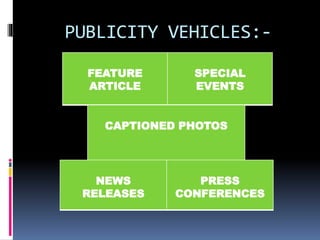
PUBLICITY VEHICLES:-
FEATURE
ARTICLE
SPECIAL
EVENTS
CAPTIONED PHOTOS
NEWS
RELEASES
PRESS
CONFERENCES
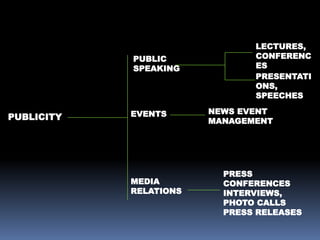
PUBLICITY
PUBLIC
SPEAKING
EVENTS
MEDIA
RELATIONS
LECTURES,
CONFERENC
ES
PRESENTATI
ONS,
SPEECHES
NEWS EVENT
MANAGEMENT
PRESS
CONFERENCES
INTERVIEWS,
PHOTO CALLS
PRESS RELEASES
OUTLINE:-
 GETTING ATTENTION FROM PRESS.
 WRITING A GOOD PRESS RELEASE.
 COMMUNICATINGWITHTHE PRESS.
 BEST PRACTICES.
THE POWER OF PUBLICITY
 Perceived as more credible.
 Often perceived as endorsed by the medium
in which it appears.
 Often has high news value.
 Often generates high frequency of exposure.
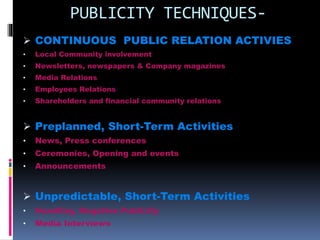
PUBLICITY TECHNIQUES-
 CONTINUOUS PUBLIC RELATION ACTIVIES
• Local Community involvement
• Newsletters, newspapers & Company magazines
• Media Relations
• Employees Relations
• Shareholders and financial community relations
 Preplanned, Short-Term Activities
• News, Press conferences
• Ceremonies, Opening and events
• Announcements
 Unpredictable, Short-Term Activities
• Handling, Negative Publicity
• Media Interviews
GETTING ATTENTION FROM THE
PRESS:
 Creating “Buzz”
 Famous By Association
 Making An Announcement
• Lunch, Investment, Opening Of An Office, Impressive Statistics, New Product
With Hot New Features
 Other Option/ Goodie
• A funny story
• Be Part Of ATrend
• Mystery Or Something Impressive.
ADVANTAGES:-
 It Is Credible
 It Is Cost Effective
 Often Generates High Frequency Of Exposure
DISADVANTAGES:-
 Less Control
 Less accuracy
 Few Releases Published
WRITING A GOOD PRESS RELEASE
 Only For Announcing SomethingTraditional Or
Classic
 Communicating WithThe Press
 Before sending press release
• Know And Select The Right Media & Journalist
• Know How The Journalist Prefer to Receive Info
• Send Email With Catch by/Punch Line and Good Title
Along With Exclusive Information With Some Videos And
Pictures.

project on Publicity process

  • 1.
    School Of Media& Communication studies
  • 2.
    Sub:- Integrated Marketing& Communication TOPIC- PUBLICITY PROCESS SUBMITTED TO- Ms. GARIMA MISHRA SUBMITTED BY – TRIPTY BJMC SEMESTER 3rd CAT 1 Assignment
  • 3.
    PUBLICITY PROCESS  Publicitycomprises non-personal communication by third- party sources regarding an organization’s products. It includes activities to provide newsworthy information to reporting sources like the media to build a favourable image of the organization and its products.  Publicity involves the generation of news about a company, product, service, brand or person in various media. It is a subset of the public relations effort. Key Points Regarding Publicity:-  Publicity is generally short-term focused.  Publicity is not always under the control of the firm.  Publicity can be negative as well as positive.
  • 4.
    Examples Of Publicity:- Sponsorship Someone’sanalysis or prediction A testimonial
  • 5.
    TYPES OF PUBLICITY: Positive Publicity Negative Publicity
  • 8.
    OUTCOMES OF PUBLICITY:-  ATTENTION  VISIBILITY  MARKET SHARE  RECOGNITION  BRANDING
  • 9.
  • 10.
  • 11.
    OUTLINE:-  GETTING ATTENTIONFROM PRESS.  WRITING A GOOD PRESS RELEASE.  COMMUNICATINGWITHTHE PRESS.  BEST PRACTICES.
  • 12.
    THE POWER OFPUBLICITY  Perceived as more credible.  Often perceived as endorsed by the medium in which it appears.  Often has high news value.  Often generates high frequency of exposure.
  • 14.
    PUBLICITY TECHNIQUES-  CONTINUOUSPUBLIC RELATION ACTIVIES • Local Community involvement • Newsletters, newspapers & Company magazines • Media Relations • Employees Relations • Shareholders and financial community relations  Preplanned, Short-Term Activities • News, Press conferences • Ceremonies, Opening and events • Announcements  Unpredictable, Short-Term Activities • Handling, Negative Publicity • Media Interviews
  • 15.
    GETTING ATTENTION FROMTHE PRESS:  Creating “Buzz”  Famous By Association  Making An Announcement • Lunch, Investment, Opening Of An Office, Impressive Statistics, New Product With Hot New Features  Other Option/ Goodie • A funny story • Be Part Of ATrend • Mystery Or Something Impressive.
  • 16.
    ADVANTAGES:-  It IsCredible  It Is Cost Effective  Often Generates High Frequency Of Exposure DISADVANTAGES:-  Less Control  Less accuracy  Few Releases Published
  • 17.
    WRITING A GOODPRESS RELEASE  Only For Announcing SomethingTraditional Or Classic  Communicating WithThe Press  Before sending press release • Know And Select The Right Media & Journalist • Know How The Journalist Prefer to Receive Info • Send Email With Catch by/Punch Line and Good Title Along With Exclusive Information With Some Videos And Pictures.