Public Relations,
Publicity, and Corporate
Advertising
17
McGraw-Hill/Irwin Copyright © 2009 by The McGraw-Hill Companies, Inc. All rights reserved.
Aqua Teen Hunger Force
Guerilla Marketing
Guerilla Marketing
Guerilla Marketing
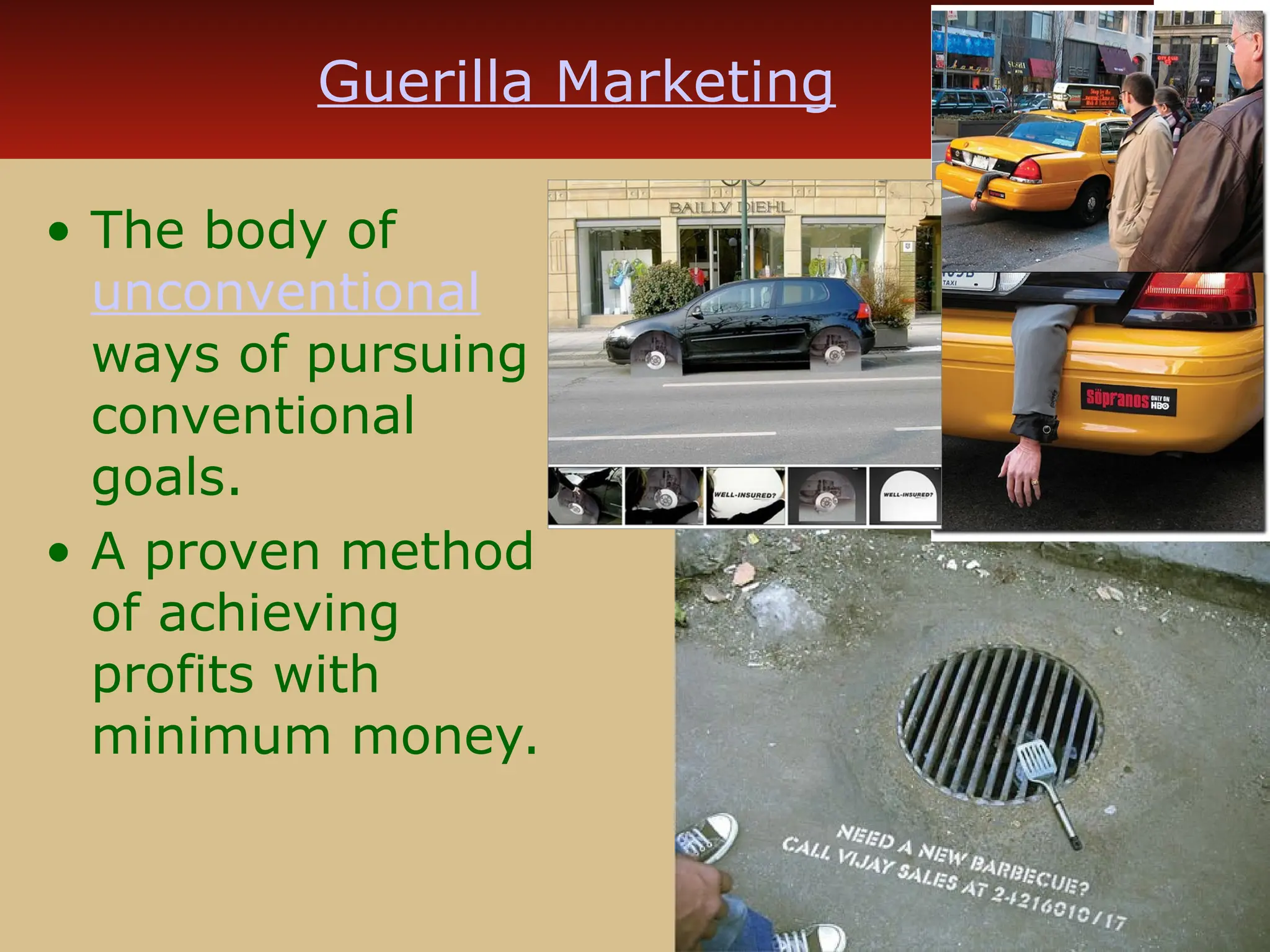
• The body of
unconventional
ways of pursuing
conventional
goals.
• A proven method
of achieving
profits with
minimum money.
Guerilla Marketing Gone Apes
• To promote the new Aqua Teen Hunger
Force Movie, Turner Broadcasting Network
teamed up with Guerilla Interference Inc.
• The Goal: Deploy 400 LED “LiteBright”
displays within 10 major cities.
• Part of the marketing plan was to promote
The Cartoon Network’s eccentric, nighttime,
college-crowd brand of programming Adult
Swim.
Guerilla Marketing Gone Apes
• Some of Boston’s residents mistook the
devices for explosives and contacted
authorities.
• The city quickly reacted and shut down all
major public transportation and spent
$500,000 deploying police and bomb
sniffing dogs.
• Turner Broadcasting was fined $1,000,000
from the city of Boston and also paid
$1,000,000 to “goodwill” funds to homeland
security.
Results
• In the days since the event:
– Made national televised news
– The average number of American households
who viewed Aqua Teen Hunger Force rose 5%,
to 1,082,500, from the previous week of
1,030,500 viewers.
– T-shirts were instantly available for sale
portraying the controversial characters.
– Web site spiked 105.2%, to 790,000 from
385,000 one week before.
– Total US Gross: $5,520,368
– US DVD Sales: $11,084,232
– Movie Budget: $750,000
Ethical Breach?
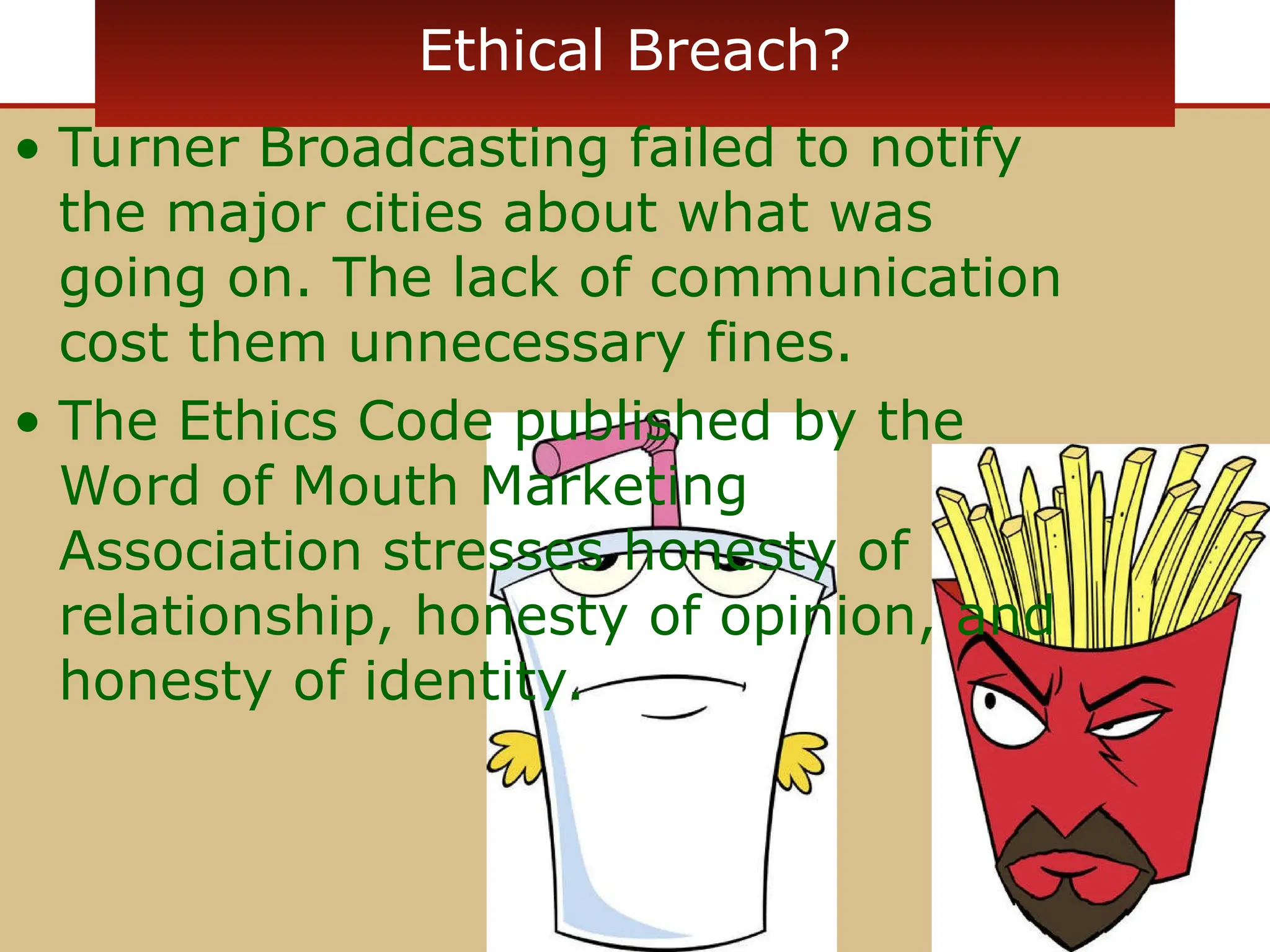
• Turner Broadcasting failed to notify
the major cities about what was
going on. The lack of communication
cost them unnecessary fines.
• The Ethics Code published by the
Word of Mouth Marketing
Association stresses honesty of
relationship, honesty of opinion, and
honesty of identity.
Sources:
• http://www.businessweek.com/innovate/
http://www.businessweek.com/innovate/
content/feb2007/id20070209_934852_page_2.htm
• http://youtube.com/watch?v=9yigQGKaf2A
http://youtube.com/watch?v=9yigQGKaf2A
• www.Google.com
www.Google.com
Public Relations Defined
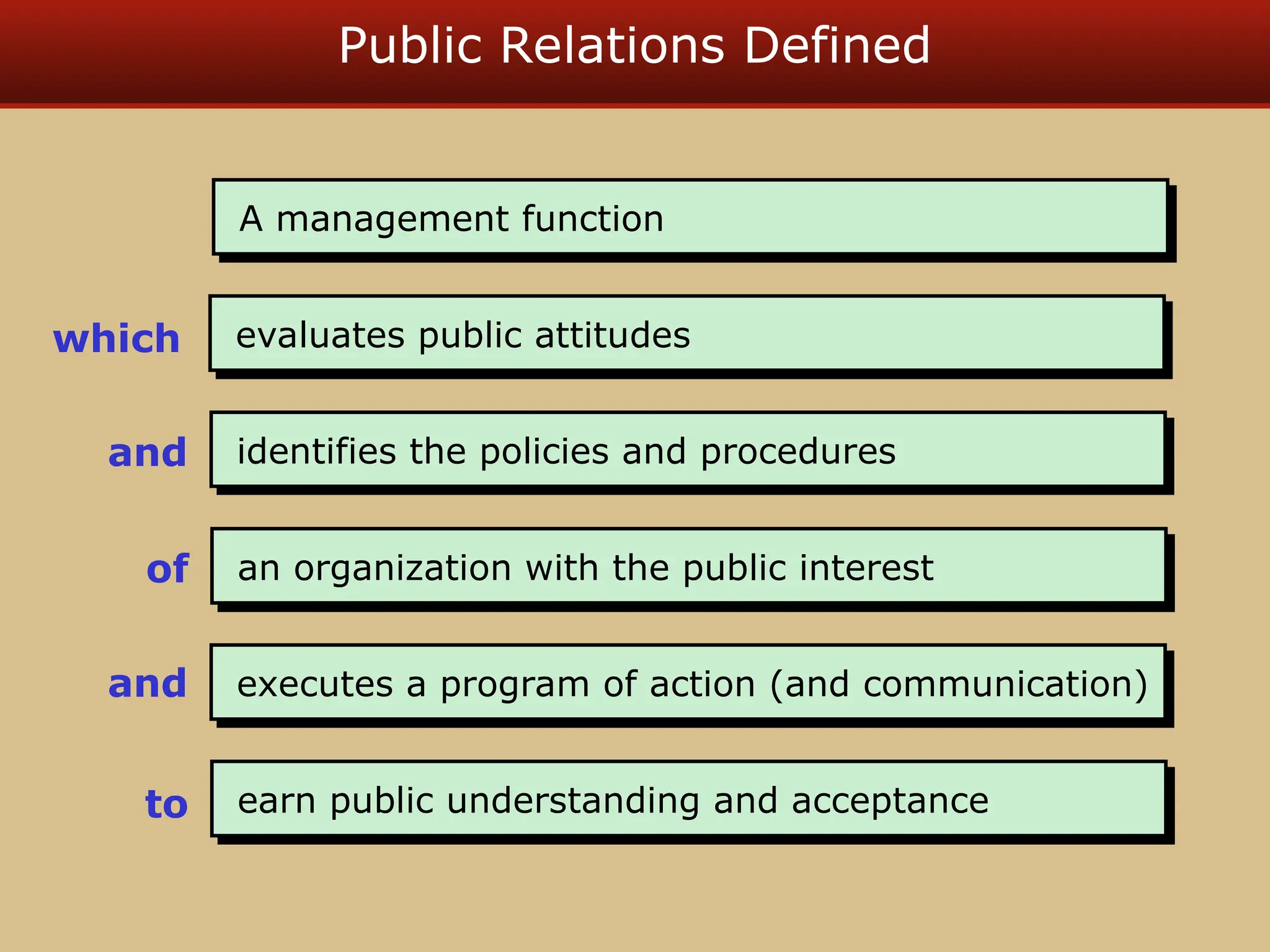
A management function
evaluates public attitudes
which
identifies the policies and procedures
and
an organization with the public interest
of
executes a program of action (and communication)
and
earn public understanding and acceptance
to
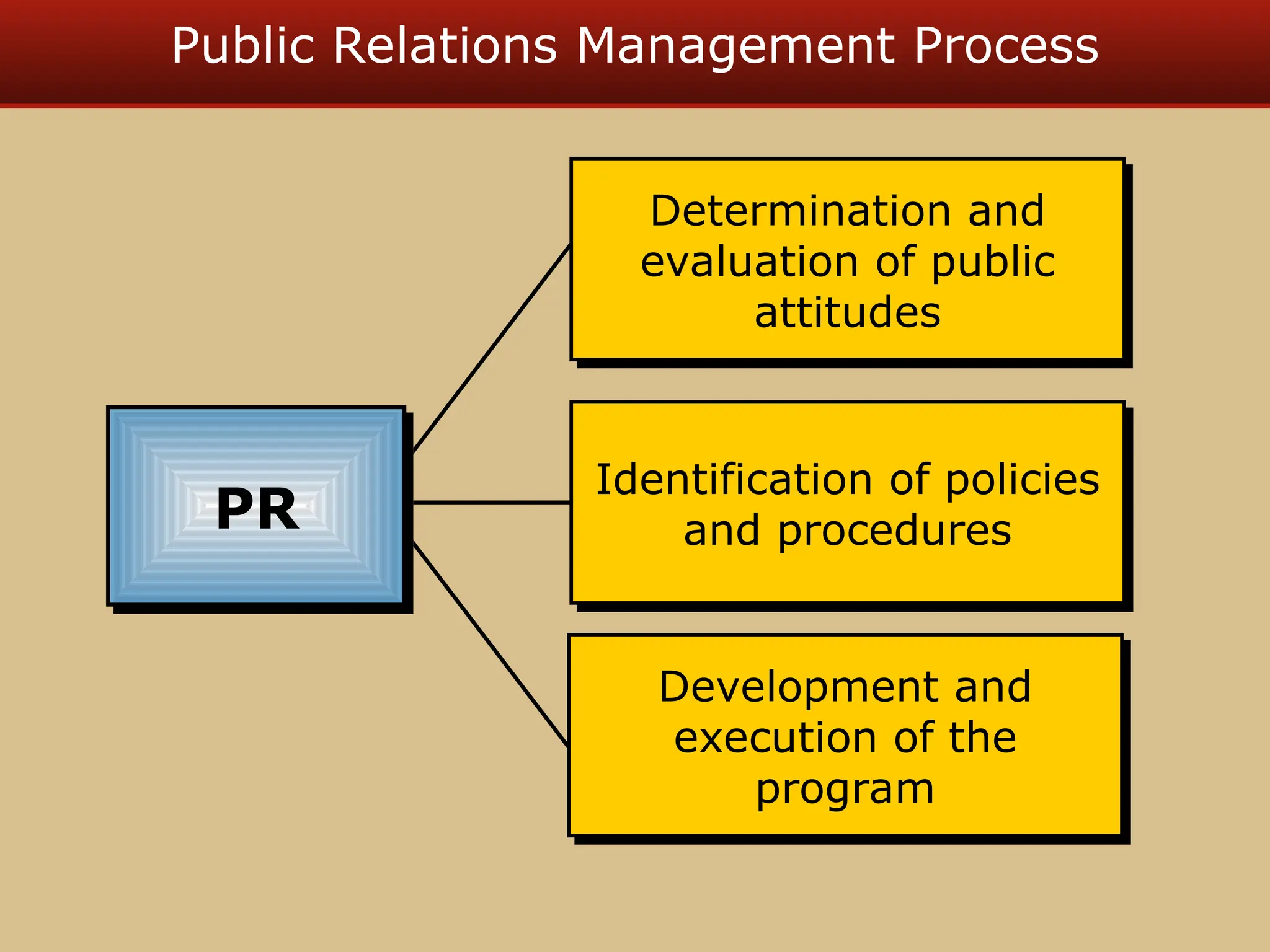
Public Relations Management Process
Identification of policies
and procedures
Determination and
evaluation of public
attitudes
Development and
execution of the
program
PR
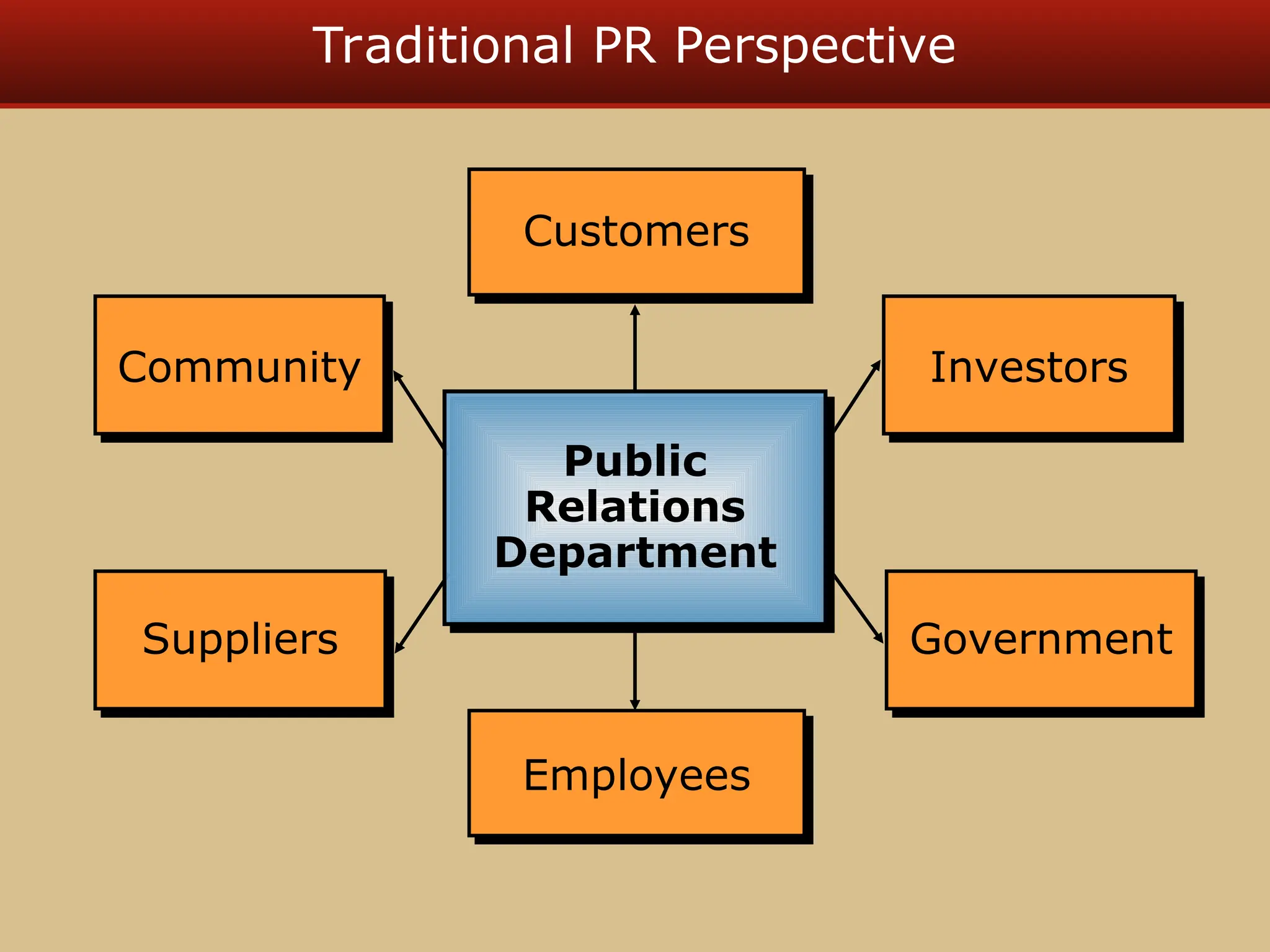
Traditional PR Perspective
Customers
Employees
Investors
Government
Community
Suppliers
Public
Relations
Department
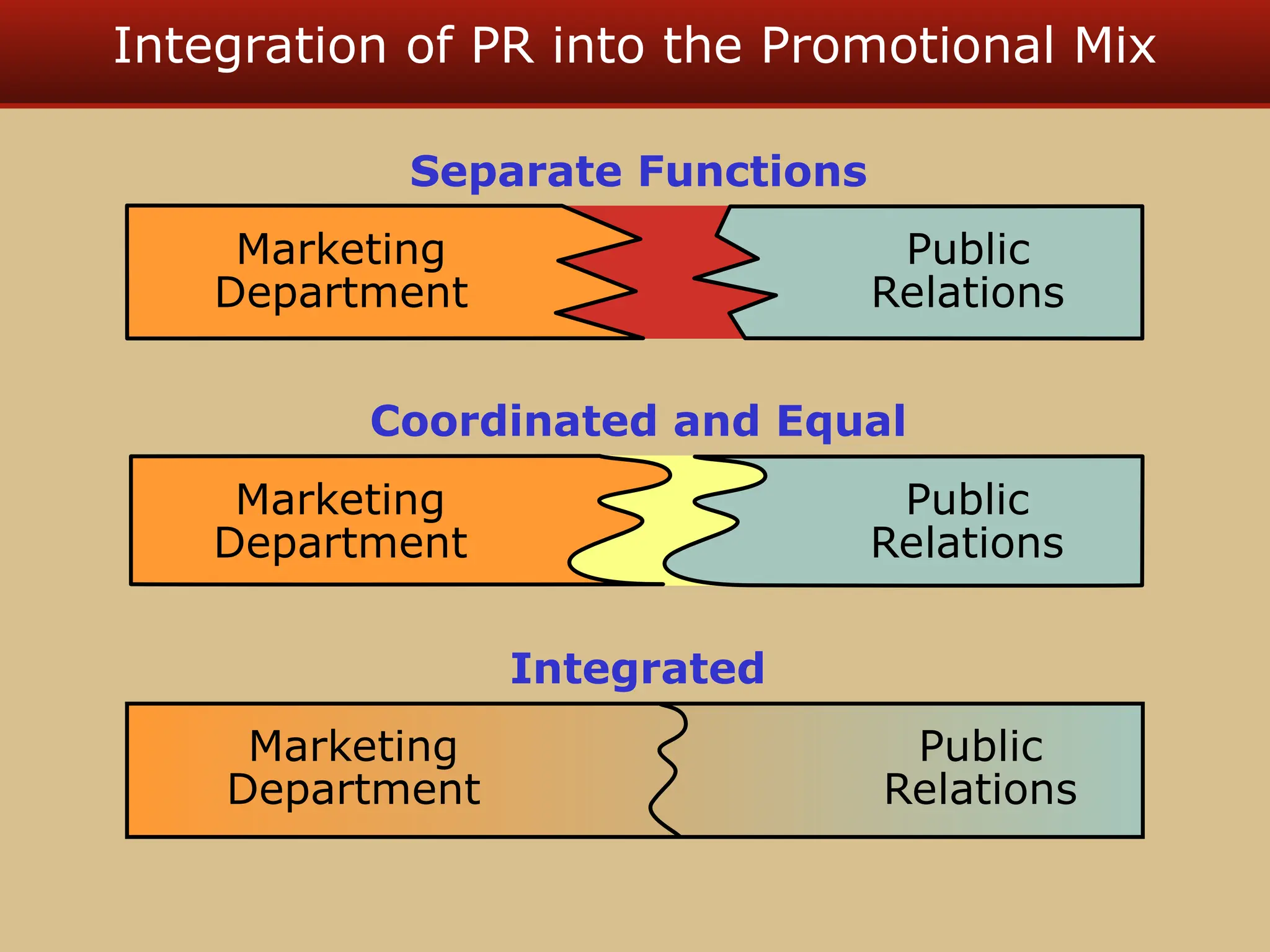
Integration of PR into the Promotional Mix
Marketing
Department
Public
Relations
Separate Functions
Marketing
Department
Public
Relations
Coordinated and Equal
Marketing
Department
Public
Relations
Integrated
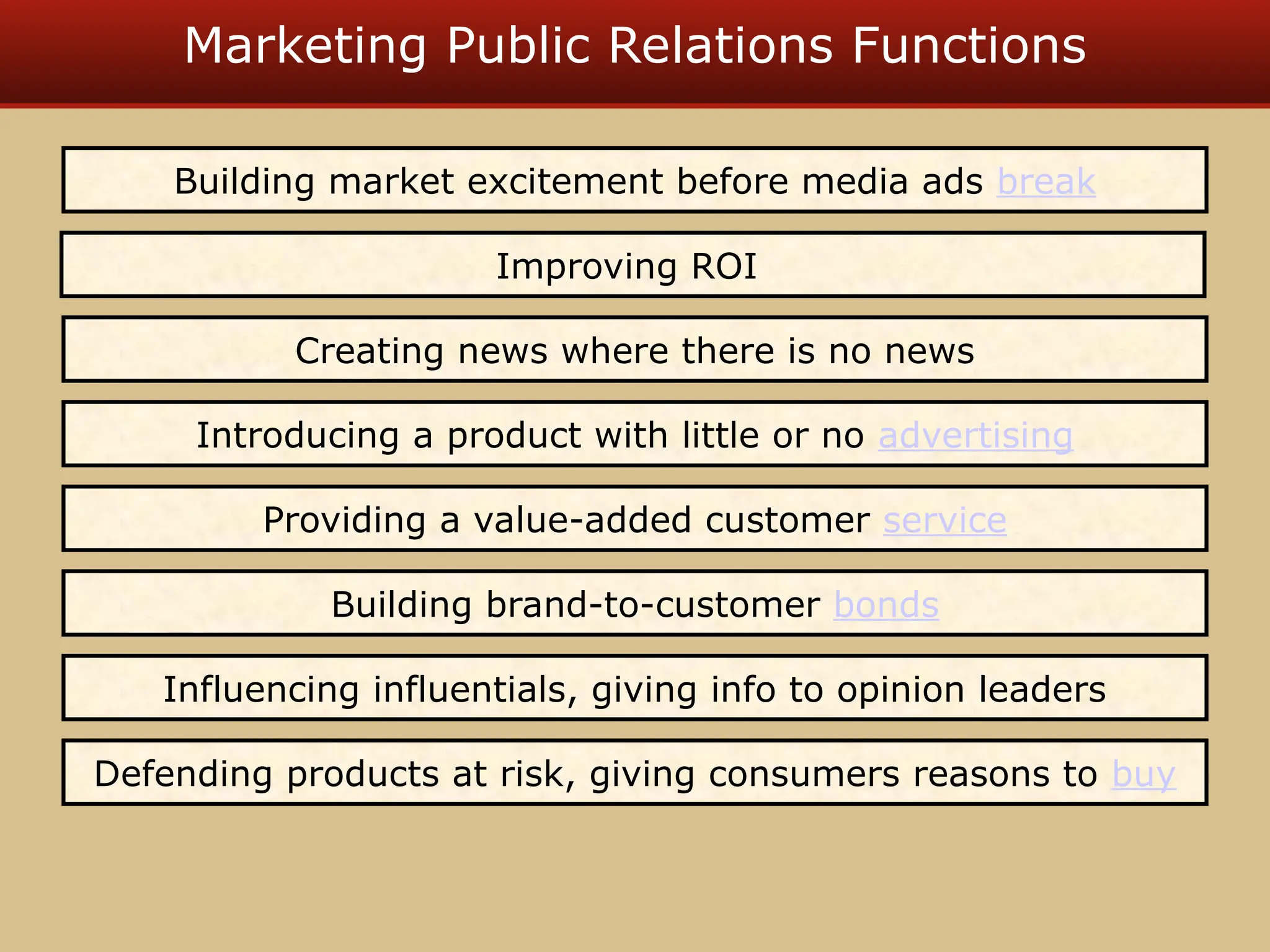
Marketing Public Relations Functions
Building market excitement before media ads break
Creating news where there is no news
Introducing a product with little or no advertising
Providing a value-added customer service
Building brand-to-customer bonds
Influencing influentials, giving info to opinion leaders
Improving ROI
Defending products at risk, giving consumers reasons to buy
MPR in Practice
Benefits of MPR
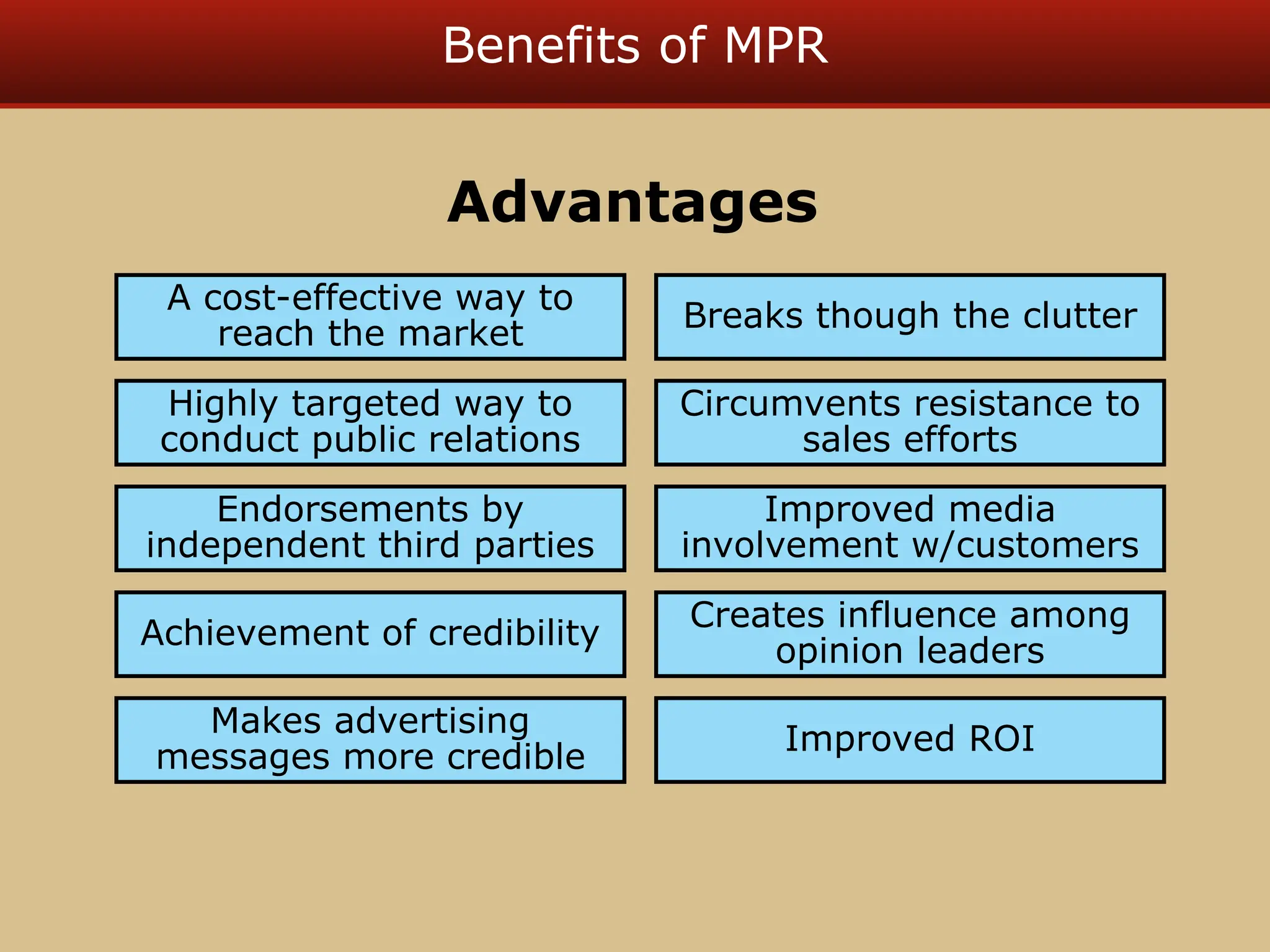
A cost-effective way to
reach the market
Highly targeted way to
conduct public relations
Endorsements by
independent third parties
Achievement of credibility
Makes advertising
messages more credible
Breaks though the clutter
Circumvents resistance to
sales efforts
Advantages
Improved ROI
Creates influence among
opinion leaders
Improved media
involvement w/customers
Benefits of MPR
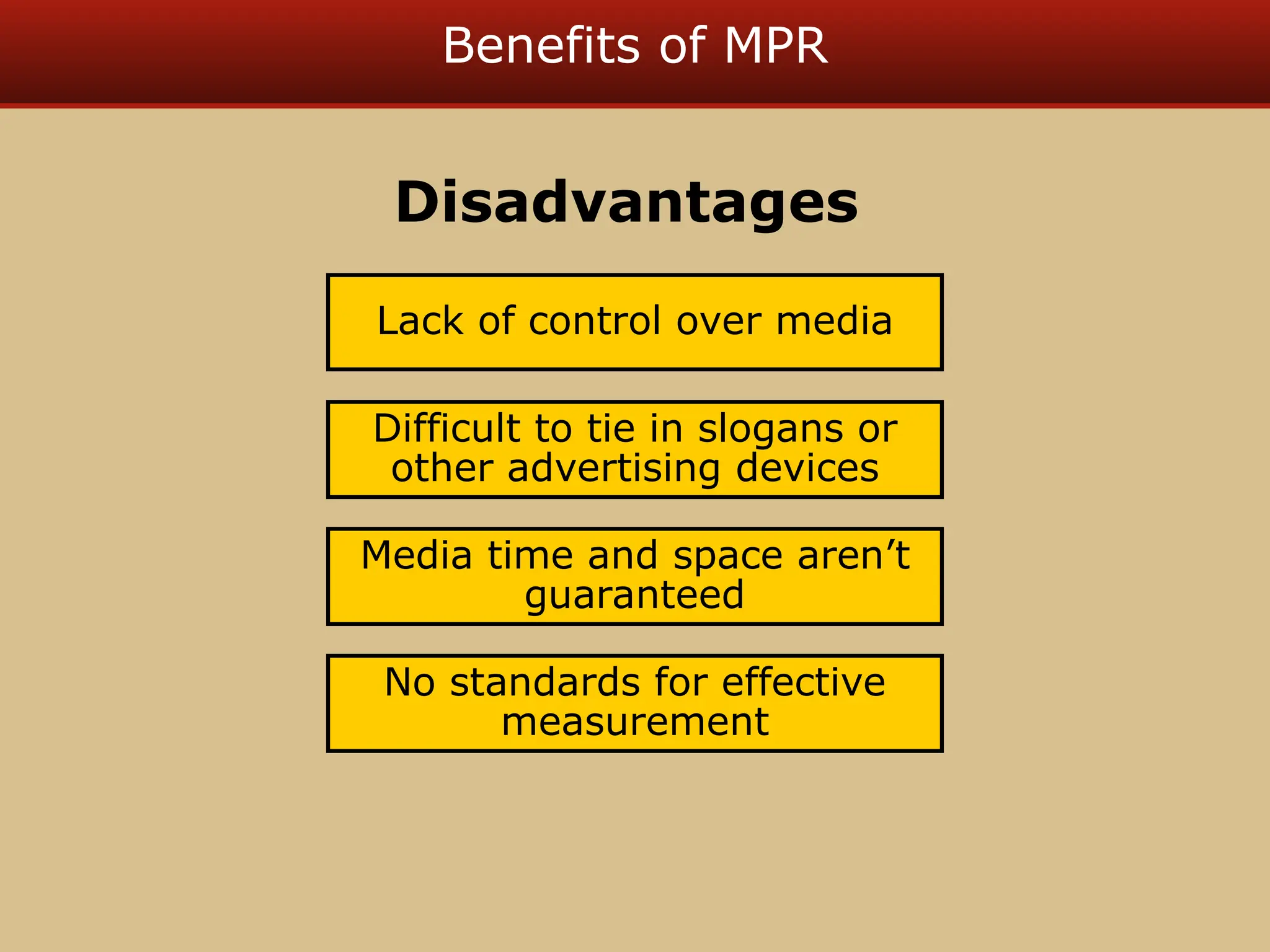
Difficult to tie in slogans or
other advertising devices
No standards for effective
measurement
Lack of control over media
Media time and space aren’t
guaranteed
Disadvantages
The Process of Public Relations
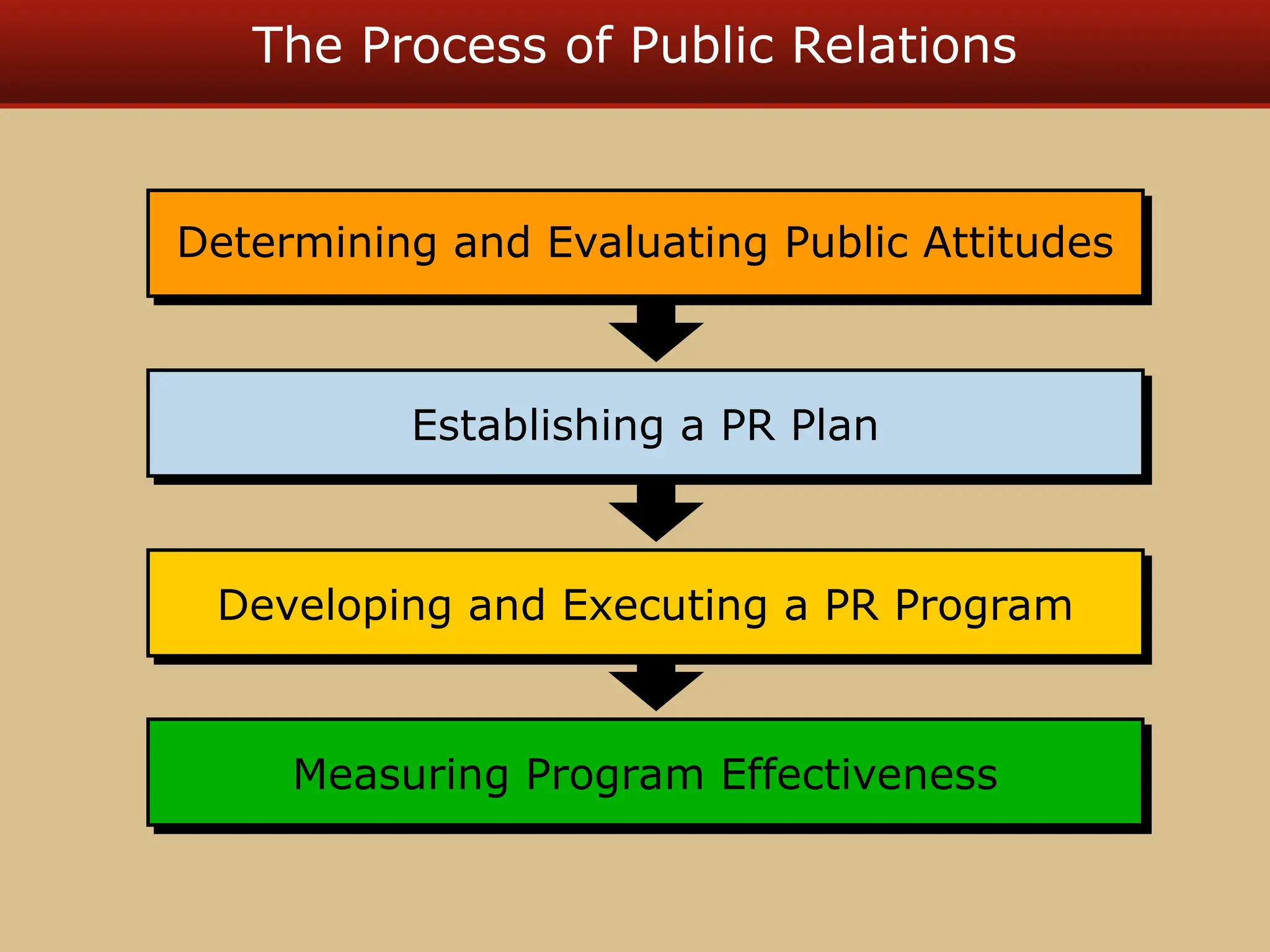
Measuring Program Effectiveness
Developing and Executing a PR Program
Establishing a PR Plan
Determining and Evaluating Public Attitudes
Test Your Knowledge
In public relations targeting, external audiences
include:
A) Customers
B) The public at large
C) Suppliers
D) Stockholders
E) All of the above
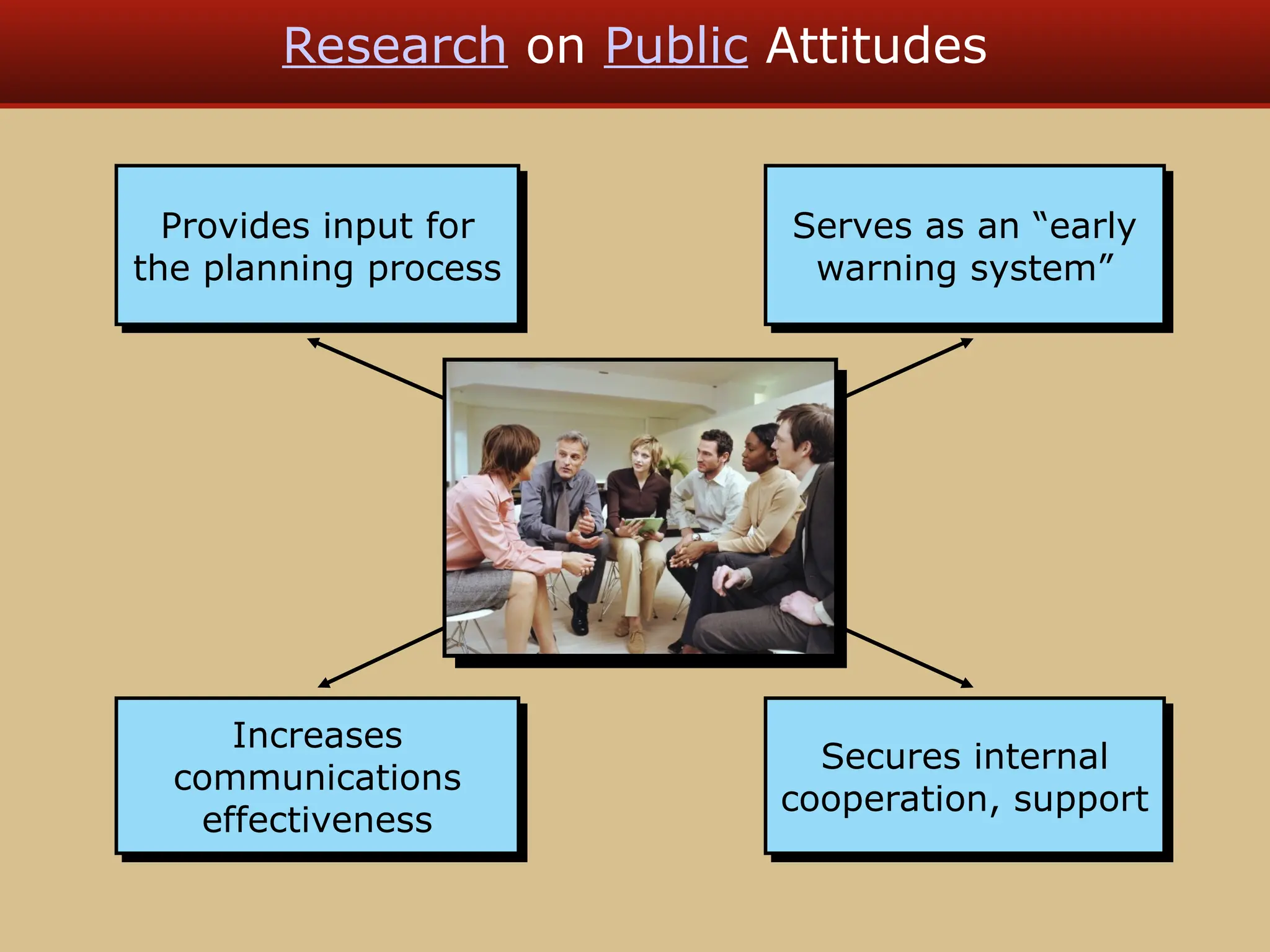
Research on Public Attitudes
Provides input for
the planning process
Serves as an “early
warning system”
Secures internal
cooperation, support
Increases
communications
effectiveness
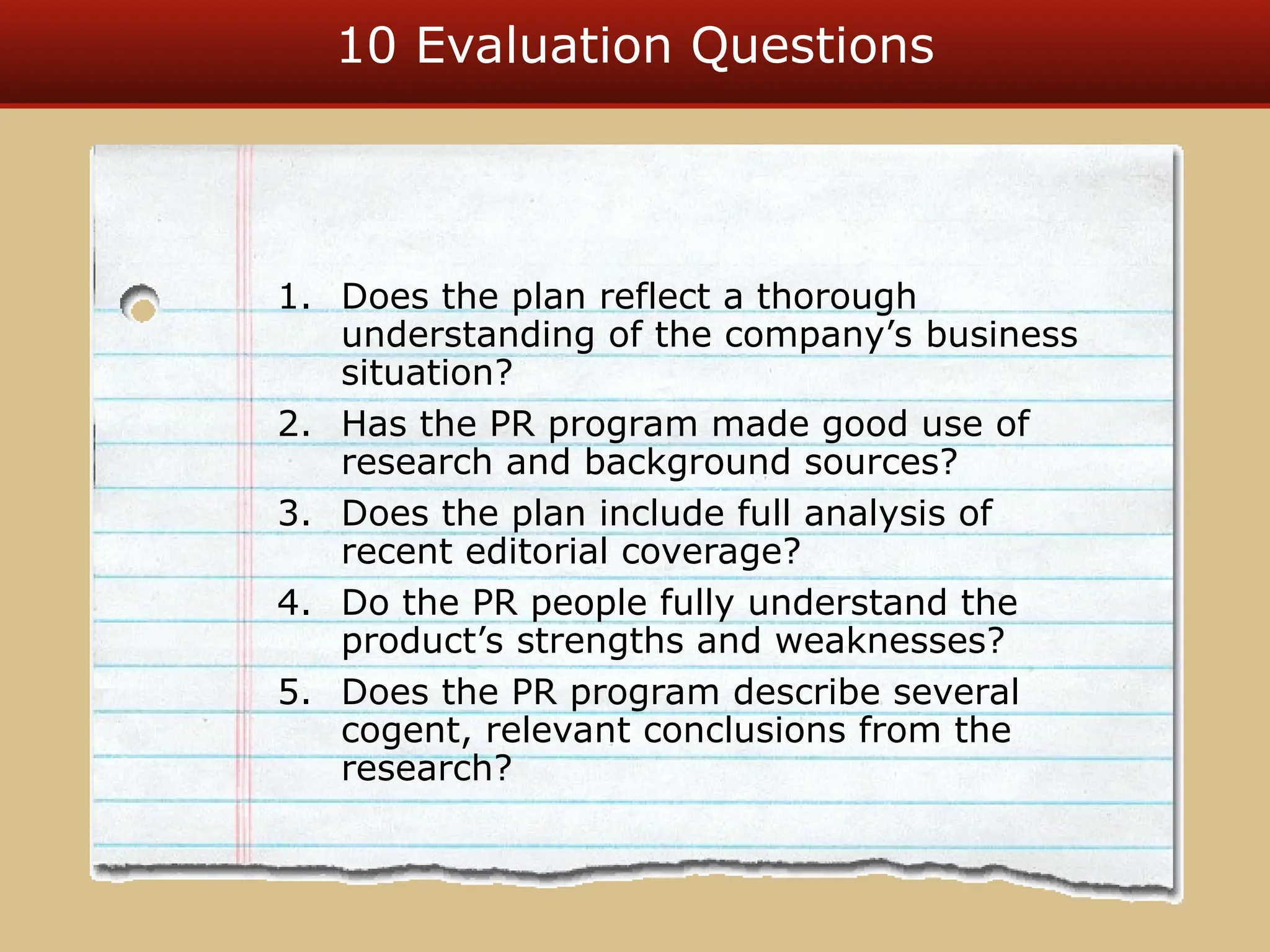
10 Evaluation Questions
1. Does the plan reflect a thorough
understanding of the company’s business
situation?
2. Has the PR program made good use of
research and background sources?
3. Does the plan include full analysis of
recent editorial coverage?
4. Do the PR people fully understand the
product’s strengths and weaknesses?
5. Does the PR program describe several
cogent, relevant conclusions from the
research?
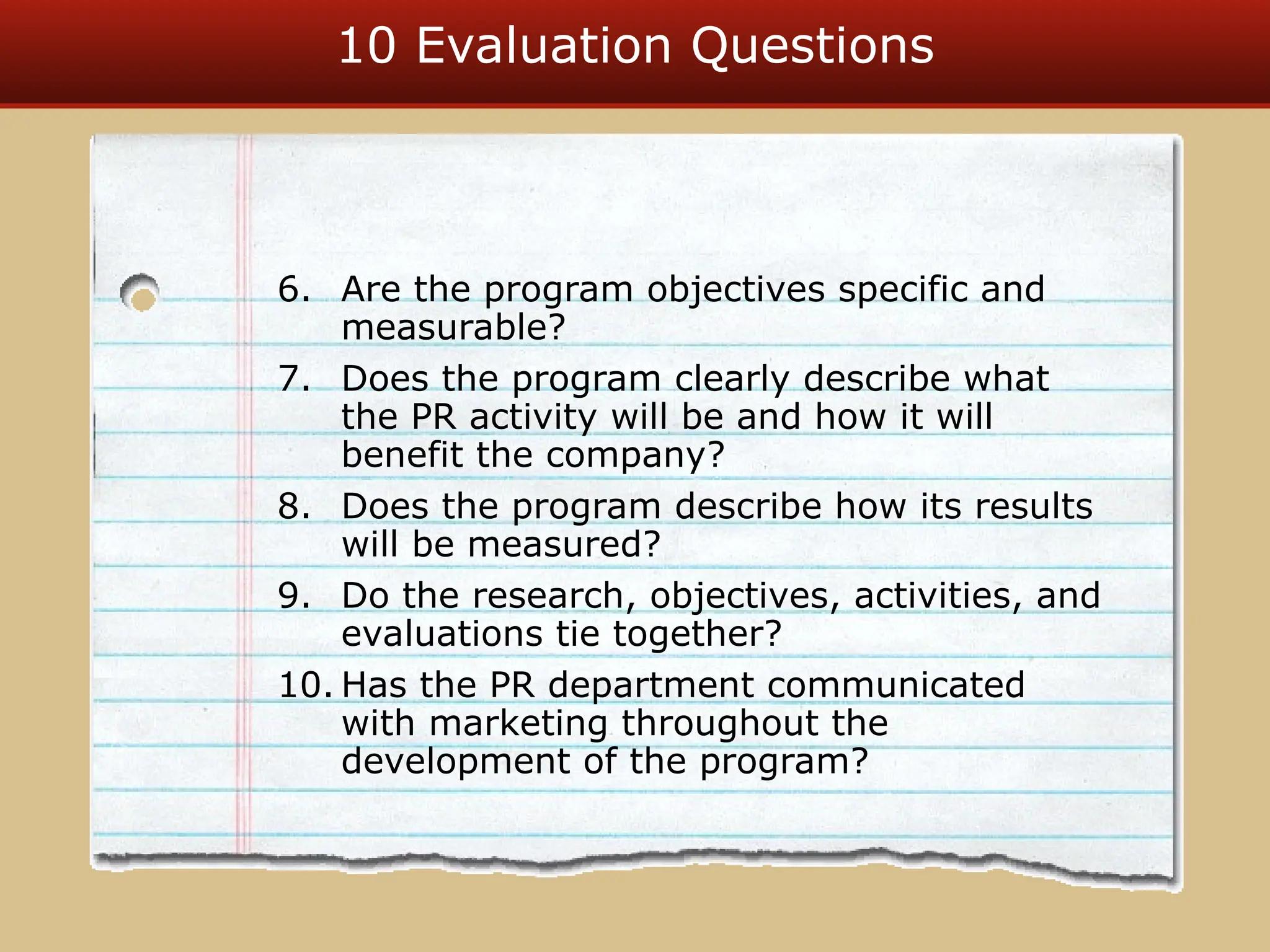
10 Evaluation Questions
6. Are the program objectives specific and
measurable?
7. Does the program clearly describe what
the PR activity will be and how it will
benefit the company?
8. Does the program describe how its results
will be measured?
9. Do the research, objectives, activities, and
evaluations tie together?
10. Has the PR department communicated
with marketing throughout the
development of the program?
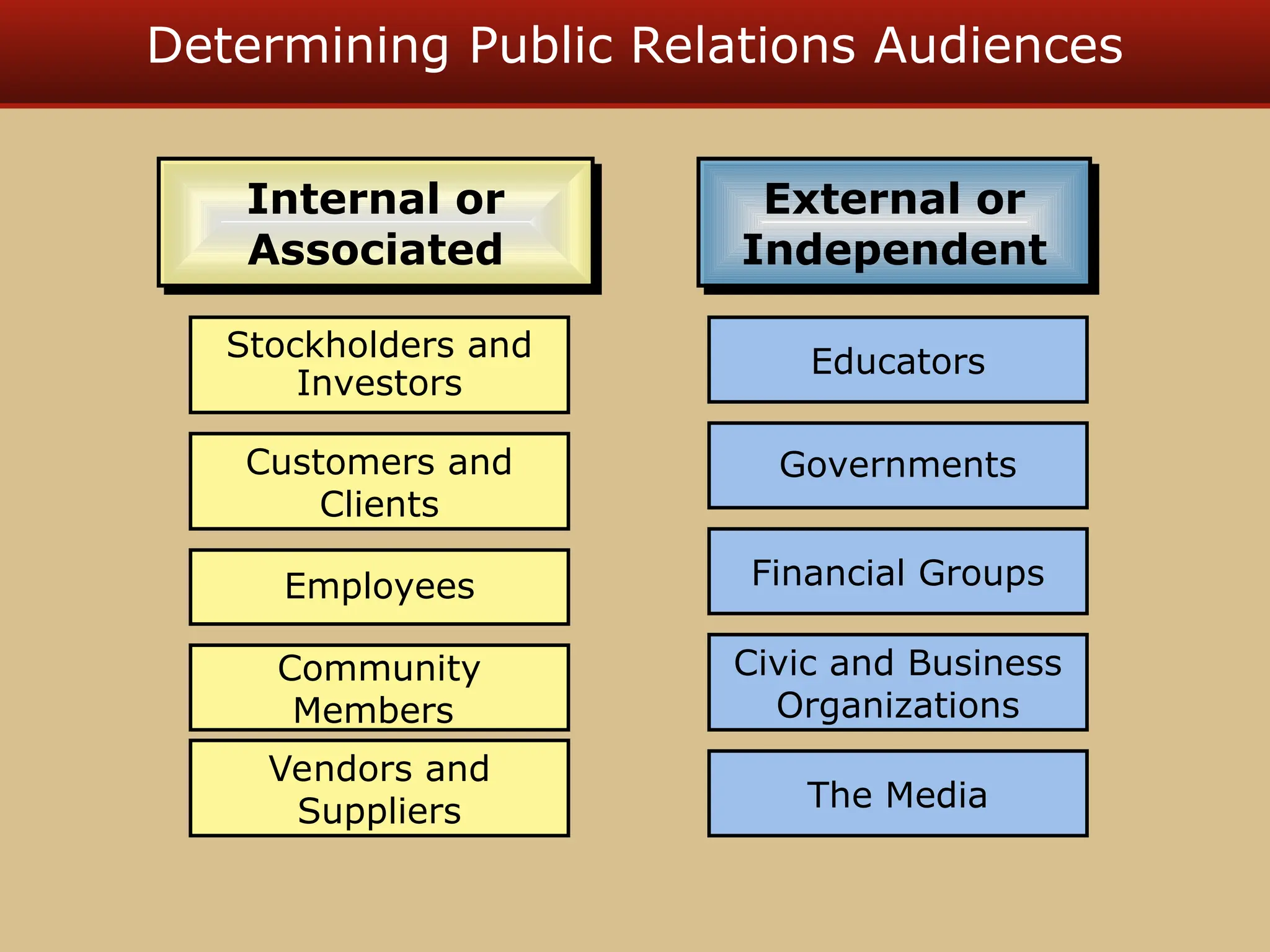
Determining Public Relations Audiences
Customers and
Clients
Employees
Vendors and
Suppliers
Community
Members
Stockholders and
Investors
Internal or
Associated
The Media
Governments
Financial Groups
External or
Independent
Educators
Civic and Business
Organizations
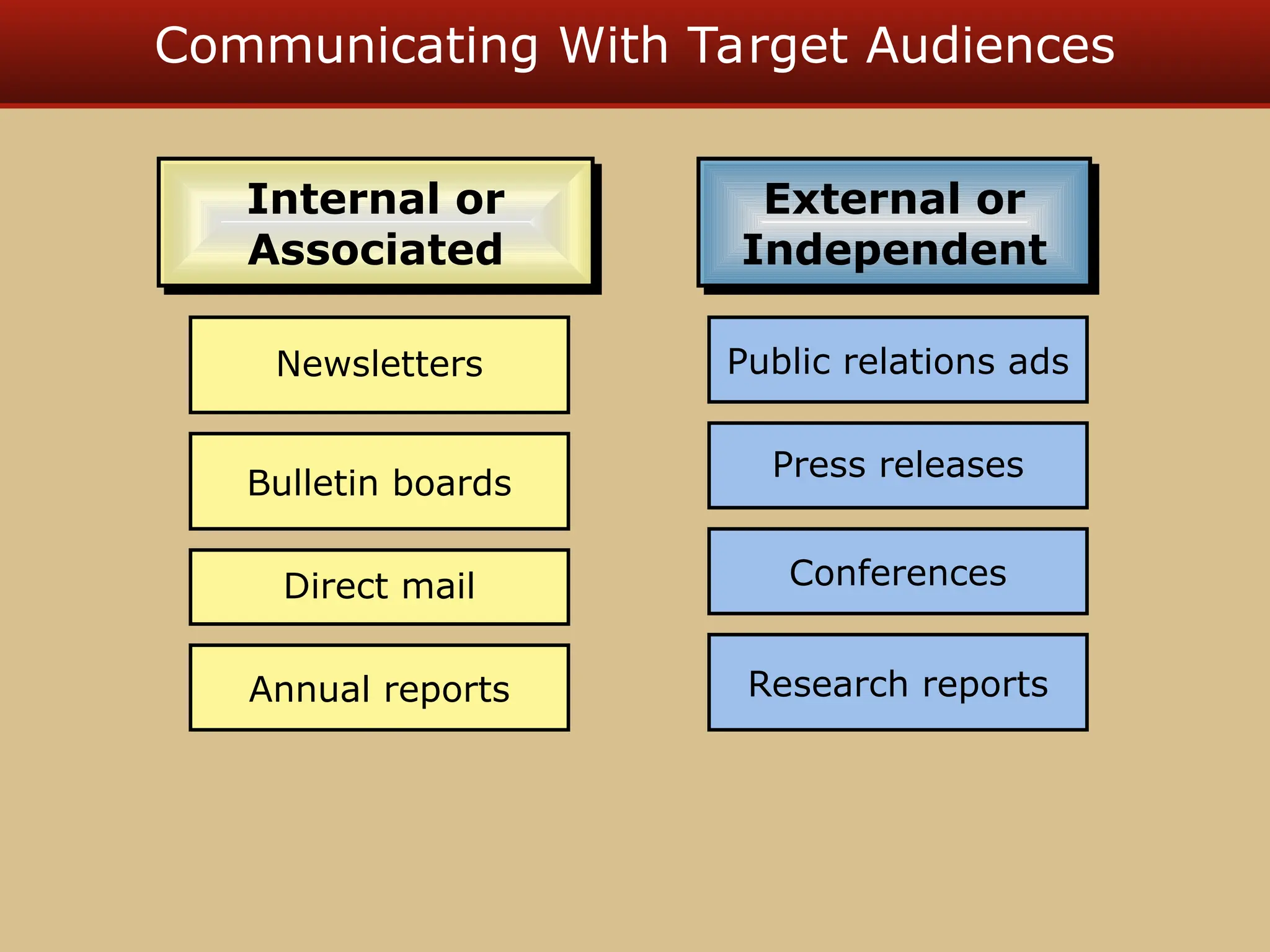
Communicating With Target Audiences
Bulletin boards
Direct mail
Annual reports
Newsletters
Internal or
Associated
Press releases
Conferences
External or
Independent
Public relations ads
Research reports
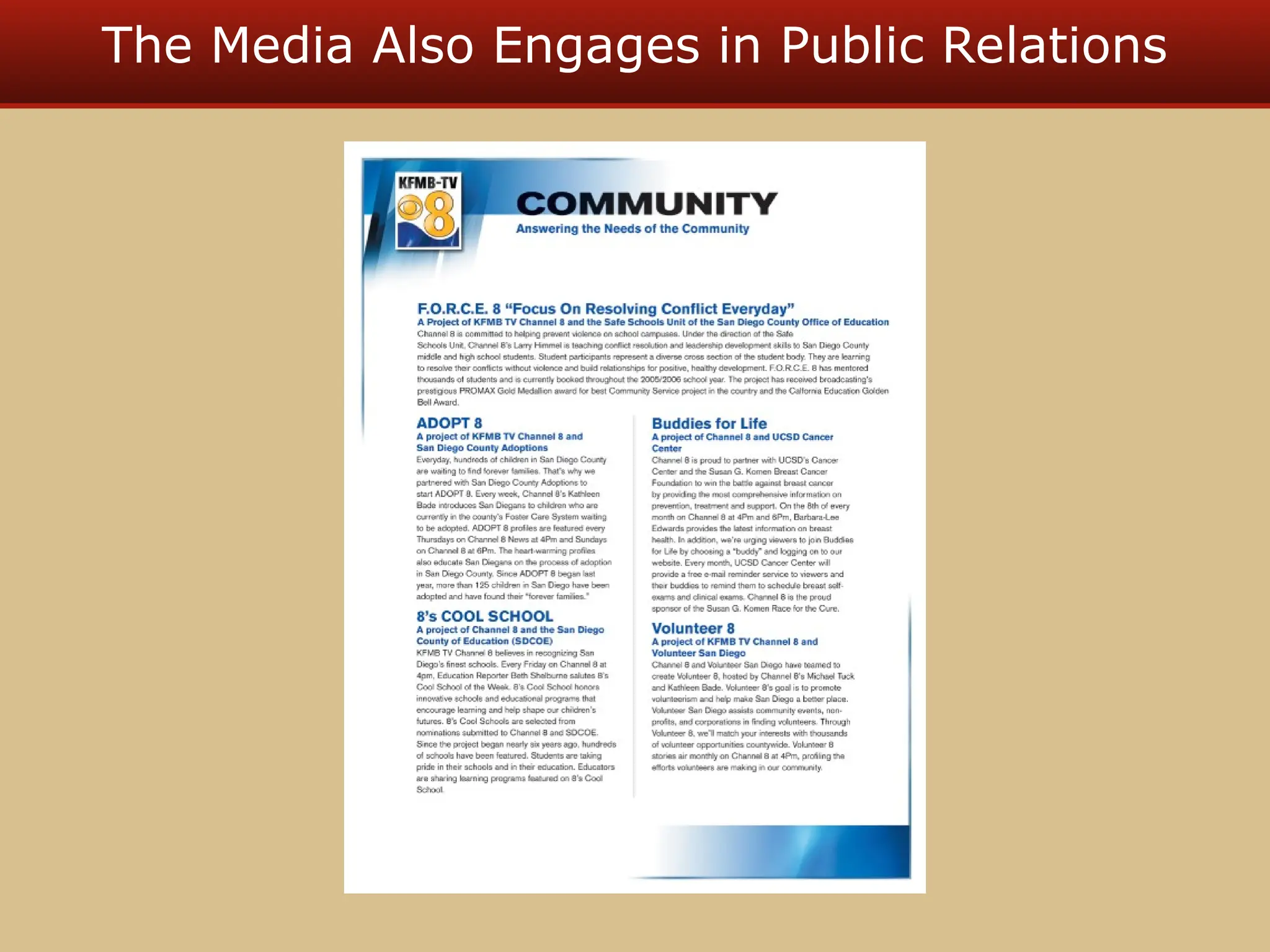
The Media Also Engages in Public Relations
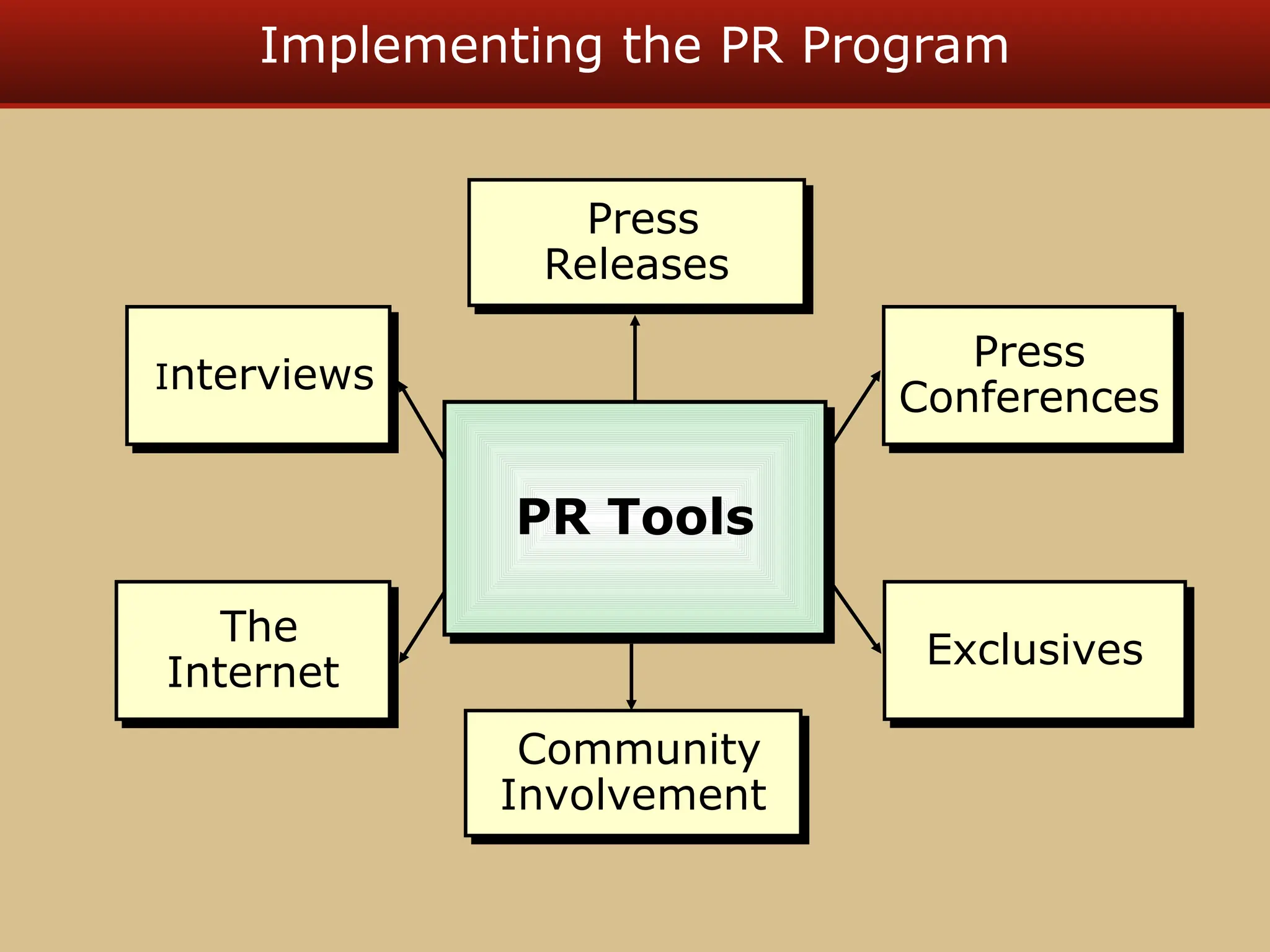
Implementing the PR Program
Press
Releases
Community
Involvement
Press
Conferences
Exclusives
Interviews
The
Internet
PR Tools
Special Olympics Torch Run
*Click outside of the video screen to advance to the next slide
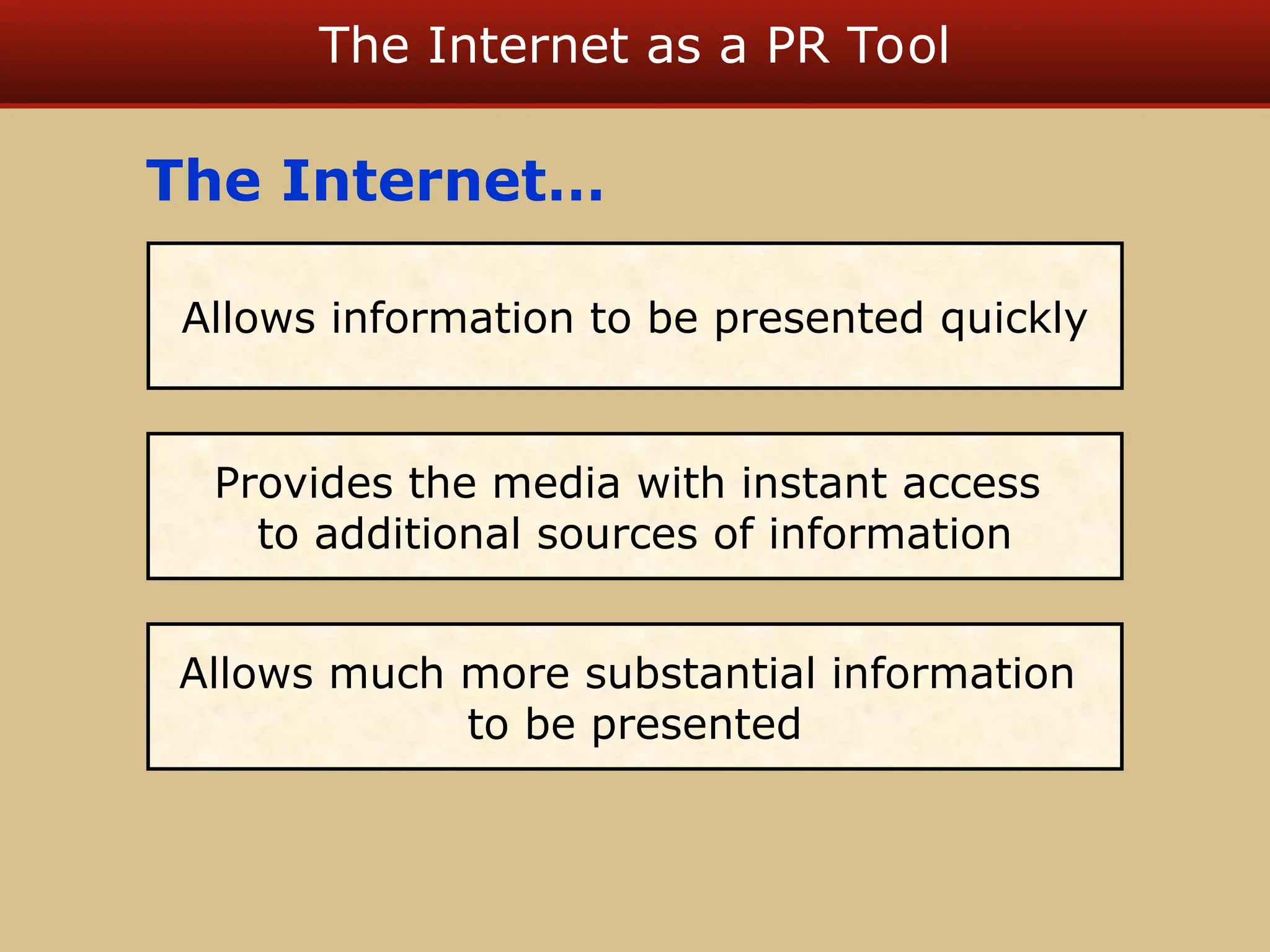
The Internet as a PR Tool
Allows much more substantial information
to be presented
Provides the media with instant access
to additional sources of information
Allows information to be presented quickly
The Internet…
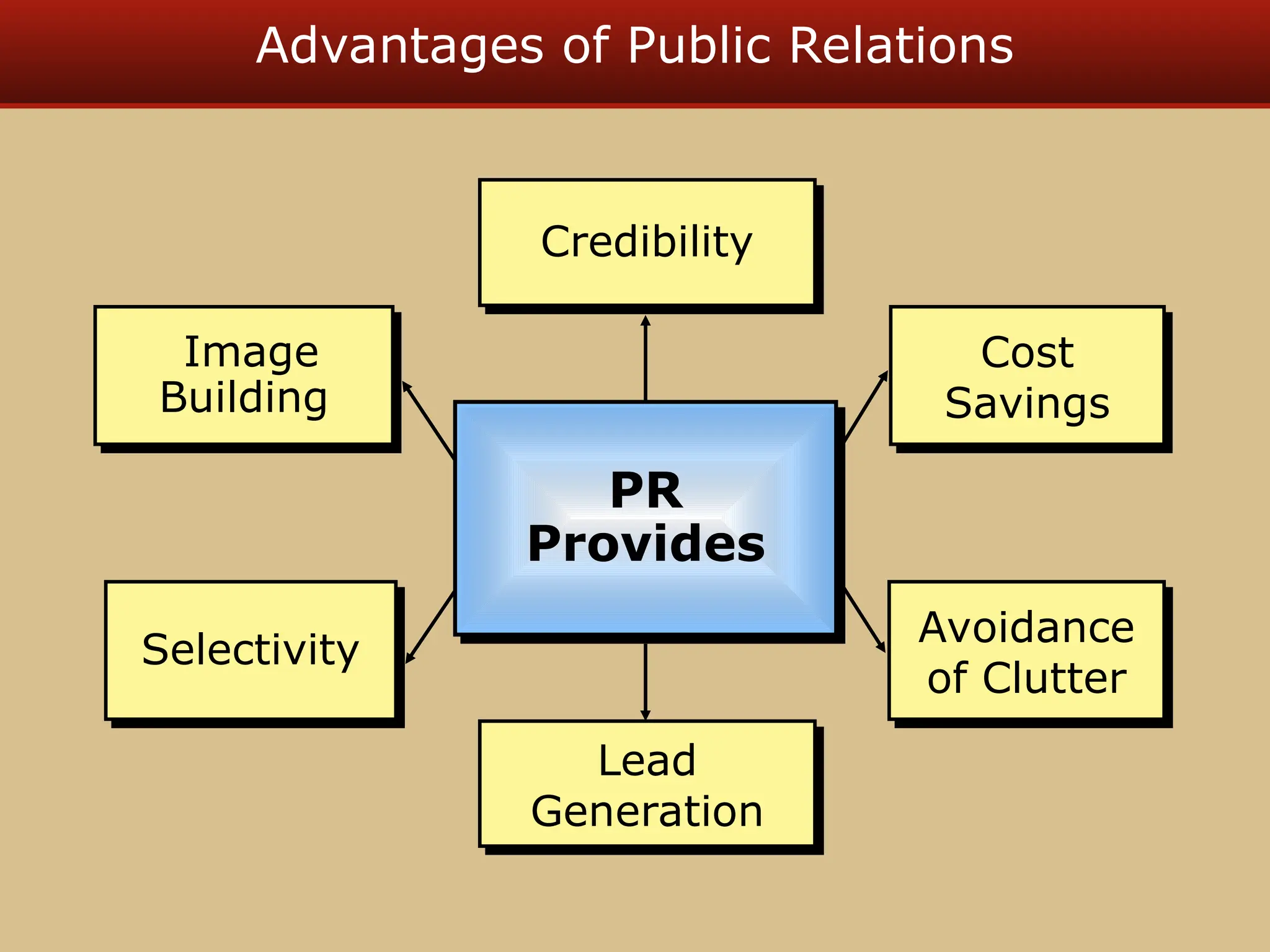
Advantages of Public Relations
Credibility
Lead
Generation
Cost
Savings
Avoidance
of Clutter
Image
Building
Selectivity
PR
Provides
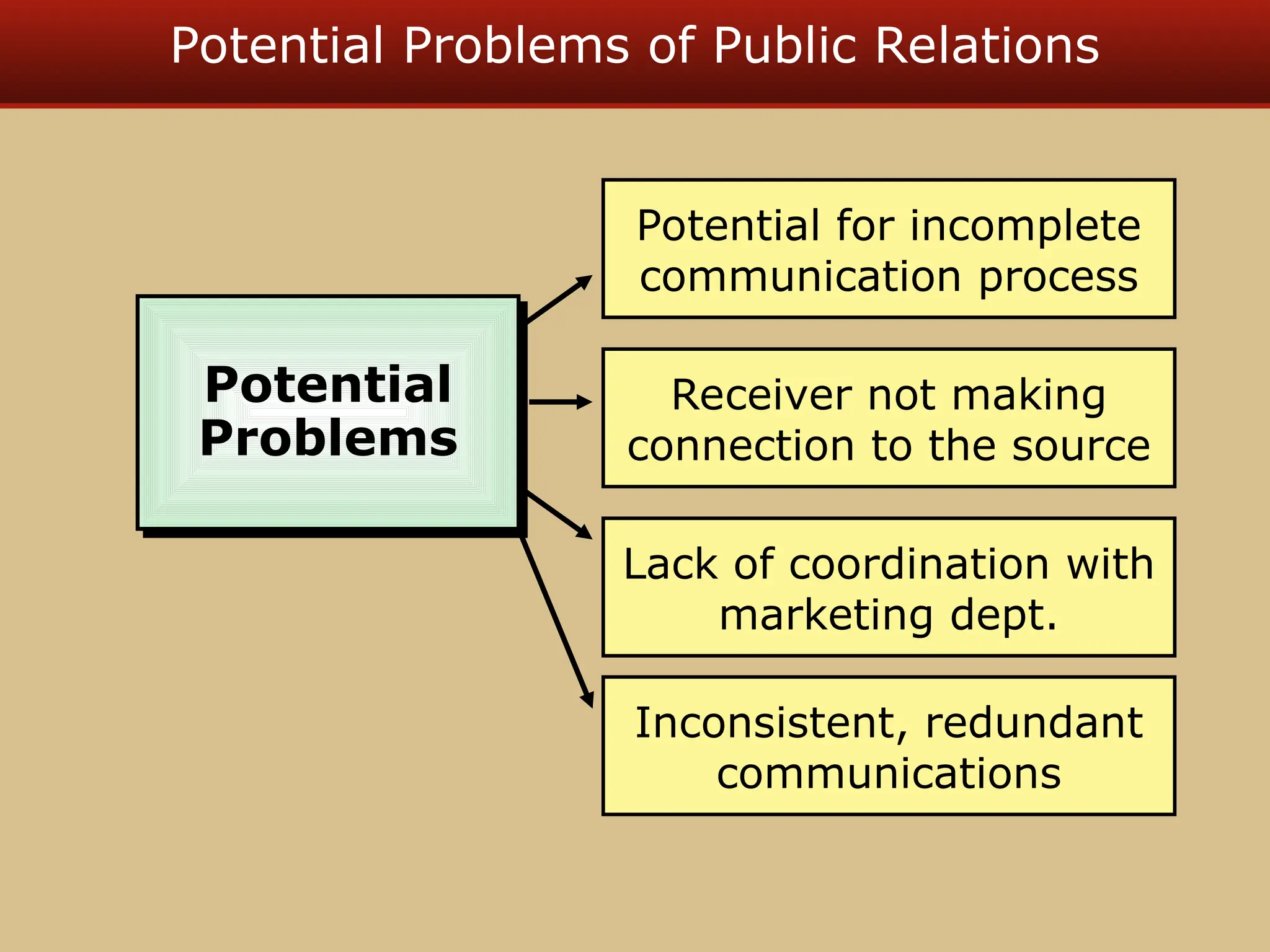
Potential Problems of Public Relations
Potential
Problems
Potential for incomplete
communication process
Receiver not making
connection to the source
Lack of coordination with
marketing dept.
Inconsistent, redundant
communications
Test Your Knowledge
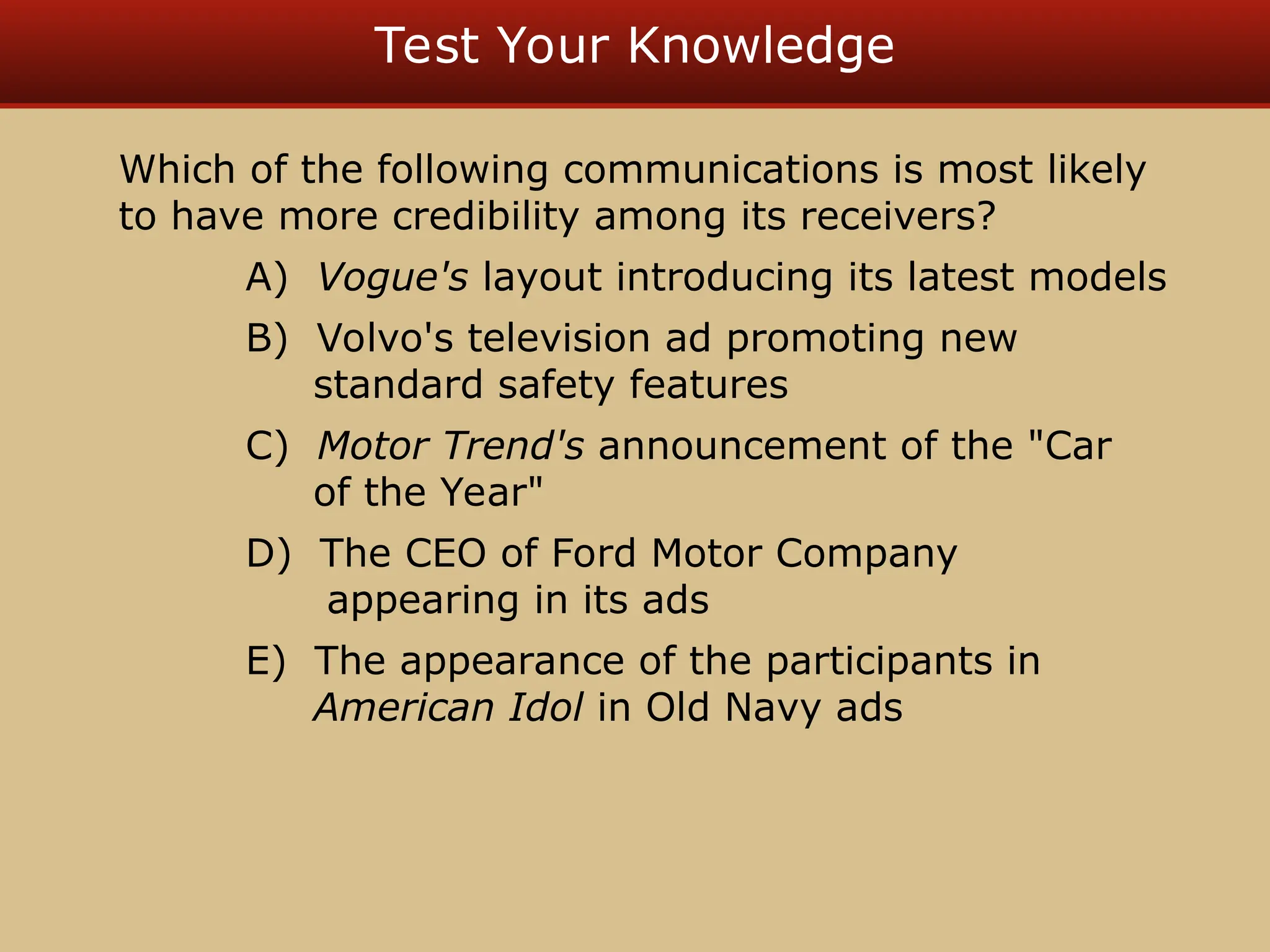
Which of the following communications is most likely
to have more credibility among its receivers?
A) Vogue's layout introducing its latest models
B) Volvo's television ad promoting new
standard safety features
C) Motor Trend's announcement of the "Car
of the Year"
D) The CEO of Ford Motor Company
appearing in its ads
E) The appearance of the participants in
American Idol in Old Navy ads
General Mills Capitalizes on Publicity
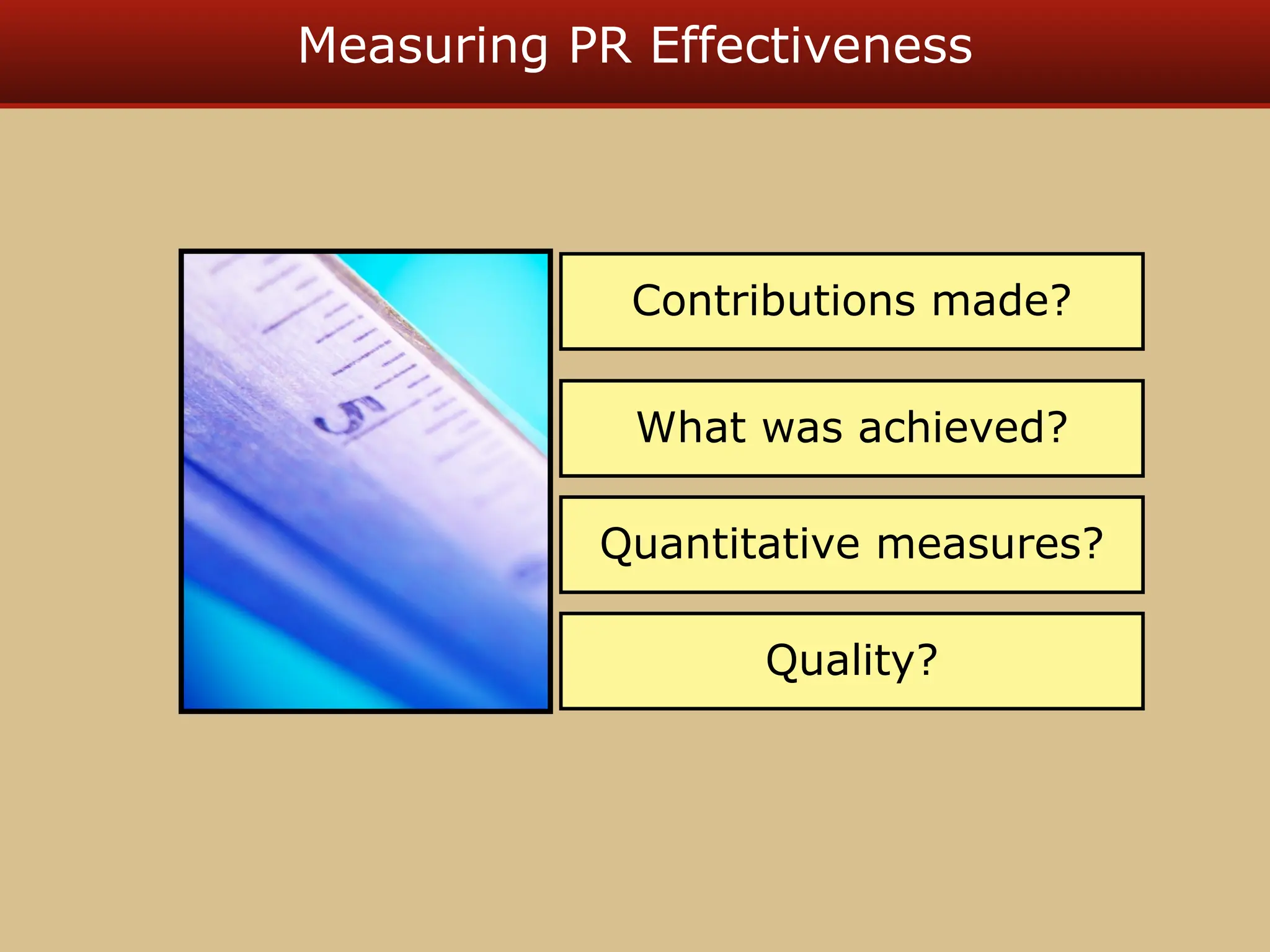
Measuring PR Effectiveness
Contributions made?
What was achieved?
Quantitative measures?
Quality?
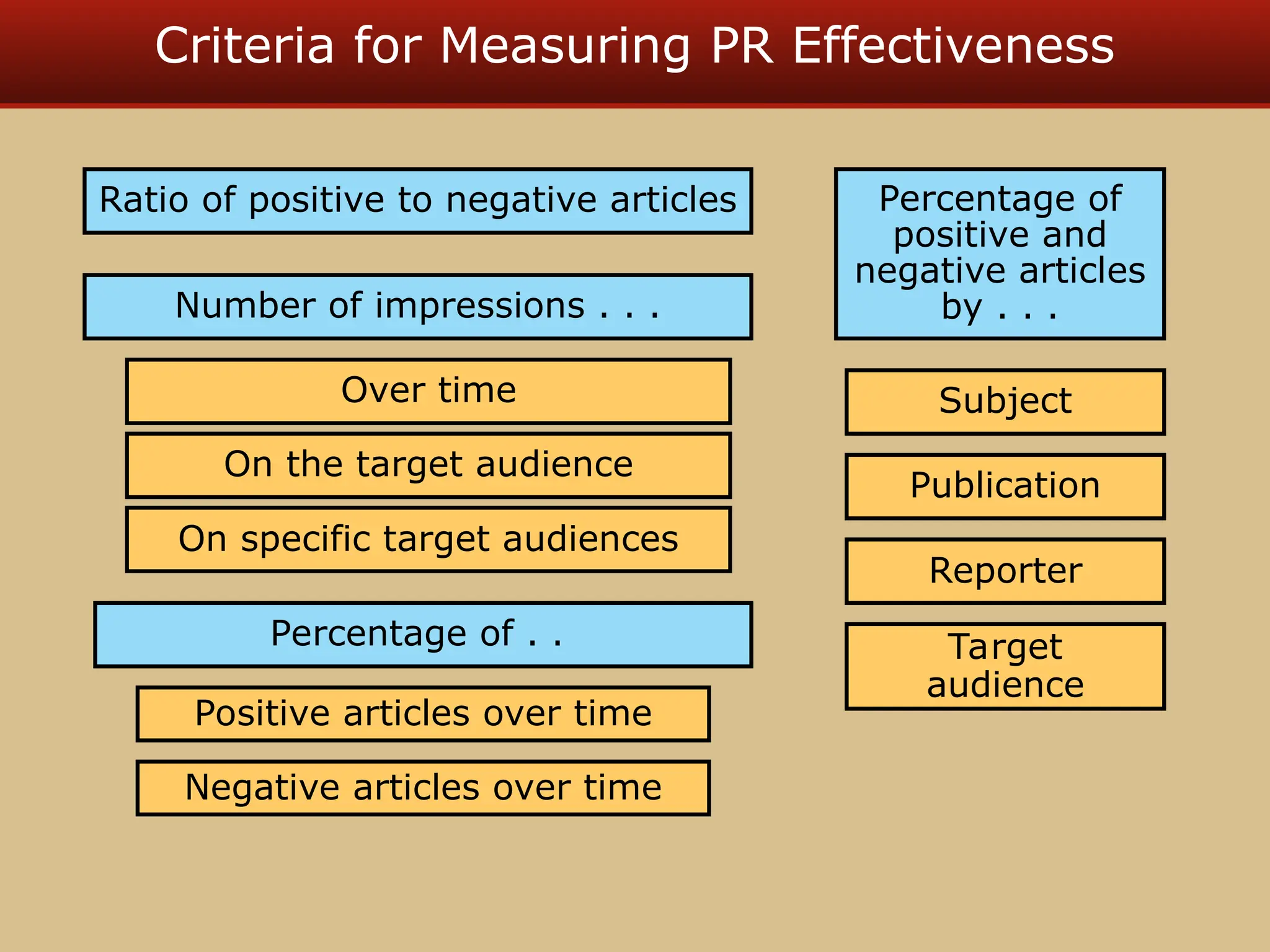
Criteria for Measuring PR Effectiveness
Subject
Publication
Reporter
Target
audience
Percentage of
positive and
negative articles
by . . .
Over time
On the target audience
On specific target audiences
Number of impressions . . .
Ratio of positive to negative articles
Positive articles over time
Negative articles over time
Percentage of . .
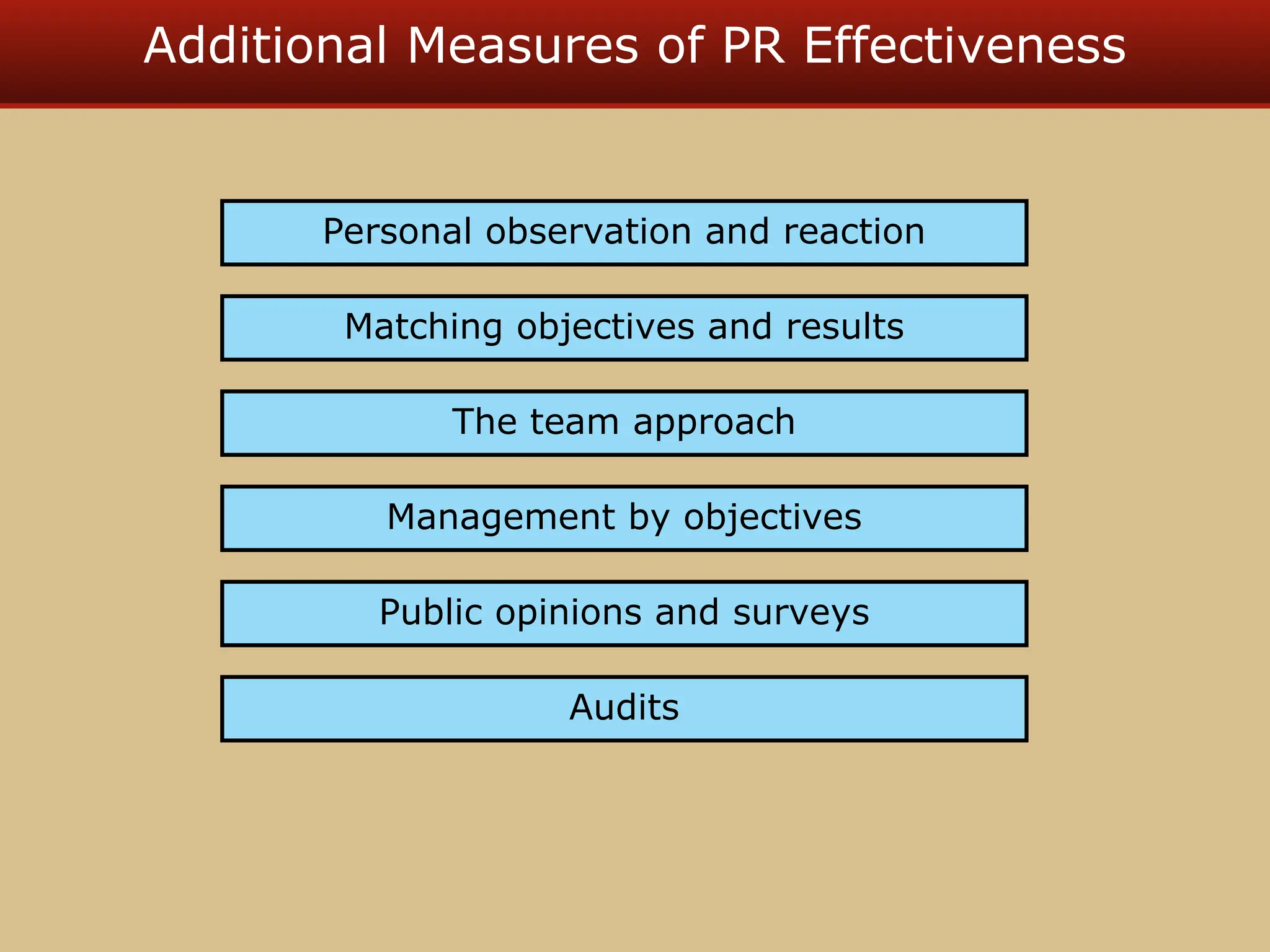
Additional Measures of PR Effectiveness
Personal observation and reaction
Matching objectives and results
The team approach
Management by objectives
Public opinions and surveys
Audits
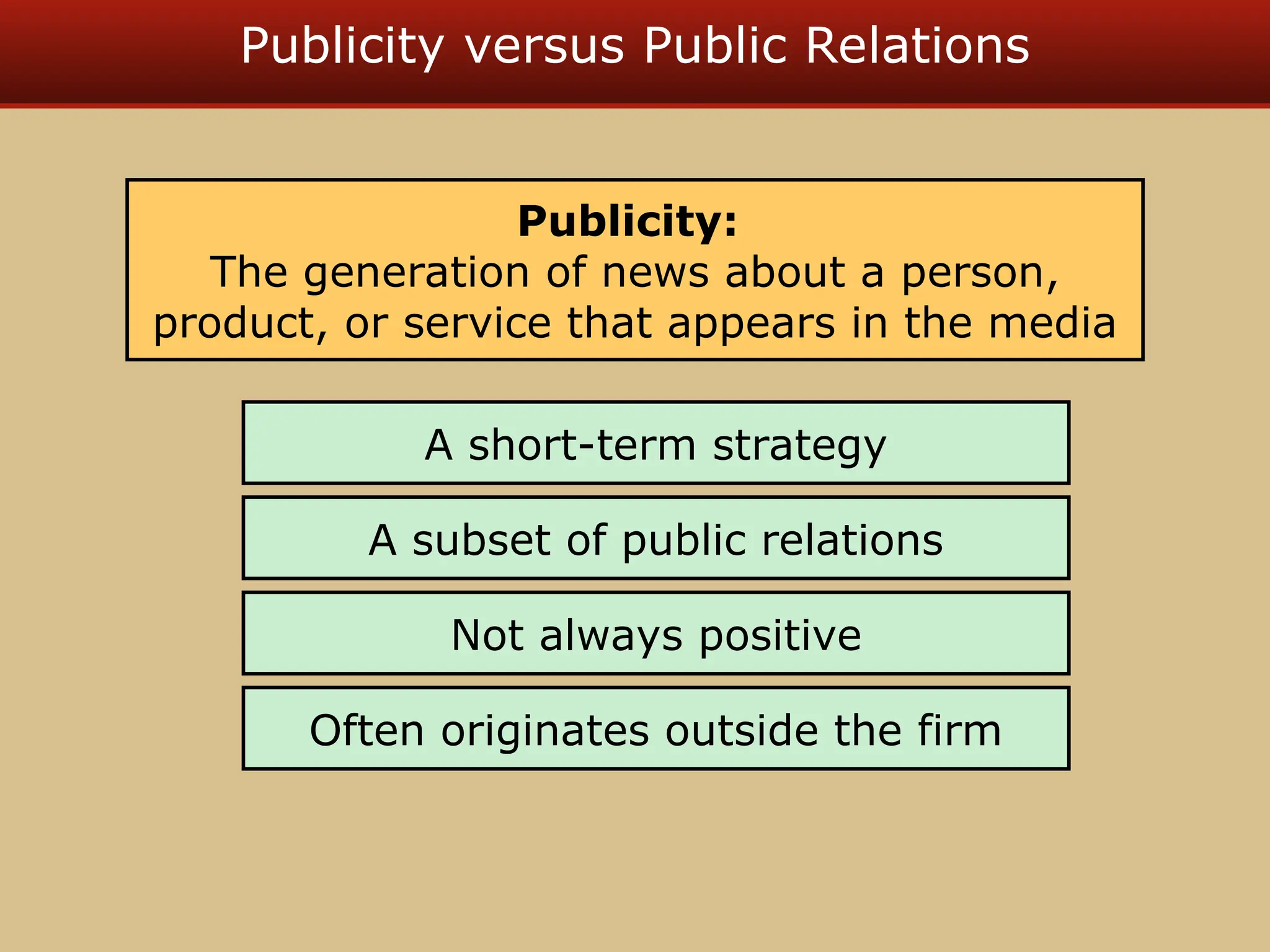
Publicity versus Public Relations
A short-term strategy
Publicity:
The generation of news about a person,
product, or service that appears in the media
A subset of public relations
Not always positive
Often originates outside the firm
A Response to Negative Publicity
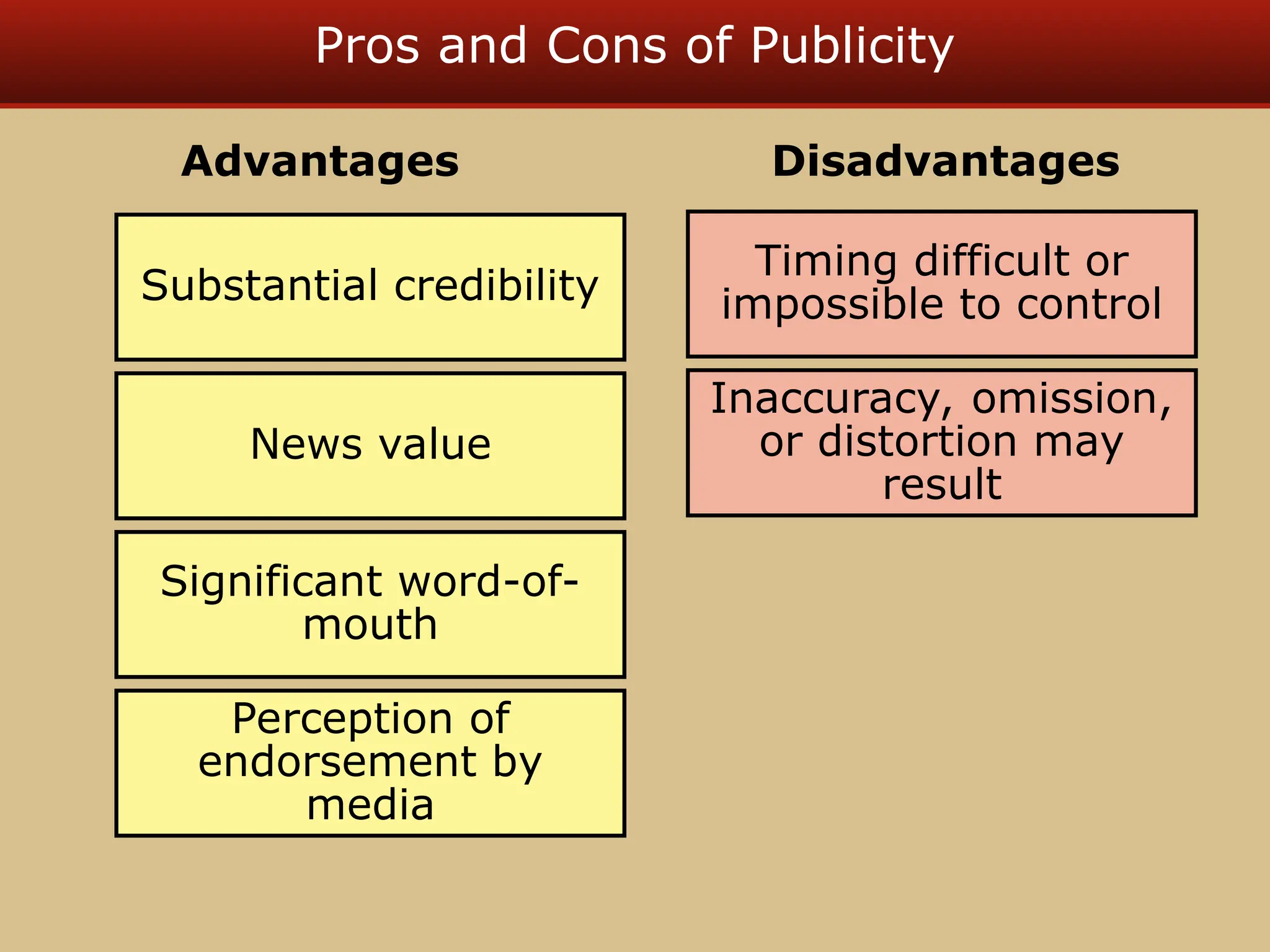
Pros and Cons of Publicity
Substantial credibility
News value
Significant word-of-
mouth
Perception of
endorsement by
media
Advantages
Inaccuracy, omission,
or distortion may
result
Timing difficult or
impossible to control
Disadvantages
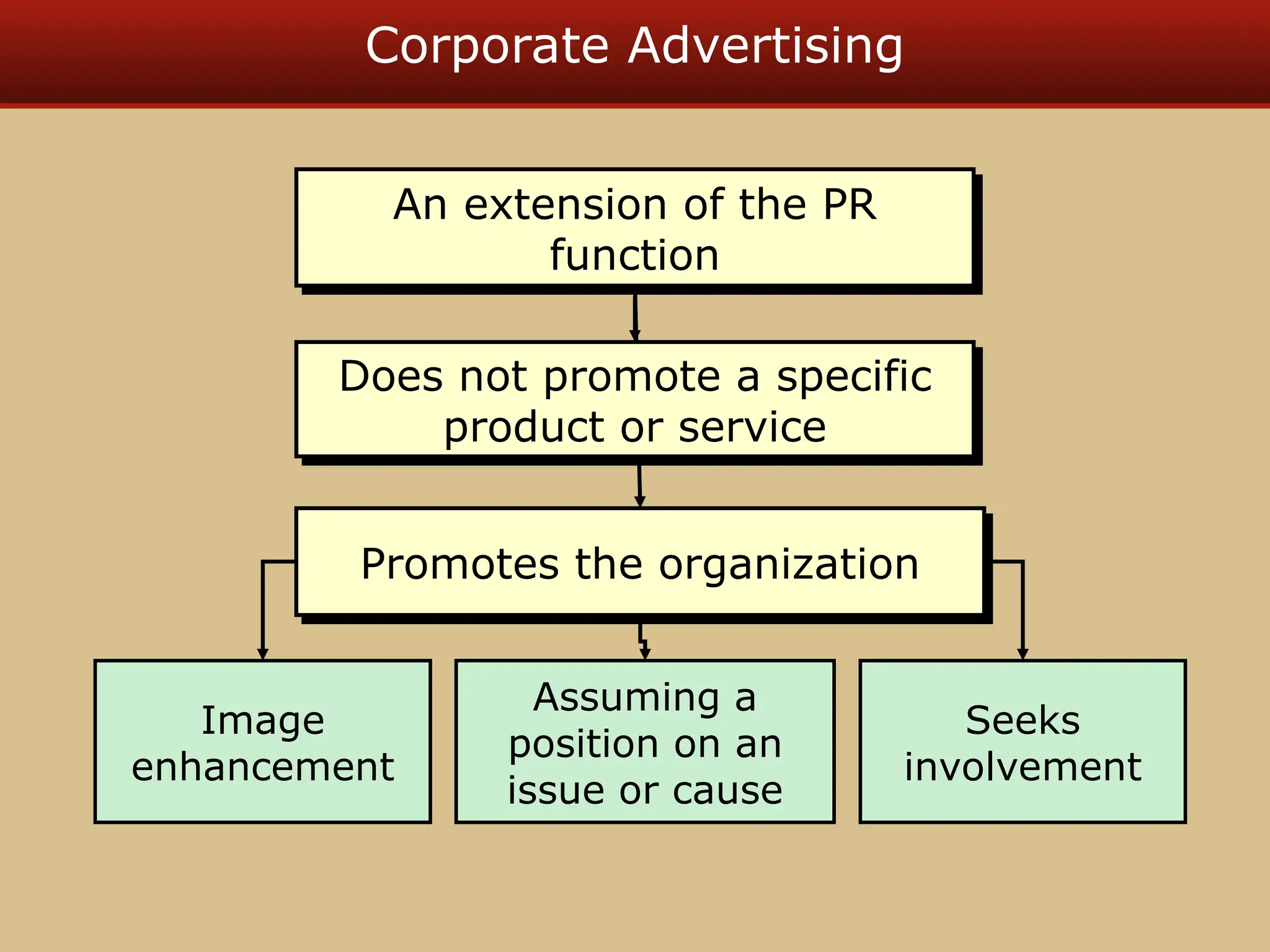
Corporate Advertising
An extension of the PR
function
Promotes the organization
Does not promote a specific
product or service
Image
enhancement
Assuming a
position on an
issue or cause
Seeks
involvement
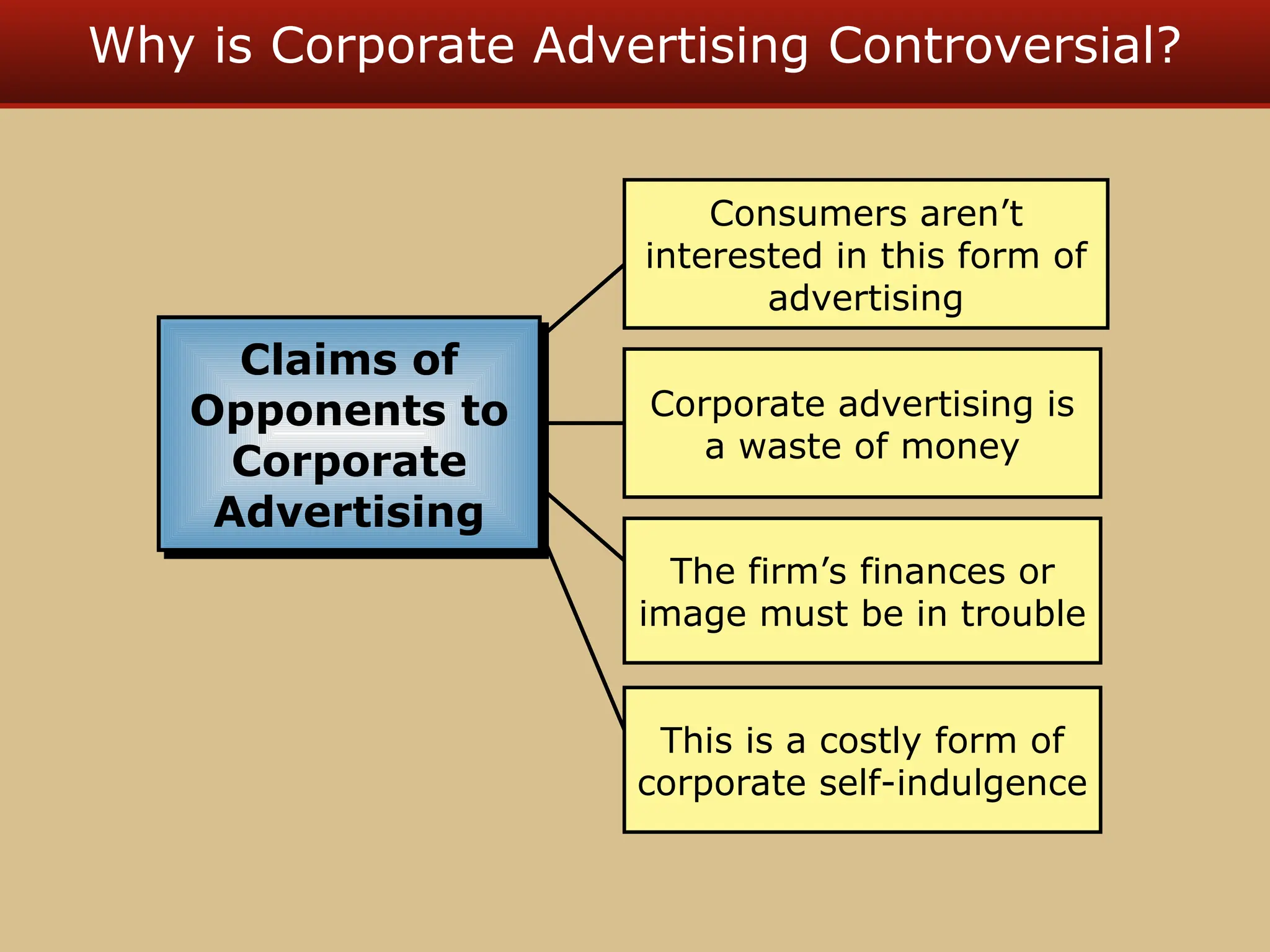
Why is Corporate Advertising Controversial?
Claims of
Opponents to
Corporate
Advertising
Consumers aren’t
interested in this form of
advertising
Corporate advertising is
a waste of money
The firm’s finances or
image must be in trouble
This is a costly form of
corporate self-indulgence
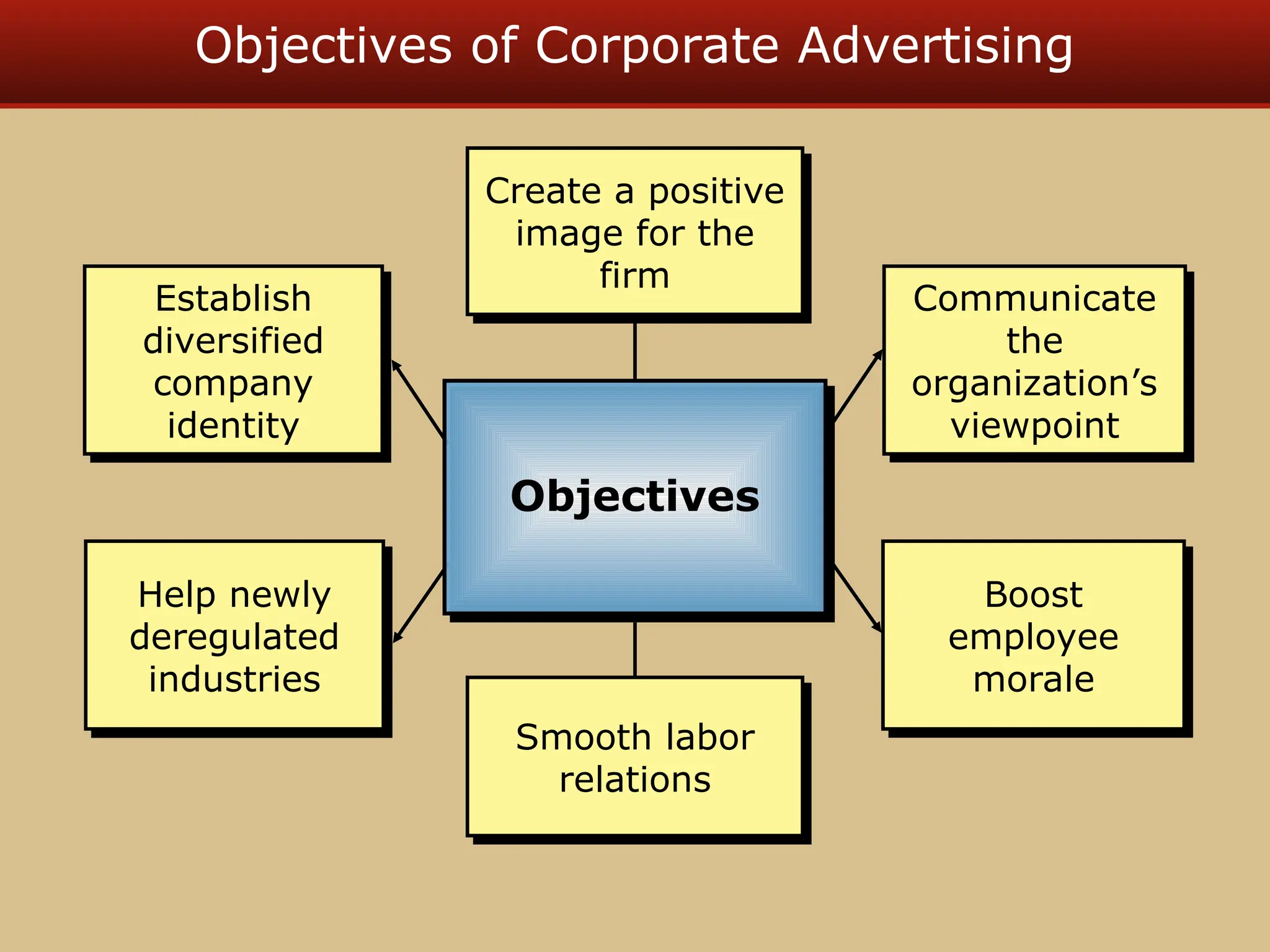
Objectives of Corporate Advertising
Create a positive
image for the
firm
Smooth labor
relations
Communicate
the
organization’s
viewpoint
Boost
employee
morale
Establish
diversified
company
identity
Help newly
deregulated
industries
Objectives
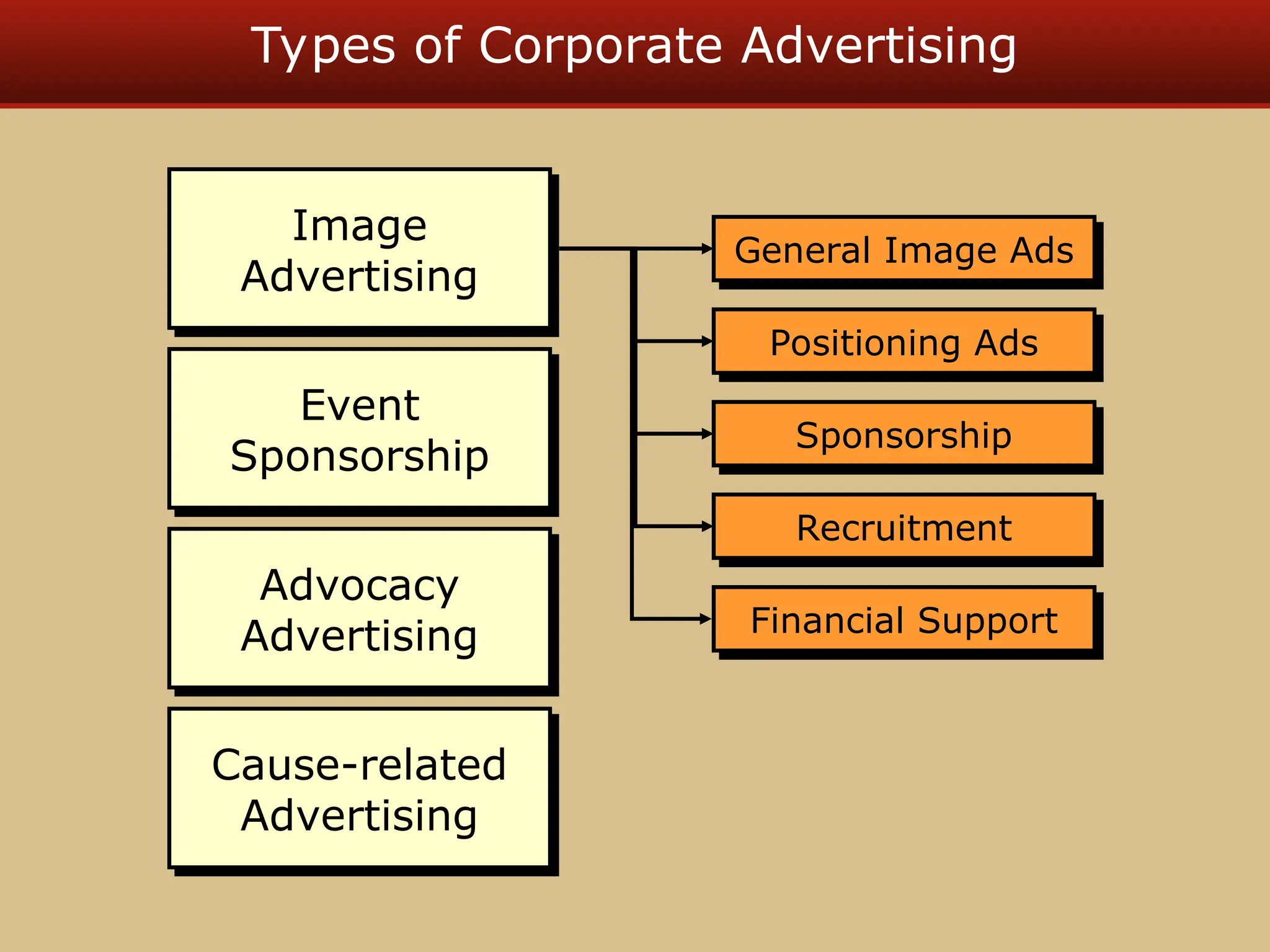
Types of Corporate Advertising
Positioning Ads
Sponsorship
Recruitment
General Image Ads
Financial Support
Image
Advertising
Event
Sponsorship
Advocacy
Advertising
Cause-related
Advertising
Boeing Advertises to Enhance Its Image
*Click outside of the video screen to advance to the next slide
Employee Recruitment by Grant Thornton
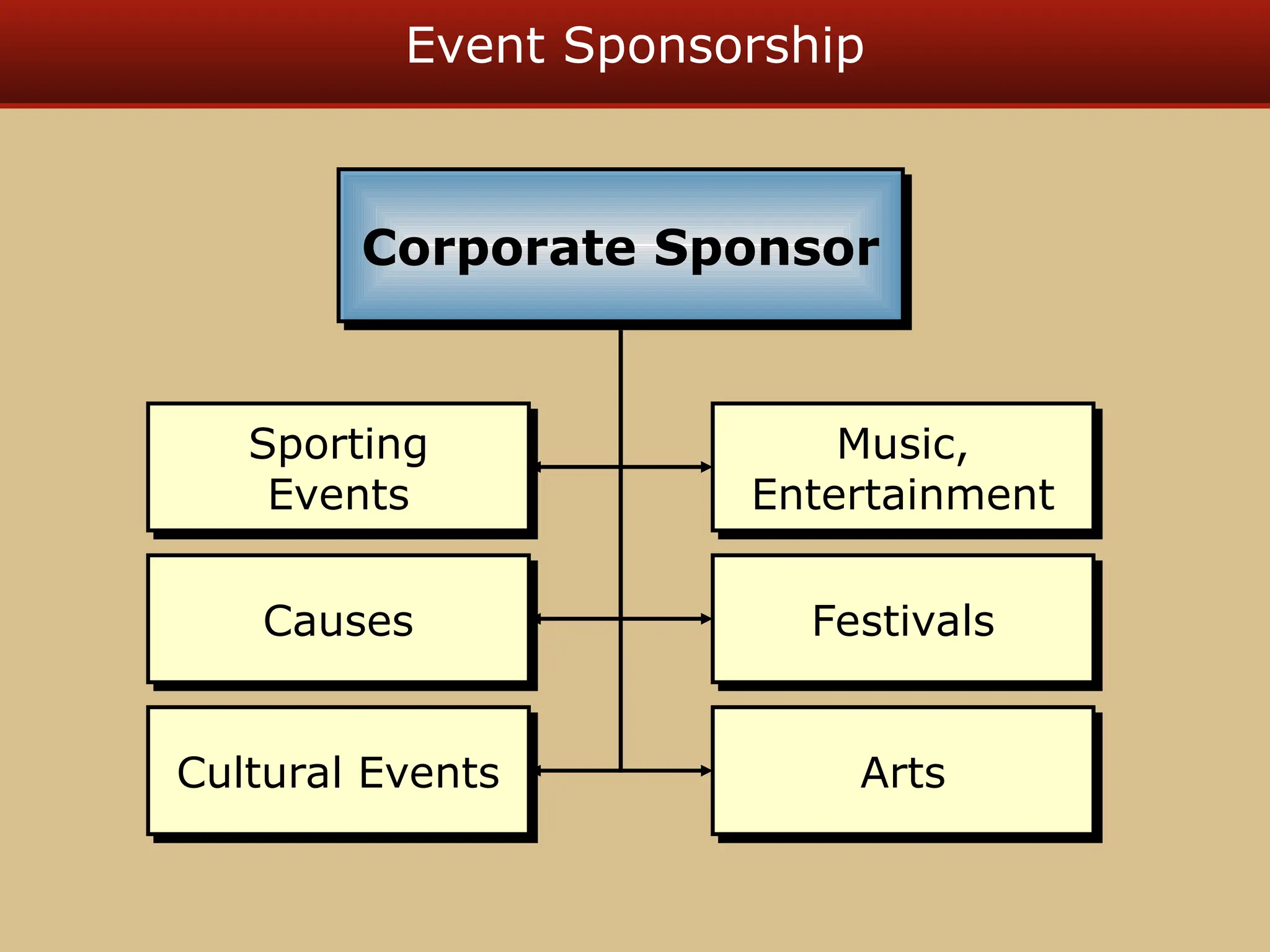
Event Sponsorship
Sporting
Events
Music,
Entertainment
Causes Festivals
Cultural Events Arts
Corporate Sponsor
Test Your Knowledge
Why would World Wrestling Entertainment (WWE)
sponsor a car on the NASCAR racing circuit?
A) To build equity and gain affinity with its
target market
B) To show its position on sports marketing
C) To create a generic positioning strategy
D) To further segment its target market
E) To reduce its overall promotional expenses
Advocacy Advertising
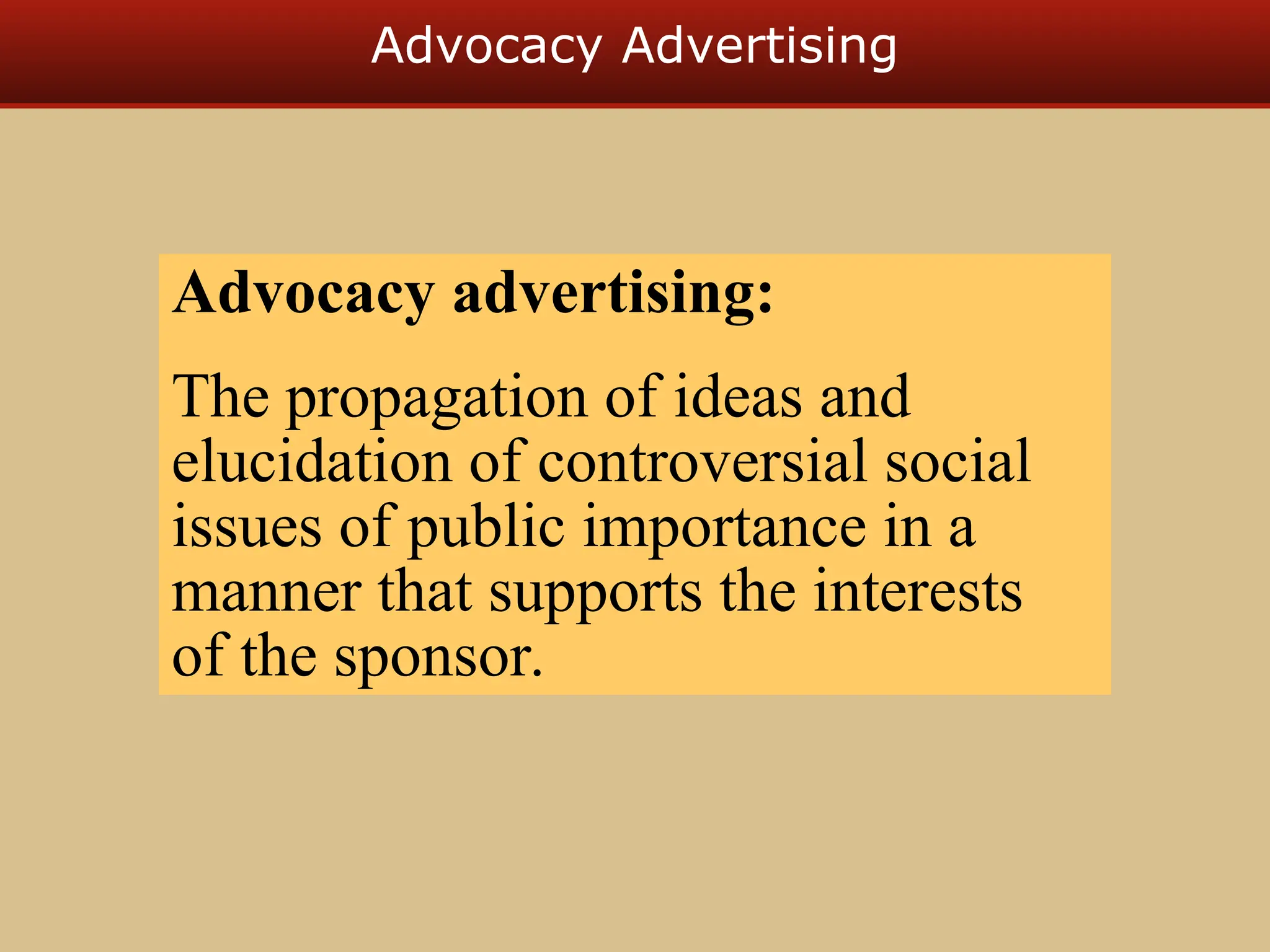
Advocacy advertising:
The propagation of ideas and
elucidation of controversial social
issues of public importance in a
manner that supports the interests
of the sponsor.
American Gas Association Advocacy Ad
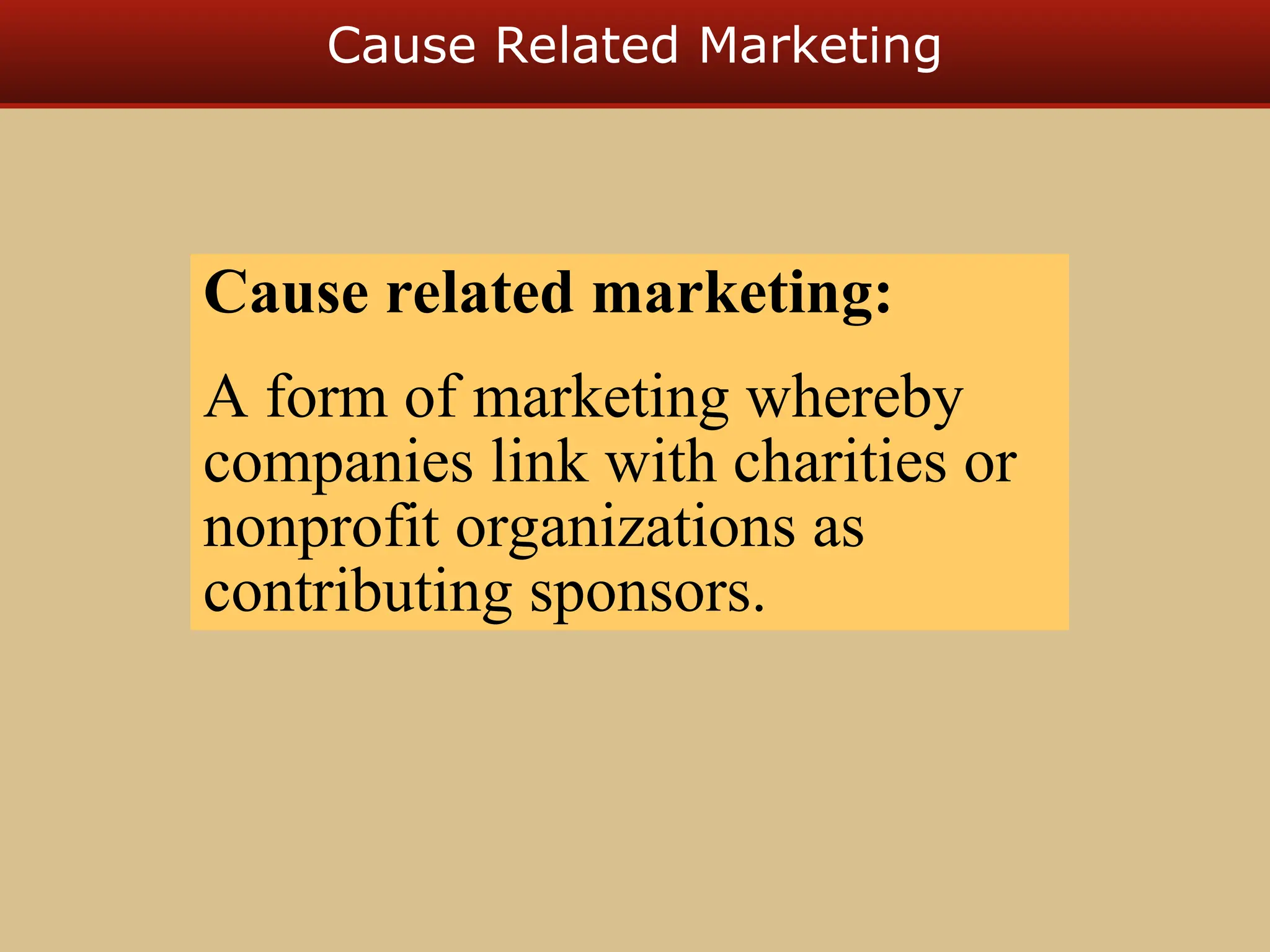
Cause Related Marketing
Cause related marketing:
A form of marketing whereby
companies link with charities or
nonprofit organizations as
contributing sponsors.
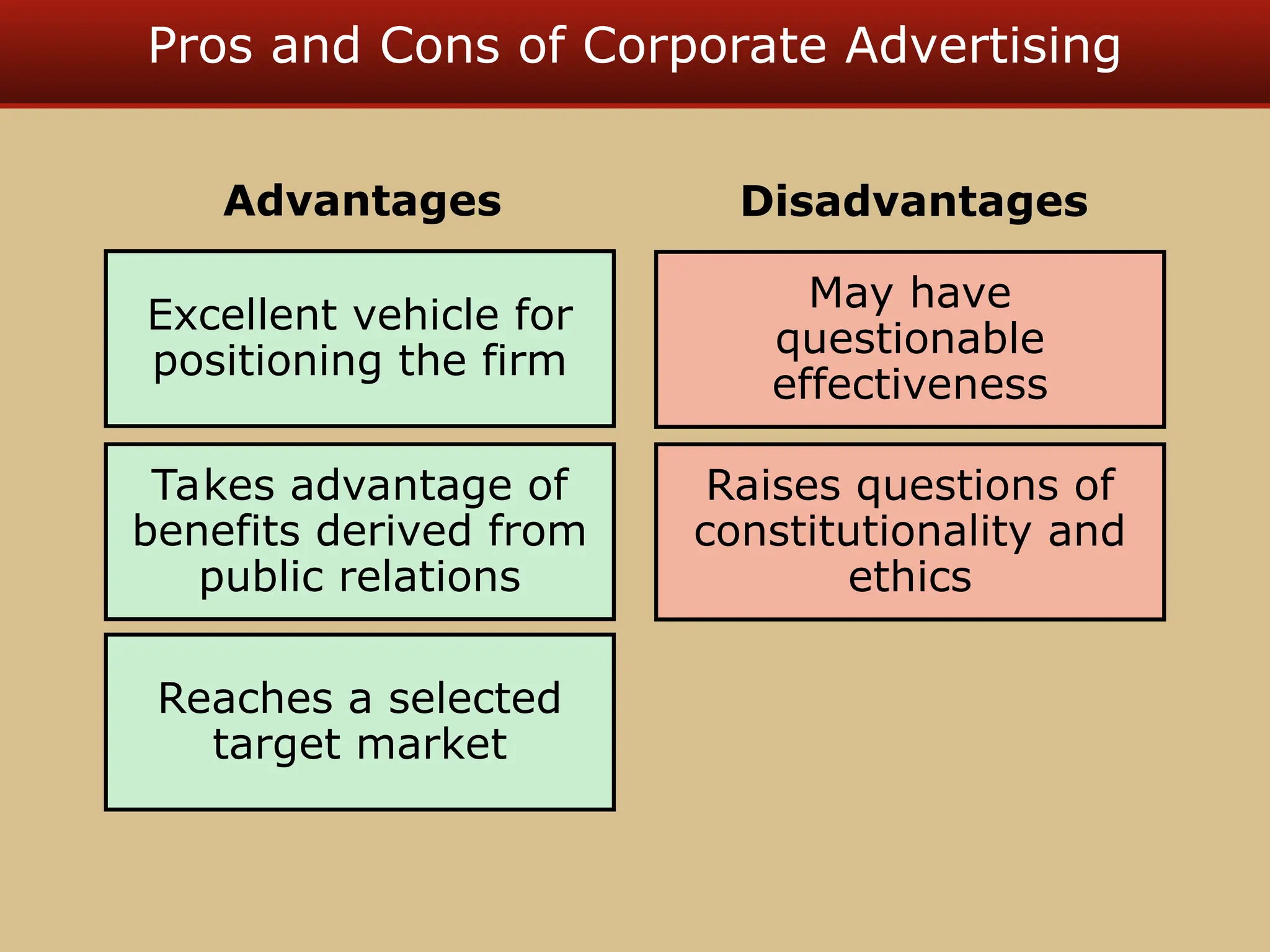
Pros and Cons of Corporate Advertising
Raises questions of
constitutionality and
ethics
May have
questionable
effectiveness
Excellent vehicle for
positioning the firm
Takes advantage of
benefits derived from
public relations
Reaches a selected
target market
Advantages Disadvantages
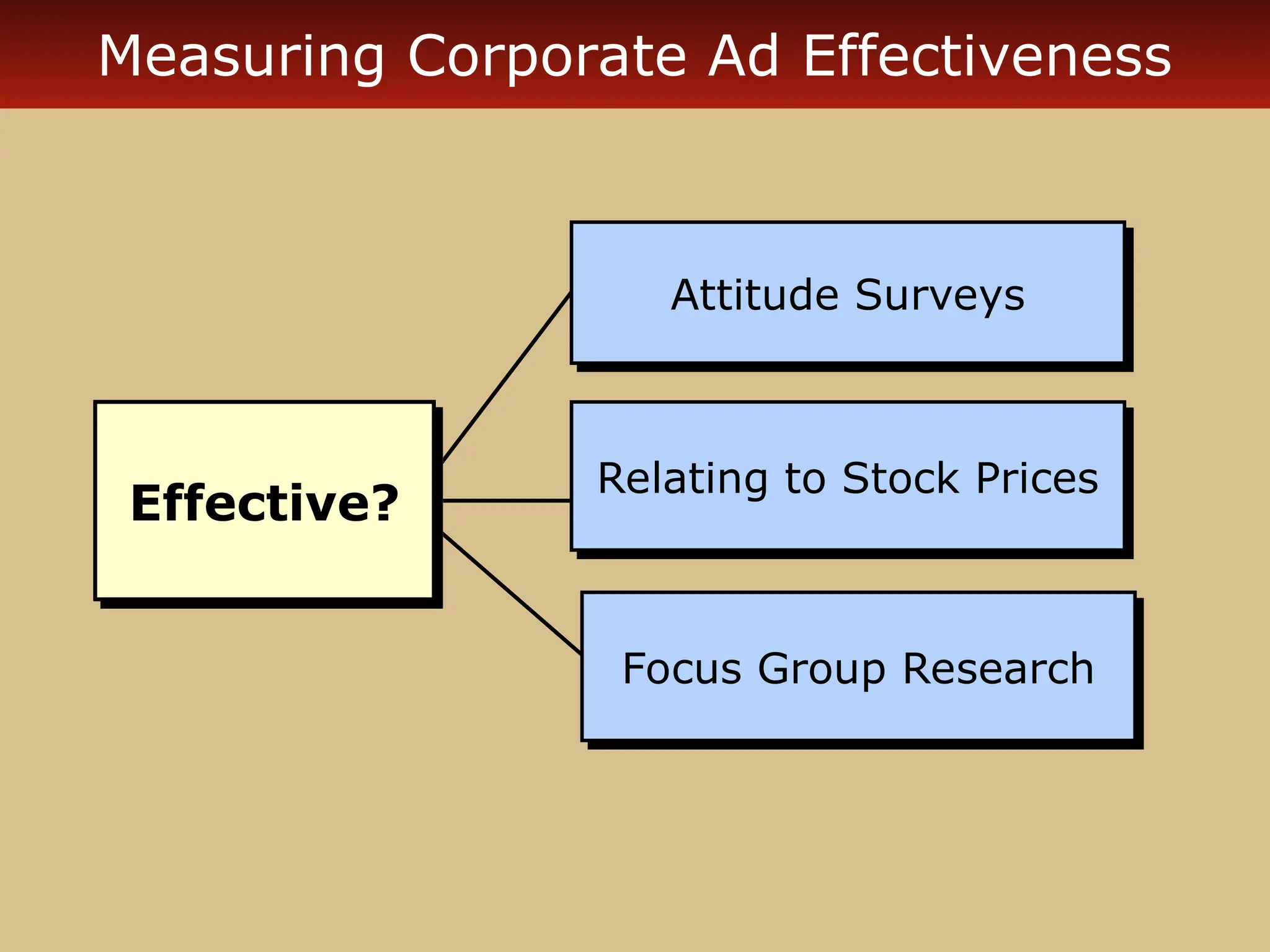
Measuring Corporate Ad Effectiveness
Relating to Stock Prices
Attitude Surveys
Focus Group Research
Effective?

Chapter17-1.ppt presentation chapter number

  • 1.
    Public Relations, Publicity, andCorporate Advertising 17 McGraw-Hill/Irwin Copyright © 2009 by The McGraw-Hill Companies, Inc. All rights reserved.
  • 2.
    Aqua Teen HungerForce Aqua Teen Hunger Force Guerilla Marketing Guerilla Marketing
  • 3.
    Guerilla Marketing • Thebody of unconventional ways of pursuing conventional goals. • A proven method of achieving profits with minimum money.
  • 4.
    Guerilla Marketing GoneApes • To promote the new Aqua Teen Hunger Force Movie, Turner Broadcasting Network teamed up with Guerilla Interference Inc. • The Goal: Deploy 400 LED “LiteBright” displays within 10 major cities. • Part of the marketing plan was to promote The Cartoon Network’s eccentric, nighttime, college-crowd brand of programming Adult Swim.
  • 5.
    Guerilla Marketing GoneApes • Some of Boston’s residents mistook the devices for explosives and contacted authorities. • The city quickly reacted and shut down all major public transportation and spent $500,000 deploying police and bomb sniffing dogs. • Turner Broadcasting was fined $1,000,000 from the city of Boston and also paid $1,000,000 to “goodwill” funds to homeland security.
  • 6.
    Results • In thedays since the event: – Made national televised news – The average number of American households who viewed Aqua Teen Hunger Force rose 5%, to 1,082,500, from the previous week of 1,030,500 viewers. – T-shirts were instantly available for sale portraying the controversial characters. – Web site spiked 105.2%, to 790,000 from 385,000 one week before. – Total US Gross: $5,520,368 – US DVD Sales: $11,084,232 – Movie Budget: $750,000
  • 7.
    Ethical Breach? • TurnerBroadcasting failed to notify the major cities about what was going on. The lack of communication cost them unnecessary fines. • The Ethics Code published by the Word of Mouth Marketing Association stresses honesty of relationship, honesty of opinion, and honesty of identity.
  • 8.
  • 9.
    Public Relations Defined Amanagement function evaluates public attitudes which identifies the policies and procedures and an organization with the public interest of executes a program of action (and communication) and earn public understanding and acceptance to
  • 10.
    Public Relations ManagementProcess Identification of policies and procedures Determination and evaluation of public attitudes Development and execution of the program PR
  • 11.
  • 12.
    Integration of PRinto the Promotional Mix Marketing Department Public Relations Separate Functions Marketing Department Public Relations Coordinated and Equal Marketing Department Public Relations Integrated
  • 13.
    Marketing Public RelationsFunctions Building market excitement before media ads break Creating news where there is no news Introducing a product with little or no advertising Providing a value-added customer service Building brand-to-customer bonds Influencing influentials, giving info to opinion leaders Improving ROI Defending products at risk, giving consumers reasons to buy
  • 14.
  • 15.
    Benefits of MPR Acost-effective way to reach the market Highly targeted way to conduct public relations Endorsements by independent third parties Achievement of credibility Makes advertising messages more credible Breaks though the clutter Circumvents resistance to sales efforts Advantages Improved ROI Creates influence among opinion leaders Improved media involvement w/customers
  • 16.
    Benefits of MPR Difficultto tie in slogans or other advertising devices No standards for effective measurement Lack of control over media Media time and space aren’t guaranteed Disadvantages
  • 17.
    The Process ofPublic Relations Measuring Program Effectiveness Developing and Executing a PR Program Establishing a PR Plan Determining and Evaluating Public Attitudes
  • 18.
    Test Your Knowledge Inpublic relations targeting, external audiences include: A) Customers B) The public at large C) Suppliers D) Stockholders E) All of the above
  • 19.
    Research on PublicAttitudes Provides input for the planning process Serves as an “early warning system” Secures internal cooperation, support Increases communications effectiveness
  • 20.
    10 Evaluation Questions 1.Does the plan reflect a thorough understanding of the company’s business situation? 2. Has the PR program made good use of research and background sources? 3. Does the plan include full analysis of recent editorial coverage? 4. Do the PR people fully understand the product’s strengths and weaknesses? 5. Does the PR program describe several cogent, relevant conclusions from the research?
  • 21.
    10 Evaluation Questions 6.Are the program objectives specific and measurable? 7. Does the program clearly describe what the PR activity will be and how it will benefit the company? 8. Does the program describe how its results will be measured? 9. Do the research, objectives, activities, and evaluations tie together? 10. Has the PR department communicated with marketing throughout the development of the program?
  • 22.
    Determining Public RelationsAudiences Customers and Clients Employees Vendors and Suppliers Community Members Stockholders and Investors Internal or Associated The Media Governments Financial Groups External or Independent Educators Civic and Business Organizations
  • 23.
    Communicating With TargetAudiences Bulletin boards Direct mail Annual reports Newsletters Internal or Associated Press releases Conferences External or Independent Public relations ads Research reports
  • 24.
    The Media AlsoEngages in Public Relations
  • 25.
    Implementing the PRProgram Press Releases Community Involvement Press Conferences Exclusives Interviews The Internet PR Tools
  • 26.
    Special Olympics TorchRun *Click outside of the video screen to advance to the next slide
  • 27.
    The Internet asa PR Tool Allows much more substantial information to be presented Provides the media with instant access to additional sources of information Allows information to be presented quickly The Internet…
  • 28.
    Advantages of PublicRelations Credibility Lead Generation Cost Savings Avoidance of Clutter Image Building Selectivity PR Provides
  • 29.
    Potential Problems ofPublic Relations Potential Problems Potential for incomplete communication process Receiver not making connection to the source Lack of coordination with marketing dept. Inconsistent, redundant communications
  • 30.
    Test Your Knowledge Whichof the following communications is most likely to have more credibility among its receivers? A) Vogue's layout introducing its latest models B) Volvo's television ad promoting new standard safety features C) Motor Trend's announcement of the "Car of the Year" D) The CEO of Ford Motor Company appearing in its ads E) The appearance of the participants in American Idol in Old Navy ads
  • 31.
  • 32.
    Measuring PR Effectiveness Contributionsmade? What was achieved? Quantitative measures? Quality?
  • 33.
    Criteria for MeasuringPR Effectiveness Subject Publication Reporter Target audience Percentage of positive and negative articles by . . . Over time On the target audience On specific target audiences Number of impressions . . . Ratio of positive to negative articles Positive articles over time Negative articles over time Percentage of . .
  • 34.
    Additional Measures ofPR Effectiveness Personal observation and reaction Matching objectives and results The team approach Management by objectives Public opinions and surveys Audits
  • 35.
    Publicity versus PublicRelations A short-term strategy Publicity: The generation of news about a person, product, or service that appears in the media A subset of public relations Not always positive Often originates outside the firm
  • 36.
    A Response toNegative Publicity
  • 37.
    Pros and Consof Publicity Substantial credibility News value Significant word-of- mouth Perception of endorsement by media Advantages Inaccuracy, omission, or distortion may result Timing difficult or impossible to control Disadvantages
  • 38.
    Corporate Advertising An extensionof the PR function Promotes the organization Does not promote a specific product or service Image enhancement Assuming a position on an issue or cause Seeks involvement
  • 39.
    Why is CorporateAdvertising Controversial? Claims of Opponents to Corporate Advertising Consumers aren’t interested in this form of advertising Corporate advertising is a waste of money The firm’s finances or image must be in trouble This is a costly form of corporate self-indulgence
  • 40.
    Objectives of CorporateAdvertising Create a positive image for the firm Smooth labor relations Communicate the organization’s viewpoint Boost employee morale Establish diversified company identity Help newly deregulated industries Objectives
  • 41.
    Types of CorporateAdvertising Positioning Ads Sponsorship Recruitment General Image Ads Financial Support Image Advertising Event Sponsorship Advocacy Advertising Cause-related Advertising
  • 42.
    Boeing Advertises toEnhance Its Image *Click outside of the video screen to advance to the next slide
  • 43.
  • 44.
  • 45.
    Test Your Knowledge Whywould World Wrestling Entertainment (WWE) sponsor a car on the NASCAR racing circuit? A) To build equity and gain affinity with its target market B) To show its position on sports marketing C) To create a generic positioning strategy D) To further segment its target market E) To reduce its overall promotional expenses
  • 46.
    Advocacy Advertising Advocacy advertising: Thepropagation of ideas and elucidation of controversial social issues of public importance in a manner that supports the interests of the sponsor.
  • 47.
  • 48.
    Cause Related Marketing Causerelated marketing: A form of marketing whereby companies link with charities or nonprofit organizations as contributing sponsors.
  • 49.
    Pros and Consof Corporate Advertising Raises questions of constitutionality and ethics May have questionable effectiveness Excellent vehicle for positioning the firm Takes advantage of benefits derived from public relations Reaches a selected target market Advantages Disadvantages
  • 50.
    Measuring Corporate AdEffectiveness Relating to Stock Prices Attitude Surveys Focus Group Research Effective?

Editor's Notes

  • #9 Relation to text This slide relates to material on p. 559 of the text. Summary Overview Public relations can be defined as a management function which evaluates public attitudes, identifies the policies and procedures for an organization with public interest, and executes a program of action to earn public understanding and acceptance. Use of this slide This slide can be used to introduce public relations as an IMC tool.
  • #10 Relation to text This slide relates to material on p. 559 of the text. Summary Overview This slide shows the three steps of the public relations management process, which are: Determination and evaluation of public attitudes Identification of policies and procedures Development and execution of the program The process begins with an understanding of current attitudes and then management develops and executes plans that bring about public understanding and acceptance. Use of this slide This slide can be used to discuss the public relations management process.
  • #11 Relation to text This slide relates to material on pp. 560-561 of the text. Summary Overview This slide shows the traditional view of public relations. That is, PR is viewed as a non-marketing function, whose primary responsibility is to maintain mutually beneficial relationships between the organization and its publics. The publics consist of: Customers or potential customers Employees Investors Neighbors Special-interest groups Suppliers, and so on. From a traditional perspective, public relations and marketing are separate departments. As public relations moves toward a new role, it will be viewed as a strong department that works closely with marketing, blending their talents to provide the best overall image of the firm and its products or services. Use of this slide This slide can be used to discuss the traditional and emerging roles of public relations.
  • #12 Relation to text This slide relates to material on p. 561 of the text. Summary Overview This slide shows the integration of public relations into the IMC process. Three alternative organizational designs are presented, including: Either marketing or public relations is the dominant function Marketing and public relations are equal but separate functions Marketing and public relations perform the same roles Use of this slide This slide can be used to introduce alternative ways to integrate public relations into the IMC process.
  • #13 Relation to text This slide relates to material on pp. 561-563 of the text. Summary Overview Public relations activities designed to support marketing objectives are marketing public relations (MPR) functions. Marketing objectives that may be helped by MPR include: Building marketplace excitement before media advertising breaks Improving ROI Creating advertising news where there is no product news Providing a value-added customer service Building brand-to-consumer bonds Influencing the influentials by providing information to opinion leaders Defending a product at risk and giving customers a reason to buy Use of this slide This slide can be used to show the various ways MPR can help an organization achieve its marketing objectives and add value to the overall IMC program.
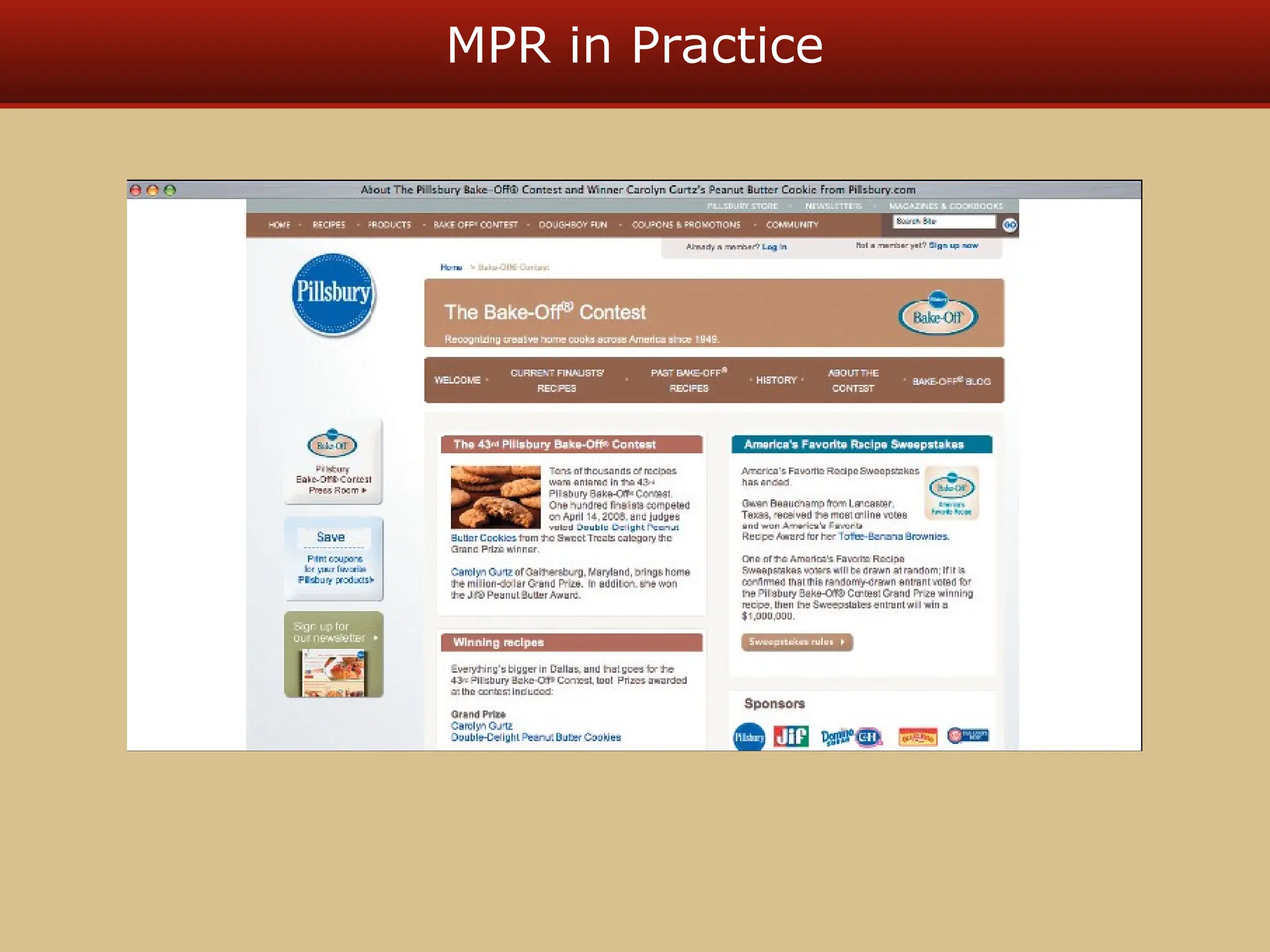
  • #14 Relation to text This slide relates to page 561-563 and Figure 17-1. Summary Overview The Pillsbury Bake-Off has led to strong brand loyalty among Pillsbury customers, who compete by submitting baked goods. The contest has taken place annually since 1949, and the winner now receives a $1 million prize. The winning recipes are posted on the Pillsbury Web site. This is a great example of building a brand-to-customer bond. Other examples include Orkin Pest Control, Syngenta Professional Products, Meriwest Credit Union, Mitsubishi, and Hall & Oates. Use of this slide Use this slide to present a real-world example of marketing public relations at work, specifically, building a brand-to-customer bond.
  • #15 Relation to text This slide relates to material on pp. 563-564 of the text. Summary Overview The slide outlines the advantages of using marketing public relations. The advantages include: Cost-effective way to reach the market Highly targeted way to conduct public relations Endorsements by independent third parties Achievement of credibility Makes advertising messages more credible Breaks through the clutter Circumvents resistance to sales efforts Use of this slide This slide can be used to discuss the advantages of MPR.
  • #16 Relation to text This slide relates to material on pp. 563-564 of the text. Summary Overview The slide outlines the disadvantages of using MPR, which include: Lack of control over media Difficult to tie in slogans or other advertising devices Media time and space are not guaranteed No standards for effective measurement Use of this slide This slide can be used to discuss the disadvantages of marketing public relations. One of the major threats is that MPRs may lead to public relations becoming subservient to marketing. However, if done properly and used in conjunction with other traditional public relations practices, as well as IMC elements, MPR can continue to be used effectively.
  • #17 Relation to text This slide relates to material on pp. 564-573 of the text. Summary Overview This slide outlines the various activities of the public relations process, which includes: Determining and evaluating public attitudes Establishing the PR plan Developing and executing a PR program Measuring program effectiveness Use of this slide This slide introduces the public relation process. More information on the activities at each step of the process will follow.
  • #18 Ans: B
  • #19 Relation to text This slide relates to material on p. 564-565 of the text. Summary Overview This slide shows some of the reasons why companies regularly survey public attitudes. Such research: Provides input for the planning process Serves as an early warning system Secures internal cooperation, support Increases communications effectiveness Companies are concerned with public attitudes because they can affect sales of the products and negative attitudes can also affect employee morale. Use of this slide This slide can be used to discuss some of the reasons companies survey public attitudes.
  • #20 Relation to text This slide relates to material on p. 565 and Figure 17-2 of the text. Summary Overview This slide presents the first five of ten key questions for evaluating public relations plans. The public relations process is ongoing and requires formalized policies and procedures for dealing with problems and opportunities. Answering these questions can help determine whether the PR plan is workable. Use of this slide This slide can be used to discuss the questions marketers might want to ask when evaluating the PR plan to ensure that it will be successful.
  • #21 Relation to text This slide relates to material on p. 565 and Figure 17-2 of the text. Summary Overview This slide presents the second five of ten key questions for evaluating public relations plans. The public relations process is ongoing and requires formalized policies and procedures for dealing with problems and opportunities. Answering these questions will help determine whether the PR plan is workable. Use of this slide This slide can be used to discuss the various question marketers might want to ask when evaluating the PR plan to ensure that it will be successful.
  • #22 Relation to text This slide relates to material on pp. 548-550 of the text. Summary Overview The targets of public relations efforts can vary, with different objectives for each. As this slide shows, the target audience for public relations activities can be broken into two main categories, internal audiences and external audiences. Internal audiences are those groups closely associated with the company, such as: Stockholders and investors Employees of the firm Vendors and suppliers Customers and clients External or independent audiences are those groups not closely connected to the company, including: Community members The media Educators Civic and business organizations Governments Financial groups Use of this slide This slide can be used to discuss the various types of groups and organizations toward which public relations activities may be targeted.
  • #23 Relation to text This slide relates to pp. 566-569 of the text. Summary Overview It may be necessary to communicate with relevant target audiences on an ongoing basis, and for a variety of reasons, ranging from ensuring goodwill to introducing new policies, procedures, or even products. This slide shows commonly used communication vehicles. Use of this slide This slide can be used to discuss the methods by which organizations keep in touch with target audiences.
  • #24 Relation to text This slide relates to the material on p. 567-568 of the text. Summary Overview This slide shows a public relations piece distributed by a San Diego TV station that describes a variety of ways the station contributes to the community. Use of this slide This slide can be used to discuss why the media are concerned about how the community perceives them.
  • #25 Relation to text This slide relates to material on pp. 551-553 of the text. Summary Overview Once research has been conducted and the target audiences identified, the public relations program must be developed and delivered to the receivers. This slide shows the tools available for this purpose, which include: Press releases – one of the more important publics is the press; information must be factual, true, and of interest to the medium and its audience Press conferences – must be of major interest to a specific group before it is likely to gain coverage Exclusives – offer one particular medium exclusive rights to a story Community involvement – memberships or participation in local organizations The Internet – can be used to disseminate information Interview – typically done with a spokesperson for the firm The specific mode of distribution is determined by the nature of the story and the interest of the media and its publics. Other methods of distribution not mentioned are photo kits, bylined articles, speeches, and trade shows. Use of this slide This slide can be used to discuss the various public relations tools that are available to companies.
  • #26 Relation to text This slide relates to the material on p. 570, which discusses community involvement as part of the public relations process. Summary Overview This slide contains a commercial for television station KASA Fox 2, and is an example of the media engaging in public relations activities. This spot asks the public to buy a T-shirt for the law enforcement torch run, which supports the Special Olympics. Television stations are an important part of local communities and use spots like this to demonstrate their community involvement. Use of this slide This commercial can be used to demonstrate how local media such as television stations demonstrate their community involvement.
  • #27 Relation to text This slide relates to material on pp. 570-571 of the text. Summary Overview This slide shows the primary differences between public relations activities conducted in traditional media and those conducted on the Internet. These differences are: The Internet allows information to be presented quickly The Internet offers the opportunity to build internal links that provide the media with instant access to additional sources of information on the issue. And get what they need. The Internet offers the ability to provide much more substantial information. Use of this slide This slide can be used to discuss how the Internet has become a means by which companies and organizations disseminate public relations information.
  • #28 Relation to text This slide relates to material on pp. 571-572 of the text. Summary Overview This slide outlines the advantages of using public relations in the IMC program, which are: Credibility – not seen as being sponsored by the organization which enhances perceptions of credibility Cost savings – do not have to pay for media time or space Avoidance of clutter – generally news items not cluttered by other ads Lead generation – certain announcements can lead to inquiries Selectivity – can reach specific groups Image building – can develop a positive image for the company Use of this slide This slide can be used to discuss the advantages of using public relations.
  • #29 Relation to text This slide relates to material on p. 572 of the text. Summary Overview This slide outlines the potential problems that may arise when using public relations in the IMC program. They are: The potential for not completing the communication process The receiver of the message may not make the connection to the source Mismanagement A lack of coordination with the marketing department, which can result in inconsistent communications, redundancies in efforts, and so on. Use of this slide This slide can be used to discuss the potential pitfalls associated with using public relations.
  • #30 Ans: C
  • #31 Relation to text This slide relates to the material on p. 571 and Exhibit 17-14. Summary Overview Companies often mention favorable reviews or awards their products or service have received from the media in their advertisements. This slide shows an ad for General Mills cereals, and demonstrates how General Mills uses publicity from a variety of sources to promote the importance of whole grain in a healthy diet. Use of this slide This slide can be used to show how favorable news about a product or service can be used as the basis for an advertisement.
  • #32 Relation to text This slide relates to p. 573 of the text. Summary Overview As with the other promotional program elements, it is important to evaluate the effectiveness of public relations efforts. Such an evaluation will help you: Determine the contribution PR made toward attaining communications objectives. Identify what has been achieved through public relations activities. Provide management with a way to measure public relations achievements quantitatively. Give management a way to judge the quality of public relations achievements and activities. Use of this slide Use this slide to explain why it is important to measure the effectiveness of PR efforts.
  • #33 Relation to text This slide relates to material on pp. 573-574 and Figure 17-3 of the text. Summary Overview As with the other promotional program elements, it is important to evaluate the success of the public relations efforts. This slide outlines a system for measuring the effectiveness of a public relations program that was developed by Lotus HAL. Total number of impressions… Over time On the target audience On specific target audiences Percentage of… Positive articles over time Negative articles over time Ratio of positive to negative articles Percentage of positive and negative articles by subject, publication, reporter, and/or target audience Use of this slide This slide can be used to discuss the importance of, and criteria for, measuring PR effectiveness.
  • #34 Relation to text This slide relates to pp. 573-574 of the text. Summary Overview This slide presents some additional ways to evaluate the effectiveness of a PR campaign: Personal observation and reaction one’s superiors should occur at all levels of the organization. Matching objectives and results. Specific objectives designed to attain the overall communications objectives should be related to actions, activities, or media coverage. The team approach, whereby evaluators are actually involved in the campaign. Management by objectives. Executives and their managers act together to identify goals to be attained and the responsibilities of the managers. These goals are then used as a standard to measure accomplishments. Public opinion and surveys. Audits. Both internal and external audits may be used. Internal audits involve evaluations by superiors or peers within the firm to determine the performance of the employee and the program. External audits are conducted by consultants, the client, or other parties outside the organization. Use of this slide Use this slide to explain other methods for evaluating the effectiveness of a PR campaign.

  • #35 Relation to text This slide relates to material on p. 574 of the text. Summary Overview Publicity and public relations are not the same thing. Public relations is a long-term strategy; publicity is a short-term strategy. Public relations is designed to provide positive information, and is usually controlled by the firm. Publicity is not always positive, and often originates from sources outside the firm. Use of this slide This slide can be used to explain the differences between publicity and public relations.
  • #36 Relation to text This slide relates to the material on pp. 575-577 and Exhibit 17-19 of the text. Summary Overview Marketers sometimes have to run ads to address negative publicity about their company and/or its products and policies. This slide shows an ad that was used by Tree Top to respond to negative publicity the company received from the media regarding the safety of its apple juice. The company’s problems began when major news media reported that the chemical Alar, which is used to regulate the growth of apples, might cause cancer in children. A few special interest groups were able to generate adverse publicity regarding the potential dangers of Alar. Tree Top responded with this ad, which was designed to inform that Alar was not used in its products and that they were safe for children. Use of this slide This ad shows an example of how a company responds to negative publicity about its products.
  • #37 Relation to text This slide relates to material on pp. 577 of the text. Summary Overview This slide summarizes the advantages and disadvantages of publicity, which are: Advantages Substantial credibility News value Significant word-of-mouth Perception of endorsement by media Disadvantages Timing may be difficult or impossible to control Inaccuracy, omission, or distortion may result Because of the many advantages of publicity, it can generate a vast amount of influence on consumers. However, marketers cannot control the dissemination of publicity and some inaccuracies or distortions may occur. Use of this slide This slide can be used to discuss the advantages and disadvantages of publicity.
  • #38 Relation to text This slide relates to material on pp. 577-579 of the text. Summary Overview Corporate advertising has been growing as more companies are running ads to create a positive image or communicate their views on social, environmental, and/or business issues. Approximately seven percent of all advertising spent is for corporate advertising. This slide shows the various characteristics of corporate advertising. These characteristics of corporate advertising include the following: Corporate advertising is an extension of the PR function It does not promote a specific product or service It promotes the organization to achieve the following: Image enhancement Assuming a position on an issue or cause Seeks involvement Use of this slide This slide can be used to introduce the characteristics of corporate advertising.
  • #39 Relation to text This slide relates to material on pp. 577-579 of the text. Summary Overview This slide offers a number of reasons why corporate advertising is considered controversial. Opponents of corporate advertising claim that: Consumers are not interested in this form of advertising The ads may be seen as an indication that the firm must be in trouble This is a costly form of corporate self-indulgence Corporate advertising is a waste of money Despite these criticisms, corporate advertising has been increasing in use. Use of this slide This slide can be used to discuss some of the reasons that corporate advertising is considered to be controversial.
  • #40 Relation to text This slide relates to material on p. 579 of the text. Summary Overview This slide shows the various objectives of corporate advertising, which are: Create a positive image for the firm Communicate the organization’s viewpoint Boost employee morale Smooth labor relations Help newly deregulated industries Establish diversified company’s identity As these objectives indicate, corporate advertising is targeted at both internal and external audiences and involves the promotion of the organization as well as its ideas. Use of this slide This slide can be used to discuss the various objectives of corporate advertising.
  • #41 Relation to text This slide relates to material on pp. 579-585 of the text. Summary Overview This slide shows the various types of corporate advertising with special attention toward image advertising. Later slides will discuss the other types in more detail. The types of corporate advertising are: Image Advertising – advertising that is designed to create goodwill, creating a position for the company and generating resources, both human and financial. Types of image ads include: General image or positioning ads – create or change an image of the firm in the public mind Sponsorship – providing support for TV programs or special programming Recruitment – create an image of the firm to help recruit new employees Financial support – help generate investments in the corporation Event sponsorship Advocacy advertising Cause-related advertising A positive corporate image cannot be created with ads alone. Quality products and services, innovation, sound financial practices, and good corporate citizenship are other factors that contribute to overall image. Use of this slide This slide can be used to discuss the various types of corporate advertising available to the advertiser with a focus on image advertising.
  • #42 Relation to text This slide relates to material on pp. 579-580 that discusses corporate image advertising. Summary Overview The slide shows a commercial from the global image campaign for Boeing. While Boeing is well known as the world’s leading manufacturer of commercial jets, a four-year series of acquisitions transformed the company into a major force in markets for military aircraft, rockets, satellites, and broad band communications to the mobile traveler. Boeing is trying to set the stage for its future as more than a commercial airplane manufacturer with a global image and branding campaign that uses the tagline: “Boeing Forever New Frontiers.” A goal of this campaign is to leverage Boeing’s strong brand image with customers and aviation, business and government influentials. Thus, the TV spots are being aired during business-oriented programs on network and cable. Another goal of the campaign is as to create excitement among the company’s employees regarding the future of the company. Use of this slide The commercial shown in this slide is a very good example of corporate image advertising.
  • #43 Relation to text This slide relates to the material on pp. 579-580, which discusses types of corporate advertising. Summary Overview Recruitment advertising is one of the types of corporate advertising done by companies. Companies with well known products and corporate images often will use them in their recruitment ads to attract the interest of potential employees. This slide shows an example of a recruitment advertisement used by Grant Thornton designed to attract new employees. If you have a passion for accounting and want to work with others who share that passion, you might be interested in the Grant Thornton accounting firm. Use of this slide This slide can be used as an example of recruitment advertising done by a major company.
  • #44 Relation to text This slide relates to material on pp. 565-567 of the text. Summary Overview Another form of corporate advertising is event sponsorship. This slide shows the various types of activities sponsored by corporations. These corporate sponsored activities include: Sporting events Music and entertainment Causes Festivals Cultural events The arts Many corporations are attracted to event sponsorships because it gets their company and/or product names in front of consumers. Additionally, IMC programs can be built around them and promotional tie-ins can be made to local, regional, or national markets. By choosing the right events for sponsorship, companies can get visibility among their target market and enhance the image of the company. Use of this slide This slide can be used to discuss the various types of activities that can be corporate sponsored events.
  • #45 Ans: A
  • #46 Relation to text This slide relates to material on p. 584 of the text. Summary Overview This slide shows another form of corporate advertising known as advocacy advertising. Advocacy advertising is the propagation of ideas and elucidation of controversial social issues of public importance in a manner that supports the interests of the sponsor. While still portraying an image for the company or organization, advocacy advertising adopts a position on a particular issue rather than promoting the organization itself. Advocacy advertising has been criticized by a number of sources. Critics argue that companies with large advertising budgets purchase too much ad space and that advocacy ads may be misleading. Use of this slide This slide can be used to discuss advocacy advertising.
  • #47 Relation to text This slide relates to the material on p. 584 and Exhibit 17-24 of the text. Summary Overview Advocacy advertising is used by a variety of organizations and companies to communicate their position on a particular issue. This slide shows an example of an advocacy ad by the American Gas Association that addresses natural gas as environmentally sound, abundant, and “the future.” Organizations such as the American Gas Association often use advertising to communicate their position on a controversial issue or one that they feel is of importance to the public. Use of this slide This slide can be used to provide an example of how an organization uses advocacy advertising.
  • #48 Relation to text This slide relates to material on pp. 584-585 of the text. Summary Overview Another form of corporate advertising is cause- related marketing which is a form of marketing whereby companies link with charities or nonprofit organizations as contributing sponsors. Cause-related marketing could take on different forms such as making outright donations to a nonprofit cause, donating a percentage of the sales of a product or service to a cause, have company employees volunteer for the cause, donating materials or supplies, running public service announcements, or providing event refreshments. This is an increasingly popular method of image building as association with a cause may be a way to differentiate one brand or store from another, increase consumer acceptance of price increases, and generate favorable publicity. Use of this slide This slide can be used to discuss cause-related marketing.
  • #49 Relation to text This slide relates to material on p. 586 of the text. Summary Overview This slide summarizes the advantages and disadvantages of corporate advertising. These are as follows: Advantages Excellent vehicle for positioning the firm and establishing an image or position Takes advantage of benefits derived from public relations Reaches a selected target market Disadvantages May have questionable effectiveness – no evidence it actually works Raises questions of constitutionality and ethics – larger firms can control public opinion The many advantages are reasons why this type of advertising has increased in popularity. Although a number of valid points have been offered against corporate advertising, its use is likely to continue. Use of this slide This slide can be used to discuss the advantages and disadvantages of corporate advertising.
  • #50 Relation to text This slide relates to material on pp. 569-570 of the text. Summary Overview This slide shows the various methods that can be used to evaluate the effectiveness of corporate advertising which include: Attitude surveys Relating to stock prices Focus group research Use of this slide This slide can be used to discuss evaluating the effectiveness of corporate advertising. While the effectiveness of corporate advertising has been measured by some of these methods, it is not necessarily done on a regular basis like product specific advertising measurements.