PROJECT DESIGN & PROJECT MANAGEMENT FOR
URBAN DESIGN
CONTENTS OF THE PROJECT MANAGEMENT COURSE
 INTRODUCTION
 ORGANIZATIONAL STRUCTURE AND PROJECT LIFECYCLE
 PROJECT MANAGEMENT PROCESSES
 PROJECT INTEGRATION MANAGEMENT
 PROJECT SCOPE MANAGEMENT
 PROJECT TIME MANAGEMENT
 PROJECT COST MANAGEMENT
 PROJECT QUALITY MANAGEMENT
 PROJECT H.R MANAGEMENT
 PROJECT COMMUNICATION MANAGEMENT
 PROJECT RISK MANAGEMENT
 PROJECT PROCUREMENT MANAGEMENT
 PROJECT STAKEHOLDER MANAGEMENT
INTRODUCTION
What is a Project?
 A temporary endeavor
 have a definite beginning and end
 Creates a unique product, service or result
 Projects can involve
o A single person
o A single organizational unit
o Multiple organizational units
Projects Create
 An item, an enhancement or a component of an item
 Service or capability to perform a service
 Improvement to an existing item
 Result- outcome or document
What is a Project management?
 Application of Knowledge, skills, tools and techniques to meet project
requirements
 There are five project management groups
o Initiating
o Planning
o Executing
o Monitoring and Controlling
o Closing
 These five project management groups have 47 project management
processes
Typical Project management includes
 Identifying requirements
 Addressing needs, concerns and expectations of stakeholders
 Setting up, maintaining and carrying out communications
 Managing stakeholders
 Balancing competing project constraints
o Scope
o Quality
o Schedule
o Budget
o Resources and Risks
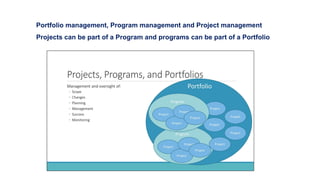
Portfolio management, Program management and Project management
Projects can be part of a Program and programs can be part of a Portfolio
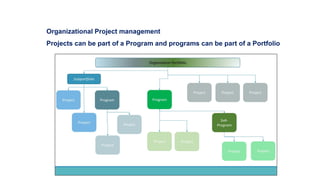
Organizational Project management
Projects can be part of a Program and programs can be part of a Portfolio
Project Management Offices(PMO’s)
 Support project managers
 Manage shared resources across the PMO
 Couching, Mentoring and Training
 Conducting project audit
 Developing and managing processes and procedures
 Facilitating communications across projects
Project Management Office Types
 Standards project management for an organization
 Three types of project offices
o Supportive-consultative role, template provision, couching, training etc
o Controlling-compliance through a framework, specific forms of
templates, governance
o Directive-directly manages projects as a PMO, owns and controls the
project lifecycle
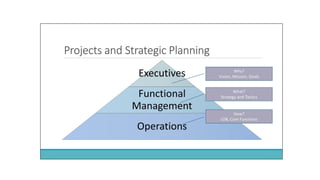
Projects and Strategic Planning
Why would an organization ever do a project?
 Market demands
 Opportunities and Risks
 Social need
 Environmental considerations
 Customer request
 Technological advancements
 Legal requirements
Projects and Operations
 Projects are temporary
o Developing new products and services
o Moving, adding, changing or Deleting
o Implementing new services or solutions
 Operations are ongoing
o Repetitive actions
o Maintenance
o Core business functions
Relationship between Project mgmt ,Operations mgmt and Organizational
Strategy
 Operations and project management create the whole life product cycle
 Closeout or end of project phase
 Product Development
 Improving operational processes and lifecycles
 Product lifecycle
 Knowledge transfer
Organizations and Project Management
 Project based organizations
 Project management and organizational governance
 Projects and organization strategy
 Culture
Business Value
Entire value of the business
 Tangible elements
o Monitory assets
o Fixtures and equipment
o Equity
 Intangible elements
o Reputation
o Brand Recognition
o Trademarks
Roles of Project Manager
 Lead the team to achieve project objectives
 Balance the competing objectives of the project
 Communicate with stakeholders
 Contribute to business value
Responsibilities and Competencies of the Project Manager
 Satisfy task needs, team needs and individual needs
 Liaison between team needs and business strategy
 Three values of a project manager
o Knowledge-Understanding of project management
o Performance-Accomplish as a project manager
o Personal-Behavior, effectiveness, character, leadership
Skills of Project Manager
 Problem solving
 Motivating
 Communicating
 Influencing the organization
 Leadership
 Negotiating
 Political and cultural awareness
 Conflict Management
 Coaching etc.

Organizational Influences on Project Management
 Organizational cultures and lifestyles
 Organizational communications
 Structure of the organization
ORGANIZATIONAL STRUCTURE AND PROJECT LIFECYCLE
Organizational Culture
 Values
 Business model
 Policies, methods and processes
 View of Authority
 Work ethics and working hours
Organizational Structures
 Affects power of project manager
 Affects the abilities of decision making
 Affects communication demands
 Affects project team management
 Affects stakeholder management
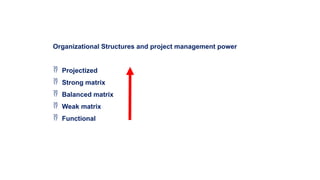
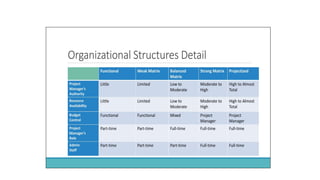
Organizational Structures and project management power
 Projectized
 Strong matrix
 Balanced matrix
 Weak matrix
 Functional
Organizational Process Assets
 Came from
o Process and Procedures (Historical)
o Corporate Knowledge Base (Prepared)
 Historical or Prepared
o Past projects
o Lessons learned
o Processes and procedures
o Guidelines and accepted practices
Corporate Knowledge Base
 Configuration management knowledge
 Financial databases; labor hours incurred costs, budget and any cost overrun
 Historical information and lessons learned databases
 Project files from previous projects etc
Enterprise Environmental Assets/Factors
 Organizational policies
 Industry standards and regulations(Standards are optional and Regulations are not)
 Rules that the project manager must abide by
 Processes that must be followed
 Graphic distribution of facilities
 Marketplace conditions etc
Project Stakeholders and Governance
 Interested parties in the project’s existence
 Affected by the project
 Can affect the project
 Project team and manager
 Project stakeholders are anyone who is affected by the project
o Positive stakeholders
o Negative stakeholders
o Neutral stakeholders
Project Stakeholders
Common stakeholders are
 Sponsor
 Customers and users
 Sellers
 Business partners
 Organizational groups
 Functional managers
Project Governance
 Deliverable acceptance criteria
 Escalation process
 Relationship among projects, programs, project team, stakeholders
 Process for communication information
 Decision making process
 Project lifecycle approach
 Process for stage gate or phase views(Reporting/Presenting time)
 Control and oversight of the project
Project Success
Define what equates to project success first
Meeting project objectives
 Scope
 Costs
 Schedule
 Quality
 Resources
 Risks
Project Team
 Dedicated- project team works on the project full time
o Collocated or virtual
o Reports directly to the project manager
o Lines of authority are clear
 Part Time- project team works part time on the project
o Carries on regular operational work
o Functional manager usually in control of project resources
o Project team could be on multiple projects at one time
Project Life Cycle
 Unique to each project
 Defines duration of the project
 It usually is subdivided by phases i.e. in construction for example
Concept- Design-Drawings-Bid-Construction
Project Phases
Phases result in key deliverables
Phase names describe the work
 Sub structure
 Super structure
 Walling and Internal works
 External and site works
Milestones are often linked to phases
Project Phase Relationships
 Sequential relationship
 Overlapping relationship
 Iterative relationships
THANK YOU !!!

PROJECT MANAGEMENT FOR URBAN DESIGN.pptx

  • 1.
    PROJECT DESIGN &PROJECT MANAGEMENT FOR URBAN DESIGN
  • 2.
    CONTENTS OF THEPROJECT MANAGEMENT COURSE  INTRODUCTION  ORGANIZATIONAL STRUCTURE AND PROJECT LIFECYCLE  PROJECT MANAGEMENT PROCESSES  PROJECT INTEGRATION MANAGEMENT  PROJECT SCOPE MANAGEMENT  PROJECT TIME MANAGEMENT  PROJECT COST MANAGEMENT  PROJECT QUALITY MANAGEMENT  PROJECT H.R MANAGEMENT  PROJECT COMMUNICATION MANAGEMENT  PROJECT RISK MANAGEMENT  PROJECT PROCUREMENT MANAGEMENT  PROJECT STAKEHOLDER MANAGEMENT
  • 3.
  • 4.
    What is aProject?  A temporary endeavor  have a definite beginning and end  Creates a unique product, service or result  Projects can involve o A single person o A single organizational unit o Multiple organizational units
  • 5.
    Projects Create  Anitem, an enhancement or a component of an item  Service or capability to perform a service  Improvement to an existing item  Result- outcome or document
  • 6.
    What is aProject management?  Application of Knowledge, skills, tools and techniques to meet project requirements  There are five project management groups o Initiating o Planning o Executing o Monitoring and Controlling o Closing  These five project management groups have 47 project management processes
  • 7.
    Typical Project managementincludes  Identifying requirements  Addressing needs, concerns and expectations of stakeholders  Setting up, maintaining and carrying out communications  Managing stakeholders  Balancing competing project constraints o Scope o Quality o Schedule o Budget o Resources and Risks
  • 8.
    Portfolio management, Programmanagement and Project management Projects can be part of a Program and programs can be part of a Portfolio
  • 9.
    Organizational Project management Projectscan be part of a Program and programs can be part of a Portfolio
  • 10.
    Project Management Offices(PMO’s) Support project managers  Manage shared resources across the PMO  Couching, Mentoring and Training  Conducting project audit  Developing and managing processes and procedures  Facilitating communications across projects
  • 11.
    Project Management OfficeTypes  Standards project management for an organization  Three types of project offices o Supportive-consultative role, template provision, couching, training etc o Controlling-compliance through a framework, specific forms of templates, governance o Directive-directly manages projects as a PMO, owns and controls the project lifecycle
  • 12.
    Projects and StrategicPlanning Why would an organization ever do a project?  Market demands  Opportunities and Risks  Social need  Environmental considerations  Customer request  Technological advancements  Legal requirements
  • 14.
    Projects and Operations Projects are temporary o Developing new products and services o Moving, adding, changing or Deleting o Implementing new services or solutions  Operations are ongoing o Repetitive actions o Maintenance o Core business functions
  • 15.
    Relationship between Projectmgmt ,Operations mgmt and Organizational Strategy  Operations and project management create the whole life product cycle  Closeout or end of project phase  Product Development  Improving operational processes and lifecycles  Product lifecycle  Knowledge transfer
  • 16.
    Organizations and ProjectManagement  Project based organizations  Project management and organizational governance  Projects and organization strategy  Culture
  • 17.
    Business Value Entire valueof the business  Tangible elements o Monitory assets o Fixtures and equipment o Equity  Intangible elements o Reputation o Brand Recognition o Trademarks
  • 18.
    Roles of ProjectManager  Lead the team to achieve project objectives  Balance the competing objectives of the project  Communicate with stakeholders  Contribute to business value
  • 19.
    Responsibilities and Competenciesof the Project Manager  Satisfy task needs, team needs and individual needs  Liaison between team needs and business strategy  Three values of a project manager o Knowledge-Understanding of project management o Performance-Accomplish as a project manager o Personal-Behavior, effectiveness, character, leadership
  • 20.
    Skills of ProjectManager  Problem solving  Motivating  Communicating  Influencing the organization  Leadership  Negotiating  Political and cultural awareness  Conflict Management  Coaching etc.
  • 21.
    Organizational Influences onProject Management  Organizational cultures and lifestyles  Organizational communications  Structure of the organization ORGANIZATIONAL STRUCTURE AND PROJECT LIFECYCLE
  • 22.
    Organizational Culture  Values Business model  Policies, methods and processes  View of Authority  Work ethics and working hours
  • 23.
    Organizational Structures  Affectspower of project manager  Affects the abilities of decision making  Affects communication demands  Affects project team management  Affects stakeholder management
  • 24.
    Organizational Structures andproject management power  Projectized  Strong matrix  Balanced matrix  Weak matrix  Functional
  • 26.
    Organizational Process Assets Came from o Process and Procedures (Historical) o Corporate Knowledge Base (Prepared)  Historical or Prepared o Past projects o Lessons learned o Processes and procedures o Guidelines and accepted practices
  • 27.
    Corporate Knowledge Base Configuration management knowledge  Financial databases; labor hours incurred costs, budget and any cost overrun  Historical information and lessons learned databases  Project files from previous projects etc
  • 28.
    Enterprise Environmental Assets/Factors Organizational policies  Industry standards and regulations(Standards are optional and Regulations are not)  Rules that the project manager must abide by  Processes that must be followed  Graphic distribution of facilities  Marketplace conditions etc
  • 29.
    Project Stakeholders andGovernance  Interested parties in the project’s existence  Affected by the project  Can affect the project  Project team and manager  Project stakeholders are anyone who is affected by the project o Positive stakeholders o Negative stakeholders o Neutral stakeholders
  • 30.
    Project Stakeholders Common stakeholdersare  Sponsor  Customers and users  Sellers  Business partners  Organizational groups  Functional managers
  • 31.
    Project Governance  Deliverableacceptance criteria  Escalation process  Relationship among projects, programs, project team, stakeholders  Process for communication information  Decision making process  Project lifecycle approach  Process for stage gate or phase views(Reporting/Presenting time)  Control and oversight of the project
  • 32.
    Project Success Define whatequates to project success first Meeting project objectives  Scope  Costs  Schedule  Quality  Resources  Risks
  • 33.
    Project Team  Dedicated-project team works on the project full time o Collocated or virtual o Reports directly to the project manager o Lines of authority are clear  Part Time- project team works part time on the project o Carries on regular operational work o Functional manager usually in control of project resources o Project team could be on multiple projects at one time
  • 34.
    Project Life Cycle Unique to each project  Defines duration of the project  It usually is subdivided by phases i.e. in construction for example Concept- Design-Drawings-Bid-Construction
  • 35.
    Project Phases Phases resultin key deliverables Phase names describe the work  Sub structure  Super structure  Walling and Internal works  External and site works Milestones are often linked to phases
  • 37.
    Project Phase Relationships Sequential relationship  Overlapping relationship  Iterative relationships
  • 38.