Mesopotamia
* Located in the
middle east; along
the banks of the
Tigris and
Euphrates rivers
Location/Geography
Egypt
*Located in
North/East Africa
with the Nile River
running through it
These two rivers were essential
to the survival of these two great
civilizations
Mesopotamia
*Introduced writing as
formal law codes, city
planning/architecture/ins
titutions.
*Created the wheel
around 4000 B.C.E
*Innovations in irrigation,
farming, pottery, bronze,
and copper.
All of these innovations over
time lead Mesopotamia into a
More complex society
Mesopotamia Cont.
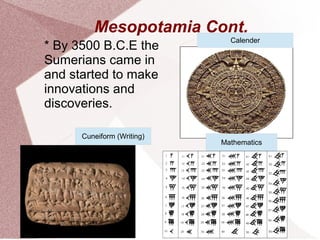
* By 3500 B.C.E the
Sumerians came in
and started to make
innovations and
discoveries.
Cuneiform (Writing)
Mathematics
Calender
Mesopotamia Cont.
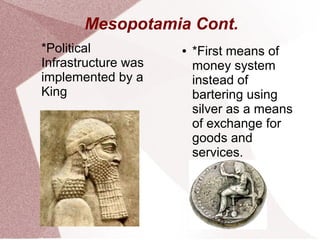
*Political
Infrastructure was
implemented by a
King
● *First means of
money system
instead of
bartering using
silver as a means
of exchange for
goods and
services.
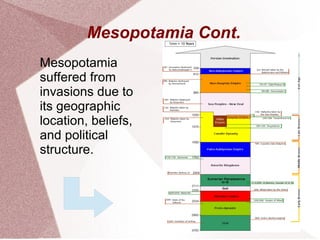
Mesopotamia Cont.
Mesopotamia
suffered from
invasions due to
its geographic
location, beliefs,
and political
structure.
Egypt
*Arose about
1000 years
after
Mesopotamia
due to the
influence of
trade and
technological
advances.
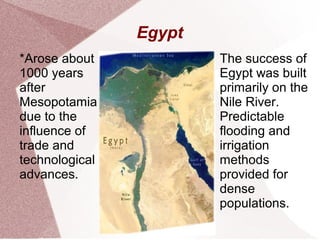
The success of
Egypt was built
primarily on the
Nile River.
Predictable
flooding and
irrigation
methods
provided for
dense
populations.
Egypt Cont.
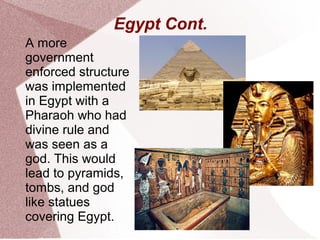
A more
government
enforced structure
was implemented
in Egypt with a
Pharaoh who had
divine rule and
was seen as a
god. This would
lead to pyramids,
tombs, and god
like statues
covering Egypt.
Egypt Cont.
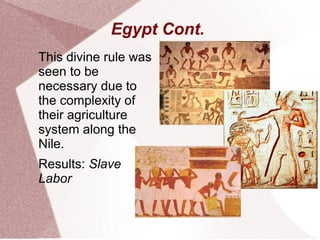
This divine rule was
seen to be
necessary due to
the complexity of
their agriculture
system along the
Nile.
Results: Slave
Labor
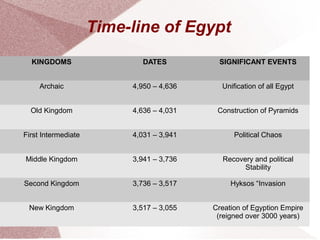
Time-line of Egypt
KINGDOMS DATES SIGNIFICANT EVENTS
Archaic 4,950 – 4,636 Unification of all Egypt
Old Kingdom 4,636 – 4,031 Construction of Pyramids
First Intermediate 4,031 – 3,941 Political Chaos
Middle Kingdom 3,941 – 3,736 Recovery and political
Stability
Second Kingdom 3,736 – 3,517 Hyksos “Invasion
New Kingdom 3,517 – 3,055 Creation of Egyption Empire
(reigned over 3000 years)
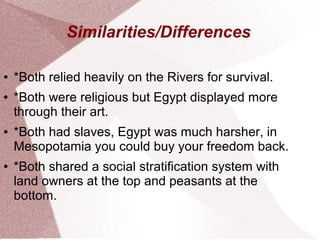
Similarities/Differences
● *Both relied heavily on the Rivers for survival.
● *Both were religious but Egypt displayed more
through their art.
● *Both had slaves, Egypt was much harsher, in
Mesopotamia you could buy your freedom back.
● *Both shared a social stratification system with
land owners at the top and peasants at the
bottom.
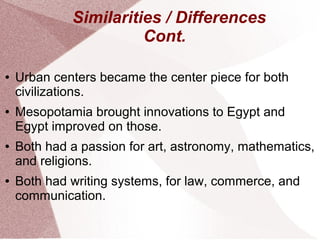
Similarities / Differences
Cont.
● Urban centers became the center piece for both
civilizations.
● Mesopotamia brought innovations to Egypt and
Egypt improved on those.
● Both had a passion for art, astronomy, mathematics,
and religions.
● Both had writing systems, for law, commerce, and
communication.
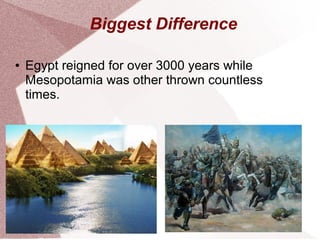
Biggest Difference
● Egypt reigned for over 3000 years while
Mesopotamia was other thrown countless
times.
Synopsis
It is remarkable what makes and shapes a
civilization from its political infrastructure, its
geography, religion, and so much more.
Each variable makes historians question what
makes each civilization prosper and not succumb to
outside or inside forces.
Works Cited
http://www-groups.dcs.st-
and.ac.uk/~history/HistTopics/Babylonian_num
erals.html
Stearns, Peter N. World History in Brief:
Major Patterns of Change and Continuity.
Boston: Pearson, 2012. Print.
http://web.archive.org/web/20001215160400/http://
www.anthro.mankato.msus.edu/prehistory/egypt/hi
story/timeline.html

Project history

  • 1.
    Mesopotamia * Located inthe middle east; along the banks of the Tigris and Euphrates rivers Location/Geography Egypt *Located in North/East Africa with the Nile River running through it These two rivers were essential to the survival of these two great civilizations
  • 2.
    Mesopotamia *Introduced writing as formallaw codes, city planning/architecture/ins titutions. *Created the wheel around 4000 B.C.E *Innovations in irrigation, farming, pottery, bronze, and copper. All of these innovations over time lead Mesopotamia into a More complex society
  • 3.
    Mesopotamia Cont. * By3500 B.C.E the Sumerians came in and started to make innovations and discoveries. Cuneiform (Writing) Mathematics Calender
  • 4.
    Mesopotamia Cont. *Political Infrastructure was implementedby a King ● *First means of money system instead of bartering using silver as a means of exchange for goods and services.
  • 5.
    Mesopotamia Cont. Mesopotamia suffered from invasionsdue to its geographic location, beliefs, and political structure.
  • 6.
    Egypt *Arose about 1000 years after Mesopotamia dueto the influence of trade and technological advances. The success of Egypt was built primarily on the Nile River. Predictable flooding and irrigation methods provided for dense populations.
  • 7.
    Egypt Cont. A more government enforcedstructure was implemented in Egypt with a Pharaoh who had divine rule and was seen as a god. This would lead to pyramids, tombs, and god like statues covering Egypt.
  • 8.
    Egypt Cont. This divinerule was seen to be necessary due to the complexity of their agriculture system along the Nile. Results: Slave Labor
  • 9.
    Time-line of Egypt KINGDOMSDATES SIGNIFICANT EVENTS Archaic 4,950 – 4,636 Unification of all Egypt Old Kingdom 4,636 – 4,031 Construction of Pyramids First Intermediate 4,031 – 3,941 Political Chaos Middle Kingdom 3,941 – 3,736 Recovery and political Stability Second Kingdom 3,736 – 3,517 Hyksos “Invasion New Kingdom 3,517 – 3,055 Creation of Egyption Empire (reigned over 3000 years)
  • 10.
    Similarities/Differences ● *Both reliedheavily on the Rivers for survival. ● *Both were religious but Egypt displayed more through their art. ● *Both had slaves, Egypt was much harsher, in Mesopotamia you could buy your freedom back. ● *Both shared a social stratification system with land owners at the top and peasants at the bottom.
  • 11.
    Similarities / Differences Cont. ●Urban centers became the center piece for both civilizations. ● Mesopotamia brought innovations to Egypt and Egypt improved on those. ● Both had a passion for art, astronomy, mathematics, and religions. ● Both had writing systems, for law, commerce, and communication.
  • 12.
    Biggest Difference ● Egyptreigned for over 3000 years while Mesopotamia was other thrown countless times.
  • 13.
    Synopsis It is remarkablewhat makes and shapes a civilization from its political infrastructure, its geography, religion, and so much more. Each variable makes historians question what makes each civilization prosper and not succumb to outside or inside forces.
  • 14.
    Works Cited http://www-groups.dcs.st- and.ac.uk/~history/HistTopics/Babylonian_num erals.html Stearns, PeterN. World History in Brief: Major Patterns of Change and Continuity. Boston: Pearson, 2012. Print. http://web.archive.org/web/20001215160400/http:// www.anthro.mankato.msus.edu/prehistory/egypt/hi story/timeline.html