PROJECT DEMO
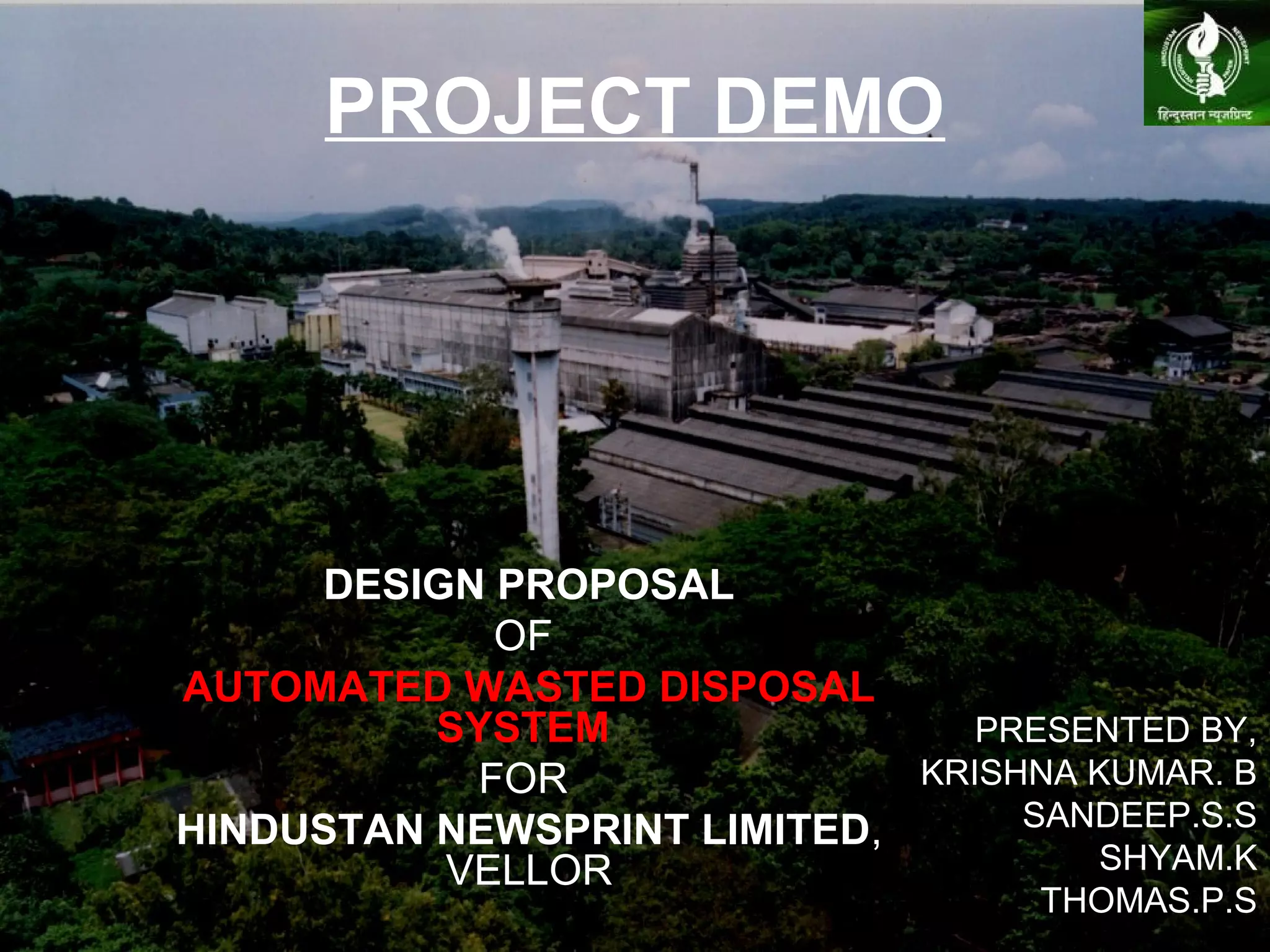
DESIGN PROPOSAL
OF
AUTOMATED WASTED DISPOSAL
SYSTEM
FOR
HINDUSTAN NEWSPRINT LIMITED,
VELLOR
PRESENTED BY,
KRISHNA KUMAR. B
SANDEEP.S.S
SHYAM.K
THOMAS.P.S
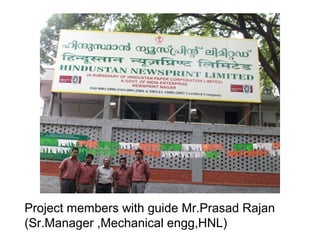
Project members with guide Mr.Prasad Rajan
(Sr.Manager ,Mechanical engg,HNL)
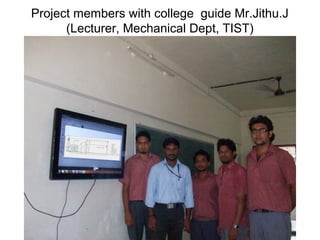
Project members with college guide Mr.Jithu.J
(Lecturer, Mechanical Dept, TIST)
OBJECTIVES
The main objectives of this project are:
• To study the current waste management system
in the industry.
• To replace the manually transported waste into
automated waste transportation to the truck.
INTRODUCTION
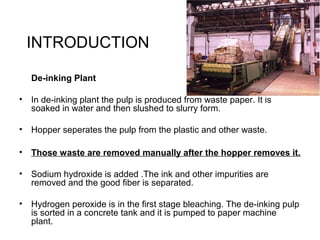
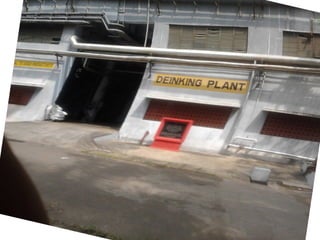
De-inking Plant
• In de-inking plant the pulp is produced from waste paper. It is
soaked in water and then slushed to slurry form.
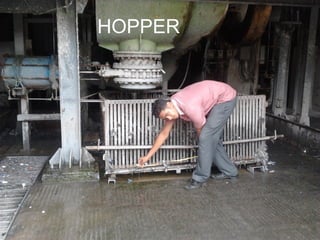
• Hopper seperates the pulp from the plastic and other waste.
• Those waste are removed manually after the hopper removes it.
• Sodium hydroxide is added .The ink and other impurities are
removed and the good fiber is separated.
• Hydrogen peroxide is in the first stage bleaching. The de-inking pulp
is sorted in a concrete tank and it is pumped to paper machine
plant.
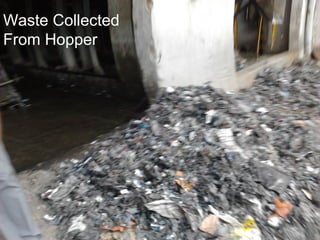
• In the De-inking plant the waste coming out of the hopper
is collected in a 1m x 1m x 1m box.
• From the hopper the waste comes in equal interval of time.
Later on, this after getting piled up, is manually transferred
to the truck using a shovel. This process is repeated and
requires much time which is a hectic job.
• The installation of this Automated Waste Disposal
System (AWDS) will be a substitute for that human labour.
• Through this project the design proposal of the Automated
Waste Disposal System (AWDS) is clearly shown.
HOPPER
Waste Collected
From Hopper
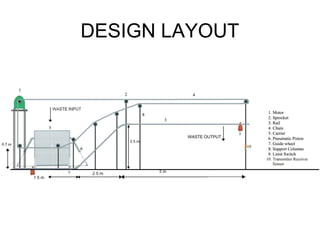
DESIGN LAYOUT
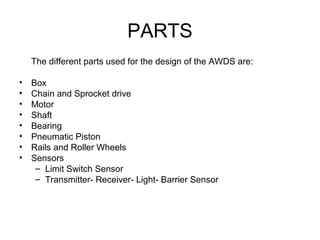
PARTS
The different parts used for the design of the AWDS are:
• Box
• Chain and Sprocket drive
• Motor
• Shaft
• Bearing
• Pneumatic Piston
• Rails and Roller Wheels
• Sensors
– Limit Switch Sensor
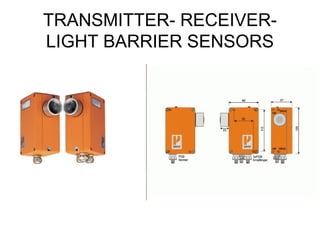
– Transmitter- Receiver- Light- Barrier Sensor
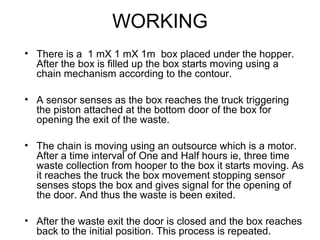
WORKING
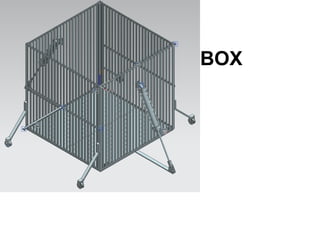
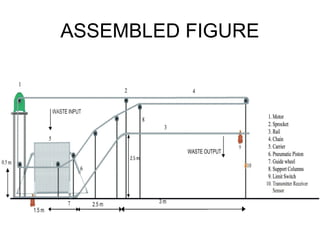
• There is a 1 mX 1 mX 1m box placed under the hopper.
After the box is filled up the box starts moving using a
chain mechanism according to the contour.
• A sensor senses as the box reaches the truck triggering
the piston attached at the bottom door of the box for
opening the exit of the waste.
• The chain is moving using an outsource which is a motor.
After a time interval of One and Half hours ie, three time
waste collection from hooper to the box it starts moving. As
it reaches the truck the box movement stopping sensor
senses stops the box and gives signal for the opening of
the door. And thus the waste is been exited.
• After the waste exit the door is closed and the box reaches
back to the initial position. This process is repeated.
• Small modifications are made for the automation system
such as :
• Bottom doors are attached to the box
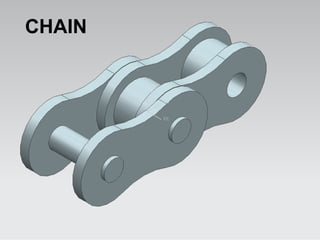
• Chains are included at the sides of the box for its
movement
• Sensors are added for :
– detection of the truck
– starting and stopping of the box movement
PARTS
The different parts used for the design of the AWDS are:
• Box
• Chain and Sprocket drive
• Motor
• Shaft
• Bearing
• Pneumatic Piston
• Rails and Roller Wheels
• Sensors
– Limit Switch Sensor
– Transmitter- Receiver- Light- Barrier Sensor
BOX
CHAIN
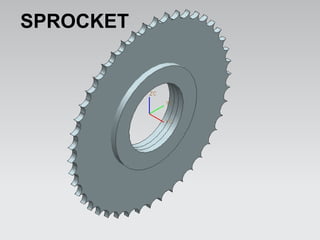
SPROCKET
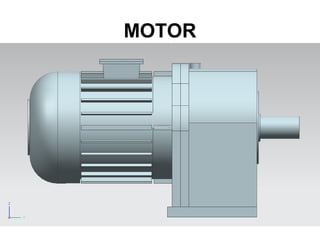
MOTOR
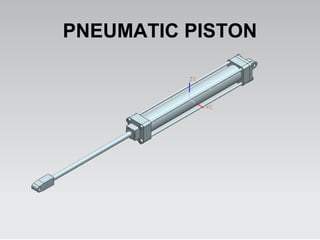
PNEUMATIC PISTON
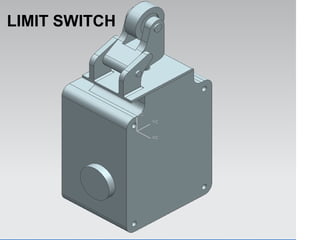
LIMIT SWITCH
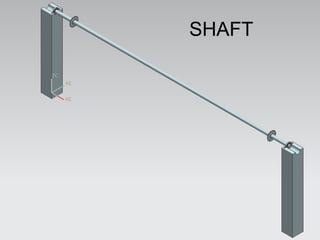
SHAFT
TRANSMITTER- RECEIVER-
LIGHT BARRIER SENSORS
ASSEMBLED FIGURE
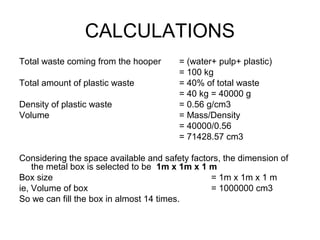
CALCULATIONS
Total waste coming from the hooper = (water+ pulp+ plastic)
= 100 kg
Total amount of plastic waste = 40% of total waste
= 40 kg = 40000 g
Density of plastic waste = 0.56 g/cm3
Volume = Mass/Density
= 40000/0.56
= 71428.57 cm3
Considering the space available and safety factors, the dimension of
the metal box is selected to be 1m x 1m x 1 m
Box size = 1m x 1m x 1 m
ie, Volume of box = 1000000 cm3
So we can fill the box in almost 14 times.
Design of Box
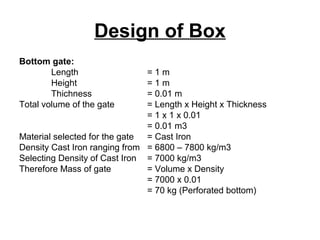
Bottom gate:
Length = 1 m
Height = 1 m
Thichness = 0.01 m
Total volume of the gate = Length x Height x Thickness
= 1 x 1 x 0.01
= 0.01 m3
Material selected for the gate = Cast Iron
Density Cast Iron ranging from = 6800 – 7800 kg/m3
Selecting Density of Cast Iron = 7000 kg/m3
Therefore Mass of gate = Volume x Density
= 7000 x 0.01
= 70 kg (Perforated bottom)
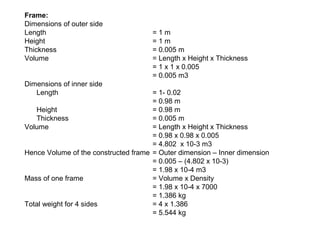
Frame:
Dimensions of outer side
Length = 1 m
Height = 1 m
Thickness = 0.005 m
Volume = Length x Height x Thickness
= 1 x 1 x 0.005
= 0.005 m3
Dimensions of inner side
Length = 1- 0.02
= 0.98 m
Height = 0.98 m
Thickness = 0.005 m
Volume = Length x Height x Thickness
= 0.98 x 0.98 x 0.005
= 4.802 x 10⁻³ m3
Hence Volume of the constructed frame = Outer dimension – Inner dimension
= 0.005 – (4.802 x 10⁻³)
= 1.98 x 10⁻⁴ m3
Mass of one frame = Volume x Density
= 1.98 x 10-4 x 7000
= 1.386 kg
Total weight for 4 sides = 4 x 1.386
= 5.544 kg
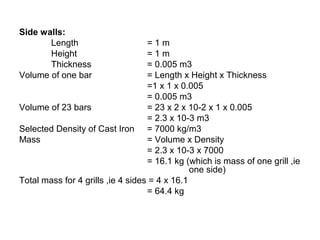
Side walls:
Length = 1 m
Height = 1 m
Thickness = 0.005 m3
Volume of one bar = Length x Height x Thickness
=1 x 1 x 0.005
= 0.005 m3
Volume of 23 bars = 23 x 2 x 10-2 x 1 x 0.005
= 2.3 x 10⁻³ m3
Selected Density of Cast Iron = 7000 kg/m3
Mass = Volume x Density
= 2.3 x 10-3 x 7000
= 16.1 kg (which is mass of one grill ,ie
one side)
Total mass for 4 grills ,ie 4 sides = 4 x 16.1
= 64.4 kg
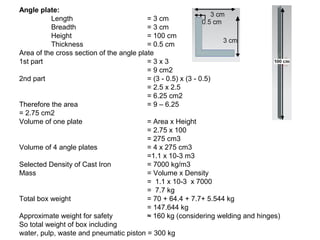
Angle plate:
Length = 3 cm
Breadth = 3 cm
Height = 100 cm
Thickness = 0.5 cm
Area of the cross section of the angle plate
1st part = 3 x 3
= 9 cm2
2nd part = (3 - 0.5) x (3 - 0.5)
= 2.5 x 2.5
= 6.25 cm2
Therefore the area = 9 – 6.25
= 2.75 cm2
Volume of one plate = Area x Height
= 2.75 x 100
= 275 cm3
Volume of 4 angle plates = 4 x 275 cm3
=1.1 x 10⁻³ m3
Selected Density of Cast Iron = 7000 kg/m3
Mass = Volume x Density
= 1.1 x 10-3 x 7000
= 7.7 kg
Total box weight = 70 + 64.4 + 7.7+ 5.544 kg
= 147.644 kg
Approximate weight for safety ≈ 160 kg (considering welding and hinges)
So total weight of box including
water, pulp, waste and pneumatic piston = 300 kg
Force Analysis
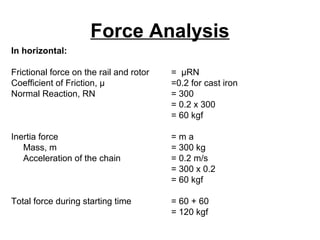
In horizontal:
Frictional force on the rail and rotor = µRN
Coefficient of Friction, µ =0.2 for cast iron
Normal Reaction, RN = 300
= 0.2 x 300
= 60 kgf
Inertia force = m a
Mass, m = 300 kg
Acceleration of the chain = 0.2 m/s
= 300 x 0.2
= 60 kgf
Total force during starting time = 60 + 60
= 120 kgf
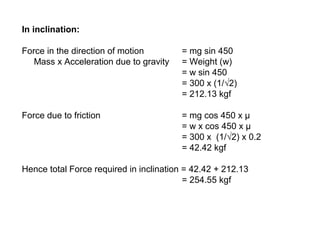
In inclination:
Force in the direction of motion = mg sin 450
Mass x Acceleration due to gravity = Weight (w)
= w sin 450
= 300 x (1/√2)
= 212.13 kgf
Force due to friction = mg cos 450 x µ
= w x cos 450 x µ
= 300 x (1/√2) x 0.2
= 42.42 kgf
Hence total Force required in inclination = 42.42 + 212.13
= 254.55 kgf
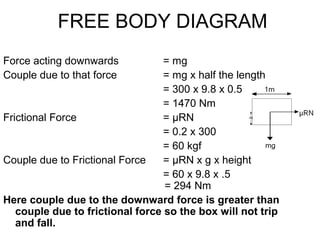
FREE BODY DIAGRAM
Force acting downwards = mg
Couple due to that force = mg x half the length
= 300 x 9.8 x 0.5
= 1470 Nm
Frictional Force = µRN
= 0.2 x 300
= 60 kgf
Couple due to Frictional Force = µRN x g x height
= 60 x 9.8 x .5
= 294 Nm
Here couple due to the downward force is greater than
couple due to frictional force so the box will not trip
and fall.
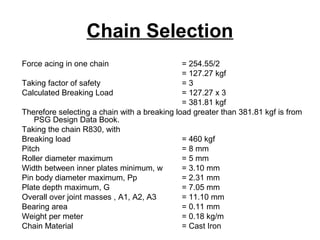
Chain Selection
Force acing in one chain = 254.55/2
= 127.27 kgf
Taking factor of safety = 3
Calculated Breaking Load = 127.27 x 3
= 381.81 kgf
Therefore selecting a chain with a breaking load greater than 381.81 kgf is from
PSG Design Data Book.
Taking the chain R830, with
Breaking load = 460 kgf
Pitch = 8 mm
Roller diameter maximum = 5 mm
Width between inner plates minimum, w = 3.10 mm
Pin body diameter maximum, Pp = 2.31 mm
Plate depth maximum, G = 7.05 mm
Overall over joint masses , A1, A2, A3 = 11.10 mm
Bearing area = 0.11 mm
Weight per meter = 0.18 kg/m
Chain Material = Cast Iron
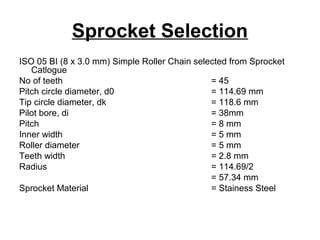
Sprocket Selection
ISO 05 BI (8 x 3.0 mm) Simple Roller Chain selected from Sprocket
Catlogue
No of teeth = 45
Pitch circle diameter, d0 = 114.69 mm
Tip circle diameter, dk = 118.6 mm
Pilot bore, di = 38mm
Pitch = 8 mm
Inner width = 5 mm
Roller diameter = 5 mm
Teeth width = 2.8 mm
Radius = 114.69/2
= 57.34 mm
Sprocket Material = Stainess Steel
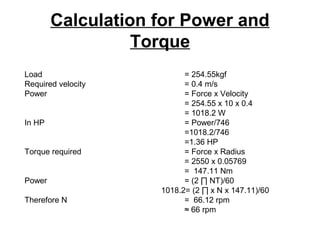
Calculation for Power and
Torque
Load = 254.55kgf
Required velocity = 0.4 m/s
Power = Force x Velocity
= 254.55 x 10 x 0.4
= 1018.2 W
In HP = Power/746
=1018.2/746
=1.36 HP
Torque required = Force x Radius
= 2550 x 0.05769
= 147.11 Nm
Power = (2 ∏ NT)/60
1018.2= (2 ∏ x N x 147.11)/60
Therefore N = 66.12 rpm
≈ 66 rpm
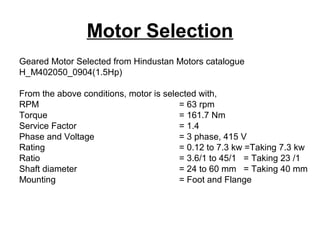
Motor Selection
Geared Motor Selected from Hindustan Motors catalogue
H_M402050_0904(1.5Hp)
From the above conditions, motor is selected with,
RPM = 63 rpm
Torque = 161.7 Nm
Service Factor = 1.4
Phase and Voltage = 3 phase, 415 V
Rating = 0.12 to 7.3 kw =Taking 7.3 kw
Ratio = 3.6/1 to 45/1 = Taking 23 /1
Shaft diameter = 24 to 60 mm = Taking 40 mm
Mounting = Foot and Flange
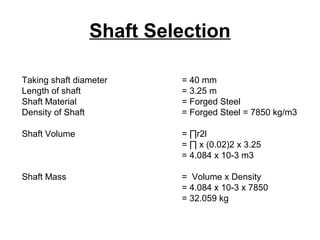
Shaft Selection
Taking shaft diameter = 40 mm
Length of shaft = 3.25 m
Shaft Material = Forged Steel
Density of Shaft = Forged Steel = 7850 kg/m3
Shaft Volume = ∏r2l
= ∏ x (0.02)2 x 3.25
= 4.084 x 10⁻³ m3
Shaft Mass = Volume x Density
= 4.084 x 10-3 x 7850
= 32.059 kg
Bearing Design
Density of Sprocket = Stainless Steel = 7480-8000 kg/m3
Selecting Density of Stainless Steel = 7500 kg/m3
Sprocket Volume = ∏r2l
= ∏ x ([118.6/2]2 – [40/2]2) x 2.8
= 27414.0778 mm3
Sprocket Mass = Volume x Density
= 27414.0778 x 10-9 x 7500
= 0.205 kg x 2
= 0.411 kg
Total Radial Load Acting on the Bearing = Shaft Mass + Bearing Mass
= 32.059 + 0.411
= 32.4702 kg
Axial Load, Fa = 0 kgf
Radial Load, Fr = 32.4702 /2
= 16.23 kg (for one bearing)
Equivalent Load , P = ( X Fr + Y Fa) S
Taking ,
Radial Factor, X = 1
Thrust Factor, Y = 0
Service Factor, S = 1.3
Therefore ,P = X Fr S
= 1 x 16.23 x 1.3
= 21.099 kg
Length of Chain at Inclination
According to Pythagoras Theorem
AC2 = √( AB2 +BC2)
AC = (2.52 + 2.52)
AC = 3.5 m
Total travel distance = 2.5 +3.5 + 1.5
= 7.5 m
Velocity, V = ω r
Radial Velocity, ω = [(2 x ∏ x N)/60]
rpm, N = 63 rpm
Therefore, V = [(2 x ∏ x N)/60] x r
= [(2 x ∏ x 63)/ 60] x (0.11469/2)
= 0.37 m/s
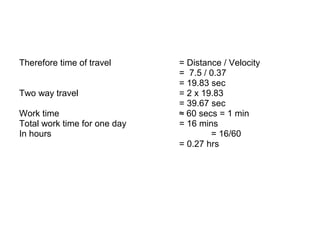
Therefore time of travel = Distance / Velocity
= 7.5 / 0.37
= 19.83 sec
Two way travel = 2 x 19.83
= 39.67 sec
Work time ≈ 60 secs = 1 min
Total work time for one day = 16 mins
In hours = 16/60
= 0.27 hrs
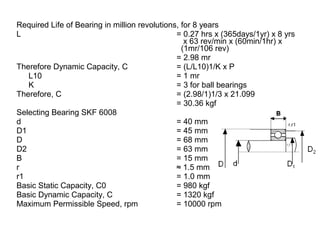
Required Life of Bearing in million revolutions, for 8 years
L = 0.27 hrs x (365days/1yr) x 8 yrs
x 63 rev/min x (60min/1hr) x
(1mr/106 rev)
= 2.98 mr
Therefore Dynamic Capacity, C = (L/L10)1/K x P
L10 = 1 mr
K = 3 for ball bearings
Therefore, C = (2.98/1)1/3 x 21.099
= 30.36 kgf
Selecting Bearing SKF 6008
d = 40 mm
D1 = 45 mm
D = 68 mm
D2 = 63 mm
B = 15 mm
r ≈ 1.5 mm
r1 = 1.0 mm
Basic Static Capacity, C0 = 980 kgf
Basic Dynamic Capacity, C = 1320 kgf
Maximum Permissible Speed, rpm = 10000 rpm
Bearing Probability of Survival
We know that, C1 = (L101/L10)1/K x P1
= (L101/1)1/3 x 21.099
Therefore, L101 = 244870.336 mr
L/L101 = [ln(1/p1)/ln(1/p10)]1/b
L101 = calculated life of the selected bearing, for given load for 90%
survival
Ln(1/p10) = ln(1/0.9) = 0.1053
b = 1.34 for deep grove ball bearings
2.98/244870.336 = [ln (1/p)/ 0.1053)1/1.34
Therefore, p1 = 0.9999
= 99.99%
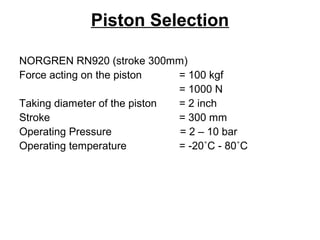
Piston Selection
NORGREN RN920 (stroke 300mm)
Force acting on the piston = 100 kgf
= 1000 N
Taking diameter of the piston = 2 inch
Stroke = 300 mm
Operating Pressure = 2 – 10 bar
Operating temperature = -20˚C - 80˚C
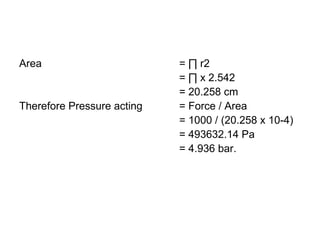
Area = ∏ r2
= ∏ x 2.542
= 20.258 cm
Therefore Pressure acting = Force / Area
= 1000 / (20.258 x 10⁻⁴)
= 493632.14 Pa
= 4.936 bar.
CONCLUSION
• By completion of this project the Industry
gets a good profit.
• This machine can also be used in many
Industry. Can used also in various raw
material transportation.
• Though this kind of system exists in
various fields, the AWDS is one of a kind
which is so simple and is ecofriendly.
BIBLIOGRAPHY
• PSG Data book
• www.fotoelectik-pauly.de
• www.imis.com
• Hindustan electric motors Catlogue
• Norgen RM Cylinders Catlogue
PROJECT DEMO final

PROJECT DEMO final

  • 1.
    PROJECT DEMO DESIGN PROPOSAL OF AUTOMATEDWASTED DISPOSAL SYSTEM FOR HINDUSTAN NEWSPRINT LIMITED, VELLOR PRESENTED BY, KRISHNA KUMAR. B SANDEEP.S.S SHYAM.K THOMAS.P.S
  • 2.
    Project members withguide Mr.Prasad Rajan (Sr.Manager ,Mechanical engg,HNL)
  • 3.
    Project members withcollege guide Mr.Jithu.J (Lecturer, Mechanical Dept, TIST)
  • 4.
    OBJECTIVES The main objectivesof this project are: • To study the current waste management system in the industry. • To replace the manually transported waste into automated waste transportation to the truck.
  • 5.
    INTRODUCTION De-inking Plant • Inde-inking plant the pulp is produced from waste paper. It is soaked in water and then slushed to slurry form. • Hopper seperates the pulp from the plastic and other waste. • Those waste are removed manually after the hopper removes it. • Sodium hydroxide is added .The ink and other impurities are removed and the good fiber is separated. • Hydrogen peroxide is in the first stage bleaching. The de-inking pulp is sorted in a concrete tank and it is pumped to paper machine plant.
  • 7.
    • In theDe-inking plant the waste coming out of the hopper is collected in a 1m x 1m x 1m box. • From the hopper the waste comes in equal interval of time. Later on, this after getting piled up, is manually transferred to the truck using a shovel. This process is repeated and requires much time which is a hectic job. • The installation of this Automated Waste Disposal System (AWDS) will be a substitute for that human labour. • Through this project the design proposal of the Automated Waste Disposal System (AWDS) is clearly shown.
  • 8.
  • 9.
  • 10.
  • 11.
    PARTS The different partsused for the design of the AWDS are: • Box • Chain and Sprocket drive • Motor • Shaft • Bearing • Pneumatic Piston • Rails and Roller Wheels • Sensors – Limit Switch Sensor – Transmitter- Receiver- Light- Barrier Sensor
  • 12.
    WORKING • There isa 1 mX 1 mX 1m box placed under the hopper. After the box is filled up the box starts moving using a chain mechanism according to the contour. • A sensor senses as the box reaches the truck triggering the piston attached at the bottom door of the box for opening the exit of the waste. • The chain is moving using an outsource which is a motor. After a time interval of One and Half hours ie, three time waste collection from hooper to the box it starts moving. As it reaches the truck the box movement stopping sensor senses stops the box and gives signal for the opening of the door. And thus the waste is been exited. • After the waste exit the door is closed and the box reaches back to the initial position. This process is repeated.
  • 13.
    • Small modificationsare made for the automation system such as : • Bottom doors are attached to the box • Chains are included at the sides of the box for its movement • Sensors are added for : – detection of the truck – starting and stopping of the box movement
  • 14.
    PARTS The different partsused for the design of the AWDS are: • Box • Chain and Sprocket drive • Motor • Shaft • Bearing • Pneumatic Piston • Rails and Roller Wheels • Sensors – Limit Switch Sensor – Transmitter- Receiver- Light- Barrier Sensor
  • 15.
  • 16.
  • 17.
  • 18.
  • 19.
  • 20.
  • 21.
  • 22.
  • 23.
  • 24.
    CALCULATIONS Total waste comingfrom the hooper = (water+ pulp+ plastic) = 100 kg Total amount of plastic waste = 40% of total waste = 40 kg = 40000 g Density of plastic waste = 0.56 g/cm3 Volume = Mass/Density = 40000/0.56 = 71428.57 cm3 Considering the space available and safety factors, the dimension of the metal box is selected to be 1m x 1m x 1 m Box size = 1m x 1m x 1 m ie, Volume of box = 1000000 cm3 So we can fill the box in almost 14 times.
  • 25.
    Design of Box Bottomgate: Length = 1 m Height = 1 m Thichness = 0.01 m Total volume of the gate = Length x Height x Thickness = 1 x 1 x 0.01 = 0.01 m3 Material selected for the gate = Cast Iron Density Cast Iron ranging from = 6800 – 7800 kg/m3 Selecting Density of Cast Iron = 7000 kg/m3 Therefore Mass of gate = Volume x Density = 7000 x 0.01 = 70 kg (Perforated bottom)
  • 26.
    Frame: Dimensions of outerside Length = 1 m Height = 1 m Thickness = 0.005 m Volume = Length x Height x Thickness = 1 x 1 x 0.005 = 0.005 m3 Dimensions of inner side Length = 1- 0.02 = 0.98 m Height = 0.98 m Thickness = 0.005 m Volume = Length x Height x Thickness = 0.98 x 0.98 x 0.005 = 4.802 x 10⁻³ m3 Hence Volume of the constructed frame = Outer dimension – Inner dimension = 0.005 – (4.802 x 10⁻³) = 1.98 x 10⁻⁴ m3 Mass of one frame = Volume x Density = 1.98 x 10-4 x 7000 = 1.386 kg Total weight for 4 sides = 4 x 1.386 = 5.544 kg
  • 27.
    Side walls: Length =1 m Height = 1 m Thickness = 0.005 m3 Volume of one bar = Length x Height x Thickness =1 x 1 x 0.005 = 0.005 m3 Volume of 23 bars = 23 x 2 x 10-2 x 1 x 0.005 = 2.3 x 10⁻³ m3 Selected Density of Cast Iron = 7000 kg/m3 Mass = Volume x Density = 2.3 x 10-3 x 7000 = 16.1 kg (which is mass of one grill ,ie one side) Total mass for 4 grills ,ie 4 sides = 4 x 16.1 = 64.4 kg
  • 28.
    Angle plate: Length =3 cm Breadth = 3 cm Height = 100 cm Thickness = 0.5 cm Area of the cross section of the angle plate 1st part = 3 x 3 = 9 cm2 2nd part = (3 - 0.5) x (3 - 0.5) = 2.5 x 2.5 = 6.25 cm2 Therefore the area = 9 – 6.25 = 2.75 cm2 Volume of one plate = Area x Height = 2.75 x 100 = 275 cm3 Volume of 4 angle plates = 4 x 275 cm3 =1.1 x 10⁻³ m3 Selected Density of Cast Iron = 7000 kg/m3 Mass = Volume x Density = 1.1 x 10-3 x 7000 = 7.7 kg Total box weight = 70 + 64.4 + 7.7+ 5.544 kg = 147.644 kg Approximate weight for safety ≈ 160 kg (considering welding and hinges) So total weight of box including water, pulp, waste and pneumatic piston = 300 kg
  • 29.
    Force Analysis In horizontal: Frictionalforce on the rail and rotor = µRN Coefficient of Friction, µ =0.2 for cast iron Normal Reaction, RN = 300 = 0.2 x 300 = 60 kgf Inertia force = m a Mass, m = 300 kg Acceleration of the chain = 0.2 m/s = 300 x 0.2 = 60 kgf Total force during starting time = 60 + 60 = 120 kgf
  • 30.
    In inclination: Force inthe direction of motion = mg sin 450 Mass x Acceleration due to gravity = Weight (w) = w sin 450 = 300 x (1/√2) = 212.13 kgf Force due to friction = mg cos 450 x µ = w x cos 450 x µ = 300 x (1/√2) x 0.2 = 42.42 kgf Hence total Force required in inclination = 42.42 + 212.13 = 254.55 kgf
  • 31.
    FREE BODY DIAGRAM Forceacting downwards = mg Couple due to that force = mg x half the length = 300 x 9.8 x 0.5 = 1470 Nm Frictional Force = µRN = 0.2 x 300 = 60 kgf Couple due to Frictional Force = µRN x g x height = 60 x 9.8 x .5 = 294 Nm Here couple due to the downward force is greater than couple due to frictional force so the box will not trip and fall.
  • 32.
    Chain Selection Force acingin one chain = 254.55/2 = 127.27 kgf Taking factor of safety = 3 Calculated Breaking Load = 127.27 x 3 = 381.81 kgf Therefore selecting a chain with a breaking load greater than 381.81 kgf is from PSG Design Data Book. Taking the chain R830, with Breaking load = 460 kgf Pitch = 8 mm Roller diameter maximum = 5 mm Width between inner plates minimum, w = 3.10 mm Pin body diameter maximum, Pp = 2.31 mm Plate depth maximum, G = 7.05 mm Overall over joint masses , A1, A2, A3 = 11.10 mm Bearing area = 0.11 mm Weight per meter = 0.18 kg/m Chain Material = Cast Iron
  • 33.
    Sprocket Selection ISO 05BI (8 x 3.0 mm) Simple Roller Chain selected from Sprocket Catlogue No of teeth = 45 Pitch circle diameter, d0 = 114.69 mm Tip circle diameter, dk = 118.6 mm Pilot bore, di = 38mm Pitch = 8 mm Inner width = 5 mm Roller diameter = 5 mm Teeth width = 2.8 mm Radius = 114.69/2 = 57.34 mm Sprocket Material = Stainess Steel
  • 34.
    Calculation for Powerand Torque Load = 254.55kgf Required velocity = 0.4 m/s Power = Force x Velocity = 254.55 x 10 x 0.4 = 1018.2 W In HP = Power/746 =1018.2/746 =1.36 HP Torque required = Force x Radius = 2550 x 0.05769 = 147.11 Nm Power = (2 ∏ NT)/60 1018.2= (2 ∏ x N x 147.11)/60 Therefore N = 66.12 rpm ≈ 66 rpm
  • 35.
    Motor Selection Geared MotorSelected from Hindustan Motors catalogue H_M402050_0904(1.5Hp) From the above conditions, motor is selected with, RPM = 63 rpm Torque = 161.7 Nm Service Factor = 1.4 Phase and Voltage = 3 phase, 415 V Rating = 0.12 to 7.3 kw =Taking 7.3 kw Ratio = 3.6/1 to 45/1 = Taking 23 /1 Shaft diameter = 24 to 60 mm = Taking 40 mm Mounting = Foot and Flange
  • 36.
    Shaft Selection Taking shaftdiameter = 40 mm Length of shaft = 3.25 m Shaft Material = Forged Steel Density of Shaft = Forged Steel = 7850 kg/m3 Shaft Volume = ∏r2l = ∏ x (0.02)2 x 3.25 = 4.084 x 10⁻³ m3 Shaft Mass = Volume x Density = 4.084 x 10-3 x 7850 = 32.059 kg
  • 37.
    Bearing Design Density ofSprocket = Stainless Steel = 7480-8000 kg/m3 Selecting Density of Stainless Steel = 7500 kg/m3 Sprocket Volume = ∏r2l = ∏ x ([118.6/2]2 – [40/2]2) x 2.8 = 27414.0778 mm3 Sprocket Mass = Volume x Density = 27414.0778 x 10-9 x 7500 = 0.205 kg x 2 = 0.411 kg Total Radial Load Acting on the Bearing = Shaft Mass + Bearing Mass = 32.059 + 0.411 = 32.4702 kg Axial Load, Fa = 0 kgf Radial Load, Fr = 32.4702 /2 = 16.23 kg (for one bearing) Equivalent Load , P = ( X Fr + Y Fa) S Taking , Radial Factor, X = 1 Thrust Factor, Y = 0 Service Factor, S = 1.3 Therefore ,P = X Fr S = 1 x 16.23 x 1.3 = 21.099 kg
  • 38.
    Length of Chainat Inclination According to Pythagoras Theorem AC2 = √( AB2 +BC2) AC = (2.52 + 2.52) AC = 3.5 m Total travel distance = 2.5 +3.5 + 1.5 = 7.5 m Velocity, V = ω r Radial Velocity, ω = [(2 x ∏ x N)/60] rpm, N = 63 rpm Therefore, V = [(2 x ∏ x N)/60] x r = [(2 x ∏ x 63)/ 60] x (0.11469/2) = 0.37 m/s
  • 39.
    Therefore time oftravel = Distance / Velocity = 7.5 / 0.37 = 19.83 sec Two way travel = 2 x 19.83 = 39.67 sec Work time ≈ 60 secs = 1 min Total work time for one day = 16 mins In hours = 16/60 = 0.27 hrs
  • 40.
    Required Life ofBearing in million revolutions, for 8 years L = 0.27 hrs x (365days/1yr) x 8 yrs x 63 rev/min x (60min/1hr) x (1mr/106 rev) = 2.98 mr Therefore Dynamic Capacity, C = (L/L10)1/K x P L10 = 1 mr K = 3 for ball bearings Therefore, C = (2.98/1)1/3 x 21.099 = 30.36 kgf Selecting Bearing SKF 6008 d = 40 mm D1 = 45 mm D = 68 mm D2 = 63 mm B = 15 mm r ≈ 1.5 mm r1 = 1.0 mm Basic Static Capacity, C0 = 980 kgf Basic Dynamic Capacity, C = 1320 kgf Maximum Permissible Speed, rpm = 10000 rpm
  • 41.
    Bearing Probability ofSurvival We know that, C1 = (L101/L10)1/K x P1 = (L101/1)1/3 x 21.099 Therefore, L101 = 244870.336 mr L/L101 = [ln(1/p1)/ln(1/p10)]1/b L101 = calculated life of the selected bearing, for given load for 90% survival Ln(1/p10) = ln(1/0.9) = 0.1053 b = 1.34 for deep grove ball bearings 2.98/244870.336 = [ln (1/p)/ 0.1053)1/1.34 Therefore, p1 = 0.9999 = 99.99%
  • 42.
    Piston Selection NORGREN RN920(stroke 300mm) Force acting on the piston = 100 kgf = 1000 N Taking diameter of the piston = 2 inch Stroke = 300 mm Operating Pressure = 2 – 10 bar Operating temperature = -20˚C - 80˚C
  • 43.
    Area = ∏r2 = ∏ x 2.542 = 20.258 cm Therefore Pressure acting = Force / Area = 1000 / (20.258 x 10⁻⁴) = 493632.14 Pa = 4.936 bar.
  • 44.
    CONCLUSION • By completionof this project the Industry gets a good profit. • This machine can also be used in many Industry. Can used also in various raw material transportation. • Though this kind of system exists in various fields, the AWDS is one of a kind which is so simple and is ecofriendly.
  • 45.
    BIBLIOGRAPHY • PSG Databook • www.fotoelectik-pauly.de • www.imis.com • Hindustan electric motors Catlogue • Norgen RM Cylinders Catlogue