PROJECT CLOSING-WAYS OF
CLOSING A PROJECT –PROCESS OF
CLOSING A PROJECT
Jiyadjaleel
MHA- 2nd
Year
INTRODUCTION
• A project is a temporary endeavor that is needed to produce a unique outcome or result at a pre
specified time using predetermined resources.
• The project lifecycle consists of five groups:
• Initiating process group
• Planning process group
• Executing process group
• Monitoring and controlling process group
• Closing process group
PROJECT CLOSURE
• The closing phase of project management is the final phase of
the project lifecycle. This is the stage where all deliverables are finalized and
formally transferred, and all documentation is signed off, approved, and
archived.
The project closure process ensures that:
• All work has been completed according to the project plan and scope.
• All project management processes have been executed.
• You have received final sign-off and approval from all parties
IMPORTANCE OF CLOSING A PROJECT
• The project management closure process also gives the team the
opportunity to review and evaluate the project’s performance to ensure
future projects’ success.
• Following a clear project closure plan helps you properly transition your
solution to the client or end-user. This process ensures the final stakeholders
have the information, resources, and training to successfully manage and
use the end product.
• The project closure process also ensures the project is formally completed
and is no longer considered a project, allowing you to hand the reins over to
the correct team in charge of managing and maintaining the project’s
outputs.
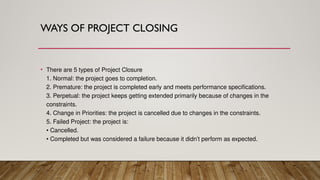
WAYS OF PROJECT CLOSING
• There are 5 types of Project Closure
1. Normal: the project goes to completion.
2. Premature: the project is completed early and meets performance specifications.
3. Perpetual: the project keeps getting extended primarily because of changes in the
constraints.
4. Change in Priorities: the project is cancelled due to changes in the constraints.
5. Failed Project: the project is:
• Cancelled.
• Completed but was considered a failure because it didn’t perform as expected.
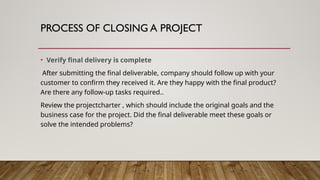
PROCESS OF CLOSING A PROJECT
• Verify final delivery is complete
After submitting the final deliverable, company should follow up with your
customer to confirm they received it. Are they happy with the final product?
Are there any follow-up tasks required..
Review the projectcharter , which should include the original goals and the
business case for the project. Did the final deliverable meet these goals or
solve the intended problems?
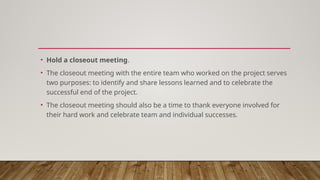
• Hold a closeout meeting.
• The closeout meeting with the entire team who worked on the project serves
two purposes: to identify and share lessons learned and to celebrate the
successful end of the project.
• The closeout meeting should also be a time to thank everyone involved for
their hard work and celebrate team and individual successes.
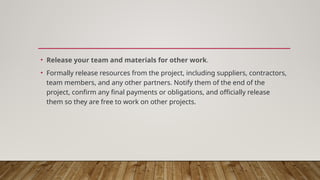
• Release your team and materials for other work.
• Formally release resources from the project, including suppliers, contractors,
team members, and any other partners. Notify them of the end of the
project, confirm any final payments or obligations, and officially release
them so they are free to work on other projects.
• Ensure project documents are properly filed
• it is important to make sure project documents are filed This allows the
documents to be retrieved if needed or for others to learn from the work
that was completed.
• This step may also involve making sure your contracts manager is aware that
the project has ended so he or she can send out the final invoice or close out
any additional contractual paperwork.
REFERENCES
• Hospital administration and planning-Dr.AG.Chandorkar, 2nd
edition paras publishing,
2009.
• https://www.lucidchart.com/blog/nailing-the-project-management-closure-process
THANKYOU

Project closing in the organization.pptx

  • 1.
    PROJECT CLOSING-WAYS OF CLOSINGA PROJECT –PROCESS OF CLOSING A PROJECT Jiyadjaleel MHA- 2nd Year
  • 2.
    INTRODUCTION • A projectis a temporary endeavor that is needed to produce a unique outcome or result at a pre specified time using predetermined resources. • The project lifecycle consists of five groups: • Initiating process group • Planning process group • Executing process group • Monitoring and controlling process group • Closing process group
  • 3.
    PROJECT CLOSURE • Theclosing phase of project management is the final phase of the project lifecycle. This is the stage where all deliverables are finalized and formally transferred, and all documentation is signed off, approved, and archived. The project closure process ensures that: • All work has been completed according to the project plan and scope. • All project management processes have been executed. • You have received final sign-off and approval from all parties
  • 4.
    IMPORTANCE OF CLOSINGA PROJECT • The project management closure process also gives the team the opportunity to review and evaluate the project’s performance to ensure future projects’ success. • Following a clear project closure plan helps you properly transition your solution to the client or end-user. This process ensures the final stakeholders have the information, resources, and training to successfully manage and use the end product. • The project closure process also ensures the project is formally completed and is no longer considered a project, allowing you to hand the reins over to the correct team in charge of managing and maintaining the project’s outputs.
  • 5.
    WAYS OF PROJECTCLOSING • There are 5 types of Project Closure 1. Normal: the project goes to completion. 2. Premature: the project is completed early and meets performance specifications. 3. Perpetual: the project keeps getting extended primarily because of changes in the constraints. 4. Change in Priorities: the project is cancelled due to changes in the constraints. 5. Failed Project: the project is: • Cancelled. • Completed but was considered a failure because it didn’t perform as expected.
  • 6.
    PROCESS OF CLOSINGA PROJECT • Verify final delivery is complete After submitting the final deliverable, company should follow up with your customer to confirm they received it. Are they happy with the final product? Are there any follow-up tasks required.. Review the projectcharter , which should include the original goals and the business case for the project. Did the final deliverable meet these goals or solve the intended problems?
  • 7.
    • Hold acloseout meeting. • The closeout meeting with the entire team who worked on the project serves two purposes: to identify and share lessons learned and to celebrate the successful end of the project. • The closeout meeting should also be a time to thank everyone involved for their hard work and celebrate team and individual successes.
  • 8.
    • Release yourteam and materials for other work. • Formally release resources from the project, including suppliers, contractors, team members, and any other partners. Notify them of the end of the project, confirm any final payments or obligations, and officially release them so they are free to work on other projects.
  • 9.
    • Ensure projectdocuments are properly filed • it is important to make sure project documents are filed This allows the documents to be retrieved if needed or for others to learn from the work that was completed. • This step may also involve making sure your contracts manager is aware that the project has ended so he or she can send out the final invoice or close out any additional contractual paperwork.
  • 10.
    REFERENCES • Hospital administrationand planning-Dr.AG.Chandorkar, 2nd edition paras publishing, 2009. • https://www.lucidchart.com/blog/nailing-the-project-management-closure-process
  • 11.