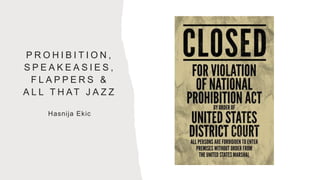
P R O H I B I T I O N ,
S P E A K E A S I E S ,
F L A P P E R S &
A L L T H AT J A Z Z
Hasnija Ekic
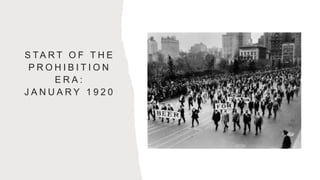
S TA R T O F T H E
P R O H I B I T I O N
E R A :
J A N U A R Y 1 9 2 0
T H E S I S
S TAT E M E N T
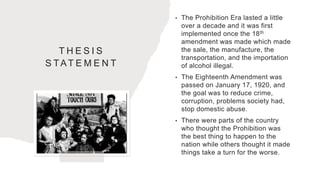
• The Prohibition Era lasted a little
over a decade and it was first
implemented once the 18th
amendment was made which made
the sale, the manufacture, the
transportation, and the importation
of alcohol illegal.
• The Eighteenth Amendment was
passed on January 17, 1920, and
the goal was to reduce crime,
corruption, problems society had,
stop domestic abuse.
• There were parts of the country
who thought the Prohibition was
the best thing to happen to the
nation while others thought it made
things take a turn for the worse.
W H E N D I D I T
S TA R T ?
The Prohibition Era started in the United States
around 1920 and it lasted over a decade.
Basically, there was a ban on importation,
transportation, and sale of alcoholic beverages
and. This ban was nationwide as well.
There were many people in the country against
it, and this is the main reason for the increase
in crime.
With the the start of the prohibition people
started opening speakeasies to distribute and
have secret bars with alcoholic beverages.
Most speakeasies started shortly after the
prohibition of alcohol took effect.
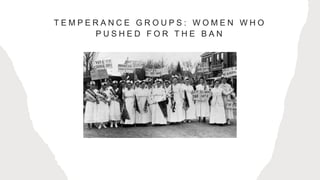
T E M P E R A N C E G R O U P S : W O M E N W H O
P U S H E D F O R T H E B A N
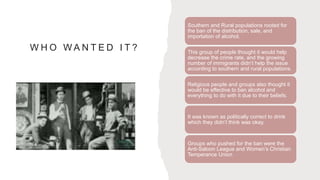
W H O W A N T E D I T ?
Southern and Rural populations rooted for
the ban of the distribution, sale, and
importation of alcohol.
This group of people thought it would help
decrease the crime rate, and the growing
number of immigrants didn’t help the issue
according to southern and rural populations.
Religious people and groups also thought it
would be effective to ban alcohol and
everything to do with it due to their beliefs.
It was known as politically correct to drink
which they didn’t think was okay.
Groups who pushed for the ban were the
Anti-Saloon League and Women’s Christian
Temperance Union
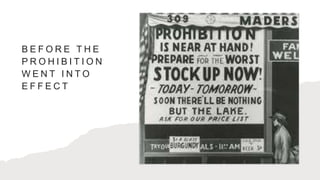
B E F O R E T H E
P R O H I B I T I O N
W E N T I N T O
E F F E C T
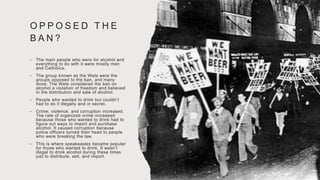
O P P O S E D T H E
B A N ?
• The main people who were for alcohol and
everything to do with it were mostly men
and Catholics.
• The group known as the Wets were the
groups opposed to the ban, and many
more. The Wets considered the ban on
alcohol a violation of freedom and believed
in the distribution and sale of alcohol.
• People who wanted to drink but couldn’t
had to do it illegally and in secret.
• Crime, violence, and corruption increased.
The rate of organized crime increased
because those who wanted to drink had to
figure out ways to import and purchase
alcohol. It caused corruption because
police officers turned their head to people
who were breaking the law.
• This is where speakeasies became popular
for those who wanted to drink. It wasn’t
illegal to drink alcohol during these times
just to distribute, sell, and import.
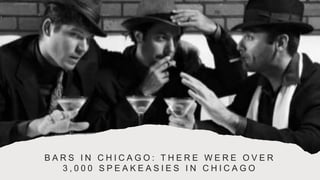
B A R S I N C H I C A G O : T H E R E W E R E O V E R
3 , 0 0 0 S P E A K E A S I E S I N C H I C A G O
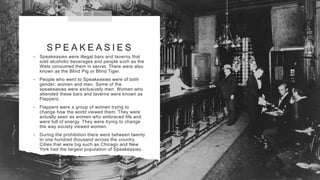
S P E A K E A S I E S
• Speakeasies were illegal bars and taverns that
sold alcoholic beverages and people such as the
Wets consumed them in secret. There were also
known as the Blind Pig or Blind Tiger.
• People who went to Speakeasies were of both
gender; women and men. Some of the
speakeasies were exclusively men. Women who
attended these bars and taverns were known as
Flappers.
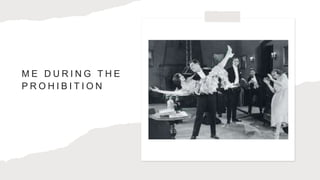
• Flappers were a group of women trying to
change how the world viewed them. They were
actually seen as women who embraced life and
were full of energy. They were trying to change
the way society viewed women.
• During the prohibition there were between twenty
to one hundred thousand across the country.
Cities that were big such as Chicago and New
York had the largest population of Speakeasies.
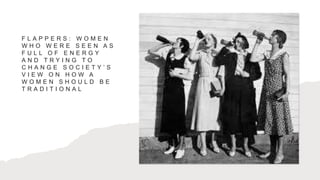
F L A P P E R S : W O M E N
W H O W E R E S E E N A S
F U L L O F E N E R G Y
A N D T R Y I N G T O
C H A N G E S O C I E T Y ’ S
V I E W O N H O W A
W O M E N S H O U L D B E
T R A D I T I O N A L
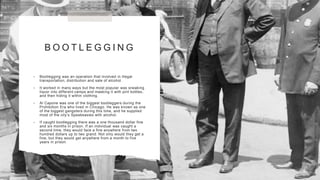
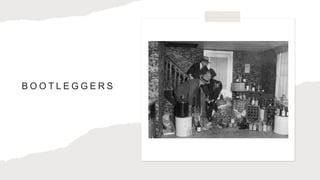
B O O T L E G G I N G
• Bootlegging was an operation that involved in illegal
transportation, distribution and sale of alcohol.
• It worked in many ways but the most popular was sneaking
liquor into different camps and masking it with pint bottles,
and then hiding it within clothing.
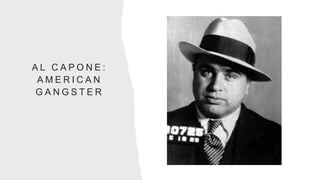
• Al Capone was one of the biggest bootleggers during the
Prohibition Era who lived in Chicago. He was known as one
of the biggest gangsters during this time, and he supplied
most of the city’s Speakeasies with alcohol.
• If caught bootlegging there was a one thousand dollar fine
and six months in prison. If an individual was caught a
second time, they would face a fine anywhere from two
hundred dollars up to two grand. Not only would they get a
fine, but they would get anywhere from a month to five
years in prison.
A L C A P O N E :
A M E R I C A N
G A N G S T E R
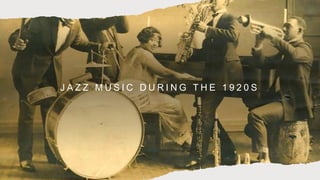
J A Z Z M U S I C D U R I N G T H E 1 9 2 0 S
M U S I C D U R I N G T H E
P R O H I B I T I O N ?
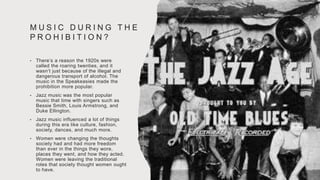
• There’s a reason the 1920s were
called the roaring twenties, and it
wasn’t just because of the illegal and
dangerous transport of alcohol. The
music in the Speakeasies made the
prohibition more popular.
• Jazz music was the most popular
music that time with singers such as
Bessie Smith, Louis Armstrong, and
Duke Ellington.
• Jazz music influenced a lot of things
during this era like culture, fashion,
society, dances, and much more.
• Women were changing the thoughts
society had and had more freedom
than ever in the things they wore,
places they went, and how they acted.
Women were leaving the traditional
roles that society thought women ought
to have.
D A I LY L I F E I N A M E R I C A
L I F E I N
A M E R I C A
Once the Prohibition on alcohol was in effect the nation had
changed in many ways, such as groups formed to protect the ban,
and it was mostly women. Men, Catholics, and Flappers could be
found in saloons, bars, speakeasies, etc.
During the daily life during the Prohibition Era organized crime had
a major increase because of all the illegal alcohol that was being
imported and sold behind closed doors.
Women during this time were breaking traditional values and roles,
they were more open to changing the way society viewed them.
Contrary to women being more powerful and able to speak up, they
still weren’t supposed to walk into bars and saloons, or they would
be thought of as prostitutes or just for the entertainment of men. It
wasn’t lady like to drink in front of others and was only allowed to
have a drink in their own home.
B O O T L E G G E R S
M E D U R I N G T H E
P R O H I B I T I O N
F E E L A B O U T T H E
P R O H I B I T I O N ?
If I was living in the prohibition during this time,
I honestly feel like I would be neutral to both
sides. I don’t drink myself, but I always found
the 1920s fascinating with everything that went
on. The fringe dresses women wore, the
music, prohibition, and much more.
I think it was an exciting time to be alive, and I
think if someone wants to drink, they should be
able to and it goes to show that not even the
law can stop them. I can see how they though
their freedom was being taken away, and I can
also see why women wanted it banned.
Living in the 1920s would’ve been a fun time to
be alive, I would’ve worn the dresses and
listened to the music and been what they
called women a Flapper.
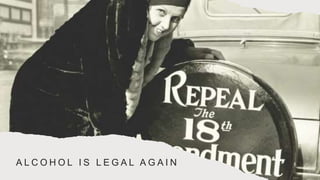
A L C O H O L I S L E G A L A G A I N
S U C C E S S O R
F A I L U R E
The Prohibition lasted about thirteen years, and it caused
nothing but trouble including highly organized crime,
corruption with police, bribery, protests and people saying
they lost their freedom.
The Prohibition was considered a political failure because
alcohol is legal today. The eighteenth amendment was
repealed by the twenty-first amendment and alcohol was
legal again. I think that it’s a good thing that alcohol was
legalized again because if someone wants to drink, they
will.
Personally, I think it was a failure as well because the
goals of the prohibition were good ideas, but it turned
their goals into their worst nightmare, because of of
people like bootleggers and of course alcoholics.
The Prohibition was more work than it was worth, cops
were taking bribes to turn a blind eye to people who were
in violation of the law, and it costed the government
millions of dollars to enforce the no alcohol rules.
T H E N A N D N O W
It’s been over a hundred years since the Prohibition
started in 1920 and times have definitely changed.
People have moved from drinking strictly from bars to
pretty much everywhere such as their home, parks,
restaurants, concerts, family’s houses.
Women are no longer viewed as prostitutes or just for
entertainment if they are having drink at a bar, and
society doesn’t view women as having those traditional
roles such as cooking, cleaning, and stay at home
parents.
Alcohol isn’t viewed as something horrible, and having a
drink is normal for all genders. Today, no one really cares
about what another is doing, wearing or drinking. Women
have careers now and can walk into a bar for a drink
without being judged.
The role of it I would say is to drink when there’s a
celebration or after having a long day. Those who don’t
drink turn a blind eye and it doesn’t bother them. There is
no organized crime associated with alcohol now because
it is legal, but there is still incidents of assault and
battered women due to drunks.
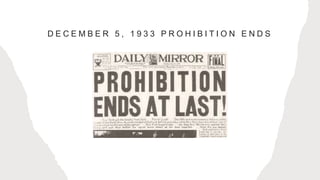
D E C E M B E R 5 , 1 9 3 3 P R O H I B I T I O N E N D S
N E W
I N F O R M AT I O N ?
Most of the information about the Prohibition
Era I knew, because I found that time so
interesting that I would do research myself.
Another reason I know so much is because
I’ve learned about it throughout my years of
education throughout school.
I did learn something new, which are Flappers
and I found them interesting, and how women
were bold enough to get out of the traditional
roles and take the risk. Back then women had
to listen to their husbands, and the Flappers
didn’t really care and were all about fun.
The exact dates I didn’t really remember but I
really enjoyed everything about the Prohibition
Era.
U N I Q U E T O
A M E R I C A T O D AY
The Prohibition Era is unique to America today
because we get to see what people went through
back then, and how easy it is for us to go to the
store a just buy alcohol.
I think it’s good that we learn about the
Prohibition Era, because America wasn’t the only
country to have prohibition on alcohol, many
countries in Europe and most Muslim countries
still have a ban in effect to this day.
I also believe that this was a very big trial and
error for America, and we can learn what not to
do if the idea were to ever come up again. There
is blueprint of what would happen if it were to
take place in today’s society, but I think it would
be even worse because times have changed
immensely.
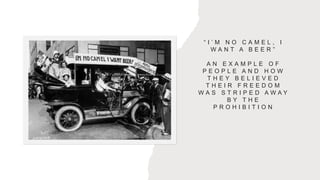
“ I ’ M N O C A M E L , I
W A N T A B E E R ”
A N E X A M P L E O F
P E O P L E A N D H O W
T H E Y B E L I E V E D
T H E I R F R E E D O M
W A S S T R I P E D A W A Y
B Y T H E
P R O H I B I T I O N
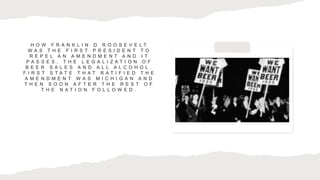
H O W F R A N K L I N D R O O S E V E L T
W A S T H E F I R S T P R E S I D E N T T O
R E P E L A N A M E N D M E N T A N D I T
P A S S E S . T H E L E G A L I Z A T I O N O F
B E E R S A L E S A N D A L L A L C O H O L .
F I R S T S T A T E T H A T R A T I F I E D T H E
A M E N D M E N T W A S M I C H I G A N A N D
T H E N S O O N A F T E R T H E R E S T O F
T H E N A T I O N F O L L O W E D .
C O N C L U S I O N
The Prohibition Era had a lot of downfalls
and problems. People were always violation
the law, trading and selling alcohol. People
were angry about their freedoms being
taken away in their eyes and being told they
couldn’t drink was one of those.
Some people were for the ban and
protested to keep it in place, but soon
realized that it was causing even more
crime than before. The government was
pouring money into the prohibition, and it
wasn’t helping the nation.
All in all, it’s a good thing that the 21st
Amendment happened and legalized
alcohol because now the crime rate would
decrease with it being legal. There would be
no more issues with bootleggers selling and
trading alcohol illegally.
W O R K S C I T E D
• Foner, E. (2017). Give Me Liberty! An American History (Ser. 5E). W.W. Norton &
Company.
• Lopez, G. (2019, June 5). Prohibition worked better than you think. Vox. Retrieved
December 6, 2021, from https://www.vox.com/the-
highlight/2019/6/5/18518005/prohibition-alcohol-public-health-crime-benefits.
• History Editors. (2009, October 29). Prohibition. History Retrieved December 6, 2021,
from https://www.history.com/topics/roaring-twenties/prohibition.
• Lerner, M. (n.d.). Unintended consequences. PBS. Retrieved December 6, 2021, from
https://www.pbs.org/kenburns/prohibition/unintended-consequences.
• Funderburg, J. A. (2014). Bootleggers and beer barons of the prohibition era.
McFarland & Company, Inc., Publishers.
• Gitlin, Martin. The Prohibition era. ABDO, 2010.

Hst 102 211 project

  • 1.
    P R OH I B I T I O N , S P E A K E A S I E S , F L A P P E R S & A L L T H AT J A Z Z Hasnija Ekic
  • 2.
    S TA RT O F T H E P R O H I B I T I O N E R A : J A N U A R Y 1 9 2 0
  • 3.
    T H ES I S S TAT E M E N T • The Prohibition Era lasted a little over a decade and it was first implemented once the 18th amendment was made which made the sale, the manufacture, the transportation, and the importation of alcohol illegal. • The Eighteenth Amendment was passed on January 17, 1920, and the goal was to reduce crime, corruption, problems society had, stop domestic abuse. • There were parts of the country who thought the Prohibition was the best thing to happen to the nation while others thought it made things take a turn for the worse.
  • 4.
    W H EN D I D I T S TA R T ? The Prohibition Era started in the United States around 1920 and it lasted over a decade. Basically, there was a ban on importation, transportation, and sale of alcoholic beverages and. This ban was nationwide as well. There were many people in the country against it, and this is the main reason for the increase in crime. With the the start of the prohibition people started opening speakeasies to distribute and have secret bars with alcoholic beverages. Most speakeasies started shortly after the prohibition of alcohol took effect.
  • 5.
    T E MP E R A N C E G R O U P S : W O M E N W H O P U S H E D F O R T H E B A N
  • 6.
    W H OW A N T E D I T ? Southern and Rural populations rooted for the ban of the distribution, sale, and importation of alcohol. This group of people thought it would help decrease the crime rate, and the growing number of immigrants didn’t help the issue according to southern and rural populations. Religious people and groups also thought it would be effective to ban alcohol and everything to do with it due to their beliefs. It was known as politically correct to drink which they didn’t think was okay. Groups who pushed for the ban were the Anti-Saloon League and Women’s Christian Temperance Union
  • 7.
    B E FO R E T H E P R O H I B I T I O N W E N T I N T O E F F E C T
  • 8.
    O P PO S E D T H E B A N ? • The main people who were for alcohol and everything to do with it were mostly men and Catholics. • The group known as the Wets were the groups opposed to the ban, and many more. The Wets considered the ban on alcohol a violation of freedom and believed in the distribution and sale of alcohol. • People who wanted to drink but couldn’t had to do it illegally and in secret. • Crime, violence, and corruption increased. The rate of organized crime increased because those who wanted to drink had to figure out ways to import and purchase alcohol. It caused corruption because police officers turned their head to people who were breaking the law. • This is where speakeasies became popular for those who wanted to drink. It wasn’t illegal to drink alcohol during these times just to distribute, sell, and import.
  • 9.
    B A RS I N C H I C A G O : T H E R E W E R E O V E R 3 , 0 0 0 S P E A K E A S I E S I N C H I C A G O
  • 10.
    S P EA K E A S I E S • Speakeasies were illegal bars and taverns that sold alcoholic beverages and people such as the Wets consumed them in secret. There were also known as the Blind Pig or Blind Tiger. • People who went to Speakeasies were of both gender; women and men. Some of the speakeasies were exclusively men. Women who attended these bars and taverns were known as Flappers. • Flappers were a group of women trying to change how the world viewed them. They were actually seen as women who embraced life and were full of energy. They were trying to change the way society viewed women. • During the prohibition there were between twenty to one hundred thousand across the country. Cities that were big such as Chicago and New York had the largest population of Speakeasies.
  • 11.
    F L AP P E R S : W O M E N W H O W E R E S E E N A S F U L L O F E N E R G Y A N D T R Y I N G T O C H A N G E S O C I E T Y ’ S V I E W O N H O W A W O M E N S H O U L D B E T R A D I T I O N A L
  • 12.
    B O OT L E G G I N G • Bootlegging was an operation that involved in illegal transportation, distribution and sale of alcohol. • It worked in many ways but the most popular was sneaking liquor into different camps and masking it with pint bottles, and then hiding it within clothing. • Al Capone was one of the biggest bootleggers during the Prohibition Era who lived in Chicago. He was known as one of the biggest gangsters during this time, and he supplied most of the city’s Speakeasies with alcohol. • If caught bootlegging there was a one thousand dollar fine and six months in prison. If an individual was caught a second time, they would face a fine anywhere from two hundred dollars up to two grand. Not only would they get a fine, but they would get anywhere from a month to five years in prison.
  • 13.
    A L CA P O N E : A M E R I C A N G A N G S T E R
  • 14.
    J A ZZ M U S I C D U R I N G T H E 1 9 2 0 S
  • 15.
    M U SI C D U R I N G T H E P R O H I B I T I O N ? • There’s a reason the 1920s were called the roaring twenties, and it wasn’t just because of the illegal and dangerous transport of alcohol. The music in the Speakeasies made the prohibition more popular. • Jazz music was the most popular music that time with singers such as Bessie Smith, Louis Armstrong, and Duke Ellington. • Jazz music influenced a lot of things during this era like culture, fashion, society, dances, and much more. • Women were changing the thoughts society had and had more freedom than ever in the things they wore, places they went, and how they acted. Women were leaving the traditional roles that society thought women ought to have.
  • 16.
    D A ILY L I F E I N A M E R I C A
  • 17.
    L I FE I N A M E R I C A Once the Prohibition on alcohol was in effect the nation had changed in many ways, such as groups formed to protect the ban, and it was mostly women. Men, Catholics, and Flappers could be found in saloons, bars, speakeasies, etc. During the daily life during the Prohibition Era organized crime had a major increase because of all the illegal alcohol that was being imported and sold behind closed doors. Women during this time were breaking traditional values and roles, they were more open to changing the way society viewed them. Contrary to women being more powerful and able to speak up, they still weren’t supposed to walk into bars and saloons, or they would be thought of as prostitutes or just for the entertainment of men. It wasn’t lady like to drink in front of others and was only allowed to have a drink in their own home.
  • 18.
    B O OT L E G G E R S
  • 19.
    M E DU R I N G T H E P R O H I B I T I O N
  • 20.
    F E EL A B O U T T H E P R O H I B I T I O N ? If I was living in the prohibition during this time, I honestly feel like I would be neutral to both sides. I don’t drink myself, but I always found the 1920s fascinating with everything that went on. The fringe dresses women wore, the music, prohibition, and much more. I think it was an exciting time to be alive, and I think if someone wants to drink, they should be able to and it goes to show that not even the law can stop them. I can see how they though their freedom was being taken away, and I can also see why women wanted it banned. Living in the 1920s would’ve been a fun time to be alive, I would’ve worn the dresses and listened to the music and been what they called women a Flapper.
  • 21.
    A L CO H O L I S L E G A L A G A I N
  • 22.
    S U CC E S S O R F A I L U R E The Prohibition lasted about thirteen years, and it caused nothing but trouble including highly organized crime, corruption with police, bribery, protests and people saying they lost their freedom. The Prohibition was considered a political failure because alcohol is legal today. The eighteenth amendment was repealed by the twenty-first amendment and alcohol was legal again. I think that it’s a good thing that alcohol was legalized again because if someone wants to drink, they will. Personally, I think it was a failure as well because the goals of the prohibition were good ideas, but it turned their goals into their worst nightmare, because of of people like bootleggers and of course alcoholics. The Prohibition was more work than it was worth, cops were taking bribes to turn a blind eye to people who were in violation of the law, and it costed the government millions of dollars to enforce the no alcohol rules.
  • 23.
    T H EN A N D N O W It’s been over a hundred years since the Prohibition started in 1920 and times have definitely changed. People have moved from drinking strictly from bars to pretty much everywhere such as their home, parks, restaurants, concerts, family’s houses. Women are no longer viewed as prostitutes or just for entertainment if they are having drink at a bar, and society doesn’t view women as having those traditional roles such as cooking, cleaning, and stay at home parents. Alcohol isn’t viewed as something horrible, and having a drink is normal for all genders. Today, no one really cares about what another is doing, wearing or drinking. Women have careers now and can walk into a bar for a drink without being judged. The role of it I would say is to drink when there’s a celebration or after having a long day. Those who don’t drink turn a blind eye and it doesn’t bother them. There is no organized crime associated with alcohol now because it is legal, but there is still incidents of assault and battered women due to drunks.
  • 24.
    D E CE M B E R 5 , 1 9 3 3 P R O H I B I T I O N E N D S
  • 25.
    N E W IN F O R M AT I O N ? Most of the information about the Prohibition Era I knew, because I found that time so interesting that I would do research myself. Another reason I know so much is because I’ve learned about it throughout my years of education throughout school. I did learn something new, which are Flappers and I found them interesting, and how women were bold enough to get out of the traditional roles and take the risk. Back then women had to listen to their husbands, and the Flappers didn’t really care and were all about fun. The exact dates I didn’t really remember but I really enjoyed everything about the Prohibition Era.
  • 26.
    U N IQ U E T O A M E R I C A T O D AY The Prohibition Era is unique to America today because we get to see what people went through back then, and how easy it is for us to go to the store a just buy alcohol. I think it’s good that we learn about the Prohibition Era, because America wasn’t the only country to have prohibition on alcohol, many countries in Europe and most Muslim countries still have a ban in effect to this day. I also believe that this was a very big trial and error for America, and we can learn what not to do if the idea were to ever come up again. There is blueprint of what would happen if it were to take place in today’s society, but I think it would be even worse because times have changed immensely.
  • 27.
    “ I ’M N O C A M E L , I W A N T A B E E R ” A N E X A M P L E O F P E O P L E A N D H O W T H E Y B E L I E V E D T H E I R F R E E D O M W A S S T R I P E D A W A Y B Y T H E P R O H I B I T I O N
  • 28.
    H O WF R A N K L I N D R O O S E V E L T W A S T H E F I R S T P R E S I D E N T T O R E P E L A N A M E N D M E N T A N D I T P A S S E S . T H E L E G A L I Z A T I O N O F B E E R S A L E S A N D A L L A L C O H O L . F I R S T S T A T E T H A T R A T I F I E D T H E A M E N D M E N T W A S M I C H I G A N A N D T H E N S O O N A F T E R T H E R E S T O F T H E N A T I O N F O L L O W E D .
  • 29.
    C O NC L U S I O N The Prohibition Era had a lot of downfalls and problems. People were always violation the law, trading and selling alcohol. People were angry about their freedoms being taken away in their eyes and being told they couldn’t drink was one of those. Some people were for the ban and protested to keep it in place, but soon realized that it was causing even more crime than before. The government was pouring money into the prohibition, and it wasn’t helping the nation. All in all, it’s a good thing that the 21st Amendment happened and legalized alcohol because now the crime rate would decrease with it being legal. There would be no more issues with bootleggers selling and trading alcohol illegally.
  • 30.
    W O RK S C I T E D • Foner, E. (2017). Give Me Liberty! An American History (Ser. 5E). W.W. Norton & Company. • Lopez, G. (2019, June 5). Prohibition worked better than you think. Vox. Retrieved December 6, 2021, from https://www.vox.com/the- highlight/2019/6/5/18518005/prohibition-alcohol-public-health-crime-benefits. • History Editors. (2009, October 29). Prohibition. History Retrieved December 6, 2021, from https://www.history.com/topics/roaring-twenties/prohibition. • Lerner, M. (n.d.). Unintended consequences. PBS. Retrieved December 6, 2021, from https://www.pbs.org/kenburns/prohibition/unintended-consequences. • Funderburg, J. A. (2014). Bootleggers and beer barons of the prohibition era. McFarland & Company, Inc., Publishers. • Gitlin, Martin. The Prohibition era. ABDO, 2010.

Editor's Notes

  • #2 Cited Source on last slide as well. https://www.walmart.com/ip/National-Prohibition-Act-Closed-Violation-Boardwalk-Empire-style-Poster-12x18/128508116?wmlspartner=wlpa&selectedSellerId=101004178&&adid=22222222227000000000&wl0=&wl1=g&wl2=c&wl3=42423897272&wl4=aud-1025716567856:pla-51320962143&wl5=9022871&wl6=&wl7=&wl8=&wl9=pla&wl10=136628331&wl11=online&wl12=128508116&veh=sem&gclid=Cj0KCQiA47GNBhDrARIsAKfZ2rAeH3ehvpf9FPH9dMf9KaWBx3KJvhFYJCnwqaOAOYwDjp6NKxEI7wMaAk_bEALw_wcB&gclsrc=aw.ds - picture in slide one
  • #4 https://noalcohol.us/noalcohol/resources/theprohibition.phtml