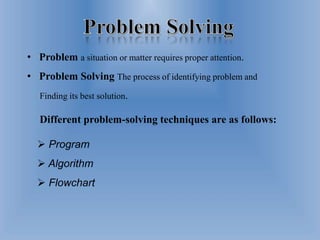
 Program
 Algorithm
 Flowchart
• Problem a situation or matter requires proper attention.
• Problem Solving The process of identifying problem and
Finding its best solution.
Different problem-solving techniques are as follows:
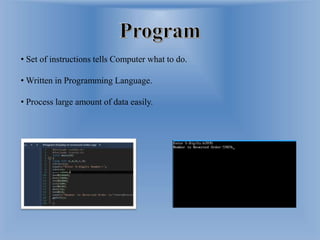
• Set of instructions tells Computer what to do.
• Written in Programming Language.
• Process large amount of data easily.
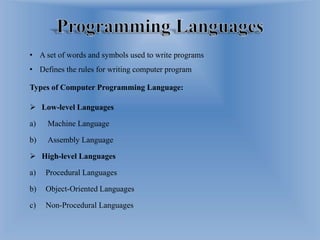
 Low-level Languages
a) Machine Language
b) Assembly Language
 High-level Languages
a) Procedural Languages
b) Object-Oriented Languages
c) Non-Procedural Languages
• A set of words and symbols used to write programs
• Defines the rules for writing computer program
Types of Computer Programming Language:
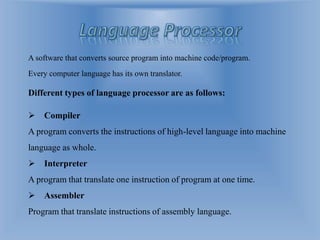
 Compiler
A program converts the instructions of high-level language into machine
language as whole.
 Interpreter
A program that translate one instruction of program at one time.
 Assembler
Program that translate instructions of assembly language.
A software that converts source program into machine code/program.
Every computer language has its own translator.
Different types of language processor are as follows:
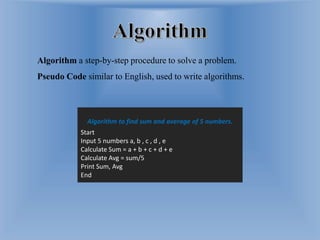
Algorithm to find sum and average of 5 numbers.
Start
Input 5 numbers a, b , c , d , e
Calculate Sum = a + b + c + d + e
Calculate Avg = sum/5
Print Sum, Avg
End
Algorithm a step-by-step procedure to solve a problem.
Pseudo Code similar to English, used to write algorithms.
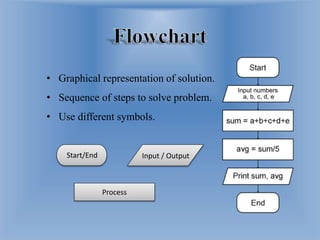
• Graphical representation of solution.
• Sequence of steps to solve problem.
• Use different symbols.
Process
Start/End Input / Output

Programming Fundamentals Chapter-1.pptx

  • 1.
     Program  Algorithm Flowchart • Problem a situation or matter requires proper attention. • Problem Solving The process of identifying problem and Finding its best solution. Different problem-solving techniques are as follows:
  • 2.
    • Set ofinstructions tells Computer what to do. • Written in Programming Language. • Process large amount of data easily.
  • 3.
     Low-level Languages a)Machine Language b) Assembly Language  High-level Languages a) Procedural Languages b) Object-Oriented Languages c) Non-Procedural Languages • A set of words and symbols used to write programs • Defines the rules for writing computer program Types of Computer Programming Language:
  • 4.
     Compiler A programconverts the instructions of high-level language into machine language as whole.  Interpreter A program that translate one instruction of program at one time.  Assembler Program that translate instructions of assembly language. A software that converts source program into machine code/program. Every computer language has its own translator. Different types of language processor are as follows:
  • 5.
    Algorithm to findsum and average of 5 numbers. Start Input 5 numbers a, b , c , d , e Calculate Sum = a + b + c + d + e Calculate Avg = sum/5 Print Sum, Avg End Algorithm a step-by-step procedure to solve a problem. Pseudo Code similar to English, used to write algorithms.
  • 6.
    • Graphical representationof solution. • Sequence of steps to solve problem. • Use different symbols. Process Start/End Input / Output