Program
Security
By
Prof. Muhammad Iqbal Bhat
Government Degree College
Beerwah
P
r
o
f
.
M
.
I
q
b
a
l
B
h
a
t
(
J
K
H
E
D
)
Topics
DEFINITION OF PROGRAM
SECURITY
GOALS OF PROGRAM
SECURITY
EXAMPLES OF PROGRAM
SECURITY BREACHES
OVERVIEW OF SECURE
PROGRAMMING
PRACTICES
P
r
o
f
.
M
.
I
q
b
a
l
B
h
a
t
(
J
K
H
E
D
)
Recent Attacks:
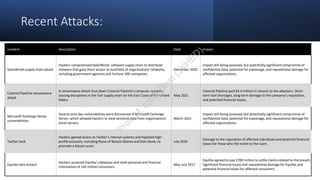
Incident Description Date Impact
SolarWinds supply chain attack
Hackers compromised SolarWinds' software supply chain to distribute
malware that gave them access to hundreds of organizations' networks,
including government agencies and Fortune 500 companies.
December 2020
Impact still being assessed, but potentially significant compromise of
confidential data, potential for espionage, and reputational damage for
affected organizations.
Colonial Pipeline ransomware
attack
A ransomware attack shut down Colonial Pipeline's computer systems,
causing disruptions in the fuel supply chain on the East Coast of the United
States.
May 2021
Colonial Pipeline paid $4.4 millionin ransom to the attackers. Short-
term fuel shortages, long-term damage to the company's reputation,
and potential financial losses.
Microsoft Exchange Server
vulnerabilities
Several zero-day vulnerabilities were discovered in Microsoft Exchange
Server, which allowed hackers to steal sensitive data from organizations'
email servers.
March 2021
Impact still being assessed, but potentially significant compromise of
confidential data, potential for espionage, and reputational damage for
affected organizations.
Twitter hack
Hackers gained access to Twitter's internal systems and hijacked high-
profile accounts, including those of Barack Obama and Elon Musk, to
promote a bitcoin scam.
July 2020
Damage to the reputation of affected individuals and potential financial
losses for those who fell victim to the scam.
Equifax data breach
Hackers accessed Equifax's database and stole personal and financial
information of 143 millionconsumers.
May-July 2017
Equifax agreed to pay $700 million to settle claims related to the breach.
Significant financial losses and reputational damage for Equifax and
potential financial losses for affected consumers.
P
r
o
f
.
M
.
I
q
b
a
l
B
h
a
t
(
J
K
H
E
D
)
Program Security:
Program security is a set of
practices, processes, and
technologies used to protect
computer programs from
unauthorized access, modification,
or destruction.
Programs can include any
software, from standalone
applications to complex systems
and networks.
Program security is a subset of
information security, which refers
to the protection of all types of
information assets, including data,
software, hardware, and people.
Program security involves both
proactive measures, such as
implementing security controls,
and reactive measures, such as
detecting and responding to
security incidents.
Program security is essential in
today's digital world due to the
growing number and
sophistication of cyber threats,
which can lead to financial loss,
reputation damage, and legal
liability for organizations.
Program security is a multifaceted
discipline that encompasses a
range of technical and non-
technical areas, including
cryptography, access control, risk
management, incident response,
and security awareness training.
Program security is often
integrated into the software
development lifecycle, with
security requirements and testing
being incorporated throughout the
process.
Program security is not a one-time
effort but an ongoing process, as
new threats and vulnerabilities
emerge and existing ones evolve
over time.
Program security requires a holistic
approach that considers not only
technical factors but also
organizational culture, policies,
and governance structures.
P
r
o
f
.
M
.
I
q
b
a
l
B
h
a
t
(
J
K
H
E
D
)
Goals of Program Security:
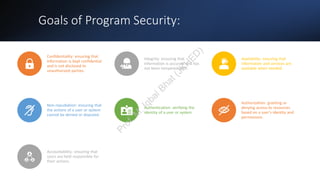
Confidentiality: ensuring that
information is kept confidential
and is not disclosed to
unauthorized parties.
Integrity: ensuring that
information is accurate and has
not been tampered with.
Availability: ensuring that
information and services are
available when needed.
Non-repudiation: ensuring that
the actions of a user or system
cannot be denied or disputed.
Authentication: verifying the
identity of a user or system.
Authorization: granting or
denying access to resources
based on a user's identity and
permissions.
Accountability: ensuring that
users are held responsible for
their actions.
P
r
o
f
.
M
.
I
q
b
a
l
B
h
a
t
(
J
K
H
E
D
)
Secure programming practices
Secure programming practices are techniques used to develop software that is resistant to security threats and
vulnerabilities.
Secure programming practices should be applied throughout the software development lifecycle, including
design, coding, testing, and deployment.
Secure programming practices are intended to prevent or mitigate various types of security vulnerabilities, such
as buffer overflows, SQL injection, cross-site scripting (XSS), and race conditions.
Some common secure programming practices include input validation, output encoding, proper error handling,
authentication and access control, encryption and decryption, and secure coding standards.
Input validation involves checking and sanitizing user input to ensure it meets certain criteria, such as type,
length, and format.
Output encoding involves encoding output to prevent injection attacks, such as XSS attacks, which exploit
vulnerabilities in web applications that allow user input to be included in web pages without proper encoding.
P
r
o
f
.
M
.
I
q
b
a
l
B
h
a
t
(
J
K
H
E
D
)
Continue…
Proper error handling involves handling errors in a way that does not expose sensitive information or provide information that could
be used to exploit the system.
Authentication and access control involves verifying the identity of users and restricting access to resources based on their
permissions and privileges.
Encryption and decryption involve protecting data by converting it into a code that cannot be easily read or understood without a
decryption key.
Secure coding standards are guidelines or best practices for writing secure code that are often enforced through code reviews or
automated tools.
Secure programming practices are constantly evolving as new threats and vulnerabilities emerge, so it is important for developers to
stay up-to-date on the latest techniques and tools for secure programming.
Secure programming practices are increasingly important in the age of cloud computing, mobile computing, and Internet of Things
(IoT) devices, where software systems are more interconnected and exposed to a wider range of security threats and vulnerabilities.
P
r
o
f
.
M
.
I
q
b
a
l
B
h
a
t
(
J
K
H
E
D
)
Threat Modeling:
Threat modeling is a process used to identify and prioritize potential threats and vulnerabilities in a software
system or application.
The goal of threat modeling is to provide a structured approach to security risk assessment and help
developers and security analysts identify and address security issues before they are exploited by attackers.
Threat modeling can be done at various stages of the software development lifecycle, from design to
deployment, and can be applied to both new and existing software systems.
Threat modeling can also be automated using tools such as Microsoft Threat Modeling Tool, IriusRisk, and
ThreatModeler.
Threat modeling is an important part of a comprehensive security program, but it is not a substitute for
other security measures, such as access controls, encryption, and monitoring.
P
r
o
f
.
M
.
I
q
b
a
l
B
h
a
t
(
J
K
H
E
D
)
Threat Modeling Process:
Identify the system components and boundaries: This involves identifying the various components of the system
and defining the boundaries of the system, including inputs and outputs.
Create a data flow diagram: This involves mapping out the flow of data through the system, including how data
enters, moves through, and exits the system.
Identify threats and vulnerabilities: This involves identifying potential threats and vulnerabilities at each stage of
the data flow, including input validation, authentication and access control, encryption, and error handling.
Prioritize and evaluate threats: This involves prioritizing the identified threats based on the potential impact and
likelihood of occurrence and evaluating the effectiveness of existing security controls in mitigating these threats.
Mitigate the most critical threats: This involves implementing appropriate security measures to address the most
critical threats identified during the threat modeling process.
P
r
o
f
.
M
.
I
q
b
a
l
B
h
a
t
(
J
K
H
E
D
)
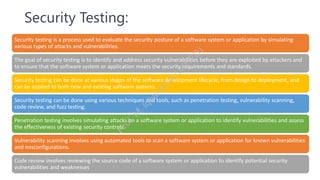
Security Testing:
Security testing is a process used to evaluate the security posture of a software system or application by simulating
various types of attacks and vulnerabilities.
The goal of security testing is to identify and address security vulnerabilities before they are exploited by attackers and
to ensure that the software system or application meets the security requirements and standards.
Security testing can be done at various stages of the software development lifecycle, from design to deployment, and
can be applied to both new and existing software systems.
Security testing can be done using various techniques and tools, such as penetration testing, vulnerability scanning,
code review, and fuzz testing.
Penetration testing involves simulating attacks on a software system or application to identify vulnerabilities and assess
the effectiveness of existing security controls.
Vulnerability scanning involves using automated tools to scan a software system or application for known vulnerabilities
and misconfigurations.
Code review involves reviewing the source code of a software system or application to identify potential security
vulnerabilities and weaknesses
P
r
o
f
.
M
.
I
q
b
a
l
B
h
a
t
(
J
K
H
E
D
)
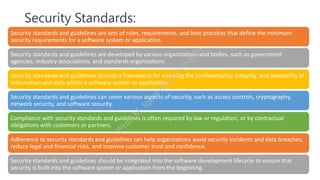
Security Standards:
Security standards and guidelines are sets of rules, requirements, and best practices that define the minimum
security requirements for a software system or application.
Security standards and guidelines are developed by various organizations and bodies, such as government
agencies, industry associations, and standards organizations.
Security standards and guidelines provide a framework for ensuring the confidentiality, integrity, and availability of
information and data within a software system or application.
Security standards and guidelines can cover various aspects of security, such as access controls, cryptography,
network security, and software security.
Compliance with security standards and guidelines is often required by law or regulation, or by contractual
obligations with customers or partners.
Adherence to security standards and guidelines can help organizations avoid security incidents and data breaches,
reduce legal and financial risks, and improve customer trust and confidence.
Security standards and guidelines should be integrated into the software development lifecycle to ensure that
security is built into the software system or application from the beginning.
P
r
o
f
.
M
.
I
q
b
a
l
B
h
a
t
(
J
K
H
E
D
)
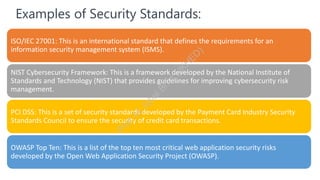
Examples of Security Standards:
ISO/IEC 27001: This is an international standard that defines the requirements for an
information security management system (ISMS).
NIST Cybersecurity Framework: This is a framework developed by the National Institute of
Standards and Technology (NIST) that provides guidelines for improving cybersecurity risk
management.
PCI DSS: This is a set of security standards developed by the Payment Card Industry Security
Standards Council to ensure the security of credit card transactions.
OWASP Top Ten: This is a list of the top ten most critical web application security risks
developed by the Open Web Application Security Project (OWASP).
P
r
o
f
.
M
.
I
q
b
a
l
B
h
a
t
(
J
K
H
E
D
)

Program Security in information security.pdf

  • 1.
    Program Security By Prof. Muhammad IqbalBhat Government Degree College Beerwah P r o f . M . I q b a l B h a t ( J K H E D )
  • 2.
    Topics DEFINITION OF PROGRAM SECURITY GOALSOF PROGRAM SECURITY EXAMPLES OF PROGRAM SECURITY BREACHES OVERVIEW OF SECURE PROGRAMMING PRACTICES P r o f . M . I q b a l B h a t ( J K H E D )
  • 3.
    Recent Attacks: Incident DescriptionDate Impact SolarWinds supply chain attack Hackers compromised SolarWinds' software supply chain to distribute malware that gave them access to hundreds of organizations' networks, including government agencies and Fortune 500 companies. December 2020 Impact still being assessed, but potentially significant compromise of confidential data, potential for espionage, and reputational damage for affected organizations. Colonial Pipeline ransomware attack A ransomware attack shut down Colonial Pipeline's computer systems, causing disruptions in the fuel supply chain on the East Coast of the United States. May 2021 Colonial Pipeline paid $4.4 millionin ransom to the attackers. Short- term fuel shortages, long-term damage to the company's reputation, and potential financial losses. Microsoft Exchange Server vulnerabilities Several zero-day vulnerabilities were discovered in Microsoft Exchange Server, which allowed hackers to steal sensitive data from organizations' email servers. March 2021 Impact still being assessed, but potentially significant compromise of confidential data, potential for espionage, and reputational damage for affected organizations. Twitter hack Hackers gained access to Twitter's internal systems and hijacked high- profile accounts, including those of Barack Obama and Elon Musk, to promote a bitcoin scam. July 2020 Damage to the reputation of affected individuals and potential financial losses for those who fell victim to the scam. Equifax data breach Hackers accessed Equifax's database and stole personal and financial information of 143 millionconsumers. May-July 2017 Equifax agreed to pay $700 million to settle claims related to the breach. Significant financial losses and reputational damage for Equifax and potential financial losses for affected consumers. P r o f . M . I q b a l B h a t ( J K H E D )
  • 4.
    Program Security: Program securityis a set of practices, processes, and technologies used to protect computer programs from unauthorized access, modification, or destruction. Programs can include any software, from standalone applications to complex systems and networks. Program security is a subset of information security, which refers to the protection of all types of information assets, including data, software, hardware, and people. Program security involves both proactive measures, such as implementing security controls, and reactive measures, such as detecting and responding to security incidents. Program security is essential in today's digital world due to the growing number and sophistication of cyber threats, which can lead to financial loss, reputation damage, and legal liability for organizations. Program security is a multifaceted discipline that encompasses a range of technical and non- technical areas, including cryptography, access control, risk management, incident response, and security awareness training. Program security is often integrated into the software development lifecycle, with security requirements and testing being incorporated throughout the process. Program security is not a one-time effort but an ongoing process, as new threats and vulnerabilities emerge and existing ones evolve over time. Program security requires a holistic approach that considers not only technical factors but also organizational culture, policies, and governance structures. P r o f . M . I q b a l B h a t ( J K H E D )
  • 5.
    Goals of ProgramSecurity: Confidentiality: ensuring that information is kept confidential and is not disclosed to unauthorized parties. Integrity: ensuring that information is accurate and has not been tampered with. Availability: ensuring that information and services are available when needed. Non-repudiation: ensuring that the actions of a user or system cannot be denied or disputed. Authentication: verifying the identity of a user or system. Authorization: granting or denying access to resources based on a user's identity and permissions. Accountability: ensuring that users are held responsible for their actions. P r o f . M . I q b a l B h a t ( J K H E D )
  • 6.
    Secure programming practices Secureprogramming practices are techniques used to develop software that is resistant to security threats and vulnerabilities. Secure programming practices should be applied throughout the software development lifecycle, including design, coding, testing, and deployment. Secure programming practices are intended to prevent or mitigate various types of security vulnerabilities, such as buffer overflows, SQL injection, cross-site scripting (XSS), and race conditions. Some common secure programming practices include input validation, output encoding, proper error handling, authentication and access control, encryption and decryption, and secure coding standards. Input validation involves checking and sanitizing user input to ensure it meets certain criteria, such as type, length, and format. Output encoding involves encoding output to prevent injection attacks, such as XSS attacks, which exploit vulnerabilities in web applications that allow user input to be included in web pages without proper encoding. P r o f . M . I q b a l B h a t ( J K H E D )
  • 7.
    Continue… Proper error handlinginvolves handling errors in a way that does not expose sensitive information or provide information that could be used to exploit the system. Authentication and access control involves verifying the identity of users and restricting access to resources based on their permissions and privileges. Encryption and decryption involve protecting data by converting it into a code that cannot be easily read or understood without a decryption key. Secure coding standards are guidelines or best practices for writing secure code that are often enforced through code reviews or automated tools. Secure programming practices are constantly evolving as new threats and vulnerabilities emerge, so it is important for developers to stay up-to-date on the latest techniques and tools for secure programming. Secure programming practices are increasingly important in the age of cloud computing, mobile computing, and Internet of Things (IoT) devices, where software systems are more interconnected and exposed to a wider range of security threats and vulnerabilities. P r o f . M . I q b a l B h a t ( J K H E D )
  • 8.
    Threat Modeling: Threat modelingis a process used to identify and prioritize potential threats and vulnerabilities in a software system or application. The goal of threat modeling is to provide a structured approach to security risk assessment and help developers and security analysts identify and address security issues before they are exploited by attackers. Threat modeling can be done at various stages of the software development lifecycle, from design to deployment, and can be applied to both new and existing software systems. Threat modeling can also be automated using tools such as Microsoft Threat Modeling Tool, IriusRisk, and ThreatModeler. Threat modeling is an important part of a comprehensive security program, but it is not a substitute for other security measures, such as access controls, encryption, and monitoring. P r o f . M . I q b a l B h a t ( J K H E D )
  • 9.
    Threat Modeling Process: Identifythe system components and boundaries: This involves identifying the various components of the system and defining the boundaries of the system, including inputs and outputs. Create a data flow diagram: This involves mapping out the flow of data through the system, including how data enters, moves through, and exits the system. Identify threats and vulnerabilities: This involves identifying potential threats and vulnerabilities at each stage of the data flow, including input validation, authentication and access control, encryption, and error handling. Prioritize and evaluate threats: This involves prioritizing the identified threats based on the potential impact and likelihood of occurrence and evaluating the effectiveness of existing security controls in mitigating these threats. Mitigate the most critical threats: This involves implementing appropriate security measures to address the most critical threats identified during the threat modeling process. P r o f . M . I q b a l B h a t ( J K H E D )
  • 10.
    Security Testing: Security testingis a process used to evaluate the security posture of a software system or application by simulating various types of attacks and vulnerabilities. The goal of security testing is to identify and address security vulnerabilities before they are exploited by attackers and to ensure that the software system or application meets the security requirements and standards. Security testing can be done at various stages of the software development lifecycle, from design to deployment, and can be applied to both new and existing software systems. Security testing can be done using various techniques and tools, such as penetration testing, vulnerability scanning, code review, and fuzz testing. Penetration testing involves simulating attacks on a software system or application to identify vulnerabilities and assess the effectiveness of existing security controls. Vulnerability scanning involves using automated tools to scan a software system or application for known vulnerabilities and misconfigurations. Code review involves reviewing the source code of a software system or application to identify potential security vulnerabilities and weaknesses P r o f . M . I q b a l B h a t ( J K H E D )
  • 11.
    Security Standards: Security standardsand guidelines are sets of rules, requirements, and best practices that define the minimum security requirements for a software system or application. Security standards and guidelines are developed by various organizations and bodies, such as government agencies, industry associations, and standards organizations. Security standards and guidelines provide a framework for ensuring the confidentiality, integrity, and availability of information and data within a software system or application. Security standards and guidelines can cover various aspects of security, such as access controls, cryptography, network security, and software security. Compliance with security standards and guidelines is often required by law or regulation, or by contractual obligations with customers or partners. Adherence to security standards and guidelines can help organizations avoid security incidents and data breaches, reduce legal and financial risks, and improve customer trust and confidence. Security standards and guidelines should be integrated into the software development lifecycle to ensure that security is built into the software system or application from the beginning. P r o f . M . I q b a l B h a t ( J K H E D )
  • 12.
    Examples of SecurityStandards: ISO/IEC 27001: This is an international standard that defines the requirements for an information security management system (ISMS). NIST Cybersecurity Framework: This is a framework developed by the National Institute of Standards and Technology (NIST) that provides guidelines for improving cybersecurity risk management. PCI DSS: This is a set of security standards developed by the Payment Card Industry Security Standards Council to ensure the security of credit card transactions. OWASP Top Ten: This is a list of the top ten most critical web application security risks developed by the Open Web Application Security Project (OWASP). P r o f . M . I q b a l B h a t ( J K H E D )