Nature and functionsof profit:
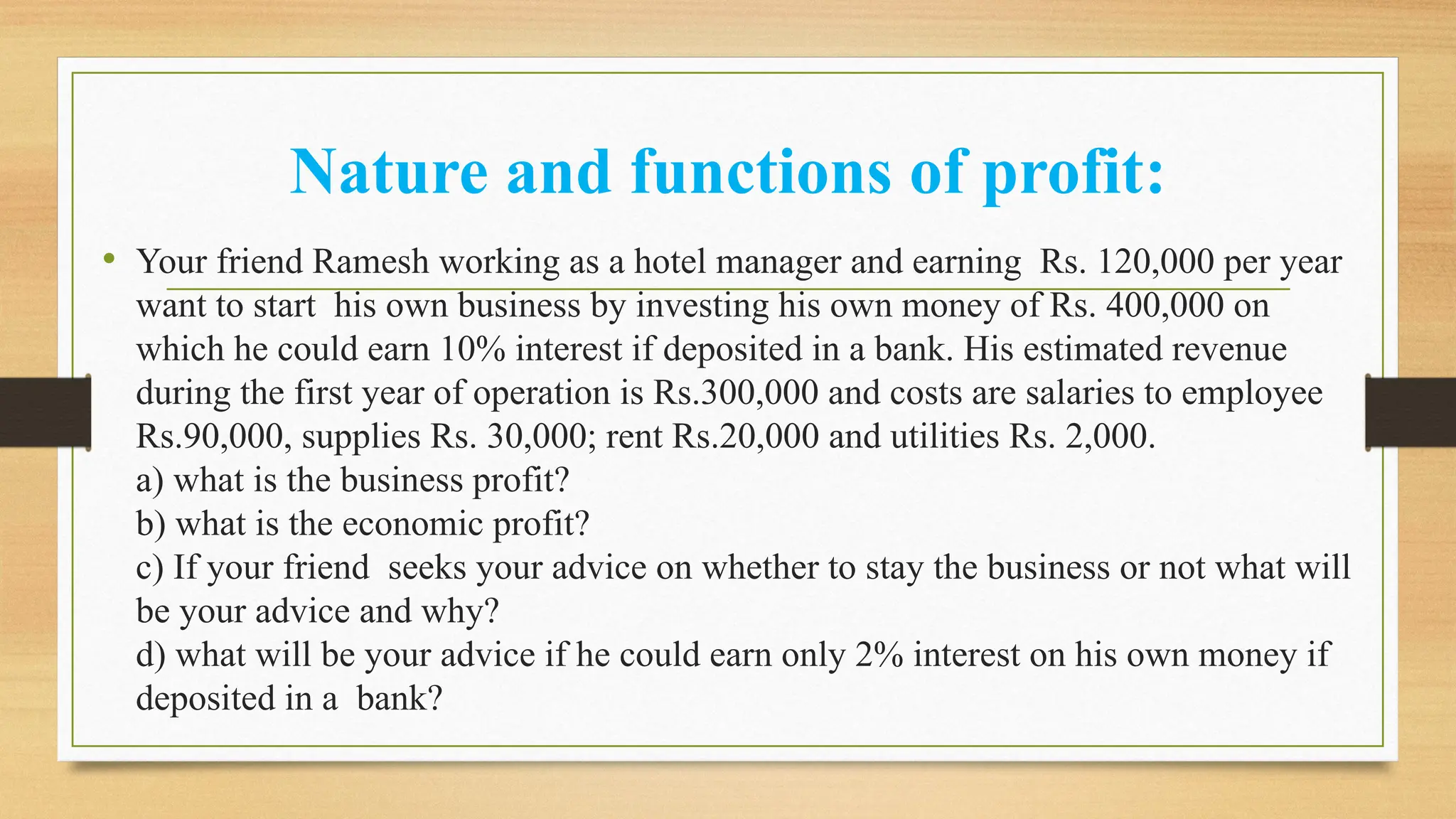
• Your friend Ramesh working as a hotel manager and earning Rs. 120,000 per year
want to start his own business by investing his own money of Rs. 400,000 on
which he could earn 10% interest if deposited in a bank. His estimated revenue
during the first year of operation is Rs.300,000 and costs are salaries to employee
Rs.90,000, supplies Rs. 30,000; rent Rs.20,000 and utilities Rs. 2,000.
a) what is the business profit?
b) what is the economic profit?
c) If your friend seeks your advice on whether to stay the business or not what will
be your advice and why?
d) what will be your advice if he could earn only 2% interest on his own money if
deposited in a bank?
2.
Nature and functionsof profit:
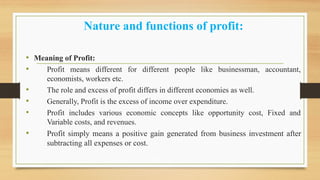
• Meaning of Profit:
• Profit means different for different people like businessman, accountant,
economists, workers etc.
• The role and excess of profit differs in different economies as well.
• Generally, Profit is the excess of income over expenditure.
• Profit includes various economic concepts like opportunity cost, Fixed and
Variable costs, and revenues.
• Profit simply means a positive gain generated from business investment after
subtracting all expenses or cost.
3.
Cont…..
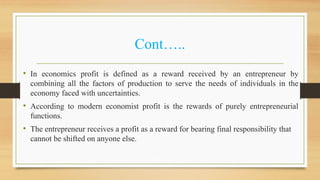
• In economicsprofit is defined as a reward received by an entrepreneur by
combining all the factors of production to serve the needs of individuals in the
economy faced with uncertainties.
• According to modern economist profit is the rewards of purely entrepreneurial
functions.
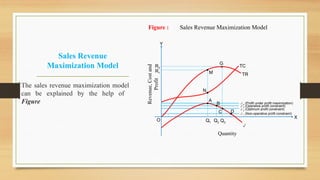
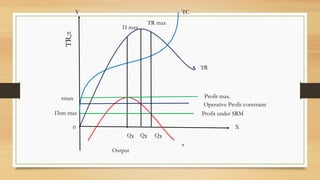
• The entrepreneur receives a profit as a reward for bearing final responsibility that
cannot be shifted on anyone else.
4.
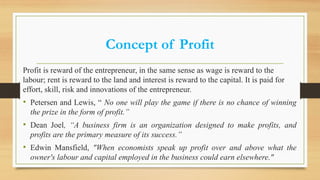
Concept of Profit
Profitis reward of the entrepreneur, in the same sense as wage is reward to the
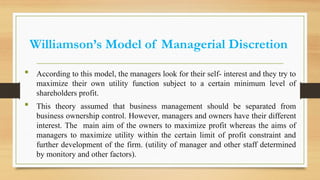
labour; rent is reward to the land and interest is reward to the capital. It is paid for
effort, skill, risk and innovations of the entrepreneur.
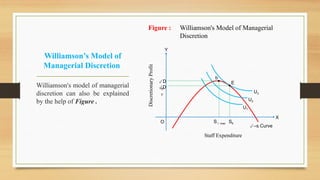
• Petersen and Lewis, “ No one will play the game if there is no chance of winning
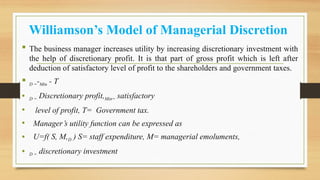
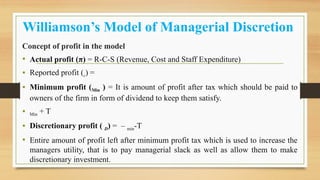
the prize in the form of profit.”
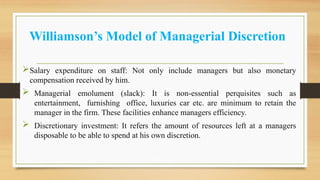
• Dean Joel, “A business firm is an organization designed to make profits, and
profits are the primary measure of its success.”
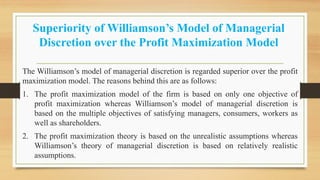
• Edwin Mansfield, "When economists speak up profit over and above what the
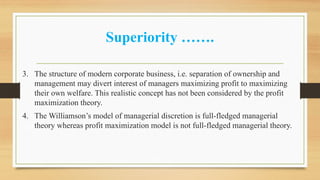
owner's labour and capital employed in the business could earn elsewhere."
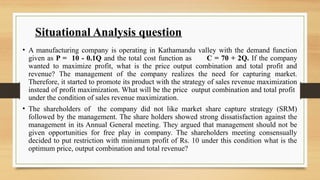
5.
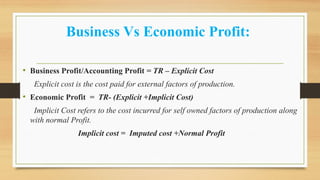
Business Vs EconomicProfit:
• Business Profit/Accounting Profit = TR – Explicit Cost
Explicit cost is the cost paid for external factors of production.
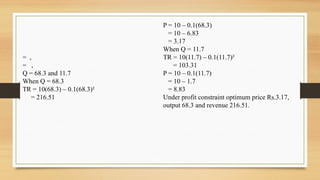
• Economic Profit = TR- (Explicit +Implicit Cost)
Implicit Cost refers to the cost incurred for self owned factors of production along
with normal Profit.
Implicit cost = Imputed cost +Normal Profit
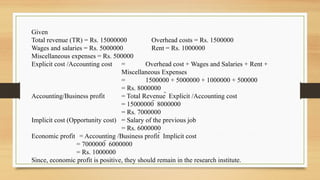
6.
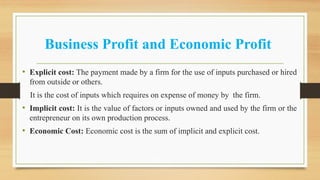
Business Profit andEconomic Profit
• Explicit cost: The payment made by a firm for the use of inputs purchased or hired
from outside or others.
It is the cost of inputs which requires on expense of money by the firm.
• Implicit cost: It is the value of factors or inputs owned and used by the firm or the
entrepreneur on its own production process.
• Economic Cost: Economic cost is the sum of implicit and explicit cost.
7.
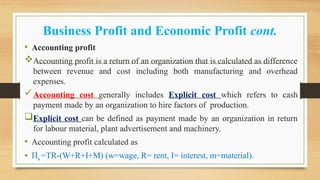
Business Profit andEconomic Profit cont.
• Accounting profit
Accounting profit is a return of an organization that is calculated as difference
between revenue and cost including both manufacturing and overhead
expenses.
Accounting cost generally includes Explicit cost which refers to cash
payment made by an organization to hire factors of production.
Explicit cost can be defined as payment made by an organization in return
for labour material, plant advertisement and machinery.
• Accounting profit calculated as
• Πa =TR-(W+R+I+M) (w=wage, R= rent, I= interest, m=material).
8.
Business Profit andEconomic Profit cont.
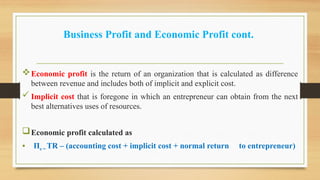
Economic profit is the return of an organization that is calculated as difference
between revenue and includes both of implicit and explicit cost.
Implicit cost that is foregone in which an entrepreneur can obtain from the next
best alternatives uses of resources.
Economic profit calculated as
• Πe = TR – (accounting cost + implicit cost + normal return to entrepreneur)
9.
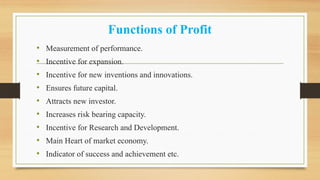
Functions of Profit
•Measurement of performance.
• Incentive for expansion.
• Incentive for new inventions and innovations.
• Ensures future capital.
• Attracts new investor.
• Increases risk bearing capacity.
• Incentive for Research and Development.
• Main Heart of market economy.
• Indicator of success and achievement etc.
10.
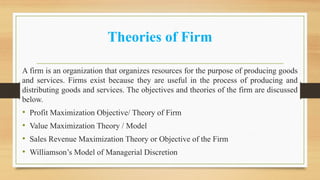
Theories of Firm
Afirm is an organization that organizes resources for the purpose of producing goods
and services. Firms exist because they are useful in the process of producing and
distributing goods and services. The objectives and theories of the firm are discussed
below.
• Profit Maximization Objective/ Theory of Firm
• Value Maximization Theory / Model
• Sales Revenue Maximization Theory or Objective of the Firm
• Williamson’s Model of Managerial Discretion
11.
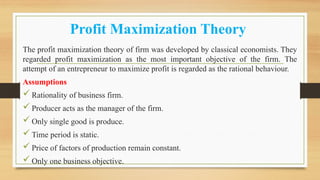
Profit Maximization Theory
Theprofit maximization theory of firm was developed by classical economists. They
regarded profit maximization as the most important objective of the firm. The
attempt of an entrepreneur to maximize profit is regarded as the rational behaviour.
Assumptions
Rationality of business firm.
Producer acts as the manager of the firm.
Only single good is produce.
Time period is static.
Price of factors of production remain constant.
Only one business objective.
12.
Profit Maxim…..
There aretwo approaches to explain the profit maximization objective of the firm
which are explained below.
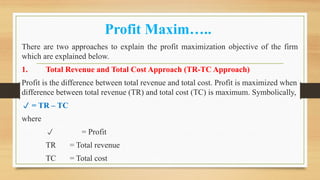
1. Total Revenue and Total Cost Approach (TR-TC Approach)
Profit is the difference between total revenue and total cost. Profit is maximized when
difference between total revenue (TR) and total cost (TC) is maximum. Symbolically,
= TR – TC
where
= Profit
TR = Total revenue
TC = Total cost
13.
Profit Maximization
Theory
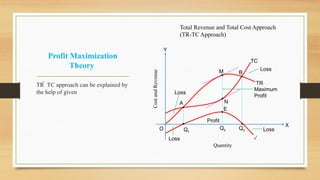
TR TC approach can be explained by
the help of given
TR
TC
Q3
Q2
Q1
A
B
M
N
Loss
Maximum
Profit
E
Loss
Profit
Loss
Loss
O
X
Y
Cost
and
Revenue
Quantity
Total Revenue and Total Cost Approach
(TR-TC Approach)
14.
Profit Maxim…….
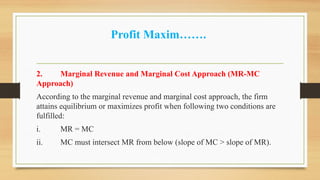
2. MarginalRevenue and Marginal Cost Approach (MR-MC
Approach)
According to the marginal revenue and marginal cost approach, the firm
attains equilibrium or maximizes profit when following two conditions are
fulfilled:
i. MR = MC
ii. MC must intersect MR from below (slope of MC > slope of MR).
15.
Profit Maximization Theory
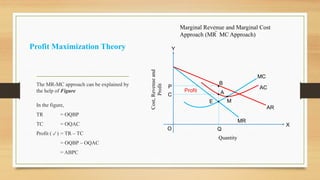
TheMR-MC approach can be explained by
the help of Figure
In the figure,
TR = OQBP
TC = OQAC
Profit () = TR – TC
= OQBP – OQAC
= ABPC
Marginal Revenue and Marginal Cost
Approach (MR MC Approach)
MC
AC
AR
MR
Q
C
B
P
A
E
Quantity
Cost,
Revenue
and
Profit
Y
X
O
M
Profit
16.
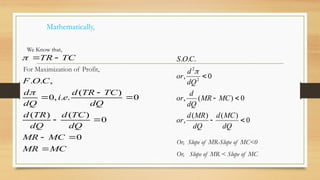
Mathematically,
For Maximization ofProfit,
MC
MR
MC
MR
dQ
TC
d
dQ
TR
d
dQ
TC
TR
d
e
i
dQ
d
C
O
F
TC
TR
0
0
)
(
)
(
0
)
(
.
.
,
0
,
.
.
We Know that,
0
)
(
)
(
,
0
)
(
,
0
,
.
.
.
2
2
dQ
MC
d
dQ
MR
d
or
MC
MR
dQ
d
or
dQ
d
or
C
O
S
Or, Slope of MR-Slope of MC<0
Or, Slope of MR < Slope of MC
17.
Profit Maximization….
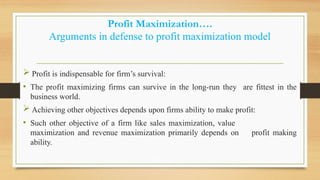
Arguments indefense to profit maximization model
Profit is indispensable for firm’s survival:
• The profit maximizing firms can survive in the long-run they are fittest in the
business world.
Achieving other objectives depends upon firms ability to make profit:
• Such other objective of a firm like sales maximization, value
maximization and revenue maximization primarily depends on profit making
ability.
18.
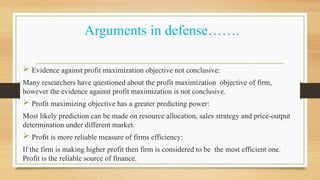
Arguments in defense…….
Evidence against profit maximization objective not conclusive:
Many researchers have questioned about the profit maximization objective of firm,
however the evidence against profit maximization is not conclusive.
Profit maximizing objective has a greater predicting power:
Most likely prediction can be made on resource allocation, sales strategy and price-output
determination under different market.
Profit is more reliable measure of firms efficiency:
If the firm is making higher profit then firm is considered to be the most efficient one.
Profit is the reliable source of finance.
19.
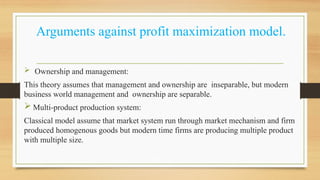
Arguments against profitmaximization model.
Ownership and management:
This theory assumes that management and ownership are inseparable, but modern
business world management and ownership are separable.
Multi-product production system:
Classical model assume that market system run through market mechanism and firm
produced homogenous goods but modern time firms are producing multiple product
with multiple size.
20.
Arguments against……
Policyof profit maximization:
Policy of maximize profit cause increase risk and instability, which managers fear.
Therefore , risk averse managers avoid a policy of maximization.
Based on unrealistic assumption.
Empirical evidence vague:
Profit maximization is vague because most firm do not rank profits as the major goal.
The main problems are control and management.
21.
Value Maxim…….
Valuemaximization model is the modified version of profit maximization model.
The profit maximization model has an objective of short run profit maximization
but the value maximization model has an objective of long run profit
maximization.
Long-run profit of business firm is measured in term of share price in stock market
which indicates the wealth of shareholders
The value of firm or share price in the stock market depends upon time of return,
cash flow and risk.
22.
Value Maxim.......
• Manageralways concentrates on those economics activities that contribute to
increase share price in stock market.
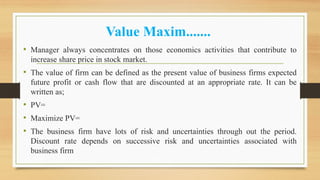
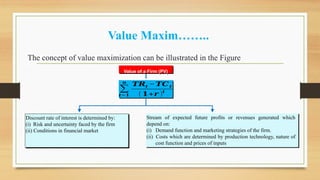
• The value of firm can be defined as the present value of business firms expected
future profit or cash flow that are discounted at an appropriate rate. It can be
written as;
• PV=
• Maximize PV=
• The business firm have lots of risk and uncertainties through out the period.
Discount rate depends on successive risk and uncertainties associated with
business firm
23.
Value Maxim……..
The conceptof value maximization can be illustrated in the Figure
∑
𝒕=𝟏
𝒏
𝑻𝑹𝒕 −𝑻𝑪𝒕
(𝟏+𝒓 )
𝒕
Discount rate of interest is determined by:
(i) Risk and uncertainty faced by the firm
(ii) Conditions in financial market
Stream of expected future profits or revenues generated which
depend on:
(i) Demand function and marketing strategies of the firm.
(ii) Costs which are determined by production technology, nature of
cost function and prices of inputs
Value of a Firm (PV)
24.
Value Maxim……..
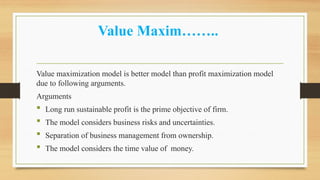
Value maximizationmodel is better model than profit maximization model
due to following arguments.
Arguments
Long run sustainable profit is the prime objective of firm.
The model considers business risks and uncertainties.
Separation of business management from ownership.
The model considers the time value of money.
25.
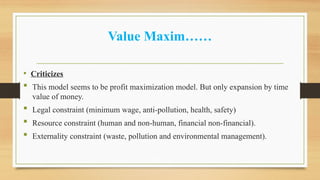
Value Maxim……
• Criticizes
This model seems to be profit maximization model. But only expansion by time
value of money.
Legal constraint (minimum wage, anti-pollution, health, safety)
Resource constraint (human and non-human, financial non-financial).
Externality constraint (waste, pollution and environmental management).
26.
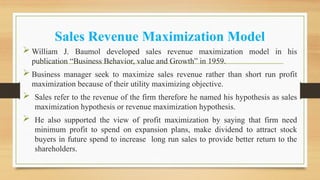
Sales Revenue MaximizationModel
William J. Baumol developed sales revenue maximization model in his
publication “Business Behavior, value and Growth” in 1959.
Business manager seek to maximize sales revenue rather than short run profit
maximization because of their utility maximizing objective.
Sales refer to the revenue of the firm therefore he named his hypothesis as sales
maximization hypothesis or revenue maximization hypothesis.
He also supported the view of profit maximization by saying that firm need
minimum profit to spend on expansion plans, make dividend to attract stock
buyers in future spend to increase long run sales to provide better return to the
shareholders.
27.
Sales Revenue…..
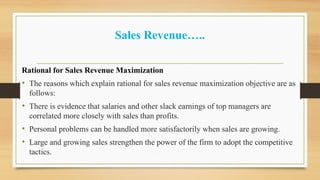
Rational forSales Revenue Maximization
• The reasons which explain rational for sales revenue maximization objective are as
follows:
• There is evidence that salaries and other slack earnings of top managers are
correlated more closely with sales than profits.
• Personal problems can be handled more satisfactorily when sales are growing.
• Large and growing sales strengthen the power of the firm to adopt the competitive
tactics.
28.
Sales Revenue .…
•Larger sales growing over time given prestige to the managers, while large profits
go into the pockets of shareholders.
• Managers find profit maximization a difficult objective to fulfil consistently over
time and at the same level. Profit may fluctuate with changing conditions.
• Increased sales revenue increase competitive capacity of managers in the market.
29.
Sales Revenue…..
Assumptions
• Thetime horizon of a firm is a single period.
• During this time period, the firm attempts to maximize the total sales revenue
subject to profit constraint.
• Firms earn minimum profit to keep shareholders happy and prevent the fall in
share price.
• The market is imperfectly competitive.
• The demand curve is downward slopping and average cost curves are U-shaped.
30.
Sales Revenue
Maximization Model
Thesales revenue maximization model
can be explained by the help of
Figure
Figure : Sales Revenue Maximization Model
TR
TC
Q3
Q1
M
N
A
C D
G
4 (Profit under profit maximization)
2 (Optimum profit constraint)
1 (Non-operative profit constraint)
Revenue,
Cost
and
Profit
Quantity
X
Y
O
R1
R2
B 3 (Operative profit constraint)
Q2
31.
Sales Revenue …..
Thismodel or theory can be explained under the two cases: sales revenue
maximization without profit constraint and sales revenue maximization with profit
constraint.
Case 1: Sales Revenue Maximization without Profit Constraint
If there is no profit constraint or shareholders of the firm do not demand any type of
profit, the manager will produce and sell OQ3 quantity of output. At this output, total
revenue is OR2 which is the maximum revenue and total profit is CQ3.
32.
Sales Revenue……
Case 2:Sales Revenue Maximization with Profit Constraint
Under the profit constraint case, there are three situations which are as follows:
i. If minimum profit constraint imposed by shareholders is 2, the manager will
sell OQ3 output, where total revenue is maximum. This is known as the optimum
profit constraint.
ii. If minimum profit constraint imposed by shareholders is 3, the manager will
sell OQ2 output. This is known as the operative profit constraint.
iii. If minimum profit constraint is 1, the manager will sell OQ3 output. This is
known as the non-operative profit constraint.
33.
Sales Revenue ….
•Managers wants steady performance with the satisfactory level of profit rather than
unstable short term profit.
• Increasing sales revenue measures the efficiency of manager and gives prestige,
reputation to managers.
• Salaries and other benefits for top level managers closely depend on sales revenue
rather than profit
• Oligopolistic firm want to capture a larger share of market in order to prevent new
entry and competition. So sales revenue is an indicator of managerial efficiency .
34.
Sales Revenue ….
It is consists with long run profit maximization.
The firm can sell more than profit maximizing level only due to the ignorance of
their demand curve.
According to W. G. Shepherd in case of oligopoly, the equilibrium lies at the
point of kink demand curve.
It cannot be tasted without knowing demand and cost function of individual firm.
It does not show the process of equilibrium of the industry consisting of all firm
are attaining sales maximization.
35.
Williamson’s Model ofManagerial Discretion
• Similar to Baumol’s ideas in sales revenue maximization, Oliver E. Williamson
also argues that managers have certain self- interest while making business
decision regarding price and output determination.
• He published his article in “American Economic Review” in 1963 under the title
of managerial discretion and presented an idea that manager have discretion to
pursue business objective rather than profit maximization. Therefor the model
is based on managerial discretion.
36.
Williamson’s Model ofManagerial Discretion
According to this model, the managers look for their self- interest and they try to
maximize their own utility function subject to a certain minimum level of
shareholders profit.
This theory assumed that business management should be separated from
business ownership control. However, managers and owners have their different
interest. The main aim of the owners to maximize profit whereas the aims of
managers to maximize utility within the certain limit of profit constraint and
further development of the firm. (utility of manager and other staff determined
by monitory and other factors).
37.
Williamson’s Model of
ManagerialDiscretion
Williamson's model of managerial
discretion can also be explained
by the help of Figure .
Figure : Williamson's Model of Managerial
Discretion
U1
U2
U3
S max SE
–s Curve
D
E
O
X
Y
Staff Expenditure
Discretionary
Profit
E
b
D
M
38.
Williamson’s Model ofManagerial Discretion
The business manager increases utility by increasing discretionary investment with
the help of discretionary profit. It is that part of gross profit which is left after
deduction of satisfactory level of profit to the shareholders and government taxes.
D =-Min - T
• D = Discretionary profit,Min= satisfactory
• level of profit, T= Government tax.
• Manager’s utility function can be expressed as
• U=f( S, M,D ) S= staff expenditure, M= managerial emoluments,
• D = discretionary investment
39.
Williamson’s Model ofManagerial Discretion
Salary expenditure on staff: Not only include managers but also monetary
compensation received by him.
Managerial emolument (slack): It is non-essential perquisites such as
entertainment, furnishing office, luxuries car etc. are minimum to retain the
manager in the firm. These facilities enhance managers efficiency.
Discretionary investment: It refers the amount of resources left at a managers
disposable to be able to spend at his own discretion.
40.
Williamson’s Model ofManagerial Discretion
Concept of profit in the model
• Actual profit (π) = R-C-S (Revenue, Cost and Staff Expenditure)
• Reported profit (r) =
• Minimum profit (Min ) = It is amount of profit after tax which should be paid to
owners of the firm in form of dividend to keep them satisfy.
• Min + T
• Discretionary profit ( D) = – min-T
• Entire amount of profit left after minimum profit tax which is used to increase the
managers utility, that is to pay managerial slack as well as allow them to make
discretionary investment.
41.
Superiority of Williamson’sModel of Managerial
Discretion over the Profit Maximization Model
The Williamson’s model of managerial discretion is regarded superior over the profit
maximization model. The reasons behind this are as follows:
1. The profit maximization model of the firm is based on only one objective of
profit maximization whereas Williamson’s model of managerial discretion is
based on the multiple objectives of satisfying managers, consumers, workers as
well as shareholders.
2. The profit maximization theory is based on the unrealistic assumptions whereas
Williamson’s theory of managerial discretion is based on relatively realistic
assumptions.
42.
Superiority …….
3. Thestructure of modern corporate business, i.e. separation of ownership and
management may divert interest of managers maximizing profit to maximizing
their own welfare. This realistic concept has not been considered by the profit
maximization theory.
4. The Williamson’s model of managerial discretion is full-fledged managerial
theory whereas profit maximization model is not full-fledged managerial theory.
43.
Situational Analysis question
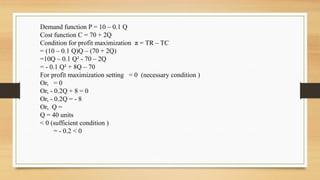
•A manufacturing company is operating in Kathamandu valley with the demand function
given as P = 10 - 0.1Q and the total cost function as C = 70 + 2Q. If the company
wanted to maximize profit, what is the price output combination and total profit and
revenue? The management of the company realizes the need for capturing market.
Therefore, it started to promote its product with the strategy of sales revenue maximization
instead of profit maximization. What will be the price output combination and total profit
under the condition of sales revenue maximization.
• The shareholders of the company did not like market share capture strategy (SRM)
followed by the management. The share holders showed strong dissatisfaction against the
management in its Annual General meeting. They argued that management should not be
given opportunities for free play in company. The shareholders meeting consensually
decided to put restriction with minimum profit of Rs. 10 under this condition what is the
optimum price, output combination and total revenue?
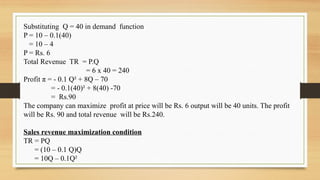
Substituting Q =40 in demand function
P = 10 – 0.1(40)
= 10 – 4
P = Rs. 6
Total Revenue TR = P.Q
= 6 x 40 = 240
Profit π = - 0.1 Q² + 8Q – 70
= - 0.1(40)² + 8(40) -70
= Rs.90
The company can maximize profit at price will be Rs. 6 output will be 40 units. The profit
will be Rs. 90 and total revenue will be Rs.240.
Sales revenue maximization condition
TR = PQ
= (10 – 0.1 Q)Q
= 10Q – 0.1Q²
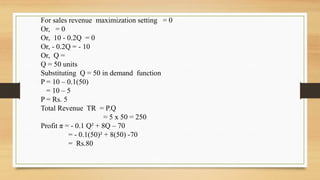
46.
For sales revenuemaximization setting = 0
Or, = 0
Or, 10 - 0.2Q = 0
Or, - 0.2Q = - 10
Or, Q =
Q = 50 units
Substituting Q = 50 in demand function
P = 10 – 0.1(50)
= 10 – 5
P = Rs. 5
Total Revenue TR = P.Q
= 5 x 50 = 250
Profit π = - 0.1 Q² + 8Q – 70
= - 0.1(50)² + 8(50) -70
= Rs.80
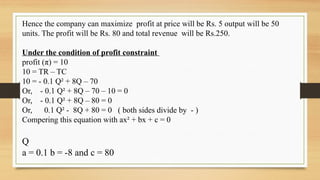
47.
Hence the companycan maximize profit at price will be Rs. 5 output will be 50
units. The profit will be Rs. 80 and total revenue will be Rs.250.
Under the condition of profit constraint
profit (π) = 10
10 = TR – TC
10 = - 0.1 Q² + 8Q – 70
Or, - 0.1 Q² + 8Q – 70 – 10 = 0
Or, - 0.1 Q² + 8Q – 80 = 0
Or, 0.1 Q² - 8Q + 80 = 0 ( both sides divide by - )
Compering this equation with ax² + bx + c = 0
Q
a = 0.1 b = -8 and c = 80
48.
= ,
= ,
Q= 68.3 and 11.7
When Q = 68.3
TR = 10(68.3) – 0.1(68.3)²
= 216.51
P = 10 – 0.1(68.3)
= 10 – 6.83
= 3.17
When Q = 11.7
TR = 10(11.7) – 0.1(11.7)²
= 103.31
P = 10 – 0.1(11.7)
= 10 – 1.7
= 8.83
Under profit constraint optimum price Rs.3.17,
output 68.3 and revenue 216.51.
EXERCISE 1
Two formerMBS students worked in the world Bank at a salary Rs. 30,00,000 each for one year
after they graduated. After a year they decided to quit their job and started a research institute.
They used Rs. 15,00,000 to overheads (i.e. computer, furniture, etc.) For the next year, they took
Rs. 150,00,000 in revenue each year and paid five research assistants Rs. 10,00,000 annually
each and rented an office for Rs. 10,00,000 per year with miscellaneous expenses Rs. 5,00,000
per year.
a. Define accounting cost and economic cost.
b. Compute accounting profit and economic profit. Should they remain in research institute
after the year if they are indifferent between working for themselves or other in a similar
capacity? [2014 Semester]
51.
Given
Total revenue (TR)= Rs. 15000000 Overhead costs = Rs. 1500000
Wages and salaries = Rs. 5000000 Rent = Rs. 1000000
Miscellaneous expenses = Rs. 500000
Explicit cost /Accounting cost = Overhead cost + Wages and Salaries + Rent +
Miscellaneous Expenses
= 1500000 + 5000000 + 1000000 + 500000
= Rs. 8000000
Accounting/Business profit = Total Revenue Explicit /Accounting cost
= 15000000 8000000
= Rs. 7000000
Implicit cost (Opportunity cost) = Salary of the previous job
= Rs. 6000000
Economic profit = Accounting /Business profit Implicit cost
= 7000000 6000000
= Rs. 1000000
Since, economic profit is positive, they should remain in the research institute.
EXERCISE 7
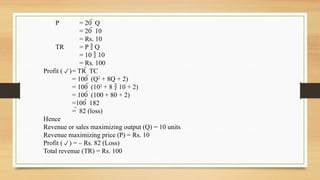
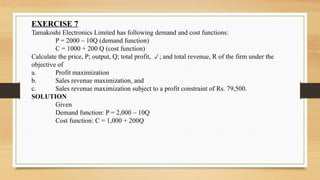
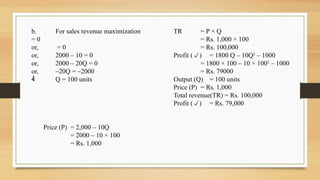
Tamakoshi ElectronicsLimited has following demand and cost functions:
P = 2000 – 10Q (demand function)
C = 1000 + 200 Q (cost function)
Calculate the price, P; output, Q; total profit, ; and total revenue, R of the firm under the
objective of
a. Profit maximization
b. Sales revenue maximization, and
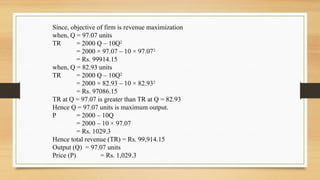
c. Sales revenue maximization subject to a profit constraint of Rs. 79,500.
SOLUTION
Given
Demand function: P = 2,000 – 10Q
Cost function: C = 1,000 + 200Q

![EXERCISE 1
Two former MBS students worked in the world Bank at a salary Rs. 30,00,000 each for one year
after they graduated. After a year they decided to quit their job and started a research institute.
They used Rs. 15,00,000 to overheads (i.e. computer, furniture, etc.) For the next year, they took
Rs. 150,00,000 in revenue each year and paid five research assistants Rs. 10,00,000 annually
each and rented an office for Rs. 10,00,000 per year with miscellaneous expenses Rs. 5,00,000
per year.
a. Define accounting cost and economic cost.
b. Compute accounting profit and economic profit. Should they remain in research institute
after the year if they are indifferent between working for themselves or other in a similar
capacity? [2014 Semester]](https://image.slidesharecdn.com/economics-chapter01-250905181425-b2eb4aef/85/Economics-Chapter_01-pptx-of-chapter-6-50-320.jpg)
![EXERCISE 2
Let demand function: P = 100 4Q, cost function: TC = 50 + 6Q2
. Compute profit maximizing
output, price, TR and maximum profit. [2015 Semester]
SOLUTION
Given
Demand function: P = 100 4Q
Cost function: TC = 50 + 6Q2
We know that,
TR
= P Q
= (100 4 Q) Q
= 100Q 4Q2
Profit () = TR TC
= 100Q 4Q2
(50 + 6Q2
)
= 100Q 4Q2
50 6Q2
= 50 + 100Q 10Q2](https://image.slidesharecdn.com/economics-chapter01-250905181425-b2eb4aef/85/Economics-Chapter_01-pptx-of-chapter-6-52-320.jpg)
![Condition For profit maximization
= 0
or, [ 50 + 100Q 10Q2
] = 0
or, –5 + 100 – = 0
or, 0 + 100 1 10 2Q = 0
or, 100 20Q = 0
or, –20Q = –100
, Q = = 5 units
Putting value of Q in demand function,
P = 100 4 5
= 100 20
= Rs. 80
TR = P Q
= 80 5
= Rs. 400
Maximum Profit () = TR TC
= 400 (50 + 6Q2
)
= 400 (50 + 6 52
)
= 400 (50 + 150)
= 400 200
= Rs. 200
Hence
Profit maximizing output
(Q) = 5 units
Profit maximizing price (P)
= Rs. 80
Total revenue (TR) = Rs.
400
Maximum profit () = Rs.
200](https://image.slidesharecdn.com/economics-chapter01-250905181425-b2eb4aef/85/Economics-Chapter_01-pptx-of-chapter-6-53-320.jpg)
![a. Profit maximization
We know that,
Profit () = TR – TC
= P × Q – TC
= [(2,000 – 10Q)Q] – [1,000 + 200Q]
= 2,000 Q – 10Q2
– [1,000 + 200Q]
= 2,000 Q – 10Q2
– 1,000 – 200Q
= 1800Q – 10Q2
– 1000
Condition For profit maximization
= 0
or,(1800Q – 10Q2
– 1000) = 0
or, 1800 – 20Q = 0
or, –20Q = –1800
Q = 90 units
Hence profit maximizing output is 90 units.
Profit () = 1800 Q – 10Q2
– 1000
= 1800 × 90 – 10(90)2
– 1000
= 80,000
Price (P) = 2,000 – 10Q
= 2,000 – 10 × 90
= Rs. 1,100
Total revenue (TR) = P × Q
= 1100 × 90
= Rs. 99,000
Output (Q) = 90 units
Profit () = Rs. 80,000
Price (P) = Rs. 1,100
Total revenue (TR) = Rs. 99,000](https://image.slidesharecdn.com/economics-chapter01-250905181425-b2eb4aef/85/Economics-Chapter_01-pptx-of-chapter-6-57-320.jpg)
![c. Given profit constraint () = Rs. 79500
Profit function () = 1800Q – 10Q2
– 1000
or, 1800 Q – 10Q2
– 1000 = 79500
or, Q2
– 180Q + 8050 = 0
Comparing this equation with ax2
+ bx + c = 0
x =
Q = [Where, a=1, b = –80 and c = 8050]
= =
Taking +ve sign,
Q = = 97.07 units
Taking –ve sign,
Q = = 82.93 units](https://image.slidesharecdn.com/economics-chapter01-250905181425-b2eb4aef/85/Economics-Chapter_01-pptx-of-chapter-6-59-320.jpg)