Professional Studies 3A
21st Century skills in
Technology and
Education
Assignment 1 of
Shanleigh Anne Brough
201133277
079 487 5353
Introduction of
what's to come.
 In this presentation I will be focusing on
the following 5 topics:
1. Knowledge Society agenda.
2. Pervasiveness of technology.
3. The Goals of “Education For All”
4. The future strategic objectives
5. Professional development of teachers relating to ICT’S and professional
aptitude.
Within these topics I have carefully selected themes that I feel are
the most important within the context. And topics that I believe
need to be expressed in more detail.
***Enjoy***
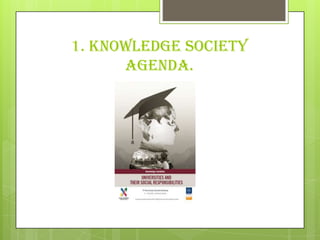
1. Knowledge Society
Agenda.
1. Knowledge Society
Agenda.
 The information provided for this topic comes from the
reading of:
 Being a Teacher,in the Knowledge Society
Prof. Bernard CORNU
(INRP, CNED-EIFAD, France)
 I will be focusing on, What Knowledge is?
 What Information is?
 Why we should integrate the ICT.
 And how educators feel about ICT
1. Knowledge Society
Agenda.
 What is Knowledge?
 Knowledge is the output of the reconstructionof
information by a person, according to his/her history
and context.It depends on the person.
 What is Knowledge society?
 A human society, in which knowledge should bring justice,
solidarity, democracy, peace... A society in which knowledge could
be a force for changing society. A society which should provide
universal and equitable access to information (UNESCO).
1. Knowledge Society
Agenda.
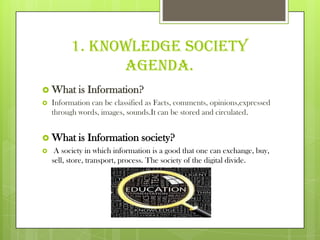
 What is Information?
 Information can be classified as Facts, comments, opinions,expressed
through words, images, sounds.It can be stored and circulated.
 What is Information society?
 A society in which information is a good that one can exchange, buy,
sell, store, transport, process. The society of the digital divide.
1. Knowledge Society
Agenda.
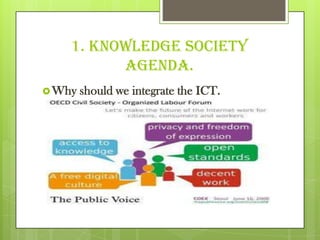
Why should we integrate the ICT.
1. Knowledge Society
Agenda.
 To learn to know about ICT and Knowledge as
well as how to access Knowledge.
 To Learn to do New capacities through ICT.
 To Learn to live together through the New era of
communication, the « e-citizen »
 To Learn to be in the knowledge society and
improve personal development.
1. Knowledge Society
Agenda
How educators feel about ICT
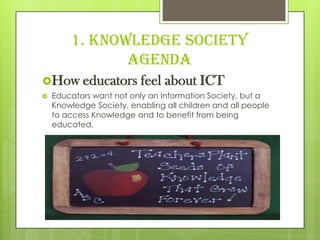
 Educators want not only an Information Society, but a
Knowledge Society, enabling all children and all people
to access Knowledge and to benefit from being
educated.
1. Knowledge Society
Agenda
 How educators feel about ICT
 Education is a key issue in the Knowledge Society,
and Educators have a major mission.
 Particularly, it is the responsibility of all educators
and decision-makers around the world to help
developing countries take part in the developments
of ICT in Education.
2. Pervasiveness of technology.
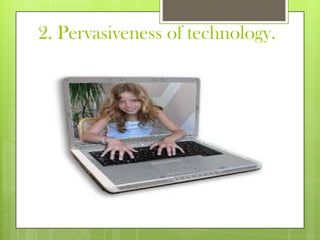
 The reading below is an example of how we rely on
technology on a regular daily basis.
 Get up. Turn off the digital alarm clock. Hit the switch on the
automatic coffee maker. Turn on the morning news. Shower,
then use an electric toothbrush. Take coffee on drive to work
in a new car with a U2 CD in the CD player. Stop by to get
money from an ATM. Work all day on computer, while
listening to iPod (except when the phone rings or the fax
machine indicates an incoming fax). Stop by store on the way
home to rent a video and to pay for groceries with a debit
card. Relax with a movie, TV dinner, and microwave
popcorn. Call Mom on the cell phone before bed.
2. Pervasiveness of technology.
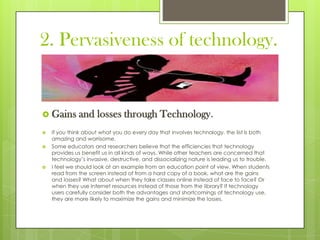
 Gains and losses through Technology.
 If you think about what you do every day that involves technology, the list is both
amazing and worrisome.
 Some educators and researchers believe that the efficiencies that technology
provides us benefit us in all kinds of ways. While other teachers are concerned that
technology’s invasive, destructive, and dissocializing nature is leading us to trouble.
 I feel we should look at an example from an education point of view. When students
read from the screen instead of from a hard copy of a book, what are the gains
and losses? What about when they take classes online instead of face to face? Or
when they use Internet resources instead of those from the library? If technology
users carefully consider both the advantages and shortcomings of technology use,
they are more likely to maximize the gains and minimize the losses.
3. The Goals of “Education For All”
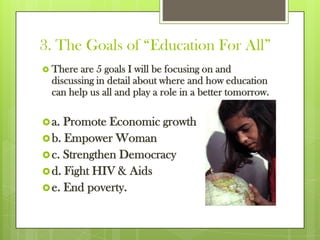
 There are 5 goals I will be focusing on and
discussing in detail about where and how education
can help us all and play a role in a better tomorrow.
a. Promote Economic growth
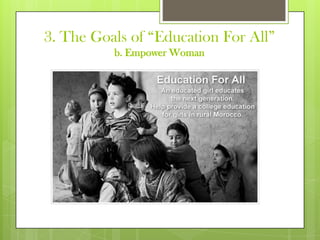
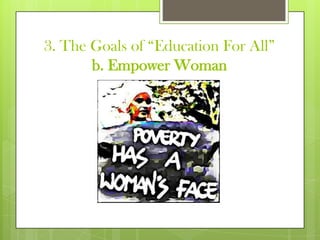
b. Empower Woman
c. Strengthen Democracy
d. Fight HIV & Aids
e. End poverty.
3. The Goals of “Education For All”
a. Promote Economic growth
 Youth and Education. Discovered itwe will support free markets and free
trade to unleash the power of the private sector to promote economic growth
and prosperity ...(FY 2007-2012 Department of State and USAID Strategic Plan, Bureau of Resource
Management, May 2007)
 The "World Economic Development Declaration" (The Zhuhai Declaration)
points out: Education and skill development must be promoted for all
people, no matter where they come from and regardless of their race, sex and
income level, to eradicate illiteracy and ignorance. Human resources should
be vigorously developed to facilitate economic development. (By Xue Lan, Professor
and Vice-president of School of Public Policy Management, Tsinghua University)
 Education plays an important basic role in the respects of HR training,
intellectual innovation and dissemination and promotion of the intellectual
application, as a result human resources plays a driving force to the economic
increase.
3. The Goals of “Education For All”
b. Empower Woman
3. The Goals of “Education For All”
b. Empower Woman
 Below is an extract of a real life story, proving how democracy can strengthen
through education.
 The reading is from :Noxolo Mgudlwa – Idasa (South Africa)
 Ignas Kleden – KID (Indonesia)
 In his opening presentation, Ignas Kleden explained the history and
work of the Indonesia Community for Democracy (KID) and its
schools for democracy. It has five locations throughout the
Indonesian Archipelago, including three new schools; the rationale
of the schools is that optimum democracy equals a high quality of
participation and quality of discourse; the schools’ content includes
knowledge, values, and skills; the methodology is carried out both
in class and out of class; participants represent business, civil society
organizations, political parties, and government bureaucracies,
and women comprise 30 percent; there are nine modules; there
are some 400 alumni of the schools, a number of whom were
elected to local parliaments in the 2009 election at the district level;
and the main strategy is to reform from below to strengthen
democracy in the country.
3. The Goals of “Education For All”
c. Strengthen Democracy
3. The Goals of “Education For All”
d. Fight HIV & Aids
 The most common place for people to learn about HIV and AIDS is at school.
 Due to their capacity and universality, schools are a crucial setting for educating young
people about AIDS.8
 As young people are at a high risk of becoming infected with HIV, it is vital that they are
educated about HIV transmission before they are exposed to situations that put them at
risk of HIV infection (for example, before they are sexually active).
 Schools play a major role in shaping the attitudes, opinions and behaviour of young
people and so are ideal environments for teaching the social as well as the biological
aspects of HIV and AIDS.
 (Dr Peter Piot, former UNAIDS Executive Director)
3. The Goals of “Education For All”
e. End poverty.
3. The Goals of “Education For All”
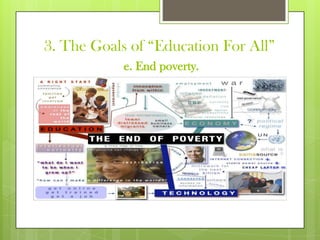
e. End poverty.
 Investing in education is the single most
effective means of reducing poverty.
 Education is more than reading, writing,
and arithmetic. It is one of the most
important investments a country can
make in its people and its future and is
critical to reducing poverty and
inequality.
3. The Goals of “Education For All”
e. End poverty.
The following indicates ways in which
education can reduce poverty.
 Education gives people critical skills and tools to
help them better provide for themselves and their
children.
 Education helps people work better and can create
opportunities for sustainable and viable economic
growth now and into the future.
3. The Goals of “Education For All”
e. End poverty.
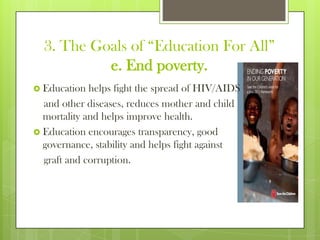
 Education helps fight the spread of HIV/AIDS
and other diseases, reduces mother and child
mortality and helps improve health.
 Education encourages transparency, good
governance, stability and helps fight against
graft and corruption.
4. The future strategic objectives
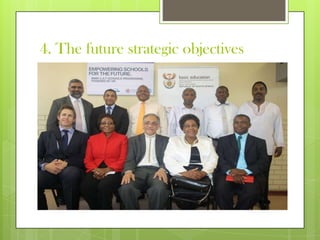
In the section to come i will be focusing on
the Strategic overview of the National
Development plan.
The Vision:
 The vision is for a South Africa in which all people
will have access to a lifelong learning, education and
training opportunities which will , in turn,
contribute towards improving the quality of life and
building of a peaceful, prosperous and democratic
south Africa.
4. The future strategic objectives
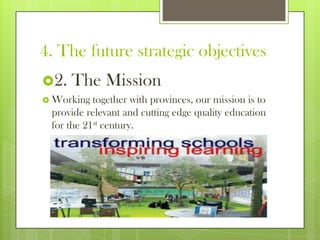
2. The Mission
 Working together with provinces, our mission is to
provide relevant and cutting edge quality education
for the 21st century.
4. The future strategic objectives
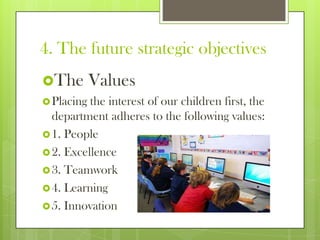
The Values
Placing the interest of our children first, the
department adheres to the following values:
1. People
2. Excellence
3. Teamwork
4. Learning
5. Innovation
5. Professional development of teachers relating to
ICT’S and professional aptitude.
Some Common Principles of ICT are:
 a well-qualified profession
 a profession placed within the context of lifelong
learning
 a mobile profession
 a profession based on partnerships
5. Professional development of teachers relating
to ICT’S and professional aptitude.
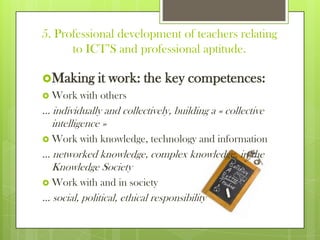
Making it work: the key competences:
 Work with others
… individually and collectively, building a « collective
intelligence »
 Work with knowledge, technology and information
… networked knowledge, complex knowledge, in the
Knowledge Society
 Work with and in society
… social, political, ethical responsibility
5. Professional development of teachers
relating to ICT’S and professional aptitude
The broad standards of the ICTeTSA
include teachers to:
 1. Engage in instructional design Processes.
 2. Facilitate and inspire student learning, innovation
and creativity.
 3. Create and manage effective learning
environments.
5. Professional development of teachers
relating to ICT’S and professional aptitude
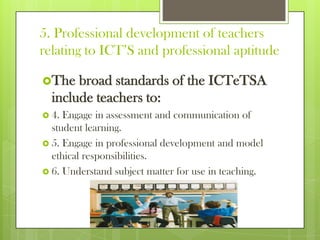
The broad standards of the ICTeTSA
include teachers to:
 4. Engage in assessment and communication of
student learning.
 5. Engage in professional development and model
ethical responsibilities.
 6. Understand subject matter for use in teaching.
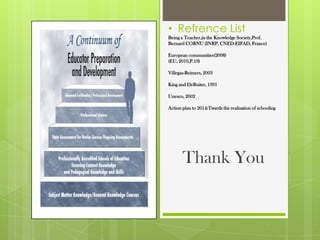
• Refrence List
Being a Teacher,in the Knowledge Society,Prof.
Bernard CORNU (INRP, CNED-EIFAD, France)
European communities(2008)
(EU, 2010,P.19)
Villegas-Reimers, 2003
King and DeRuiter, 1991
Unesco, 2002
Action plan to 2014:Twards the realisation of schooling
Thank You

Professional studies 3 a shanleigh

  • 1.
    Professional Studies 3A 21stCentury skills in Technology and Education Assignment 1 of Shanleigh Anne Brough 201133277 079 487 5353
  • 2.
    Introduction of what's tocome.  In this presentation I will be focusing on the following 5 topics: 1. Knowledge Society agenda. 2. Pervasiveness of technology. 3. The Goals of “Education For All” 4. The future strategic objectives 5. Professional development of teachers relating to ICT’S and professional aptitude. Within these topics I have carefully selected themes that I feel are the most important within the context. And topics that I believe need to be expressed in more detail. ***Enjoy***
  • 3.
  • 4.
    1. Knowledge Society Agenda. The information provided for this topic comes from the reading of:  Being a Teacher,in the Knowledge Society Prof. Bernard CORNU (INRP, CNED-EIFAD, France)  I will be focusing on, What Knowledge is?  What Information is?  Why we should integrate the ICT.  And how educators feel about ICT
  • 5.
    1. Knowledge Society Agenda. What is Knowledge?  Knowledge is the output of the reconstructionof information by a person, according to his/her history and context.It depends on the person.  What is Knowledge society?  A human society, in which knowledge should bring justice, solidarity, democracy, peace... A society in which knowledge could be a force for changing society. A society which should provide universal and equitable access to information (UNESCO).
  • 6.
    1. Knowledge Society Agenda. What is Information?  Information can be classified as Facts, comments, opinions,expressed through words, images, sounds.It can be stored and circulated.  What is Information society?  A society in which information is a good that one can exchange, buy, sell, store, transport, process. The society of the digital divide.
  • 7.
    1. Knowledge Society Agenda. Whyshould we integrate the ICT.
  • 8.
    1. Knowledge Society Agenda. To learn to know about ICT and Knowledge as well as how to access Knowledge.  To Learn to do New capacities through ICT.  To Learn to live together through the New era of communication, the « e-citizen »  To Learn to be in the knowledge society and improve personal development.
  • 9.
    1. Knowledge Society Agenda Howeducators feel about ICT  Educators want not only an Information Society, but a Knowledge Society, enabling all children and all people to access Knowledge and to benefit from being educated.
  • 10.
    1. Knowledge Society Agenda How educators feel about ICT  Education is a key issue in the Knowledge Society, and Educators have a major mission.  Particularly, it is the responsibility of all educators and decision-makers around the world to help developing countries take part in the developments of ICT in Education.
  • 11.
  • 12.
    2. Pervasiveness oftechnology.  The reading below is an example of how we rely on technology on a regular daily basis.  Get up. Turn off the digital alarm clock. Hit the switch on the automatic coffee maker. Turn on the morning news. Shower, then use an electric toothbrush. Take coffee on drive to work in a new car with a U2 CD in the CD player. Stop by to get money from an ATM. Work all day on computer, while listening to iPod (except when the phone rings or the fax machine indicates an incoming fax). Stop by store on the way home to rent a video and to pay for groceries with a debit card. Relax with a movie, TV dinner, and microwave popcorn. Call Mom on the cell phone before bed.
  • 13.
    2. Pervasiveness oftechnology.  Gains and losses through Technology.  If you think about what you do every day that involves technology, the list is both amazing and worrisome.  Some educators and researchers believe that the efficiencies that technology provides us benefit us in all kinds of ways. While other teachers are concerned that technology’s invasive, destructive, and dissocializing nature is leading us to trouble.  I feel we should look at an example from an education point of view. When students read from the screen instead of from a hard copy of a book, what are the gains and losses? What about when they take classes online instead of face to face? Or when they use Internet resources instead of those from the library? If technology users carefully consider both the advantages and shortcomings of technology use, they are more likely to maximize the gains and minimize the losses.
  • 14.
    3. The Goalsof “Education For All”
  • 15.
    3. The Goalsof “Education For All”  There are 5 goals I will be focusing on and discussing in detail about where and how education can help us all and play a role in a better tomorrow. a. Promote Economic growth b. Empower Woman c. Strengthen Democracy d. Fight HIV & Aids e. End poverty.
  • 16.
    3. The Goalsof “Education For All” a. Promote Economic growth  Youth and Education. Discovered itwe will support free markets and free trade to unleash the power of the private sector to promote economic growth and prosperity ...(FY 2007-2012 Department of State and USAID Strategic Plan, Bureau of Resource Management, May 2007)  The "World Economic Development Declaration" (The Zhuhai Declaration) points out: Education and skill development must be promoted for all people, no matter where they come from and regardless of their race, sex and income level, to eradicate illiteracy and ignorance. Human resources should be vigorously developed to facilitate economic development. (By Xue Lan, Professor and Vice-president of School of Public Policy Management, Tsinghua University)  Education plays an important basic role in the respects of HR training, intellectual innovation and dissemination and promotion of the intellectual application, as a result human resources plays a driving force to the economic increase.
  • 17.
    3. The Goalsof “Education For All” b. Empower Woman
  • 18.
    3. The Goalsof “Education For All” b. Empower Woman
  • 19.
     Below isan extract of a real life story, proving how democracy can strengthen through education.  The reading is from :Noxolo Mgudlwa – Idasa (South Africa)  Ignas Kleden – KID (Indonesia)  In his opening presentation, Ignas Kleden explained the history and work of the Indonesia Community for Democracy (KID) and its schools for democracy. It has five locations throughout the Indonesian Archipelago, including three new schools; the rationale of the schools is that optimum democracy equals a high quality of participation and quality of discourse; the schools’ content includes knowledge, values, and skills; the methodology is carried out both in class and out of class; participants represent business, civil society organizations, political parties, and government bureaucracies, and women comprise 30 percent; there are nine modules; there are some 400 alumni of the schools, a number of whom were elected to local parliaments in the 2009 election at the district level; and the main strategy is to reform from below to strengthen democracy in the country. 3. The Goals of “Education For All” c. Strengthen Democracy
  • 20.
    3. The Goalsof “Education For All” d. Fight HIV & Aids  The most common place for people to learn about HIV and AIDS is at school.  Due to their capacity and universality, schools are a crucial setting for educating young people about AIDS.8  As young people are at a high risk of becoming infected with HIV, it is vital that they are educated about HIV transmission before they are exposed to situations that put them at risk of HIV infection (for example, before they are sexually active).  Schools play a major role in shaping the attitudes, opinions and behaviour of young people and so are ideal environments for teaching the social as well as the biological aspects of HIV and AIDS.  (Dr Peter Piot, former UNAIDS Executive Director)
  • 21.
    3. The Goalsof “Education For All” e. End poverty.
  • 22.
    3. The Goalsof “Education For All” e. End poverty.  Investing in education is the single most effective means of reducing poverty.  Education is more than reading, writing, and arithmetic. It is one of the most important investments a country can make in its people and its future and is critical to reducing poverty and inequality.
  • 23.
    3. The Goalsof “Education For All” e. End poverty. The following indicates ways in which education can reduce poverty.  Education gives people critical skills and tools to help them better provide for themselves and their children.  Education helps people work better and can create opportunities for sustainable and viable economic growth now and into the future.
  • 24.
    3. The Goalsof “Education For All” e. End poverty.  Education helps fight the spread of HIV/AIDS and other diseases, reduces mother and child mortality and helps improve health.  Education encourages transparency, good governance, stability and helps fight against graft and corruption.
  • 25.
    4. The futurestrategic objectives
  • 26.
    4. The futurestrategic objectives In the section to come i will be focusing on the Strategic overview of the National Development plan. The Vision:  The vision is for a South Africa in which all people will have access to a lifelong learning, education and training opportunities which will , in turn, contribute towards improving the quality of life and building of a peaceful, prosperous and democratic south Africa.
  • 27.
    4. The futurestrategic objectives 2. The Mission  Working together with provinces, our mission is to provide relevant and cutting edge quality education for the 21st century.
  • 28.
    4. The futurestrategic objectives The Values Placing the interest of our children first, the department adheres to the following values: 1. People 2. Excellence 3. Teamwork 4. Learning 5. Innovation
  • 29.
    5. Professional developmentof teachers relating to ICT’S and professional aptitude. Some Common Principles of ICT are:  a well-qualified profession  a profession placed within the context of lifelong learning  a mobile profession  a profession based on partnerships
  • 30.
    5. Professional developmentof teachers relating to ICT’S and professional aptitude. Making it work: the key competences:  Work with others … individually and collectively, building a « collective intelligence »  Work with knowledge, technology and information … networked knowledge, complex knowledge, in the Knowledge Society  Work with and in society … social, political, ethical responsibility
  • 31.
    5. Professional developmentof teachers relating to ICT’S and professional aptitude The broad standards of the ICTeTSA include teachers to:  1. Engage in instructional design Processes.  2. Facilitate and inspire student learning, innovation and creativity.  3. Create and manage effective learning environments.
  • 32.
    5. Professional developmentof teachers relating to ICT’S and professional aptitude The broad standards of the ICTeTSA include teachers to:  4. Engage in assessment and communication of student learning.  5. Engage in professional development and model ethical responsibilities.  6. Understand subject matter for use in teaching.
  • 33.
    • Refrence List Beinga Teacher,in the Knowledge Society,Prof. Bernard CORNU (INRP, CNED-EIFAD, France) European communities(2008) (EU, 2010,P.19) Villegas-Reimers, 2003 King and DeRuiter, 1991 Unesco, 2002 Action plan to 2014:Twards the realisation of schooling Thank You