Youth Advisory Panel (YAP) Issue Brief
From Youth Bulge to Youth-led:
Engaging Youth Participation
in Development
Youth Advisory Panel (YAP) Issue Brief 1
From Youth Bulge to Youth-led:
Engaging Youth Participation
in Development
Overview
According to United Nations, young people are categorized as those people between 10 – 24 years
old. In Indonesia’s context, Law 40 of 2009 categorized young people as 16-30 years old. There are 65
million young people in Indonesia, constituting 33% of Indonesia’s population.
Youth participation is a right protected by the Law according to Chapter III of the function, direction
and strategy for youth services of Law No. 40 of 2009. Article 7 mentions increased participation and an
active role for youth in developing themselves, society, the nation and their country.
Youth participation is important, because when young people participate, it draws upon their
expertise, enables them to exercise their rights as citizens, and contributes to a more democratic society.
It also promotes young people’s personal development, and provides them with substantive knowledge
of practical skills.
Participation is a basic right for young people, but questions do arise about how it can be
implemented. What is inclusive youth participation, who are the participants, what do they do, and
with what outcomes? When we say ‘youth meaningfully participate’, are we talking about “youth-led
activity”, “civic engagement,” or simply when we have young people around the table?
This issue brief summaries key priorities and facts on youth participation in development within
Indonesia’s context. The issue brief uses youth-related studies, publications, lessons learned, and
findings conducted by different stakeholders, including UNFPA and partner agencies. This issue brief
was developed by young people under age of 24 to sound their voice on how young people should be
involved as co-authors and co-producers of future development.
Young people’s participation is a pre-condition for sustainable development. Young people are a
diverse group of the population aged 10-24; some are in school, some are living with HIV, some are
persons with disabilities, migrants, drug users, and diverse sexual orientation. Some young people are
living in poverty, conflict, and emergency situations; some are young parents, or are pregnant.
Young people in Indonesia
The situation for young people in Indonesia is as challenging, complex and promising as the nation
is itself. Although some countries in the Asia and Pacific region have shrinking populations of young
people, Indonesia has a large and rapidly growing youth population. Today, about 33 per cent of the
population in Indonesia is under age 35. These rising numbers of young people, accompanied by falling
fertility rates, offers a critical window of development opportunity - the demographic dividend.
Yet too many youth are unable to participate fully in society. Youth participation is one of the
main governance challenges in Indonesia. According to the Universal Declaration of Human Rights,
1	 * The findings, interpretations and conclusions presented in this document do not reflect the policies and positions of UNFPA
and the government of Indonesia.
2
participation is a fundamental right that needs to be ensured without discrimination of age, gender,
ethnicity, race, religion or other identities. We can no longer deny that the future of Indonesia, especially
in development, both depends on, and will affect youth.
Inclusive Youth Participation
Young people have a unique understanding of their situation and are social actors with skills that can
bringaboutconstructiveresolutionstotheirproblems.Experienceshowsthatdevelopmentprogrammes,
including youth programmes, are more effective when young people are treated as partners. Young
people have a right to participate in programmes that affect them.
Inclusiveyouthparticipationisamajorconditionofownershipforthesocio-economictransformation
ofIndonesia.Inclusiveparticipationshouldideallyprovideequalchancesforallstakeholderstoparticipate.
With the growing number and diversity of youth, they should be considered as a key stakeholder, thus it
is important to engage with youth in the development process.
Given this situation, there is a clear need to reinforce youth participation in development and
further think of new tools that can improve the inclusivity of this major category of the population.
In fact, the problem of the youth participation raises some fundamental questions that need to be
reviewed by all stakeholders involved in development activities in Indonesia: what is the missing link to
resolve the problem of inclusive participation of youth in Indonesia? How do we provide the education,
health, skills, leadership training? How can we combat the challenge of unemployment, and resources
to finance action plans?
The answer to many of these questions is certainly through the promotion and strengthening of
inclusive, just and equitable developmental governance and through providing opportunities for youth
groups to join the development discussion. The implementation of national policies and programmes
adapted to this purpose must be monitored and evaluated by a particular mechanism that includes
young people at the table.
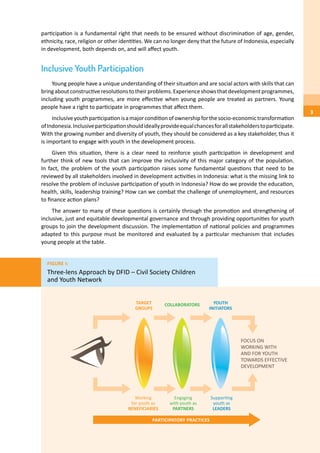
Figure 1:
Three-lens Approach by DFID – Civil Society Children
and Youth Network
3
Youth participation in development can start gradually, beginning with youth as the beneficiaries,
then youth as partners and finally, as leaders. DFID – Civil Society Children and Youth Network describes
an approach to youth participation as the “three-lens approach.” The DFID model uses three lenses for
youth participation, aiming to foster the active, informed and voluntary involvement of young people in
decision making.
This approach says that development assistance should work for young people in three ways. One
is for the benefit of youth or as target beneficiaries; second is with youth as partners; and the third is
for programmes and policy to be shaped by youth as leaders. This is a dynamic approach which depends
on the local context and development intervention. An important aspect of the model is that youth
participation focuses youth as leaders, not just beneficiaries. This is based on the understanding that
youth have the capacity to act, and have the skills and ability to change their own lives. Capacity building
and sharing among youth groups and networks is necessary in order to build that understanding, and
to prepare an avenue for young people to share their knowledge and lesson learned in participating in
development issues.
Inclusive participation also means that the participation process will include, and be accessible to,
youth from various backgrounds. As leaders, young people have power to shape the future they want
and express their views and opinions toward their country’s development. Various stakeholders, such as
government, civil society, and private sector should encourage the leadership of young people through
enabling youth-initiated and directed intervention. This mechanism could be establish by opening up a
space for youth-led decision-making within existing structures, system and processes. One of the real
example is to involve young people in the development of national strategy, and mainstreaming young
people within country planning.
Moreover, various stakeholders also need to recognize young people as mutual partner and leader
in their community, further mainstreaming their participation is important. According to DFID – Civil
Society Children and Youth Network, mainstreaming youth participation can be measured in four key
areas:
zz Organisational development, e.g., formulating youth policy at an institutional level;
zz Policy and planning, e.g., integrating youth at sub-national levels, in country planning and in public
policy;
zz Implementation, e.g., applying the principles and lessons learnt to modify existing initiatives or to
start new pilots;
zz Monitoring & evaluating, e.g., documenting thoroughly, using the quality standards, and developing
them into comprehensive process standards.
Young People and their Limitless Issues
There are many factors affecting the level of participation by young people such as limited education
and health care attained by young people, which is the result of issues with access, fees, and quality
of education and health service. On the other hand, there are also factors of poverty, social custom,
religious and cultural behaviour, and willingness from adults to provide them the space to participate.
Education is one of main tools in helping youth transition into adulthood, since it is one of the
main factors to provide youth with decent jobs. However, 19.6% of youth age 15 – 24 are unemployed,
which is 5 times larger than the adult unemployment rate. Both rural and urban areas have the same
unemployment rate when it came to youth. There is also a special need to pay more attention to young
people with disabilities. According to the Indonesian Journal of Disability Studies 2014, published by
Brawijaya University in Malang, Indonesia, only 50% of young people with disabilities finish elementary
school and only 47 percent continue onto senior high school. Sadly, only 3% of young people with
disabilities go on to study at university.
4
As mentioned earlier, youth unemployment is also a serious reality faced by young people today.
Young women are more likely to be unemployed than young men, which is shown by the figures from 2011
when 21% of young women were unemployed compared to 19% of young men. One way of addressing the
youth unemployment rate is to refocus the education. Education should not only be limited to academic
activities, but non-academic activities such as entrepreneurship, volunteering experience and other soft
skills should be taught, as this would provide more opportunities for youth to gain work experience.
Special attention also needs to be paid to young people with disabilities, since they have an even greater
challenge in the job market.
	 Access to Health plays a very important role in determining the wellbeing of youth. Again, youth
who live in poverty are more vulnerable due to the limited access to health services. Health services
should be accessible, which means that they need to be youth friendly in term of treatment, location,
and also operation time.
Health services are not limited to general health services; they also need to include sexual
reproductive health services. Every year, there are approximately 16 million births among adolescent
girls, accounting for 11% of all births worldwide. Pregnancy-related complications are the leading cause
of death among young women 15 to 19 yrs. Globally, 41% of unsafe abortions occur among women ages
15–24. Girls with no education are three times more likely to marry before the age of 18 than those with
secondary or higher education. The percentage of women aged 15 to 19 years who begin childbearing
increased from 9% in 2007 to 10% in 2012.
Marriage at a young age is still relatively common, especially in rural and slum areas. A study
conducted in 2009 found that there were 690,000 marriages involving children (under the age of 18),
sometimes as young as 13. Despite their young age, many of them had their first child shortly after being
married. These figures are especially concerning given that less than a half of adolescents know about
the human reproductive process and less than 30% know about HIV/ AIDS prevention. There have also
been continuous debates about the need for comprehensive sexuality education and safe sex knowledge
in schools. Parents and religious leaders do agree with such education in schools.
Youth participation is a process of involving young people in the policies and decisions that affect
their lives. But many young people are uninvolved or minimally involved in public affairs, and yet, on the
other hand, some small groups of people are extremely active. Programmes and policies have to take
this into account and be shaped to the needs of various groups in various levels of participation.
Youth participation in politics is a good example of this premise. Politics has become the most
efficient tool in involving young people in the decision making process. Young people, nevertheless need
to be provided with chances to get to know their rights in the political process, including their right
to vote and their right to participate in parliamentary procedure. The recent Indonesian Presidential
Election in 2014 has shown the great power owned by young people in shaping their decision towards
nation’s development. Young people in the recent election participated meaningfully through definite
action and social media to shape their decisions and inform their choices and ideas. However, lower
income youth participated less than higher income youth in issues related to politics, since participation
in discussions on social media requires an advanced technological device.
Conclusion and Recommendations
Young people need to be a co-owner of the future, they are the leaders and innovators today and
in the future. To optimized the role of young people and to ensure their leadership, space to participate
and investment must be given to them.
Investing in young people and providing them with opportunity, education, life skills, and health
services, including sexual and reproductive health information and services will help foster their
5
leadership in the community. Doing this will not only save lives and empower young people, but it can
also lead to significant economic gains for the young people themselves, their families, and the nation.
Such investments have also been shown to reduce healthcare costs, improve productivity, and increase
rates of education which lead to greater economic growth.
Ensure meaningful participation of young people in decision-making processes will foster young
people to be leaders and innovators. Participation of young people is critical to ensure that policies and
programmes meet their needs. Government and development and civil society partners must also enable
young people’s participation in the development of national health, education, and poverty reduction
policies and programmes. This requires greater involvement and investment in leadership skills among
diverse young people to participate meaningfully in advocacy and decision-making processes at the
community, national and international level. Young people’s participation refers to the active engagement
and real influence of young people, not to their passive presence or token roles in adult agencies.
Policies have a significant impact on young people and their lives. Policies that affect the whole
community and specifically impact on young people’s lives benefit from their participation. Young people
are valuable members of the community and have a wide range of experiences, viewpoints and ideas
to contribute alongside other citizens. By including young people and their participation in the public
decision-making processes it will ensure that national policies and local services are best configured to
meet their needs.
Inclusive participation will not see young people as an object or target, but as a mutual partnership
in development. It is also means that the participation process will also include and accessible to young
people from various background.
6
Authors:
Angga Dwi Martha, Anindya Nastiti Restuviani, Rizky Azhar Murdiono, Anggraini Sari Astuti, Briliansy
Mulyanto and Faza Fairuza Az-Zahra.
AmnestyInternational.LeftwithoutaChoice:BarrierstoReproductiveHealthinIndonesia.UnitedKingdom:
Amnesty International. 2010. Web. May, 13. 2015. http://www2.ohchr.org/english/bodies/cedaw/
docs/ngos/AmnestyInternational_for_PSWG_en_Indonesia.pdf
Central Agency on Statistics. Statistik Pemuda Indonesia 2011: Hasil Sensus Penduduk 2011. Jakarta: BPS.
2011. Print.
Checkoway, Barry. What is Youth Participation? Children and Youth Services Review. 33.1. (2011). 340-345.
Print.
DFID - Civil Society Children and Youth Network. “Youth Participation in Development: A Guide for
Development Agencies and Policy Makers.” DFID - Civil Society Children and Youth Network. DFID –
CSO Youth Working Group, 2010. Web. 18 July. 2015. http://www.ygproject.org/guide/introduction/
three-lens-approach
Government of Indonesia. Law No. 40 of 2009 - Law on the Youth of the Republic of Indonesia. Jakarta:
DPR-RI. 2009. Print.
NFPCB, Central Bureau of Statistic, Ministry of Health of the Republic of Indonesia & ICF- International.
Indonesia Demographic and Health Survey 2012. Jakarta: BPS, BKKBN, KemenKes, and ICF
International. 2013. Print.
Pusat Studi dan Layanan Disabilitas. “UB Menerima Mahasiswa Disabilitas 20 Kuota untuk Tahun 2013”.
Pusat Studi dan Layanan Disabilitas. Universitas Brawijaya, n.d. Web. 17 May. 2013. http://psld.
ub.ac.id/?p=381
Rizky, Ulfah Fatmala. Identifikasi Kebutuhan Siswa Penyandang Disabilitas Pasca Sekolah Menengah Atas.
Malang: Indonesian Journal of Disability Studies. 2014. Web. June 2014. http://www.ijds.ub.ac.id
United Nations Population Fund. Indonesian Youth in The 21st
Century. Jakarta: UNFPA Indonesia. 2014.
Print.
United Nations Population Fund. UNFPA Indonesia Monograph Series No 2. Jakarta: UNFPA Indonesia.
2014. Print.
United Nations Population Fund. Strategy on Adolescents and Youth, towards realizing the full potential of
Adolescents and Youth. New York: UNFPA. 2012. Print.
United Nations Population Fund. The Power of 1.8 Billion Adolescent, Youth and the Transformation of the
Future. New York: UNFPA. 2014. Print.
World Health Organization. Using Human Rights for Maternal and Neonatal Health:
	 A Tool for Strengthening Laws, Policies and Standard of Care. A Report of Indonesia Field Test
Analysis. Jakarta: WHO, Ministry of Health of the Republic of Indonesia. 2006. Web. May, 13.
2015. http://www.ino.searo.who.int/LinkFiles/ Reproductive_health_Using_Human_Rights_for_
Maternal.pdf
Youth Study Center (YouSure) and UNFPA. Comprehensive Study on Adolescent and Youth Related Policies
in Indonesia: Framework for Holistic Youth Development Policy. Jakarta: UNFPA Indonesia. 2015.
Print.
7
UNFPA Indonesia

Issue_Brief-Youth_Participation_03

  • 1.
    Youth Advisory Panel(YAP) Issue Brief From Youth Bulge to Youth-led: Engaging Youth Participation in Development
  • 2.
    Youth Advisory Panel(YAP) Issue Brief 1 From Youth Bulge to Youth-led: Engaging Youth Participation in Development Overview According to United Nations, young people are categorized as those people between 10 – 24 years old. In Indonesia’s context, Law 40 of 2009 categorized young people as 16-30 years old. There are 65 million young people in Indonesia, constituting 33% of Indonesia’s population. Youth participation is a right protected by the Law according to Chapter III of the function, direction and strategy for youth services of Law No. 40 of 2009. Article 7 mentions increased participation and an active role for youth in developing themselves, society, the nation and their country. Youth participation is important, because when young people participate, it draws upon their expertise, enables them to exercise their rights as citizens, and contributes to a more democratic society. It also promotes young people’s personal development, and provides them with substantive knowledge of practical skills. Participation is a basic right for young people, but questions do arise about how it can be implemented. What is inclusive youth participation, who are the participants, what do they do, and with what outcomes? When we say ‘youth meaningfully participate’, are we talking about “youth-led activity”, “civic engagement,” or simply when we have young people around the table? This issue brief summaries key priorities and facts on youth participation in development within Indonesia’s context. The issue brief uses youth-related studies, publications, lessons learned, and findings conducted by different stakeholders, including UNFPA and partner agencies. This issue brief was developed by young people under age of 24 to sound their voice on how young people should be involved as co-authors and co-producers of future development. Young people’s participation is a pre-condition for sustainable development. Young people are a diverse group of the population aged 10-24; some are in school, some are living with HIV, some are persons with disabilities, migrants, drug users, and diverse sexual orientation. Some young people are living in poverty, conflict, and emergency situations; some are young parents, or are pregnant. Young people in Indonesia The situation for young people in Indonesia is as challenging, complex and promising as the nation is itself. Although some countries in the Asia and Pacific region have shrinking populations of young people, Indonesia has a large and rapidly growing youth population. Today, about 33 per cent of the population in Indonesia is under age 35. These rising numbers of young people, accompanied by falling fertility rates, offers a critical window of development opportunity - the demographic dividend. Yet too many youth are unable to participate fully in society. Youth participation is one of the main governance challenges in Indonesia. According to the Universal Declaration of Human Rights, 1 * The findings, interpretations and conclusions presented in this document do not reflect the policies and positions of UNFPA and the government of Indonesia. 2
  • 3.
    participation is afundamental right that needs to be ensured without discrimination of age, gender, ethnicity, race, religion or other identities. We can no longer deny that the future of Indonesia, especially in development, both depends on, and will affect youth. Inclusive Youth Participation Young people have a unique understanding of their situation and are social actors with skills that can bringaboutconstructiveresolutionstotheirproblems.Experienceshowsthatdevelopmentprogrammes, including youth programmes, are more effective when young people are treated as partners. Young people have a right to participate in programmes that affect them. Inclusiveyouthparticipationisamajorconditionofownershipforthesocio-economictransformation ofIndonesia.Inclusiveparticipationshouldideallyprovideequalchancesforallstakeholderstoparticipate. With the growing number and diversity of youth, they should be considered as a key stakeholder, thus it is important to engage with youth in the development process. Given this situation, there is a clear need to reinforce youth participation in development and further think of new tools that can improve the inclusivity of this major category of the population. In fact, the problem of the youth participation raises some fundamental questions that need to be reviewed by all stakeholders involved in development activities in Indonesia: what is the missing link to resolve the problem of inclusive participation of youth in Indonesia? How do we provide the education, health, skills, leadership training? How can we combat the challenge of unemployment, and resources to finance action plans? The answer to many of these questions is certainly through the promotion and strengthening of inclusive, just and equitable developmental governance and through providing opportunities for youth groups to join the development discussion. The implementation of national policies and programmes adapted to this purpose must be monitored and evaluated by a particular mechanism that includes young people at the table. Figure 1: Three-lens Approach by DFID – Civil Society Children and Youth Network 3
  • 4.
    Youth participation indevelopment can start gradually, beginning with youth as the beneficiaries, then youth as partners and finally, as leaders. DFID – Civil Society Children and Youth Network describes an approach to youth participation as the “three-lens approach.” The DFID model uses three lenses for youth participation, aiming to foster the active, informed and voluntary involvement of young people in decision making. This approach says that development assistance should work for young people in three ways. One is for the benefit of youth or as target beneficiaries; second is with youth as partners; and the third is for programmes and policy to be shaped by youth as leaders. This is a dynamic approach which depends on the local context and development intervention. An important aspect of the model is that youth participation focuses youth as leaders, not just beneficiaries. This is based on the understanding that youth have the capacity to act, and have the skills and ability to change their own lives. Capacity building and sharing among youth groups and networks is necessary in order to build that understanding, and to prepare an avenue for young people to share their knowledge and lesson learned in participating in development issues. Inclusive participation also means that the participation process will include, and be accessible to, youth from various backgrounds. As leaders, young people have power to shape the future they want and express their views and opinions toward their country’s development. Various stakeholders, such as government, civil society, and private sector should encourage the leadership of young people through enabling youth-initiated and directed intervention. This mechanism could be establish by opening up a space for youth-led decision-making within existing structures, system and processes. One of the real example is to involve young people in the development of national strategy, and mainstreaming young people within country planning. Moreover, various stakeholders also need to recognize young people as mutual partner and leader in their community, further mainstreaming their participation is important. According to DFID – Civil Society Children and Youth Network, mainstreaming youth participation can be measured in four key areas: zz Organisational development, e.g., formulating youth policy at an institutional level; zz Policy and planning, e.g., integrating youth at sub-national levels, in country planning and in public policy; zz Implementation, e.g., applying the principles and lessons learnt to modify existing initiatives or to start new pilots; zz Monitoring & evaluating, e.g., documenting thoroughly, using the quality standards, and developing them into comprehensive process standards. Young People and their Limitless Issues There are many factors affecting the level of participation by young people such as limited education and health care attained by young people, which is the result of issues with access, fees, and quality of education and health service. On the other hand, there are also factors of poverty, social custom, religious and cultural behaviour, and willingness from adults to provide them the space to participate. Education is one of main tools in helping youth transition into adulthood, since it is one of the main factors to provide youth with decent jobs. However, 19.6% of youth age 15 – 24 are unemployed, which is 5 times larger than the adult unemployment rate. Both rural and urban areas have the same unemployment rate when it came to youth. There is also a special need to pay more attention to young people with disabilities. According to the Indonesian Journal of Disability Studies 2014, published by Brawijaya University in Malang, Indonesia, only 50% of young people with disabilities finish elementary school and only 47 percent continue onto senior high school. Sadly, only 3% of young people with disabilities go on to study at university. 4
  • 5.
    As mentioned earlier,youth unemployment is also a serious reality faced by young people today. Young women are more likely to be unemployed than young men, which is shown by the figures from 2011 when 21% of young women were unemployed compared to 19% of young men. One way of addressing the youth unemployment rate is to refocus the education. Education should not only be limited to academic activities, but non-academic activities such as entrepreneurship, volunteering experience and other soft skills should be taught, as this would provide more opportunities for youth to gain work experience. Special attention also needs to be paid to young people with disabilities, since they have an even greater challenge in the job market. Access to Health plays a very important role in determining the wellbeing of youth. Again, youth who live in poverty are more vulnerable due to the limited access to health services. Health services should be accessible, which means that they need to be youth friendly in term of treatment, location, and also operation time. Health services are not limited to general health services; they also need to include sexual reproductive health services. Every year, there are approximately 16 million births among adolescent girls, accounting for 11% of all births worldwide. Pregnancy-related complications are the leading cause of death among young women 15 to 19 yrs. Globally, 41% of unsafe abortions occur among women ages 15–24. Girls with no education are three times more likely to marry before the age of 18 than those with secondary or higher education. The percentage of women aged 15 to 19 years who begin childbearing increased from 9% in 2007 to 10% in 2012. Marriage at a young age is still relatively common, especially in rural and slum areas. A study conducted in 2009 found that there were 690,000 marriages involving children (under the age of 18), sometimes as young as 13. Despite their young age, many of them had their first child shortly after being married. These figures are especially concerning given that less than a half of adolescents know about the human reproductive process and less than 30% know about HIV/ AIDS prevention. There have also been continuous debates about the need for comprehensive sexuality education and safe sex knowledge in schools. Parents and religious leaders do agree with such education in schools. Youth participation is a process of involving young people in the policies and decisions that affect their lives. But many young people are uninvolved or minimally involved in public affairs, and yet, on the other hand, some small groups of people are extremely active. Programmes and policies have to take this into account and be shaped to the needs of various groups in various levels of participation. Youth participation in politics is a good example of this premise. Politics has become the most efficient tool in involving young people in the decision making process. Young people, nevertheless need to be provided with chances to get to know their rights in the political process, including their right to vote and their right to participate in parliamentary procedure. The recent Indonesian Presidential Election in 2014 has shown the great power owned by young people in shaping their decision towards nation’s development. Young people in the recent election participated meaningfully through definite action and social media to shape their decisions and inform their choices and ideas. However, lower income youth participated less than higher income youth in issues related to politics, since participation in discussions on social media requires an advanced technological device. Conclusion and Recommendations Young people need to be a co-owner of the future, they are the leaders and innovators today and in the future. To optimized the role of young people and to ensure their leadership, space to participate and investment must be given to them. Investing in young people and providing them with opportunity, education, life skills, and health services, including sexual and reproductive health information and services will help foster their 5
  • 6.
    leadership in thecommunity. Doing this will not only save lives and empower young people, but it can also lead to significant economic gains for the young people themselves, their families, and the nation. Such investments have also been shown to reduce healthcare costs, improve productivity, and increase rates of education which lead to greater economic growth. Ensure meaningful participation of young people in decision-making processes will foster young people to be leaders and innovators. Participation of young people is critical to ensure that policies and programmes meet their needs. Government and development and civil society partners must also enable young people’s participation in the development of national health, education, and poverty reduction policies and programmes. This requires greater involvement and investment in leadership skills among diverse young people to participate meaningfully in advocacy and decision-making processes at the community, national and international level. Young people’s participation refers to the active engagement and real influence of young people, not to their passive presence or token roles in adult agencies. Policies have a significant impact on young people and their lives. Policies that affect the whole community and specifically impact on young people’s lives benefit from their participation. Young people are valuable members of the community and have a wide range of experiences, viewpoints and ideas to contribute alongside other citizens. By including young people and their participation in the public decision-making processes it will ensure that national policies and local services are best configured to meet their needs. Inclusive participation will not see young people as an object or target, but as a mutual partnership in development. It is also means that the participation process will also include and accessible to young people from various background. 6
  • 7.
    Authors: Angga Dwi Martha,Anindya Nastiti Restuviani, Rizky Azhar Murdiono, Anggraini Sari Astuti, Briliansy Mulyanto and Faza Fairuza Az-Zahra. AmnestyInternational.LeftwithoutaChoice:BarrierstoReproductiveHealthinIndonesia.UnitedKingdom: Amnesty International. 2010. Web. May, 13. 2015. http://www2.ohchr.org/english/bodies/cedaw/ docs/ngos/AmnestyInternational_for_PSWG_en_Indonesia.pdf Central Agency on Statistics. Statistik Pemuda Indonesia 2011: Hasil Sensus Penduduk 2011. Jakarta: BPS. 2011. Print. Checkoway, Barry. What is Youth Participation? Children and Youth Services Review. 33.1. (2011). 340-345. Print. DFID - Civil Society Children and Youth Network. “Youth Participation in Development: A Guide for Development Agencies and Policy Makers.” DFID - Civil Society Children and Youth Network. DFID – CSO Youth Working Group, 2010. Web. 18 July. 2015. http://www.ygproject.org/guide/introduction/ three-lens-approach Government of Indonesia. Law No. 40 of 2009 - Law on the Youth of the Republic of Indonesia. Jakarta: DPR-RI. 2009. Print. NFPCB, Central Bureau of Statistic, Ministry of Health of the Republic of Indonesia & ICF- International. Indonesia Demographic and Health Survey 2012. Jakarta: BPS, BKKBN, KemenKes, and ICF International. 2013. Print. Pusat Studi dan Layanan Disabilitas. “UB Menerima Mahasiswa Disabilitas 20 Kuota untuk Tahun 2013”. Pusat Studi dan Layanan Disabilitas. Universitas Brawijaya, n.d. Web. 17 May. 2013. http://psld. ub.ac.id/?p=381 Rizky, Ulfah Fatmala. Identifikasi Kebutuhan Siswa Penyandang Disabilitas Pasca Sekolah Menengah Atas. Malang: Indonesian Journal of Disability Studies. 2014. Web. June 2014. http://www.ijds.ub.ac.id United Nations Population Fund. Indonesian Youth in The 21st Century. Jakarta: UNFPA Indonesia. 2014. Print. United Nations Population Fund. UNFPA Indonesia Monograph Series No 2. Jakarta: UNFPA Indonesia. 2014. Print. United Nations Population Fund. Strategy on Adolescents and Youth, towards realizing the full potential of Adolescents and Youth. New York: UNFPA. 2012. Print. United Nations Population Fund. The Power of 1.8 Billion Adolescent, Youth and the Transformation of the Future. New York: UNFPA. 2014. Print. World Health Organization. Using Human Rights for Maternal and Neonatal Health: A Tool for Strengthening Laws, Policies and Standard of Care. A Report of Indonesia Field Test Analysis. Jakarta: WHO, Ministry of Health of the Republic of Indonesia. 2006. Web. May, 13. 2015. http://www.ino.searo.who.int/LinkFiles/ Reproductive_health_Using_Human_Rights_for_ Maternal.pdf Youth Study Center (YouSure) and UNFPA. Comprehensive Study on Adolescent and Youth Related Policies in Indonesia: Framework for Holistic Youth Development Policy. Jakarta: UNFPA Indonesia. 2015. Print. 7
  • 8.