Journal of Education and Learning (EduLearn)
Vol. 16, No. 3, August 2022, pp. 299~307
ISSN: 2089-9823 DOI: 10.11591/edulearn.v16i3.20404  299
Journal homepage: http://edulearn.intelektual.org
Professional development teacher to improve skills of science
process and creativity of learners
Muhammad Sholahuddin Amrulloh1
, Andarula Galushasti2
1
Early Childhood Islamic Education Study Program, Faculty of Tarbiyah and Teacher Training,
State Islamic University K.H. Achmad Siddiq, Jember, Indonesia
2
Department of Agriculture Production, Food Crop Production Technology Study Program, State Polytechnic Jember, Jember, Indonesia
Article Info ABSTRACT
Article history:
Received Oct 26, 2021
Revised Dec 24, 2021
Accepted Feb 02, 2022
This qualitative research emphasized learning strategies in the process of full
engagement by students and discovering the implementation of learning,
science process skills, and learners' creativity. The selection of contextual
teaching and learning methods due to teachers having a role more in strategy
affairs while learners were more focused on self-actualization of practice in
their groups. Here, there was an interaction between teachers and learners to
complement each other. The participant was student of class five Elementary
School/Madrasah Ibtidaiyah Ma'arif 37 Sunan Kalijogo, Ambulu, Jember
Regency, Indonesia. Methods of data collection were interviews,
observations, and documentation. Data collection was related to natural
science subjects. The study results showed the procedures for implementing
contextual teaching and learning in natural science subjects. Applying
contextual teaching and learning methods was very effective in natural
science subjects. The findings of this study showed that improving the
quality of learning and learning support facilities can realize the ability of
competence of students and teacher professionalism.
Keywords:
Competence
Contextual teaching
Creativity
Science skills teacher
Teacher professionalism
This is an open access article under the CC BY-SA license.
Corresponding Author:
Muhammad Sholahuddin Amrulloh
Early Childhood Islamic Education Study Program, Faculty of Tarbiyah and Teacher Training
State Islamic University K.H. Achmad Siddiq
Mataram Street No. 1, Mangli District, Jember 68136, East Java, Indonesia
Email: sholahuddin11@gmail.com
1. INTRODUCTION
Education is one of the joints of national development and one of the most important instruments for
achieving national development goals [1]. According to Five Principles of the Indonesian State (Pancasila),
education is critical because it is expected that education results in a just and prosperous society with an
equitable distribution of wealth both materially and spiritually. Therefore, the Indonesian people want to
build a just and prosperous society based on Pancasila [2].
To achieve these goals, the government, in collaboration with all Indonesians, works tirelessly to
promote development in all areas. This national development is carried out within the context of full human
development and the development of the entire Indonesian population [3]. Education development is a
component of national development, and the national education goal remains ideal [4]. While achieving it
still necessitates the achievement of educational purposes at all levels of quality educational institutions.
In the age of globalization, the Indonesian nation faces enormous human resources challenges. As a
result, the Indonesian country must prepare quality human resources, which can only be accomplished by
advancing quality education [5]. A quality educational institution has a conducive academic atmosphere, a
teaching and learning process, relevant curriculum, learning resources, learning facilities, and good
 ISSN: 2089-9823
J Edu & Learn, Vol. 16, No. 3, August 2022: 299-307
300
management, particularly professional educators (teachers). Therefore, quality educational institutions can
also generate quality human resources [6].
Qualified teachers are professional in their approach to teaching students, i.e., those who have the
knowledge, personality, social, and skill competencies [7]. For example, teachers can effectively
communicate educational messages to their students [8]. Similarly, Islamic Education teachers are expected
to have comparable competencies, so that religious educator can truly become teachers who can be disturbed
and imitated [9]–[11].
Learning is a system with interconnected aspects. The instructor, among other things, determines the
success of learning by selecting and implementing appropriate methods and learning strategies for students.
Because educators must transfer knowledge and promote positive values, coherence between teachers and
learners should be the fundamental reference point. On the other hand, learners must be capable of being
active learners. This process necessitates teacher commitment and engaged student learning [12]. Students
engage in a multi-step learning sequence to decipher a single explanation in learning assignments that
emphasize creative thinking [13]. Individual learning examples are presented, considering challenges ranging
from the overall design of the course to daily learning activities within the system [14]. Deep learning is
accomplished using a representative approach until the final goal is attained. Increasing the depth of learning
demonstrates deep learning's potential for estimation and responding to a learning challenge [15].
Furthermore, learning has become an essential component in developing learners' abilities and knowledge
[16]. It is possible to identify specific learning needs in each learner and meet learning objectives through
various learning methods [17], [18].
Teachers are critical players in the learning process because they act as learning mediators. Teachers
serve as intermediaries in influencing learner behavior. The extent to which the teacher can play the role
determines whether or not the learning process succeeds. Teachers also serve as facilitators for students who
are actively learning and learning managers who can create a welcoming learning environment. Allows the
vision and the appropriate strategy to be calibrated to improve the school's learning environment [19].
Analytical thinking is developed during the teaching and learning process. Contextually, it can assess some
of the outcomes of creating a welcoming learning environment [20]. An attention-grabbing simulation of
scientific learning is an effective learning environment for improving learners' high-level thinking skills [21].
Furthermore, technology can improve learning processes and establish new networks [22]. This
attitude plays a role in the teaching and learning process by influencing learner behavior [18], [23]. Today's
educational, technological developments, such as online education, must shift the focus from the teacher to
the learner, transforming the teacher into a mentor and facilitator of the learning process. Learners are
empowered to play a role in the learning process because they have the freedom to define their own learning
goals, skills, and collaboration strategies [14], [24].
Natural science is one of the subjects offered in elementary schools (SD)/madrasah ibtidaiyah (MI).
Because many provide training in developing scientific ways of thinking in learning biological sciences,
natural science is popular. However, only competent teachers in the science discipline's skills, methods, and
procedures can assist learners in developing scientific skills and processes related to natural science learning
[25]. As a result, to meet human needs, learners must acquire scientific knowledge and skills that enhance
their understanding of human interaction and the environment [26].
As a result, students must acquire scientific knowledge and good skills in understanding. In this
study, teachers play a more significant role in strategy matters, whereas learners focus on self-actualization of
practice in their groups [27]. Teachers and students interact in this setting, and the two compliments each
other. Self-actualization theory is applied to the drive for autonomy, independence, and assertiveness. On the
other hand, there is a propensity to emphasize duty, obedience, conformity, and the mutual reliance on human
interaction and the environment in meeting human needs [28]. Self-actualization is exemplified. Some
behaviors suggest that teachers can reduce or ignore the long-term benefits of learning and innovation
because they can be disproportionately affected due to their limited decision-making rationality [16]. They
actualize themselves in the learning process by giving learners the ability to take action and make deliberate
choices in their learning process. They are given much leeway in defining essential aspects of the learning
process [14]. Learners' values may influence how classroom information is processed further. Learners
demonstrate values such as conformity, self-direction, virtue, and self-actualization in the classroom [29].
The concept of learning assists teachers in connecting the material taught to the real-world situations
of their students. Learners connect their knowledge and its application in their lives as family members and
members of society. According to the dialogical learning concept, critical thinkers determine different ways
of life [20]. The educational experience may be defined as a guided immersion into the reality that fosters
learners' intrinsic motivation to acquire the knowledge required to complete challenges [14] solving serious
learning problems to expand on the proposed profound learning potential [15].
J Edu & Learn ISSN: 2089-9823 
Professional development teacher to improve skills of science … (Muhammad Sholahuddin Amrulloh)
301
The contextual learning process continues to be hampered by insufficient resources. As a result, it is
appropriate for teachers to use contextual teaching and learning methods to cultivate or hone learners'
scientific process skills and creativity. Learners in class five still need to improve their skills and creativity.
Contextual teaching and learning is a multifaceted system made up of several components. These
components are: i) Making meaningful connections; ii) Doing significant work; iii) Collaborating; iv) Critical
and creative thinking; v) Nurturing individuals; vi) Meeting high standards; and vii) Exercising authentic
judgment. These components must work together to create a network where students can make sense of and
store information [23]. It categorizes elements for designing educational experiences that allow co-authors to
drive learning development and describes the mechanisms that enable unscripted narratives to emerge based
on intrinsic motivation [14].
Furthermore, creative teaching can make learning more engaging, meaningful, and experiential,
assisting learners in developing the necessary cognitive and emotional skills [19]. Students perform better on
tasks requiring immediate knowledge transfer than those requiring distant knowledge transfer. Students'
reflections on the sequence emphasized the importance of "thinking outside the box" for deeper learning [13].
Some students continue to struggle with receiving natural science materials. Soybean feels less
pressured to implement practices that are not commonly used to understand the material better. There are
numerous learning style instruments available for determining a student's learning style. For starters, concrete
experiences are related to a person's preference for learning things that have personal meaning in their lives.
Reflective observation is the second dimension of comprehension. Students who prefer this style want to take
the time to think about and reflect on the material they are learning [30]. Third, students can better
understand the material independently rather than relying on their teachers. Students may be more driven to
learn because their increased knowledge is more meaningful, relevant, and valuable in solving problems
encountered in everyday life [31]. Learners answer that by conducting their experiments to understand better
the learning concepts and the material [31]. The advantage of doing so is that learners have a solid
understanding of a concept, acquire experience, handle issues creatively, and hone other skills [32]. As a
result, contextual teaching and learning become critical for improving science process skills and increasing
learner creativity.
Previous research has also looked at contextual teaching and learning in various case studies.
Historical explanations in some studies state that efforts to develop sky learning models have implications for
the developers of student active learning models. Because historical reasons can have multiple
interpretations, the teacher must encourage his students to think critically, concoct, and reconstruct their
knowledge while still basing their performance on historical facts. Contextual teaching and learning with
various methods vary among the models used [33]. For example, teachers can use contextual teaching and
learning models in Indonesian subjects to improve students' guiding and verse writing skills. This model is
because the steps in this learning model apply to learn concepts that connect the taught material to real-world
scenarios. Furthermore, the teaching and learning process feels more lively and enjoyable than traditional
lectures, discussions, and assignments [34].
The role of teachers is in mastering contextual teaching and learning concepts. Teachers, as
professional educators, must create a learning environment that can enhance and develop learners' creative
potential by learning in the classroom and making the learning process enjoyable by employing appropriate
learning methods. The innovative dimensions of teacher practice significantly impact learning and the
presentation of creative teaching challenges by teachers [19]. Appropriate active learning methods in distance
learning can reduce failure anxiety, boost self-efficacy, foster positive emotions, and improve learning
outcomes [31]. Because this model is holistic, contextual teaching and learning are appropriate learning
models used concerning problems that arise in this study. This model considers learners from a psychological
standpoint and a social and neurophysiological standpoint. This model also necessitates integral learning,
which combines classroom learning experiences with learners' daily lives [33]. Therefore, contextual
teaching and learning research be developed and studied further, with implications for improving science
process skills and learner creativity.
2. RESEARCH METHOD
The research employed qualitative descriptive design. It is a design whose research uses an
explanation or description of an event that occurs at this time. Thus, the researcher only describes the
circumstances and events at the center of attention, then explains them into words and sentences containing
meaning. This study was carried out at one of the (MI) schools in East Java Province, namely Madrasah
Ibtidaiyah Ma'arif 37 Sunan Kalijogo, Ambulu, Jember Regency, Indonesia which is devoted only to class
five students only. While these research subjects are natural science teachers and students of class five
Madrasah Ibtidaiyah Ma’arif 37 Sunan Kalijogo, Ambulu, Jember Regency, Indonesia. This research applied
 ISSN: 2089-9823
J Edu & Learn, Vol. 16, No. 3, August 2022: 299-307
302
contextual teaching and learning models of science process skills and learners' creativity. It also helped
teachers become professional teachers in the active learning process.
The process of collecting data carried out in this study using several methods. First is observation.
Observation is one of the most scientific and widely used data collection methods. This method is used in the
scientific world and is often used in various life activities. This observation method is conducted to obtain
data about the conditions and processes of implementing contextual teaching and learning model methods in
natural science subjects. This observation method is also used to determine whether students gain more
awareness of themselves, others, and the surrounding environment, acquire memories, acquire knowledge,
science process skills, and creativity of learners who need attention and teaching in school.
The second is the interview. The interview conducted in this study is an unstructured yang
interview. If the observation includes all the components, the interview method can be ignored. Teacher
professionalism aims to improve both the personal and social dimensions of teaching while balancing
intellectual and professional dimensions. As a result, because professionalism is primarily an attitude rather
than a set of competencies, teachers' professionalism, particularly in natural science subjects, is characterized
by several characteristics, including a mature and developing personality.
Furthermore, the third is documentation. Documentation conducted in this study uses documentation
in the form of photos of events or activities when applying contextual teaching and learning models in natural
science subjects. This method is used to help authors remember and collect observational data.
Documentation can also be used to collect documentary data, such as the implementation of natural science
subjects in improving the skills of the science process and learners' creativity, including: i) The learning
syllabus; ii) Rencana Pelaksanaan Pembelajaran (RPP)/lesson plan; and iii). Other documents related to the
operation of implementing activities.
3. RESULTS AND DISCUSSION
Contextual teaching and learning process learner's science process skills make observations or
practices, record findings when practicing, discuss with the group, report the results of discussions or
presentations, and question & answer (Q&A) the effects of group discussions. As for aspect-aspects of
learners' science process skills, observe with sensory tools and collect as much data as possible. Activities to
observe with sensory tools include seeing, listening, reading, hearing, and even groping. Learning in the
classroom can not be separated from communication between teachers and learners, learners with learners, or
the environment. Communication is a relationship between two or more people that allows understanding of
contact. Building basic level student communication is not as easy as the middle and upper levels because
learners at the primary level need teacher guidance to train them to develop their communication skills.
Communication is essential for learners, both in the classroom and in the environment. Many interact
automatic learners communicate more with their surroundings. That is where this aspect of communicating
with learners grows. Furthermore, in contextual teaching and learning, learners are allowed to develop. The
following observation process is to estimate or predict.
In this aspect, there are two indicators: i) Using props to estimate events that occur; and ii) Making
judgments based on observed events. Indirectly, this aspect is closely related to everything material and the
surrounding environment. Teachers ask learners to practice with magnets and other props when discussing
style materials. In observations during the learning process, learners in their group identified objects used as
functional materials. Not only that, but learners were also asked to compare the things they observed. The
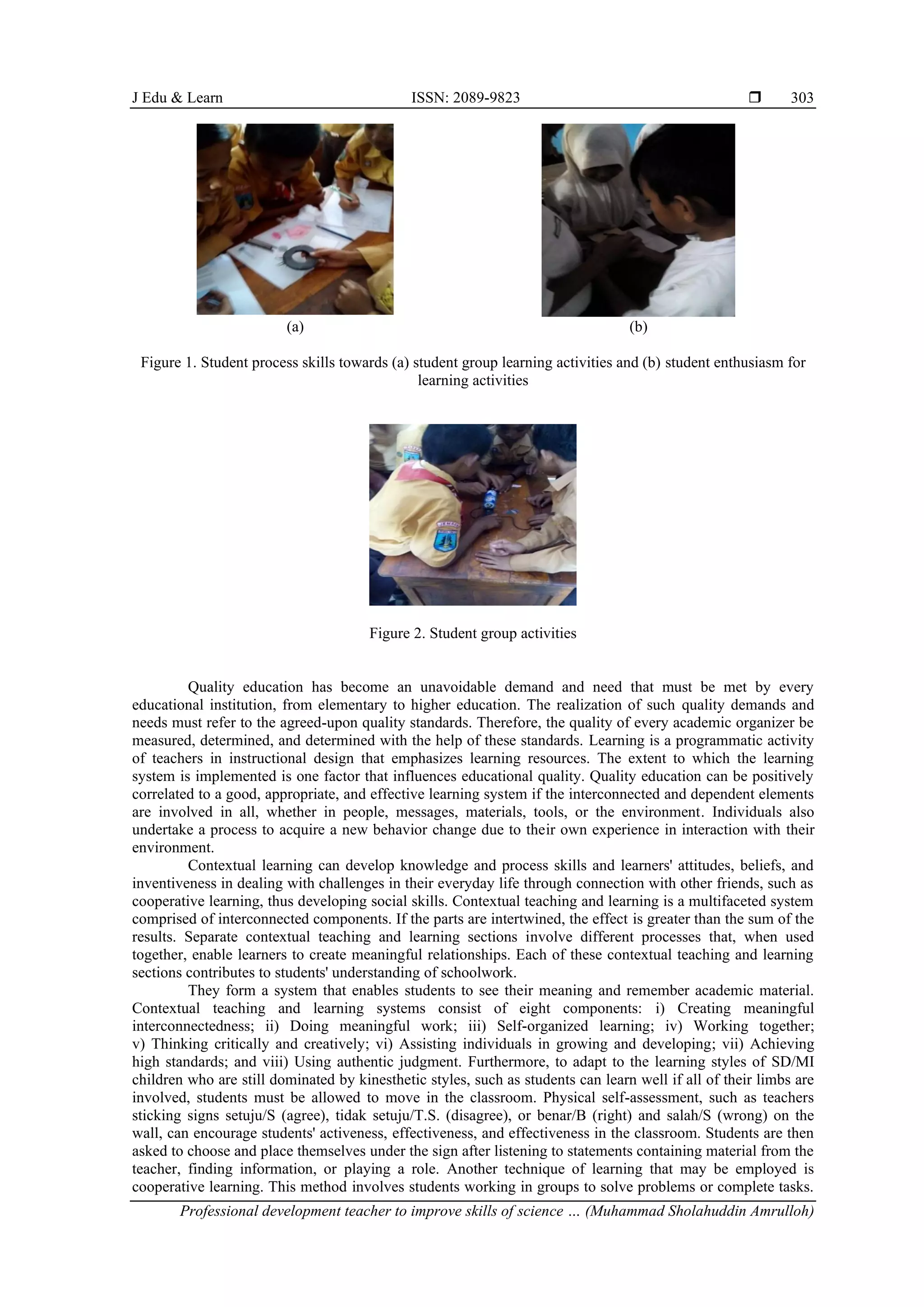
student's group learning activities have been illustrated in Figure 1(a), and the students' enthusiasm for these
learning activities has also been expressed in Figure 1(b).
Learners' creativity in contextual teaching and learning is observed in several stages of learning
aspects of creativity that can be seen, including curiosity. Improving the science process skills of innovative
learners from teachers becomes a top priority [35], [36]. Applying contextual teaching and learning methods
makes positive changes in learners [37]. Learners are more active in class, thus honing their skills in them.
When learners feel happy and comfortable learning, then learners enjoy the learning process and throw away
the saturated or bored learners. From the results of interviews and observations with the above sources, a
significant change in the skills of the scientific process of learners can be seen. Not only are silent listening
and taking notes, but learners are more active and can express themselves when they directly practice and
learn in groups. So, contextual teaching and learning methods are effective if applied to natural science
subjects that require much practice in the learning process. Learners' skills automatically continue to be
honed with many techniques, as seen in Figure 2.
J Edu & Learn ISSN: 2089-9823 
Professional development teacher to improve skills of science … (Muhammad Sholahuddin Amrulloh)
303
(a) (b)
Figure 1. Student process skills towards (a) student group learning activities and (b) student enthusiasm for
learning activities
Figure 2. Student group activities
Quality education has become an unavoidable demand and need that must be met by every
educational institution, from elementary to higher education. The realization of such quality demands and
needs must refer to the agreed-upon quality standards. Therefore, the quality of every academic organizer be
measured, determined, and determined with the help of these standards. Learning is a programmatic activity
of teachers in instructional design that emphasizes learning resources. The extent to which the learning
system is implemented is one factor that influences educational quality. Quality education can be positively
correlated to a good, appropriate, and effective learning system if the interconnected and dependent elements
are involved in all, whether in people, messages, materials, tools, or the environment. Individuals also
undertake a process to acquire a new behavior change due to their own experience in interaction with their
environment.
Contextual learning can develop knowledge and process skills and learners' attitudes, beliefs, and
inventiveness in dealing with challenges in their everyday life through connection with other friends, such as
cooperative learning, thus developing social skills. Contextual teaching and learning is a multifaceted system
comprised of interconnected components. If the parts are intertwined, the effect is greater than the sum of the
results. Separate contextual teaching and learning sections involve different processes that, when used
together, enable learners to create meaningful relationships. Each of these contextual teaching and learning
sections contributes to students' understanding of schoolwork.
They form a system that enables students to see their meaning and remember academic material.
Contextual teaching and learning systems consist of eight components: i) Creating meaningful
interconnectedness; ii) Doing meaningful work; iii) Self-organized learning; iv) Working together;
v) Thinking critically and creatively; vi) Assisting individuals in growing and developing; vii) Achieving
high standards; and viii) Using authentic judgment. Furthermore, to adapt to the learning styles of SD/MI
children who are still dominated by kinesthetic styles, such as students can learn well if all of their limbs are
involved, students must be allowed to move in the classroom. Physical self-assessment, such as teachers
sticking signs setuju/S (agree), tidak setuju/T.S. (disagree), or benar/B (right) and salah/S (wrong) on the
wall, can encourage students' activeness, effectiveness, and effectiveness in the classroom. Students are then
asked to choose and place themselves under the sign after listening to statements containing material from the
teacher, finding information, or playing a role. Another technique of learning that may be employed is
cooperative learning. This method involves students working in groups to solve problems or complete tasks.
 ISSN: 2089-9823
J Edu & Learn, Vol. 16, No. 3, August 2022: 299-307
304
Students can be motivated to learn in groups to train children to think and understand the subject matter to
not fall behind their peers. Any method can be used as long as it encourages students to understand historical
explanations actively and allows them to weave their knowledge.
The study's findings revealed the procedures for implementing contextual teaching and learning in
natural science subjects. The implementation of natural science teaching and contextual learning is divided
into three stages. Sunan Kalijogo demonstrated following the learning plan and the theory of contextual
teaching and learning steps in the early stages of education conducted by teachers in class five Madrasah
Ibtidaiyah Ma’arif 37. However, some things become enriching because there is a slight difference between
the teacher's strategy for understanding and approach. She said greetings at the start of the lesson and the
class leader's prayer. This lesson contributes to the learning process in a positive way.
At the core, teachers carried out activities based on rare-step learning. The first learning assignment
emphasizes critical thinking by asking students to evaluate various defects in artificially contextualized
electrostatic exercises [2]. With each group performing observation tasks, learners recorded findings and
discussed them with their respective groups. Then, each group reported or presented the outcomes of their
group discussions and Q&A between groups. In the final stages, learners and groups come to their
conclusions. The teacher assists or perfects them and the teacher instructs the students on the tasks and
materials learned for the next meeting. Finally, the instructor concludes the lesson with a prayer.
Contextual teaching and learning learners' science process skills are developed in three stages. First,
the teacher begins the learning process by opening the lesson and continuing until the teacher asks and
answers questions about the learners' tasks. Second, several aspects of the student's science process skills are
visible, including observing and communicating. Finally, teachers should appropriately share their
experiences and ideas about frontline teaching and student interaction [19]. Contextual teaching and learning
core activities include students making observations or practicing, recording findings when practicing,
discussing with their groups, reporting the results of discussions or presentations, and Q&A of group
discussion results. The final stage of learning is completed, i.e., the learner completes the results of
observation with the teacher's assistance, and the teacher assigns the task to his next meeting.
Contextual teaching and learning develop learners' creativity in three stages. First, in the preliminary
stage of contextual teaching and learning, beginning with the teacher opening the lesson and ending with the
teacher doing a Q&A about the task that learners complete, the aspect of creativity seen is curiosity. Several
elements of creativity are visible at the core activity stage of learning: curiosity, perseverance, not being
easily bored, confidence and independence, being challenged by plurality and complexity and daring to take
risks. This method is done to develop the value of originality and judgment. Using imagination and creativity
in the classroom can reduce the grime associated with tight control and make learning less tedious and
refreshing for students [19]. The final stage of learning is to draw conclusions based on divergent thinking.
Learning from previous experiences provides opportunities to improve and develop successful practices for
future initiatives [38].
Teachers play a more significant role in strategic matters, whereas students focus on self
actualization of practice in their groups. As a result, teachers are expected to concentrate on teaching and
contextual learning, discovery, and knowledge [39]. Research also supports research, which shows that
combining theoretical science learning with hands-on learning methods and involving students in learning
activities can improve science process skills, instill values in students, and provide average student learning
outcomes [40]. Furthermore, other research findings have shown that contextual teaching and learning
methods can boost students' motivation to learn science [41]. Student learning participation and achievement
in Natural Science Subjects can be developed through teaching-based learning strategies and contextual
learning to make real learning [42].
Teacher professionalism aims to improve personal and social dimensions while balancing
intellectual and professional dimensions. A teacher inspires his learners and masters the skills to arouse
students' interest in science and develop a continuous profession. Furthermore, the concept of learning can
assist teachers in associating the material taught with the real-world situations of their students. As a result,
because professionalism is primarily an attitude rather than a set of competencies, teachers' professionalism,
particularly in natural science subjects, is characterized by several characteristics, such as having a mature
and developing personality [43]. The whole feeling towards science and technology and its development
insights must not be half-and-half.
4. CONCLUSION
The study's findings indicated that improving learning and learning support facilities can improve
student competence and teacher professionalism. According to a survey, combining face-to-face and online
learning and a clear relationship with approved curriculum practices results in higher completion rates and
J Edu & Learn ISSN: 2089-9823 
Professional development teacher to improve skills of science … (Muhammad Sholahuddin Amrulloh)
305
quality learning outcomes. The contextual teaching and learning process emphasizes learners' activities in
developing children's thinking by working alone, developing curious traits, discovering themselves, and
constructing new knowledge and skills. Thus the activities carried out by learners through exercises to solve
a problem can be overcome. In addition, an active learning promotion has suggested several strategies for use
in various fields of study. It can motivate learners to participate and help them recognize their abilities.
Based on the findings in this study, contextual teaching and learning methods can be used to
improve the skills of science and the creativity of learners. They can also improve the professionalism of
teachers as educators and scientific wealth in the field of science education. The contribution of this research
is as reference material for educational experts, researchers, community members, and practitioners,
especially teaching staff, who can provide understanding, enlightenment, and direction about contextual
teaching and learning methods. This research can enrich the treasures of science learning as a reference for
experts and researchers in understanding the teaching and learning process, especially for teaching and
learning personnel using contextual teaching and learning methods.
REFERENCES
[1] Sutoyo, A. Trisiana, S. Supeni, and Sakinah, “Moral Value System in Pancasila-Based National Development: Facing New
Normal,” Journal of Legal, Ethical and Regulatory Issues, vol. 24, no. 6, pp. 1–12, 2021.
[2] Yuliatin, L. Husni, Hirsanuddin, and Kaharudin, “Character education based on local wisdom in Pancasila perspective,” Journal
of Legal, Ethical and Regulatory Issues, vol. 24, no. Special Issue 1, pp. 1–11, 2021.
[3] U. Rahardja, Q. Aini, Y. I. Graha, and M. R. Tangkaw, “Gamification Framework Design of Management Education and
Development in Industrial Revolution 4.0,” Journal of Physics: Conference Series, vol. 1364, no. 1, p. 012035, Dec. 2019, doi:
10.1088/1742-6596/1364/1/012035.
[4] F. Sulianta and M. H. Saudi, “The Growth of Citizenship Geographical Education in Indonesia from Social Studies Curriculum,”
Review of International Geographical Education Online, vol. 11, no. 3, pp. 72–78, 2021, doi: 10.33403/rigeo.800470.
[5] P. Baker et al., “Globalization, first-foods systems transformations and corporate power: a synthesis of literature and data on the
market and political practices of the transnational baby food industry,” Globalization and Health, vol. 17, no. 1, p. 58, Dec. 2021,
doi: 10.1186/s12992-021-00708-1.
[6] E. V. Romanov, “Evaluation of the efficiency of Russian universities: Do we need to change the paradigm?,” The Education and
science journal, vol. 23, no. 6, pp. 84–125, Jun. 2021, doi: 10.17853/1994-5639-2021-6-83-125.
[7] R. A. Kutbiddinova, A. A. Eromasova, and M. A. Romanova, “The use of interactive methods in the educational process of the
higher education institution,” International Journal of Environmental and Science Education, vol. 11, no. 14, pp. 6557–6572,
2016.
[8] D. G. van der Merwe, “The use of interactive storytelling, cartoon animation and educational gaming to communicate the biblical
message to preschool children,” HTS Teologiese Studies / Theological Studies, vol. 76, no. 2, Nov. 2020, doi:
10.4102/hts.v76i2.6074.
[9] E. D. Rackley, “Reading Sacred Texts: A Qualitative Study of Religious Educators’ Literacy Processes,” Journal of Research on
Christian Education, vol. 29, no. 3, pp. 236–258, Sep. 2020, doi: 10.1080/10656219.2020.1838366.
[10] A. Kuusisto and L. Gearon, “The Life Trajectory of the Finnish Religious Educator,” Religion & Education, vol. 44, no. 1, pp.
39–53, Jan. 2017, doi: 10.1080/15507394.2016.1272154.
[11] D. Baker and P. B. Reyes, “Religious Educators are the Future,” Religious Education, vol. 115, no. 1, pp. 1–9, Jan. 2020, doi:
10.1080/00344087.2020.1706422.
[12] Y. Wang and Z. Xu, “Statistical Analysis for Contract Cheating in Chinese Universities,” Mathematics, vol. 9, no. 14, p. 1684,
Jul. 2021, doi: 10.3390/math9141684.
[13] J. Slisko, “Facebook-supported tasks for exploring critical and creative thinking in a physics teaching course,” Knowledge
Management & E-Learning: An International Journal, vol. 13, no. 1, pp. 58–82, Mar. 2021, doi: 10.34105/j.kmel.2021.13.004.
[14] M. P. Recke and S. Perna, “Emergent narratives in remote learning experiences for project based education,” Electronic Journal
of e-Learning, vol. 19, no. 2, pp. 59–70, Apr. 2021, doi: 10.34190/ejel.19.2.2142.
[15] Y. Liu, Y. Sun, and B. Li, “A two-stage household electricity demand estimation approach based on edge deep sparse coding,”
Information, vol. 10, no. 7, pp. 1–16, Jul. 2019, doi: 10.3390/info10070224.
[16] N. J. Foss, R. Mudambi, and S. Murtinu, “Taxing the multinational enterprise: On the forced redesign of global value chains and
other inefficiencies,” Journal of International Business Studies, vol. 50, no. 9, pp. 1644–1655, Dec. 2019, doi: 10.1057/s41267-
018-0159-3.
[17] D. Mhlanga, “Artificial intelligence in the industry 4.0, and its impact on poverty, innovation, infrastructure development, and the
sustainable development goals: Lessons from emerging economies?,” Sustainability, vol. 13, no. 11, pp. 1–16, May 2021, doi:
10.3390/su13115788.
[18] T. Hidayat, A. Galushasti, B. P. Y. Kurniawan, and R. S. Mahanani, “Fine moving value in behavioral anomalies to minimize
poverty in disadvantaged areas,” Review of Applied Socio-Economic Research, vol. 22, no. 2, pp. 78–85, Dec. 2021, doi:
10.54609/reaser.v22i2.112.
[19] H.-H. Chen and Y.-H. Yuan, “The Study of the Relationships of Teacher’s Creative Teaching, Imagination, and Principal’s
Visionary Leadership,” SAGE Open, vol. 11, no. 3, p. 215824402110299, Jul. 2021, doi: 10.1177/21582440211029932.
[20] F. Haffejee, “The use of photovoice to transform health science students into critical thinkers,” BMC Medical Education, vol. 21,
no. 1, pp. 1–10, Dec. 2021, doi: 10.1186/s12909-021-02656-1.
[21] D. Isnaini and J. Ikhsan, “Improving Higher Order Thinking Skills via Semi Second Life,” European Journal of Educational
Research, vol. 10, no. 1, pp. 261–274, Jan. 2021, doi: 10.12973/eu-jer.10.1.261.
[22] É. Schnebelin, P. Labarthe, and J.-M. Touzard, “How digitalisation interacts with ecologisation? Perspectives from actors of the
French Agricultural Innovation System,” Journal of Rural Studies, vol. 86, pp. 599–610, Aug. 2021, doi:
10.1016/j.jrurstud.2021.07.023.
[23] J. M. L. Lago and R. Ortega-Dela Cruz, “Linking to the real world: contextual teaching and learning of statistical hypothesis
testing,” LUMAT: International Journal on Math, Science and Technology Education, vol. 9, no. 1, pp. 597–621, Aug. 2021, doi:
10.31129/LUMAT.9.1.1571.
 ISSN: 2089-9823
J Edu & Learn, Vol. 16, No. 3, August 2022: 299-307
306
[24] B. P. Y. Kurniawan and A. Galushasti, “Effectiveness of fine-moving value in developing theoretical model of organizational
performance: A perspective of the theory of planned behavior,” Academy of Strategic Management Journal, vol. 20, no. 3, pp. 1–
13, Jun. 2021.
[25] L. Molefe and J.-B. Aubin, “Exploring how science process skills blend with the scientific process: Pre-service teachers’ views
following fieldwork experience,” South African Journal of Education, vol. 41, no. 2, pp. 1–13, May 2021, doi:
10.15700/saje.v41n2a1878.
[26] M. N. N. Ndjangala, J. Abah, and P. Mashebe, “Teachers’ views on challenges affecting learners’ performance in natural
science,” International Journal of Evaluation and Research in Education (IJERE), vol. 10, no. 1, p. 48, Mar. 2021, doi:
10.11591/ijere.v10i1.20732.
[27] R. S. Mahanani, T. Hidayat, I. Wardati, A. Galushasti, and L. C. Wiyono, “Local economic development strategies to increase
economic growth in agrotourism areas,” Turyzm/Tourism, vol. 31, no. 2, pp. 117–131, Dec. 2021, doi: 10.18778/0867-
5856.31.2.07.
[28] D. Haslam, C. Poniman, A. Filus, A. Sumargi, and L. Boediman, “Parenting Style, Child Emotion Regulation and Behavioral
Problems: The Moderating Role of Cultural Values in Australia and Indonesia,” Marriage & Family Review, vol. 56, no. 4, pp.
320–342, May 2020, doi: 10.1080/01494929.2020.1712573.
[29] S. Kumar, “Individual personal values as mediators during behavioral perception and transference,” Interpersona: An
International Journal on Personal Relationships, vol. 12, no. 1, pp. 122–132, Jul. 2018, doi: 10.5964/ijpr.v12i1.221.
[30] A. N. Morell, “Distance Learning,” in SAE Technical Papers, Sep. 1990, no. 9, pp. 29–30, doi: 10.4271/902000.
[31] R. Rusmini, S. Suyono, and R. Agustini, “Analysis of science process skills of chemical education students through self project
based learning (SjBL) in the pandemic COVID 19 era,” Journal of Technology and Science Education, vol. 11, no. 2, pp. 371–
387, Jun. 2021, doi: 10.3926/jotse.1288.
[32] N. Ratnawati, N. Wahyuningtyas, I. N. Ruja, M. M. Habibi, R. Anggraini, and H. Y. The, “Developing multimedia-based learning
media for basic skill of teaching material in order to equip professional teachers,” International Journal of Emerging
Technologies in Learning (iJET), vol. 16, no. 7, pp. 77–89, Apr. 2021, doi: 10.3991/ijet.v16i07.21203.
[33] N. Saidah, “Explanation of history and its implications in the development of SKI learning models for MI,” LITERASI (Jurnal
Ilmu Pendidikan), vol. 3, no. 1, pp. 43–60, Mar. 2016, doi: 10.21927/literasi.2012.3(1).43-60.
[34] I. Isniarni, “Improving poetry and poetry writing skills with contextual teaching and learning models for class V MI Ma’arif
Candran Godean students,” Al-Bidayah: Jurnal Pendidikan Dasar Islam, vol. 10, no. 1, pp. 101–118, Dec. 2018, doi:
10.14421/al-bidayah.v10i1.132.
[35] W. Wahyudi, B. Waluya, H. Suyitno, S. Sutriyono, and I. Anugraheni, “Development of Problem-based Blended Learning
(PB2L) model to increase pre-service primary teacher’s creative thinking skill,” Journal of Education and Learning (EduLearn),
vol. 13, no. 3, pp. 324–334, Aug. 2019, doi: 10.11591/edulearn.v13i3.9907.
[36] D. Yang, S. Skelcher, and F. Gao, “An investigation of teacher experiences in learning the project-based learning approach,”
Journal of Education and Learning (EduLearn), vol. 15, no. 4, pp. 490–504, Nov. 2021, doi: 10.11591/edulearn.v15i4.20302.
[37] T. N. Vidanagama and S. L. Karunathilake, “Identification of a framework for implementing ICT in Sri Lankan secondary
education system,” Journal of Education and Learning (EduLearn), vol. 15, no. 2, pp. 242–250, May 2021, doi:
10.11591/edulearn.v15i2.19601.
[38] I. van Putten et al., “A Decade of Incorporating Social Sciences in the Integrated Marine Biosphere Research Project (IMBeR):
Much Done, Much to Do?,” Frontiers in Marine Science, vol. 8, no. June, pp. 1–14, Jun. 2021, doi: 10.3389/fmars.2021.662350.
[39] E. Buldu and M. Buldu, “Investigating Pre-Service Early Childhood Teachers’ cPCK and pPCK on the Knowledge Used in
Scientific Process Through CoRe,” SAGE Open, vol. 11, no. 2, p. 215824402110255, Apr. 2021, doi:
10.1177/21582440211025564.
[40] S. E. Atmojo, “Development of science learning devices with the vision of Sets using the discovery learning method to instill
values for elementary school students,” Premiere Educandum : Jurnal Pendidikan Dasar dan Pembelajaran, vol. 5, no. 1, pp. 1–
20, Nov. 2016, doi: 10.25273/pe.v5i01.321.
[41] F. M. Rohmanurmeta, “Increasing science learning motivation through quantum teaching mearning methods for class IV
students,” Premiere Educandum : Jurnal Pendidikan Dasar dan Pembelajaran, vol. 5, no. 2, pp. 253–262, Nov. 2016, doi:
10.25273/pe.v5i02.288.
[42] A. Sulistyarsi, “Implementation of project-based learning strategies in making science teaching aids to improve learning
achievement and activeness of class IV students SDN Cermo 01 Kare Madiun,” Premiere Educandum : Jurnal Pendidikan Dasar
dan Pembelajaran, vol. 2, no. 1, pp. 21–37, Nov. 2016, doi: 10.25273/pe.v2i01.45.
[43] M. R. Ridla, “Professionalism of islamic religious education teachers in the learning process,” Tadris, vol. 3, no. 1, pp. 30–44,
2008, doi: 10.19105/tjpi.v3i1.230.
BIOGRAPHIES OF AUTHORS
Muhammad Sholahuddin Amrulloh is a lecturer at the Faculty of Tarbiyah at
the UIN Kyai Haji Achmad Siddiq Jember. M. Sholahuddin Amrulloh received his master
degree in UIN Sunan Kalijaga Yogyakarta and his bachelor degree from IAIN Jember. When
he was a student at IAIN Jember in 2014, he was sent to Thailand to study. In 2018 he became
a lecturer at STAI Alqodiri Jember, and in 2019 he joined UIN Jember as a lecturer at the
Faculty of Tarbiyah. He has written several papers in education. He has written several papers
on professional development teachers, contextual teaching and learning, science skills, and
creativity. Apart from being a lecturer, he is also active in community and business social
activities. He can be contacted at email: sholahuddin11@gmail.com.
J Edu & Learn ISSN: 2089-9823 
Professional development teacher to improve skills of science … (Muhammad Sholahuddin Amrulloh)
307
Andarula Galushasti received a master's degree in Applied Agribusiness
Management with a concentration in Quality Management from Politeknik Negeri Jember
(POLIJE), Jember, Indonesia, and a bachelor's degree also from Politeknik Negeri Jember,
Jember, Indonesia. In 2021 he joined Rumah Scopus as a member and companion in writing
international scientific articles. In 2022 he officially became a lecturer at Jember State
Polytechnic with the status of a civil servant. He has written several papers on the psychology
of entrepreneurial learning, local economic development, and anomalies of entrepreneur
behavior in alleviating poverty in 3T areas. His research interests also include economics,
human resources, psychoanalytic, learning and education. He can be contacted at email:
andarula@polije.ac.id.

Professional development teacher to improve skills of science process and creativity of learners

  • 1.
    Journal of Educationand Learning (EduLearn) Vol. 16, No. 3, August 2022, pp. 299~307 ISSN: 2089-9823 DOI: 10.11591/edulearn.v16i3.20404  299 Journal homepage: http://edulearn.intelektual.org Professional development teacher to improve skills of science process and creativity of learners Muhammad Sholahuddin Amrulloh1 , Andarula Galushasti2 1 Early Childhood Islamic Education Study Program, Faculty of Tarbiyah and Teacher Training, State Islamic University K.H. Achmad Siddiq, Jember, Indonesia 2 Department of Agriculture Production, Food Crop Production Technology Study Program, State Polytechnic Jember, Jember, Indonesia Article Info ABSTRACT Article history: Received Oct 26, 2021 Revised Dec 24, 2021 Accepted Feb 02, 2022 This qualitative research emphasized learning strategies in the process of full engagement by students and discovering the implementation of learning, science process skills, and learners' creativity. The selection of contextual teaching and learning methods due to teachers having a role more in strategy affairs while learners were more focused on self-actualization of practice in their groups. Here, there was an interaction between teachers and learners to complement each other. The participant was student of class five Elementary School/Madrasah Ibtidaiyah Ma'arif 37 Sunan Kalijogo, Ambulu, Jember Regency, Indonesia. Methods of data collection were interviews, observations, and documentation. Data collection was related to natural science subjects. The study results showed the procedures for implementing contextual teaching and learning in natural science subjects. Applying contextual teaching and learning methods was very effective in natural science subjects. The findings of this study showed that improving the quality of learning and learning support facilities can realize the ability of competence of students and teacher professionalism. Keywords: Competence Contextual teaching Creativity Science skills teacher Teacher professionalism This is an open access article under the CC BY-SA license. Corresponding Author: Muhammad Sholahuddin Amrulloh Early Childhood Islamic Education Study Program, Faculty of Tarbiyah and Teacher Training State Islamic University K.H. Achmad Siddiq Mataram Street No. 1, Mangli District, Jember 68136, East Java, Indonesia Email: sholahuddin11@gmail.com 1. INTRODUCTION Education is one of the joints of national development and one of the most important instruments for achieving national development goals [1]. According to Five Principles of the Indonesian State (Pancasila), education is critical because it is expected that education results in a just and prosperous society with an equitable distribution of wealth both materially and spiritually. Therefore, the Indonesian people want to build a just and prosperous society based on Pancasila [2]. To achieve these goals, the government, in collaboration with all Indonesians, works tirelessly to promote development in all areas. This national development is carried out within the context of full human development and the development of the entire Indonesian population [3]. Education development is a component of national development, and the national education goal remains ideal [4]. While achieving it still necessitates the achievement of educational purposes at all levels of quality educational institutions. In the age of globalization, the Indonesian nation faces enormous human resources challenges. As a result, the Indonesian country must prepare quality human resources, which can only be accomplished by advancing quality education [5]. A quality educational institution has a conducive academic atmosphere, a teaching and learning process, relevant curriculum, learning resources, learning facilities, and good
  • 2.
     ISSN: 2089-9823 JEdu & Learn, Vol. 16, No. 3, August 2022: 299-307 300 management, particularly professional educators (teachers). Therefore, quality educational institutions can also generate quality human resources [6]. Qualified teachers are professional in their approach to teaching students, i.e., those who have the knowledge, personality, social, and skill competencies [7]. For example, teachers can effectively communicate educational messages to their students [8]. Similarly, Islamic Education teachers are expected to have comparable competencies, so that religious educator can truly become teachers who can be disturbed and imitated [9]–[11]. Learning is a system with interconnected aspects. The instructor, among other things, determines the success of learning by selecting and implementing appropriate methods and learning strategies for students. Because educators must transfer knowledge and promote positive values, coherence between teachers and learners should be the fundamental reference point. On the other hand, learners must be capable of being active learners. This process necessitates teacher commitment and engaged student learning [12]. Students engage in a multi-step learning sequence to decipher a single explanation in learning assignments that emphasize creative thinking [13]. Individual learning examples are presented, considering challenges ranging from the overall design of the course to daily learning activities within the system [14]. Deep learning is accomplished using a representative approach until the final goal is attained. Increasing the depth of learning demonstrates deep learning's potential for estimation and responding to a learning challenge [15]. Furthermore, learning has become an essential component in developing learners' abilities and knowledge [16]. It is possible to identify specific learning needs in each learner and meet learning objectives through various learning methods [17], [18]. Teachers are critical players in the learning process because they act as learning mediators. Teachers serve as intermediaries in influencing learner behavior. The extent to which the teacher can play the role determines whether or not the learning process succeeds. Teachers also serve as facilitators for students who are actively learning and learning managers who can create a welcoming learning environment. Allows the vision and the appropriate strategy to be calibrated to improve the school's learning environment [19]. Analytical thinking is developed during the teaching and learning process. Contextually, it can assess some of the outcomes of creating a welcoming learning environment [20]. An attention-grabbing simulation of scientific learning is an effective learning environment for improving learners' high-level thinking skills [21]. Furthermore, technology can improve learning processes and establish new networks [22]. This attitude plays a role in the teaching and learning process by influencing learner behavior [18], [23]. Today's educational, technological developments, such as online education, must shift the focus from the teacher to the learner, transforming the teacher into a mentor and facilitator of the learning process. Learners are empowered to play a role in the learning process because they have the freedom to define their own learning goals, skills, and collaboration strategies [14], [24]. Natural science is one of the subjects offered in elementary schools (SD)/madrasah ibtidaiyah (MI). Because many provide training in developing scientific ways of thinking in learning biological sciences, natural science is popular. However, only competent teachers in the science discipline's skills, methods, and procedures can assist learners in developing scientific skills and processes related to natural science learning [25]. As a result, to meet human needs, learners must acquire scientific knowledge and skills that enhance their understanding of human interaction and the environment [26]. As a result, students must acquire scientific knowledge and good skills in understanding. In this study, teachers play a more significant role in strategy matters, whereas learners focus on self-actualization of practice in their groups [27]. Teachers and students interact in this setting, and the two compliments each other. Self-actualization theory is applied to the drive for autonomy, independence, and assertiveness. On the other hand, there is a propensity to emphasize duty, obedience, conformity, and the mutual reliance on human interaction and the environment in meeting human needs [28]. Self-actualization is exemplified. Some behaviors suggest that teachers can reduce or ignore the long-term benefits of learning and innovation because they can be disproportionately affected due to their limited decision-making rationality [16]. They actualize themselves in the learning process by giving learners the ability to take action and make deliberate choices in their learning process. They are given much leeway in defining essential aspects of the learning process [14]. Learners' values may influence how classroom information is processed further. Learners demonstrate values such as conformity, self-direction, virtue, and self-actualization in the classroom [29]. The concept of learning assists teachers in connecting the material taught to the real-world situations of their students. Learners connect their knowledge and its application in their lives as family members and members of society. According to the dialogical learning concept, critical thinkers determine different ways of life [20]. The educational experience may be defined as a guided immersion into the reality that fosters learners' intrinsic motivation to acquire the knowledge required to complete challenges [14] solving serious learning problems to expand on the proposed profound learning potential [15].
  • 3.
    J Edu &Learn ISSN: 2089-9823  Professional development teacher to improve skills of science … (Muhammad Sholahuddin Amrulloh) 301 The contextual learning process continues to be hampered by insufficient resources. As a result, it is appropriate for teachers to use contextual teaching and learning methods to cultivate or hone learners' scientific process skills and creativity. Learners in class five still need to improve their skills and creativity. Contextual teaching and learning is a multifaceted system made up of several components. These components are: i) Making meaningful connections; ii) Doing significant work; iii) Collaborating; iv) Critical and creative thinking; v) Nurturing individuals; vi) Meeting high standards; and vii) Exercising authentic judgment. These components must work together to create a network where students can make sense of and store information [23]. It categorizes elements for designing educational experiences that allow co-authors to drive learning development and describes the mechanisms that enable unscripted narratives to emerge based on intrinsic motivation [14]. Furthermore, creative teaching can make learning more engaging, meaningful, and experiential, assisting learners in developing the necessary cognitive and emotional skills [19]. Students perform better on tasks requiring immediate knowledge transfer than those requiring distant knowledge transfer. Students' reflections on the sequence emphasized the importance of "thinking outside the box" for deeper learning [13]. Some students continue to struggle with receiving natural science materials. Soybean feels less pressured to implement practices that are not commonly used to understand the material better. There are numerous learning style instruments available for determining a student's learning style. For starters, concrete experiences are related to a person's preference for learning things that have personal meaning in their lives. Reflective observation is the second dimension of comprehension. Students who prefer this style want to take the time to think about and reflect on the material they are learning [30]. Third, students can better understand the material independently rather than relying on their teachers. Students may be more driven to learn because their increased knowledge is more meaningful, relevant, and valuable in solving problems encountered in everyday life [31]. Learners answer that by conducting their experiments to understand better the learning concepts and the material [31]. The advantage of doing so is that learners have a solid understanding of a concept, acquire experience, handle issues creatively, and hone other skills [32]. As a result, contextual teaching and learning become critical for improving science process skills and increasing learner creativity. Previous research has also looked at contextual teaching and learning in various case studies. Historical explanations in some studies state that efforts to develop sky learning models have implications for the developers of student active learning models. Because historical reasons can have multiple interpretations, the teacher must encourage his students to think critically, concoct, and reconstruct their knowledge while still basing their performance on historical facts. Contextual teaching and learning with various methods vary among the models used [33]. For example, teachers can use contextual teaching and learning models in Indonesian subjects to improve students' guiding and verse writing skills. This model is because the steps in this learning model apply to learn concepts that connect the taught material to real-world scenarios. Furthermore, the teaching and learning process feels more lively and enjoyable than traditional lectures, discussions, and assignments [34]. The role of teachers is in mastering contextual teaching and learning concepts. Teachers, as professional educators, must create a learning environment that can enhance and develop learners' creative potential by learning in the classroom and making the learning process enjoyable by employing appropriate learning methods. The innovative dimensions of teacher practice significantly impact learning and the presentation of creative teaching challenges by teachers [19]. Appropriate active learning methods in distance learning can reduce failure anxiety, boost self-efficacy, foster positive emotions, and improve learning outcomes [31]. Because this model is holistic, contextual teaching and learning are appropriate learning models used concerning problems that arise in this study. This model considers learners from a psychological standpoint and a social and neurophysiological standpoint. This model also necessitates integral learning, which combines classroom learning experiences with learners' daily lives [33]. Therefore, contextual teaching and learning research be developed and studied further, with implications for improving science process skills and learner creativity. 2. RESEARCH METHOD The research employed qualitative descriptive design. It is a design whose research uses an explanation or description of an event that occurs at this time. Thus, the researcher only describes the circumstances and events at the center of attention, then explains them into words and sentences containing meaning. This study was carried out at one of the (MI) schools in East Java Province, namely Madrasah Ibtidaiyah Ma'arif 37 Sunan Kalijogo, Ambulu, Jember Regency, Indonesia which is devoted only to class five students only. While these research subjects are natural science teachers and students of class five Madrasah Ibtidaiyah Ma’arif 37 Sunan Kalijogo, Ambulu, Jember Regency, Indonesia. This research applied
  • 4.
     ISSN: 2089-9823 JEdu & Learn, Vol. 16, No. 3, August 2022: 299-307 302 contextual teaching and learning models of science process skills and learners' creativity. It also helped teachers become professional teachers in the active learning process. The process of collecting data carried out in this study using several methods. First is observation. Observation is one of the most scientific and widely used data collection methods. This method is used in the scientific world and is often used in various life activities. This observation method is conducted to obtain data about the conditions and processes of implementing contextual teaching and learning model methods in natural science subjects. This observation method is also used to determine whether students gain more awareness of themselves, others, and the surrounding environment, acquire memories, acquire knowledge, science process skills, and creativity of learners who need attention and teaching in school. The second is the interview. The interview conducted in this study is an unstructured yang interview. If the observation includes all the components, the interview method can be ignored. Teacher professionalism aims to improve both the personal and social dimensions of teaching while balancing intellectual and professional dimensions. As a result, because professionalism is primarily an attitude rather than a set of competencies, teachers' professionalism, particularly in natural science subjects, is characterized by several characteristics, including a mature and developing personality. Furthermore, the third is documentation. Documentation conducted in this study uses documentation in the form of photos of events or activities when applying contextual teaching and learning models in natural science subjects. This method is used to help authors remember and collect observational data. Documentation can also be used to collect documentary data, such as the implementation of natural science subjects in improving the skills of the science process and learners' creativity, including: i) The learning syllabus; ii) Rencana Pelaksanaan Pembelajaran (RPP)/lesson plan; and iii). Other documents related to the operation of implementing activities. 3. RESULTS AND DISCUSSION Contextual teaching and learning process learner's science process skills make observations or practices, record findings when practicing, discuss with the group, report the results of discussions or presentations, and question & answer (Q&A) the effects of group discussions. As for aspect-aspects of learners' science process skills, observe with sensory tools and collect as much data as possible. Activities to observe with sensory tools include seeing, listening, reading, hearing, and even groping. Learning in the classroom can not be separated from communication between teachers and learners, learners with learners, or the environment. Communication is a relationship between two or more people that allows understanding of contact. Building basic level student communication is not as easy as the middle and upper levels because learners at the primary level need teacher guidance to train them to develop their communication skills. Communication is essential for learners, both in the classroom and in the environment. Many interact automatic learners communicate more with their surroundings. That is where this aspect of communicating with learners grows. Furthermore, in contextual teaching and learning, learners are allowed to develop. The following observation process is to estimate or predict. In this aspect, there are two indicators: i) Using props to estimate events that occur; and ii) Making judgments based on observed events. Indirectly, this aspect is closely related to everything material and the surrounding environment. Teachers ask learners to practice with magnets and other props when discussing style materials. In observations during the learning process, learners in their group identified objects used as functional materials. Not only that, but learners were also asked to compare the things they observed. The student's group learning activities have been illustrated in Figure 1(a), and the students' enthusiasm for these learning activities has also been expressed in Figure 1(b). Learners' creativity in contextual teaching and learning is observed in several stages of learning aspects of creativity that can be seen, including curiosity. Improving the science process skills of innovative learners from teachers becomes a top priority [35], [36]. Applying contextual teaching and learning methods makes positive changes in learners [37]. Learners are more active in class, thus honing their skills in them. When learners feel happy and comfortable learning, then learners enjoy the learning process and throw away the saturated or bored learners. From the results of interviews and observations with the above sources, a significant change in the skills of the scientific process of learners can be seen. Not only are silent listening and taking notes, but learners are more active and can express themselves when they directly practice and learn in groups. So, contextual teaching and learning methods are effective if applied to natural science subjects that require much practice in the learning process. Learners' skills automatically continue to be honed with many techniques, as seen in Figure 2.
  • 5.
    J Edu &Learn ISSN: 2089-9823  Professional development teacher to improve skills of science … (Muhammad Sholahuddin Amrulloh) 303 (a) (b) Figure 1. Student process skills towards (a) student group learning activities and (b) student enthusiasm for learning activities Figure 2. Student group activities Quality education has become an unavoidable demand and need that must be met by every educational institution, from elementary to higher education. The realization of such quality demands and needs must refer to the agreed-upon quality standards. Therefore, the quality of every academic organizer be measured, determined, and determined with the help of these standards. Learning is a programmatic activity of teachers in instructional design that emphasizes learning resources. The extent to which the learning system is implemented is one factor that influences educational quality. Quality education can be positively correlated to a good, appropriate, and effective learning system if the interconnected and dependent elements are involved in all, whether in people, messages, materials, tools, or the environment. Individuals also undertake a process to acquire a new behavior change due to their own experience in interaction with their environment. Contextual learning can develop knowledge and process skills and learners' attitudes, beliefs, and inventiveness in dealing with challenges in their everyday life through connection with other friends, such as cooperative learning, thus developing social skills. Contextual teaching and learning is a multifaceted system comprised of interconnected components. If the parts are intertwined, the effect is greater than the sum of the results. Separate contextual teaching and learning sections involve different processes that, when used together, enable learners to create meaningful relationships. Each of these contextual teaching and learning sections contributes to students' understanding of schoolwork. They form a system that enables students to see their meaning and remember academic material. Contextual teaching and learning systems consist of eight components: i) Creating meaningful interconnectedness; ii) Doing meaningful work; iii) Self-organized learning; iv) Working together; v) Thinking critically and creatively; vi) Assisting individuals in growing and developing; vii) Achieving high standards; and viii) Using authentic judgment. Furthermore, to adapt to the learning styles of SD/MI children who are still dominated by kinesthetic styles, such as students can learn well if all of their limbs are involved, students must be allowed to move in the classroom. Physical self-assessment, such as teachers sticking signs setuju/S (agree), tidak setuju/T.S. (disagree), or benar/B (right) and salah/S (wrong) on the wall, can encourage students' activeness, effectiveness, and effectiveness in the classroom. Students are then asked to choose and place themselves under the sign after listening to statements containing material from the teacher, finding information, or playing a role. Another technique of learning that may be employed is cooperative learning. This method involves students working in groups to solve problems or complete tasks.
  • 6.
     ISSN: 2089-9823 JEdu & Learn, Vol. 16, No. 3, August 2022: 299-307 304 Students can be motivated to learn in groups to train children to think and understand the subject matter to not fall behind their peers. Any method can be used as long as it encourages students to understand historical explanations actively and allows them to weave their knowledge. The study's findings revealed the procedures for implementing contextual teaching and learning in natural science subjects. The implementation of natural science teaching and contextual learning is divided into three stages. Sunan Kalijogo demonstrated following the learning plan and the theory of contextual teaching and learning steps in the early stages of education conducted by teachers in class five Madrasah Ibtidaiyah Ma’arif 37. However, some things become enriching because there is a slight difference between the teacher's strategy for understanding and approach. She said greetings at the start of the lesson and the class leader's prayer. This lesson contributes to the learning process in a positive way. At the core, teachers carried out activities based on rare-step learning. The first learning assignment emphasizes critical thinking by asking students to evaluate various defects in artificially contextualized electrostatic exercises [2]. With each group performing observation tasks, learners recorded findings and discussed them with their respective groups. Then, each group reported or presented the outcomes of their group discussions and Q&A between groups. In the final stages, learners and groups come to their conclusions. The teacher assists or perfects them and the teacher instructs the students on the tasks and materials learned for the next meeting. Finally, the instructor concludes the lesson with a prayer. Contextual teaching and learning learners' science process skills are developed in three stages. First, the teacher begins the learning process by opening the lesson and continuing until the teacher asks and answers questions about the learners' tasks. Second, several aspects of the student's science process skills are visible, including observing and communicating. Finally, teachers should appropriately share their experiences and ideas about frontline teaching and student interaction [19]. Contextual teaching and learning core activities include students making observations or practicing, recording findings when practicing, discussing with their groups, reporting the results of discussions or presentations, and Q&A of group discussion results. The final stage of learning is completed, i.e., the learner completes the results of observation with the teacher's assistance, and the teacher assigns the task to his next meeting. Contextual teaching and learning develop learners' creativity in three stages. First, in the preliminary stage of contextual teaching and learning, beginning with the teacher opening the lesson and ending with the teacher doing a Q&A about the task that learners complete, the aspect of creativity seen is curiosity. Several elements of creativity are visible at the core activity stage of learning: curiosity, perseverance, not being easily bored, confidence and independence, being challenged by plurality and complexity and daring to take risks. This method is done to develop the value of originality and judgment. Using imagination and creativity in the classroom can reduce the grime associated with tight control and make learning less tedious and refreshing for students [19]. The final stage of learning is to draw conclusions based on divergent thinking. Learning from previous experiences provides opportunities to improve and develop successful practices for future initiatives [38]. Teachers play a more significant role in strategic matters, whereas students focus on self actualization of practice in their groups. As a result, teachers are expected to concentrate on teaching and contextual learning, discovery, and knowledge [39]. Research also supports research, which shows that combining theoretical science learning with hands-on learning methods and involving students in learning activities can improve science process skills, instill values in students, and provide average student learning outcomes [40]. Furthermore, other research findings have shown that contextual teaching and learning methods can boost students' motivation to learn science [41]. Student learning participation and achievement in Natural Science Subjects can be developed through teaching-based learning strategies and contextual learning to make real learning [42]. Teacher professionalism aims to improve personal and social dimensions while balancing intellectual and professional dimensions. A teacher inspires his learners and masters the skills to arouse students' interest in science and develop a continuous profession. Furthermore, the concept of learning can assist teachers in associating the material taught with the real-world situations of their students. As a result, because professionalism is primarily an attitude rather than a set of competencies, teachers' professionalism, particularly in natural science subjects, is characterized by several characteristics, such as having a mature and developing personality [43]. The whole feeling towards science and technology and its development insights must not be half-and-half. 4. CONCLUSION The study's findings indicated that improving learning and learning support facilities can improve student competence and teacher professionalism. According to a survey, combining face-to-face and online learning and a clear relationship with approved curriculum practices results in higher completion rates and
  • 7.
    J Edu &Learn ISSN: 2089-9823  Professional development teacher to improve skills of science … (Muhammad Sholahuddin Amrulloh) 305 quality learning outcomes. The contextual teaching and learning process emphasizes learners' activities in developing children's thinking by working alone, developing curious traits, discovering themselves, and constructing new knowledge and skills. Thus the activities carried out by learners through exercises to solve a problem can be overcome. In addition, an active learning promotion has suggested several strategies for use in various fields of study. It can motivate learners to participate and help them recognize their abilities. Based on the findings in this study, contextual teaching and learning methods can be used to improve the skills of science and the creativity of learners. They can also improve the professionalism of teachers as educators and scientific wealth in the field of science education. The contribution of this research is as reference material for educational experts, researchers, community members, and practitioners, especially teaching staff, who can provide understanding, enlightenment, and direction about contextual teaching and learning methods. This research can enrich the treasures of science learning as a reference for experts and researchers in understanding the teaching and learning process, especially for teaching and learning personnel using contextual teaching and learning methods. REFERENCES [1] Sutoyo, A. Trisiana, S. Supeni, and Sakinah, “Moral Value System in Pancasila-Based National Development: Facing New Normal,” Journal of Legal, Ethical and Regulatory Issues, vol. 24, no. 6, pp. 1–12, 2021. [2] Yuliatin, L. Husni, Hirsanuddin, and Kaharudin, “Character education based on local wisdom in Pancasila perspective,” Journal of Legal, Ethical and Regulatory Issues, vol. 24, no. Special Issue 1, pp. 1–11, 2021. [3] U. Rahardja, Q. Aini, Y. I. Graha, and M. R. Tangkaw, “Gamification Framework Design of Management Education and Development in Industrial Revolution 4.0,” Journal of Physics: Conference Series, vol. 1364, no. 1, p. 012035, Dec. 2019, doi: 10.1088/1742-6596/1364/1/012035. [4] F. Sulianta and M. H. Saudi, “The Growth of Citizenship Geographical Education in Indonesia from Social Studies Curriculum,” Review of International Geographical Education Online, vol. 11, no. 3, pp. 72–78, 2021, doi: 10.33403/rigeo.800470. [5] P. Baker et al., “Globalization, first-foods systems transformations and corporate power: a synthesis of literature and data on the market and political practices of the transnational baby food industry,” Globalization and Health, vol. 17, no. 1, p. 58, Dec. 2021, doi: 10.1186/s12992-021-00708-1. [6] E. V. Romanov, “Evaluation of the efficiency of Russian universities: Do we need to change the paradigm?,” The Education and science journal, vol. 23, no. 6, pp. 84–125, Jun. 2021, doi: 10.17853/1994-5639-2021-6-83-125. [7] R. A. Kutbiddinova, A. A. Eromasova, and M. A. Romanova, “The use of interactive methods in the educational process of the higher education institution,” International Journal of Environmental and Science Education, vol. 11, no. 14, pp. 6557–6572, 2016. [8] D. G. van der Merwe, “The use of interactive storytelling, cartoon animation and educational gaming to communicate the biblical message to preschool children,” HTS Teologiese Studies / Theological Studies, vol. 76, no. 2, Nov. 2020, doi: 10.4102/hts.v76i2.6074. [9] E. D. Rackley, “Reading Sacred Texts: A Qualitative Study of Religious Educators’ Literacy Processes,” Journal of Research on Christian Education, vol. 29, no. 3, pp. 236–258, Sep. 2020, doi: 10.1080/10656219.2020.1838366. [10] A. Kuusisto and L. Gearon, “The Life Trajectory of the Finnish Religious Educator,” Religion & Education, vol. 44, no. 1, pp. 39–53, Jan. 2017, doi: 10.1080/15507394.2016.1272154. [11] D. Baker and P. B. Reyes, “Religious Educators are the Future,” Religious Education, vol. 115, no. 1, pp. 1–9, Jan. 2020, doi: 10.1080/00344087.2020.1706422. [12] Y. Wang and Z. Xu, “Statistical Analysis for Contract Cheating in Chinese Universities,” Mathematics, vol. 9, no. 14, p. 1684, Jul. 2021, doi: 10.3390/math9141684. [13] J. Slisko, “Facebook-supported tasks for exploring critical and creative thinking in a physics teaching course,” Knowledge Management & E-Learning: An International Journal, vol. 13, no. 1, pp. 58–82, Mar. 2021, doi: 10.34105/j.kmel.2021.13.004. [14] M. P. Recke and S. Perna, “Emergent narratives in remote learning experiences for project based education,” Electronic Journal of e-Learning, vol. 19, no. 2, pp. 59–70, Apr. 2021, doi: 10.34190/ejel.19.2.2142. [15] Y. Liu, Y. Sun, and B. Li, “A two-stage household electricity demand estimation approach based on edge deep sparse coding,” Information, vol. 10, no. 7, pp. 1–16, Jul. 2019, doi: 10.3390/info10070224. [16] N. J. Foss, R. Mudambi, and S. Murtinu, “Taxing the multinational enterprise: On the forced redesign of global value chains and other inefficiencies,” Journal of International Business Studies, vol. 50, no. 9, pp. 1644–1655, Dec. 2019, doi: 10.1057/s41267- 018-0159-3. [17] D. Mhlanga, “Artificial intelligence in the industry 4.0, and its impact on poverty, innovation, infrastructure development, and the sustainable development goals: Lessons from emerging economies?,” Sustainability, vol. 13, no. 11, pp. 1–16, May 2021, doi: 10.3390/su13115788. [18] T. Hidayat, A. Galushasti, B. P. Y. Kurniawan, and R. S. Mahanani, “Fine moving value in behavioral anomalies to minimize poverty in disadvantaged areas,” Review of Applied Socio-Economic Research, vol. 22, no. 2, pp. 78–85, Dec. 2021, doi: 10.54609/reaser.v22i2.112. [19] H.-H. Chen and Y.-H. Yuan, “The Study of the Relationships of Teacher’s Creative Teaching, Imagination, and Principal’s Visionary Leadership,” SAGE Open, vol. 11, no. 3, p. 215824402110299, Jul. 2021, doi: 10.1177/21582440211029932. [20] F. Haffejee, “The use of photovoice to transform health science students into critical thinkers,” BMC Medical Education, vol. 21, no. 1, pp. 1–10, Dec. 2021, doi: 10.1186/s12909-021-02656-1. [21] D. Isnaini and J. Ikhsan, “Improving Higher Order Thinking Skills via Semi Second Life,” European Journal of Educational Research, vol. 10, no. 1, pp. 261–274, Jan. 2021, doi: 10.12973/eu-jer.10.1.261. [22] É. Schnebelin, P. Labarthe, and J.-M. Touzard, “How digitalisation interacts with ecologisation? Perspectives from actors of the French Agricultural Innovation System,” Journal of Rural Studies, vol. 86, pp. 599–610, Aug. 2021, doi: 10.1016/j.jrurstud.2021.07.023. [23] J. M. L. Lago and R. Ortega-Dela Cruz, “Linking to the real world: contextual teaching and learning of statistical hypothesis testing,” LUMAT: International Journal on Math, Science and Technology Education, vol. 9, no. 1, pp. 597–621, Aug. 2021, doi: 10.31129/LUMAT.9.1.1571.
  • 8.
     ISSN: 2089-9823 JEdu & Learn, Vol. 16, No. 3, August 2022: 299-307 306 [24] B. P. Y. Kurniawan and A. Galushasti, “Effectiveness of fine-moving value in developing theoretical model of organizational performance: A perspective of the theory of planned behavior,” Academy of Strategic Management Journal, vol. 20, no. 3, pp. 1– 13, Jun. 2021. [25] L. Molefe and J.-B. Aubin, “Exploring how science process skills blend with the scientific process: Pre-service teachers’ views following fieldwork experience,” South African Journal of Education, vol. 41, no. 2, pp. 1–13, May 2021, doi: 10.15700/saje.v41n2a1878. [26] M. N. N. Ndjangala, J. Abah, and P. Mashebe, “Teachers’ views on challenges affecting learners’ performance in natural science,” International Journal of Evaluation and Research in Education (IJERE), vol. 10, no. 1, p. 48, Mar. 2021, doi: 10.11591/ijere.v10i1.20732. [27] R. S. Mahanani, T. Hidayat, I. Wardati, A. Galushasti, and L. C. Wiyono, “Local economic development strategies to increase economic growth in agrotourism areas,” Turyzm/Tourism, vol. 31, no. 2, pp. 117–131, Dec. 2021, doi: 10.18778/0867- 5856.31.2.07. [28] D. Haslam, C. Poniman, A. Filus, A. Sumargi, and L. Boediman, “Parenting Style, Child Emotion Regulation and Behavioral Problems: The Moderating Role of Cultural Values in Australia and Indonesia,” Marriage & Family Review, vol. 56, no. 4, pp. 320–342, May 2020, doi: 10.1080/01494929.2020.1712573. [29] S. Kumar, “Individual personal values as mediators during behavioral perception and transference,” Interpersona: An International Journal on Personal Relationships, vol. 12, no. 1, pp. 122–132, Jul. 2018, doi: 10.5964/ijpr.v12i1.221. [30] A. N. Morell, “Distance Learning,” in SAE Technical Papers, Sep. 1990, no. 9, pp. 29–30, doi: 10.4271/902000. [31] R. Rusmini, S. Suyono, and R. Agustini, “Analysis of science process skills of chemical education students through self project based learning (SjBL) in the pandemic COVID 19 era,” Journal of Technology and Science Education, vol. 11, no. 2, pp. 371– 387, Jun. 2021, doi: 10.3926/jotse.1288. [32] N. Ratnawati, N. Wahyuningtyas, I. N. Ruja, M. M. Habibi, R. Anggraini, and H. Y. The, “Developing multimedia-based learning media for basic skill of teaching material in order to equip professional teachers,” International Journal of Emerging Technologies in Learning (iJET), vol. 16, no. 7, pp. 77–89, Apr. 2021, doi: 10.3991/ijet.v16i07.21203. [33] N. Saidah, “Explanation of history and its implications in the development of SKI learning models for MI,” LITERASI (Jurnal Ilmu Pendidikan), vol. 3, no. 1, pp. 43–60, Mar. 2016, doi: 10.21927/literasi.2012.3(1).43-60. [34] I. Isniarni, “Improving poetry and poetry writing skills with contextual teaching and learning models for class V MI Ma’arif Candran Godean students,” Al-Bidayah: Jurnal Pendidikan Dasar Islam, vol. 10, no. 1, pp. 101–118, Dec. 2018, doi: 10.14421/al-bidayah.v10i1.132. [35] W. Wahyudi, B. Waluya, H. Suyitno, S. Sutriyono, and I. Anugraheni, “Development of Problem-based Blended Learning (PB2L) model to increase pre-service primary teacher’s creative thinking skill,” Journal of Education and Learning (EduLearn), vol. 13, no. 3, pp. 324–334, Aug. 2019, doi: 10.11591/edulearn.v13i3.9907. [36] D. Yang, S. Skelcher, and F. Gao, “An investigation of teacher experiences in learning the project-based learning approach,” Journal of Education and Learning (EduLearn), vol. 15, no. 4, pp. 490–504, Nov. 2021, doi: 10.11591/edulearn.v15i4.20302. [37] T. N. Vidanagama and S. L. Karunathilake, “Identification of a framework for implementing ICT in Sri Lankan secondary education system,” Journal of Education and Learning (EduLearn), vol. 15, no. 2, pp. 242–250, May 2021, doi: 10.11591/edulearn.v15i2.19601. [38] I. van Putten et al., “A Decade of Incorporating Social Sciences in the Integrated Marine Biosphere Research Project (IMBeR): Much Done, Much to Do?,” Frontiers in Marine Science, vol. 8, no. June, pp. 1–14, Jun. 2021, doi: 10.3389/fmars.2021.662350. [39] E. Buldu and M. Buldu, “Investigating Pre-Service Early Childhood Teachers’ cPCK and pPCK on the Knowledge Used in Scientific Process Through CoRe,” SAGE Open, vol. 11, no. 2, p. 215824402110255, Apr. 2021, doi: 10.1177/21582440211025564. [40] S. E. Atmojo, “Development of science learning devices with the vision of Sets using the discovery learning method to instill values for elementary school students,” Premiere Educandum : Jurnal Pendidikan Dasar dan Pembelajaran, vol. 5, no. 1, pp. 1– 20, Nov. 2016, doi: 10.25273/pe.v5i01.321. [41] F. M. Rohmanurmeta, “Increasing science learning motivation through quantum teaching mearning methods for class IV students,” Premiere Educandum : Jurnal Pendidikan Dasar dan Pembelajaran, vol. 5, no. 2, pp. 253–262, Nov. 2016, doi: 10.25273/pe.v5i02.288. [42] A. Sulistyarsi, “Implementation of project-based learning strategies in making science teaching aids to improve learning achievement and activeness of class IV students SDN Cermo 01 Kare Madiun,” Premiere Educandum : Jurnal Pendidikan Dasar dan Pembelajaran, vol. 2, no. 1, pp. 21–37, Nov. 2016, doi: 10.25273/pe.v2i01.45. [43] M. R. Ridla, “Professionalism of islamic religious education teachers in the learning process,” Tadris, vol. 3, no. 1, pp. 30–44, 2008, doi: 10.19105/tjpi.v3i1.230. BIOGRAPHIES OF AUTHORS Muhammad Sholahuddin Amrulloh is a lecturer at the Faculty of Tarbiyah at the UIN Kyai Haji Achmad Siddiq Jember. M. Sholahuddin Amrulloh received his master degree in UIN Sunan Kalijaga Yogyakarta and his bachelor degree from IAIN Jember. When he was a student at IAIN Jember in 2014, he was sent to Thailand to study. In 2018 he became a lecturer at STAI Alqodiri Jember, and in 2019 he joined UIN Jember as a lecturer at the Faculty of Tarbiyah. He has written several papers in education. He has written several papers on professional development teachers, contextual teaching and learning, science skills, and creativity. Apart from being a lecturer, he is also active in community and business social activities. He can be contacted at email: sholahuddin11@gmail.com.
  • 9.
    J Edu &Learn ISSN: 2089-9823  Professional development teacher to improve skills of science … (Muhammad Sholahuddin Amrulloh) 307 Andarula Galushasti received a master's degree in Applied Agribusiness Management with a concentration in Quality Management from Politeknik Negeri Jember (POLIJE), Jember, Indonesia, and a bachelor's degree also from Politeknik Negeri Jember, Jember, Indonesia. In 2021 he joined Rumah Scopus as a member and companion in writing international scientific articles. In 2022 he officially became a lecturer at Jember State Polytechnic with the status of a civil servant. He has written several papers on the psychology of entrepreneurial learning, local economic development, and anomalies of entrepreneur behavior in alleviating poverty in 3T areas. His research interests also include economics, human resources, psychoanalytic, learning and education. He can be contacted at email: andarula@polije.ac.id.