PRODUCTION EXPERIMENTS
(FMP)
KIERAN BEAL
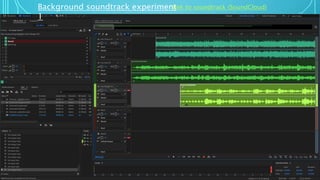
Background soundtrack experiment
1
link to soundtrack (SoundCloud)
BACKGROUND SOUNDTRACK EXPERIMENT 1
In previous projects I have always just used royalty free musical soundtracks in my projects,
in theory I could still do this and may still do. However first I wanted to try to make my own
soundtrack to put into the documentary film, despite this fact I did not create everything
from scratch, I gathered a collection of soundtracks from various royalty free websites, then
remixed them in Adobe Audition. This was my first time using audition so the work I
finished here was very simple, I layered a few soundtracks over each other that started at
separate times to create and introduction. I then inserted the delay guitar effect and distant
source, this way the soundtrack using a guitar and drum beat doesn't overpower the
ambient sounds of the other music tracks.
I believe that this experiment has gone well, and I have familiarised myself with the new
layout of this software, and I am now able to create my own basic soundtracks using royalty
free music. Whether I will use this method for my project remains to be seen, the main
issue with this approach is that free royalty music that is free to download is incredibly
limited. As a result the potential kinds of soundtracks that I can create is also very limited,
the only way to rectify this issue would be to collect instrument sounds, build separate
soundtracks from scratch, layer and then edit them. While this is possible it would take a
considerable amount of time to do, and I would have to reserve room for it on my
production schedule to create and finish editing into my video.
BACKGROUND SOUNDTRACK EXPERIMENT 2
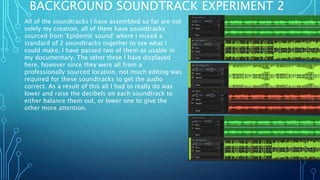
All of the soundtracks I have assembled so far are not
solely my creation, all of them have soundtracks
sourced from 'Epidemic sound' where I mixed a
standard of 2 soundtracks together to see what I
could make, I have passed two of them as usable in
my documentary. The other three I have displayed
here, however since they were all from a
professionally sourced location, not much editing was
required for these soundtracks to get the audio
correct. As a result of this all I had to really do was
lower and raise the decibels on each soundtrack to
either balance them out, or lower one to give the
other more attention.
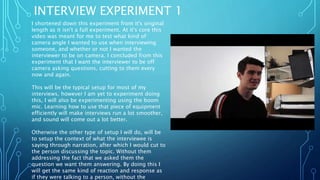
INTERVIEW EXPERIMENT 1
I shortened down this experiment from it's original
length as it isn't a full experiment. At it's core this
video was meant for me to test what kind of
camera angle I wanted to use when interviewing
someone, and whether or not I wanted the
interviewer to be on camera. I concluded from this
experiment that I want the interviewer to be off
camera asking questions, cutting to them every
now and again.
This will be the typical setup for most of my
interviews, however I am yet to experiment doing
this, I will also be experimenting using the boom
mic. Learning how to use that piece of equipment
efficiently will make interviews run a lot smoother,
and sound will come out a lot better.
Otherwise the other type of setup I will do, will be
to setup the context of what the interviewee is
saying through narration, after which I would cut to
the person discussing the topic. Without them
addressing the fact that we asked them the
question we want them answering. By doing this I
will get the same kind of reaction and response as
if they were talking to a person, without the
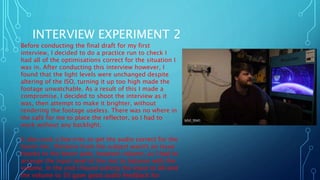
INTERVIEW EXPERIMENT 2
Before conducting the final draft for my first
interview, I decided to do a practice run to check I
had all of the optimisations correct for the situation I
was in. After conducting this interview however, I
found that the light levels were unchanged despite
altering of the ISO, turning it up too high made the
footage unwatchable. As a result of this I made a
compromise, I decided to shoot the interview as it
was, then attempt to make it brighter, without
rendering the footage useless. There was no where in
the café for me to place the reflector, so I had to
work without any backlight.
It also took a few tries to get the audio correct for the
boom mic. Distance from the subject wasn't an issue
thanks to the boom pole, however volume, as I had to
arrange the input level of the mic to balance with the
volume. In the end I found setting the input to 80 and
the volume to 50 gave good audio feedback for
VIDEOGAME FOOTAGE EXPERIMENTS
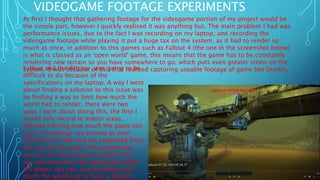
At first I thought that gathering footage for the videogame portion of my project would be
the simple part, however I quickly realised it was anything but. The main problem I had was
performance issues, due to the fact I was recording on my laptop, and recording the
videogame footage while playing it put a huge tax on the system, as it had to render so
much as once, in addition to this games such as Fallout 4 (the one in the screenshot below)
is what is classed as an 'open world' game, this means that the game has to be constantly
rendering new terrain so you have somewhere to go, which puts even greater strain on the
system. It was because of this that realised capturing useable footage of game like Skyrim,Fallout and the Witcher, was going to be
difficult to do because of the
specifications on my laptop. A way I went
about finding a solution to this issue was
by finding a way to limit how much the
world had to render, there were two
ways I went about doing this, the first I
would only record in indoor areas,
thereby limiting how much the game can
load as buildings are treated as their
own interior cells and are seperated from
the rest of the world. The second way
was by only recording in weather like
you see onscreen, this limits how much
the player can see, and therefore how
much the world has to load, a feature
VIDEOGAME FOOTAGE EXPERIMENTS
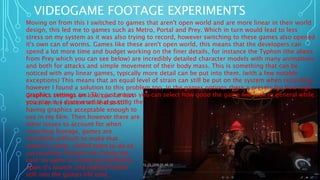
Moving on from this I switched to games that aren't open world and are more linear in their world
design, this led me to games such as Metro, Portal and Prey. Which in turn would lead to less
stress on my system as it was also trying to record, however switching to these games also opened
it's own can of worms. Games like these aren't open world, this means that the developers can
spend a lot more time and budget working on the finer details, for instance the Typhon (the aliens
from Prey which you can see below) are incredibly detailed character models with many animations
and both for attacks and simple movement of their body mass. This is something that can be
noticed with any linear games, typically more detail can be put into them. (with a few notable
exceptions) This means that an equal level of strain can still be put on the system when recording,
however I found a solution to this problem too, in the games options there a presets for how high
graphics settings are. This just means you can select how good the game will look in general while
you play it, I discovered that putting the
Graphics settings on low, put far less
strain on my system while also still
having graphics acceptable enough to
use in my film. Then however there are
other issues to account for when
recording footage, games are
incredibly difficult to make that
require a large, skilled team to do so
successfully. Despite this being the
case no game is ironed out perfectly
upon it's launch and indeed further
still into the games life time.
VIDEO GAME EXPERIMENTSAs mentioned previously no game is perfectly done, there are bugs and glitches that very easily
slip through the cracks, as they appear randomly so it is impossible to pin down when they will
happen and how to get rid of them. A bug or glitch is a unique anomaly found in all videogames
at some point, and they can seriously disrupt gameplay, from crashing the game, to making
enemies invisible, to stopping objectives being completed they can effect the game in just about
any way. This creates problems on my part because at multiple points in gameplay I would find
myself faced with a glitch at a critical moment when gathering good footage would be invaluable,
unfortunately there is absolutely no way to bypass/fix most bugs in most games. So the only
thing to do is to reload your game and try again, consequently one of the steps to my production
in this regard was making multiple save points should anything go wrong.
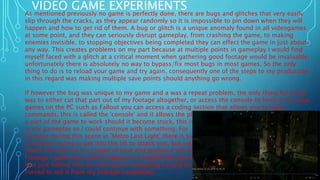
If however the bug was unique to my game and a was a repeat problem, the only thing for to do
was to either cut that part out of my footage altogether, or access the console to force it. In some
games on the PC such as Fallout you can access a coding section that allows you to input
commands, this is called the 'console' and it allows the player to input certain commands to force
a part of the game to work should it become stuck, this is a feature I had to use at a few points
in my gameplay so I could continue with something. For
Instance during this scene in 'Metro Last Light' there is supposed to be
A monster trying to get into the lift to attack you, but your character
Slams the door on it a couple of time and pushes it off. However in the
Footage I gathered it didn't appear so it looked like my character
Was just hitting thin air, this wasn't something I could fix so I was
Forced to cut it from my footage completely.
NARRATION EXPERIMENT
Then first draft of my script was 8 acts long, including the
intro and the conclusion. Information throughout the
documentary isn't an issue however it still needs refining.
The first it has is that it wasn't snappy enough,
particularly in the intro sequence, facts are present but
they drag out for too long, it's not enough to capture the
audiences attention and so it would be worth re-recording
this part but made punchier.
Acts 2 and 3 also typically let the rest of the script down,
terms of research that I have conducted these are
probably the two areas that come up lacking the most. In
addition to this I have already performed more research
about other areas of psychology that are far more
interesting than what I have already written, therefore I
think the best thing to do would be to go back and re-
draft act 2 and 3.
The conclusion I drafted was also too brief, in addition to
NARRATION EXPERIMENTS
During the recording of the script for the narration of my project, the script itself changed
multiple times, including the intro (I shortened it). However in addition to this it was also
a long process to gather all of the narration I needed. This was because I had to do many
takes in order to get the right input and volume level on the recorder, in addition to this,
many of the takes I had far too much echo in them due to the design of the room, I was
finally able to reduce the echo on these recordings but it is still present, however it is so
low I can probably fix it in Audition.
Then there was also a human factor to be taken into account, my narrator would
occasionally trip over lines, or pauses to take a breath, they also had a cold on the day of
production so some of the dialogue sounded very nasally. Meaning I also had to do
multiple takes to compensate for that, all of this together consequentially led to dozens
of takes needing to be made, which comes as an inconvenience when trying to look
through them to find the ones I needed.

Production experiments

  • 1.
  • 2.
    Background soundtrack experiment 1 linkto soundtrack (SoundCloud)
  • 3.
    BACKGROUND SOUNDTRACK EXPERIMENT1 In previous projects I have always just used royalty free musical soundtracks in my projects, in theory I could still do this and may still do. However first I wanted to try to make my own soundtrack to put into the documentary film, despite this fact I did not create everything from scratch, I gathered a collection of soundtracks from various royalty free websites, then remixed them in Adobe Audition. This was my first time using audition so the work I finished here was very simple, I layered a few soundtracks over each other that started at separate times to create and introduction. I then inserted the delay guitar effect and distant source, this way the soundtrack using a guitar and drum beat doesn't overpower the ambient sounds of the other music tracks. I believe that this experiment has gone well, and I have familiarised myself with the new layout of this software, and I am now able to create my own basic soundtracks using royalty free music. Whether I will use this method for my project remains to be seen, the main issue with this approach is that free royalty music that is free to download is incredibly limited. As a result the potential kinds of soundtracks that I can create is also very limited, the only way to rectify this issue would be to collect instrument sounds, build separate soundtracks from scratch, layer and then edit them. While this is possible it would take a considerable amount of time to do, and I would have to reserve room for it on my production schedule to create and finish editing into my video.
  • 4.
    BACKGROUND SOUNDTRACK EXPERIMENT2 All of the soundtracks I have assembled so far are not solely my creation, all of them have soundtracks sourced from 'Epidemic sound' where I mixed a standard of 2 soundtracks together to see what I could make, I have passed two of them as usable in my documentary. The other three I have displayed here, however since they were all from a professionally sourced location, not much editing was required for these soundtracks to get the audio correct. As a result of this all I had to really do was lower and raise the decibels on each soundtrack to either balance them out, or lower one to give the other more attention.
  • 5.
    INTERVIEW EXPERIMENT 1 Ishortened down this experiment from it's original length as it isn't a full experiment. At it's core this video was meant for me to test what kind of camera angle I wanted to use when interviewing someone, and whether or not I wanted the interviewer to be on camera. I concluded from this experiment that I want the interviewer to be off camera asking questions, cutting to them every now and again. This will be the typical setup for most of my interviews, however I am yet to experiment doing this, I will also be experimenting using the boom mic. Learning how to use that piece of equipment efficiently will make interviews run a lot smoother, and sound will come out a lot better. Otherwise the other type of setup I will do, will be to setup the context of what the interviewee is saying through narration, after which I would cut to the person discussing the topic. Without them addressing the fact that we asked them the question we want them answering. By doing this I will get the same kind of reaction and response as if they were talking to a person, without the
  • 6.
    INTERVIEW EXPERIMENT 2 Beforeconducting the final draft for my first interview, I decided to do a practice run to check I had all of the optimisations correct for the situation I was in. After conducting this interview however, I found that the light levels were unchanged despite altering of the ISO, turning it up too high made the footage unwatchable. As a result of this I made a compromise, I decided to shoot the interview as it was, then attempt to make it brighter, without rendering the footage useless. There was no where in the café for me to place the reflector, so I had to work without any backlight. It also took a few tries to get the audio correct for the boom mic. Distance from the subject wasn't an issue thanks to the boom pole, however volume, as I had to arrange the input level of the mic to balance with the volume. In the end I found setting the input to 80 and the volume to 50 gave good audio feedback for
  • 7.
    VIDEOGAME FOOTAGE EXPERIMENTS Atfirst I thought that gathering footage for the videogame portion of my project would be the simple part, however I quickly realised it was anything but. The main problem I had was performance issues, due to the fact I was recording on my laptop, and recording the videogame footage while playing it put a huge tax on the system, as it had to render so much as once, in addition to this games such as Fallout 4 (the one in the screenshot below) is what is classed as an 'open world' game, this means that the game has to be constantly rendering new terrain so you have somewhere to go, which puts even greater strain on the system. It was because of this that realised capturing useable footage of game like Skyrim,Fallout and the Witcher, was going to be difficult to do because of the specifications on my laptop. A way I went about finding a solution to this issue was by finding a way to limit how much the world had to render, there were two ways I went about doing this, the first I would only record in indoor areas, thereby limiting how much the game can load as buildings are treated as their own interior cells and are seperated from the rest of the world. The second way was by only recording in weather like you see onscreen, this limits how much the player can see, and therefore how much the world has to load, a feature
  • 8.
    VIDEOGAME FOOTAGE EXPERIMENTS Movingon from this I switched to games that aren't open world and are more linear in their world design, this led me to games such as Metro, Portal and Prey. Which in turn would lead to less stress on my system as it was also trying to record, however switching to these games also opened it's own can of worms. Games like these aren't open world, this means that the developers can spend a lot more time and budget working on the finer details, for instance the Typhon (the aliens from Prey which you can see below) are incredibly detailed character models with many animations and both for attacks and simple movement of their body mass. This is something that can be noticed with any linear games, typically more detail can be put into them. (with a few notable exceptions) This means that an equal level of strain can still be put on the system when recording, however I found a solution to this problem too, in the games options there a presets for how high graphics settings are. This just means you can select how good the game will look in general while you play it, I discovered that putting the Graphics settings on low, put far less strain on my system while also still having graphics acceptable enough to use in my film. Then however there are other issues to account for when recording footage, games are incredibly difficult to make that require a large, skilled team to do so successfully. Despite this being the case no game is ironed out perfectly upon it's launch and indeed further still into the games life time.
  • 9.
    VIDEO GAME EXPERIMENTSAsmentioned previously no game is perfectly done, there are bugs and glitches that very easily slip through the cracks, as they appear randomly so it is impossible to pin down when they will happen and how to get rid of them. A bug or glitch is a unique anomaly found in all videogames at some point, and they can seriously disrupt gameplay, from crashing the game, to making enemies invisible, to stopping objectives being completed they can effect the game in just about any way. This creates problems on my part because at multiple points in gameplay I would find myself faced with a glitch at a critical moment when gathering good footage would be invaluable, unfortunately there is absolutely no way to bypass/fix most bugs in most games. So the only thing to do is to reload your game and try again, consequently one of the steps to my production in this regard was making multiple save points should anything go wrong. If however the bug was unique to my game and a was a repeat problem, the only thing for to do was to either cut that part out of my footage altogether, or access the console to force it. In some games on the PC such as Fallout you can access a coding section that allows you to input commands, this is called the 'console' and it allows the player to input certain commands to force a part of the game to work should it become stuck, this is a feature I had to use at a few points in my gameplay so I could continue with something. For Instance during this scene in 'Metro Last Light' there is supposed to be A monster trying to get into the lift to attack you, but your character Slams the door on it a couple of time and pushes it off. However in the Footage I gathered it didn't appear so it looked like my character Was just hitting thin air, this wasn't something I could fix so I was Forced to cut it from my footage completely.
  • 10.
    NARRATION EXPERIMENT Then firstdraft of my script was 8 acts long, including the intro and the conclusion. Information throughout the documentary isn't an issue however it still needs refining. The first it has is that it wasn't snappy enough, particularly in the intro sequence, facts are present but they drag out for too long, it's not enough to capture the audiences attention and so it would be worth re-recording this part but made punchier. Acts 2 and 3 also typically let the rest of the script down, terms of research that I have conducted these are probably the two areas that come up lacking the most. In addition to this I have already performed more research about other areas of psychology that are far more interesting than what I have already written, therefore I think the best thing to do would be to go back and re- draft act 2 and 3. The conclusion I drafted was also too brief, in addition to
  • 11.
    NARRATION EXPERIMENTS During therecording of the script for the narration of my project, the script itself changed multiple times, including the intro (I shortened it). However in addition to this it was also a long process to gather all of the narration I needed. This was because I had to do many takes in order to get the right input and volume level on the recorder, in addition to this, many of the takes I had far too much echo in them due to the design of the room, I was finally able to reduce the echo on these recordings but it is still present, however it is so low I can probably fix it in Audition. Then there was also a human factor to be taken into account, my narrator would occasionally trip over lines, or pauses to take a breath, they also had a cold on the day of production so some of the dialogue sounded very nasally. Meaning I also had to do multiple takes to compensate for that, all of this together consequentially led to dozens of takes needing to be made, which comes as an inconvenience when trying to look through them to find the ones I needed.