MARKETING MANAGEMENT CIA 1
A PROJECT REPORT ON PRODUCT REVIVAL- ‘NESTLE
MILO’
ASSIGNMENT SUBMITTED BY:
RAHUL KHEMKA (1416405)
ANUBHAV GOYAL (1416407)
RAMANJEET SINGH (1416419)
CHNDRIKA SHARMA
APOORVA SHARMA
DIVYATA BHANSAL
RAGHAV AHUJA
SHUBHAM RAWAL
AGENDA
• Industry Trend
• Why this Product?
• About Nestle
- Bcg demographic structure
• Reasons for the failure of this product in the market
• Re-launching the product
• Improvements in the new product
• The 4 P’s of marketing
• Conclusion
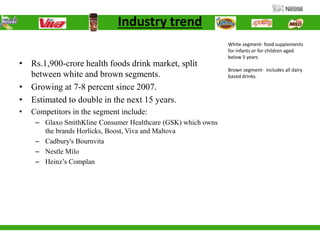
Industry trend
• Rs.1,900-crore health foods drink market, split
between white and brown segments.
• Growing at 7-8 percent since 2007.
• Estimated to double in the next 15 years.
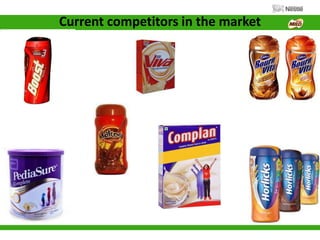
• Competitors in the segment include:
– Glaxo SmithKline Consumer Healthcare (GSK) which owns
the brands Horlicks, Boost, Viva and Maltova
– Cadbury's Bournvita
– Nestle Milo
– Heinz’s Complan
White segment- food supplements
for infants or for children aged
below 5 years
Brown segment- includes all dairy
based drinks.
Why this Product?
• The demand for dairy drinks is increasing as the population is increasing. At
present, 48% of Indians are below the age of 30. India is a ‘young nation’
and this is the perfect time to re-launch the product.
• With more nutritional values, 8 new flavors and no artificial(high fructose
corn syup) sweetener, this product would be an instant hit.
• The drink will also revive Nestlé's position in the market after the Maggi
incident.
• The people in the age group of 19-26 years will have a lot of memories
attached with this drink and will also try it to cherish those memories.
• No new product launched in this segment and people are now bored of the
existing ones- bournvita, Horlicks, pediasure, nutrilite junior, etc. and will
give a try to the new ones.
About Nestle
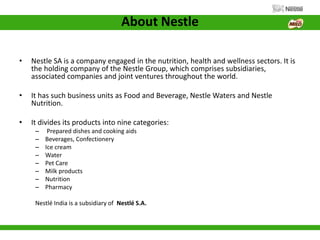
• Nestle SA is a company engaged in the nutrition, health and wellness sectors. It is
the holding company of the Nestle Group, which comprises subsidiaries,
associated companies and joint ventures throughout the world.
• It has such business units as Food and Beverage, Nestle Waters and Nestle
Nutrition.
• It divides its products into nine categories:
– Prepared dishes and cooking aids
– Beverages, Confectionery
– Ice cream
– Water
– Pet Care
– Milk products
– Nutrition
– Pharmacy
NestlĂŠ India is a subsidiary of NestlĂŠ S.A.
BCG MATRIX
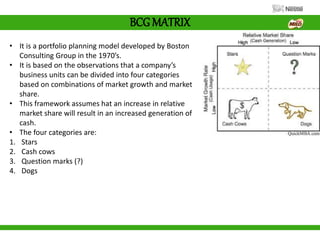
• It is a portfolio planning model developed by Boston
Consulting Group in the 1970’s.
• It is based on the observations that a company’s
business units can be divided into four categories
based on combinations of market growth and market
share.
• This framework assumes hat an increase in relative
market share will result in an increased generation of
cash.
• The four categories are:
1. Stars
2. Cash cows
3. Question marks (?)
4. Dogs
NestlĂŠ's BCG matrix
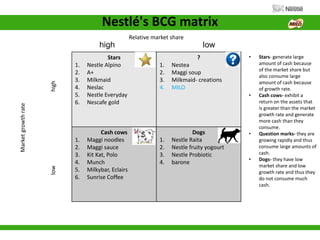
Stars
1. Nestle Alpino
2. A+
3. Milkmaid
4. Neslac
5. Nestle Everyday
6. Nescafe gold
?
1. Nestea
2. Maggi soup
3. Milkmaid- creations
4. MILO
Cash cows
1. Maggi noodles
2. Maggi sauce
3. Kit Kat, Polo
4. Munch
5. Milkybar, Eclairs
6. Sunrise Coffee
Dogs
1. Nestle Raita
2. Nestle fruity yogourt
3. Nestle Probiotic
4. barone
Marketgrowthrate
Relative market share
lowhigh
• Stars- generate large
amount of cash because
of the market share but
also consume large
amount of cash because
of growth rate.
• Cash cows- exhibit a
return on the assets that
is greater than the market
growth rate and generate
more cash than they
consume.
• Question marks- they are
growing rapidly and thus
consume large amounts of
cash.
• Dogs- they have low
market share and low
growth rate and thus they
do not consume much
cash.
Reasons for the failure of the product
• despite of heavy discounts in India and Heavy push marketing used by Nestle for
their brand in Milo, they had to pull up their brand Milo in the year 2009. Dropping
sales forced Nestle led to stop production of milo in India.
The reasons for failure are as follows:
• It is absolutely vile! It is overly sweet to a point where it tastes sour and bitter.
Literally bitter to where it makes you purse your lips into a pucker.
• The distribution strategy and the supply chain used by Nestle is not so wide as
compared to the major players used by Bournvita, Complain and Horlicks.
Contd.
• Milo has been lacking a distinct positioning.
Bournvita and Horlicks have been repositioned, and
Cadbury and GSK are pushing their brands
aggressively," said an analyst.
Nestle had also withdrawn another product, chocolate-coffee blend ‘Nescafe Choc Café’.
SWOT analysis of ‘MILO’
1. STRENGTH.
• Nestle brand
• Product quality.
• Energy drink.
• Value for money.
• Part of Nestle(reputation) funds used for nestle promotion.
• Unique selling point.
• Available in 10 different flavors.
• One product for 2 different age categories (5yrs- 15yrs) and
(15 yrs.- 25 yrs.)
• It is available in different shapes and types of packing.
SWOT analysis of ‘MILO’
2. Weaknesses.
• Not enough investment in milo.
• Packaging(design of tin + labeling).
• Not innovative
• Low R&D
• Weak, damaged brand- resulted in loss of trust of the
consumers.
SWOT analysis of ‘MILO’
3. Opportunities.
• Increased media availability than what was available
back in 2009 (Mobile/internet)
• Increased fitness industry.
• Increase awareness of health and fitness.
• Sponsorship (through sporting events).
SWOT analysis of ‘MILO’
4. Threats
• Milo has many formidable competitors.
• Competition.
• Competitors could use aggressive marketing tactics
cut prices/ increases promotion .
• Competitors bring out similar products.
• Competitors have diversity in packaging (bottles
pouches, cans, etc
Current competitors in the market
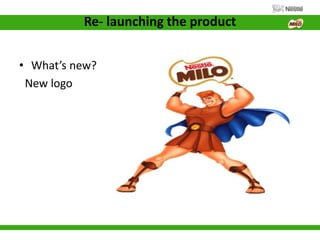
Re- launching the product
• What’s new?
New logo
What’s new?
• New tagline:
“HEALTH WITH BENEFITS”
Old punchline- ‘Olympic energy everyday!’
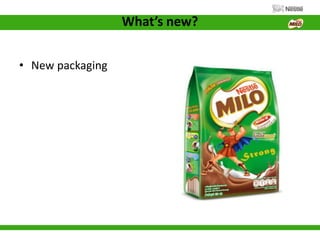
What’s new?
• New packaging
What’s new?
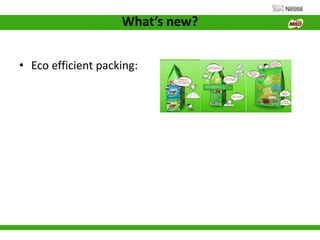
• Eco efficient packing:
What’s new?
10 new flavors you will never get bored of:
• Original(vanilla)
• Butterscotch
• Chocolate
• Almond roasted
• Strawberry
• Kesar pista
• Banana
• Mango
• Blueberry
• Coffee
What’s new?
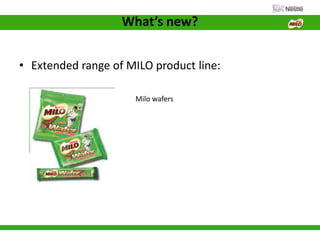
• Extended range of MILO product line:
Milo wafers
What’s new?
Milo chocolate bar
Milo cans
What’s new?
• Available in small pouches (5 Rs. and 15 Rs.)
• Available in cans and tins.
What’s new?
• Increased ingredients which will lead to improved visible
results in just two weeks. the added benefits are:
a. vitamin b3
b. amino acid
c. bacteria culture- resulting in better digestion
d. calcium absorbing agents
e. proteins and minerals
f. protomalt
g. actigen-e
h. natural goodness
Improvements in the new product:
• Most of the dairy based drinks in the global based
market are malt- based. MILO is chocolate based or
based on the flavors with no traits of malt. Malt is
bitter in taste and to suppress the bitterness, excess
sugar is added. Thus, no malt will also reduce the
sweetness.
Improvements in the new product:
• Earlier, MILO was just a sports drink. But now, it is a
dairy based product and the target market for this is
children and young adults upto the age of 25 years.
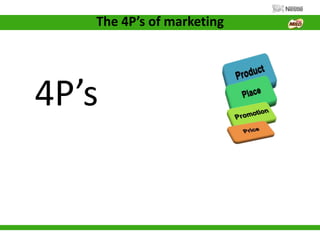
The 4P’s of marketing
4P’s
PRODUCT MIX
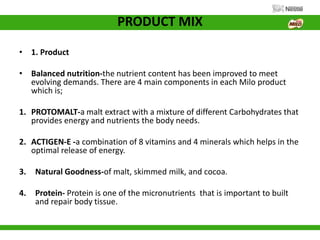
• 1. Product
• Balanced nutrition-the nutrient content has been improved to meet
evolving demands. There are 4 main components in each Milo product
which is;
1. PROTOMALT-a malt extract with a mixture of different Carbohydrates that
provides energy and nutrients the body needs.
2. ACTIGEN-E -a combination of 8 vitamins and 4 minerals which helps in the
optimal release of energy.
3. Natural Goodness-of malt, skimmed milk, and cocoa.
4. Protein- Protein is one of the micronutrients that is important to built
and repair body tissue.
PLACE
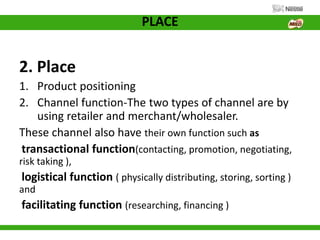
2. Place
1. Product positioning
2. Channel function-The two types of channel are by
using retailer and merchant/wholesaler.
These channel also have their own function such as
transactional function(contacting, promotion, negotiating,
risk taking ),
logistical function ( physically distributing, storing, sorting )
and
facilitating function (researching, financing )
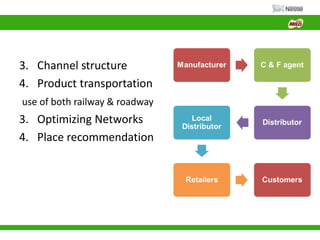
3. Channel structure
4. Product transportation
use of both railway & roadway
3. Optimizing Networks
4. Place recommendation
PROMOTION
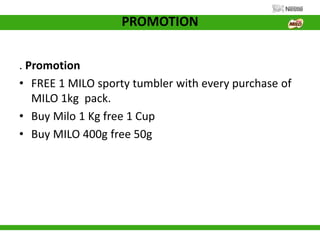
. Promotion
• FREE 1 MILO sporty tumbler with every purchase of
MILO 1kg pack.
• Buy Milo 1 Kg free 1 Cup
• Buy MILO 400g free 50g
PRICE
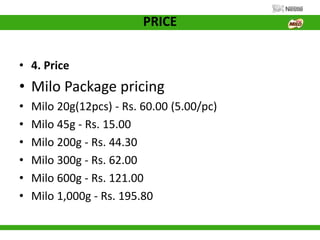
• 4. Price
• Milo Package pricing
• Milo 20g(12pcs) - Rs. 60.00 (5.00/pc)
• Milo 45g - Rs. 15.00
• Milo 200g - Rs. 44.30
• Milo 300g - Rs. 62.00
• Milo 600g - Rs. 121.00
• Milo 1,000g - Rs. 195.80
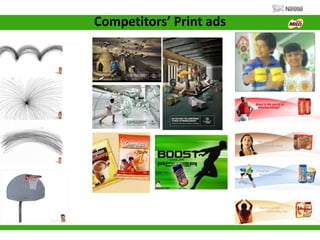
Competitors’ Print ads
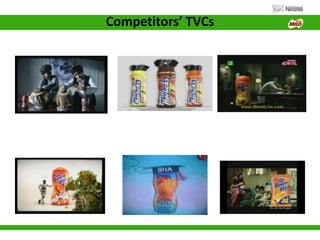
Competitors’ TVCs
CONCLUSION
THANK YOU

product launch and revival- milo

  • 1.
    MARKETING MANAGEMENT CIA1 A PROJECT REPORT ON PRODUCT REVIVAL- ‘NESTLE MILO’ ASSIGNMENT SUBMITTED BY: RAHUL KHEMKA (1416405) ANUBHAV GOYAL (1416407) RAMANJEET SINGH (1416419) CHNDRIKA SHARMA APOORVA SHARMA DIVYATA BHANSAL RAGHAV AHUJA SHUBHAM RAWAL
  • 2.
    AGENDA • Industry Trend •Why this Product? • About Nestle - Bcg demographic structure • Reasons for the failure of this product in the market • Re-launching the product • Improvements in the new product • The 4 P’s of marketing • Conclusion
  • 3.
    Industry trend • Rs.1,900-crorehealth foods drink market, split between white and brown segments. • Growing at 7-8 percent since 2007. • Estimated to double in the next 15 years. • Competitors in the segment include: – Glaxo SmithKline Consumer Healthcare (GSK) which owns the brands Horlicks, Boost, Viva and Maltova – Cadbury's Bournvita – Nestle Milo – Heinz’s Complan White segment- food supplements for infants or for children aged below 5 years Brown segment- includes all dairy based drinks.
  • 4.
    Why this Product? •The demand for dairy drinks is increasing as the population is increasing. At present, 48% of Indians are below the age of 30. India is a ‘young nation’ and this is the perfect time to re-launch the product. • With more nutritional values, 8 new flavors and no artificial(high fructose corn syup) sweetener, this product would be an instant hit. • The drink will also revive Nestlé's position in the market after the Maggi incident. • The people in the age group of 19-26 years will have a lot of memories attached with this drink and will also try it to cherish those memories. • No new product launched in this segment and people are now bored of the existing ones- bournvita, Horlicks, pediasure, nutrilite junior, etc. and will give a try to the new ones.
  • 5.
    About Nestle • NestleSA is a company engaged in the nutrition, health and wellness sectors. It is the holding company of the Nestle Group, which comprises subsidiaries, associated companies and joint ventures throughout the world. • It has such business units as Food and Beverage, Nestle Waters and Nestle Nutrition. • It divides its products into nine categories: – Prepared dishes and cooking aids – Beverages, Confectionery – Ice cream – Water – Pet Care – Milk products – Nutrition – Pharmacy Nestlé India is a subsidiary of Nestlé S.A.
  • 6.
    BCG MATRIX • Itis a portfolio planning model developed by Boston Consulting Group in the 1970’s. • It is based on the observations that a company’s business units can be divided into four categories based on combinations of market growth and market share. • This framework assumes hat an increase in relative market share will result in an increased generation of cash. • The four categories are: 1. Stars 2. Cash cows 3. Question marks (?) 4. Dogs
  • 7.
    Nestlé's BCG matrix Stars 1.Nestle Alpino 2. A+ 3. Milkmaid 4. Neslac 5. Nestle Everyday 6. Nescafe gold ? 1. Nestea 2. Maggi soup 3. Milkmaid- creations 4. MILO Cash cows 1. Maggi noodles 2. Maggi sauce 3. Kit Kat, Polo 4. Munch 5. Milkybar, Eclairs 6. Sunrise Coffee Dogs 1. Nestle Raita 2. Nestle fruity yogourt 3. Nestle Probiotic 4. barone Marketgrowthrate Relative market share lowhigh • Stars- generate large amount of cash because of the market share but also consume large amount of cash because of growth rate. • Cash cows- exhibit a return on the assets that is greater than the market growth rate and generate more cash than they consume. • Question marks- they are growing rapidly and thus consume large amounts of cash. • Dogs- they have low market share and low growth rate and thus they do not consume much cash.
  • 8.
    Reasons for thefailure of the product • despite of heavy discounts in India and Heavy push marketing used by Nestle for their brand in Milo, they had to pull up their brand Milo in the year 2009. Dropping sales forced Nestle led to stop production of milo in India. The reasons for failure are as follows: • It is absolutely vile! It is overly sweet to a point where it tastes sour and bitter. Literally bitter to where it makes you purse your lips into a pucker. • The distribution strategy and the supply chain used by Nestle is not so wide as compared to the major players used by Bournvita, Complain and Horlicks.
  • 9.
    Contd. • Milo hasbeen lacking a distinct positioning. Bournvita and Horlicks have been repositioned, and Cadbury and GSK are pushing their brands aggressively," said an analyst. Nestle had also withdrawn another product, chocolate-coffee blend ‘Nescafe Choc Café’.
  • 10.
    SWOT analysis of‘MILO’ 1. STRENGTH. • Nestle brand • Product quality. • Energy drink. • Value for money. • Part of Nestle(reputation) funds used for nestle promotion. • Unique selling point. • Available in 10 different flavors. • One product for 2 different age categories (5yrs- 15yrs) and (15 yrs.- 25 yrs.) • It is available in different shapes and types of packing.
  • 11.
    SWOT analysis of‘MILO’ 2. Weaknesses. • Not enough investment in milo. • Packaging(design of tin + labeling). • Not innovative • Low R&D • Weak, damaged brand- resulted in loss of trust of the consumers.
  • 12.
    SWOT analysis of‘MILO’ 3. Opportunities. • Increased media availability than what was available back in 2009 (Mobile/internet) • Increased fitness industry. • Increase awareness of health and fitness. • Sponsorship (through sporting events).
  • 13.
    SWOT analysis of‘MILO’ 4. Threats • Milo has many formidable competitors. • Competition. • Competitors could use aggressive marketing tactics cut prices/ increases promotion . • Competitors bring out similar products. • Competitors have diversity in packaging (bottles pouches, cans, etc
  • 14.
  • 15.
    Re- launching theproduct • What’s new? New logo
  • 16.
    What’s new? • Newtagline: “HEALTH WITH BENEFITS” Old punchline- ‘Olympic energy everyday!’
  • 17.
  • 18.
    What’s new? • Ecoefficient packing:
  • 19.
    What’s new? 10 newflavors you will never get bored of: • Original(vanilla) • Butterscotch • Chocolate • Almond roasted • Strawberry • Kesar pista • Banana • Mango • Blueberry • Coffee
  • 20.
    What’s new? • Extendedrange of MILO product line: Milo wafers
  • 21.
  • 22.
    What’s new? • Availablein small pouches (5 Rs. and 15 Rs.) • Available in cans and tins.
  • 23.
    What’s new? • Increasedingredients which will lead to improved visible results in just two weeks. the added benefits are: a. vitamin b3 b. amino acid c. bacteria culture- resulting in better digestion d. calcium absorbing agents e. proteins and minerals f. protomalt g. actigen-e h. natural goodness
  • 24.
    Improvements in thenew product: • Most of the dairy based drinks in the global based market are malt- based. MILO is chocolate based or based on the flavors with no traits of malt. Malt is bitter in taste and to suppress the bitterness, excess sugar is added. Thus, no malt will also reduce the sweetness.
  • 25.
    Improvements in thenew product: • Earlier, MILO was just a sports drink. But now, it is a dairy based product and the target market for this is children and young adults upto the age of 25 years.
  • 26.
    The 4P’s ofmarketing 4P’s
  • 27.
    PRODUCT MIX • 1.Product • Balanced nutrition-the nutrient content has been improved to meet evolving demands. There are 4 main components in each Milo product which is; 1. PROTOMALT-a malt extract with a mixture of different Carbohydrates that provides energy and nutrients the body needs. 2. ACTIGEN-E -a combination of 8 vitamins and 4 minerals which helps in the optimal release of energy. 3. Natural Goodness-of malt, skimmed milk, and cocoa. 4. Protein- Protein is one of the micronutrients that is important to built and repair body tissue.
  • 28.
    PLACE 2. Place 1. Productpositioning 2. Channel function-The two types of channel are by using retailer and merchant/wholesaler. These channel also have their own function such as transactional function(contacting, promotion, negotiating, risk taking ), logistical function ( physically distributing, storing, sorting ) and facilitating function (researching, financing )
  • 29.
    3. Channel structure 4.Product transportation use of both railway & roadway 3. Optimizing Networks 4. Place recommendation
  • 30.
    PROMOTION . Promotion • FREE1 MILO sporty tumbler with every purchase of MILO 1kg pack. • Buy Milo 1 Kg free 1 Cup • Buy MILO 400g free 50g
  • 31.
    PRICE • 4. Price •Milo Package pricing • Milo 20g(12pcs) - Rs. 60.00 (5.00/pc) • Milo 45g - Rs. 15.00 • Milo 200g - Rs. 44.30 • Milo 300g - Rs. 62.00 • Milo 600g - Rs. 121.00 • Milo 1,000g - Rs. 195.80
  • 32.
  • 33.
  • 34.