Product Ethnography
Doing Primary User Research
UX Training Content
Author:Anand Jha
Date: 10 Oct 2015
Version 1.0
INDEX
What is Product Ethnography
Etic and Emic Studies
Actors and System Objects
2
The engagement funnel
The Toolkit
What is Product Ethnography
• Understanding social construct of the user
• Articulating functional and emotional needs of the users
• Exploring the socio – economical forces that manufacture these
needs
• Moving from “what is said” to “what is felt”
3
Using this information to select the pain points the product is likely
to solve and understanding how can the solution appeal to the
user.
Neutral observer
• Observer’s background influences what he/ She chooses to
observe, how he/she chooses to report, what he/she finds
significant/un-significant
• The observer’s vantage points change based on gender, class,
caste and other social parameters.
• Each time observer and user interact, they perform to each
other their social roles, thus generating garbage information
that must not be factored into insight.
• Unless the information exchange environment is more neutral
(which is where rapport building, empathy and passive
observation come into picture) its difficult to obtain clean
qualitative data
4
INDEX
What is Product Ethnography
Etic and Emic Studies
Actors and System Objects
5
The engagement funnel
The Toolkit
Etic and Emic Studies
• These approaches determine that the Individual is shaped by
their cultural, subcultural landscape
• Etic studies require a heavy investment from researcher’s time
to gain acceptance from the researched group and access to
their belief systems.
• Its not primarily as much a case of difference in research
methodologies as in their application
6
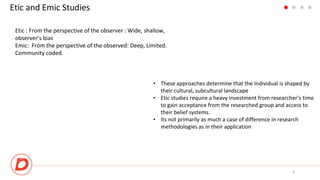
Etic : From the perspective of the observer : Wide, shallow,
observer’s bias
Emic: From the perspective of the observed: Deep, Limited.
Community coded.
Quick exercise(1 hr)
Do an online search for case studies done using etic or emic
approaches. Condense and narrate it to the peer group.
7
INDEX
What is Product Ethnography
Etic and Emic Studies
Actors and System Objects
8
The engagement funnel
The Toolkit
Actors and System objects
• A system needs to be reduced to actors and system objects to
observe and convey in detail, various social exchanges.
• These social exchanges need to be minutely observed and
documented for future articulation
9
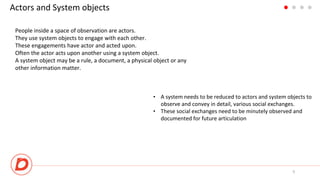
People inside a space of observation are actors.
They use system objects to engage with each other.
These engagements have actor and acted upon.
Often the actor acts upon another using a system object.
A system object may be a rule, a document, a physical object or any
other information matter.
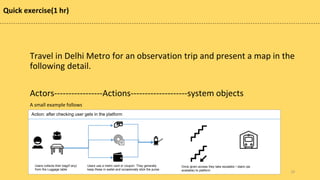
Quick exercise(1 hr)
Travel in Delhi Metro for an observation trip and present a map in the
following detail.
Actors-----------------Actions--------------------system objects
A small example follows
10
Action: after checking user gets in the platform
Users collects their bag(if any)
from the Luggage table
Users use a metro card or coupon. They generally
keep these in wallet and occasionally stick the purse
Once given access they take escalator / stairs (as
available) to platform
INDEX
What is Product Ethnography
Etic and Emic Studies
Actors and System Objects
11
The engagement funnel
The Toolkit
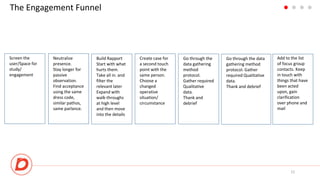
The Engagement Funnel
12
Screen the
user/Space for
study/
engagement
Neutralize
presence.
Stay longer for
passive
observation.
Find acceptance
using the same
dress code,
similar pathos,
same parlance.
Build Rapport
Start with what
hurts them.
Take all in. and
filter the
relevant later
Expand with
walk-throughs
at high level
and then move
into the details
Create case for
a second touch
point with the
same person.
Choose a
changed
operative
situation/
circumstance
Go through the
data gathering
method
protocol.
Gather required
Qualitative
data.
Thank and
debrief
Add to the list
of focus group
contacts. Keep
in touch with
things that have
been acted
upon, gain
clarification
over phone and
mail
Go through the data
gathering method
protocol. Gather
required Qualitative
data.
Thank and debrief
INDEX
What is Product Ethnography
Etic and Emic Studies
Actors and System Objects
13
The engagement funnel
The Toolkit
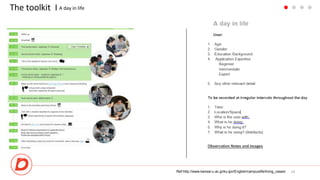
The toolkit I
14
A day in life
Ref:http://www.kansai-u.ac.jp/ku-jpn/English/campuslife/living_cases/
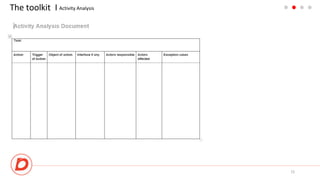
The toolkit I
15
Activity Analysis
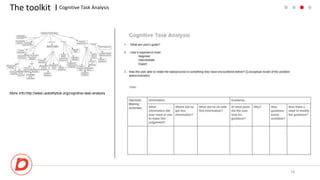
The toolkit I
16
Cognitive Task Analysis
More Info:http://www.usabilitybok.org/cognitive-task-analysis
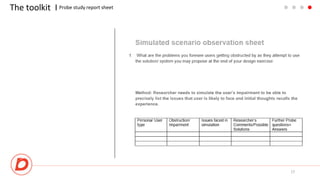
The toolkit I
17
Probe study report sheet
The toolkit I
18
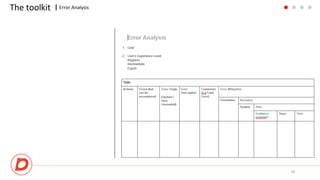
Error Analysis
The toolkit I
19
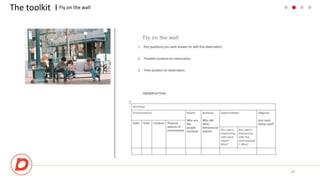
Fly on the wall
The toolkit I
20
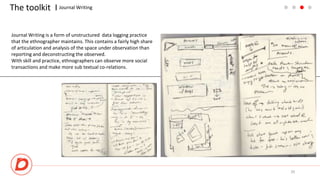
Journal Writing
Journal Writing is a form of unstructured data logging practice
that the ethnographer maintains. This contains a fairly high share
of articulation and analysis of the space under observation than
reporting and deconstructing the observed.
With skill and practice, ethnographers can observe more social
transactions and make more sub textual co-relations.
The toolkit I
21
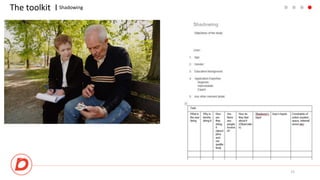
Shadowing
The toolkit I
22
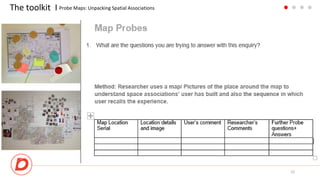
Probe Maps: Unpacking Spatial Associations
The toolkit I
23
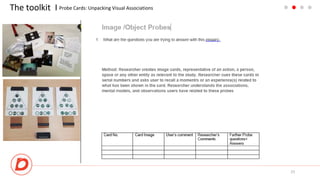
Probe Cards: Unpacking Visual Associations
The toolkit I
24
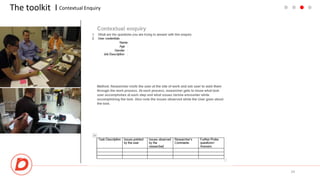
Contextual Enquiry
The toolkit I
25
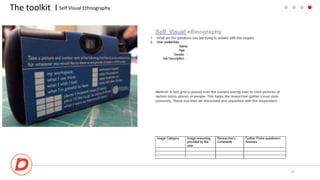
Self Visual Ethnography
Thank You!
UserX Delhivery Design
UserX@delhivery.com
765 432 9886
26

Product ethnography

  • 1.
    Product Ethnography Doing PrimaryUser Research UX Training Content Author:Anand Jha Date: 10 Oct 2015 Version 1.0
  • 2.
    INDEX What is ProductEthnography Etic and Emic Studies Actors and System Objects 2 The engagement funnel The Toolkit
  • 3.
    What is ProductEthnography • Understanding social construct of the user • Articulating functional and emotional needs of the users • Exploring the socio – economical forces that manufacture these needs • Moving from “what is said” to “what is felt” 3 Using this information to select the pain points the product is likely to solve and understanding how can the solution appeal to the user.
  • 4.
    Neutral observer • Observer’sbackground influences what he/ She chooses to observe, how he/she chooses to report, what he/she finds significant/un-significant • The observer’s vantage points change based on gender, class, caste and other social parameters. • Each time observer and user interact, they perform to each other their social roles, thus generating garbage information that must not be factored into insight. • Unless the information exchange environment is more neutral (which is where rapport building, empathy and passive observation come into picture) its difficult to obtain clean qualitative data 4
  • 5.
    INDEX What is ProductEthnography Etic and Emic Studies Actors and System Objects 5 The engagement funnel The Toolkit
  • 6.
    Etic and EmicStudies • These approaches determine that the Individual is shaped by their cultural, subcultural landscape • Etic studies require a heavy investment from researcher’s time to gain acceptance from the researched group and access to their belief systems. • Its not primarily as much a case of difference in research methodologies as in their application 6 Etic : From the perspective of the observer : Wide, shallow, observer’s bias Emic: From the perspective of the observed: Deep, Limited. Community coded.
  • 7.
    Quick exercise(1 hr) Doan online search for case studies done using etic or emic approaches. Condense and narrate it to the peer group. 7
  • 8.
    INDEX What is ProductEthnography Etic and Emic Studies Actors and System Objects 8 The engagement funnel The Toolkit
  • 9.
    Actors and Systemobjects • A system needs to be reduced to actors and system objects to observe and convey in detail, various social exchanges. • These social exchanges need to be minutely observed and documented for future articulation 9 People inside a space of observation are actors. They use system objects to engage with each other. These engagements have actor and acted upon. Often the actor acts upon another using a system object. A system object may be a rule, a document, a physical object or any other information matter.
  • 10.
    Quick exercise(1 hr) Travelin Delhi Metro for an observation trip and present a map in the following detail. Actors-----------------Actions--------------------system objects A small example follows 10 Action: after checking user gets in the platform Users collects their bag(if any) from the Luggage table Users use a metro card or coupon. They generally keep these in wallet and occasionally stick the purse Once given access they take escalator / stairs (as available) to platform
  • 11.
    INDEX What is ProductEthnography Etic and Emic Studies Actors and System Objects 11 The engagement funnel The Toolkit
  • 12.
    The Engagement Funnel 12 Screenthe user/Space for study/ engagement Neutralize presence. Stay longer for passive observation. Find acceptance using the same dress code, similar pathos, same parlance. Build Rapport Start with what hurts them. Take all in. and filter the relevant later Expand with walk-throughs at high level and then move into the details Create case for a second touch point with the same person. Choose a changed operative situation/ circumstance Go through the data gathering method protocol. Gather required Qualitative data. Thank and debrief Add to the list of focus group contacts. Keep in touch with things that have been acted upon, gain clarification over phone and mail Go through the data gathering method protocol. Gather required Qualitative data. Thank and debrief
  • 13.
    INDEX What is ProductEthnography Etic and Emic Studies Actors and System Objects 13 The engagement funnel The Toolkit
  • 14.
    The toolkit I 14 Aday in life Ref:http://www.kansai-u.ac.jp/ku-jpn/English/campuslife/living_cases/
  • 15.
  • 16.
    The toolkit I 16 CognitiveTask Analysis More Info:http://www.usabilitybok.org/cognitive-task-analysis
  • 17.
    The toolkit I 17 Probestudy report sheet
  • 18.
  • 19.
  • 20.
    The toolkit I 20 JournalWriting Journal Writing is a form of unstructured data logging practice that the ethnographer maintains. This contains a fairly high share of articulation and analysis of the space under observation than reporting and deconstructing the observed. With skill and practice, ethnographers can observe more social transactions and make more sub textual co-relations.
  • 21.
  • 22.
    The toolkit I 22 ProbeMaps: Unpacking Spatial Associations
  • 23.
    The toolkit I 23 ProbeCards: Unpacking Visual Associations
  • 24.
  • 25.
    The toolkit I 25 SelfVisual Ethnography
  • 26.
    Thank You! UserX DelhiveryDesign UserX@delhivery.com 765 432 9886 26