Creating Communicational Spaces
University of Alberta, May 2003
Techno-Experiential Design Assessment:
A Method For Understanding Media Effects
Roman Onufrijchuk, Dan Schick, Ryan Semeniuk & Angie Hsieh
Centre for Policy Research on Science and Technology,
Simon Fraser University, Vancouver, Canada
ABSTRACT: Techno-Experiential Design Assessment (TEDA) is a methodology to
systematically study the effects of a specific technology or service on user experience.
TEDA focuses on both constant and dynamic themes of mediated interaction and provides
a grounded tool for design thinking, research and practice.
Techno-Experiential Design Assessment (TEDA) is a method for systematically studying
the effects of a specific technology or service on user experience and identify the
opportunities and constraints for design. It originated in efforts to grasp the significance
and make sense of the flood of data on technological innovations and correlate this with
user data gathered empirically in the field. TEDA is a tool to help the designer arrive at a
better understanding of the user within media environments. This is especially important
since media designers are often working on behalf of a user whom they will probably
never meet – an anonymous user, an anonymous audience. One of the problems goading
TEDA into sustained and systematic testing grows out of this anonymity and the need to
overcome it.
Creating Communicational Spaces University of Alberta, May 2003
2
A design problem is not a collection of parts easily broken down and quantified.
Design problems are tied up with the whole of human experience including
interpretation, materiality, politics and countless other factors. While there is continuous
research to learn what users want and need, often the designer must negotiate research
reports from different disciplines using different disciplinary languages. Despite libraries
of social research, the user remains an elusive target. There is too much information and
no way to make sense of it relevant to specific design questions. TEDA is a tool to make
sense of diverse collections of information and assist the designer towards practical
solutions grounded in social research.
Data collection for TEDA begins with a review of documentary, trade,
commissioned, and appropriate theoretical literature. Insights from this are organized
around the Ethos protocol—a set of intuitive categories for organizing human
experience—and then entered into a database. Then researchers move into primary data
acquisition in the field by performing individual or group interviews. Interviews probe
users’ experience to identify how innovations might facilitate or frustrate their pursuits of
optimal inter-relational processes in addition to those intended by the designer.
Interviews are recorded, transcribed, indexed and coded into the same database as the
literature review, and organized around the same Ethos protocol. This database also
contains data from all previous projects. Thus, all stages of research may exercise a
common vocabulary for extracting intelligence out of varied sources of information, as
well as identifying gaps in knowledge and research.
There are two primary analytical components to TEDA: tetrads and the Ethos
protocol. The Ethos protocol was developed as a guide to the constant themes of lived
experience that the designer must address. Tetrads are dynamic indicators based on
Marshall McLuhan’s approach to pattern recognition and systematic study of media and
technological effects on society. McLuhan’s methods, when grounded and guided by the
Ethos protocol, enable respondents to reveal a great deal about how they feel they are,
and might be, affected by changes in their technologies – their hopes, anxieties, wants
Creating Communicational Spaces University of Alberta, May 2003
3
and dreams within their socially-conditioned media consumption patterns and obligation-
bound daily lives.
It seems appropriate to debut our research reporting in Edmonton, McLuhan’s
birthplace. Not only is his influence still felt, it is becoming more pronounced as we
catch up to his projections for our future. McLuhan continues to be a source of oracular
and quotable wisdom and insight, but his intellectual legacy has not been seriously
investigated for a foundation for a method. He was, after all, notorious for claiming not
to have a method, only probes and provocations. However, in the last work of his life
(City as Classroom, 1977), and in the two the posthumous publications (Laws of Media,
1988; The Global Village, 1989), he did reveal a methodology. McLuhan’s method
stemmed from techniques for pattern recognition and interpretation. Aimed at
developing “integral awareness,” or a posture of mind and ways of perception,
McLuhan’s method was intended to inoculate people against the disorienting effects of
new technologies and context-altering innovations. He was deeply concerned about
information and stimulus overload—the precise epistemological circumstances of the life
of the designer and communication practitioner.
McLuhan’s method for pattern recognition and the critical awareness he sought to create
required two “instruments,” or strategies, of mind and perception:
- First, inquiry should proceed by an “oscillation” between figures and grounds.
The researcher must engage in repeated conscious shifts of attention from the thing
normally focused on (figure) to the background against which, or context within
which, it is framed or matrixed (ground). Oscillation between figures and grounds
through inquiry, McLuhan suggested, enables researchers to use “tetradic analysis”
to perceive, sort and interpret their data.
- Second, McLuhan had developed four laws of media—or tetrads—as means for
inquiry into the hidden grounds of media and technologies, or environmental
effects, as McLuhan also called them. Tetrads are a way of asking questions to
identify areas unnoticed in projecting the future applications, merits or benefits of
new technologies. The four laws are posed as questions: What will this
Creating Communicational Spaces University of Alberta, May 2003
4
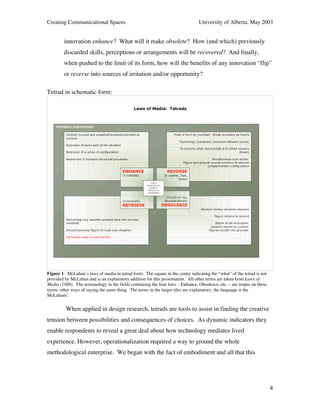
innovation enhance? What will it make obsolete? How (and which) previously
discarded skills, perceptions or arrangements will be recovered? And finally,
when pushed to the limit of its form, how will the benefits of any innovation “flip”
or reverse into sources of irritation and/or opportunity?
Tetrad in schematic form:
Figure 1: McLuhan’s laws of media in tetrad form. The square in the centre indicating the “what” of the tetrad is not
provided by McLuhan and is an explanatory addition for this presentation. All other terms are taken from Laws of
Media (1988). The terminology in the fields containing the four laws – Enhance, Obsolesce, etc. – are tropes on these
terms, other ways of saying the same thing. The terms in the larger tiles are explanatory; the language is the
McLuhans’.
When applied in design research, tetrads are tools to assist in finding the creative
tension between possibilities and consequences of choices. As dynamic indicators they
enable respondents to reveal a great deal about how technology mediates lived
experience. However, operationalization required a way to ground the whole
methodological enterprise. We began with the fact of embodiment and all that this
Creating Communicational Spaces University of Alberta, May 2003
5
implied. This led to a taxonomy of the constant elements of human experience,
subsequently dubbed the Ethos protocol.
The Ethos protocol is a set of prompts for inquiry that model how an innovation
might “fit” in the shifting matrix of imperatives, desires, efforts and constraints that
makes up our lives. Our schema situates, or embeds, McLuhan’s “dynamic indicators,”
as the tetradic and figure/ground procedures of TEDA have come to be called. Our work
on McLuhan had revealed that a structure was needed to enable the development of a
common vocabulary for the spheres of experience that any innovation could affect
directly and indirectly (hidden, perhaps overlooked or unforeseen, environmental
effects). We turned to the literature on experience, Continental thought, the social
sciences, and humanities to articulate such a structure. The Ethos protocol was the result.
Figure 2: The Ethos Protocol: The product &/ service (or medium/media) is the variable mediating, facilitating or
frustrating pursuit of optimum states in, or conditioning experience of, the vital orientations.
Creating Communicational Spaces University of Alberta, May 2003
6
In the spirit of design analysis, we “parse” the constants of experience into 5
settings: dwelling, mobility, business, market & community. We further parse mediated
experience according to three vital domains: A SELF (or person or group; user, client –
the one to be or being affected), in a world made up of OTHERS (friends, family,
coworkers) and THINGS (material objects).
Each vital domain is the source of sets of “imperatives,” though one could
variously also call them “motivators,” “attention-attractors,” “roosts of desires,” or – as
we do – vital orientations. The vital orientations describe the things that users will tend
to. We also refer to the orientations as the constants of human life because while the
content may change, the categories remain constant. From OTHERS, we list the family &
kinship, rules (social codes and institutions), Neighbouring (& political process),
exchange, and security categories. The body, sustenance, needful things (material
culture), chores and ordeals as well as values & meanings are the subsets of the larger
THING category. From the SELF we identify personhood and control, conviviality, play
(ecstatic practices), appetites and preferences, relaxation, knowledge and media, life
course, and projects. The 18 vital orientations as well as the 5 settings organize our
application of tetradic analysis and are the substance of the figure/ground oscillations.
Since combining the Ethos protocol with McLuhan’s dynamic indicators, we have
applied TEDA in 4 industry-driven field trials. For each, the application culminated in a set
of reports and recommendations, as appropriate to the research brief. Normally, the
primary report includes tetradic analysis as well as a number of analytical instruments for
the designer to work with. One of these instruments is the comparative “vital matrix,” a
schematic grid of the data revealing what is known about areas probed, and which areas
are little explored and which areas of potential opportunity require further inquiry. With
the database, this can be easily compared and contrasted to results from other research or
literature reviews.
Creating Communicational Spaces University of Alberta, May 2003
7
Beginning in the latter half of 2002, team members who also teach began
applying TEDA to their courses as a critical media studies methodology. The vocabulary
of the Ethos protocol demonstrated itself descriptive and analytic when applied to history
as well as to discussion of policy. Two factors of this experience were striking: ease of
grasp, that students picked up the categories and principles quickly; and the capacity for
tetradic thinking, when focused and directed, is an effective tool for “mobility of
thought,” as Harold Innis would have called anything that makes both the learner and the
teacher think.
We have been using TEDA for two years to gather rich information about
users—about what they want, feel they need, fear and are anxious about—and much
more about what we do not know about them. Ralph Kaplan, design consultant and
writer, once observed that people are delighted when presented with something they have
always needed or wanted and not known that they have needed or wanted it. Our method
is aimed at helping designers and planners work to exactly this end.
For more information about collaborative research
projects, application development and methodology
testing please contact Dan Schick (daschick@sfu.ca),
Centre for Policy Research on Science and
Technology, Simon Fraser University, Vancouver,
BC, Canada

TEDA Edmonton Paper

  • 1.
    Creating Communicational Spaces Universityof Alberta, May 2003 Techno-Experiential Design Assessment: A Method For Understanding Media Effects Roman Onufrijchuk, Dan Schick, Ryan Semeniuk & Angie Hsieh Centre for Policy Research on Science and Technology, Simon Fraser University, Vancouver, Canada ABSTRACT: Techno-Experiential Design Assessment (TEDA) is a methodology to systematically study the effects of a specific technology or service on user experience. TEDA focuses on both constant and dynamic themes of mediated interaction and provides a grounded tool for design thinking, research and practice. Techno-Experiential Design Assessment (TEDA) is a method for systematically studying the effects of a specific technology or service on user experience and identify the opportunities and constraints for design. It originated in efforts to grasp the significance and make sense of the flood of data on technological innovations and correlate this with user data gathered empirically in the field. TEDA is a tool to help the designer arrive at a better understanding of the user within media environments. This is especially important since media designers are often working on behalf of a user whom they will probably never meet – an anonymous user, an anonymous audience. One of the problems goading TEDA into sustained and systematic testing grows out of this anonymity and the need to overcome it.
  • 2.
    Creating Communicational SpacesUniversity of Alberta, May 2003 2 A design problem is not a collection of parts easily broken down and quantified. Design problems are tied up with the whole of human experience including interpretation, materiality, politics and countless other factors. While there is continuous research to learn what users want and need, often the designer must negotiate research reports from different disciplines using different disciplinary languages. Despite libraries of social research, the user remains an elusive target. There is too much information and no way to make sense of it relevant to specific design questions. TEDA is a tool to make sense of diverse collections of information and assist the designer towards practical solutions grounded in social research. Data collection for TEDA begins with a review of documentary, trade, commissioned, and appropriate theoretical literature. Insights from this are organized around the Ethos protocol—a set of intuitive categories for organizing human experience—and then entered into a database. Then researchers move into primary data acquisition in the field by performing individual or group interviews. Interviews probe users’ experience to identify how innovations might facilitate or frustrate their pursuits of optimal inter-relational processes in addition to those intended by the designer. Interviews are recorded, transcribed, indexed and coded into the same database as the literature review, and organized around the same Ethos protocol. This database also contains data from all previous projects. Thus, all stages of research may exercise a common vocabulary for extracting intelligence out of varied sources of information, as well as identifying gaps in knowledge and research. There are two primary analytical components to TEDA: tetrads and the Ethos protocol. The Ethos protocol was developed as a guide to the constant themes of lived experience that the designer must address. Tetrads are dynamic indicators based on Marshall McLuhan’s approach to pattern recognition and systematic study of media and technological effects on society. McLuhan’s methods, when grounded and guided by the Ethos protocol, enable respondents to reveal a great deal about how they feel they are, and might be, affected by changes in their technologies – their hopes, anxieties, wants
  • 3.
    Creating Communicational SpacesUniversity of Alberta, May 2003 3 and dreams within their socially-conditioned media consumption patterns and obligation- bound daily lives. It seems appropriate to debut our research reporting in Edmonton, McLuhan’s birthplace. Not only is his influence still felt, it is becoming more pronounced as we catch up to his projections for our future. McLuhan continues to be a source of oracular and quotable wisdom and insight, but his intellectual legacy has not been seriously investigated for a foundation for a method. He was, after all, notorious for claiming not to have a method, only probes and provocations. However, in the last work of his life (City as Classroom, 1977), and in the two the posthumous publications (Laws of Media, 1988; The Global Village, 1989), he did reveal a methodology. McLuhan’s method stemmed from techniques for pattern recognition and interpretation. Aimed at developing “integral awareness,” or a posture of mind and ways of perception, McLuhan’s method was intended to inoculate people against the disorienting effects of new technologies and context-altering innovations. He was deeply concerned about information and stimulus overload—the precise epistemological circumstances of the life of the designer and communication practitioner. McLuhan’s method for pattern recognition and the critical awareness he sought to create required two “instruments,” or strategies, of mind and perception: - First, inquiry should proceed by an “oscillation” between figures and grounds. The researcher must engage in repeated conscious shifts of attention from the thing normally focused on (figure) to the background against which, or context within which, it is framed or matrixed (ground). Oscillation between figures and grounds through inquiry, McLuhan suggested, enables researchers to use “tetradic analysis” to perceive, sort and interpret their data. - Second, McLuhan had developed four laws of media—or tetrads—as means for inquiry into the hidden grounds of media and technologies, or environmental effects, as McLuhan also called them. Tetrads are a way of asking questions to identify areas unnoticed in projecting the future applications, merits or benefits of new technologies. The four laws are posed as questions: What will this
  • 4.
    Creating Communicational SpacesUniversity of Alberta, May 2003 4 innovation enhance? What will it make obsolete? How (and which) previously discarded skills, perceptions or arrangements will be recovered? And finally, when pushed to the limit of its form, how will the benefits of any innovation “flip” or reverse into sources of irritation and/or opportunity? Tetrad in schematic form: Figure 1: McLuhan’s laws of media in tetrad form. The square in the centre indicating the “what” of the tetrad is not provided by McLuhan and is an explanatory addition for this presentation. All other terms are taken from Laws of Media (1988). The terminology in the fields containing the four laws – Enhance, Obsolesce, etc. – are tropes on these terms, other ways of saying the same thing. The terms in the larger tiles are explanatory; the language is the McLuhans’. When applied in design research, tetrads are tools to assist in finding the creative tension between possibilities and consequences of choices. As dynamic indicators they enable respondents to reveal a great deal about how technology mediates lived experience. However, operationalization required a way to ground the whole methodological enterprise. We began with the fact of embodiment and all that this
  • 5.
    Creating Communicational SpacesUniversity of Alberta, May 2003 5 implied. This led to a taxonomy of the constant elements of human experience, subsequently dubbed the Ethos protocol. The Ethos protocol is a set of prompts for inquiry that model how an innovation might “fit” in the shifting matrix of imperatives, desires, efforts and constraints that makes up our lives. Our schema situates, or embeds, McLuhan’s “dynamic indicators,” as the tetradic and figure/ground procedures of TEDA have come to be called. Our work on McLuhan had revealed that a structure was needed to enable the development of a common vocabulary for the spheres of experience that any innovation could affect directly and indirectly (hidden, perhaps overlooked or unforeseen, environmental effects). We turned to the literature on experience, Continental thought, the social sciences, and humanities to articulate such a structure. The Ethos protocol was the result. Figure 2: The Ethos Protocol: The product &/ service (or medium/media) is the variable mediating, facilitating or frustrating pursuit of optimum states in, or conditioning experience of, the vital orientations.
  • 6.
    Creating Communicational SpacesUniversity of Alberta, May 2003 6 In the spirit of design analysis, we “parse” the constants of experience into 5 settings: dwelling, mobility, business, market & community. We further parse mediated experience according to three vital domains: A SELF (or person or group; user, client – the one to be or being affected), in a world made up of OTHERS (friends, family, coworkers) and THINGS (material objects). Each vital domain is the source of sets of “imperatives,” though one could variously also call them “motivators,” “attention-attractors,” “roosts of desires,” or – as we do – vital orientations. The vital orientations describe the things that users will tend to. We also refer to the orientations as the constants of human life because while the content may change, the categories remain constant. From OTHERS, we list the family & kinship, rules (social codes and institutions), Neighbouring (& political process), exchange, and security categories. The body, sustenance, needful things (material culture), chores and ordeals as well as values & meanings are the subsets of the larger THING category. From the SELF we identify personhood and control, conviviality, play (ecstatic practices), appetites and preferences, relaxation, knowledge and media, life course, and projects. The 18 vital orientations as well as the 5 settings organize our application of tetradic analysis and are the substance of the figure/ground oscillations. Since combining the Ethos protocol with McLuhan’s dynamic indicators, we have applied TEDA in 4 industry-driven field trials. For each, the application culminated in a set of reports and recommendations, as appropriate to the research brief. Normally, the primary report includes tetradic analysis as well as a number of analytical instruments for the designer to work with. One of these instruments is the comparative “vital matrix,” a schematic grid of the data revealing what is known about areas probed, and which areas are little explored and which areas of potential opportunity require further inquiry. With the database, this can be easily compared and contrasted to results from other research or literature reviews.
  • 7.
    Creating Communicational SpacesUniversity of Alberta, May 2003 7 Beginning in the latter half of 2002, team members who also teach began applying TEDA to their courses as a critical media studies methodology. The vocabulary of the Ethos protocol demonstrated itself descriptive and analytic when applied to history as well as to discussion of policy. Two factors of this experience were striking: ease of grasp, that students picked up the categories and principles quickly; and the capacity for tetradic thinking, when focused and directed, is an effective tool for “mobility of thought,” as Harold Innis would have called anything that makes both the learner and the teacher think. We have been using TEDA for two years to gather rich information about users—about what they want, feel they need, fear and are anxious about—and much more about what we do not know about them. Ralph Kaplan, design consultant and writer, once observed that people are delighted when presented with something they have always needed or wanted and not known that they have needed or wanted it. Our method is aimed at helping designers and planners work to exactly this end. For more information about collaborative research projects, application development and methodology testing please contact Dan Schick (daschick@sfu.ca), Centre for Policy Research on Science and Technology, Simon Fraser University, Vancouver, BC, Canada