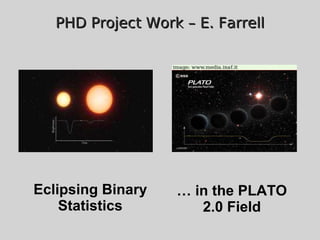
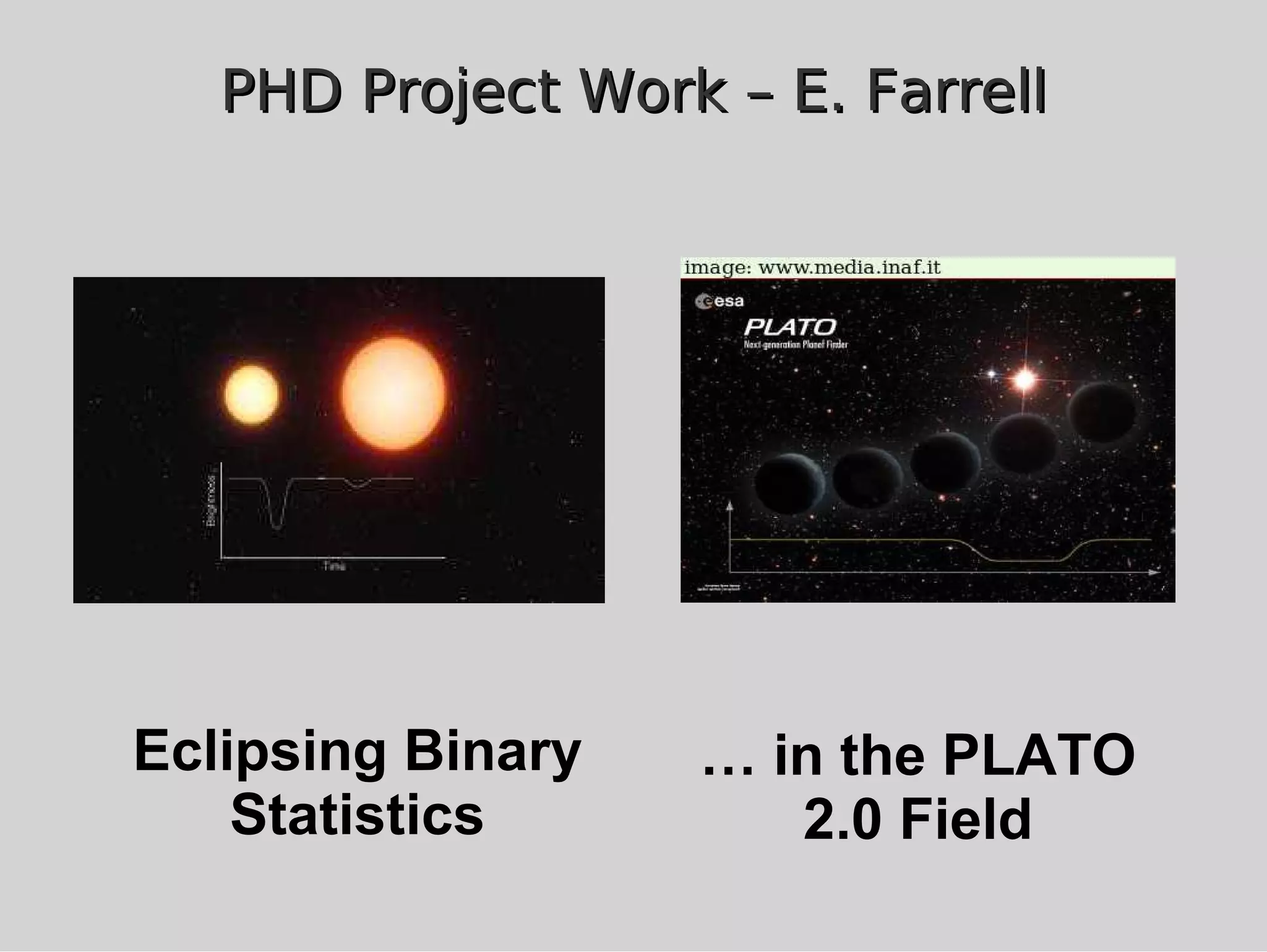
PHD Project Work – E. FarrellPHD Project Work – E. Farrell
Eclipsing Binary
Statistics
… in the PLATO
2.0 Field
PLATO 2.0 MissionPLATO 2.0 Mission
PLAnetary Transits & Oscillations of stars
PLATO 2.0 MissionPLATO 2.0 Mission
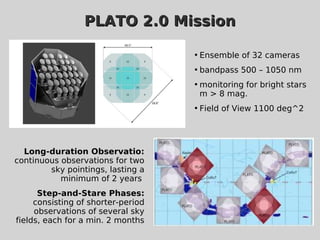
Long-duration Observatio:
continuous observations for two
sky pointings, lasting a
minimum of 2 years
Step-and-Stare Phases:
consisting of shorter-period
observations of several sky
fields, each for a min. 2 months

Ensemble of 32 cameras

bandpass 500 – 1050 nm

monitoring for bright stars
m > 8 mag.

Field of View 1100 deg^2
PLATO 2.0 MissionPLATO 2.0 Mission
PLAnetary Transits &
Oscillations of stars
Plato ESA presentation 2014
Will provide data on Exoplanets:
•mean density
composition (rocky, mini-gas)
constrain atmosphere scale
heights
•albedo and its diversity
indicative for clouds, hazes
•accurate ages
evolutionary pathways
•characterized host stars
incident flux, stellar activity
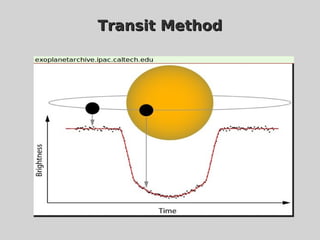
Transit MethodTransit Method
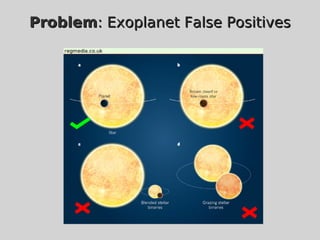
ProblemProblem: Exoplanet False Positives: Exoplanet False Positives
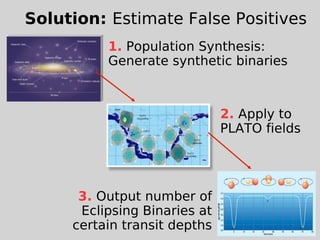
Solution: Estimate False Positives
1. Population Synthesis:
Generate synthetic binaries
2. Apply to
PLATO fields
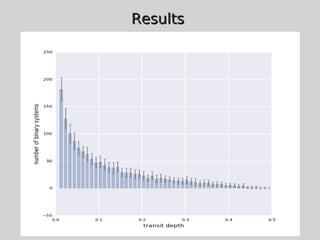
3. Output number of
Eclipsing Binaries at
certain transit depths
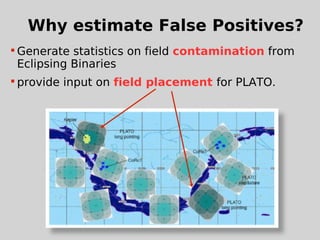
Why estimate False Positives?

Generate statistics on field contamination from
Eclipsing Binaries

provide input on field placement for PLATO.
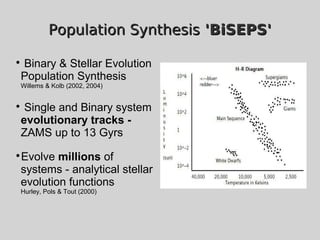
Population SynthesisPopulation Synthesis 'BiSEPS''BiSEPS'

Binary & Stellar Evolution
Population Synthesis
Willems & Kolb (2002, 2004)

Single and Binary system
evolutionary tracks -
ZAMS up to 13 Gyrs

Evolve millions of
systems - analytical stellar
evolution functions
Hurley, Pols & Tout (2000)
Population SynthesisPopulation Synthesis 'BiSEPS''BiSEPS'

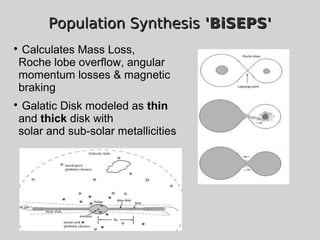
Calculates Mass Loss,
Roche lobe overflow, angular
momentum losses & magnetic
braking

Galatic Disk modeled as thin
and thick disk with
solar and sub-solar metallicities
Eclipsing BinariesEclipsing Binaries

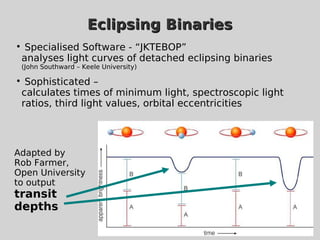
Specialised Software - “JKTEBOP”
analyses light curves of detached eclipsing binaries
(John Southward – Keele University)

Sophisticated –
calculates times of minimum light, spectroscopic light
ratios, third light values, orbital eccentricities
Adapted by
Rob Farmer,
Open University
to output
transit
depths
ResultsResults
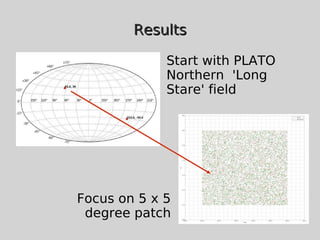
Start with PLATO
Northern 'Long
Stare' field
Focus on 5 x 5
degree patch
ResultsResults
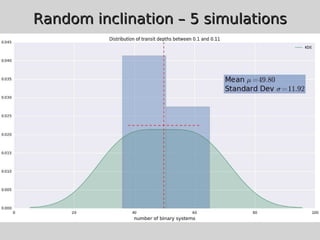
Random inclination – 5 simulationsRandom inclination – 5 simulations
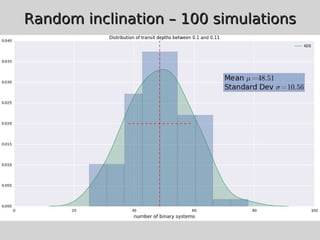
Random inclination – 100 simulationsRandom inclination – 100 simulations
Future WorkFuture Work
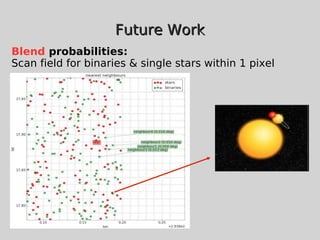
Blend probabilities:
Scan field for binaries & single stars within 1 pixel
Future WorkFuture Work
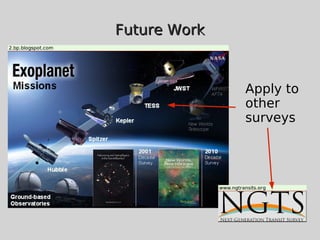
Apply to
other
surveys
Future WorkFuture Work
Contribute to open-source community library

Phd talk.mini

  • 1.
    PHD Project Work– E. FarrellPHD Project Work – E. Farrell Eclipsing Binary Statistics … in the PLATO 2.0 Field
  • 2.
    PLATO 2.0 MissionPLATO2.0 Mission PLAnetary Transits & Oscillations of stars
  • 3.
    PLATO 2.0 MissionPLATO2.0 Mission Long-duration Observatio: continuous observations for two sky pointings, lasting a minimum of 2 years Step-and-Stare Phases: consisting of shorter-period observations of several sky fields, each for a min. 2 months  Ensemble of 32 cameras  bandpass 500 – 1050 nm  monitoring for bright stars m > 8 mag.  Field of View 1100 deg^2
  • 4.
    PLATO 2.0 MissionPLATO2.0 Mission PLAnetary Transits & Oscillations of stars Plato ESA presentation 2014 Will provide data on Exoplanets: •mean density composition (rocky, mini-gas) constrain atmosphere scale heights •albedo and its diversity indicative for clouds, hazes •accurate ages evolutionary pathways •characterized host stars incident flux, stellar activity
  • 5.
  • 6.
    ProblemProblem: Exoplanet FalsePositives: Exoplanet False Positives
  • 7.
    Solution: Estimate FalsePositives 1. Population Synthesis: Generate synthetic binaries 2. Apply to PLATO fields 3. Output number of Eclipsing Binaries at certain transit depths
  • 8.
    Why estimate FalsePositives?  Generate statistics on field contamination from Eclipsing Binaries  provide input on field placement for PLATO.
  • 9.
    Population SynthesisPopulation Synthesis'BiSEPS''BiSEPS'  Binary & Stellar Evolution Population Synthesis Willems & Kolb (2002, 2004)  Single and Binary system evolutionary tracks - ZAMS up to 13 Gyrs  Evolve millions of systems - analytical stellar evolution functions Hurley, Pols & Tout (2000)
  • 10.
    Population SynthesisPopulation Synthesis'BiSEPS''BiSEPS'  Calculates Mass Loss, Roche lobe overflow, angular momentum losses & magnetic braking  Galatic Disk modeled as thin and thick disk with solar and sub-solar metallicities
  • 11.
    Eclipsing BinariesEclipsing Binaries  SpecialisedSoftware - “JKTEBOP” analyses light curves of detached eclipsing binaries (John Southward – Keele University)  Sophisticated – calculates times of minimum light, spectroscopic light ratios, third light values, orbital eccentricities Adapted by Rob Farmer, Open University to output transit depths
  • 12.
    ResultsResults Start with PLATO Northern'Long Stare' field Focus on 5 x 5 degree patch
  • 13.
  • 14.
    Random inclination –5 simulationsRandom inclination – 5 simulations
  • 15.
    Random inclination –100 simulationsRandom inclination – 100 simulations
  • 16.
    Future WorkFuture Work Blendprobabilities: Scan field for binaries & single stars within 1 pixel
  • 17.
  • 18.
    Future WorkFuture Work Contributeto open-source community library