Emerging Needs & Opportunities in
Data-Intensive Domains: Astronomy
Joshua Bloom (@profjsb)

Gordon & Betty Moore Foundation Data-Driven Investigator
UC Berkeley, Astronomy
Irvine, CA Mar 20, 2017
Presented to the National Academy of Sciences Roundtable on the
"Intersection of Domain Expertise and Data Science"
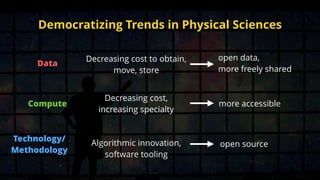
Data
Decreasing cost to obtain,
move, store
Compute
Decreasing cost,
increasing specialty
Technology/
Methodology
Algorithmic innovation,
software tooling
Democratizing Trends in Physical Sciences
open data,
more freely shared
more accessible
open source
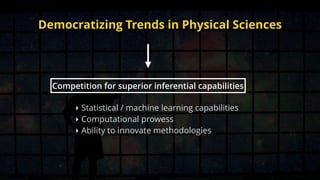
Democratizing Trends in Physical Sciences
Competition for superior inferential capabilities
‣ Statistical / machine learning capabilities
‣ Computational prowess
‣ Ability to innovate methodologies
Astronomy's Data deluge
- who wins?
- examples of data science impact in astro
Notable data-driven success with domain + methodologies
Outline
particle physics & gravitational wave astronomy
Educational challenges given these trends
Symbiotic relationship between data domains
& methodological sciences
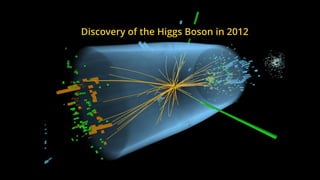
Discovery of the Higgs Boson in 2012
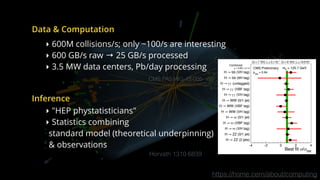
‣ 600M collisions/s; only ~100/s are interesting
‣ 600 GB/s raw → 25 GB/s processed
‣ 3.5 MW data centers, Pb/day processing
Data & Computation
https://home.cern/about/computing
Horvath 1310.6839
Inference
‣ "HEP phystatisticians"
‣ Statistics combining 

standard model (theoretical underpinning)

& observations
4.3 Compatibility of the observed state with the SM Higgs boson hypothesis
SM
σ/σBest fit
-4 -2 0 2 4
ZZ (2 jets)→H
ZZ (0/1 jet)→H
(VH tag)ττ→H
(VBF tag)ττ→H
(0/1 jet)ττ→H
WW (VH tag)→H
WW (VBF tag)→H
WW (0/1 jet)→H
(VH tag)γγ→H
(VBF tag)γγ→H
(untagged)γγ→H
bb (ttH tag)→H
bb (VH tag)→H
0.14±= 0.80µ
Combined
-1
19.6 fb≤= 8 TeV, Ls-1
5.1 fb≤= 7 TeV, Ls
CMS Preliminary
= 0.94
SM
p
= 125.7 GeVHm
bb→H
0.14±= 0.80µ
Combined
-1
19.6 fb≤= 8 TeV, Ls-1
5.1 fb≤= 7 TeV, Ls
CMS Preliminary
= 0.65
SM
p
= 125.7 GeVHm
0.14±= 0.80µ
Combined
= 7 TeV, Ls
CMS Preli
= 0.52
SM
p
CMS PAS HIG-13-005
https://apod.nasa.gov/apod/ap160211.html
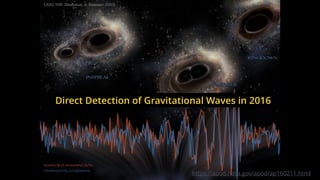
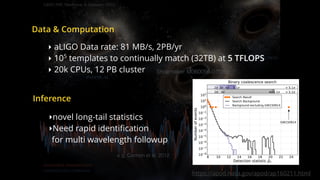
Direct Detection of Gravitational Waves in 2016
https://apod.nasa.gov/apod/ap160211.html
‣ aLIGO Data rate: 81 MB/s, 2PB/yr
‣ 105
templates to continually match (32TB) at 5 TFLOPS
‣ 20k CPUs, 12 PB cluster Shoemaker M060056-01.doc
Data & Computation
Inference
‣novel long-tail statistics
‣Need rapid identification

for multi wavelength followup
e.g. Cannon et al. 2012
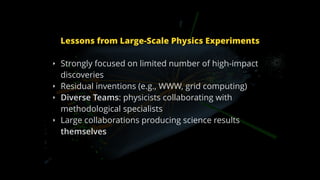
Lessons from Large-Scale Physics Experiments
‣ Strongly focused on limited number of high-impact
discoveries
‣ Residual inventions (e.g., WWW, grid computing)
‣ Diverse Teams: physicists collaborating with
methodological specialists
‣ Large collaborations producing science results
themselves
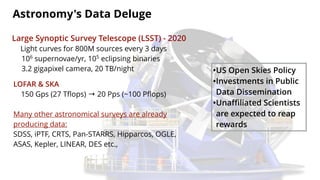
Astronomy's Data Deluge
Large Synoptic Survey Telescope (LSST) - 2020
Light curves for 800M sources every 3 days
106
supernovae/yr, 105
eclipsing binaries
3.2 gigapixel camera, 20 TB/night
LOFAR & SKA
150 Gps (27 Tflops) → 20 Pps (~100 Pflops)
Many other astronomical surveys are already
producing data:
SDSS, iPTF, CRTS, Pan-STARRS, Hipparcos, OGLE,
ASAS, Kepler, LINEAR, DES etc.,
•US Open Skies Policy
•Investments in Public
Data Dissemination
•Unaffiliated Scientists
are expected to reap
rewards
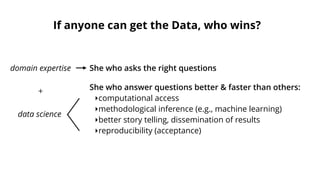
If anyone can get the Data, who wins?
She who asks the right questions
She who answer questions better & faster than others:
‣computational access
‣methodological inference (e.g., machine learning)
‣better story telling, dissemination of results
‣reproducibility (acceptance)
domain expertise
data science
+
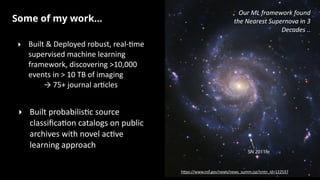
Our	ML	framework	found	
the	Nearest	Supernova	in	3	
Decades	..
‣ Built	&	Deployed	robust,	real-Ime	
supervised	machine	learning	
framework,	discovering	>10,000	
events	in	>	10	TB	of	imaging	

								→	75+	journal	arIcles
‣ Built	probabilisIc	source	
classificaIon	catalogs	on	public	
archives	with	novel	acIve	
learning	approach
h"ps://www.nsf.gov/news/news_summ.jsp?cntn_id=122537
Some of my work…
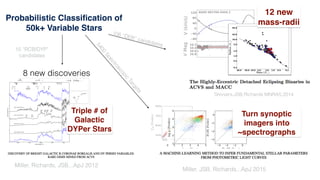
Probabilistic Classification of
50k+ Variable Stars
Shivvers,JSB,Richards MNRAS,2014
106 “DEB” candidates
12 new
mass-radii
15 “RCB/DYP”

candidates
8 new discoveries
Triple # of
Galactic
DYPer Stars
Miller, Richards, JSB,..ApJ 2012
5400
Spectroscopic
Targets
Miller, JSB, Richards,..ApJ 2015
Turn synoptic
imagers into
~spectrographs
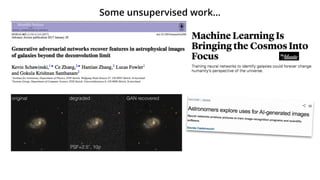
L112 K. Schawinski et al.
Figure 2. We show the results obtained for one example galaxy. From left to right: the original SDSS image, the degraded image with a worse PSF and higher
noise level (indicating the PSF and noise level used), the image as recovered by the GAN, and for comparison, the result of a deconvolution. This figure visually
illustrates the GAN’s ability to recover features that conventional deconvolutions cannot.
Some unsupervised work…
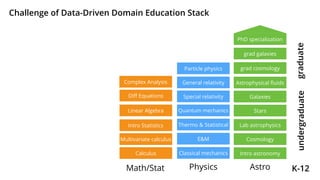
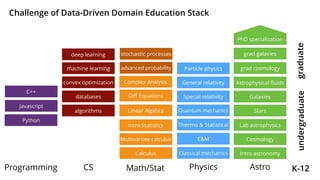
Calculus
Linear Algebra
Multivariate calculus
Diff Equations
Complex Analysis
Special relativity
Quantum mechanics
Classical mechanics
Thermo & Statistical Lab astrophysics
Intro astronomy
E&M
Particle physics
Cosmology
Stars
Galaxies
Astrophysical fluids
grad cosmology
grad galaxies
Intro Statistics
K-12
undergraduategraduate
General relativity
PhysicsMath/Stat Astro
PhD specialization
Challenge of Data-Driven Domain Education Stack
Calculus
Linear Algebra
Multivariate calculus
Diff Equations
Complex Analysis
Special relativity
Quantum mechanics
Classical mechanics
Thermo & Statistical Lab astrophysics
Intro astronomy
E&M
Particle physics
Cosmology
Stars
Galaxies
Astrophysical fluids
grad cosmology
grad galaxies
Intro Statistics
K-12
undergraduategraduate
General relativity
PhysicsMath/Stat Astro
databases
algorithms
convex optimization
machine learning advanced probability
deep learning
Python
Javascript
stochastic processes
C++
CSProgramming
PhD specialization
Challenge of Data-Driven Domain Education Stack
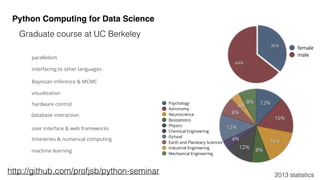
Python Computing for Data Science
Graduate course at UC Berkeley
64%
36%
female
male
8%
4%
8%
12%
4%
12%
8%
16%
16%
12%Psychology
Astronomy
Neuroscience
Biostatistics
Physics
Chemical Engineering
ISchool
Earth and Planetary Sciences
Industrial Engineering
Mechanical Engineering
visualization
machine learning
database interaction
user interface & web frameworks
timeseries & numerical computing
interfacing to other languages
Bayesian inference & MCMC
hardware control
parallelism
2013 statistics
http://github.com/profjsb/python-seminar
Time domain preprocessing
- Start with raw photometry!
- Gaussian process detrending!
- Calibration!
- Petigura & Marcy 2012!
!
Transit search
- Matched filter!
- Similar to BLS algorithm (Kovcas+ 2002)!
- Leverages Fast-Folding Algorithm
O(N^2) → O(N log N) (Staelin+ 1968)!
!
Data validation
- Significant peaks in periodogram, but
inconsistent with exoplanet transit
TERRA – optimized for small planets
Detrended/calibrated photometry
TERRA
RawFlux(ppt)CalibratedFlux
Erik Petigura
Berkeley Astro
Grad Student
Prevalence of Earth-size planets orbiting Sun-like stars
Erik A. Petiguraa,b,1
, Andrew W. Howardb
, and Geoffrey W. Marcya
a
Astronomy Department, University of California, Berkeley, CA 94720; and b
Institute for Astronomy, University of Hawaii at Manoa, Honolulu, HI 96822
Contributed by Geoffrey W. Marcy, October 22, 2013 (sent for review October 18, 2013)
Determining whether Earth-like planets are common or rare looms
as a touchstone in the question of life in the universe. We searched
for Earth-size planets that cross in front of their host stars by
examining the brightness measurements of 42,000 stars from
National Aeronautics and Space Administration’s Kepler mission.
We found 603 planets, including 10 that are Earth size (1 − 2 R⊕)
and receive comparable levels of stellar energy to that of Earth
(0:25 − 4 F⊕). We account for Kepler’s imperfect detectability of
such planets by injecting synthetic planet–caused dimmings into
the Kepler brightness measurements and recording the fraction
detected. We find that 11 ± 4% of Sun-like stars harbor an Earth-
size planet receiving between one and four times the stellar inten-
sity as Earth. We also find that the occurrence of Earth-size planets is
constant with increasing orbital period (P), within equal intervals of
logP up to ∼200 d. Extrapolating, one finds 5:7+1:7
−2:2 % of Sun-like stars
harbor an Earth-size planet with orbital periods of 200–400 d.
extrasolar planets | astrobiology
The National Aeronautics and Space Administration’s (NASA’s)
Kepler mission was launched in 2009 to search for planets
that transit (cross in front of) their host stars (1–4). The resulting
dimming of the host stars is detectable by measuring their bright-
ness, and Kepler monitored the brightness of 150,000 stars every
30 min for 4 y. To date, this exoplanet survey has detected more
We searched for transiting planets in Kepler brightness mea-
surements using our custom-built TERRA software package
described in previous works (6, 9) and in SI Appendix. In brief,
TERRA conditions Kepler photometry in the time domain, re-
moving outliers, long timescale variability (>10 d), and systematic
errors common to a large number of stars. TERRA then searches
for transit signals by evaluating the signal-to-noise ratio (SNR) of
prospective transits over a finely spaced 3D grid of orbital period,
P, time of transit, t0, and transit duration, ΔT. This grid-based
search extends over the orbital period range of 0.5–400 d.
TERRA produced a list of “threshold crossing events” (TCEs)
that meet the key criterion of a photometric dimming SNR ratio
SNR > 12. Unfortunately, an unwieldy 16,227 TCEs met this cri-
terion, many of which are inconsistent with the periodic dimming
profile from a true transiting planet. Further vetting was performed
by automatically assessing which light curves were consistent with
theoretical models of transiting planets (10). We also visually
inspected each TCE light curve, retaining only those exhibiting a
consistent, periodic, box-shaped dimming, and rejecting those
caused by single epoch outliers, correlated noise, and other data
anomalies. The vetting process was applied homogeneously to all
TCEs and is described in further detail in SI Appendix.
To assess our vetting accuracy, we evaluated the 235 Kepler
objects of interest (KOIs) among Best42k stars having P > 50 d,
which had been found by the Kepler Project and identified as planet
candidates in the official Exoplanet Archive (exoplanetarchive.
RONOMY
Bootcamp/Seminar Alum
Python
DOE/NERSC computation
PNAS [2014]
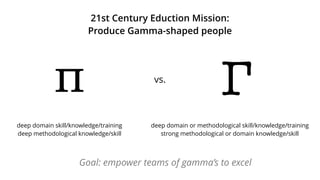
ỉπ vs.
21st Century Eduction Mission:
Produce Gamma-shaped people
deep domain skill/knowledge/training
deep methodological knowledge/skill
deep domain or methodological skill/knowledge/training
strong methodological or domain knowledge/skill
Goal: empower teams of gamma’s to excel
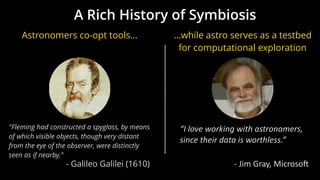
“I	love	working	with	astronomers,	
since	their	data	is	worthless.”	
"Fleming had constructed a spyglass, by means
of which visible objects, though very distant
from the eye of the observer, were distinctly
seen as if nearby."
- Galileo Galilei (1610) 	-	Jim	Gray,	MicrosoT
A Rich History of Symbiosis
Astronomers co-opt tools… …while astro serves as a testbed
for computational exploration
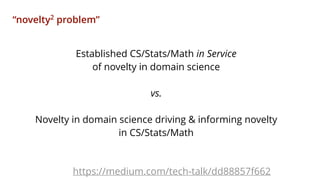
Established CS/Stats/Math in Service
of novelty in domain science
vs.
Novelty in domain science driving & informing novelty
in CS/Stats/Math
“novelty2
problem”
https://medium.com/tech-talk/dd88857f662
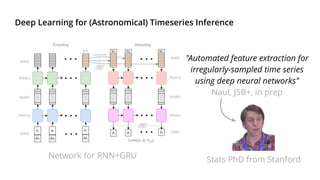
"Automated feature extraction for
irregularly-sampled time series
using deep neural networks"
Naul, JSB+, in prep
Network for RNN+GRU
Deep Learning for (Astronomical) Timeseries Inference
Stats PhD from Stanford
https://www.forbes.com/sites/jillianscudder/2017/01/21/astroquizzical-care-planet-nine
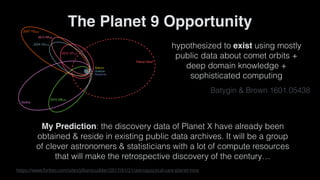
The Planet 9 Opportunity
hypothesized to exist using mostly
public data about comet orbits +
deep domain knowledge +
sophisticated computing
Batygin & Brown 1601.05438
My Prediction: the discovery data of Planet X have already been
obtained & reside in existing public data archives. It will be a group
of clever astronomers & statisticians with a lot of compute resources
that will make the retrospective discovery of the century…
Summary
•DemocraIzing	trends	in	the	physical	sciences	
•Winners	will	be	those	domain	experts	with	superior	inferenIal	capabiliIes,	
not	themselves,	but	in	teams	
•Data	science	educaIon	for	domains	should	be	focused	on	learning	enough	
to	work	with	those	methodological	domains	
•Symbiosis:	Physical	domain	science	data/quesIons	can	also	foster	novel	
methodological	approaches
Emerging Needs & Opportunities in
Data-Intensive Domains: Astronomy
Joshua Bloom
@profjsb
Irvine, CA Mar 20, 2017
Thanks!

Data Science Education: Needs & Opportunities in Astronomy

  • 1.
    Emerging Needs &Opportunities in Data-Intensive Domains: Astronomy Joshua Bloom (@profjsb)
 Gordon & Betty Moore Foundation Data-Driven Investigator UC Berkeley, Astronomy Irvine, CA Mar 20, 2017 Presented to the National Academy of Sciences Roundtable on the "Intersection of Domain Expertise and Data Science"
  • 2.
    Data Decreasing cost toobtain, move, store Compute Decreasing cost, increasing specialty Technology/ Methodology Algorithmic innovation, software tooling Democratizing Trends in Physical Sciences open data, more freely shared more accessible open source
  • 3.
    Democratizing Trends inPhysical Sciences Competition for superior inferential capabilities ‣ Statistical / machine learning capabilities ‣ Computational prowess ‣ Ability to innovate methodologies
  • 4.
    Astronomy's Data deluge -who wins? - examples of data science impact in astro Notable data-driven success with domain + methodologies Outline particle physics & gravitational wave astronomy Educational challenges given these trends Symbiotic relationship between data domains & methodological sciences
  • 5.
    Discovery of theHiggs Boson in 2012
  • 6.
    ‣ 600M collisions/s;only ~100/s are interesting ‣ 600 GB/s raw → 25 GB/s processed ‣ 3.5 MW data centers, Pb/day processing Data & Computation https://home.cern/about/computing Horvath 1310.6839 Inference ‣ "HEP phystatisticians" ‣ Statistics combining 
 standard model (theoretical underpinning)
 & observations 4.3 Compatibility of the observed state with the SM Higgs boson hypothesis SM σ/σBest fit -4 -2 0 2 4 ZZ (2 jets)→H ZZ (0/1 jet)→H (VH tag)ττ→H (VBF tag)ττ→H (0/1 jet)ττ→H WW (VH tag)→H WW (VBF tag)→H WW (0/1 jet)→H (VH tag)γγ→H (VBF tag)γγ→H (untagged)γγ→H bb (ttH tag)→H bb (VH tag)→H 0.14±= 0.80µ Combined -1 19.6 fb≤= 8 TeV, Ls-1 5.1 fb≤= 7 TeV, Ls CMS Preliminary = 0.94 SM p = 125.7 GeVHm bb→H 0.14±= 0.80µ Combined -1 19.6 fb≤= 8 TeV, Ls-1 5.1 fb≤= 7 TeV, Ls CMS Preliminary = 0.65 SM p = 125.7 GeVHm 0.14±= 0.80µ Combined = 7 TeV, Ls CMS Preli = 0.52 SM p CMS PAS HIG-13-005
  • 7.
  • 8.
    https://apod.nasa.gov/apod/ap160211.html ‣ aLIGO Datarate: 81 MB/s, 2PB/yr ‣ 105 templates to continually match (32TB) at 5 TFLOPS ‣ 20k CPUs, 12 PB cluster Shoemaker M060056-01.doc Data & Computation Inference ‣novel long-tail statistics ‣Need rapid identification
 for multi wavelength followup e.g. Cannon et al. 2012
  • 9.
    Lessons from Large-ScalePhysics Experiments ‣ Strongly focused on limited number of high-impact discoveries ‣ Residual inventions (e.g., WWW, grid computing) ‣ Diverse Teams: physicists collaborating with methodological specialists ‣ Large collaborations producing science results themselves
  • 10.
    Astronomy's Data Deluge LargeSynoptic Survey Telescope (LSST) - 2020 Light curves for 800M sources every 3 days 106 supernovae/yr, 105 eclipsing binaries 3.2 gigapixel camera, 20 TB/night LOFAR & SKA 150 Gps (27 Tflops) → 20 Pps (~100 Pflops) Many other astronomical surveys are already producing data: SDSS, iPTF, CRTS, Pan-STARRS, Hipparcos, OGLE, ASAS, Kepler, LINEAR, DES etc., •US Open Skies Policy •Investments in Public Data Dissemination •Unaffiliated Scientists are expected to reap rewards
  • 11.
    If anyone canget the Data, who wins? She who asks the right questions She who answer questions better & faster than others: ‣computational access ‣methodological inference (e.g., machine learning) ‣better story telling, dissemination of results ‣reproducibility (acceptance) domain expertise data science +
  • 12.
  • 13.
    Probabilistic Classification of 50k+Variable Stars Shivvers,JSB,Richards MNRAS,2014 106 “DEB” candidates 12 new mass-radii 15 “RCB/DYP”
 candidates 8 new discoveries Triple # of Galactic DYPer Stars Miller, Richards, JSB,..ApJ 2012 5400 Spectroscopic Targets Miller, JSB, Richards,..ApJ 2015 Turn synoptic imagers into ~spectrographs
  • 14.
    L112 K. Schawinskiet al. Figure 2. We show the results obtained for one example galaxy. From left to right: the original SDSS image, the degraded image with a worse PSF and higher noise level (indicating the PSF and noise level used), the image as recovered by the GAN, and for comparison, the result of a deconvolution. This figure visually illustrates the GAN’s ability to recover features that conventional deconvolutions cannot. Some unsupervised work…
  • 15.
    Calculus Linear Algebra Multivariate calculus DiffEquations Complex Analysis Special relativity Quantum mechanics Classical mechanics Thermo & Statistical Lab astrophysics Intro astronomy E&M Particle physics Cosmology Stars Galaxies Astrophysical fluids grad cosmology grad galaxies Intro Statistics K-12 undergraduategraduate General relativity PhysicsMath/Stat Astro PhD specialization Challenge of Data-Driven Domain Education Stack
  • 16.
    Calculus Linear Algebra Multivariate calculus DiffEquations Complex Analysis Special relativity Quantum mechanics Classical mechanics Thermo & Statistical Lab astrophysics Intro astronomy E&M Particle physics Cosmology Stars Galaxies Astrophysical fluids grad cosmology grad galaxies Intro Statistics K-12 undergraduategraduate General relativity PhysicsMath/Stat Astro databases algorithms convex optimization machine learning advanced probability deep learning Python Javascript stochastic processes C++ CSProgramming PhD specialization Challenge of Data-Driven Domain Education Stack
  • 17.
    Python Computing forData Science Graduate course at UC Berkeley 64% 36% female male 8% 4% 8% 12% 4% 12% 8% 16% 16% 12%Psychology Astronomy Neuroscience Biostatistics Physics Chemical Engineering ISchool Earth and Planetary Sciences Industrial Engineering Mechanical Engineering visualization machine learning database interaction user interface & web frameworks timeseries & numerical computing interfacing to other languages Bayesian inference & MCMC hardware control parallelism 2013 statistics http://github.com/profjsb/python-seminar
  • 18.
    Time domain preprocessing -Start with raw photometry! - Gaussian process detrending! - Calibration! - Petigura & Marcy 2012! ! Transit search - Matched filter! - Similar to BLS algorithm (Kovcas+ 2002)! - Leverages Fast-Folding Algorithm O(N^2) → O(N log N) (Staelin+ 1968)! ! Data validation - Significant peaks in periodogram, but inconsistent with exoplanet transit TERRA – optimized for small planets Detrended/calibrated photometry TERRA RawFlux(ppt)CalibratedFlux Erik Petigura Berkeley Astro Grad Student Prevalence of Earth-size planets orbiting Sun-like stars Erik A. Petiguraa,b,1 , Andrew W. Howardb , and Geoffrey W. Marcya a Astronomy Department, University of California, Berkeley, CA 94720; and b Institute for Astronomy, University of Hawaii at Manoa, Honolulu, HI 96822 Contributed by Geoffrey W. Marcy, October 22, 2013 (sent for review October 18, 2013) Determining whether Earth-like planets are common or rare looms as a touchstone in the question of life in the universe. We searched for Earth-size planets that cross in front of their host stars by examining the brightness measurements of 42,000 stars from National Aeronautics and Space Administration’s Kepler mission. We found 603 planets, including 10 that are Earth size (1 − 2 R⊕) and receive comparable levels of stellar energy to that of Earth (0:25 − 4 F⊕). We account for Kepler’s imperfect detectability of such planets by injecting synthetic planet–caused dimmings into the Kepler brightness measurements and recording the fraction detected. We find that 11 ± 4% of Sun-like stars harbor an Earth- size planet receiving between one and four times the stellar inten- sity as Earth. We also find that the occurrence of Earth-size planets is constant with increasing orbital period (P), within equal intervals of logP up to ∼200 d. Extrapolating, one finds 5:7+1:7 −2:2 % of Sun-like stars harbor an Earth-size planet with orbital periods of 200–400 d. extrasolar planets | astrobiology The National Aeronautics and Space Administration’s (NASA’s) Kepler mission was launched in 2009 to search for planets that transit (cross in front of) their host stars (1–4). The resulting dimming of the host stars is detectable by measuring their bright- ness, and Kepler monitored the brightness of 150,000 stars every 30 min for 4 y. To date, this exoplanet survey has detected more We searched for transiting planets in Kepler brightness mea- surements using our custom-built TERRA software package described in previous works (6, 9) and in SI Appendix. In brief, TERRA conditions Kepler photometry in the time domain, re- moving outliers, long timescale variability (>10 d), and systematic errors common to a large number of stars. TERRA then searches for transit signals by evaluating the signal-to-noise ratio (SNR) of prospective transits over a finely spaced 3D grid of orbital period, P, time of transit, t0, and transit duration, ΔT. This grid-based search extends over the orbital period range of 0.5–400 d. TERRA produced a list of “threshold crossing events” (TCEs) that meet the key criterion of a photometric dimming SNR ratio SNR > 12. Unfortunately, an unwieldy 16,227 TCEs met this cri- terion, many of which are inconsistent with the periodic dimming profile from a true transiting planet. Further vetting was performed by automatically assessing which light curves were consistent with theoretical models of transiting planets (10). We also visually inspected each TCE light curve, retaining only those exhibiting a consistent, periodic, box-shaped dimming, and rejecting those caused by single epoch outliers, correlated noise, and other data anomalies. The vetting process was applied homogeneously to all TCEs and is described in further detail in SI Appendix. To assess our vetting accuracy, we evaluated the 235 Kepler objects of interest (KOIs) among Best42k stars having P > 50 d, which had been found by the Kepler Project and identified as planet candidates in the official Exoplanet Archive (exoplanetarchive. RONOMY Bootcamp/Seminar Alum Python DOE/NERSC computation PNAS [2014]
  • 19.
    ỉπ vs. 21st CenturyEduction Mission: Produce Gamma-shaped people deep domain skill/knowledge/training deep methodological knowledge/skill deep domain or methodological skill/knowledge/training strong methodological or domain knowledge/skill Goal: empower teams of gamma’s to excel
  • 20.
    “I love working with astronomers, since their data is worthless.” "Fleming had constructeda spyglass, by means of which visible objects, though very distant from the eye of the observer, were distinctly seen as if nearby." - Galileo Galilei (1610) - Jim Gray, MicrosoT A Rich History of Symbiosis Astronomers co-opt tools… …while astro serves as a testbed for computational exploration
  • 21.
    Established CS/Stats/Math inService of novelty in domain science vs. Novelty in domain science driving & informing novelty in CS/Stats/Math “novelty2 problem” https://medium.com/tech-talk/dd88857f662
  • 22.
    "Automated feature extractionfor irregularly-sampled time series using deep neural networks" Naul, JSB+, in prep Network for RNN+GRU Deep Learning for (Astronomical) Timeseries Inference Stats PhD from Stanford
  • 23.
    https://www.forbes.com/sites/jillianscudder/2017/01/21/astroquizzical-care-planet-nine The Planet 9Opportunity hypothesized to exist using mostly public data about comet orbits + deep domain knowledge + sophisticated computing Batygin & Brown 1601.05438 My Prediction: the discovery data of Planet X have already been obtained & reside in existing public data archives. It will be a group of clever astronomers & statisticians with a lot of compute resources that will make the retrospective discovery of the century…
  • 24.
  • 25.
    Emerging Needs &Opportunities in Data-Intensive Domains: Astronomy Joshua Bloom @profjsb Irvine, CA Mar 20, 2017 Thanks!