06/10/2016
1
6 October 2016
RISK TO REWARD
SEMINAR SERIES:
GRAHAM RAGANPHUONG T.V. NGO
STEPHANIE PEARCE
PROCUREMENT:
FUNDAMENTALS TO
FORWARD THINKING
06/10/2016
2
OVERVIEW
• Introduction to Procurement
Fundamentals
• Perspective: Bidder vs. Owner
– Conflict of Interest
– Conducting a Fair Process
– Clarification of Q’s and A’s
– Sole Sourcing Contracts
– Selecting a Winning Bidder
06/10/2016
3
3
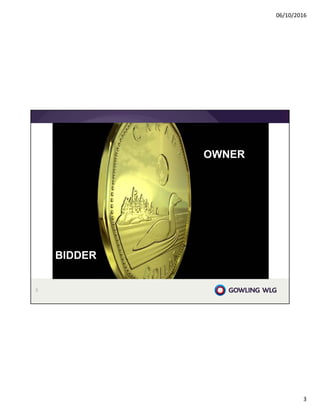
OWNER
BIDDER
06/10/2016
4
Conflict of
Interest
4
06/10/2016
5
Conflict of Interest
06/10/2016
6
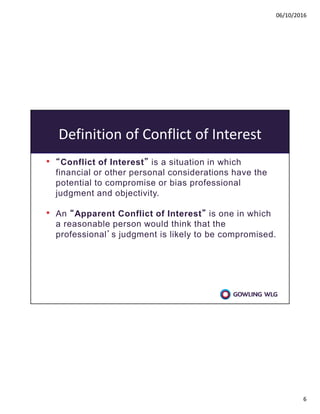
Definition of Conflict of Interest
• “Conflict of Interest” is a situation in which
financial or other personal considerations have the
potential to compromise or bias professional
judgment and objectivity.
• An “Apparent Conflict of Interest” is one in which
a reasonable person would think that the
professional’s judgment is likely to be compromised.
06/10/2016
7
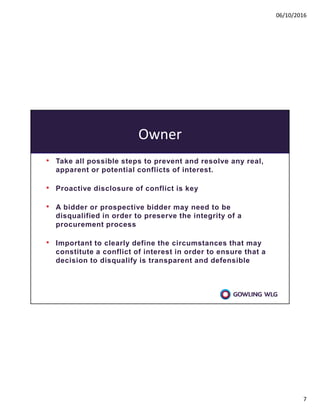
Owner
• Take all possible steps to prevent and resolve any real,
apparent or potential conflicts of interest.
• Proactive disclosure of conflict is key
• A bidder or prospective bidder may need to be
disqualified in order to preserve the integrity of a
procurement process
• Important to clearly define the circumstances that may
constitute a conflict of interest in order to ensure that a
decision to disqualify is transparent and defensible
06/10/2016
8
Bidder
• Internal compliance – ensure that all stakeholders are
aware of and in compliance with requirements to avoid
COIs
• Proactive disclosure of conflict is key – complete and
accurate completion of COI declarations or certifications
• Appropriate Communications- exercise caution during
the procurement process
06/10/2016
9
Conducting a
Fair Process
9
06/10/2016
10
-
06/10/2016
11
Owner
• Fairness, openness and transparency
• Internal procurement polices
• Common Law Principles
– Duty of good faith
– Duty to disclose material information
– Duty to disclose the rated criteria
– Tender deadlines are to be strictly enforced
– Duty to only accept compliant bids
06/10/2016
12
Bidder
• Common Law Principles
– Duty of good faith
– Duty to disclose material information
– Duty to disclose the rated criteria
– Tender deadlines are to be strictly enforced
– Duty to accept only compliant bids
– Duty of the bidder to honour its tender
06/10/2016
13
Clarification of
Qs and As
13
06/10/2016
14
Clarification of Qs and As
06/10/2016
15
Inquiry Process
• The inquiry process is often the best opportunity
in the bid process to dialogue with the
soliciting party
• Bidders can seek clarification or object to a
requirement
• Questions and answers get incorporated into
the RFP as amendments, and are provided to
all bidders
06/10/2016
16
Owner
• Ensure the information provided
is not misleading
• Questions and answers should be
provided to all bidders
• Answers should be incorporated
into RFP as amendments
06/10/2016
17
Bidder
• Don’t miss the boat – If you have a
question, ask!
• Act quickly – Don’t “wait and see”
– It is incumbent upon the bidder to seek clarification or object to
the requirement
– Bidder bears the onus to seek clarification before submitting a
bid if they believe the wording is unclear or ambiguous
• Be mindful of mandatory requirements
06/10/2016
18
Sole Sourcing
Contracts
18
06/10/2016
19
Sole Sourcing Contracts
06/10/2016
20
Sole Sourcing Contracts
• Less competitive procurement process where government
entity able to contact a sole or single supplier or a number of
suppliers individually
• If under the CITT jurisdiction
– Trade agreements apply
– Sole sourcing can be legally challenged
• Public entities outside of CITT jurisdiction/private entities:
– Can self-impose policies against sole-sourcing
– No common law legal duty to engage in open and
competitive procurement processes
06/10/2016
21
Owner
• Public vs. private
• Exception to competition – onus is on the
owner to show this method is appropriate
• Expediency or convenience won’t cut it
• Increased risk
06/10/2016
22
Bidder
• Selected as sole source
• Objecting to selection of a sole sourcing
provider
06/10/2016
23
Selecting a
Winning
Bidder
23
06/10/2016
24
06/10/2016
25
Owner
• Follow the RFP
• Follow the process
• Minimize ambiguous requirements
• Do not evaluate undisclosed criteria
• Award to winning bidder
• Record Keeping
06/10/2016
26
Bidder
• Ensure compliance with all mandatory
requirements
• Challenging after the selection
• Forum and process
• Evidentiary issues
06/10/2016
27
QUESTIONS?
27
06/10/2016
28
CONTACT US
Stephanie Pearce
Partner
stephanie.pearce@gowlingwlg.com
613-783-8842
Phuong T.V. Ngo
Partner
phuong.ngo@gowlingwlg.com
613-786-0236
Graham Ragan
Partner
graham.ragan@gowlingwlg.com
613-786-8699
Gowling WLG is an international law firm comprising the members of Gowling WLG International
Limited, an English Company Limited by Guarantee, and their respective affiliates. Each member
and affiliate is an autonomous and independent entity. Gowling WLG International Limited promotes,
facilitates and coordinates the activities of its members but does not itself provide services to clients.
Our structure is explained in more detail at gowlingwlg.com/legal
06/10/2016
29

Procurement: Fundamentals to forward thinking

  • 1.
    06/10/2016 1 6 October 2016 RISKTO REWARD SEMINAR SERIES: GRAHAM RAGANPHUONG T.V. NGO STEPHANIE PEARCE PROCUREMENT: FUNDAMENTALS TO FORWARD THINKING
  • 2.
    06/10/2016 2 OVERVIEW • Introduction toProcurement Fundamentals • Perspective: Bidder vs. Owner – Conflict of Interest – Conducting a Fair Process – Clarification of Q’s and A’s – Sole Sourcing Contracts – Selecting a Winning Bidder
  • 3.
  • 4.
  • 5.
  • 6.
    06/10/2016 6 Definition of Conflictof Interest • “Conflict of Interest” is a situation in which financial or other personal considerations have the potential to compromise or bias professional judgment and objectivity. • An “Apparent Conflict of Interest” is one in which a reasonable person would think that the professional’s judgment is likely to be compromised.
  • 7.
    06/10/2016 7 Owner • Take allpossible steps to prevent and resolve any real, apparent or potential conflicts of interest. • Proactive disclosure of conflict is key • A bidder or prospective bidder may need to be disqualified in order to preserve the integrity of a procurement process • Important to clearly define the circumstances that may constitute a conflict of interest in order to ensure that a decision to disqualify is transparent and defensible
  • 8.
    06/10/2016 8 Bidder • Internal compliance– ensure that all stakeholders are aware of and in compliance with requirements to avoid COIs • Proactive disclosure of conflict is key – complete and accurate completion of COI declarations or certifications • Appropriate Communications- exercise caution during the procurement process
  • 9.
  • 10.
  • 11.
    06/10/2016 11 Owner • Fairness, opennessand transparency • Internal procurement polices • Common Law Principles – Duty of good faith – Duty to disclose material information – Duty to disclose the rated criteria – Tender deadlines are to be strictly enforced – Duty to only accept compliant bids
  • 12.
    06/10/2016 12 Bidder • Common LawPrinciples – Duty of good faith – Duty to disclose material information – Duty to disclose the rated criteria – Tender deadlines are to be strictly enforced – Duty to accept only compliant bids – Duty of the bidder to honour its tender
  • 13.
  • 14.
  • 15.
    06/10/2016 15 Inquiry Process • Theinquiry process is often the best opportunity in the bid process to dialogue with the soliciting party • Bidders can seek clarification or object to a requirement • Questions and answers get incorporated into the RFP as amendments, and are provided to all bidders
  • 16.
    06/10/2016 16 Owner • Ensure theinformation provided is not misleading • Questions and answers should be provided to all bidders • Answers should be incorporated into RFP as amendments
  • 17.
    06/10/2016 17 Bidder • Don’t missthe boat – If you have a question, ask! • Act quickly – Don’t “wait and see” – It is incumbent upon the bidder to seek clarification or object to the requirement – Bidder bears the onus to seek clarification before submitting a bid if they believe the wording is unclear or ambiguous • Be mindful of mandatory requirements
  • 18.
  • 19.
  • 20.
    06/10/2016 20 Sole Sourcing Contracts •Less competitive procurement process where government entity able to contact a sole or single supplier or a number of suppliers individually • If under the CITT jurisdiction – Trade agreements apply – Sole sourcing can be legally challenged • Public entities outside of CITT jurisdiction/private entities: – Can self-impose policies against sole-sourcing – No common law legal duty to engage in open and competitive procurement processes
  • 21.
    06/10/2016 21 Owner • Public vs.private • Exception to competition – onus is on the owner to show this method is appropriate • Expediency or convenience won’t cut it • Increased risk
  • 22.
    06/10/2016 22 Bidder • Selected assole source • Objecting to selection of a sole sourcing provider
  • 23.
  • 24.
  • 25.
    06/10/2016 25 Owner • Follow theRFP • Follow the process • Minimize ambiguous requirements • Do not evaluate undisclosed criteria • Award to winning bidder • Record Keeping
  • 26.
    06/10/2016 26 Bidder • Ensure compliancewith all mandatory requirements • Challenging after the selection • Forum and process • Evidentiary issues
  • 27.
  • 28.
    06/10/2016 28 CONTACT US Stephanie Pearce Partner stephanie.pearce@gowlingwlg.com 613-783-8842 PhuongT.V. Ngo Partner phuong.ngo@gowlingwlg.com 613-786-0236 Graham Ragan Partner graham.ragan@gowlingwlg.com 613-786-8699 Gowling WLG is an international law firm comprising the members of Gowling WLG International Limited, an English Company Limited by Guarantee, and their respective affiliates. Each member and affiliate is an autonomous and independent entity. Gowling WLG International Limited promotes, facilitates and coordinates the activities of its members but does not itself provide services to clients. Our structure is explained in more detail at gowlingwlg.com/legal
  • 29.