PROCESS SCHEDULING
Presented by,
N .Siva keerthana,
M . Sc Computer Science,
Department of Computer Science,
Nadar Saraswathi college of Arts and Science.
Process Scheduling
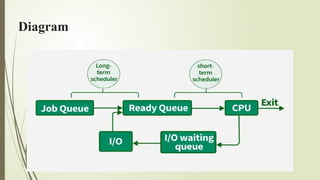
 Process scheduling in a distributed operating system (DOS) involves
managing and allocating tasks across multiple networked computers to
optimize resource utilization and performance.
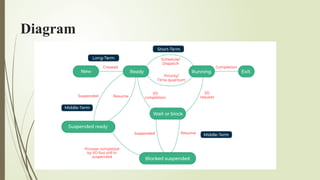
 It is the activity of the process manager that handles the removal of the
running process from the CPU and the selection of another process
 Based on a particular strategy, a process moves between various scheduling
queues, such as the ready queue, waiting queue or devices queue.
Diagram
Categories of Scheduling
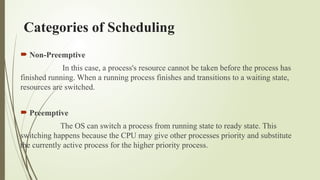
 Non-Preemptive
In this case, a process's resource cannot be taken before the process has
finished running. When a running process finishes and transitions to a waiting state,
resources are switched.
 Preemptive
The OS can switch a process from running state to ready state. This
switching happens because the CPU may give other processes priority and substitute
the currently active process for the higher priority process.
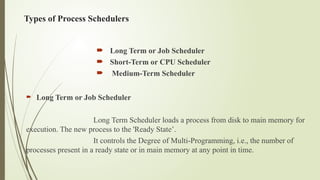
Types of Process Schedulers
 Long Term or Job Scheduler
 Short-Term or CPU Scheduler
 Medium-Term Scheduler
 Long Term or Job Scheduler
Long Term Scheduler loads a process from disk to main memory for
execution. The new process to the 'Ready State’.
It controls the Degree of Multi-Programming, i.e., the number of
processes present in a ready state or in main memory at any point in time.
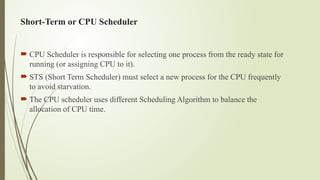
Short-Term or CPU Scheduler
 CPU Scheduler is responsible for selecting one process from the ready state for
running (or assigning CPU to it).
 STS (Short Term Scheduler) must select a new process for the CPU frequently
to avoid starvation.
 The CPU scheduler uses different Scheduling Algorithm to balance the
allocation of CPU time.
Diagram
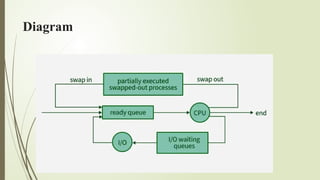
Medium-Term Scheduler
 Medium Term Scheduler (MTS) is responsible for moving a process from
memory to disk (or swapping).
 It reduces the degree of multiprogramming (Number of processes present in
main memory).
 This process is called swapping and the process is said to be swapped out or
rolled out.
 Swapping may be necessary to improve the process mix (of CPU bound and IO
bound)
Diagram
Some Other Schedulers
 I/O Schedulers
I/O schedulers are in charge of managing the execution of I/O operations
such as reading and writing to discs or networks.
They can use various algorithms to determine the order in which I/O
operations are executed, such as RR (Round Robin).
 Real-Time Schedulers
Real-Time Schedulers ensure that critical tasks are completed within a
specified time frame.
They can prioritize and schedule tasks using various algorithms such as
RM (Rate Monotonic).
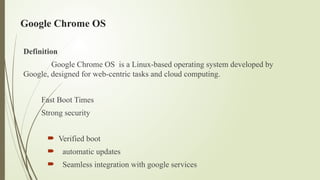
Google Chrome OS
Definition
Google Chrome OS is a Linux-based operating system developed by
Google, designed for web-centric tasks and cloud computing.
Fast Boot Times
Strong security
 Verified boot
 automatic updates
 Seamless integration with google services
Key Characteristics
 Web-Based & Cloud-Centric
 Fast and Lightweight
 Security
 Automatic Updates
 Integration with Google Services
 Hardware-Specific
 App Support
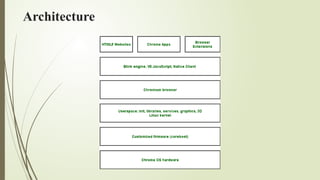
Architecture
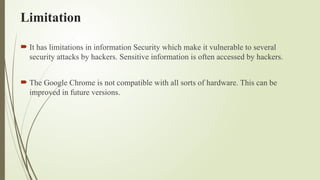
Limitation
 It has limitations in information Security which make it vulnerable to several
security attacks by hackers. Sensitive information is often accessed by hackers.
 The Google Chrome is not compatible with all sorts of hardware. This can be
improved in future versions.
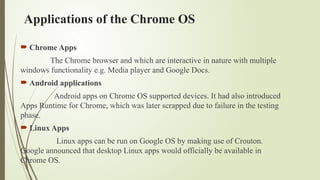
Applications of the Chrome OS
 Chrome Apps
The Chrome browser and which are interactive in nature with multiple
windows functionality e.g. Media player and Google Docs.
 Android applications
Android apps on Chrome OS supported devices. It had also introduced
Apps Runtime for Chrome, which was later scrapped due to failure in the testing
phase.
 Linux Apps
Linux apps can be run on Google OS by making use of Crouton.
Google announced that desktop Linux apps would officially be available in
Chrome OS.
THANK YOU

Process Scheduling in Distributed Operating System

  • 1.
    PROCESS SCHEDULING Presented by, N.Siva keerthana, M . Sc Computer Science, Department of Computer Science, Nadar Saraswathi college of Arts and Science.
  • 2.
    Process Scheduling  Processscheduling in a distributed operating system (DOS) involves managing and allocating tasks across multiple networked computers to optimize resource utilization and performance.  It is the activity of the process manager that handles the removal of the running process from the CPU and the selection of another process  Based on a particular strategy, a process moves between various scheduling queues, such as the ready queue, waiting queue or devices queue.
  • 3.
  • 4.
    Categories of Scheduling Non-Preemptive In this case, a process's resource cannot be taken before the process has finished running. When a running process finishes and transitions to a waiting state, resources are switched.  Preemptive The OS can switch a process from running state to ready state. This switching happens because the CPU may give other processes priority and substitute the currently active process for the higher priority process.
  • 5.
    Types of ProcessSchedulers  Long Term or Job Scheduler  Short-Term or CPU Scheduler  Medium-Term Scheduler  Long Term or Job Scheduler Long Term Scheduler loads a process from disk to main memory for execution. The new process to the 'Ready State’. It controls the Degree of Multi-Programming, i.e., the number of processes present in a ready state or in main memory at any point in time.
  • 6.
    Short-Term or CPUScheduler  CPU Scheduler is responsible for selecting one process from the ready state for running (or assigning CPU to it).  STS (Short Term Scheduler) must select a new process for the CPU frequently to avoid starvation.  The CPU scheduler uses different Scheduling Algorithm to balance the allocation of CPU time.
  • 7.
  • 8.
    Medium-Term Scheduler  MediumTerm Scheduler (MTS) is responsible for moving a process from memory to disk (or swapping).  It reduces the degree of multiprogramming (Number of processes present in main memory).  This process is called swapping and the process is said to be swapped out or rolled out.  Swapping may be necessary to improve the process mix (of CPU bound and IO bound)
  • 9.
  • 10.
    Some Other Schedulers I/O Schedulers I/O schedulers are in charge of managing the execution of I/O operations such as reading and writing to discs or networks. They can use various algorithms to determine the order in which I/O operations are executed, such as RR (Round Robin).  Real-Time Schedulers Real-Time Schedulers ensure that critical tasks are completed within a specified time frame. They can prioritize and schedule tasks using various algorithms such as RM (Rate Monotonic).
  • 11.
    Google Chrome OS Definition GoogleChrome OS is a Linux-based operating system developed by Google, designed for web-centric tasks and cloud computing. Fast Boot Times Strong security  Verified boot  automatic updates  Seamless integration with google services
  • 12.
    Key Characteristics  Web-Based& Cloud-Centric  Fast and Lightweight  Security  Automatic Updates  Integration with Google Services  Hardware-Specific  App Support
  • 13.
  • 14.
    Limitation  It haslimitations in information Security which make it vulnerable to several security attacks by hackers. Sensitive information is often accessed by hackers.  The Google Chrome is not compatible with all sorts of hardware. This can be improved in future versions.
  • 15.
    Applications of theChrome OS  Chrome Apps The Chrome browser and which are interactive in nature with multiple windows functionality e.g. Media player and Google Docs.  Android applications Android apps on Chrome OS supported devices. It had also introduced Apps Runtime for Chrome, which was later scrapped due to failure in the testing phase.  Linux Apps Linux apps can be run on Google OS by making use of Crouton. Google announced that desktop Linux apps would officially be available in Chrome OS.
  • 16.