Process model based decision support
for multi-stakeholder
water-food-energy-ecosystem networks
Harmonization of	local	interests
with global sustainability
Monika Varga
Research	Group	on Process Network	Engineering
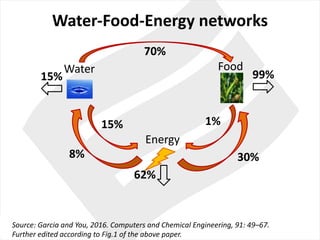
Water-Food-Energy networks
Water Food
Energy
Source:	Garcia and	You,	2016.	Computers and	Chemical Engineering,	91:	49–67.
Further edited according to Fig.1	of	the above paper.
30%
62%
8%
70%
15%
15%
99%
1%
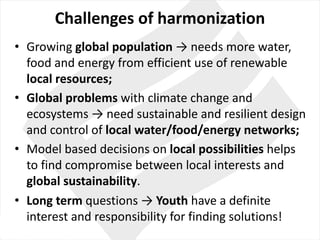
Challenges of	harmonization
• Growing global population →	needs	more	water,	
food and	energy	from efficient use of renewable
local	resources;
• Global	problems with climate change and	
ecosystems →	need sustainable and	resilient design	
and	control of	local	water/food/energy networks;
• Model based decisions on local	possibilities helps
to find compromise between local	interests and	
global sustainability.
• Long	term questions →	Youth have a	definite
interest	and	responsibility for finding solutions!
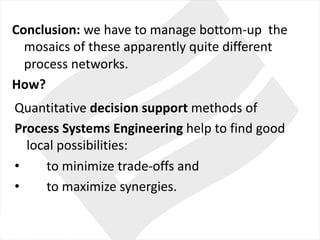
Conclusion: we have to manage bottom-up the
mosaics of	these apparently quite different
process networks.
How?
Quantitative decision support methods of	
Process Systems	Engineering help to find good
local	possibilities:
• to minimize trade-offs and	
• to maximize synergies.
What is	Process Systems	Engineering?
• It originates from chemical engineering;
• It offers modeling	and	simulation tools for
– design,	operation,	control,	and	optimization of	
process systems.
• Recently it encompasses	a	broad range	of	
multidisciplinary applications:
– e.g.	biotechnology,	environmental engineering,	
agriculture and food industry,	advanced	materials,
etc.
How do process modeling and	simulation
support better decisions?
• A	model is	a	simplified	representation	of	the
essential features of	a	process to	promote	
understanding	of	its real,	dynamic behavior;
• Model based simulation enables to	percieve
those causal interactions	that	would	not	
otherwise	be	obvious;
• The	simulation based design	and	control
decisions can consider the balances.
Our method for modeling and	simulation:	
Direct Computer	Mapping
• Automatic generation of	executable process
models from:
– Structure:	network of	the investigated problem;
– Functionalities:	program	prototypes to calculate
the elementary processes
• Graphical interface for model expert
• Case specific interfaces for users (web	based,	
MS	Excel,	etc.)
• Successful and	ongoing demand-led
applications:	modelers +	field experts
Our recent partners (modeling &	field experts)
• National	Polytechnic	Institute	of	Toulouse,	France	
• Center	for	Process	and	Environmental	Engineering,	
UPC,	Barcelona,	Spain
• University	of	Pannonia,	Veszprem,	Hungary
• Ecological Research	Center,	Hungarian	Academy	of	
Sciences
• China	Agricultural	University,	Beijing,	China
• Fino-Food	Ltd.,	Hungary
• GS1	Hungary	Non-profit	Ltd.
• Research	Institute	for	Fisheries	and	Aquaculture,	
National	Agricultural	Research	and	Innovation	Centre
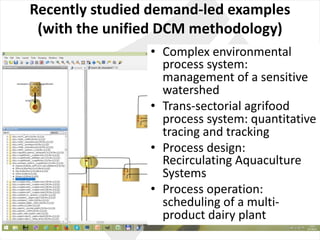
Recently studied demand-led examples
(with the unified DCM	methodology)
• Complex environmental
process system:	
management	of	a	sensitive
watershed
• Trans-sectorial agrifood
process system:	quantitative
tracing and	tracking
• Process design:	
Recirculating Aquaculture
Systems
• Process operation:	
scheduling of	a	multi-
product dairy plant
Recently studied demand-led examples
• Complex environmental
process system:	
management	of	a	sensitive
watershed [1,	2]
• Trans-sectorial agrifood
process system:	quantitative
tracing and	tracking
• Process design:	
Recirculating Aquaculture
Systems
• Process operation:	
scheduling of	a	multi-
product dairy plant
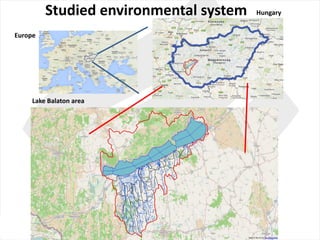
Studied environmental system
Europe
Lake	Balaton	area
Hungary
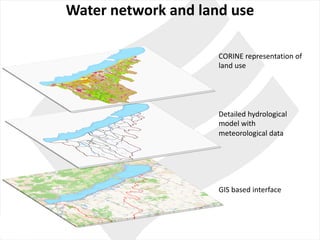
GIS	based interface
Detailed hydrological
model with
meteorological data
CORINE	representation of	
land use
Water network and	land use
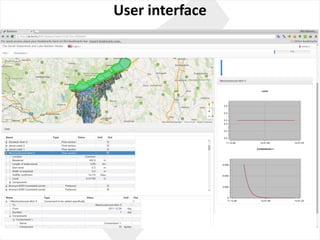
User interface
What is	it for?
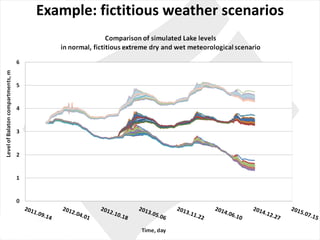
• To study the effects of	(extremly or slowly
changing)	meteorological situations;
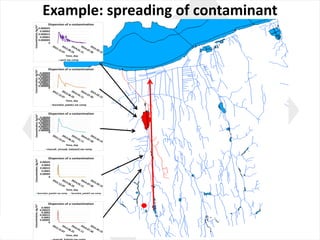
• To follow contaminants in the watershed;
• To study the effects of	possible land use;	
• To combine with the investigation of	water-
food-energy-ecosystem related studies.
Example:	fictitious weather scenarios
Example:	spreading of	contaminant
Recently studied demand-led examples
• Complex environmental
process system:	management	
of	a	sensitive watershed
• Trans-sectorial agrifood	
process system:	quantitative
tracing	and	tracking	[2,	3,	4,	
10]
• Process design:	Recirculating
Aquaculture Systems
• Process operation:	scheduling
of	a	multi-product dairy plant
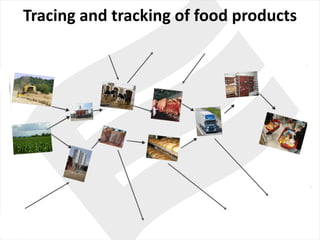
Tracing	and	tracking	of	food products
Challenges
• Heterogeneous actors (plant cultivation,	
fodder production,		animal breeding,	food
processing,	commerce,	etc.)
• Data	service	varies from the log	book of	
family farms to the sophisticated ERP
systems;
• Need for tracking	and	tracing	of	(sometimes
suddenly appearing)	harmful and	useful
components.
Test	systems
• Family farm	(plant cultivation,	vegetables)
• Meat chain (from plant cultivation to slaughtering)
Technical partner
• GS1	Hungary	Nonprofit Ltd.
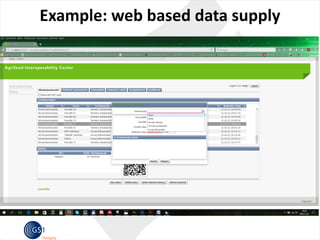
Example:	web	based data supply
What is	it for?
• Qualitative tracking
• Qualitative tracing
• Quantitative tracking
• Quantitative tracing
• Balance control
• Value chain analysis (ongoing)
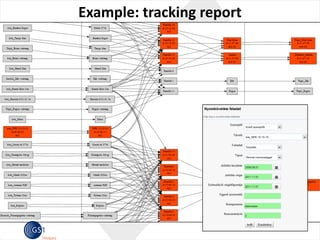
Example:	tracking report
Recently studied demand-led examples
• Complex environmental
process system:	
management	of	a	sensitive
watershed
• Trans-sectorial agrifood
process system:	quantitative
tracing and	tracking
• Process design:	
Recirculating	Aquaculture
Systems [5,	6,	8]
• Process operation:	
scheduling of	a	multi-
product dairy plant
Recirculation Aquaculture System
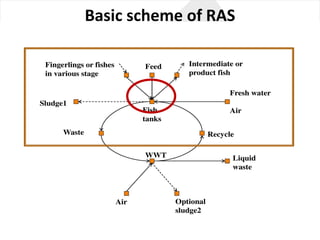
Basic	scheme of	RAS
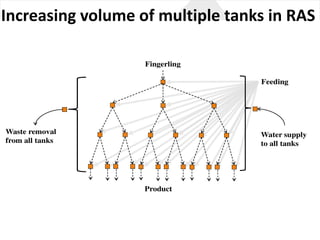
Increasing volume of	multiple tanks in RAS
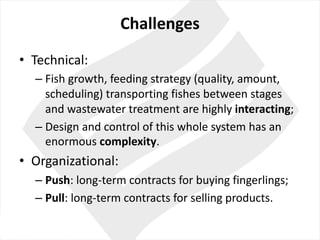
Challenges
• Technical:	
– Fish growth,	feeding strategy (quality,	amount,	
scheduling)	transporting fishes between stages
and	wastewater treatment are highly interacting;	
– Design	and	control of	this whole system has	an	
enormous complexity.	
• Organizational:	
– Push:	long-term contracts for buying fingerlings;
– Pull:	long-term contracts for selling products.
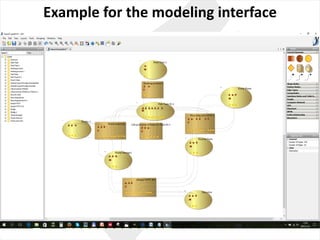
Example for the modeling interface
What is	it for?
• To design a	new system for:	
– optimal tank	structure of	the subsequent stages
(adapted to the fish species	and	to commercial
strategy)	;
– optimal waste water treatment unit.
• To control an	existing system for:	
– optimal operation (e.g.	minimize fresh water use);
– optimal transporting strategy between the stages.
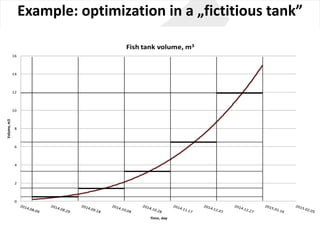
Example:	optimization in a	„fictitious tank”
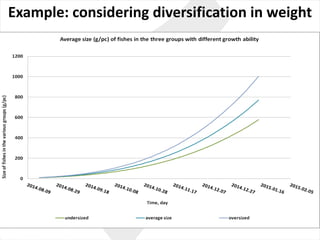
Example:	considering diversification in weight
Recently studied demand-led examples
• Complex environmental
process system:	
management	of	a	sensitive
watershed
• Trans-sectorial agrifood
process system:	quantitative
tracing and	tracking
• Process design:	
Recirculating Aquaculture
Systems
• Process operation:	
scheduling of	a	multi-
product dairy plant [7,	9]
Demand driven scheduling of	a	dairy plant
PLANNING	–
Monthly
••Target:	Equilibrated material balance
••Push feature:	Yearly based contracts for raw milk
••Pull feature:	EXPECTED	selling with EMPIRICAL	ESTIMATION
SCHEDULING	–
Weekly
••Target:	100%	serving rate
••Pull feature:	last week selling and	production numbers +	real
orders (fixed	+	ad-hoc)
••Push feature:	MUST	process the milk in less	than 48	hours
RESCHEDULING	
– Daily	/	Shift	
••Target:	100%	serving rate with minimum	number of	conversions
••Pull features:	
••Orders of	the coming 4	days
••Available stock
Planning,	scheduling and	re-scheduling
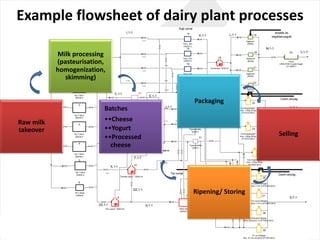
Example flowsheet of	dairy plant processes
Raw milk
takeover
Milk processing
(pasteurisation,	
homogenization,	
skimming)
Batches
••Cheese
••Yogurt
••Processed
cheese
Packaging
Ripening/	Storing
Selling
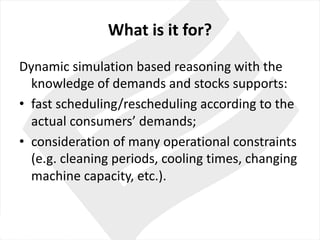
What is	it for?
Dynamic simulation based reasoning with the
knowledge of	demands and	stocks supports:	
• fast scheduling/rescheduling according to the
actual consumers’	demands;
• consideration of	many operational constraints
(e.g.	cleaning periods,	cooling times,	changing
machine capacity,	etc.).
0
1000
2000
3000
4000
5000
6000
7000
8000
2014.4.3.18
2014.4.3.14
2014.4.3.10
2014.4.3.6
2014.4.3.2
2014.4.2.22
2014.4.2.18
2014.4.2.14
2014.4.2.10
2014.4.2.6
2014.4.2.2
2014.4.1.22
2014.4.1.18
2014.4.1.14
2014.4.1.10
2014.4.1.6
2014.4.1.2
2014.3.31.22
2014.3.31.18
2014.3.31.14
2014.3.31.10
2014.3.31.6
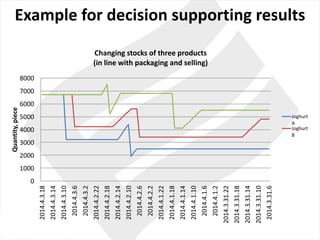
Quantity,	piece
Changing stocks of	three products
(in line	with packaging and	selling)
Joghurt	
A
Joghurt	
B
Example for decision supporting results
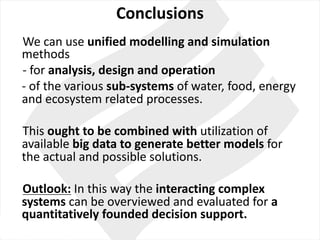
Conclusions
We can use unified modelling	and	simulation
methods
- for analysis,	design	and	operation
- of	the various sub-systems of water,	food,	energy
and	ecosystem related processes.
This ought to be	combined with utilization of	
available big data to generate better models for
the actual and	possible solutions.
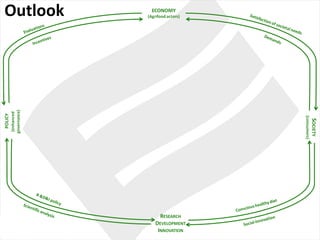
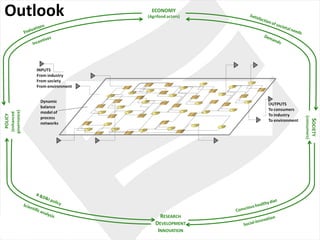
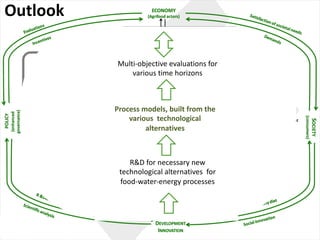
Outlook: In this way the interacting complex
systems can be	overviewed and	evaluated for a	
quantitatively founded decision support.
Outlook
Outlook
Outlook
Outlook
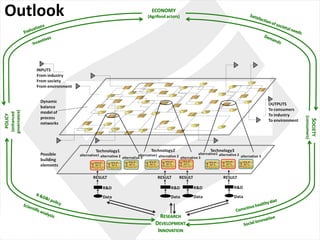
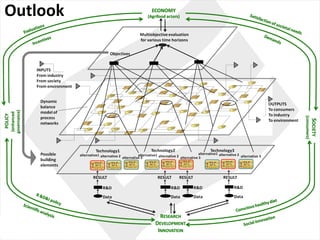
R&D	for necessary new
technological alternatives for
food-water-energy processes
Process models,	built from the
various technological
alternatives
Multi-objective evaluations for
various time horizons
Outlook
efita2017.org/
References
1. Varga M, Balogh S, Csukás B. An extensible, generic environmental process modelling framework
with an example for a watershed of a shallow lake ENVIRONMENTAL MODELLING & SOFTWARE 75:
pp. 243-262. (2016) IF: 4.42
2. Varga M, Csukás B. Simulation of Agro-environmental Processes by Direct Computer Mapping
Lecture Notes in Engineering and Computer Science II: pp. 847-852. (2015) World Congress on
Engineering and Computer Science 2015. San Francisco, USA. ISBN 978-988-14047-2-5
3. Varga M, Csukás B, Balogh S. Transparent Agrifood Interoperability, Based on a Simplified Dynamic
Simulation Model In: Mildorf T, Charvat K (szerk.) ICT for Agriculture, Rural Development and
Environment: Where we are? Where we will go?. Prague: Czech Centre for Science and Society,
2012. pp. 155-174. (ISBN: 978-80-905151-0-9)
4. András Tankovics, Sándor Balogh, Mónika Varga. Testing of a process model based Web interface for
integration of small family farms in sector spanning traceability. Agriculture Informatics 2013 - The
past, present and future of agricultural informatics, 8-9. November 2013, Debrecen, Hungary.
5. Varga M, Balogh S, Wei Y, Li D, Csukas B Dynamic simulation based method for the reduction of
complexity in design and control of Recirculating Aquaculture Systems INFORMATION PROCESSING
IN AGRICULTURE 3:(3) pp. 146-156. (2016)
6. Varga Mónika, Balogh Sándor, Kucska Balázs, Yaoguang Wei, Daoliang Li, Csukás Béla Testing of
Direct Computer Mapping for dynamic simulation of a simplified Recirculating Aquaculture System.
JOURNAL OF AGRICULTURAL INFORMATICS 6: (3) pp. 1-12. (2015)
7. Linda Egyed, Mónika Varga, Béla Csukás. First steps toward Direct Computer Mapping based
scheduling of dairy production. Agricultural Informatics 2014 - Future Internet and ICT Innovation,
13-15 November 2014, Debrecen, Hungary.
8. Gergo Gyalog. Bio-economic optimization of fish producing technologies. Ongoing PhD thesis.
9. Linda Egyed. Analysis and development of multiscale (sub)optimal scheduling in a dairy plant.
Ongoing PhD thesis.
10. András Tankovics. Dynamic process modeling of a dairy farm. Ongoing PhD thesis.

Process model-based decision support for multi-stakeholder water-food-energy-ecosystem network

  • 1.
    Process model baseddecision support for multi-stakeholder water-food-energy-ecosystem networks Harmonization of local interests with global sustainability Monika Varga Research Group on Process Network Engineering
  • 2.
    Water-Food-Energy networks Water Food Energy Source: Garciaand You, 2016. Computers and Chemical Engineering, 91: 49–67. Further edited according to Fig.1 of the above paper. 30% 62% 8% 70% 15% 15% 99% 1%
  • 3.
    Challenges of harmonization • Growingglobal population → needs more water, food and energy from efficient use of renewable local resources; • Global problems with climate change and ecosystems → need sustainable and resilient design and control of local water/food/energy networks; • Model based decisions on local possibilities helps to find compromise between local interests and global sustainability. • Long term questions → Youth have a definite interest and responsibility for finding solutions!
  • 4.
    Conclusion: we haveto manage bottom-up the mosaics of these apparently quite different process networks. How? Quantitative decision support methods of Process Systems Engineering help to find good local possibilities: • to minimize trade-offs and • to maximize synergies.
  • 5.
    What is Process Systems Engineering? •It originates from chemical engineering; • It offers modeling and simulation tools for – design, operation, control, and optimization of process systems. • Recently it encompasses a broad range of multidisciplinary applications: – e.g. biotechnology, environmental engineering, agriculture and food industry, advanced materials, etc.
  • 6.
    How do processmodeling and simulation support better decisions? • A model is a simplified representation of the essential features of a process to promote understanding of its real, dynamic behavior; • Model based simulation enables to percieve those causal interactions that would not otherwise be obvious; • The simulation based design and control decisions can consider the balances.
  • 7.
    Our method formodeling and simulation: Direct Computer Mapping • Automatic generation of executable process models from: – Structure: network of the investigated problem; – Functionalities: program prototypes to calculate the elementary processes • Graphical interface for model expert • Case specific interfaces for users (web based, MS Excel, etc.) • Successful and ongoing demand-led applications: modelers + field experts
  • 8.
    Our recent partners(modeling & field experts) • National Polytechnic Institute of Toulouse, France • Center for Process and Environmental Engineering, UPC, Barcelona, Spain • University of Pannonia, Veszprem, Hungary • Ecological Research Center, Hungarian Academy of Sciences • China Agricultural University, Beijing, China • Fino-Food Ltd., Hungary • GS1 Hungary Non-profit Ltd. • Research Institute for Fisheries and Aquaculture, National Agricultural Research and Innovation Centre
  • 9.
    Recently studied demand-ledexamples (with the unified DCM methodology) • Complex environmental process system: management of a sensitive watershed • Trans-sectorial agrifood process system: quantitative tracing and tracking • Process design: Recirculating Aquaculture Systems • Process operation: scheduling of a multi- product dairy plant
  • 10.
    Recently studied demand-ledexamples • Complex environmental process system: management of a sensitive watershed [1, 2] • Trans-sectorial agrifood process system: quantitative tracing and tracking • Process design: Recirculating Aquaculture Systems • Process operation: scheduling of a multi- product dairy plant
  • 11.
  • 12.
    GIS based interface Detailed hydrological modelwith meteorological data CORINE representation of land use Water network and land use
  • 13.
  • 14.
    What is it for? •To study the effects of (extremly or slowly changing) meteorological situations; • To follow contaminants in the watershed; • To study the effects of possible land use; • To combine with the investigation of water- food-energy-ecosystem related studies.
  • 15.
  • 16.
  • 17.
    Recently studied demand-ledexamples • Complex environmental process system: management of a sensitive watershed • Trans-sectorial agrifood process system: quantitative tracing and tracking [2, 3, 4, 10] • Process design: Recirculating Aquaculture Systems • Process operation: scheduling of a multi-product dairy plant
  • 18.
  • 19.
    Challenges • Heterogeneous actors(plant cultivation, fodder production, animal breeding, food processing, commerce, etc.) • Data service varies from the log book of family farms to the sophisticated ERP systems; • Need for tracking and tracing of (sometimes suddenly appearing) harmful and useful components.
  • 20.
    Test systems • Family farm (plantcultivation, vegetables) • Meat chain (from plant cultivation to slaughtering) Technical partner • GS1 Hungary Nonprofit Ltd.
  • 21.
  • 22.
    What is it for? •Qualitative tracking • Qualitative tracing • Quantitative tracking • Quantitative tracing • Balance control • Value chain analysis (ongoing)
  • 23.
  • 24.
    Recently studied demand-ledexamples • Complex environmental process system: management of a sensitive watershed • Trans-sectorial agrifood process system: quantitative tracing and tracking • Process design: Recirculating Aquaculture Systems [5, 6, 8] • Process operation: scheduling of a multi- product dairy plant
  • 25.
  • 26.
  • 27.
  • 28.
    Challenges • Technical: – Fishgrowth, feeding strategy (quality, amount, scheduling) transporting fishes between stages and wastewater treatment are highly interacting; – Design and control of this whole system has an enormous complexity. • Organizational: – Push: long-term contracts for buying fingerlings; – Pull: long-term contracts for selling products.
  • 29.
    Example for themodeling interface
  • 30.
    What is it for? •To design a new system for: – optimal tank structure of the subsequent stages (adapted to the fish species and to commercial strategy) ; – optimal waste water treatment unit. • To control an existing system for: – optimal operation (e.g. minimize fresh water use); – optimal transporting strategy between the stages.
  • 31.
  • 32.
  • 33.
    Recently studied demand-ledexamples • Complex environmental process system: management of a sensitive watershed • Trans-sectorial agrifood process system: quantitative tracing and tracking • Process design: Recirculating Aquaculture Systems • Process operation: scheduling of a multi- product dairy plant [7, 9]
  • 34.
    Demand driven schedulingof a dairy plant
  • 35.
    PLANNING – Monthly ••Target: Equilibrated material balance ••Pushfeature: Yearly based contracts for raw milk ••Pull feature: EXPECTED selling with EMPIRICAL ESTIMATION SCHEDULING – Weekly ••Target: 100% serving rate ••Pull feature: last week selling and production numbers + real orders (fixed + ad-hoc) ••Push feature: MUST process the milk in less than 48 hours RESCHEDULING – Daily / Shift ••Target: 100% serving rate with minimum number of conversions ••Pull features: ••Orders of the coming 4 days ••Available stock Planning, scheduling and re-scheduling
  • 36.
    Example flowsheet of dairyplant processes Raw milk takeover Milk processing (pasteurisation, homogenization, skimming) Batches ••Cheese ••Yogurt ••Processed cheese Packaging Ripening/ Storing Selling
  • 37.
    What is it for? Dynamicsimulation based reasoning with the knowledge of demands and stocks supports: • fast scheduling/rescheduling according to the actual consumers’ demands; • consideration of many operational constraints (e.g. cleaning periods, cooling times, changing machine capacity, etc.).
  • 38.
  • 39.
    Conclusions We can useunified modelling and simulation methods - for analysis, design and operation - of the various sub-systems of water, food, energy and ecosystem related processes. This ought to be combined with utilization of available big data to generate better models for the actual and possible solutions. Outlook: In this way the interacting complex systems can be overviewed and evaluated for a quantitatively founded decision support.
  • 40.
  • 41.
  • 42.
  • 43.
  • 44.
    R&D for necessary new technologicalalternatives for food-water-energy processes Process models, built from the various technological alternatives Multi-objective evaluations for various time horizons Outlook
  • 45.
  • 46.
    References 1. Varga M,Balogh S, Csukás B. An extensible, generic environmental process modelling framework with an example for a watershed of a shallow lake ENVIRONMENTAL MODELLING & SOFTWARE 75: pp. 243-262. (2016) IF: 4.42 2. Varga M, Csukás B. Simulation of Agro-environmental Processes by Direct Computer Mapping Lecture Notes in Engineering and Computer Science II: pp. 847-852. (2015) World Congress on Engineering and Computer Science 2015. San Francisco, USA. ISBN 978-988-14047-2-5 3. Varga M, Csukás B, Balogh S. Transparent Agrifood Interoperability, Based on a Simplified Dynamic Simulation Model In: Mildorf T, Charvat K (szerk.) ICT for Agriculture, Rural Development and Environment: Where we are? Where we will go?. Prague: Czech Centre for Science and Society, 2012. pp. 155-174. (ISBN: 978-80-905151-0-9) 4. András Tankovics, Sándor Balogh, Mónika Varga. Testing of a process model based Web interface for integration of small family farms in sector spanning traceability. Agriculture Informatics 2013 - The past, present and future of agricultural informatics, 8-9. November 2013, Debrecen, Hungary. 5. Varga M, Balogh S, Wei Y, Li D, Csukas B Dynamic simulation based method for the reduction of complexity in design and control of Recirculating Aquaculture Systems INFORMATION PROCESSING IN AGRICULTURE 3:(3) pp. 146-156. (2016) 6. Varga Mónika, Balogh Sándor, Kucska Balázs, Yaoguang Wei, Daoliang Li, Csukás Béla Testing of Direct Computer Mapping for dynamic simulation of a simplified Recirculating Aquaculture System. JOURNAL OF AGRICULTURAL INFORMATICS 6: (3) pp. 1-12. (2015) 7. Linda Egyed, Mónika Varga, Béla Csukás. First steps toward Direct Computer Mapping based scheduling of dairy production. Agricultural Informatics 2014 - Future Internet and ICT Innovation, 13-15 November 2014, Debrecen, Hungary. 8. Gergo Gyalog. Bio-economic optimization of fish producing technologies. Ongoing PhD thesis. 9. Linda Egyed. Analysis and development of multiscale (sub)optimal scheduling in a dairy plant. Ongoing PhD thesis. 10. András Tankovics. Dynamic process modeling of a dairy farm. Ongoing PhD thesis.