RESEARCH METHODOLOGY
PROCESS AND PRECISION
MRS.A. AISWARYA LAKSHMI M.SC.,M.PHIL.,UGC- NET.,
PH.D
ACCURACY AND PRECISION
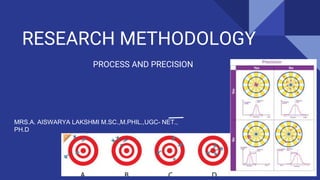
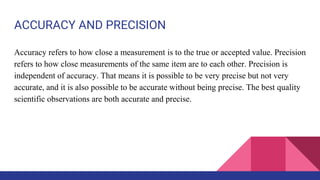
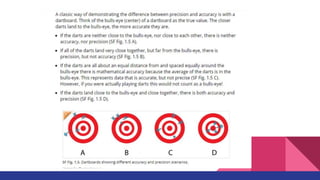
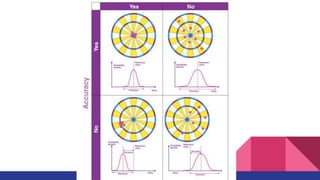
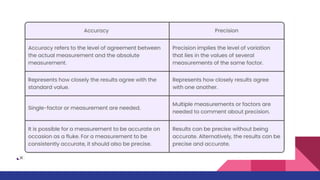
Accuracy refers to how close a measurement is to the true or accepted value. Precision
refers to how close measurements of the same item are to each other. Precision is
independent of accuracy. That means it is possible to be very precise but not very
accurate, and it is also possible to be accurate without being precise. The best quality
scientific observations are both accurate and precise.
TYPES OF ACCURACY
POINT ACCURACY
The accuracy of the instrument only at a particular point on its scale is known as point accuracy. It is
important to note that this accuracy does not give any information about the general accuracy of the
instrument.
ACCURACY AS PERCENTAGE OF SCALE RANGE
The uniform scale range determines the accuracy of a measurement. This can be better understood
with the help of the following example:
Consider a thermometer having the scale range up to 500ºC. The thermometer has an accuracy of
±0.5 percent of scale range i.e. 0.005 x 500 = ± 2.5 ºC. Therefore, the reading will have a maximum
error of ± 2.5 ºC.
ACCURACY AS PERCENTAGE OF TRUE VALUE
Such type of accuracy of the instruments is determined by identifying the measured value regarding
their true value. The accuracy of the instruments is neglected up to ±0.5 percent from the true value.
PRECISION
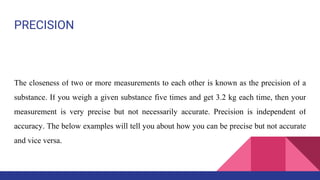
The closeness of two or more measurements to each other is known as the precision of a
substance. If you weigh a given substance five times and get 3.2 kg each time, then your
measurement is very precise but not necessarily accurate. Precision is independent of
accuracy. The below examples will tell you about how you can be precise but not accurate
and vice versa.
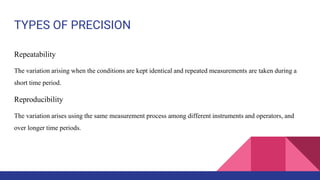
TYPES OF PRECISION
Repeatability
The variation arising when the conditions are kept identical and repeated measurements are taken during a
short time period.
Reproducibility
The variation arises using the same measurement process among different instruments and operators, and
over longer time periods.
Process and precision in research types and examples.pptx

Process and precision in research types and examples.pptx

  • 1.
    RESEARCH METHODOLOGY PROCESS ANDPRECISION MRS.A. AISWARYA LAKSHMI M.SC.,M.PHIL.,UGC- NET., PH.D
  • 2.
    ACCURACY AND PRECISION Accuracyrefers to how close a measurement is to the true or accepted value. Precision refers to how close measurements of the same item are to each other. Precision is independent of accuracy. That means it is possible to be very precise but not very accurate, and it is also possible to be accurate without being precise. The best quality scientific observations are both accurate and precise.
  • 4.
    TYPES OF ACCURACY POINTACCURACY The accuracy of the instrument only at a particular point on its scale is known as point accuracy. It is important to note that this accuracy does not give any information about the general accuracy of the instrument. ACCURACY AS PERCENTAGE OF SCALE RANGE The uniform scale range determines the accuracy of a measurement. This can be better understood with the help of the following example: Consider a thermometer having the scale range up to 500ºC. The thermometer has an accuracy of ±0.5 percent of scale range i.e. 0.005 x 500 = ± 2.5 ºC. Therefore, the reading will have a maximum error of ± 2.5 ºC.
  • 5.
    ACCURACY AS PERCENTAGEOF TRUE VALUE Such type of accuracy of the instruments is determined by identifying the measured value regarding their true value. The accuracy of the instruments is neglected up to ±0.5 percent from the true value.
  • 6.
    PRECISION The closeness oftwo or more measurements to each other is known as the precision of a substance. If you weigh a given substance five times and get 3.2 kg each time, then your measurement is very precise but not necessarily accurate. Precision is independent of accuracy. The below examples will tell you about how you can be precise but not accurate and vice versa.
  • 7.
    TYPES OF PRECISION Repeatability Thevariation arising when the conditions are kept identical and repeated measurements are taken during a short time period. Reproducibility The variation arises using the same measurement process among different instruments and operators, and over longer time periods.