imaginative
practice,
imaginative
inquiry
imaginative
practice,
imaginative
inquiry
Proceedings of the
Sixth International Conference
on Imagination and Education
Rydges Lakeside, Canberra, Australia, 29–31 January 2008
Edited by Robert Fitzgerald & Thomas W. Nielsen
imaginative
practice,
imaginative
inquiry
Proceedings of the
Sixth International Conference
on Imagination and Education
Rydges Lakeside, Canberra, Australia, 29–31 January 2008
Edited by Robert Fitzgerald & Thomas W. Nielsen
Imaginative Practice, Imaginative Inquiry
Proceedings of the Sixth International Conference on Imagination and Education
Edited by Robert Fitzgerald & Thomas W. Nielsen
© 2008
ISBN 978-1-74077-285-3
Published by the University of Canberra, Australian Capital Territory, Australia
Directors
Robert Fitzgerald, University of Canberra, Australia
Thomas W. Nielsen, University of Canberra, Australia
Reviewers
Sean Blenkinsop, Simon Fraser University, Canada
Linda Knight, University of Canberra, Australia
Francesco Sofo, University of Canberra, Australia
Philip Riley, Monash University, Australia
Thomas W. Nielsen, University of Canberra, Australia
Leah Moore, University of Canberra, Australia
Iain Hay, University of Canberra, Australia
Noel Gough, La Trobe University
Andrea Gallant, La Trobe University, Australia
Robert Fitzgerald, University of Canberra, Australia
Mark Fettes, Simon Fraser University, Canada
Kieran Egan, Simon Fraser University, Canada
Reesa Sorin, James Cook University, Australia
Program Committee
Robert Fitzgerald, University of Canberra, Australia
Linda Knight, University of Canberra, Australia
Bronwen Haralambous, Australia
Thomas W. Nielsen, University of Canberra, Australia
Leah Moore, University of Canberra, Australia
Kaye Price, University of Canberra, Australia
Conference Organisers
Teresa A Martin, Simon Fraser University, Canada
Add-On Education Services, Australia
Institutional sponsors
University of Canberra
Simon Fraser University (Imaginative Education Research Group)
La Trobe University
Our thanks to eliteaudiovisual for their professional AV support
iii
Preface
Robert Fitzgerald & Thomas W. Nielsen
University of Canberra
Imaginative Practice, Imaginative Inquiry:
The impulse of Imaginative Education
It is with great pleasure that we introduce the conference proceedings for the 6th
International Conference on Imagination and Education, Imaginative Practice,
Imaginative Inquiry, 29-31 January, Canberra, Australia. Welcome!
Ever since 2003, when the Imagination and Education Research Group
(IERG) convened the 1st Conference on Imagination and Education in
Vancouver, Canada, we have had the idea of bringing this event to Australia. At a
time of uncertainty and stress about how to make teaching and learning engaging
enough to counteract behaviour problems, about an overcrowded curriculum and
a complex and multi-levelled society in general, a gathering of this sort is overdue
in Australia.
It is not so long ago that imaginative processes were held up to be the apex of
human experience by a whole movement. When Romantics like William
Wordsworth claimed that, ‘Imagination… is Reason in her most exalted mood’
(The Prelude, Bk. XIV, line 192), he exemplified a belief that our imagination is a
direct link to the spiritual world, to which we can gain access only through the
creative powers of our being. The Romantic Period has since been claimed to
have been a type of counter-reaction to the dry intellectualism of the
Enlightenment. Indeed, the Romantic Period and the Enlightenment Period are
often seen as polar swings of preference between understanding the world
through ‘mind’ and understanding it through ‘emotion’.
One would think that by now we would have outgrown the dichotomy created
by seeing ‘mind-rationality-objectivity’ as separate to ‘emotions-imagination-
subjectivity’. But the reality is that the tensions between the ‘factual’ and the
‘artistic’ still resurface in educational theory and practice. We now have terms like
‘imaginative education’ (eg. Egan 2005, 1997), ‘emotional intelligence education’
(Goleman 1998) and ‘multiple intelligences education’ (Gardner 1983), which
implies a need for such initiatives! As John Dewey (1916) highlighted almost a
century ago, when education does what it is supposed to do in all its aspects, then
we probably do not need prefixes in front of it anymore!
Today, there isn’t a place in the world, however, where maths and science do
not take up more time in mainstream education than do the humanities and the
arts (Robinson 2006). While ‘imagination’ and ‘emotions’ are not – and nor
should they be – confined to the arts and the humanities, the hierarchical
imaginative practice, imaginative inquiry
iv
structure of our education system does reflect a preference for human qualities
that we have most often come to equate with ‘academic’ ability.
The only problem is that the notion of ‘academic’ ability derives from a 19th
century concept of schooling – a concept driven by the needs of the industrial
revolution, which are incompatible with the multi-social and multi-technological
world of today. It has been said that we are now part of a ‘knowledge age’;
however, the abundance of information and knowledge that come with it offers
no immediate solutions to the challenges that face our planet. Moreover, the
world has changed so rapidly in the last century that we now find it hard to
predict what skills and attributes will be in demand just a few years ahead. We are
to educate children for jobs that do not yet exist. These uncertainties highlight an
even greater need for an education that caters for the whole human being and all
its faculties.
There is, in other words, a need for thinking about thinking and learning in
newer and much more flexible ways than exist within the normal conception of
‘academic’ ability. We need to think about thinking and learning in much more
imaginative ways. This intent is getting more widespread and is abundantly
evident in the presentations at this conference. From Kieran Egan’s notion of
embodied thinking as an expanded notion of learning, to Mark Fettes’s argument
that the modern project hasn’t fulfilled its promise, to Noel Gough’s interplay of
dialogical space between the sciences and narrative inquiry, we see an intent to
view the body and the imagination as integral to the mind and rationality.
In the presentations by Sean Blenkinsop, Miranda Armstrong and Bernie
Neville we hear about how this intent is being implemented in communities,
schools and teacher education institutions. Indeed, in the presentations at this
conference as a whole, we see evidence of a widespread intent to teach and learn
holistically across the curriculum, as well as across communities and institutions.
At time of writing we have 140 confirmed delegates attending (and a number of
virtual delegates), who represent 20 countries. Our web-based conference system
has nearly 167 registered users (authors and readers). There is a movement on
the rise – again.
But unlike the polar swings of the past, we hope that this movement will not be
seen in hindsight as yet another ‘knee-jerk’ reaction to various educational
manifestations of capitalism, consumerism or competition. It is our hope that this
conference will provide a strong impulse to synthesise notions of ‘romanticism’
and ‘rationality’, the spiritual and the practical, imaginative enquiry and
imaginative practice, so that we can work to establish the Imaginative Education
initiative in Australia and the Asia-Pacific region.
With these words we hope you have an enjoyable and intellectually challenging
conference. All conference submissions were double-blind peer-reviewed by an
international panel of IERG associates and invited scholars. Following rigorous
peer-review, the conference organisers finally accepted 88 submissions across the
five conference tracks of evaluating imaginative learning; imagination in science
and/or mathematics teaching; imagination in the arts and/or humanities;
imagination across the curriculum; research and theory in imaginative education;
and unexplored territories and new frontiers.
We would like to thank our sponsors: IERG at Simon Fraser University, the
Imagination and Education Group at University of Canberra, La Trobe
University, and Elite Audio Visual. Special thanks to IERG for their support and
Contents
v
to Teresa Martin and Steve Hannah for their invaluable assistance with the
conference system – and to Add-On Education Services for conference support.
References
Dewey, J. (1916) Democracy and Education. New York: Simon & Schuster.
Egan, K. (1997) The Educated Mind: How Cognitive Tools Shape Our Understanding.
Chicago: University of Chicago Press.
Egan, K. (2005) An imaginative approach to teaching. San Francisco: Jossey-Bass.
Gardner, H. (1983) Frames of mind. New York: Basic Books.
Goleman, D. (1998) Working with emotional intelligence. New York: Bantam Books.
IERG (Imagination in Education Research Group, Simon Fraser University, Vancouver,
BC, Canada) (2005). Website: http://www.ierg.net
Robinson, K. (2006) Do schools kill creativity? TEDTalks [conference], available at:
http://www.ted.com/index.php/talks/view/id/66
vii
Contents
Papers....................................................................................................... 1
Teachers’ Moral Imagination: A Multifaceted Concept.......................................3
Sabry Abd-El-Fattah, Lee Soong
Imagination at the margins: Creating bridges to re-engagement......................15
Derek Bland
Air Gondwana And The Teaching Of Negotiation Skills: Imagination In
Design And Imagination In Learning ................................................................. 26
Professor Des Butler
Modest Beginnings Of A Radical Revision Of The Concept Of Imagination ....36
Chris Higgins
Creative Exploration: Doing Science In A Primary School Context ................. 48
Ian Milne
Multiple Intelligences In The Second Language Classroom ............................ 58
Josiane Parrouty
Patchwork Quilts And Speed Cars: Metaphors For Teaching And Learning....67
Reesa Sorin
Putting The Body Back Into Foreign Language Learning Through A
Somatically-Enhanced Approach.........................................................................79
Felicia Zhang, Maliwan Buranapatana
Abstracts ................................................................................................ 97
Teachers' Moral Imagination: A Multifaceted Concept..................................... 99
Sabry Abd-El-Fattah, Lee Soong
Webquests And Evaluation: A Key To The Maze? ............................................. 99
Mirat al Fatima Ahsan
To Be Imaginative Or Not To Be: How Imaginative Practitioners Can Be True
To Their Hearts And Woo Skeptics..................................................................... 99
Miranda Armstrong
Piloting Mytoons As A Digital Learning Community For Imaginative Practice
In New Media ..................................................................................................... 100
Stephen Barrass
Imagination At The Margins: Creating Bridges To Re-Engagement.............. 100
Derek Bland
Six Components Of An Ecological Imaginative Education...............................101
Sean Blenkinsop
Statistics: Art or Science? The challenge of teaching students how to entice
data to reveal its secrets......................................................................................101
Margi Bohm
imaginative practice, imaginative inquiry
viii
Labyrinth As Learning Curve: Reflections On Research Through Creative
Practice.................................................................................................................102
Jennifer Brown
How do we help pre-service student teachers to reclaim their imaginations?102
David Buley, Jan Buley
Creative, Three-Dimensional, Physical Modeling As A Tool For Learning
Mathematics ........................................................................................................103
Mike Butler
Air Gondwana And The Teaching Of Negotiation Skills: Imagination In Design
And Imagination In Learning.............................................................................103
Des Butler
Immersive Learning 101: A Virtual Learning Communities Primer ...............104
Jonathan Cabiria, Jerri Lynn Hogg
Using Persona Dolls And Hero Books As Intervention Tools In Small Group
Discourse .............................................................................................................104
Kathleen Collins
A Creative Experiment Imprinted with Imagination as Experienced in a
Learning Environment at the Faculty of Education Sciences..........................105
Jeanne d'Arc Gaudet
Crafting A Portfolio Of Fictional Tales In Dialogue With My Selected
Publications On Occupational Therapy With Young People: An Auto-
Ethnographic Design ..........................................................................................105
Sally Denshire
The Body's Role In Our Intellectual Education.................................................106
Kieran Egan
Creative Assessment And Evaluation Strategies In Tertiary Contexts............106
Robyn Ewing, Robyn Gibson, John Hughes
Cultivating Imagination in a Fractured World..................................................107
Mark Fettes
Narrative Experiments And Imaginative Inquiry.............................................107
Noel Gough
Imaginative Pedagogies: 'Art-Full' Reading And Writing ................................108
Audrey Grant, Sarah Brooke, David Hornsby, Kirsten Hutchison
A Re-Evaluation Of The “Big Three”: The Good, The True And The Beautiful
As Significant Signposts On The Journey Away From Flatland And Towards
Imaginative Education........................................................................................109
Bronwen Haralambous
Welcome To The Creativity Cafe: Developing A Network Of Shared Creative
Teaching Practice Amongst Academic Staff......................................................109
Josie Harvey
A Paradigm Shift: From Critical To Constructive Thinking............................. 110
Kim Hewlett
Modest Beginnings Of A Radical Revision Of The Concept Of Imagination .. 110
Chris Higgins
Out Of This World: Creative Uses Of The Virtual Classroom ...........................111
Jerri Lynn Hogg, Jonathan Cabiria
An Application Of CAT For Assessing Students' Technological Creativity......111
Hsin-Te Hsu, Hsiu-Ling Chen, Yu-Ming Fei
Contents
ix
Seeing The World Through Rose Coloured Glasses: Northrup Frye And The
Educated Imagination......................................................................................... 112
Emery Hyslop-Margison
The Imagination: A Critical Muscle To Develop In Educating For A Sustainable
Future................................................................................................................... 112
Sally Jensen
Drawing On Imagination: The 'Big Draw' As An Example Of Poststructural
Pedagogy .............................................................................................................. 113
Linda Knight
Developmental Patterns Of Artworks In Primary School Children................. 113
Godwin Kodituwakku, Nirosa Dissanayake, Sunila Ratnayake
Situational Understanding Will Expand The Horizon Of Curriculum
Implementation: Teacher Creativity Depicted As Action Research ................ 114
Godwin Kodituwakku, Dilhanie Hettige
Understanding Myself And My Clients In Implementing Curriculum: Master
Teacher Role Revisited........................................................................................ 115
Godwin Kodituwakku, Dilhanie Hettige
Evoking Visual Imagination In Teaching Writing To ESL Students ............... 115
Izabella Kovarzina
The Promise Of Enquiry Based Learning For The Humanities In Australia .. 116
Judy Lattas
Hong Kong University Students' Perceptions Of Verbal And Visual Humor.. 116
Ben Leung
Imagination In ESL Education: Classroom Interpsychological Environments
From A Vygotskyan Semiotic Perspective ..........................................................117
Charlotte Hua Liu
Pictograms And Ideographs In Chinese Characters: Psychic Tools In
Promoting Higher Level Psychological And Imaginative Processing.............. 118
Vivian Lo
Eco-Adaptive Education: Towards A New Paradigm Of Creative Thinking In
International Education......................................................................................118
Jennifer Mannall
Teacher Development As Determinant To Promotion Or Blocking Of The
Creative Life In The Classroom .......................................................................... 119
Robert Matthews
Stories Of Transformation: An Imaginative Approach To Secondary
Curriculum And The Work Of The Secondary Teacher....................................120
Paul McGee, Kate Burrett
Imagination Gone Wild: Online Social Networks Inspire Teaching And
Learning In The First-Year University Subject 'Plants And Animals' .............120
Katarina Mikac, Nancy Fitzsimmons
Creative Exploration: Doing science in a primary school context ................... 121
Ian Milne
Student's Personality Traits And Imaginative Pedagogy.................................. 121
Abdullah Bin Mohd Noor
Imaginative Inquiry About Cognitive Tools In Physics Teaching And Learning122
Patricia Monzón, María Vinuela
Educating Imaginative Teachers: Educating Teachers Imaginatively ............122
Bernie Neville
imaginative practice, imaginative inquiry
x
Multiple Intelligences In The Second Language Classroom ............................123
Josiane Parrouty
Is Life Like A Borderless Jigsaw Puzzle? Applying IE to Lifewide Learning
Through Growth Partnerships ...........................................................................123
Christopher Picone
Students As Practitioners-In-Training: Developing Student Awareness Of Self-
In-Context............................................................................................................124
Andrea Quinn, Bob Dick, Gerry Tehan, Yong Wah Goh, Majella Albion,
Natalie Doyle
Tonal Textures Bordering Learning, Teaching And Researching: Approaching
Imaginative Surrender And Exchange Of Embodied Voice.............................124
Lorna Ramsay
Embodied Signatures To Literacy Of Self..........................................................125
Kathryn Ricketts
Creating And Imagining In The Learning And Teaching Of Tertiary Science 126
Pauline Ross
Hephaestus' Gift: Weaving A Story Of Technology Through The Thinking Of
John Dewey, Martin Heidegger And Marshal Mcluhan...................................126
Stuart Rushton
Letter-Writing As A Mode Of Creative Communication And Thought
Development In 5th Graders.............................................................................. 127
Ashley Rybowiak
Patchwork Quilts And Speed Cars - Metaphors For Teaching And Learning. 127
Reesa Sorin
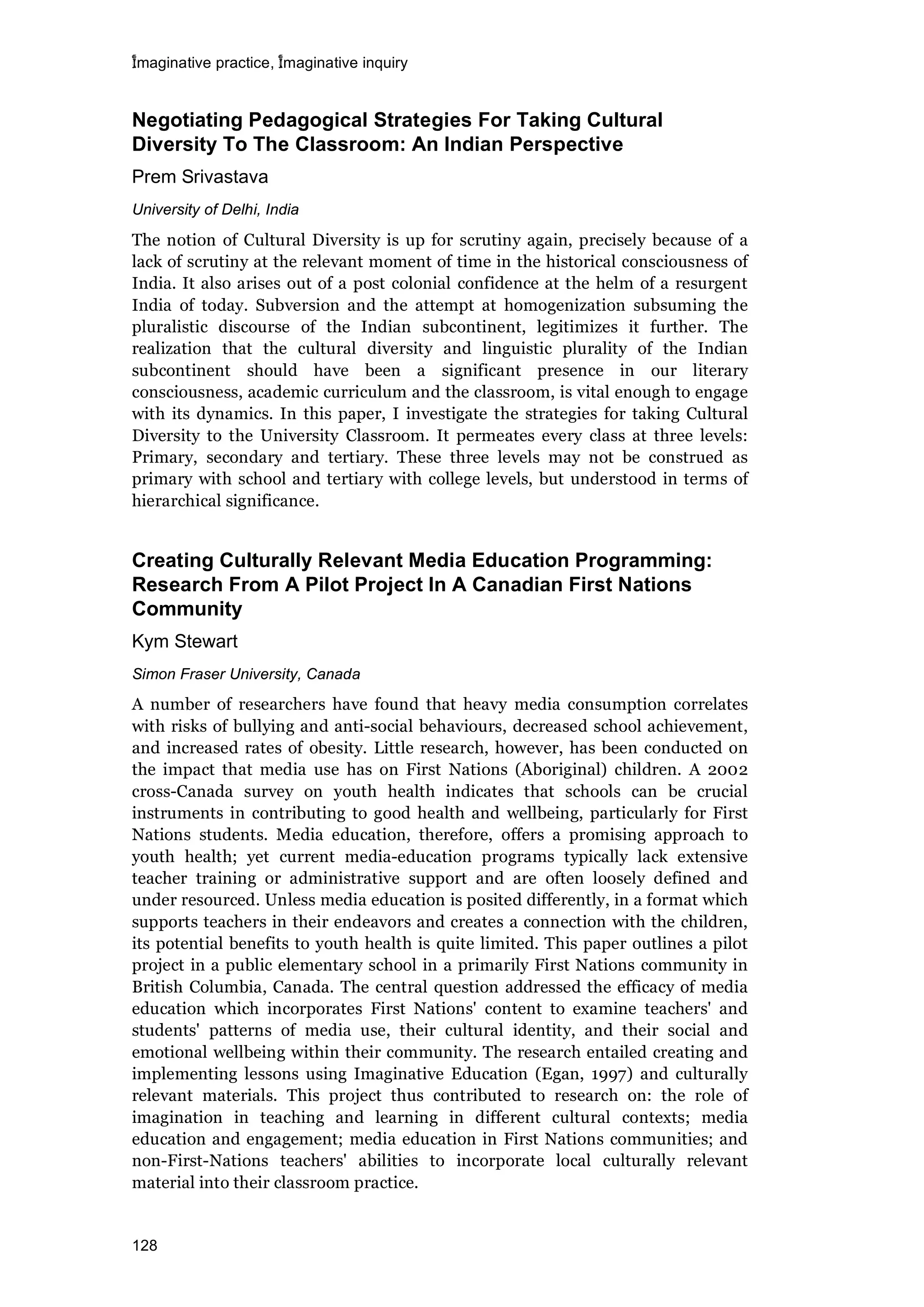
Negotiating Pedagogical Strategies For Taking Cultural Diversity To The
Classroom: An Indian Perspective.....................................................................128
Prem Srivastava
Creating Culturally Relevant Media Education Programming: Research From
A Pilot Project In A Canadian First Nations Community.................................128
Kym Stewart
Images As A Fertile Ground For Evolution Or Involution: The Role Of Mass
Media Images On The Damaging And Nourishing Of The Imagination.........129
Kym Stewart, Thomas W. Nielsen
Toy Design - Engaging The High Ability Learner Holistically.........................129
Hui Leng Tan
America's Ubiquitous Problem Child: The Divergent Learner - An Artifact Of
U.S. Culture Or Is This Challenging Student Surfacing In Other Societies?...130
Stephen Taylor
Storythread - Attentiveness And Sustainable Connections To Self, Others And
Place .....................................................................................................................130
Ron Tooth
Talking The Talk By Dancing The Dance In Preservice Teacher Arts Education131
Miriam Torzillo
Is Imaginative Teacher Education Viable In The Face Of Reform In North
America? Views From The United States And Canada......................................131
Walter Ullrich
Capture Imagination In Learning And Teaching In A Technological
Environment........................................................................................................132
Anna van der Linde
Contents
xi
School Based Reading Programme Evaluation: A Case Study Of A Hong Kong
Primary School ....................................................................................................133
Sally Wan
Invitations to Literacy: Author-Mentorship......................................................133
David Ward
Imagining Professional Community: Identity And Pedagogy Informed By A
Holistic Educational Approach...........................................................................134
Julie White, Patricia McCann, Heywood Peta
Imagination, Risk-Taking And Daring: Teacher, Artist And Researcher
Narratives Of Pedagogy And Practice ................................................................134
Julie White, Christine Sinclair, Lynda Smerdon, Mary Burston
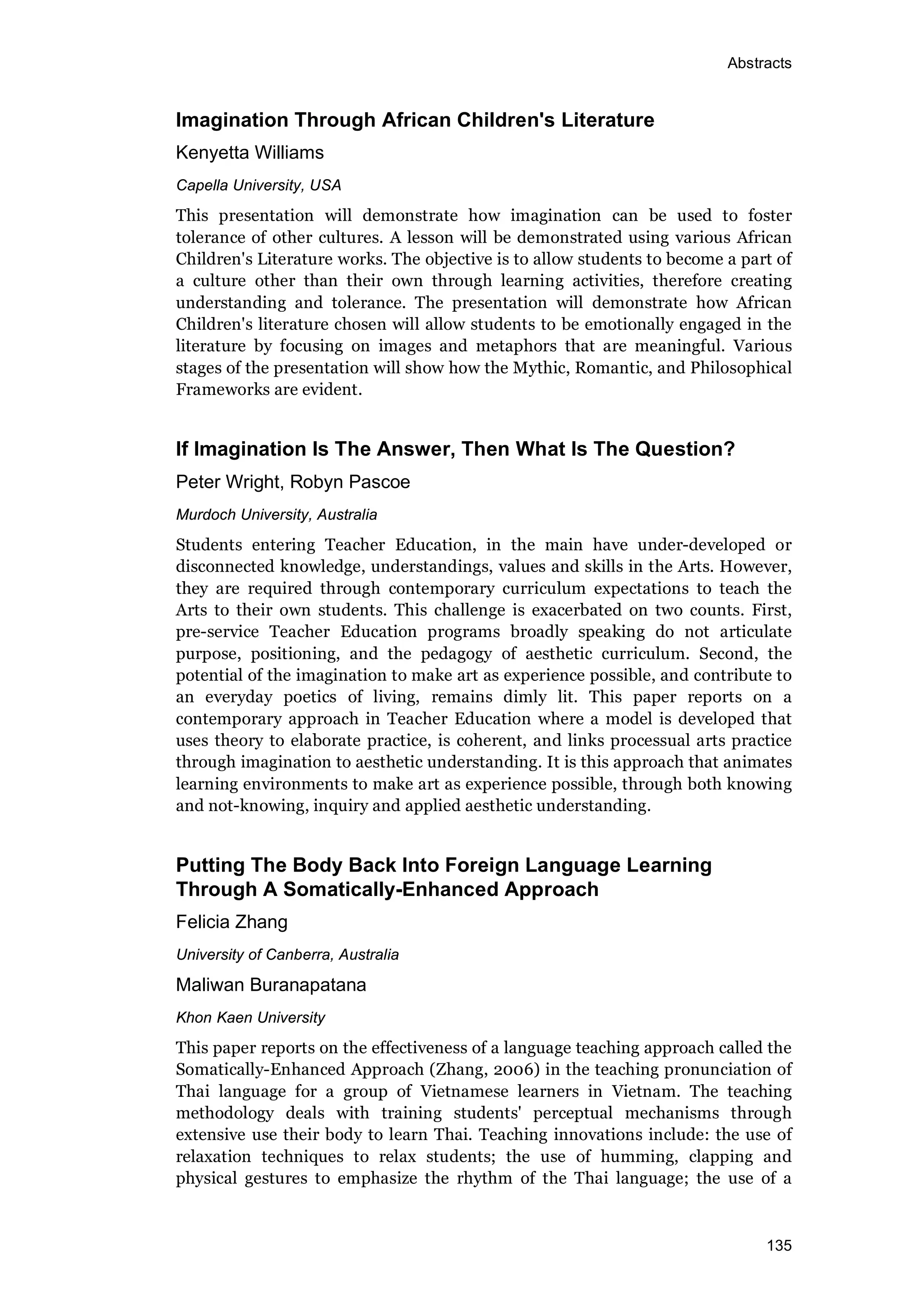
Imagination Through African Children's Literature.........................................135
Kenyetta Williams
If Imagination Is The Answer, Then What Is The Question?...........................135
Peter Wright, Robyn Pascoe
Putting The Body Back Into Foreign Language Learning Through A
Somatically-Enhanced Approach.......................................................................135
Felicia Zhang, Maliwan Buranapatana
Indexes ................................................................................................. 137
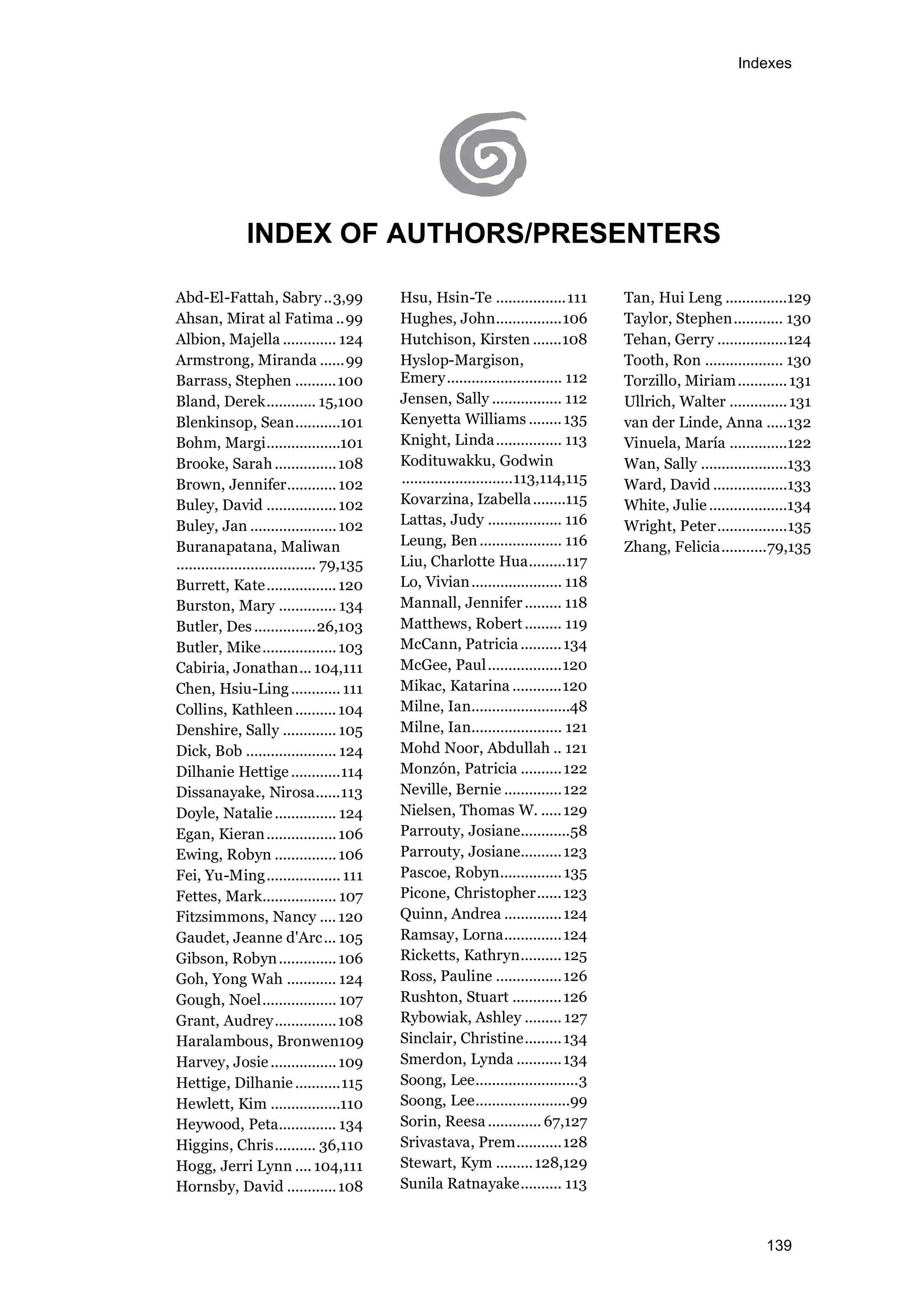
Index of authors/presenters...............................................................................139
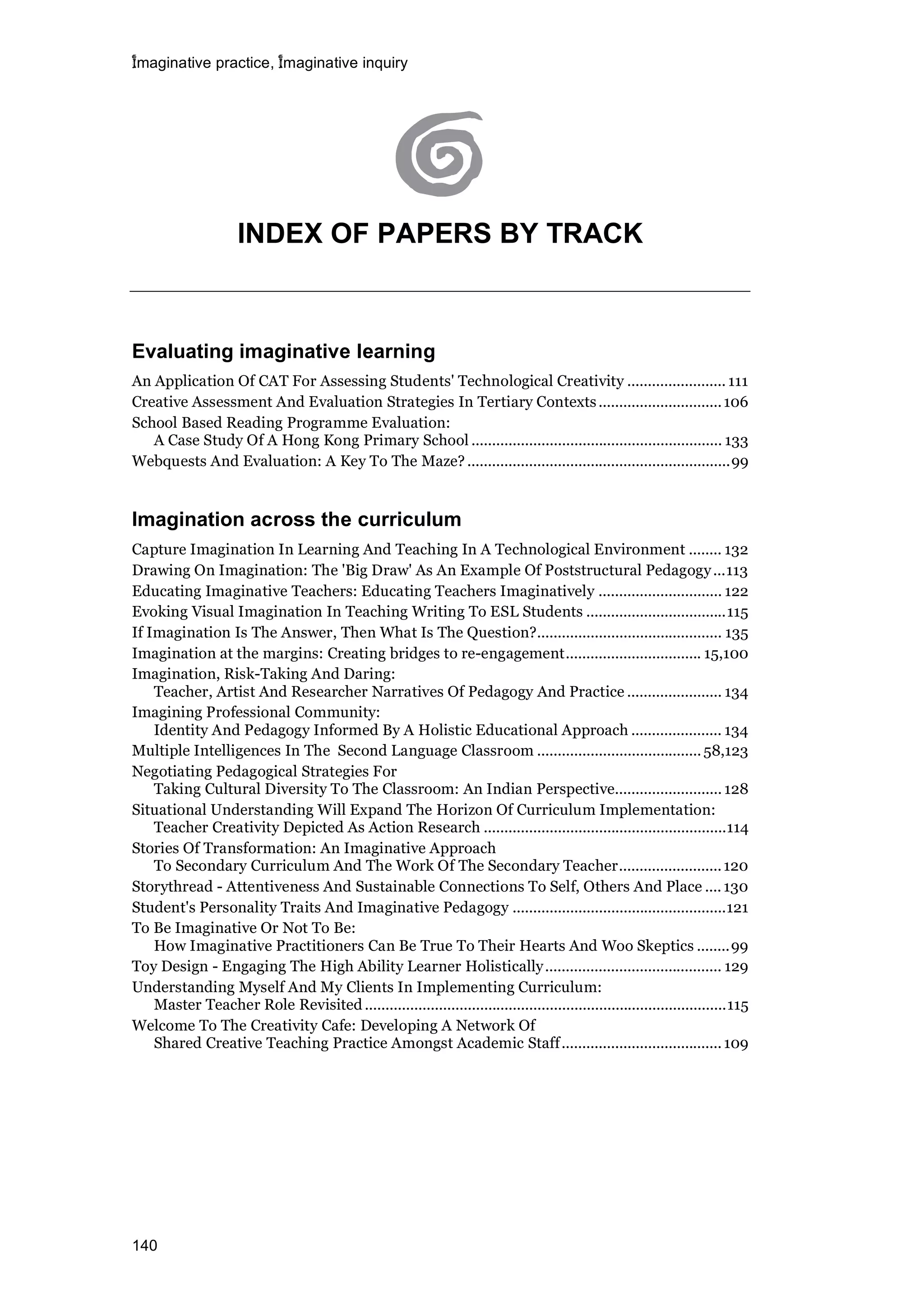
Index of papers by track......................................................................................140
1
Papers
3
TEACHERS MORAL IMAGINATION:
A MULTIFACETED CONCEPT
Sabry Abd-El-Fattah
Lee Soong
University of South Australia
The present study describes the Teachers Moral Imagination Scale (TMIS).
An exploratory factor analysis of the data collected from 182 Egyptian
teachers identified 5 correlated factors: (a) reflection (4 items), (b)
perception (5 items), (c) rationality (4 items), (d) emotion (4 items), and (e)
caring for self (4 items). The reliability of the TMIS subscales ranged from
.76 to .80. There were gender differences in moral imagination. High and low
experienced teachers diverged significantly on reflection, perception, and
rationality. Age correlated positively with rationality. The TMIS correlated
positively with a measure of reflective thinking. Implications of these
findings for measuring teachers’ moral imagination are discussed.
Introduction
Recent developments in education have spurred calls for making moral
dimension of teaching a crucial component of teacher education (Beyer, 1997;
Campbell, 1997; Fallona, 2000). Such developments have also highlighted deep
appreciation of the moral nature of teaching, of teaching as a moral craft, and of
teachers’ own sense of their work as moral in nature. For example, researchers in
teacher education have emphasised teaching as moral practice (Pring, 2001),
moral discourse and reasoning (Beyer, 1997), the moral and spiritual potential of
education (Noddings, 1992), teachers’ examination of their own conduct (Fallona,
2000), values within teaching practices and the culture of the school (Hansen,
1998), educators’ moral commitment to democratic and equitable schools
(Goodlad, Soder, & Sirotnik, 1990), and specific moral education curricula
(Benninga, 1991; Wynne & Ryan, 1993).
The notion of moral imagination refers to “The ability in particular
circumstances to discover and evaluate possibilities, not merely determined by
that circumstance, or limited by its operative mental models, or framed by a set of
rules, or rule governed concerns” (Werhane 1999, p. 93). Werhane (1999) added
that “Moral imagination entails an ability to understand a context or a set of
activities from a number of different perspectives, the actualizing of new
possibilities that are not context-dependent, and the instigation of the process of
evaluating those possibilities from a moral point of view” (p. 5).
imaginative practice, imaginative inquiry
4
Furthermore, researchers have referred to the cognitive and emotional
components of moral imagination (see Werhane, 1999). For example, Johnson
(1993) defined moral imagination as “The ability to imaginatively discern various
possibilities for acting within a given situation and to envision the potential help
and harm that are likely to result from a given action” (p. 202). Johnson’s
definition highlights two important elements of moral imagination: (a) creativity,
as in being able to imagine many possibilities and their consequences, and (b)
rationality, as in being able to morally evaluate the possibilities. Thus, one
cognitive form of moral imagination is perspective taking. This refers to “The
ability to project ourselves imaginatively into a situation into the roles of the
parties affected” (Lickona, 2001, p. 243). Similarly, Heath (1995) described moral
imagination as taken sympathetically the point of view of all those affected by a
decision. Noddings (1993) argued that the emotional connection that an
individual feels towards another is a manifestation of moral imagination as an
experience of empathic feelings. Garrison (1997) added that moral imagination,
as an affective element, highlights the needs, feelings, and vulnerability of moral
agents themselves.
The notion of moral imagination seems to be of particular interest for
researchers, educators, and policy makers. Several reasons could be identified.
For example, Nussbaum (1990), and also Wicks and Glezen (1998) referred to
moral imagination as a creative force in decision making that practitioners can
benefit from. Similarly, Werhane (1998) argued that moral imagination can
improve moral decision. Werhane (1999) highlighted that moral imagination
could influence moral reasoning by allowing individuals to “think more creatively
within the constraints of what is morally possible”’ and to “evaluate from a moral
point of view” the context of a situation that requires moral judgement, the moral
rules that come into play, and “the new possibilities one has envisioned”
(Werhane, 2002, p. 34). As a catalyst of a deliberative process, moral imagination
could also help “sharpening powers of discrimination, exercising the capacity for
envisioning new possibilities, and imaginatively tracing out the implications of
metaphors, prototypes, and narratives” (Johnson, 1993, p. 198) as individuals
construct their ethical decisions. In addition, Kekes (1991) noted that moral
imagination has both an exploratory and a corrective function. The exploratory
function of moral imagination allows the individual more choices regarding
courses of action and character development. It provides individuals with the
ability to compare and contrast their culture with that of others. The corrective
function of moral imagination contributes to self knowledge. It provides the
individual with the ability to perform a retrospective imaginative recreation of
past situations.
Although the concept of moral imagination seems to receive a deliberate
discussion (see Johnson, 1993; Werhane, 1999), there is a possible lack of
consensus regarding a self-report measure that could articulate further the
concept of moral imagination. For example, Johnson (1993) claimed that moral
imagination could be measured as a multifaceted concept. Similarly, Werhane
(1998) conceptualized moral imagination as a three-stage process of approaching
moral decision. Such process entails (a) reproductive, (b) productive, and (c)
creative. Reproductive imagination involves attaining awareness of contextual
factors that affect moral perception such as “(a) awareness of one’s context, (b)
awareness of the script of schema functioning in that context, and (c) awareness
of possible moral conflicts or dilemmas that might arise in that context-that is,
Abd-El-Fattah & Sooong
5
dilemmas created at least in part by the dominating script” (Werhane, 1994, pp.
21-22). Productive imagination involves reframing the problem from different
perspectives. That is “Revamping one’s schema to take into account new
possibilities within the scope of one’s situation and/or within one’s role”
(Werhane, 1994, p. 22). Creative imagination entails developing novel, morally
acceptable alternatives to solve problems. It highlights “(a) The ability to envision
and actualize possibilities that are not context dependent but are encouraged by-
or project-a fresh schema, and/or (b) the ability to envision possibilities that
other reasonable persons could envision, and (c) evaluation: envisioning of how
to morally justify actualizing these possibilities and/or how to evaluate both the
status quo and these newly formulated possible outcomes” (Werhane, 1994, p.
22).
Yurtserver (2006) used Werhane’s framework of moral imagination (Werhane,
1994) to develop the Moral Imagination scale (MI) within the area of business
administration. The sample of the study included 491 participants from six
organizations in Turkey. The MI scale consisted of 29 items; 12 positively and 17
negatively worded items. Participants rated their agreement or disagreement per
item on a 7-point scale. The scale was translated into English and then into
Turkish by different translators to ensure accuracy of translation. An exploratory
factor with varimax rotation of the MI scale identified three factors that explained
41.5 per cent of the total variance extracted. Factor 1, with 29.3 per cent of
variance, was labelled Reproductive Imagination (12 items). Factor 2, with 6.7 of
variance, was labelled Creative Imagination (10 items). Factor 3, with 5.5 percent
of variance, was labelled Productive Imagination (7 items).
The overall reliability of the MI scale was above .87 in all samples. The
reliabilities of all subscales of the MI scale ranged from .71 to .86 in all samples.
The validity of the MI scale was assessed by three methods. In the first method,
the 19 items for which there was agreement by fewer than seven judges out of
eight were not included in the MI scale. Thus, the MI scale consisted of a total of
29 items. In the second method, the correlation coefficients between the judges’
ratings of participants’ moral imagination (as reflected in participants’ answers to
several questions about a moral case) and the participants’ self-ratings of their
own moral imagination were .71 for overall moral imagination, .50 for
reproductive, .46 for creative, and .51 for productive imagination. In the third
method, the MI scale correlated significantly with measures of locus of control,
tolerance of ambiguity, machiavellianism (i.e., to be emotionally less concerned
with others), and empathy. In addition, the MI scale was found to be social
desirability free. Yurtserver concluded that “Future researchers …may improve
the existing MI component scales as well as uncover other possible behavioural
dimensions of moral imagination that have not been empirically addressed.” (p.
218).
In a recent theoretical review of the concept of moral imagination based on
several seminars with teachers students, Joseph (2003) stated “ …I have come to
an integrated understanding of moral imagination as a multifaceted concept with
five interwoven elements: (a) perception, (b) rationality, (c) reflection, (d)
emotion, and (e) caring for self” (p. 16). These five elements of moral imagination
are reviewed in the following sections.
Perception refers to “The ability of people to become aware of others and their
needs, desires, interests, wishes, hopes, and potentials.” (Joseph, 2003 p. 16).
This perception “allows us to perceive ‘their’ needs, desires, interests, wished, and
imaginative practice, imaginative inquiry
6
hopes” (Garrison, 1997, p. 66). According to Simpson and Garrison (1995),
“Moral perception allows ‘teachers’ to see the unique needs, desires, and interests
hidden in the words and deeds of ‘their’ students. It also allows them to see not
just who students are here and now, but the future of their best possibilities” (p.
252).
Moral rationality refers to realistic understanding of situations and events
calling for moral responses. That is, moral rationality refers to the ability to be
flexible and not just apply a moral value or rule to every situation (Joseph, 2003).
Johnson (1993) stated that “Our imaginative rationality is the chief means we
have for dealing critically, creatively, and sensitively with the novel situations that
arise for us each day” (p. 77). Put bluntly, we do not tend to just apply a moral
value or rule to every circumstance or situation, but we are expected to
understand the particular issues and problems at stake.
Reflection refers to “The continuing examination of beliefs and actions and
consideration of how they affect other people and the questioning of the origins of
our beliefs and values” (Joseph, 2003, p. 16). Reflection seems to help us
investigating the origins of our values and to question if ours ethics stem from
thoughtfully constructed choices or unexamined convention (Joseph, 1990). In
addition, reflection could help determine if our worldviews and values are
identical to or contrast with those of others. According to Joseph (2003), “By
fostering critical reflection, we, as teacher educators, do more than merely
celebrate our students’ moral voices; rather, we help them to question their own
values and actions” (p. 16).
The fourth element of moral imagination is emotions. Emotions are embedded
in our sympathetic connections and responsiveness to others. According to
Noddings and Shore (1984), “Moral intuition constructed as moral feeling is
clearly very different from the intuition of moral knowledge….it provides the
initial impulse to act in a caring fashion. A person senses the pain of others and,
without deliberation, feels that I must do something! The catalyst for moral
action is the capacity for feeling” (p. 63). Nurturing the emotional connection of
educators to their students seems to remove the sense of teachers as controllers
and students as objects.
The fifth element of moral imagination is caring for self. Caring for self refers
to “Affirmation of individuals’ need for their lives to have meaning and
purpose…awareness that as moral agents, individuals have needs that must be
considered” (Joseph, 2003, p. 16). Garrison (1997) highlighted that moral
imagination does not imply ‘self-eradication’. ‘Ethical agents’, he continued,
should “consider their own needs as well as those of others in the context of
formulating a caring response… To perceive the needs of others, we must be
vulnerable enough to know that we, too, are needful” (p. 66). We, as teacher
educators, should broaden our ideas about the moral dimensions of teaching by
imaginatively taking into account the hopes and experiences of teachers, caring
about them as people, and helping them to care about themselves.
Aim of the study
The primary goal of the present study was to develop a new measure of moral
imagination that is consistent with Joseph’s analysis of teachers’ moral
imagination (Joseph, 2003). Using Yurtserver’s MI scale (Yurtserver, 2006) as a
Abd-El-Fattah & Sooong
7
starting point, we developed items which reflected moral imagination as a
multifaceted construct that include (a) perception, (b) rationality, (c) reflection,
(d) emotion, and (e) caring for self. Accordingly, we developed the Teachers
Moral Imagination Scale (TMIS), and sought to test its psychometric properties
using data collected from a sample of Egyptian teachers.
Methods
Participants
Subject of the present study included 182 (98 males and 84 females) teachers
recruited from 8 primary schools in El-Minia, Egypt. The mean age was 31 years,
with a range from 25 to 46. Participation was voluntarily. Although the exact
numbers are unknown, it is believed that 18 teachers in the approached schools
declined to participate in data collection for the present study.
Measurements
The Teachers Moral Imagination Scale (TMIS) was developed for use within the
present study. A pool of 21 items was developed to measure five factors: (a)
perception, (b) rationality, (c) reflection, (d) emotion, and (e) caring for self.
Respondents rated their agreement or disagreement per item on a 4-point Likert
type scale that ranged from 1 (Strongly Disagree) to 4 (Strongly Agree).
Procedure
The initial version of the TMIS was prepared in English and the first author
translated it into Arabic. Applying a blind-back-translation strategy, two qualified
translators, working without referencing to the English version of the TMIS,
translated the Arabic version into English. Other two qualified translators
independently compared the original English version of the TMIS to the new
English version that was translated back from Arabic, and rated the match
between the two versions on a scale from 1 to 10. A score of 1 represented poor
match, whereas a score of 10 represented perfect match. The average percentage
of match between the two versions of the TMIS was 96 per cent which could be
considered acceptable (see Brislin, Lonner, & Thorndike, 1973). All the
translators were accredited with the British-Egyptian Centre in El-Minia, Egypt.
The Arabic version of the TMIS was administered to the sample of the study with
some assistance from other teachers in the targeted schools. The sampled
teachers were also requested to respond to several questions concerning their
age, gender, years of teaching experience (as measured by the numbers of years
working as a full-time teacher).
Results
Factor analysis
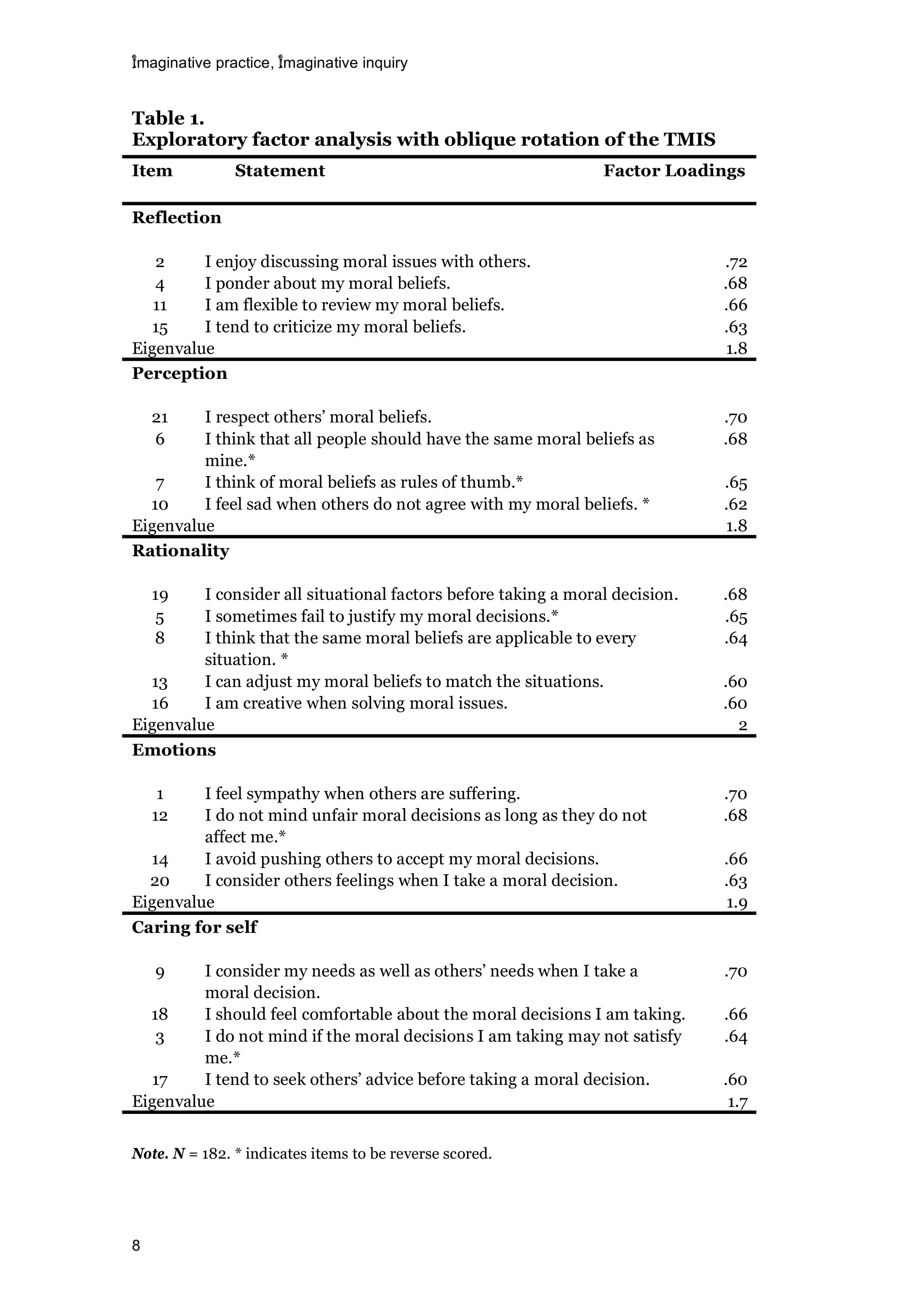
An exploratory factor analysis with oblique rotation, presented in Table 1, of the
21 items of the TMIS identified five factors: (a) reflection (4 items, Cronbach
alpha = .78), (b) perception (5 items, Cronbach alpha = .80), (c) rationality (4
items, Cronbach alpha = .77), (d) emotion (4 items, Cronbach alpha = .77), and
(e) caring for self (4 items, Cronbach alpha = .76). The TMIS item factor loadings
imaginative practice, imaginative inquiry
8
Table 1.
Exploratory factor analysis with oblique rotation of the TMIS
Note. N = 182. * indicates items to be reverse scored.
Item Statement Factor Loadings
Reflection
2 I enjoy discussing moral issues with others. .72
4 I ponder about my moral beliefs. .68
11 I am flexible to review my moral beliefs. .66
15 I tend to criticize my moral beliefs. .63
Eigenvalue 1.8
Perception
21 I respect others’ moral beliefs. .70
6 I think that all people should have the same moral beliefs as
mine.*
.68
7 I think of moral beliefs as rules of thumb.* .65
10 I feel sad when others do not agree with my moral beliefs. * .62
Eigenvalue 1.8
Rationality
19 I consider all situational factors before taking a moral decision. .68
5 I sometimes fail to justify my moral decisions.* .65
8 I think that the same moral beliefs are applicable to every
situation. *
.64
13 I can adjust my moral beliefs to match the situations. .60
16 I am creative when solving moral issues. .60
Eigenvalue 2
Emotions
1 I feel sympathy when others are suffering. .70
12 I do not mind unfair moral decisions as long as they do not
affect me.*
.68
14 I avoid pushing others to accept my moral decisions. .66
20 I consider others feelings when I take a moral decision. .63
Eigenvalue 1.9
Caring for self
9 I consider my needs as well as others’ needs when I take a
moral decision.
.70
18 I should feel comfortable about the moral decisions I am taking. .66
3 I do not mind if the moral decisions I am taking may not satisfy
me.*
.64
17 I tend to seek others’ advice before taking a moral decision. .60
Eigenvalue 1.7
Abd-El-Fattah & Sooong
9
ranged from .60 to .72. The percentage of variance explained was 19 per cent for
perception, 15 per cent for rationality, 12 per cent for reflection, 10 per cent for
emotions, and 10 per cent for caring for self.
Reflection had a positive relationship of .32 with perception, and .30 with
rationality, emotions, and caring for self. Perception had a positive relationship of
.31 with rationality and emotions, and .30 with caring for self. Rationality had a
positive relationship of .32 with emotions, and .31 with caring for self. There was
a positive relationship of .34 between emotions and caring for self. All reported
correlations were significant (p < .01).
Differences in TMIS
Gender
A series of ANOVA was run to test gender differences in moral imagination (see
Table 2). The analysis showed that male teachers had significant higher scores
than female teachers on reflection, perception, and rationality. However, the
analysis showed that female teachers had significant higher scores than male
teachers on emotions and cares for self.
Table 2.
Gender differences in moral imagination
Variables /Statistic n M SD F (1, 180)
*
d**
Reflection 13.2 .32
Males 98 12.2 4.3
Females 84 11 3.2
Perception 9.3 .28
Males 98 10.8 3.1
Females 84 10 2.5
Rationality 9.8 .29
Males 98 9.6 2.6
Females 84 8.8 2.9
Emotions
Males 98 8.1 2.2 9.5 - .29
Females 84 8.7 1.9
Caring for self
Males 98 9.8 2.5 8.4 - .26
Females 84 10.5 2.8
Note. p < .05 for all instances. ** d represents Cohen’s effect size (Cohen, 1988)
Age
A series of Pearson’s product moment correlation coefficient showed
nonsignificant relationship between teachers’ age and their reflection (r = .09, p
> .05), perception (r = .08, p >.05), emotions (r = .07, p > .05), and caring for self
(r = .08, p > .05). However, there was a significant positive relationship between
teachers’ age and rationality (r = .29, p < .01). This relationship hold true for
male (r = .31, p < .01) and female teachers (r = .28, p < .01). The z- statistic (z =
imaginative practice, imaginative inquiry
10
.22, p > .05) indicated nonsignificant differences between the correlation of age
and rationality for male and female teachers.
Teaching experience
A median split procedure was adopted to compare teachers with different levels
of teaching experience over reflection, perception, rationality, emotions, and
caring for self. The median of teaching experience was 13 years. Teachers whose
teaching experience falls on or around the median (11, 12, and 13 years) was
deleted from the total cohort. Such procedure has resulted in a deletion of total of
31 teachers. Thus, a total of 151 teachers were coded into high (N = 78) and low
(N = 73) levels of teaching experience.
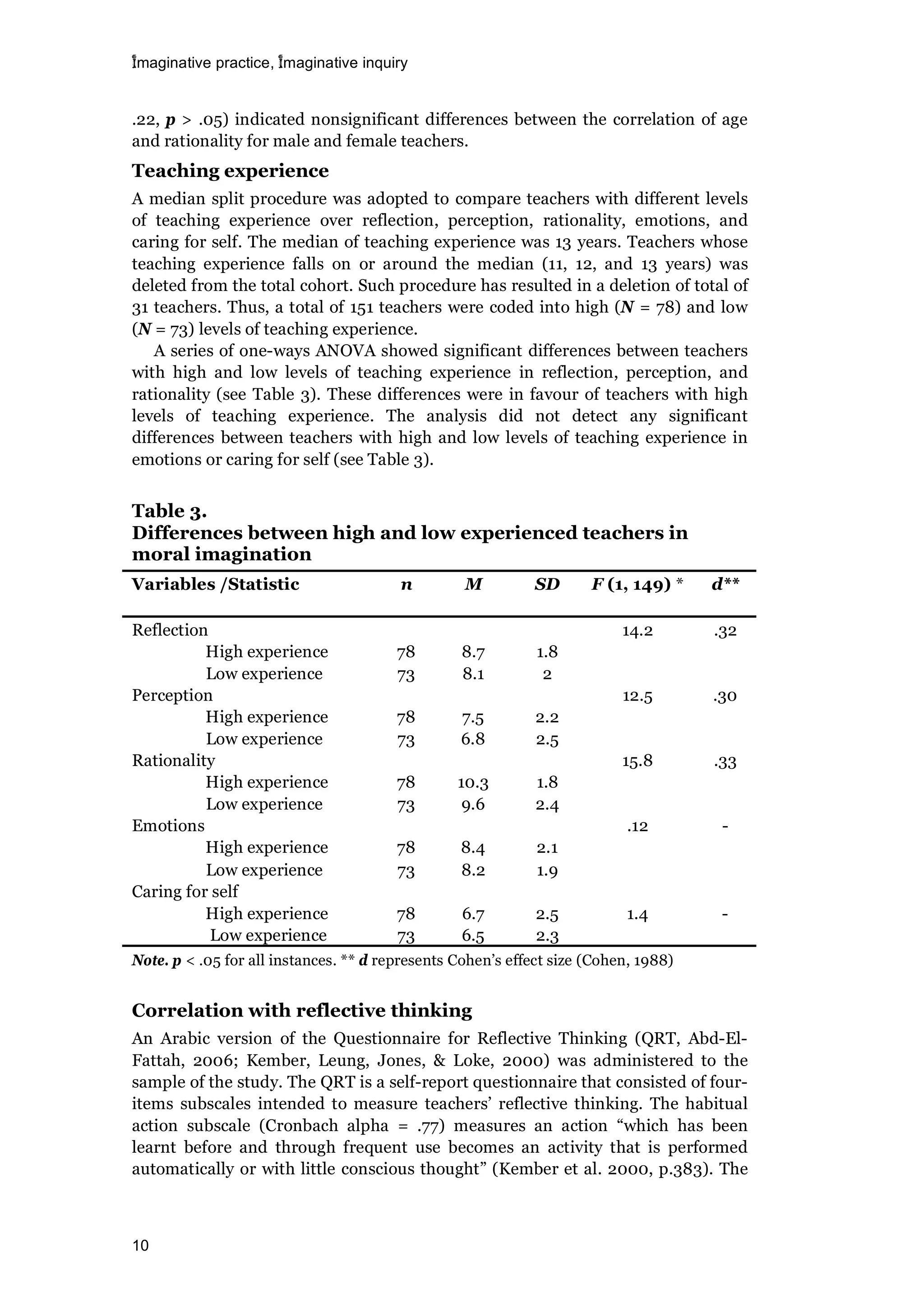
A series of one-ways ANOVA showed significant differences between teachers
with high and low levels of teaching experience in reflection, perception, and
rationality (see Table 3). These differences were in favour of teachers with high
levels of teaching experience. The analysis did not detect any significant
differences between teachers with high and low levels of teaching experience in
emotions or caring for self (see Table 3).
Table 3.
Differences between high and low experienced teachers in
moral imagination
Variables /Statistic n M SD F (1, 149) * d**
Reflection 14.2 .32
High experience 78 8.7 1.8
Low experience 73 8.1 2
Perception 12.5 .30
High experience 78 7.5 2.2
Low experience 73 6.8 2.5
Rationality 15.8 .33
High experience 78 10.3 1.8
Low experience 73 9.6 2.4
Emotions .12 -
High experience 78 8.4 2.1
Low experience 73 8.2 1.9
Caring for self
High experience 78 6.7 2.5 1.4 -
Low experience 73 6.5 2.3
Note. p < .05 for all instances. ** d represents Cohen’s effect size (Cohen, 1988)
Correlation with reflective thinking
An Arabic version of the Questionnaire for Reflective Thinking (QRT, Abd-El-
Fattah, 2006; Kember, Leung, Jones, & Loke, 2000) was administered to the
sample of the study. The QRT is a self-report questionnaire that consisted of four-
items subscales intended to measure teachers’ reflective thinking. The habitual
action subscale (Cronbach alpha = .77) measures an action “which has been
learnt before and through frequent use becomes an activity that is performed
automatically or with little conscious thought” (Kember et al. 2000, p.383). The
Abd-El-Fattah & Sooong
11
understanding subscale (Cronbach alpha = .78) measures understanding as
described by Mezirow (1991), and also Kember et al (2000, p.384) as a thoughtful
action that “makes use of existing knowledge, without attempting to appraise that
knowledge, so learning remains within pre-existing meaning schemes and
perspectives. Thoughtful action can be described as a cognitive process.” The
reflection subscale (Cronbach alpha = .81) involves “the critique of assumptions
about the content or process of problem solving. The critique of premises or
presuppositions pertains to problem posing as distinct from problem solving.
Problem posing involves making a taken-for-granted situation problematic,
raising questions regarding its validity” (Mezirow, 1991, p. 105 as quoted by
Kember et al, 2000, p.384). The critical reflection subscale (Cronbach alpha =
.79) involves the testing of premises. “Premise reflection requires a critical review
of presuppositions from conscious and unconscious prior learning and their
consequences.” (Kember et al., 2000, p.385). Students rated their agreement or
disagreement per item on a 4-point Likert type scale that ranged from 1 (Strongly
disagree) to 4 (Strongly agree).
A series of Person’s product moment correlation coefficients showed
significant relationship between teachers’ moral imagination and reflective
thinking (see Table 4).
Table 4. Correlation between teachers’ moral imagination and
reflective thinking
Variable 1 2 3 4 5 6 7 8 9
1. Reflection -
2. Perception .32 -
3. Rationality .30 .31 -
4. Emotions .30 .31 .32 -
5. Caring for self .30 .30 .31 .34 -
6. Habitual action - .31 - .30 - .33 .26 .27 -
7. Understanding .30 .32 .34 .27 .28 .30 -
8. Reflection .30 .30 .33 .27 .26 - .31 .33 -
9. Critical reflection .31 .30 .32 .27 .26 -.30 .32 .35 -
Note. N = 182. p < .05.
Discussion
Joseph (2003) conducted several seminars with teacher students to conceptualize
the notion of moral imagination. She summarised that moral imagination could
be described as a multifaceted concept that includes reflection, perception,
rationality, emotions, and caring for self. The present study aimed at developing a
self-report scale of teachers’ moral imagination based on Joseph’s framework. We
call it the Teacher’s Moral Imagination Disposition Scale (TMIS). Since the scale
is of 21-items, and can be completed within 5 minutes, we believe that the TMIS
is an instrument that will prove useful in further studies into moral imagination.
imaginative practice, imaginative inquiry
12
The original intention was for the scale to be serviceable, brief, and easy to
administer and score.
Our data suggest that the TMIS has merit as an index of teachers’ moral
imagination. The exploratory factor analysis identified five correlated factors that
were consistent with Joseph’s framework of moral imagination. (a) reflection (4
items), (b) perception (5 items), (c) rationality (4 items), (d) emotion (4 items),
and (e) caring for self (4 items). The TIMIDS showed acceptable reliability
coefficients. It appears more appropriate to employ the TMIS to describe scores
along traditional psychometric dimensions. Within the current datasets,
responses to all items of the TMIS conform to standard distributional
assumptions, and coherent and normal properties appear to be evident.
In terms of gender differences in moral imagination, the analysis showed that
male teachers (a) tended to re-examine and think carefully about their moral
beliefs (b) analyse moral problems and consider all situational factors when taken
a moral decision, and (c) appreciate individuality in moral beliefs (e.g.,
individuals are unique in their needs, desires, and interests). However, female
teachers tended to be more emotional when taking a moral decision. That is,
female teachers showed higher levels of sympathetic connections and
responsiveness to others. They were also more likely to assure balance between
their own needs and desires (i.e., self-affirmation and self-caring) and others’
needs and interests when taking a moral decision.
This finding is consistent with what Johnson (1993) highlighted that women
posses elevated levels of self-caring and affirmation. However, their sympathetic
feelings work to balance between what they need and what others desire. It is
such balance that conceptualizes women’s moral beliefs. However, men are more
likely to think analytically and scrutinize the moral situations. Similarly,
researchers have found that females were most concerned with issues of care, in
that they either incorporated care concerns to a greater extent when making
moral judgments than did males (Gilligan, & Attanucci, 1988; Kalkoske, 1993), or
that they used ethics of care to a greater extent (Gilligan, & Attanucci, 1988).
The analysis has also indicated that there is a positive relationship between
teachers’ age and rationality of moral imagination. That is, the elder the teachers,
the more likely they were to show realistic understanding of situations calling for
moral response and judgment. This finding has been replicated in several studies
based on samples of college students (Shaver, 1987; Foster & LaForce, 1999). In
addition, the results of the present study showed that experienced teachers
tended to show higher levels of rationality, perception, and reflection. That is,
experienced teachers were more likely to think rationally about their moral
decisions and speculate on their moral beliefs. Furthermore, the concurrent
validity of the TMIS was evident through its correlation with a measure of
reflective thinking. The analysis showed that teachers who tended to ponder
about their moral beliefs and think rationally about their moral decisions showed
high levels of understanding, reflection, and critical reflection but low levels of
habitual action.
In brief, the TMIS represents an acceptable measure of teachers’ moral
imagination based on Joseph’s (2003) conceptualization of moral imagination.
The TMIS consisted of five subscales with a total of 21 items that proved to
possess satisfactory psychometric properties. Also, the validity of the TMIS was
evident when correlated with a measure of reflective thinking.
Abd-El-Fattah & Sooong
13
Educational implications
Linking to educational development, the concept of moral imagination highlights
several important implications for teaching practices. Firstly, moral imagination
can be used as a guide to integrate the moral dimensions of teaching into teacher
education and development. Secondly, moral imagination requires us to
encourage teachers to articulate issues stemming from their own concerns as
practitioners and as individuals to perceive the moral possibilities of their work.
Thirdly, moral imagination entails a perception of moral values, beliefs, and
actions as inherent characteristics in all human activities, particularly teaching
practices. Fourthly, moral imagination could help nurture teachers as they reveal
their moral dilemmas associated with their own teaching profession. Fifthly,
moral imagination could encourage us to have teachers critically challenge their
own beliefs and thinking as they articulate values and characterise themselves as
moral agents. Finally, moral imagination could allow teachers to see their
students’ potentials for future educational developments.
References
Abd-El-Fattah, S. M. (2006). The Questionnaire for Reflective Thinking: Psychometric
properties. Unpublished data. El-Minia University, Egypt
Benninga, J. S. (1991). Moral, character, and civic education in the elementary School.
New York: Teachers College Press.
Beyer, L. E. (1997). The moral contours of teacher education. Journal of Teacher
Education, 48, 245-254.
Brislin, R. W., Lonner, W. J., & Thorndike, E. M. (1973). Cross-cultural research
methods. New York: John Wiley.
Campbell, E. (1997). Connecting the ethics of teaching and moral education. Journal of
Teacher Education, 48, 255-263.
Cohen, J. (1988). Statistical power analysis for the behavioural sciences (2nd
ed.).Hillsdale, NJ: Lawrence Erlbaum Associates.
Fallona, C. (2000). Manner in teaching: A study in observing and interpreting teachers’
moral virtues. Teaching and Teacher Education, 16, 681-695.
Foster, J. D., & LaForce, B. (1999). A longitudinal study of moral, religious, and identity
development in a Christian liberal arts environment. Journal of Psychology and
Theology, 27, 52-68.
Garrison, J. (1997). Dewey and Eros: Wisdom and the desire in the art of teaching. New
York: Teachers College Press.
Gilligan, C., & Attanucci, J. (1998). Two moral orientations: Gender differences and
similarities. Merrill-Palmer Quarterly, 33, 223-237.
Goodlad, J. L., Soder, R., & Sirotnik, K. A. (1990). The Moral dimensions of teaching. San
Francisco: Jossey Bass.
Hansen, D. T. (1998). The moral is in the practice. Teaching and Teacher Education, 14,
643-655.
Heath, E. (1995). The commerce of sympathy: Adam Smith on the emergence of morals.
Journal of the History of Philosophy, 33, 447-467.
Johnson, M. (1993). Moral imagination: Implications of cognitive science for ethics.
Chicago: University of Chicago Press.
Joseph, P. B. (1990). Charts and layers/heads and hearts: Toward an integrated theory of
moral education. Theory and Research in Social Education, 28, 7-26.
Joseph, P. B. (2003). Teaching about the moral classroom: Infusing the moral
imagination into teacher education. Asia-Pacific Journal of Teacher Education, 31, 7-
20.
imaginative practice, imaginative inquiry
14
Kalkoske, M. S. (1993). Sex differences in moral orientation: Results from an
examination of concurrent correlates. Paper presented at the meeting of the Society
for Research in Child Development, New Orleans, Louisiana.
Kekes, J. (1991). Moral imagination, freedom, and the humanities. American
Philosophical Quarterly, 28, 101-111.
Kember, D., Leung, D., Jones, A., & Loke, A. Y. (2000). Development of a questionnaire
to measure the level of reflective thinking. Assessment and Evaluation in Higher
Education, 25, 380-395.
Lickona, T. (2001). What is good character? Reclaiming Children and Youth, 9, 239-251.
Mezirow, J. (1991). Transformative dimensions of adult learning. San Francisco: Josey-
Bass.
Noddings, N. (1992). The Challenge to care in schools: An alternative approach to
education. New York: Teachers College Press.
Noddings, N. (1993). Caring: A feminist perspective. In K. A. Strike & P. L. Ternasky
(Eds.), Ethics for professionals in education (pp. 43-53). New York: Teachers College
Press.
Noddings, N., & Shore, P. J. (1984). Awakening the inner eye: Intuition in education.
New York: Teachers College Press.
Nussbaum, M. C. (1990). Love’s knowledge. Oxford: Oxford University Press.
Pring, T. (2001). Education as moral practice. Journal of Moral Education, 30, 101-112.
Shaver, D. G. (1987). Moral development of students attending a Christian, liberal arts
college and a Bible college. Journal of College Student Personnel, 28, 211-218.
Simpson, P. J., & Garrison, J. (1995). Teaching and moral perception. Teachers College
Record, 97, 252-278.
Werhane, P. H. (1994). Moral imagination and the search for ethical decision making in
management. The Ruffin Lectures in Business Quarterly. The Ruffm Series: Special
Issue, 1, 75-98.
Werhane, P. H. (1998). Moral imagination and management decision-making. Business
Ethics Quarterly, Ruffm Series: Special Issues, 1, 75-98.
Werhane, P. H. (1999). Moral imagination and management decision-making. New
York: Oxford University Press.
Werhane, P. H. (2002). Moral imagination and systems thinking. Journal of Business
Ethics, 38, 33-42.
Wicks, A. C., & Glezen, P. L. (1998). In search of experts: A conception of expertise for
business ethics consultation. Business Ethics Quarterly, 8, 105-126.
Wynne, E. A., & Ryan, K. (1993). Reclaiming our schools: A handbook on teaching
character, academics, and discipline. New York: Merrill.
Yurtserver, G. (2006). Measuring moral imagination. Social Behaviour and Personality,
34, 205-220.
15
IMAGINATION AT THE MARGINS: CREATING
BRIDGES TO RE-ENGAGEMENT
Derek Bland
Queensland University of Technology
For marginalised secondary school students, mainstream education may no
longer be an inviting place. While proposed solutions to the problem appear
to concentrate on transforming the students and finding ways to coerce them
back to mainstream education, this paper suggests that solutions may be
found by engaging with the students in the margins that they occupy. It is
suggested that, through the scaffolded application of active imagination via a
‘students-as-researchers’ model, it is possible for the students to identify
their own connections to the mainstream where appropriate for them.
“The margin is the place for those feelings and intuitions that daily life
doesn’t have a place for and mostly seems to suppress” (Donoghue, 1983, in
Greene, 1991, p. 27).
At risk, marginalised and disengaged
Many labels are applied to secondary school students who, for various reasons,
inhabit the margins of formal education. They are considered to be ‘at-risk’,
‘disengaged’, ‘disaffected’, ‘disadvantaged, and ‘marginalised’ to name a few.
Perhaps this variety of terms indicates the difficulties in identifying solutions to
the problems associated with educational marginalisation. While most proposed
solutions appear to concentrate on transforming the students and finding ways to
coerce them back to mainstream education, this paper suggests that solutions
may be found by engaging with the students in the margins that they occupy. It is
suggested that, through the scaffolded application of active imagination via a
‘students-as-researchers’ model, it is possible for the students to identify their
own connections to the mainstream where appropriate for them.
The aim of this paper is not to romanticise marginalisation, nor to ignore its
potentially damaging outcomes for students, but to suggest that once students
have moved into the margins, the mainstream is no longer an inviting place and
other means must be found of working with them towards educational
empowerment.
This paper builds on a previous virtual IERG conference presentation (Bland,
2004), investigating further the issues involved in working with marginalised
students as researchers. The data is developed from focus groups and interviews
with participants in an action research project. In the previous paper, features of
a students-as-researchers project were considered that had contributed to
imaginative practice, imaginative inquiry
16
positive outcomes for the project participants and their schools. The current
paper looks at the reasons behind marginalisation, identifying the ways in which
project participants have found for themselves a purpose for connecting to the
mainstream an considering tertiary education. The Education reforms that
require students to be “learning or earning” may not be appropriate to those
already hostile to mainstream institutions. Voices from the margins may, instead,
inform more imaginative means to build bridges of engagement1.
Resistance and marginalisation
Marginalisation is the educational option of choice for many secondary school
students who feel excluded from school cultures. Self-marginalised young people
may see education as offering the potential to open their future prospects but
frequently feel devalued by their schools while the pathways available to them are
also less valued (Australian Centre for Equity through Education & the Australian
Youth Research Centre, 2001). When schooling becomes an alienating and
irrelevant experience, students “see themselves as having little choice other than
to walk away from it” (Smyth & Hattam, 2001, p. 403), withdraw their labour
(McInerney, 2006) and actively exercise “their right to resist, which means they
are making choices to ‘not learn’” (Smyth, 2006, p. 282). Attitudes may then
harden into hostility towards the institution of schooling (Smyth , 2006) which
maintains an authority and privilege to which they have no access (Connell,
1993), attending only because of legal requirements.
In his classic study of self-marginalised students in Britain, Willis (1977)
argued that “the lads” (a self-titled sub-culture of working-class schoolboys)
resistance to school was associated with affirmation of their working-class
culture. Similarly, in the US, Traber (2001) tracked the self-marginalisation of
groups of disenfranchised US youth, aligning themselves with the punk
movement that had itself appropriated the margins of society. In doing so, these
young people were constructing an oppositional identity, worn as a “badge of
honour” (Traber, 2001, p. 47), and perceived as undesirable by the conservative
mainstream, and consciously rejecting the privileges of the dominant culture.
Separation through sub-cultures can empower a “collective confidence” and often
serves as a “primary function in youth cultures formed by disaffiliated
adolescents” (Kearney, 1998, p. 152). Kearney, for instance, described the growth
of the “riot grrrl” sub-culture, formed in the early 1990’s in both the US and the
UK and comprising adolescent females. Some riot grrrl members, Kearney said,
found the group to be a safe haven from misogyny and homophobia.
Intervention strategies
One government response to dealing with the risks associated with educational
marginalisation has been to enforce a regime of attendance in an approved
activity. Recent changes to government policy in Queensland relate to research
demonstrating improved life choices for students who complete Year 12.
1 Students and teachers quoted in this paper were participants in the Student Action
Research for University Access (SARUA) project. A full evaluation and description of the
project is included in a PhD study on which much of this paper is based. Follow up
interviews with participants are also referred to in this paper.
Bland
17
Effectively raising the school leaving age, the legislation requires young people to
be “learning or earning … for two years after they complete compulsory schooling
(i.e. completed year 10 or turned 16 years of age) or until they turn 17 years of age
or until they complete a Queensland Certificate of Education or a Certificate III
(or higher level) vocational qualification” (Education Queensland, 2007). This
legislation also increases the policing and surveillance of young people through
“Student Accounts”, “Learner Unique Identifier” numbers, and the establishment
of overseeing committees. Using the information thus collected “the Department
will have information on young people who are not participating in eligible
options during their compulsory participation phase. From this data, the
Department will be able to identify young people who are not engaged in
learning.” (Education Queensland, 2007).
Whether the resulting “engagement” will offer genuine and broad-ranging
post-school options to disaffected students remains to be seen. In an
investigation of alternative education provision in a disadvantaged area of a
major Queensland city, Connor (2006) found that such students are offered
limited choice through a focus on vocational education and training (VET). While
this may suit some of the marginalised students, a one-size-fits-all approach
closes off other options and, as stated by Zyngier (2003), “a practical hands-on
curriculum is not necessarily an engaging curriculum” (p. 43). Connor calls for an
education that builds connections to a range of post-compulsory learning.
Similarly, recent UK research that concluded that education policy should
encourage “all disadvantaged young people to value and aspire towards post-
compulsory education” (Joseph Rowntree Foundation, 2000, para. 24).
Deficit approaches
A problem with attempts to maintain disaffected students within the mainstream
education system is that they are, in general, deficit-based. One of the most
pervasive assumptions surrounding students who have disengaged from school is
that the cause rests with the student (Smyth & Hattam, 2001) and, in such
reasoning, academic (in)ability is attributed to shortcomings in the home,
impoverished language, a lack of ambition and other “key” attributes for success
(Connell, 2003). Variations of deficit theory imply that the disengaging student
has anti-social tendencies, has an unsupportive family, comes from an
undesirable community or is influenced by an anti-academic peer group. While
some of these factors may be true of some students and environments some of the
time, these students are not necessarily delinquent nor lacking in ability, but find
the middle class institution of schooling to be “completely banal, meaningless and
without purpose, except as a reasonably pleasant place in which to meet and
socialize with one’s friends” (Smyth, 2006, p. 286). The generalisation of deficit
interpretations to all disengaged students’ unwelcome behaviour avoids
questioning the relevance of official knowledge (Apple, 1996) for non-mainstream
students and, how cultural and structural biases exist in schools, entrenching
processes of social reproduction and disadvantage (Meadmore, 1999).
There may be little incentive for marginalised students to return to
mainstream schooling. Levin (2000) cites a considerable body of evidence
showing that “disadvantaged students tend to receive the least interesting, most
passive forms of instruction” (p. 164) and one recent Queensland study found
imaginative practice, imaginative inquiry
18
that the most educationally disadvantaged students are condemned to mediocrity
by exposure to the least stimulating and relevant material (Neville, 2005;
Zyngier, 2003). This study echoed an earlier but much cited US report
(Haberman, 1991) highlighting the dulling routines predominant in schools
serving educationally disadvantaged communities. In such learning
environments, young people are denied any real sense of agency and the
opportunity to change their world (McInerney 2006).
Strategies such as time-out rooms and Responsible Thinking Centres (RTCs)
have their place in assisting teachers to deal with immediate behaviour problems
in classrooms but may well be used to avoid addressing questions of appropriate
pedagogy, system, oppression, powerlessness and discrimination. Further, such
remedies, though well-intentioned, mostly rely on transforming or reforming the
student to stay in or fit back into the mainstream (Smyth & Down, 2004) through
compliance with its culture and curriculum. For one of the students in this study,
Zack, disruptive behaviour was a means to be sent to the RTC where he had time
away from the pressures of classwork. Zack, a year 8 student, was in danger of
expulsion due to frequent suspension from class together with many unexplained
absences. Zack’s behaviour typifies the observations of Bourke, Rigby and Burden
(2000) who suggested that Indigenous students may be using “protective
mechanisms” (p. 7) to avoid frustrating or shameful aspects of school.
As stated by Holdsworth (2004), we know “through many evaluations, that
‘alternatives’ that focus on ‘fixing’ behaviour or learning problems through
withdrawing students from the ‘mainstream’ and then seek to return those
students to the original situation, do not work” (p.7), apart from providing
temporary relief, and may, in fact, serve “to hide severe problems from view”.
Moral exclusion
Closely allied to deficit perspectives is the problem of “labelling” and the
possibility that students may become known through the deficit labels applied to
them that may then become self-fulfilling prophecies (Graham, 2007; McInerney
& McInerney, 2006). Labels are stigmatising and constitutive - the person is seen
by others through the distorting lens of that label, taking blame away from the
school or the teacher and placing it on the child. Teachers, however, may be
unwittingly contributing to the reproduction of social inequity through
discriminatory practices, such as low expectations of some students due to the
labels that they have accepted as factual descriptors. Students may also
contribute to their own stigmatisation: as students progress to secondary school
age, they start to believe that their abilities are fixed. They may use avoidance
techniques to “avoid being labelled ‘dumb’” (McInerney & McInerney, 2006, p.
239).
Some school cultures, such as that at Zack’s school, may further marginalise
at-risk students or allow them to drop out through official practices such as
academic requirements for progression, and while others may employ unofficial
forms of exclusion, such as institutional racism. ‘Demonising discourses’
(McInerney, 2006, p. 12) portray marginalised students as a danger to the well-
behaved majority, deviant, ‘contaminating’ the school culture (Zyngier, 2006, p.
4). Within these cultures, relations of power construct the social and spatial
boundaries of place, defining who may belong and who may be excluded (Angwin,
Bland
19
Blackmore & Shacklock, 2001). These practices, extending deficit notions, frame
some students as undeserving of attention and they become “morally excluded”
(Opotow, Gerson & Woodside, 2005, p. 305), undeserving of fair treatment, and
“eligible for deprivation, exploitation, and other harms that might be ignored or
condoned as normal, inevitable, and deserved”.
Rather than attempting to being them back to mainstream, we need to go
where they are, on the margins of formal schooling. Greene (1991) argued that
if we are indeed to make the margins visible and accessible, if we are to
encourage dialectic movements from margin to text and back, we ought to
open larger and larger meeting places in schools… There might be new
collaborations among questioners as teachers and students both engage in
perceptual journeys, grasp works and words as events in contexts of
meaning, undertake common searches for their place and significance in
history to which they too belong and which they invent and interpret as they
live. (p. 38).
The margins of education may indeed be places of great creativity. Science
writer, Stephen Jay Gould, extolled margins as spaces of creative change in which
“the first fruits and inklings of novel insights and radical revisions” can appear
(2001, p. 92).
Students as researchers
One means of working with students in the margins is through a students-as-
researchers (SaR) approach which offers ways for young people to engage with
the educational issues that are of direct concern to themselves. The SaR
experience, in which students begin to understand the ways that unseen forces
act on their lives, allows students to “imagine new possibilities for themselves”
(Kincheloe & Steinberg, 1998, p. 230). Kincheloe and Steinberg (1998) noted that
SaR cultivates empathy with others and that it provides opportunities for
imagination to be released in a way that posits new possibilities. The insights
gained assist the participants to “place themselves hermeneutically within the
often messy web of power relations” (p. 230) represented by their schools.
The SaR project from which this paper derives its data was a
university/schools collaboration targeting students in schools with little
progression to tertiary education. The project was based on social justice
principles and a belief that higher education should be an option for all students,
regardless of background or culture (Bland, 2006). The process employed by the
project provided a dialogic space that allowed and encouraged participants to
“ask ‘why’ and to ‘think differently’” (Noone & Cartwright, 2005, p. 4) - an
engagement of the students’ imaginations in ways that re-connect them with the
possibilities that formal education can offer, helping them to deal with the
current requirements and constraints of their school education, while imagining
“that things could be otherwise” (Noone and Cartwright, 2005, p. 2).
Imagination can be grouped into four broad and overlapping categories
(Bland, 2004):
• fantasy, which is generally unproductive but can play a role in problem-
solving, includes daydreams, wishful thinking and reverie;
• creative/aesthetic, includes problem-solving, poetic and pragmatic abilities;
imaginative practice, imaginative inquiry
20
• critical/social, which can be investigative, disruptive, hermeneutic, and
challenging; and
• empathic/ethical, which includes questioning from the point-of-view of
marginalised others and recognises the right of the other to be recognised
and heard.
Each of these types of imagination has a place within education practice and
can contribute to an engaging pedagogy where the necessary scaffolding and
supportive spaces are in place. In this SaR project, the scaffolding was provided
by university researchers and selected school staff working in a collegiate
environment of trust and parity of esteem. This collaboration was developed in
workshops which also provided opportunities for the engagement of critical
imagination to “jar” students out of their usual ways of thinking (Noone &
Cartwright, 2005, p. 3) and a process of “conscientisation” (Freire, 1998) through
which the students could gain an understanding of the power relationships that
constrained them. The students’ creative imaginations were engaged in the first
instance so that they could see a reason for participation. Throughout the project,
their empathic imaginations were engaged so that they could see a purpose in
maintaining their involvement and their critical imaginations were engaged so
that they could take advantage of the empowering potential of the project and
finally imagine themselves as university students.
The ways in which students have used the faculty of imagination demonstrate
its role in empowerment. Without this ability, according to Saul (2001) students
are likely to disconnect in frustration; a condition he believes contributes to
functional illiteracy as the “combination of controlling forces” (p. 155)
marginalise imagination. He calls for the normalisation of imagination and its re-
centring “on something real” (Saul, 2001, p. 155), particularly the conditions of
the marginalised, to enable an engagement with system forces.
Working in the margins
While participant schools have credited the project with increasing a general
awareness of tertiary education options among their student cohort, many stories
of student empowerment have been reported by the project participants. These
students’ insights represent “voices of possibility and hope” for themselves and
others who are too often in schools where their own knowledges “are ignored
and/or intentionally shut out” (Butler, 1998, p. 108). For example, a group of
students, whose classroom behaviour had seen them marginalised to a “last
chance” program attached to their school, recently undertook research into low
tertiary aspiration at their school. This resulted in a DVD being created by the
group to reveal some of the relevant concerns of their peers and to demonstrate
through interviews with current university students that these could be overcome.
None of the participants had previous experience in film-making and they were
required to undertake all associated administrative tasks.
The DVD has been widely acclaimed with some of the project students
speaking about their experiences and presenting the DVD at education
conferences. The program coordinator saw the university’s students-as-
researchers project as having potential to engage these Year 10 school resistors in
a new and purposeful way. Like most of the student group, Kev (interview)
conceded that he initially agreed to become involved in the project because it
Bland
21
would give him time away from school, and sounded like it might be fun. His
attributed his disruptive behaviour to being with ‘the wrong friends’ and simply
not enjoying school. He became labelled as a “problem student” and had very
poor relationships with staff. His ambition was to leave school as soon as possible
and follow other members of his family into the construction business, believing
he had no other choice. Mick (interview) was simply bored and became involved
in the project later but played a key role.
The success of the DVD took the team by surprise and, since it was launched at
a students-as-researchers conference at the university, it has won two awards and
the students have been guest speakers at three more conferences. Their
coordinator reported that “Mick and Kev are becoming old hands at public
speaking”. One educational association has requested a copy of their written
paper presentation at an interstate conference to publish in their journal. At one
award presentation, the young students “rubbed shoulders with (and were
congratulated by) Queensland's biggies in the film industry” and other
independent film makers, all of whom were also up for awards.
It was a result of this experience that led at least two of the project group to
give consideration to higher education. The DVD became influential in the school,
encouraging others to investigate tertiary options, and, as its reputation grew,
new respect was generated for its creators among school staff and relationships
between the teachers and the students improved greatly. As noted by Rudduck
and Flutter (2004) “disengagement can be reversed if students feel that
significant others in the school are able to see and acknowledge some of their
strengths” (p. 70). Kev now has his sites set on a degree in business and
technology and is working to remain at school to achieve this while Chris is
considering an acting career.
Improved relationships with teachers also developed at another high school
involved in the SaR project, through the work of Indigenous students. One
teacher reported that the project resulted in increased awareness in the school
community of Indigenous issues and a “mind-shift” among staff that included
discussions of how Indigenous culture could be recognised within the school
curriculum. The student participants themselves had, according to the school’s
project coordinator, set a benchmark for other Indigenous students, giving them
the “confidence to recognise their culture but also talk about their culture with
their peers” (interview). In achieving these results, the project participants
realised two of the major objectives of their project: raising the visibility of
Indigenous students within the school, and taking more ownership of the school.
Many students who took part in this study claimed that they were given no
encouragement to consider university as an option. Layla, (interview), for
example, was told “that I should quit and not even think about going to uni” while
others in her school, particularly those of Pacific Islander background,
complained of never having been given information relating to university courses.
Typical of the student groups were Jean and Wes, neither of whom had received
advice nor encouragement from their schools to consider a university course.
Following involvement in the SaR project, Jean, surprised her teachers through
her change of attitude towards her education, her university aspiration, and then
by gaining a place in an education course at a local university. Wes, who
displayed strong skills in graphic art, gained entry to the same university having
found out about alternative entry options.
imaginative practice, imaginative inquiry
22
Bridges to the mainstream
These instances illustrate the notion that, given supportive environments,
marginalised students can use their imaginations to build bridges back to
mainstream education, if it can be seen as a viable and useful option. While
university entrance is a very welcome result of project participation, it is not a key
objective. It is, though, an indication of empowerment gained through the Project
and of active agency, as was the ability of some students to make an informed
decision that university did not offer a suitable pathway. Empowerment in this
sense is the process in which both students and collaborating researchers are
continually “coming to power” (Lankshear, 1994, p. 68) through participation in
and critiquing the relevant discourse. Via the project, many students developed a
sense of agency essential to being effective actors in the discourse of education.
“We all make sense of the world with the discourse we have access to” (Smyth &
Hattam, 2001, p. 411) and one of the strengths of the SaR project was to immerse
the participants in the language of education.
The SaR method is in line with a socially just education that enables students
“to have more control of their lives, … to inquire, act and reflect on the issues that
are of concern to them and to positively transform situations where they see
disadvantage or unfairness in their own and other’s lives” (Zyngier, 2003, p. 43).
The features identified by the students for their positive engagement,
summarized in “adult-speak”, include:
• the establishment of a community of research leading to a sense of
belonging and purpose in which teachers and students learn together;
• mutual respect and parity of esteem in which each participant brings
particular skills and knowledges to the research process;
• real life, relevant problems connected with their own realities;
• ownership of the process;
• ownership of the outcomes and the ability to make decisions that affect
their environment and help others;
• cooperation in teams rather that competition;
• a process of conscientisation, overcoming misrecognition and doxic
attitudes;
• learning from mistakes, the action research methodology allowing students
to take risks, trial ideas, make mistakes and keep learning;
• scaffolding, based on a Vygtoskyian constructivist approach, through which
students work in collaboration with and alongside teachers, peers and
university researchers who provide a supportive environment that is
needed while the students learn to re-connect with ideas about schooling
and while they learn that the SARUA project genuinely values their input.
These elements of the project are of educational importance in that the
students themselves have identified them as features of educational engagement
that can be extrapolated to assist classroom teachers to maintain the connectivity
of at-risk students. Such notions can inform Queensland’s education system
where current policy is resulting in segregated, specialised institutions for gifted
and talented students to complete their senior education. Meanwhile while there
are pressures to integrate and mainstream disadvantaged students (Connor,
Bland
23
2006). Perhaps a more imaginative solution can be found by listening to the
voices of the marginalised students.
Conclusion
Thomson (2004) asserted that social justice requires schools to listen specifically
to the voices of those who are the most at risk and the least likely to be heard on
issues that directly affect their educational outcomes. Some school cultures,
however, have the potential “to deny students a voice on issues that matter to
them” (Johnson & O’Brien, 2002, p. 9) with the education system failing “to
support students to engage successfully in a ‘fair share’ of the full benefits of
education and training” (p. 9). Low teacher expectations, even in a welcoming
school environment, can lead to student underachievement and disengagement
from school (Johnson & O’Brien, 2002). Disengagement can then have both
immediate and long-term social and economic effects, leading to some students
silently voicing their responses and “voting with their feet” (p. 6) or being mere
spectators of their own learning. Students own expectations of themselves are
crucial in finding connections between their current choices and their future
options and how their decisions are investments in their own futures (Johnson &
O’Brien, 2002). As noted by Thomson (2004), at risk students have themselves
appealed for opportunities to demonstrate their strengths in addressing “the ways
in which their education is (not) working for them” (para. 28).
Well-intentioned government and school strategies to re-engage marginalised
students may be doomed to failure as they maintain a deficit approach to the
problems surrounding disengagement. The students, however, may have chosen
the margins of schooling as an act of resistance to being forced to comply with
practices and school cultures that they perceive as having little relevance to their
lives. Rather than attempting to bring these young people back to the mainstream
through coercion, a preferable action may be to work with the students in the
spaces that they have chosen. A students-as-researchers approach offers a means
by which marginalised students may find empowerment through imagination and
to build for themselves the bridges that could connect them back with the
mainstream. As Greene (1995) observed, “it takes imagination on the part of the
young people to perceive openings through which they can move” (p. 14).
The right to learn and to learn with joy would empower through active
engagement in thinking differently, imaginatively […] This is a teaching
toward liberation through a teaching toward imagination, for at the root of
anti-oppressive pedagogy is the vitality and art of imagining different ways of
being in the world, and finding opportunities for their realization as lived.
(Swanson, 2005, p. 5)
References
Angwin, J. Blackmore, J., & Shacklock, G. (2001). “Once you get into the box you can’t get
out”: Schools managing at risk students and their post-school options. Paper
presented to the Australian Association for Research in Education (AARE) Annual
Conference, Perth, December, 2001.
Apple, M. (1996). Cultural politics and education. Buckingham, UK: Open University
Press.
imaginative practice, imaginative inquiry
24
Australian Centre for Equity through Education & the Australian Youth Research Centre,
(2001). Building relationships: Making education work: A report on the perspectives
of young people. Canberra, ACT: Commonwealth Department of Education, Training
& Youth Affairs.
Bland, D. (2004) Imagination for empowerment: Research with marginalised students.
Paper presented to the Imaginative Education Research Group Annual Conference,
July, 2004 (virtual presentation).
Bland, D. (2006). Researching educational disadvantage: Using participatory action
research with marginalised students. Unpublished PhD thesis. Brisbane: QUT.
Bourke, C., Rigby, K., & Burden, J. (2000). Better practice in school attendance:
Improving the school attendance of Indigenous students. Melbourne, Vic:
Department of Education, Training and Youth Affairs.
Butler, M. (1998). Negotiating place: The importance of children’s realities. In S.
Steinberg & J. Kincheloe (Eds.), Students as researchers: Creating classrooms that
matter (pp. 94-112). London: Falmer Press.
Connell, R. W. (1993). Schools and social justice. Leichhardt, NSW: Pluto Press Australia.
Connell, R. W. (2003). Working-class families and the new secondary education.
Australian Journal of Education, 47(3), 235-250.
Connor, J. (2006). What’s mainstream? Conventional and unconventional learning in
Logan. Research paper for the Dusseldorp Skills Forum. Accessed 24/09/07 from
http://www.dsf.org.au/papers/183.htm
Education Queensland (2007). Disengagement and Re-engagement in the Compulsory
Participation Phase. Accessed 20/09/07 from
http://education.qld.gov.au/etrf/disengagement.html
Freire, P. (1998). Cultural action and conscientization. Harvard Educational Review,
68(4), 499-520.
Gould, S. (2001). The lying stones of Marrakech: Penultimate reflections in natural
history. NY: Harmony.
Graham, L. (2007). Done in by discourse…or the problem/s with labelling. In M. Keeffe &
S. Carrington (Eds.), Schools and Diversity (2nd ed.) (pp. 46-64). Frenchs Forest,
NSW: Pearson Education Australia.
Greene, M. (1991). Texts and margins. Harvard Educational Review, 61(1), 27-39.
Haberman, M. (1991). The pedagogy of poverty versus good teaching. Phi Delta Kappan,
73(4), 290-294.
Holdsworth, R. (2004). Good practice in learning alternatives. Keynote address given to
the Dusseldorp Skills Forum – Learning Choices. Accessed 24/09/07 from
http://www.dsp.org.au/learningchoices/papers.php
Johnson, K., & O'Brien, M.-L. (2002). "School is for me": Student engagement and the
Fair Go Project. Paper presented at the Australian Association for Research in
Education(AARE) Annual Conference, December, 2002, University of Queensland,
Brisbane, Australia.
Joseph Rowntree Foundation (2000). Findings. Retrieved 2 April, 2006, from
http://www.jrf.org.uk/knowledge/findings/socialpolicy/n110.asp
Kearney, R. (1988). The wake of imagination: Toward a postmodern culture.
Minneapolis, MN: University of Minnesota Press.
Kennedy, M. (1999). "Don't Need You:" Rethinking identity politics and separatism from
a Grrl perspective. In Epstein, J. (Ed.), Youth culture: Identity in a postmodern world
(pp.148-188). Maldon, Mass.: Blackwell.
Kincheloe, J., & Steinberg, S. (1998). Students-as-researchers: Critical visions,
emancipatory insights. In S. Steinberg & J. Kincheloe (Eds.), Students-as-researchers:
Creating classrooms that matter (pp. 2-19). London: Falmer Press.
Lankshear, C. (1994). Literacy and empowerment: Discourse, power, critique. New
Zealand Journal of Educational Studies, 29(1), pp. 59-72.
Levin, B. (2000). Putting students at the centre in education reform. Journal of
Educational Change, 1(2), 155-172.
McInerney, P. (2006). ‘Blame the student, blame the school or blame the system?’:
Educational policy and the dilemmas of student engagement and school retention – a
Bland
25
Freirian perspective. Paper presented to the Australian Association for Research in
Education Annual Conference, Adelaide SA, November 2006.
McInerney, D., & McInerney, V. (2006). Educational psychology: Constructing learning
(4th ed.). Sydney: Prentice-Hall.
Meadmore, D. (1999). Mapping the landscape. In D. Meadmore & B. Burnett & P. O'Brien
(Eds.), Understanding education: Contexts and agendas for the next millenium (pp.
1-10). Sydney, NSW: Prentice Hall-Sprint Print.
Neville, M. (2005). Innovation in Queensland education: Multiliteracies in action. In M.
Kalantzis, B. Cope & the Learning by Design Group (Eds.), Learning by design (pp.
231-256). Altona, VIC: Common Ground.
Noone, L., & Cartwright, P. (2005). Teaching 'now' - imagining the 'not yet': Possibilities
and dilemmas of doing a critical pedagogy in the tertiary classroom. Paper presented
at the 3rd International Conference on Imagination and Education, Coast Plaza Hotel,
Vancouver BC, Canada.
Opotow, S., Gerson, J., & Woodside, S. (2005). From moral exclusion to moral inclusion:
Theory for teaching peace. Theory into Practice, 44(4), 303–318.
Rudduck, J., & Flutter, J. (2004). How to improve your school. London: Continuum.
Saul, J. R. (2001). On equilibrium. Camberwell, VIC: Penguin Group.
Smyth, J. (2006) When students have power: student engagement, student voice, and the
possibilities for school reform around ‘dropping out’ of school. International Journal
of Leadership in Education, 9(4), 285–298.
Smyth, J., & Down, B. (2004). Enhancing school retention: Building ‘geographies of trust’
and ‘socially just’ schools. Paper presented to the Australian Association for Research
in Education (AARE) Annual Conference, Melbourne, November 2004.
Smyth, J. & Hattam, R. (2001) ‘Voiced’ research as a sociology for understanding
‘dropping out’ of school. British Journal of Sociology of Education, 22(3), 401–415.
Swanson, D. (2005). Anti-oppressive education and imagination: Living in the ‘place of
the impossible’. Paper presented to the Imaginative Education Research Group
annual conference, Vancouver, July 2005.
Thomson, P. (2004). Unpopular voices: Listening to pupils “at risk”. Paper delivered to
the International Networking for Educational Transformation on-line conference on
student voice, 20-26 September, 2004. Retrieved 25 September, 2004, from
http://www.cybertext.net.au/inet/focus_papers/f5_14.htm
Traber, D. (2001). L.A.’s white minority: Punk and the contradictions of self-
marginalization. Cultural Critique, 48 (Spring 2001), 30-64.
Willis, P. (1977). Learning to labour: How working class kids get working class jobs.
Aldershot, UK: Saxon House.
Zyngier, D. (2003). Connectedness - isn't it time that education came out from behind the
classroom door and rediscovered social justice. Social Alternatives, 22(3), 41-49.
Zyngier, D. (2006). (Re)conceptualising risk: Left numb and unengaged and lost in a no-
man’s land or what (seems to) work for at-risk students. Paper presented to the
Australian Association for Research in Education (AARE) Annual Conference,
Adelaide SA, November 2006.
26
AIR GONDWANA AND THE TEACHING OF
NEGOTIATION SKILLS: IMAGINATION IN
DESIGN AND IMAGINATION IN LEARNING
Professor Des Butler
Queensland University of Technology
The skill of negotiation is a skill that is crucial for lawyers to master. It is a
skill which is now taught explicitly alongside the substantive law and a
number of Australian law schools including that at the Queensland
University of Technology. Methods of teaching the skill may vary but a
traditional approach involves some form of instruction followed by a role
play. This paper examines the author’s imaginative use of technology to
create an engaging and challenging learning environment in which students
will themselves be required to exercise and imagination in development of
their skills.
INTRODUCTION
The skill of negotiation is crucial not only to the practice of law but also other
professions and indeed other walks of life. It is a skill now explicitly taught in the
Faculty of Law at the Queensland University of Technology in Brisbane in a
program that spans subjects in different years of the undergraduate Bachelor of
Laws course. Until recently a traditional approach to this training for large groups
(as opposed to, for example, specialist small group mediation courses) has been
taken, in the form of lecture-style instruction on theory followed by role plays.
However, from 2008 a greater use of technology will be employed in the form of a
suite of online modules called Air Gondwana. The Air Gondwana program is the
product of imagination employed with an attention to detail, and will engage
students with authentic settings in which they will be required to exercise their
own imaginations in practising and developing their attainment of the skill of
negotiation.
Negotation training in an Australian law school:
A contextual setting
For many years organisations including employer groups and government bodies
called for review of the objectives of legal education and content-driven Law
School curricula (Pearce 1987, McInnes and Marginson 1994). These calls were
echoed by the Australian Law reform Commission in its 1999 Managing Justice
Report, in which it championed the cause for a re-orientation of legal education
Butler
27
around “what lawyers need to be able to do, [rather than remaining] anchored
around outmoded notions of what lawyers need to know” (ALRC 1999, [2.21]).
This recommendation mirrored the conclusions of a 1992 American Bar
Association report which examined and reviewed the status of legal education in
the United States. This report identified a number of fundamental skills and
professional values that it felt law schools should seek to inculcate in their
graduates (American Bar Association 1992). Negotiation was one of these skills
identified.
In a seminal report, a project team in the QUT Faculty of Law recommended
that graduate capabilities become an embedded component in the undergraduate
law program (Christensen and Cuffe 2003). This report suggested that a student’s
development of skills should develop in three stages: stage 1 in the first year of
their course, stage 2 in the second year and a final stage 3 in either third or fourth
year. At stage 1 students are to be instructed to a basic level of attainment of the
skill in question, being instructed on the theoretical framework and application of
the skill, which might be practiced under guidance with feedback provided
(Christensen and Cuffe 2003, 21; Christensen and Kift 2000, 219). The
recommendations of the project team were adopted by the Faculty with an
embedded graduate capabilities program introduced into the Law School
undergraduate curriculum from 2004. Stage 1 of training of the negotiation skill
became the responsibility of the first year subjects Contracts A and Contracts B.
Responsibility for stage 2 in development of the skill was assumed by the second
subject Trusts and stage 3 by the third/fourth year elective Mediation.
The two Contracts subjects (Contracts A is a prerequisite to Contracts B) are
offered to both full-time and part-time internal students and external students
and have annual enrolments in excess of 500 students. Some external students
live locally while others are studying at a distance. Once a semester these external
students are required to attend a three-day weekend attendance school at the Law
School’s Brisbane campus. The subjects are taught by a variety of staff, both full-
time and sessional. From the introduction of the graduate capabilities program in
2004 until 2007 a traditional format of instruction and role play was utilised as a
means of developing students’ negotiation skills to the stage 1 level of attainment.
In other words, students were lectured on a principled approach to negotiation
before undertaking an exercise in their following tutorial groups in which they
were provided with one of two two-page briefing sheets containing the
background facts needed to conduct the negotiation. Students were then divided
into pairs and expected to negotiate an outcome, which they then summarised in
short form. This exercise was repeated in the second semester with a role play
based on different facts, although on this occasion the “Heads of Agreement”
document was graded. This traditional format of negotiation training was well
received by students. As a student remarked in a formal survey of the subject
Contracts B:
“Negotiation exercise was a useful and practical piece of assessment.”
However, it might be queried the extent to which this contentedness had
anything to do with the program itself, and how much could instead be attributed
to its novelty value. There is no doubt that students regarded the program as
welcome relief from the usual grind of studying legal principles and reading case
reports. As another student pointed out in the same survey of the unit Contracts
B:
imaginative practice, imaginative inquiry
28
“Doing negotiation once and calling it skills learning is a joke. Either do it
more frequently to allow skills development or scrap it.”
The traditional approach is deficit in its expectation that the initial instruction
can on its own sufficiently equip students with the essentials that are necessary to
conduct a successful role play and thereby attain a basic level of attainment of the
skill. As Williams from Utah’s Brigham Young University has stated
“Asking a new negotiation student to conduct a full negotiation is like asking a
new violin student to play a complete musical piece on the violin – it calls for the
performance of a large number of underlying skills, many of which have not yet
been adequately developed.” (Williams 2004)
The notion that proper skills training requires the provision of greater
opportunity to practice the “building blocks” of the skill was a sentiment that was
also felt by one further student in the formal 2005 survey:
“I think in order for the negotiation exercise to be beneficial there should be
practices leading up to it so that you can learn what you did wrong the first time
and then put into practice any corrections.”
A more effective approach would be to break negotiation skills down into well-
defined tasks which students may practice and upon which they could receive
feedback (Williams 2004). Focusing exercises on these “building block” tasks also
would emphasise to students the importance of the preparation stage of
negotiation. At the same time it might correct any misconceptions, which may be
unintentionally reinforced by the traditional role play-only approach, that the
main or indeed sole focus should be on the bargaining phase of the negotiation
(Roper 1983, 53). It was with these objectives in mind that the author applied for
and was awarded a University Small Learning and Teaching Grant to develop a
new program for the teaching and learning of the basic level skills of negotiation,
to be called Air Gondwana. As at the time of writing, development of the
program was almost complete, and it is planned for the program to replace the
current approach from semester 1, 2008.
Air Gondwana: An imaginative response
When designing a new approach to negotiation training it was important to
recognise that students who are new to negotiation should ideally, in addition to
receiving instruction concerning the theory and practice of negotiation skills,
observe the conduct of a successful negotiation before being expected to
participate in a role play themselves (Carr-Greg 1992, 37). Any new design also
needed to accommodate the context in which the training was to take place, such
as the large numbers of students and the different modes of offering. Apart from
anything else, any in-person model negotiation would therefore need to be
demonstrated on numerous occasions and would pose logistics problems. There
is also the variety of staff teaching the subjects, not all of whom are confident or
feel qualified in passing on effective feedback on negotiation, since in most cases
they will not have had training in negotiation skills themselves.
However, it has been recognised that technology may be an effective means by
which instruction may be given in negotiation skills and a positive model of
negotiation practices may be demonstrated (Cukier 2006). Further, technology in
the form of online modules also allows skills to be broken down into well-defined
tasks which provide students with the ability to practise the essential elements of
Butler
29
successful negotiation, and to provide consistent and effective formative feedback
on their attempts, at their own pace and at a time of their convenience. In this
way technology can be effectively used to facilitate better inculcation of
negotiation skills before students engage in a face-to-face exercise themselves
during a designated tutorial session, or at the attendance school in the case of
external students.
Air Gondwana is based on the central theme of a fictional airline and the wide
variety of negotiations with which it is involved. It utilises the well recognised
interest-based approach to negotiation promoted by the Harvard Negotiation
Project (Fisher and Ury 1999). This approach includes:
• a focus on interests – in the sense of the underlying needs, desires, hopes
and/or fears of the parties – rather than the upfront positions;
• the invention of options which produce mutual gain (as opposed to
outcomes that leave one party as a winner and the other as a loser);
• the adoption of objective criteria such as market value, precedent, scientific
or professional standards, or determination by an independent third party;
and
• the development of a BATNA (Best Alternative to a Negotiated Agreement)
or fallback position, and WATNA (Worst Alternative to a Negotiated
Agreement) or worst case scenario, to help set the parameters and context
for the negotiation.
This approach is also used in the later subjects Trusts and Mediation and
should ensure a smooth transition between the different levels of attainment
pursued in the various subjects. Air Gondwana consists of six modules to be
undertaken by students across the two Contracts subjects. Air Gondwana utilises
a number of different platforms to achieve its overall objectives. The first five of
the modules require students to access an online site, which features an interface
screen depicting a pilots’ lounge (see Figure 1).
Figure 1. The Air Gondwana interface – a pilot s ready room.
In Contracts A the first module involves video instruction on the theory and
practice of negotiation. This video, which features Law Faculty staff as actors,
includes a demonstration of a poorly conducted negotiation, instruction on
effective negotiation followed by demonstration of the same negotiation done
properly. A professional actor was engaged to provide the formal instruction
through presentations to camera and voice-over narrative for graphics. Two
modules then require students to focus on particular aspects of good negotiation
practice. These modules utilise Authorware software to present students with a
imaginative practice, imaginative inquiry
30
series of scenarios. For each scenario a number of questions based on the
“building blocks” of negotiation theory are asked, which require students to enter
short responses. Formative feedback is then provided in the form of model
answers against which students may compare their own responses.
Contracts B is generally undertaken by students in the following semester,
usually after a break of several weeks. The first module in this subject – the fourth
of the program – provides an opportunity for students to refresh their minds of
the concepts to which they were introduced in Contracts A. Rather than simply
adopt the text and image approach used in the preceding two modules, this
module presents a single scenario (the purchase of an aircraft) by way of
“machinima”, that is the rendering of three dimensional images by the use of an
online virtual environment, in this case Second Life. The capabilities of Second
Life and its potential as a synchronous form of interaction with students are
beginning to be realised by educators (Kelton 2007, Conklin 2007). However, its
capacity as a valuable asynchronous tool should not be underestimated. It is in
this capacity that it is being used in Air Gondwana: to depict realistic scenarios
using video using virtual “actors” and locations, thereby avoiding the cost and
scale of using real actors and locations. (see Figures 2 and 3).
Figure 2. Examples of Second Life characters.
Figure 3. An example of a Second Life setting.
In the case of module 4, the Second Life machinima provides a context in
which to pose refresher questions focusing on the principles of negotiation and
their practical application. This is then followed by the fifth module, which
involves an actual face to face negotiation with a fellow student. This module is a
summative exercise measuring students’ level of attainment of negotiation skills.
Butler
31
Briefing material is provided via the on-line site in advance, and includes
background information on the parties to be represented in the negotiation, and
the subject of the negotiation. Further background information is provided by
way of a second piece of Second Life machinima.
The final module explores the relationship between negotiation skills and the
laws of contract law governing negotiation. Unlike the other five modules, this
module forms part of the Contracts B broader tutorial program. The module
therefore provides an interesting blending of the skills and the content aspects of
the Contracts subjects.
The program is embedded within, and is accessed by students via, the
university’s Blackboard learning management system. It thereby takes advantage
of the hyperlinking, “hotspot” linking, and tracking capabilities of that software.
The overall appearance of the Air Gondwana is enhanced throughout by use of
realistic images of aircraft, featuring an Air Gondwana livery, created with the
use of the Flight Simulator X program, with the permission of the creators
Microsoft (see Figure 4).
Figure 4. Example of Flight Simulator X image of an Air Gondwana Avro RJ85.
Discussion
Imagination, according to the Shorter Oxford Dictionary, is the “the mental
consideration of actions and events not yet in existence; scheming or devising; …
the power which the mind has of forming concepts beyond those derived from
external objects.” Air Gondwana represents imagination in both its design and in
the students’ learning experience.
Imagination in design
Imagination has been demonstrated in Air Gondwana in the creation of an
authentic learning environment for students. “Authentic” is a term that has been
given a variety of meanings. According to a study by Bennett, Harper and
Hedberg (2001), interpretations described in the literature range from activities
based on real situations to models that focus on applying conceptual knowledge
or skills, such as critical thinking or problem solving. Air Gondwana provides an
authentic learning experience by replicating the kinds of task that are undertaken
in practice (Anker et al 2000, 124) in the form of the contract negotiations of the
fictional airline. The name of the airline itself has been carefully chosen.
Gondwanaland, or Gondwana, was the name of the Jurassic era southern
imaginative practice, imaginative inquiry
32
supercontinent, which later separated to become Australia, New Zealand, South
America, Africa and India. Hence Air Gondwana is the “Great Southern Airline”
which now links these now distant lands.
The authentic theme is firmly embedded in a solid foundation of realistic
detail which enhances rather than hinders the learning experience. This includes,
for example, an introductory video using machinima created using Microsoft’s
Flight Simulator X (with permission) which describes the operations of the
airline as an international and domestic passenger carrier. with charter and cargo
divisions. This short video features the various types of aircraft flown by the
airline, all shown in especially-designed Air Gondwana livery, as well as the
range of destinations that the airline serves. The same background information
could be provided simply in the form of text. However the realistic three
dimensional depictions help to initiate what the poet Samuel Taylor Coleridge
first called a “willing suspension of disbelief”. A willing suspension of disbelief
allows us to enjoy movies and books like The Lord of the Rings, Star Wars and
the death-defying exploits of James Bond. As Herrington, Oliver and Reeves
(2002) observed, the same willing suspension of disbelief is “highly applicable” to
education. This is because it enables or facilitates engagement. As Laurel (1993)
observed: “Engagement is what happens when we are able to give ourselves over
to a representational action, comfortably and unambiguously. It involves a kind
of complicity”. (p. 115). The authentic learning environment created by Air
Gondwana promotes students’ willing suspension of disbelief. It therefore holds
strong prospects for enhancing learning and promoting knowledge construction
(Herrington, Oliver and Reeves 2002). Put succinctly, the angel is in the detail.
This attention to detail is carried throughout the program. For example, the
role play undertaken in module 5 involves a scenario in which the airline wishes
to purchase or lease a freehold island off the Queensland coast. It is forced to
negotiate when a competing bid is received from a worldwide environmental
foundation whose charter includes the establishment of nature preserves for
wildlife. The island is portrayed as being located at a specific location, having
been discovered on Cook’s second voyage and named after the Earl of Lancaster,
and having been granted in freehold by the then Governor of Queensland to a
descendent of the Earl, “Sir Cecil Lancaster”, as a sign of appreciation for his role
in the colony becoming a State. The relevant fact sheet presents this portrayal in
an economy of words and is therefore not burdensome for the student to
consume. Nevertheless, when a learning designer who was associated with the
project read the fact sheet, she was moved to ask: “Does this island really exist?”
Imagination in learning
Air Gondwana also promotes and inspires imagination in the learning process.
The instructional video in module 1 portrays a newly appointed Air Gondwana
executive, Karl Keen, who has the task of interviewing a pilot for the purposes of
the airline’s new “island initiative”. In the first part of the video Karl is shown as
being poorly prepared and carries out the bargaining in a haphazard fashion
which ultimately proves to be unsuccessful. In the second part of the video,
instruction is provided on principled negotiation by a presenter. This instruction
is illustrated by vignettes of the Karl character being mentored by a fellow Air
Gondwana executive, Ally Albright. Ally in effect operates as the presenter’s alter
ego, translating the presenter’s theory into practice by mentoring Karl in its
application to the negotiation with the pilot. Thus, for example, the presenter
Butler
33
explains the importance of focusing on interests rather than upfront positions:
Ally tells Karl that the negotiation will not just be about the pilot’s salary (ie the
upfront position) and asks him to identify the respective interests of the airline
and of the pilot. The final stage of the video demonstrates a well prepared Karl
conducting the bargain in a professional manner that ultimately proves to be
successful.
The learning that takes place in this module is reinforced by modules 2 and 3
which provide a wide range of scenarios based on negotiations in which the
airline is involved, for example, refurbishing an aircraft, arranging a charter and
resolving an outstanding freight debt. These scenarios form the basis of questions
that allow students to practise their understanding of negotiation principles. Each
of these exercises in turn requires students to be creative and imaginative. Thus
when identifying what they perceive may be the relevant interests, students must
imagine what the various needs, desires, hopes or fears of the contracting parties
might be (Fisher and Ury 1999). This is artificial to the extent that in reality a
negotiating party may know his or her own or the client’s/principal’s interests.
However, even in the real world the same cannot be said for anticipating the
other side’s interests, where imagination and best estimation is needed.
Requiring students to imagine the interests of both sides is therefore an extension
of that requirement of practice.
The other principles of negotiation are similarly, or even more, demanding of
imagination. Imagination is a vital commodity in formulating options and
opportunities that may result in mutual gain for both parties: the “win/win” as
opposed to a “win/lose” outcome (Fisher and Ury 1999). The multiple scenarios
are designed to inculcate an attitude in students that any problem need not have
only one solution. Similarly, when developing the relevant BATNA (next best
alternative) and WATNA (worst case scenario) in different circumstances,
students are required to open their minds to imagining alternative endings to
particular sequences of events. Further, in identifying useful criteria students
must imagine how they can inject objectivity into their deals, thereby avoiding the
possibility of disputes between the parties at a later date.
The student’s preparation for the role play is completed when in the refresher
module 4 the new Air Gondwana chairman, Remington Rich, serves as a vehicle
for asking questions about the principles of negotiation and their practical
application. Rich is portrayed as a former jetsetter playboy who is entrusted by
his father, the owner of an industrial empire, with stewardship of the airline as a
trial for an eventual succession. He is therefore a convenient neophyte to
negotiation who requires an explanation of the principles of negotiation. His
questions about negotiation, while ostensibly directed to Karl, are in fact
answered by the student who has learnt about the principles of negotiation
alongside Karl in module 1. In this sense, the Air Gondwana program involves
the preparation cycle being completed by the student learning through assuming
the role of teacher.
Conclusion
A traditional approach to a basic level of negotiation training for large groups
requires students to undertake a role play or role plays after some form of
instruction. Such an approach is deficit in a number of respects, including the
imaginative practice, imaginative inquiry
34
expectation that the instruction is sufficient to enable students to appreciate the
nuances of the principles of negotiation and their practical application. A more
desirable approach is to provide students with the opportunity to focus on the
“building block” essentials of negotiation and to practise their application across
a range of realistic scenarios. That opportunity will now be provided at the
Queensland University of Technology by the Air Gondwana program.
Air Gondwana is the product of imagination in its design and is demanding of
imagination in its use. A variety of multimedia platforms is used to create an
authentic setting for student learning. The scenarios are practical and based on
real world experiences, and the program involves an attention to detail which is
presented in such a way that it enhances rather than hinders the students’
learning. This rich and engaging environment enables students to willingly
suspend their disbelief and to exercise their own imaginations in completing the
necessary tasks before undertaking their face-to-face role plays. The package is
then completed by a tutorial in which the connections between the law and the
skill of negotiation are examined.
References
American Bar Association (1992). Legal Education and Professional Development – an
Educational Continuum. Chicago
Australian Law Reform Commission (1999) Managing Justice: A review of the federal civil
justice system, Report No 89
http://www.austlii.edu.au/au/other/alrc/publications/reports/89 (at 22 September
2007)
Bennett, S., Harper, B., & Hedberg, J. (2001). Designing real-life cases to support
authentic design activities. In G. Kennedy, M. Keppell, C. McNaught , & T. Petrovic
(Eds.), Meeting at the Crossroads. Proceedings of the 18th Annual Conference of the
Australian Society for Computers in Learning in Tertiary Education. Melbourne:
Biomedical Multimedia Unit, University of Melbourne.
Carr-Greg, S. (1992) Alternative Dispute Resolution in Practical Legal Training - Too
Little Too Late? Journal of Professional Legal Education, 10(1), 23.
Christensen, S. and Cuffe N. (2003). Graduate Capabilities in Law QUT Teaching and
Learning Development Large Grant Project Report QUT Publications, Brisbane.
Christensen, S. and Kift S. (2000). Graduate Attributes and Legal Skills: Integration or
Disintegration. Legal Education Review, 11(2), 207.
Conklin, M.S. (2007). 101 Uses for Second Life in the College Classroom.
http://facstaff.elon.edu/mconklin/pubs/glshandout.pdf (at 22 September 2007).
Cukier, N. (2006) Nine Lessons for Teaching Negotiations Skills. Australasian Law
Teachers Association Conference, Victoria
Fisher, R. and Ury, W. (1999). Getting to Yes: Negotiating An Agreement Without Giving
In. 2nd ed. London: Random House
Harris, W. and Shirley, M. (2002). Assuring Quality in the Assessment of Negotiation
Skills – A Case Study in the Teaching of Trusts. Murdoch E Law, 9, No 3 [electronic
journal]
Herrington, J., Oliver, R. and Reeves, T. C. (2002). Patterns of engagement in authentic
online learning environments. In A. Williamson, C. Gunn, A. Young and T. Clear (Eds),
Winds of Change in the Sea of Learning: Proceedings of the 19th Annual Conference of
the Australasian Society for Computers in Learning in Tertiary Education.
Kelton, A.J. (2007). Second Life: Reaching into the Virtual World for Real-World
Learning. Educause Research Bulletin, 17, 1.
Laurel, B. (1993). Computers as theatre. Reading, MA: Addison-Wesley.
McInnis, C. and Marginson, S. (1994) Department of Employment, Education and
Training, Australian Law Schools after the 1987 Pearce Report, Canberra: AGPS.
Butler
35
Pearce, D. (1987). Commonwealth Tertiary Education Commission. Australian Law
Schools: Discipline Assessment for the Commonwealth Tertiary Education
Commission, Canberra: AGPS.
Roper, C. (1983) An Approach to Teaching Lawyers Negotiations Journal of Professional
Legal Education, 1, 51
Williams, G.R. (2004). The Theory and Practice of Teaching Negotiation Skills. Brigham
Young University
https://www.law.washington.edu/lct/subtech2004/program/3_papers/presentations
/Williams.pdf (at 22 September 2007)
36
MODEST BEGINNINGS OF A RADICAL
REVISION OF THE CONCEPT OF
IMAGINATION
Chris Higgins
University of Illinois, Urbana-Champaign
In this essay, I make a case for, and begin to lay out, a realist conception of
imagination. In the first section, I show that the legacy of contrasting
imagination and reality persists, even if it now takes more subtle forms. In
the second section, I outline the contours of an alternative model of
imagination as a set of related dispositions which enable us to make greater
contact with the world in its complexity.
Why we still don't have the theory of imagination we need
According to a popular bumper sticker, "reality is for people who lack
imagination." In this paper, I want to argue that this conception of imagination,
as that which enables us to embellish or depart from reality, is pretty much
exactly wrong. When properly understood, imagination can be seen as a kind of
epistemic virtue. If you are a realist, then precisely for this reason you should care
about the imagination; if you care about the imagination, you are a realist. If you
take yourself to care about one of these things but not the other, then you are
confused. Or so I shall argue.
The alert reader will already have his or her first objection ready: surely there
are nobler tasks for philosophy than debunking bumper stickers! In point of fact,
I will reply, bumper stickers are almost where the rubber meets the road for
philosophy; we would do well to see what beliefs people actually hold clearly
enough to affix and dearly enough to display. William James was right to note
that everybody has a philosophy under his hat; people were simply more discreet
back then. Bumper stickers, T-shirts, and the like often give us a direct look at
important assumptions in a raw form, the same assumptions that appear, in
disguise or gussied up, in sophisticated theories.
In any case, this particular bumper sticker has a distinguished and explicit
philosophical provenance. For Plato, famously, imagination (and the artists who
fed the imagination) were a threat to the Republic. As imaginative beings, Plato
thought, we were especially gullible, prone to believe whatever stories we were
exposed to, regardless of their truth. And for Plato, even true stories and images
are suspect since they make us feel that we have grasped the truth when we have
Higgins
37
but apprehended only the outline of its shadow.2 Or consider David Hume, who
thought all of us amateur liars for our everyday use of imagination and poets
"liars by profession."3 As recently as Jean-Paul Sartre, we find the imagination
defined as a form of "magical thinking," as a "function of consciousness [that
creates] a world of unrealities."4 Throughout the history of philosophy,
imagination has been understood primarily as the capacity to picture that which
is unreal or absent, as a power of inventiveness, and often in combination as a
fictive capacity.5
Now any reflective reader of fiction will tell you that this is an unfortunate
name for a major branch of literary art, since just about the least interesting thing
we could say about the epistemological status of novels is that novels are not
factually accurate.6 But the problem remains. The products of the imagination are
thought to be, in a word, imaginary. When we speak of realism in novels, we
typically mean a convincing form of illusionism, a particular rhetoric for
mimicking the real. Despite my respect for bumper stickers, especially those
backed up by 2400 years of intellectual history, I propose that a better word for
this is fantasy. What we admire in the imaginative is not the ability to lead us
away from this world towards an as-if world, but the ability to increase our
contact with this world in its complexity. C.S. Lewis is hardly more imaginative
than Richard Ford just because he takes us all the way to Narnia and Ford takes
us only as far as exit 8A on the NJ Turnpike. Indeed as anyone who has read both
authors will attest, The Sportswriter ultimately takes us much further than The
Lion, the Witch, and the Wardrobe.7
There are two main exceptions to this rule, but in my view, one protests too
little and one too much. The overly modest response is to upgrade the
imagination from a fictive to a hypothesizing capacity. For Alan White, and
following him Kieran Egan, the imagination becomes "thinking of something as
possibly being so." This upgrades imagination to a mode of thinking rather than a
2See Plato, Republic, trans. G.M.A. Grube and C.D.C. Reeve (Indianapolis: Hackett, 1992),
63. The critique of poetry begins at 376e-398b; the poets are finally banished at 595a-
608b. Imagination (eikasia) is introduced at 509d-511e in the famous figure of the
"divided line," as the lowest of four modes of grasping reality, one that apprehends the
merely visible world through mere likenesses. It is certainly possible to complicate this
standard reading of the Republic by attending to Plato's own use of images, from the very
project of building "a city in speech" to the fact that the lowly place of imagining is
conveyed by the image of the divided line. Indeed, immediately after the divided line is
introduced, Socrates' interlocutors are invited to "imagine" (514a) the allegory of the cave.
For an interesting reading of Plato's anti-mythic myths, see Jonathan Lear, "Allegory and
Myth in Plato's Republic," in The Blackwell Guide to Plato's Republic, ed. Gerasimos
Santas (Malden, MA: Blackwell, 2006).
3Hume, A Treatise of Human Nature (B1.3.10).
4Jean-Paul Sartre, The Psychology of the Imagination, trans. anon. (Secaucus, NJ:
Citadel Press, n.d.), 177 & passim, title facing page.
5It is customary to note that ancient versions of the imagination tend to be more passive,
modern ones more active. For my purposes here it makes no difference whether we are
talking about a passive mirroring function which reproduces appearances in the soul or
an active faculty which embellishes reality or invents its own forms. In either case, the
products of imagination stand at some remove from the real.
6Cf. Hans-Georg Gadamer, Truth and Method, trans. rev. by Joel Weinsheimer and
Donald Marshall, 2nd Rev., Continuum Impacts ed. (NY: Continuum, 2004), 73.
7Cf. Robin Barrow, "Some Observations on the Concept of Imagination," in Imagination
and Education, ed. Kieran Egan & Dan Nadaner (New York: Teachers College Press,
1988), 82-85.
imaginative practice, imaginative inquiry
38
type of non-thinking, and it allows for imagination to play a role in types of
thinking aiming at the truth. Similarly Gilbert Ryle chides us for our bad habit of
equating imagination and make-believe, of contrasting thought and imagination.8
He offers the example of an historian who must both "be fertile in hypotheses and
careful about his evidence."9 Both of these are forms of thinking, Ryle argues, and
both are crucial for arriving at historical insight. But human beings often give
themselves cognitive "half-holidays." When it is the imaginative component that
is abandoned, the result is dreary, unenlightening history. When it is the
evidence-weighing and hypothesis-testing component that is left behind, thought
goes on the half-holiday Ryle calls "pure make-believe." He calls it pure make-
believe, because he sees imagination, like White and Egan, as a kind of make-
believe that can partner with serious truth-seeking inquiry. Imagining, he writes,
is "the innovating, inventing, exploring, adventuring, risk-taking—if you like,
creative—vanguard or scout patrol of thinking."10 This first exception, then,
carves out a place for the imagination as an aid to inquiry while still not quite
establishing imagination as a form of knowing in its own right. As White puts it,
"our imagination is equally neutral as to whether we have either any knowledge
of, or any belief in, what we imagine to be so."11 It is not enough to protest against
the equation of imagination and fantasy; we need to develop the connection
between realism and imagination in a robust way.
If Ryle and White protest too little, Coleridge and company protest too much. I
am thinking of the view, running from German speculative idealism into British
romanticism, that combines two features of Kantian thought into a synthesis
Kant never dreamed of: the conception of the productive imagination
(Einbildungskraft) which appeared in the first edition of his first Critique and the
concept of genius on offer in the third Critique. Indeed, as Richard Kearney and
others have noted, Kant seemed to sense what he had unleashed, weakening his
account of the primacy of the imagination in the second edition of the Critique of
Pure Reason.12 And as Hans-Georg Gadamer has noted, later readers of Kant
were greatly taken with his concept of genius but much less so with the humble
role he accorded it in the Critique of Judgment.13 Regardless of the accuracy of its
Kantian provenance, the result, as Kearney puts it, was an "absolute conflation of
reason and imagination."14 Specifically, the idea was that imagination was:
...the primary and indispensable precondition of all knowledge. Nothing
could be known about the world unless it was first pre-formed and
transformed by the synthetic power of imagination.15
The price for this epistemological reassessment of imagination is twofold.
First, it is not clear how much is gained if imagination becomes a condition of the
real, since this may and has been taken to mean that the real is not that real after
8Gilbert Ryle, "Thought and Imagination," in On Thinking (Oxford: Basil Blackwell,
1979).
9Ibid., 51.
10Ibid.
11Alan White, The Language of Imagination (Oxford: Basil Blackwell, 1990), 188.
12Richard Kearney, The Wake of Imagination: Toward a Postmodern Culture
(Minneapolis: University of Minnesota Press, 1988), 157 & passim.
13Gadamer, Truth and Method, 47-52.
14Kearney, Wake of Imagination, 177.
15Ibid., 157.
Higgins
39
all. If the only world is a created world, than as much as creating it may be
special, knowing it seems rather unimpressive. Rather than concluding that the
imagination is a form of knowing, we may instead conclude with Schelling that
"the objective world is simply the original, as yet unconscious, poetry of the
spirit."16 (Or put another way, one repercussion of the Kantian revolution was a
fresh wave of epistemological skepticism). And really how special is this act of
creation? That is, the second price we seem to pay for the romantic inflation of
the imagination is that it becomes a universal and transcendental operation in the
human mind. The idealist productive imagination is invisible, ubiquitous. Each of
us performs the synthesis of apperception that allows a unity of perception, but it
is our transcendental ego that does the job. In reference to this imagination, it
makes little sense to talk of those who are less and who are more imaginative, or
of cultivating the imagination.
Coleridge tries to solve this problem by distinguishing this transcendental
imagination, which he calls "the primary imagination," from a "secondary
imagination," which is an "echo of the former, coexisting with our conscious
will."17 Coleridge's secondary imagination, epitomized in the sensibility of the
poet, is a "synthetic and magical power" to reconcile "discordant properties."18 It
"dissolves, diffuses, and dissipates," even as it "strives to idealize and unify," all in
the effort "to recreate"; it is the human power to find the vitality in things, which
"as objects... are essentially fixed and dead."19 This conception solves the
problems adduced above: it allows us to speak of imaginative acts rather than a
ubiquitous faculty operating behind our backs; it enables us to make sense of the
fact that some people are more imaginative than others (or that one person is
more imaginative in one sphere or moment in her life than in another); and, it
retains the possibility that the imagination is educable. Despite these advantages,
this conception ultimately offers us another "magical power" of invention rather
than a cognitive one enabling us to have truer and fuller contact with the real.20
Let me sum up this part of what I have to say by comparing my view to Kieran
Egan's balanced and helpful review of theories of the imagination.21 Like Egan, I
am troubled by the tendency to see reason and imagination as "more or less
discrete, and mutually anti-pathetic, categories," a tendency which, Egan rightly
notes, "remains influential still."22 In countering this tendency, our bumper
sticker might be Wordsworth's "imagination is reason in her most exalted mood."
16Friedrich Joseph Schelling, "System of Transcendental Philosophy," trans. Peter Heath,
in System of Transcendental Idealism (Charlottesville: University Press of Virginia,
1978), §3d. Cited in Kearney, Wake of Imagination, 179.
17Samuel Taylor Coleridge, "The Portable Coleridge," ed. I.A. Richards (New York: Viking,
1950), 516.
18Ibid., 524.
19Ibid., 516.
20Coleridge does distinguish imagination from both fantasy and fancy. By fantasy, though,
he means an image in the mind that simply mirrors an object in the world. [See Kearney,
Wake of Imagination, 182. By fancy, he means any mere rearranging of "fixities and
definites" as opposed to a genuine synthesis that dissolves and recreates in a vital fashion.
[See Coleridge, "The Portable Coleridge," 516.] Nonetheless this still leaves the secondary
imagination closer to world creation than to tracking the reality of the world.
21Kieran Egan, "A Very Short History of Imagination," unpublished ms., (Vancouver,
British Columbia: Imaginative Education Research Group, Faculty of Education, Simon
Fraser University, http://ierg.net/about/imagi.html), Accessed: Sept. 2007.
22Ibid., 20.
imaginative practice, imaginative inquiry
40
Imagination, I will argue, is not only compatible with truth-seeking and reality
tracking, but is a name for one kind of excellence in these pursuits. It is for this
reason that I also share Egan's sense that it is a mistake to construe the
imagination as something "implicated in all perception and in the construction of
all meaning."23 On this view, calling someone's thought imaginative becomes
superfluous.
By attending to what we might call the grammar of imagination, I can bring
out one further similarity with Egan's view and show where we begin to diverge.
Like Egan and others, I embrace the Wittgensteinian insight that human beings
have a bad habit of believing that every noun we use corresponds to a thing in the
world, a habit that, when it encounters the names of personal qualities, leads to
the doubly bad habit of inventing mental faculties. Ryle captures this insight with
his usual pith when he writes:
It is quite proper to say that Pickwick Papers is a work of imagination. But to
say this is not to say that it is a work issued by a sub-department of Charles
Dickens.24
Here, however, is where I begin differ even from those, like Egan, who wish to
de-reify the imagination. The typical strategy for curing us of the tendency to
treat imagination as a substantive noun has been to emphasize the verb, "to
imagine." Instead, I want to suggest that imagination is best understood as a sort
of virtue term. When we say that a person or work has wisdom, courage, or
imagination, we mean that he, she, or it is wise or imaginative. In other words,
imagination is essentially a predicate, a predicate which comes in both adjectival
and nominal forms (e.g., Annabel is imaginative; Zoe shows imagination).
Returning to Wittgenstein and Ryle, we can say that it is only because we tend to
give pride of place to the nominal form of this predicate, and to reify it, that we
get caught up in the hoary debates over what sort of psychological apparatus the
imagination is (faculty, sub-faculty, coordinating faculty, meta-faculty?).
I do not want to overstate this difference between building one's account of
imagination around the verb, "to imagine," and around the adjective,
"imaginative." If imagination is a virtue than it is a quality of persons, which
shows itself in their works and actions. When we say that someone is courageous,
for example, we mean that they have a disposition to act courageously. If one
never displayed courage, we would have reason to doubt their courage. The
difference between verb-based and predicate-based accounts, then, is largely one
of emphasis.
Nonetheless, it does make a difference whether we start with idea of a quality
that we find in a person's being and doing or start from the assumption that
imagination is a special kind of doing. The latter assumption leads to significant
problems in the analysis of imagination. When we start by equating imagination
with the act of imagining, we typically end up with the idea that imagining means
literally picturing something in the mind's eye. This then leads to a further
problem, since imagining must be distinguished from dreaming and
hallucinating. This is what seems to drive Egan and others to conclude that
imagination must be "an intentional act of mind," a solution that entails problems
23Ibid., 21.
24Ryle, "Thought and Imagination," 62.
Higgins
41
of its own.25 Imaginative acts willed as such would seem to be the exception.
When we display imaginativeness, it is rarely because we are trying to be
imaginative; more likely, we are trying to write an essay, play a sonata, make a
joke, create a syllabus, and so on. There may be a moment where I consciously try
to imagine a framing device for the essay or a new activity for my class, but it
seems wrong to limit imagination to these moments. Finally, it is not even clear
how much the verb approach does free us from faculty psychology. Because
actions must come from somewhere, we find ourselves tempted to back-order a
"capacity," which turns out to be faculty in disguise. In my view, then,
imagination is best understood neither as noun or as a verb, but as a predicate, a
quality predicated of persons along with their actions and works.
My difference with Egan, however, is not confined to this grammatical point.
In filling out his verb-centered account, he follows White in saying that "to
imagine something is to think of it as possibly being so."26 My account departs
from both parts of this definition. First, I will argue that imagination shows up in
all of the major modes of human interaction with the world. The quality I am
interested in is certainly found in thinking, but not only there. Second, as I have
already suggested, I believe it is a mistake to center the imagination around
notions of the possible, the hypothetical, or as Brian Sutton-Smith puts it, "the
subjunctive mood of mind."27 At one point, Egan notes a capaciousness in White's
definition, claiming that it
captures both the sense in which we can conceive of the world as other than
it is, with flying horses and ourselves ruling it and the sense in which the
historian or physicist or any of us strives to conceive of the world exactly as it
is.28
In my view, we must at long last corral these flying horses if we are truly to do
justice to this second, neglected aspect of imagination.
It is not that I disagree with Egan when he states that imagination "is the
source of invention, novelty, and generativity," but I do worry that this might be
taken to mean that imagination itself is equivalent to fabrication and
fictionalization.29 Imagination may well lead to inventions, but imagination itself
is not about adding to the world, but about connecting with it. As Dewey says, a
person of full or imagination perception is capable of "seeing what is there."30
Rather than speak of novelty, then, we would do better to think of imagination as
kind of freshness of vision. Indeed, this is how Egan himself glosses the second
half of White's definition, noting that it
encompasses Coleridge's sense of imagination as thinking that is unsubdued
by habit, unshackled by custom, and as that which enables us to transcend
those obstacles to seeing the world as it is that are placed before us by
conventional, inadequate interpretations and representations.31
25Egan, "Short History," 21. Emphasis mine.
26White, The Language of Imagination, 184. Emphasis in original.
27Brian Sutton-Smith, "In Search of the Imagination," in Imagination and Education, ed.
Kieran Egan & Dan Nadaner (New York: Teachers College Press, 1988), 19.
28Egan, "Short History," 17.
29Ibid., 17, 21.
30John Dewey, Art as Experience (NY: Perigree/Putnam, 1980), 52.
31Egan, "Short History," 17.
imaginative practice, imaginative inquiry
42
Here Egan seems to be referring to the passage from the Biographia Literaria
where Coleridge describes Wordsworth as the truly imaginative poet, as the one
capable of "awakening the mind's attention from the lethargy of custom, and
directing it to the loveliness and wonders of the world."32 This idea will be
important to the model of imagination I propose, a model that does not merely
object to the opposition between reality and imagination but is built from the
ground up around the insight that the real and the imaginative go hand in hand.
It is to this task we now turn.
Imagination and complex realism: Outline of a theory
In the course of my review of the literature, I have already indicated some of the
features of my theory of imagination. I would now like to lay out my account
more fully and systematically, in a series of relatively succinct, numbered theses.
My intention is neither to feign mathematical precision nor to affect
epigrammatic profundity. It is simply to sketch the broad contours of an alternate
model of the imagination quickly and clearly. A discussion follows each thesis.
Thesis #1: Imagination is a virtue.
1.1 The defining form of this family of terms is "imaginative." Imagination is
simply the nominal form of this predicative.
1.2 Imagination is a normative predicate, a term of praise.
1.3 What we are praising is a capacity of persons as embodied in their words
and deeds and works.
1.4 Virtue terms are those that help us answer the questions what is human
flourishing, what are the qualities of an admirable person, and what is
excellent to become? "States that are praiseworthy," Aristotle writes, "are
the ones we call virtues."33
1.5 There is no definitive list of the virtues. Virtue terms are controversial by
nature, since visions of human flourishing are thick, various, and rooted in
contingent ways of life (as opposed to thin and easily generalizable).34 Still,
in many such schemes imaginative excellence has held a place of honor.
Discussion
32Coleridge, "The Portable Coleridge," 518.
33Aristotle, Nicomachean Ethics, trans. Terence Irwin (Indianapolis: Hackett, 1985). One
question I will not have time to pursue here is whether, according to Aristotle's famous
distinction, imagination should be considered a moral or intellectual virtue. My basic
position is that imagination like phronesis tends to complicate this distinction rather than
to fit in either category.
34For a history of changing conceptions of the virtues along with a defense of the
inextricability of the virtues from the plural and parochial practices in which they are
discovered and nurtured, see Alasdair MacIntyre, After Virtue: A Study in Moral Theory,
Second ed. (South Bend, IN: University of Notre Dame Press, 1984), chaps. 10-14.
MacIntyre's account of the virtues is also helpful for showing how the virtues are
simultaneously deeply shared and individualizing possessions. The virtue of
imaginativess as I am understanding it is learned in communal practices, such as
disciplines. I am grateful to an anonymous reviewer of this essay for pointing out the need
to show more clearly why my approach does not lapse into the individualism that has
marked much of the discourse on imagination, for example in the concept of a creative
genius. As the reviewer rightly notes, any complex realism must factor in the way social
and cultural forces shape our commerce with the world.
Higgins
43
Before moving on to the second thesis, in which I say more about what kind of
virtue I take imagination to be, I want to pause to consider some of the
advantages of a virtue framework for imagination theory. By viewing imagination
as a virtue term, we can make good on two intuitions which cause trouble for
faculty (and quasi-faculty) theories: namely that imagination is variable and that
it is mutable.
That imagination is variable I take to be an observable fact: some people are
more imaginative than others, and individuals may be more imaginative in some
regards than in others. This fact accords well with my contention that
imagination is a term of praise. Theories that excessively broaden imagination,
for example making it synonymous with mind itself, have difficulty accounting for
such variability or the idea that imagination is praiseworthy. In such theories it
makes as little sense to praise someone for being highly imaginative as it would to
praise someone for perceiving objects in spatial and temporal terms.
Theories that view imagination as something more like a sense could
maintain that some people happen to have keener imaginations, just as some
have a keener sense of smell or sight. These theories, however, have trouble
accounting for the idea that imagination is mutable, that it can be educated and
miseducated. Certainly, eyesight may deteriorate over time, but this does not
capture the force of the powerful romantic idea that many people lose the
imaginativeness they possessed as children.35 Meanwhile, the idea that
imagination is formed over time by our interactions with teachers and the works
of culture will seem completely alien in theories where imagination is understood
as cognitive equipment.
In contrast, virtue theory holds that virtues are acquired excellences of
character. The virtues are not in-born, but cultivated over time, through practice
and contact with those who embody and display the virtues. Virtue theory is also
compatible with the notion of miseducation. One may well become less virtuous
over time. It is worth noting, however, that a virtue approach to imagination is
only compatible with a soft form of romanticism. In its strongest form,
romanticism holds that imagination is paired with innocence and impaired by our
entry into the life of language and culture. If a quality is at its fullest in early
youth and only declines over time, that quality is not a virtue. However, a virtue
approach is compatible with the notion that specific cultures over specific periods
tend to cultivate the vices of unimaginativeness more than excellences of
imagination.
Thesis #2: Imagination is acquired skill in contacting the real world in its
complexity.
2.1 Here I am understanding the real not as that which is left over when human
conceptions and perceptions are removed, not as a world of brute facts or
primary qualities. Neither am I arguing for an idealistic conception in
which the world is simply the product of our projections. Rather, I am
arguing for a complex realism. The world is accessible to us, but it also
admits of an infinity of aspects.
35See, for example, William Wordsworth, "Ode: Intimations of Immortality from
Recollections of Early Childhood," in Selected Poems and Prefaces, ed. Jack Stillinger,
Riverside Editions (Boston: Houghton Mifflin, 1965). Cf. Maxine Greene, "The Shapes of
Childhood Recalled," in Releasing the Imagination: Essays on the Arts, Imagination,
and Social Change (San Francisco: Jossey-Bass, 1995).
imaginative practice, imaginative inquiry
44
2.2 In other words, it is a mistake to assume that interpretations necessarily
distort. Bad interpretations can distort, and there are certainly enough bad
interpretations to keep us busy. But what distorts is not their
interpretativeness, but their sloppiness, vagueness, narrowness, solipsism,
tourism, proneness to wish fulfillment, and so on. The point is that good
interpretations reveal. Do they reveal the world itself? No. They reveal to
some degree an aspect of the world.
2.3 Human beings are capable of rich and thoroughgoing contact with the
world, but we are also prone to narrow and falsify our commerce with
complexity. We equate the world with our familiar interpretations of its
familiar aspects, or retreat to as-if worlds.
2.4 We call a person, or their works or actions, imaginative when they manage
to free themselves, and often us along with them, from such banality and
fantasy. We experience imagination as a good, the good of a return to
ourselves, as the relief of letting go of a lie, as an enlargement of prospect.
2.5 Each cramp in human sensibility calls for its own uniquely fashioned
crowbar, and thus not much can be said in general about how imagination
works. There is no imaginative method or recipe. Casuistry is required in
the study of imagination.
2.6 We can however take one further step before turning to cases. This is to
note that human beings relate self and world through a variety of modes,
central among them thinking, feeling, and perceiving. By saying this, I do
not mean to suggest that these are the only modes of connecting to the
world, nor to suggest that they are entirely separable from one other.
Blindness in one mode usually has an analogue in one or more other modes.
Insights in one mode will often reverberate in another.
2.7 The original thesis, then, can be refined as follows: Imagination is acquired
skill in one or more of the major modes of relating self and world; to be
imaginative is to be skilled at making greater intellectual, emotional and/or
perceptual contact with the real.
Discussion
At this point, let me consider two questions likely raised by my linking of
imagination and realism. The first asks how this relates to the more traditional
association of imagination with idealism. Imagination, it has often been thought,
is less about exploring the actual than it is about conceiving of the possible.
Writers who speak about the social imagination, for instance, typically have
something like this in mind. Human hope and social change are both predicated
on the ability to stare down the facts and maintain: and yet, I can imagine this
otherwise.
My response to this is to refuse the very dichotomy between realism and
idealism. When properly understood, realism and idealism should be seen as
allies, both of which require imagination. I think the true contrast here is between
fantasy and banality, as two rival strategies for escaping the real. By fantasy, I
mean the setting up of an as-if world. By banality, I mean the gleeful equation of
the real with our familiar labels for the familiar aspects of the world. Confusion
enters because fantasy likes to distance itself from the real in the name of
idealism, and banality likes to grab the mantle of realism when it rejects talk of
ideals. But we must insist that realism is no closer to banality than it is to fantasy.
And we must insist that idealism is no closer to fantasy than it is to banality.
Higgins
45
It is the hallmark of fantasy, not of idealism, when someone indulges in airy
invocations of truth, beauty, and goodness. Such sentimentalism and kitsch are
the rhetorical markers of fantasy. The tone of idealism is decidedly different and
much crankier. The true idealist loves ideals too much to write fiction about
them. She wants as much contact with the actual article as she can get, but this
means confronting ideals as they enter the world, namely as attenuated,
distorted, obscured, compromised. The person who loves a good seminar
discussion, for example, is more likely to be found worrying over the discussion
they just had: how it left the text behind, or left the participants' actual concerns
behind, or lacked seriousness or a sense of playfulness and so on. The pseudo-
idealist comforts himself after a bad discussion with pep talk about the beauty of
a good discussion. The true idealist is not a cheerleader but a critic who sees
compromises as such and who ruthlessly exposes impostors to the ideal.
The opposite of idealism, then, is not realism but cynicism and complacency.
From the point of view of idealism it makes little difference whether the cynicism
of the day is to give up on making things better by acting as if things already are
better or by asserting that things are what they are. One type of cynic indulges a
facile optimism, the other a facile version of acceptance. Genuine idealism,
however, is not easy. It takes effort, and indeed imagination, to hold the ideal and
the real in relation without minimizing the tension between them. The idealist
works hard to learn genuine acceptance in the face of the cynic's complacency and
genuine hope in the face of the cynic's facile optimism. Ultimately, then, the true
idealist is a realist. And we could just as easily have chipped away at this
dichotomy from the other direction, starting from realism. The realist aims to
cultivate just and loving attention for the real, but the real includes the actual and
the possible. Consider the following questions: What is really happening? What is
really there? How does this really work? What is really possible in this situation?
Is this really the path we should be pursuing? All of these questions make sense
and in each the adverb has the same force.
I mentioned above that I anticipated two questions about my model of the
imagination as a virtue in the service of a complex realism. The second question is
simply, why call this imagination? In other words, why not leave the word
imagination as it is, as a synonym for creativity, and develop some other more
appropriate term for this epistemological virtue of getting at what's really there?
My response to this is that most of what I am calling imagination falls outside of
the scope of epistemology as it is typically conceived. First, recall that thinking is
only one of three modes of contacting the real that I identify, along with feeling
and perception. Second, even what I am calling imaginative thinking itself is
broader than knowledge as ordinarily construed.
In a rough and ready way, we could define knowledge as mastery of the current
stock of accepted interpretations, awareness of the best answers we have to the
questions we have so far learned to pose to the world. As such, this falls short of
all of the following interrelated features of cognitive life:
• thinking (proper): the process of carefully retracing lines of thought to
perceive paths not taken and open up new aspects of a phenomenon for
consideration.
• insight: the moment when a piece of knowledge is related to a question that
matters to us, enlarging our understanding.
imaginative practice, imaginative inquiry
46
• understanding: the ability to make sense of the world by discerning which
of our stock answers are important and how they might fit together.
• wisdom: the ability to perceive on the basis of our understanding what
various situations demand of us.
The point is that imagination is at work in the posing of questions to the world,
in the act of listening for a response, in the act of constructing interpretations. It
is at work in the synthesis of pieces of knowledge, in the act of connecting such
syntheses to the world before you, in the act of fitting a new element into your
understanding. Still, someone might press me. Why not call what you are after
mental acuity, emotional maturity, or perceptiveness? Here my response is fine,
but which? That is, I am arguing that these three qualities share an important
family resemblance, and the word imagination is meant to name what they have
in common.
Conclusion
Here I have briefly tried to limn the outlines of a theory of imagination as that
which enables us to make closer contact with the real. Let me even more briefly
say in conclusion what the major implication of such a theory could be for
educators. My emphasis here has been on understanding imagination as a central
aim of education, as a core component of our ideals of the educated person, and
indeed, as a vision of human flourishing. Such a conception could become the
basis of new initiatives to support imaginative education, not only within the arts
but across the whole curriculum. As long as imagination and knowledge remain
disconnected, our efforts to provide imaginative education will be vulnerable to
description as luxurious, and therefore optional, "extras." In the face of this
discourse, we ask: what could be less optional than learning to think beyond
received ideas, learning to feel what is really happening, learning to see what is
really there?
Higgins
47
References
Aristotle. Nicomachean Ethics. Translated by Terence Irwin. Indianapolis: Hackett, 1985.
Barrow, Robin. "Some Observations on the Concept of Imagination." In Imagination and
Education, edited by Kieran Egan & Dan Nadaner, 79-90. New York: Teachers College
Press, 1988.
Coleridge, Samuel Taylor. "The Portable Coleridge." ed. I.A. Richards. New York: Viking,
1950.
Dewey, John. Art as Experience. NY: Perigree/Putnam, 1980.
Egan, Kieran. "A Very Short History of Imagination." Vancouver, British Columbia:
Imaginative Education Research Group, Faculty of Education, Simon Fraser
University, n.d.
Gadamer, Hans-Georg. Truth and Method. Translated by rev. by Joel Weinsheimer and
Donald Marshall. 2nd Rev., Continuum Impacts ed. NY: Continuum, 2004.
Greene, Maxine. "The Shapes of Childhood Recalled." In Releasing the Imagination:
Essays on the Arts, Imagination, and Social Change, 73-86. San Francisco: Jossey-
Bass, 1995.
Kearney, Richard. The Wake of Imagination: Toward a Postmodern Culture.
Minneapolis: University of Minnesota Press, 1988.
Lear, Jonathan. "Allegory and Myth in Plato's Republic." In The Blackwell Guide to
Plato's Republic, edited by Gerasimos Santas, 25-43. Malden, MA: Blackwell, 2006.
MacIntyre, Alasdair. After Virtue: A Study in Moral Theory. Second ed. South Bend, IN:
University of Notre Dame Press, 1984.
Plato. Republic. Translated by G.M.A. Grube and C.D.C. Reeve. Indianapolis: Hackett,
1992.
Ryle, Gilbert. "Thought and Imagination." In On Thinking, 51-64. Oxford: Basil Blackwell,
1979.
Sartre, Jean-Paul. The Psychology of the Imagination. Translated by anon. Secaucus, NJ:
Citadel Press, n.d.
Schelling, Friedrich Joseph. "System of Transcendental Philosophy." In System of
Transcendental Idealism, translated by Peter Heath. Charlottesville: University Press
of Virginia, 1978.
Sutton-Smith, Brian. "In Search of the Imagination." In Imagination and Education,
edited by Kieran Egan & Dan Nadaner, 3-29. New York: Teachers College Press, 1988.
White, Alan. The Language of Imagination. Oxford: Basil Blackwell, 1990.
Wordsworth, William. "Ode: Intimations of Immortality from Recollections of Early
Childhood." In Selected Poems and Prefaces, edited by Jack Stillinger, 186-191.
Boston: Houghton Mifflin, 1965.
48
CREATIVE EXPLORATION: DOING SCIENCE
IN A PRIMARY SCHOOL CONTEXT
Ian Milne
University of Auckland
This paper identifies the rationale for developing Creative Explorations, a co-
constructivist teaching and learning approach for primary science that
addresses issues associated with the decline in primary students' attitudes
towards science, and the need for all students to develop a level of scientific
literacy. Theoretical positions associated with the interrelationships between
aesthetic experiences, the exploration and the explanation of natural
phenomena when developing and communicating science understanding,
children's science and the nature of science are identified and discussed.
Tentative connections between some aspects of the rationale and recent
literature on the role of imagination in education have been identified. A
narrative of a school based case study centred on the material world/ rates of
change and the investigative aspect of the nature of science, identifying and
testing variables is used to exemplify elements of Creative Exploration in
action.
Introduction
This paper identifies the rationale for developing Creative Explorations, a co-
constructivist teaching and learning approach for primary science that addresses
issues associated with the decline in primary students attitudes towards science,
and the need for all students to develop a level of scientific literacy. Theoretical
positions associated with the interrelationships between aesthetic experiences,
the exploration and the explanation of natural phenomena when developing and
communicating science understanding, children’s science and the nature of
science are explored. Connections between some aspects of creative exploration
and relevant recent literature on the role of imagination in education are
identified.
Significance
The lack of status of science teaching and learning in a crowded curriculum and
the decline in students’ attitudes towards further learning in science education
are two areas of challenge to primary science educators. Despite the availability of
many quality teaching and learning resources, science as a curriculum area in
primary schools is generally perceived of as low priority. As well as the lost status
of science amongst teachers, there is also concern that the decline of secondary
Milne
49
school students interest in being involved in further science is becoming
increasingly evident in students in primary school (Crooks & Flockton, 2003).
The ever increasing call for “scientific literacy for all”, as encapsulated in the
OECD,(2006) PISA project and Tytler’s, (2007) “contention that science
education needs to diversify its emphasis beyond focussing on canonical abstract
ideas, and place an emphasis on the nature of science and the way it operates” ,
(p.31) identify the affective domain as an insight to a way forward for primary
science educators. For most young children experiences of natural phenomena
promote a sense of curiosity and wonder. This natural curiosity and interest that
motivates young learners to be engaged to seek explanations needs to be
enhanced and recognised as an essential element of science programmes in
primary schools (Fried, 2001; Bell,2001). The challenge for primary school
science teachers and educators is to develop teaching and learning approaches
that showcases science education in such a manner that will firstly appeal to
teachers and their students as being significant and worthwhile, and secondly
counter the decline in attitudes towards science being expressed by children.
Creative exploration: A sequential and cyclic model of
exploring for understanding in children s science
Introducing the model
This teaching and learning approach is based on the assumption that children
naturally seek explanations for experiences that have some affect on their
feelings, attitudes and the manner in which they think about or view natural
phenomena. Children will often construct creative explanations when seeking to
understand and explain these aesthetic experiences. Rich aesthetic experiences
can lead to the development of a sense of fascination that in turn leads to a
greater degree of engagement in the learning process. The outcome of this
engagement is a greater depth of understanding, especially if the learner involved
has communicated and justified their ideas with others. In a teaching and
learning situation children participating in rich aesthetic experiences of natural
phenomena can be guided by informed facilitation towards a greater depth of
personal understanding. This authentic process of enquiry not only leads to the
development of personal conceptual understanding but also to the development
of procedural knowledge and skills and a tentative appreciation of the nature of
science. Although the approach is presented here in a linear fashion, it should be
viewed as cyclic in nature. The cycle can follow the whole process or it may only
complete parts of the process. The more elements of the process used deepens the
depth of engagement and subsequent understanding.
imaginative practice, imaginative inquiry
50
Table 1.
Sequential elements of Creative Exploration model for
developing personal understanding in primary science
Creative Exploration
Explore a problem, situation, phenomenon, artefact, model,
event, story.
Observe What is happening? What changes happened? What
materials are involved? What are the main parts? What
are the key aspects? What do these parts/structure do?
Identify
evidence
What is the cause and effect of changes? What is the
function? What parts are interacting with other parts?
What are the outcomes of these interactions? What
trends and patterns keep occurring?
Create
explanations
Personal explanations supported by evidence are
created and processes to test them are planned
Investigate Find out, measure, compare, verify, test, clarify identify
Evaluation A self evaluation of these investigations may lead to,
new or modified explanations, doubts about existing
ideas or tentative conclusions. These tentative
explanations need to be communicated to others for
peer evaluation and feedback
Further
investigation
Evaluated explanations can lead to: re-exploration,
seeking further explanation, leading to further
investigation
Wonder
Wonder
about
Wonder at
Wonder
whether
Theoretical justification of the teaching and learning model
Creative Exploration is a co-constructivist approach that incorporates many
aspects of the following four elements associated with socio-cultural views of
learning identified by Tytler 2007 as offering insights into the conditions needed
for engaging learning programmes in science education. These elements include:
• the active role of the teacher in providing opportunities for students to
engage with and explore phenomena
• the support for students to engage with meaningful contexts
• the negotiation of meaning implied in the teacher’s guidance of students
towards the scientific views
• the meta-cognitive implications of making ideas explicit, and extending and
evaluating these
Creative Exploration evolved as a teaching and learning approach through the
development of the science assessment exemplars (Ministry of Education, 2004).
The exemplars identified the demonstration of awe, wonder and interest in
science as a key aspect of learning for the goal of “Developing interest and
relating science learning to the wider world” (Arcus, 2003; Ministry of Education,
2004). The project developers identified the following set of dispositional
indicators that science education fosters student’s ability to do at all levels.
Milne
51
• Display curiosity about the world around them
• Demonstrate enthusiasm and excitement about how science works
• Take an interest in a particular science topic
• Become absorbed in a science related activity
• Pursue science interests without prompting, outside the formal learning
environment
• Display initiative and commitment when seeking answers to their questions
• Express awe and wonder and enthusiasm about an observation, experience
or idea/explanation
• Develop and declare an interest in some aspect of science or the
environment
• Persevere to solve problems and overcome difficulties while pursuing their
own interest in science
The Creative Exploration approach has similar features to the Primary
Connections learning model (Hackling & Prain, 2005) that elaborates on the 5 E’s
model developed by Bybee (1997) of engage, explore, explain, elaborate and
evaluate. In particular, Creative Exploration as an approach places an emphasis
on the exploration of aesthetic experiences and the subsequent desire by the
learners to make sense of, or explain, the natural phenomena involved. The
underpinning philosophy of the approach is also strongly influenced by the
interactive approach (Biddulph & Osborne, 1984) that resulted from the Learning
in Science Project, and the notion of children’s science (Osborne & Freyberg’s,
1985).
Children s science
If science can be defined as the current acceptable explanation of natural
phenomena and the process by which the evidence underpinning this explanation
is generated then children’s science can be defined in much the same way.
Children’s thinking can be classified as being scientific if their explanations of
phenomena and change include the identification of the evidence they used when
constructing their explanations and this evidence is subsequently tested. Children
generating new thinking to explain the phenomena they are exploring are being
creative. Creativity is defined by the National Advisory Committee on Creativity
and Culture in Education as “imaginative activity fashioned so as to produce
outcomes that are both original and of value, (NACCCE, 1999, p. 29 cited in
Feasey 2006)” A person acting creatively is “thinking or behaving imaginatively
in the process of trying to solve a problem or answer a question, (Feasy, 2005
p.6)” It could be argued that this is a rather broad use of the notion of behaving
imaginatively, Takaya (2007) identifies a distinction between behaving
imaginatively and behaving creatively, she contends that creativity is more closely
associated with the creation of an idea or product whilst imagination is more
closely associated with the disposition of the person involved in the process. She
suggest “being imaginative suggest being in pursuit of ideas driven by curiosity
and fascination about the subject or task, (pg 39)”. These affective aspects
identified by Takaya are significant elements of this co-constructivist teaching
imaginative practice, imaginative inquiry
52
and learning approach that has children creating, communicating and evaluating
their own and others’ explanations for the phenomena they experience.
Taking children’s ideas seriously in science was identified by Harlen (2001) as
one of the two most significant developments in the past 100 years of primary
science education. She suggests that any explanation that is supported by a
positive response to the question, “What made you think that?” must be
considered as having an impact on further learning. The significance of intuitive
ideas on further learning in science was recognised by the learning in science
project (LISP) conducted at University of Waikato during the 1980’s and further
explored during the SPACE project in the UK (Harlen, 2001). Explanations
developed by children as they interact with natural phenomena become the
foundation blocks on which further and more sophisticated explanations are
developed. A knowledge of these ideas and how they were constructed is vital for
a teacher when facilitating deeper understanding and guiding the children’s
learning in science. From and imaginative educators perspective Egan (2001)
cautions the unabridged acceptance of Ausubel’s (1968) decreed “The most
important single factor influencing learning is what the learner knows. Ascertain
this and teach him accordingly”. Egan’s contention that young children are able
to imaginatively generate explanations not linked to lived experience offers a
subtle reminder about the importance of having an open mind when interacting
with the ideas children share. If the learning environment is conducive, children’s
expressed imaginations may well provide a much fuller account of their
understanding and thinking about the phenomena being explored. To be able to
capitalise on and effectively use these ideas will require the teacher to approach
their teaching in an interactive manner.
As mentioned previously, Creative Exploration as an approach draws heavily
on the assumptions underpinning the interactive approach in particular the
exploratory stage and the need to negotiate common explanations for the
phenomena being explored. This negotiation includes the clarification of the
terms and their meanings used when communicating about the phenomena and
contexts involved. It is important that teachers use active listening strategies
when teaching in an interactive style. An interaction can be described as an
interchange of communications in a context where there is a genuine desire by
the facilitator to understand the student’s point of view (Rivers, 1987). The recent
call for more dialogic teaching and learning in the UK (Alexander 2006)
highlights the significance of the need for quality communication to truly
understand the students current ideas about the phenomena in question. The
valuing of children’s thinking by the teachers involved can substantially
influenced the student’s attitudes towards further engagement and learning in
science.
Importance of affective attitudes on developing explanations
The decline in attitudes towards being involved in learning in science has resulted
in the call by some science educators to promote the development of affective
attitudes like curiosity, awe, wonder and interest as an essential goal of science
education (Millar & Osborne, 1998; Arcus, 2003). Similarly others, Dahlin,
(2001), Girod and Wong (2002) and Wickman,(2006, p. 38 cited in Tytler, 2007)
claim that a more phenomenological - aesthetic approach is required. That is an
Milne
53
approach to teaching and learning in science that stresses the importance of
aesthetic experiences of natural phenomena that leads to the development of a
sense of fascination by the learners involved. Girod and Wong (2002) contend
that Dewey’s notion of educated experiences, or fulfilled experiences of
phenomena over time, could be described as aesthetic experiences that can have a
significant influence on learning in elementary school science. Similarly, Dahlin
(2001) also contends that there needs to be a greater “emphasis on the aesthetic
dimension of knowledge formation” (p. 130). He defines aesthetic as “a point of
view which cultivates a careful and exact attention to all the qualities inherent in
sense experience… an approach to natural phenomena would not merely be to
appreciate their beauty but also understand them” (p. 130). Learners involved in
aesthetic experiences of nature can develop a sense of fascination (Godlovitch,
1998) that can generate a sense of anticipation which can in turn lead them to a
depth of engagement and learning (Girod & Wong, 2002). It could be argued that
the contention that the affective elements associated with aesthetic experiences
may strongly influence how children approach their learning is supported by
Egan (2007), proposal “Whatever content is to be dealt with needs to be attached
to students emotions in some way… and need to be part of what is dealt with in
the class” (p.19). A feature of Creative Exploration is the significance of
exploratory activities that, with teacher direction and input, provide aesthetic
experiences of natural phenomena that will promote a sense of wonder leading to
a desire for understanding and explanation of the phenomena for the learners
involved.
Wonder and its relationship with aesthetic experiences
The links between awe and wonder, and aesthetics and fascination are inherent in
Goodwin’s work (1994; 2001) where he contends that there are three aspects of
wonder that directly relate to the teaching and learning of science: “Wonder
about”, “Wonder at” and “Wonder whether”. Goodwin’s suggestion that “Wonder
about” pertains to questions relating to: How does it work? What would happen
if? Why? When? What next? is similar to the notion of anticipation that Girod
and Wong contend evolves from initial fascination. The notion “Wonder at”
pertaining to the exclamations like: wonderful! wow! how interesting! how
exciting! how beautiful!, relates to the appreciation phase of an aesthetic
experience of nature (Dahlin 2001). The third aspect; “Wondering whether”
includes a value aspect and involves value laden questions pertaining to: Should I
do this? Must I do this? Would this be better than that? Is it right? Why is this
significant /important? Goodwin (2001) includes a need to provide a greater
emphasis on the process and value dimensions affecting teaching and learning in
science. Goodwin argues that if the goal is to develop enjoyment of and a
commitment to learning in science then there are serious value judgments
implicit here that only pupils can make. Goodwin’s reference to value judgement
can be used not only to clarify our understanding of the relationship between awe
and wonder and fascination and anticipation but also link the use of wonder
when investigating scientific related issues from a nature of science perspective.
imaginative practice, imaginative inquiry
54
Nature of science
The increasing demand for science education programmes to present science in
relevant context for all students highlights the importance of including aspects of
the nature of science into the classroom work in an overt manner. Recent
curriculum developments in the United Kingdom “Twenty First Century Science”
and in New Zealand the introduction of the overarching Nature of Science Strand
in the 2006 National Curriculum draft are both examples of attempts to develop
science education programmes that will result in scientifically literate students
who will be able to participate in making informed decisions about scientific
issues that may impact on them as they go about their daily lives. PISA (2006)
identifies scientific literacy as “A willingness to engage in science-related issues
and with the ideas of science as a reflective citizen.”(Prenzel, 2006) The Nature of
Science strand in the New Zealand curriculum identifies four aspects that
include;
• Understanding about science
• Investigating in science
• Communicating in science
• Participating and contributing (Ministry of Ed, 2007).
A feature of Creative Exploration is the overt manner in which the nature of
science is featured in learning intentions The children are made aware that they
are doing science and the Nature of Science aspect involved in the scientific
activity is made explicit to the learners.
As highlighted already communication plays a central role in the Creative
Exploration approach. Firstly, the learners are encouraged to think and talk to
themselves before sharing their ideas with others. The learners are encouraged to
work in a meta cognitive manner as they share their ideas with their peers and
teachers. They evaluate their and others ideas and in the process further
negotiate their understanding and subsequent explanations. A wide variety of
communicative strategies can be used when sharing ideas in science. A feature of
the early work in exploring this approach is the use of drama and role play to
model the phenomena being explored. Initial anecdotal evidence suggest that
children creating explanations communicated by models or drama not only
increases the engagement of the learners involved but also lifts the level of
understanding of the phenomena being explored.
Teachers actions in promoting engagement and learning
The quality of teachers’ actions and responses when interacting with students can
have a significant formative influence on students’ attitudes towards science
(Osborne and Collins, 2000). The quality of these behaviours is dependent on the
attributes, skills, and dispositions that the teacher brings to his or her work with
learners. Osborne and Freyberg (1985) identified five aspects of the motivational
role that the teacher must play if they are to capitalize on the pupil’s intrinsic
control over their attention to the learning activity in hand. They suggest that the
teacher must;
“explicitly state the intent of the lesson or activity so that pupils can
reconstruct for themselves the problems to be solved or the learning task”
Milne
55
“encourage pupils to ask themselves, and each other questions which will
focus attention and initiate generative learning,
encourage pupils to take responsibility for, and to direct, their own learning,
choose situations of demonstrable interest to the pupils whenever possible,
and encourage pupils to reflect on their own ideas and ideas of others”
(p. 92)
These aspects presented by Osborne and Freyberg over twenty years ago are
still very relevant today, not only for science education but education in general.
They could be described as a set of guiding principles which teachers could apply
to their interactions with the learners they are working with as they explore, seek
and create explanations. These principles focus the attention on the learners and
the control individuals have on their learning as they make sense of,
communicate and evaluate ideas associated with the phenomena being explored
in a scientific manner.
Ice hands
A context for exploring Creative Exploration based around the material world -
melting / rates of change and the investigative aspect of Nature of Science,
identifying and testing variables.
Recently I was invited to assist a group of junior class teachers to plan and
teach a material world unit based around kitchen chemistry with the key idea
being identifying changes that occur when preparing food. There was a school
focus on lifting the level of investigative skills in science. The following narrative
describes an example of creative exploration in action. I was asked by a teacher to
model the identification and testing of variables with five year old children. The
key science understanding involved was change in the form of melting and the
context used was water?
The introductory stage of the lesson was spent revisiting the children’s
understanding of melting. There had been some prior exploratory activity and
experiences of changes in material when heated. Firstly the children were asked
to share their understanding of melting in a general way. To support this process
the children sat around an electric fry pan and were asked to predict what would
happen when a range of materials were placed firstly on the cold pan and then if
the pan was heated. In the process of testing the materials we established the idea
that some form of heat energy was required for materials to melt. The children
also noted that some things melted whilst others did not, they only got hotter.
Several children were asked to touch the cold pan and hold their hands above the
hot pan to establish that there was temperature change between the two.
The children were then introduced to an ice hand made out of frozen water
and red dye and asked to predict what would happen to the red frozen hand. The
children enthusiastically responded “it will melt.” The children were then asked “I
wonder what part would complete melting first?” The most common response
was “the pinkie (the little finger) would melt first”. When asked why they thought
this? One student suggested that the pinkie would melt first “because it was
smaller than the other parts of the frozen hand”. A short discussion with the
children established the shared theory, “the size of the piece of ice will effect how
long it will take to melt”. As a class we set out to test this theory. Working in pairs
imaginative practice, imaginative inquiry
56
the children were each given three different sized pieces of ice and a dish to test
the theory out. In the process we established the idea that the only thing that was
different was the size of the ice cubes. In their pairs the children found spots
around the classroom to observe the melting process. At this stage the teacher
visited each group, discussed the progress of their investigation and had the
children identify the relationships between the different size ice cubes and the
different parts of the ice hand.
After the consultation with each group had taken place the children and
teacher returned to the fry pan and the investigation was redone using the heated
fry pan. Sets of different sized ice blocks were tested and the prediction that the
smaller sizes would melt first was confirmed. The slowly melting hand was placed
on the hot pan and the children observed the melting process. The children were
spellbound and the engagement was intense. At the conclusion of the melting
process the children revisited their theory and decided that their observations
from the investigation had confirmed their explanation. To further aid their
understanding the children were then asked to role play what had happened to
the ice blocks. Each child was asked to pretend they were a very cold ice block.
The children then stood tall and erect and then acted out the melting process
until they were spread out on the floor. Selected children were asked to model the
process in front of the class, the observing class members then explained the
process that was being modelled. The whole teaching and learning sequence took
approximately 35 minutes and the children were completely enthralled and
engaged throughout. There was an emphasis throughout on working with the
children ideas, prompting and challenging their thinking, and introducing them
to the key idea that science is about developing explanations that can be
supported by evidence. Throughout the process the classroom teacher was taking
digital photographs which were later used in literacy time to develop a record and
account of the activity and to revisit later as the experiences were relived as a
power point presentation.
Summary
Although Creative Exploration is still in a developmental stage, it does identify
significant practices that could be beneficial for teachers when reviewing their
practices. It stresses the importance of making the learner realise that exploration
is part of science and, through close observation and wondering, patterns and
trends can be identified. The testing and further investigation of these tentative
observations and evidence through systematic inquiry can lead to validated
explanations that are able to be communicated to others. In short they are using
scientific processes to create explanations that are new to the individuals
involved. They are doing science.
Milne
57
References
Alexander, R. (2006). Towards dialogic Teaching: Rethinking classroom talk. Cambridge:
Dialogos, UK
Arcus, C. (2003). Developing a sense of wonder and awe-antarctic (and other) science
New directions for science curriculum development. New Zealand Science Teacher,
104.
Biddulph, F., & Osborne, R. (1984). Making sense of our world: an interactive teaching
approach. Hamilton, NZ: Centre for Science and Mathematics Education Research,
University of Waikato.
Crooks, T., & Flockton, L. (2003). Science assessment results 2003(National Education
Monitoring Unit report 29). Dunedin: Ministry of Education.
Egan, K. (2001). Start with what the students knows or with what the student can
imagine? Paper presented at AERA 2001 retrieved from www.educ.stu.ca/kergan/
Egan, K. (2007) Imagination, past and present. In K Egan, M Stout & K Takaya (Eds),
Teaching and learning outside the box Inspiring imagination across the curriculum
New York: Teachers College Press.
Dahlin, B. (2001). The primacy of cognition- or of perception? A phenomenological
critigue of the theoretical bases of science education. In F. Bevilacqua, E. Giannetto &
M. Mathews (Eds), Science education and culture (pp.129-151). London: Kluwer
Academic Publishers.
Feasey, R . (2005). Creative science Achieving the wow factor with 5 – 11 year olds.
London: David Fulton
Feasey, R. (2006). Creativity in teaching and learning science. In W. Harlen (Ed) ASE
Guide to Primary Science Education (pp. 207 – 215). Herts: Association for Science
Education
Girod , M., & D, Wong, (2002). An aesthetic (Deweyan) perspective on science learning:
Case studies of three fourth graders. The Elementary School Journal, 102(3), pp 199-
226.
Goodwin, A. (2001). Wonder in science teaching and learning: an update. School Science
Review, 83(302), 69-73.
Harlen, W. (2001). Taking children's ideas seriously- influences and trends. Primary
Science Review, 67, 14-17.
Hackling, M., & Prain, V. ((2005).Primary Connections Stage 2 Trial: Research report.
Australian Academy of Science
Millar, R., & Osborne, J. (1998). Beyond 2000: Science Education for the Future. London:
King's College.
Ministry of Education, (2004). The New Zealand curriculum exemplars science.
Wellington: Learning Media.
Ministry of Education. (2007). The New Zealand curriculum. Wellington: Learning
Media.
Osborne, J., & Collin, S. (2000). Pupils' views of the role and value of the science
curriculum: a focus-group study. International Journal of Science Education, 23 (5),
441-467.
Osborne, R., & Freyberg, P. (1985). Learning in Science The implications of children's
science. Auckland: Heinemann.
Prenzel, M. (2006). Scientific Literacy in PISA British Council International Seminar on
Scientific Literacy and its implications for schools. September 2006 York.
Rivers, W. (1987). Interactive language teaching. Cambridgeshire: Cambridge University
Press
Takaya, K. (2007), Imagination in the context of modern educational thought In K Egan,
M Stout & K Takaya (Eds), Teaching and learning outside the box Inspiring
imagination across the curriculum New York: Teachers College Press.
Tytler, R. (2007). Re-imagining science education: Engaging students in science for
Australia’s future. Australian Education Review Victoria ACER
58
MULTIPLE INTELLIGENCES IN THE
SECOND LANGUAGE CLASSROOM
Josiane Parrouty
Capella University, USA
MI theory is a definition and conceptualization of human intelligence. The
suggestions of MI theory offer all educators a guide to enhance their teaching
methods. In MI classrooms learners gain more confidence and take control
over their own learning and teachers allow that to happen. Having a grasp of
students' general metacognitive abilities and their understanding of
learning-to-learn skills can help teachers design MI Reflections experiences
that are appropriate for their students and avoid or overcome student
resistance. Students' theories of what it means to be intelligent can affect
their performance. Research shows that students who think that intelligence
is a fixed entity are more likely to be performance-oriented than learning-
oriented. Teachers need to understand that the MI theory is not a technique
but a framework that validates and extends many good teaching practices.
Planning a curriculum that offers students multiple pathways to learning a
particular skill, concept, or subject is a skill in its own right. To implement
such a curriculum may require risk-taking beyond a teacher's comfort zone.
Both teachers and students need to understand how and why MI theory is
relevant to their particular learning context.
Introduction
Teaching is becoming more complex and more demanding in the 21st century.
Many educators have increased their repertoire to respond to those complexities
and those demands.
Effective teachers know that students do not all learn in the same way or at the
same rate and they have embraced the theories of Multiple Intelligences and
Developmentally Appropriate Practices to provide safe environments and
meaningful content in a variety of ways.
Many educators realize that teaching is about the artful and thoughtful
integration of multiple approaches to teaching and learning in the classroom
setting. Learning is not about recall or facts on meaningless tests. Learning is
about being involved in meaningful events that increase students' understanding
of the world; it is about authenticity, being actively involved, and experiencing
variety (Wiggins, 1998). No greater source than Albert Einstein said the true sign
of intelligence is not knowledge, but imagination. Imagination is essential to the
mental health of a child and society. We have to remember that everything that
has been created came from someone's imagination. The theory of Multiple
Parrouty
59
Intelligences reminds teachers that students bring different strengths to a
learning situation (Armstrong, 2000).
The theory of multiple intelligences
Howard Gardner has been highly influential in the academic marketplace since
publishing his original findings in his book Frames of Mind: The Theory of
Multiple Intelligences in 1983.
Multiple intelligences theory has become widely recognized as a useful
framework for teachers making sense of their observations that individuals have
different strengths and learn in a variety of ways. Multiple intelligences theory
includes the traditional academic intelligences of linguistic and logical
mathematical intelligences as well as spatial, visual, musical, bodily kinaesthetic,
interpersonal, intrapersonal, naturalist and existential intelligences. Critical to
MI theory is that each intelligence has a different developmental trajectory and
different core processing operations (Gardner, 1993). This implies that learners
may engage higher order thinking and problem solving in an area of intellectual
strength and only lower order thinking in an area of relative weakness. For
example, a learner gifted in linguistic intelligence may produce a creative and
original text but may struggle with a task that demands high-level spatial ability.
One of the greatest challenges for educators today is to provide a curriculum
that effectively caters to their diverse student population. The one area that
teachers in schools have most control over is how they teach the curriculum. The
theories of Multiple Intelligences and Developmentally Appropriate Practices
help educators to diversify their teaching and learning strategies to cater to their
students’ different intellectual strengths. Effective teachers are no longer satisfied
with using instructional guides as sole indicators for instructional planning. They
adopt innovative methods to teach students and evaluate their progress. Today,
there are many new insights on the research of intelligence. The concept of
intelligence has been extended and the traditional assessment of intelligence has
been challenged extensively. The new insights have provided educators wider and
deeper dimensions for research as well as for instructional and curriculum
design. Harvard University Professor Howard Gardner’s (1983, 1993) theory of
multiple intelligences has had the greatest influence on educators’ beliefs and talk
about individual differences during the past 22 years. In our day, many educators,
policy makers, and informed parents understand that people differ in their
abilities to solve problems.
The application of the theory of Multiple Intelligences has been found to lead
to increases in learning objectives and other holistic outcomes and has been
lauded to be one of the most positive and influential theories in education today
(Campbell & Campbell, 1999).
The theory of Multiple Intelligences has united educators whose classroom
reality demonstrates the need to craft an educational experience that addresses a
variety of ways people learn (Darling-Hammond, 1998). The application of MI
theory at the K-12 level has been found to improve behaviour, aid in the inclusion
of students with special needs, encourage parent participation, and create a
learning environment supportive of critical thinking and problem solving skills
(Kornhaber and Fierros, 2000).
imaginative practice, imaginative inquiry
60
MI theory has evolved through a complex series of investigations of human
behaviour and the brain that found distinct ways humans can be smart (Gardner,
1983, 1993). The application of MI theory suggests “a need for active, authentic,
problem-based approaches and performance based real world assessments”
(Kellenbach and Viens, 2002). A primary goal for the implementation of MI
theory advocated by Howard Gardner (1995) is that instruction and curriculum
be personalized so that students may use their intellectual strengths as a means to
achieve greater academic and personal success. The challenge in education is for
teachers to create learning environments that foster the development of all nine
intelligences. Educators acknowledge that balanced instructional presentations
that address all the intelligences benefit all learners. It is important to provide a
physical environment that has personal work spaces for independent activities as
well as centres that encourage imagination. Howard Gardner who introduced the
concept of multiple intelligences pin-pointed several areas where students can
excel. These include musical, spatial, linguistic, math, relationships and others
that serve as a good base for developing an innovative learner.
Individuals using their verbal/linguistic intelligence use words effectively and
learn best by speaking, writing, reading, and listening. People using
mathematical/logical intelligence are good with numbers, logic, problem solving,
patterns, relationships, categories, and they are likely to enjoy science. When
individuals learn visually and by organizing things spatially, they display
visual/spatial intelligence. They think in images and pictures and understand
best by seeing the subject. People using bodily/kinaesthetic intelligence prefer
physical activity. They enjoy activities like dancing and building things.
Individuals using musical/rhythmic intelligence enjoy musical expressions
through songs and musical instruments. They are sensitive to various kinds of
sounds, and enjoy drumming, humming, and whistling. People using
intrapersonal intelligence are aware of their own feelings and values. They tend to
be self-motivated, intuitive, and reserved. Individuals using interpersonal
intelligence are sensitive to the feelings and intentions of others. They often make
good leaders. Individuals using the naturalist intelligence love the outdoors and
recognize details in plants, animals, rocks, clouds, and other natural formations.
People using their existentialist intelligence enjoy asking questions such as “Why
do human beings exist?” and “Is there a God?” They usually excel in philosophy.
Learners can constantly explore new ways of being smart in the multiple
intelligences classroom (Gardner, 1999).
Howard Gardner encourages teachers to re-examine their teaching methods.
This re-examination focuses upon current instructional practices and seeks to
determine if these practices are adequate for addressing diverse students’ needs.
When teachers use diverse instruction that is more congruent with all the
intelligences, students have more opportunities for achievement because of the
variety of instructional methods used in the classroom.
Gardner (1991) articulated one of the most direct summaries regarding the
theory of Multiple Intelligences when he stated,
... students possess different kinds of minds and therefore learn, remember,
perform, and understand in different ways... I have posited that all human
beings are capable of at least seven different ways of knowing the world -
ways that I have elsewhere labelled the seven human intelligences... (p. 11-
12).
Parrouty
61
Second language educators need to be better equipped to widen their
pedagogical repertoire to accommodate linguistically, culturally, and cognitively
diverse students. The theory of Multiple Intelligences suggests that there are
many “savoir faire”. From birth, individuals may differ in particular intelligence
profiles, that is to say, “all human intelligences are a function of genes and
environment interacting in different ways and in different proportions for each
group and for each individual” (Kagan and Kagan, 1998). The MI classroom offers
a multisensory learning experience to the learner. The teacher is a facilitator and
a reflective practitioner. The theory of Multiple Intelligences offers second
language teachers a way to examine their best teaching techniques and strategies
in light of human differences (Christison, 1996).
Providing opportunities for students to learn in ways in which they are most
receptive maximizes their potential for success in the academic setting and in real
life (Beckman, 1998).
Integrating multiple intelligences into the second language classroom setting
does not require a major overhaul of teaching methodology. Supplementing and
revising existing lesson plans with creative and innovative ideas suffice
(Campbell, 1997). The Theory of Multiple Intelligences has the potential to make
a positive impact on both teachers and students in second language classrooms.
Success in helping learners develop their intelligences, including linguistic
intelligence, is a combination of the right environmental influences and quality
instruction. Second language educators can effectively control these factors. No
intelligence exists by itself. Therefore, learning language activities may be
successful because they actively encourage the use of several intelligences
(Christison and Bassano, 1995). MI Theory offers a model that can help language
educators understand how their own learning style affect their teaching style and,
ultimately, how their teaching style can affect student learning.
According to Howard Gardner (1993), educators need to revise their roles and
their views about intelligence. His groundbreaking work has advanced our
knowledge beyond simplistic and naive definitions of intelligence. Gardner’s
theory of multiple intelligences offers a more holistic accounting of individual
potential and talents. Early childhood education should focus on a broad
exposure to the nine intelligences. Gardner (1993) states that children should be
given many opportunities to develop their skills. The Multiple Intelligence Theory
resonates with what educators have known for many years about good teaching -
that children have different strengths and interests, and that they need to actively
participate in their own learning. The Theory of Multiple Intelligences offers a
new, student-centered way to look at instruction and evaluation in the
educational setting. It also provides educators with innovative and
comprehensive ways to approach important skills.
Developmentally appropriate practices
Based on theories about early childhood development and learning, the National
Association for the Education of Young Children has developed guidelines that
support effective early childhood teaching practices (NAEYC, 1998).
“Developmentally Appropriate practice” (DAP) refers to educational methods
that promote children’s self-initiated learning with emphasis on individualization
of services in response to children’s characteristics, preferences, interests,
imaginative practice, imaginative inquiry
62
abilities, health status, and curricula that are unbiased and non-discriminatory
around issues of disability, sex, race, religion, and ethnic/cultural origin
(Bredekamp, 1987).
The purpose of this document was to help practitioners integrate the values
and principles of developmentally appropriate practice in five inter-related areas
of practice. Creating caring communities of learners is basic to developmentally
appropriate practice. Developmentally appropriate practice occurs within a
context that supports the development of relationships between adults and
children, among children, among teachers, and between teachers and families.
Teaching to enhance development and learning is achieved when there is balance
between a child’s self-initiated learning and adult guidance or support.
Constructing appropriate curriculum is based on decisions on many factors,
including the various disciplines, social and cultural values, parent input, and the
age and experience of the learners.
Assessment of individual children’s development and learning is essential for
planning or implementing appropriate curriculum. Establishing reciprocal
relationships with families is accomplished through building relationships with
children’s families. This provides information about the interests of the child and
the social context of his/her family (Bredekamp and Copple, 1997). A major
theme in Developmentally Appropriate Practice is to make learning meaningful
for the child and to use practices which reflect both his age and his individual
needs.
Citing social, cognitive, and emotional benefits for children, a number of early
childhood educators advocate for mixed-age grouping (Miller, 1994). Multi-age
classrooms allow children to progress according to individual rates of learning,
without being compelled to meet normative standards (Katz, 1994). Children are
expected and encouraged to exhibit individual differences. Teachers must possess
a greater repertoire of instructional strategies and skills, and take more time for
planning and materials preparation (Nye, 1993).
Developmentally appropriate practice seeks to optimize the development of
the “whole child” (Johnson and Johnson, 1992). Therefore, decisions about how
to care for and educate children cannot be made without knowledge of the child’s
cultural and social context. Effective teachers have an understanding of
individual children’s growth patterns, strengths, interests, and experiences. They
use knowledge of child development to prepare the learning environment and
plan appropriate experiences for a specific age group. For example, younger
children learn best in small groups or one-on-one interactions with adults in the
classroom setting.
Current trends in education emphasize the importance of allowing children to
explore concepts in a variety of ways, using real objects and events and authentic
materials (Bredekamp and Copple, 1997). The early childhood educator has an
important role when teaching a second language to young children. The teacher
acts as a facilitator and prepares an environment suitable for active exploration.
Effective language teachers provide instruction that is developmentally
appropriate, account for individual differences in children, and meet the different
learning styles of the students. The early childhood teacher should use a variety of
ongoing assessments that measure students’ levels of understanding and
achievement in second language acquisition. Early childhood is the perfect time
to develop the language skills that young children use in everyday life. Second
Parrouty
63
language educators must strive to ensure that early language instruction is taught
using developmentally appropriate practices.
Brain research supports the importance of developing and implementing a
curriculum that is appropriate for the learner’s particular developmental age.
Early childhood educators are aware that certain periods in a young child’s life
are more receptive for some kinds of learning. It is exciting to observe how the
literature also indicates that particular “windows of opportunities” for learning do
exist when the brain’s plasticity, or adaptability, allows for greater amounts of
information to be processed and absorbed (Wolfe and Brandt, 1998). Second
language acquisition is most successful in the primary grades when the necessary
structures in the brain for language learning are still in place. Introducing young
children to more than one language is very beneficial, even if they do not yet
understand how language is structured grammatically or written down.
This early learning creates a foundation for later, more formal, study of
another language (Sorgen, 1999). Recent research highlights the beneficial impact
on children that results when teachers use varied vocabulary, read and discuss
books, and engage children in intellectually stimulating conversations (Dickinson
and Tabors, 2001). The recent union by neuroscience and education has taken
educators by storm. Effective teachers know that learning is a process of active
construction by learners.
MI theory and developmentally appropriate practices
in the 21st century
Developmentally appropriate programs are based on what is known about
children’s development and cognitive ability. Such programs promote the
development and enhance the learning of each child in the academic setting
(Katz, 1995). According to Gardner (1993), learning theorists and developmental
psychologists have recognized that human beings come to understand the world
in many ways and that individuals tend to have preferred or stronger modes of
learning. Researchers and practitioners have learnt more about the brain in the
past thirty years than ever before. The advancements in the field of neuroscience
require that educators now shift their focus on the learning process. In our day,
teachers have a thorough understanding of how the brain develops, learns and
organizes itself. Many educators use programs such as Multiple Intelligences and
Developmentally Appropriate Practices in the school setting.
Educators who embrace the theories of Multiple Intelligences and
Developmentally Appropriate Practices acknowledge that learning involves the
“whole child”. In a developmentally appropriate classroom, the teacher strives to
help children become lifelong learners, who can think critically and imaginatively,
ask meaningful questions, appreciate diversity, work collaboratively, and have the
capacity to form caring relationships with others. By understanding the different
times and areas of brain growth, second language educators can decide how best
to approach the content and skills in their curriculum, and provide an enriched,
brain friendly classroom environment (Sylwester, 1997).
Creating learning centres around the classroom with a range of language
activities to do and materials to use can accommodate the differences among
second language learners. Learners have the opportunity to choose language
activities that fit their level of development, experience, and interest. They can
imaginative practice, imaginative inquiry
64
use worksheets and individualized contracts to discover their strengths and
weaknesses in the area of second language acquisition. Second language learners
enjoy working in small groups. Every child is involved and accountable.. The
curriculum is thematically organized through the learning centres. Students
answer a variety of questions at different levels of Bloom’s Taxonomy (knowledge,
comprehension, application, analysis, synthesis, and evaluation). Learners rotate
through various work stations in the second language classroom, each with
different learning tasks or goals. They progress at their own pace and experience
success in the process. Learning centres are associated with child-centered
approaches to the curriculum and students learn as much as is reasonably
possible on the basis of personal choice. Educators who embrace the theories of
Multiple Intelligences and Developmental Appropriate Practices attempt to
create a comfortable learning environment to facilitate second language
acquisition.
Conclusion
Educators who embrace the theories of Multiple Intelligences and
Developmentally Appropriate Practices strive to accelerate their students’
learning by creating multiple ways to interact with the learning environment.
According to Gardner (1997), the Theory of Multiple Intelligences offers a teacher
a number of different approaches to second language acquisition, several modes
of representing key concepts, and a variety of ways in which students can
demonstrate their understandings. Both theories offer second language teachers a
great variety of teaching tools. Through the lens of MI Theory and DAP, the
teacher sees the child as a unique person with the ability to create, experiment,
learn, and grow. Kieran Egan (1999) argues the importance of the practical value
of tools and techniques as educators attend to the centrality of imagination in the
teaching and learning process.
Teaching effectively is a highly creative, inquisitive, reflective, and
interpersonal process.
Becoming a master teacher involves continual practice and reflection over
time. Effective teachers are kind, thoughtful, caring, and enthusiastic. They find
the instructional skills, tactics, and strategies that make instructional concepts
come to life in the second language classroom. Educators who embrace the
Theories of Multiple Intelligences and Developmentally Appropriate Practices
structure opportunities for experiential and social learning. They design
meaningful, realistic challenges, understand how children learn over time and
they carry out their professional work in an environment that supports intelligent
and creative teaching.
References
Armstrong, T. (2000). Multiple Intelligences in the Classroom. Alexandria, VA: ASCD.
Beckman, M. (1998). Multiple Ways of Knowing: Howard Gardner’s Theory of Multiple
Intelligences Extend and Enhance Student Learning. Retrieved January 2, 2006,
from: http:www.earlychildhood.com/articles/artmi.html.
Bredekamp, S. (Ed.). (1987). Developmentally appropriate practice in early childhood
programs serving children from birth through age eight. (Expanded edition).
Washington, DC: National Association for the Education of Young Children.
Parrouty
65
Bredekamp, S., & Copple, C. (1997). Developmentally appropriate practice in early
childhood programs. (Rev. ed). Washington, DC: National Association for the
Education of Young Children.
Campbell, L. B. (1997). Variations on a Theme: How Teachers Interpret MI Theory.
Educational Leadership, 55(1). Retrieved January 4, 2006, from:
http://www.ascd.org/pubs/el/sept97/campbell.html
Campbell, L., & Campbell, B. (1999). Multiple Intelligences and Student Success: Success
Stories from six schools. Alexandria, VA: ASCD.
Christison, M. A., & Bassano, S. K. (1995). Look Who’s Talking! Burlingame. CA: Alta
Book Publishers.
Christison, M. A. (1996). Teaching and Learning Through Multiple Intelligences. TESOL
Journal, 46(9), 10-14.
Darling-Hammond, L. (1998). Teachers and Teaching: Testing Policy Hypotheses from a
National Commission Report. Educational Researcher, 27(1), 5-15.
Dickinson, D., and Tabors, P. (Eds.) (2001). Beginning Literacy With Language: Young
Children Learning at Home and School. Baltimore, MD: Paul H. Brookes Publishing.
Egan, K. (1999). Children’s minds, talking rabbits, and clockwork oranges. Essays on
Education. New York: Teachers College Press.
Gardner, H. (1983). Frames of Mind: The Theory of Multiple Intelligences. New York:
Basic Books.
Gardner, H. (1991). The Unschooled Mind: How Children Think and How Schools Should
Teach. New York: Basic Books.
Gardner, H. (1993). Multiple Intelligences: The Theory in Practice. New York: Basic
Books.
Gardner, H. (1995). Reflections on Multiple Intelligences: Myths and Messages. Phi Delta
Kappan, 77, 200-209.
Gardner, H. (1997). Extraordinary Minds: Portraits of Exceptional Individuals and an
Examination of Our Extraordinariness. New York: Basic Books.
Gardner, H. (1999). Intelligence Reframed: Multiple Intelligences for the 21st century.
New York: Basic Books.
Johnson, D., and Johnson, R. (1992). Creative controversy: Intellectual challenge in the
classroom. Edina, MI: Interaction Book Company.
Kagan, S., & Kagan, M. (1998). Multiple Intelligences: The Complete MI Book. San
Clemente, Calif.: Kagan Cooperative Learning.
Katz, L. G. (1994, April). The project approach. ERIC Digest. Retrieved January 6, 2006,
from: http://ceep.crc.uiuc.edu/eecearchive/digests/1994/lk-pro94.html
Katz, L. G. (1995, May). The benefits of mixed-age grouping. Urbana, IL: ERIC Digest.
Retrieved January 6, 2006, from:
http://www.ericfacility.net/databases/ERIC_Digests/ed363454
Kellenbach, S., & Viens, J. (2002). Open to Interpretation: Multiple Intelligences Theory
in Adult Literacy Education (NCSALL Report #21). Cambridge, MA: National Center
for the Study of Adult Learning and Literacy, Harvard Graduate School of Education.
Cambridge, MA.
Kornhaber, M., & Fierros, E. (2000). Project Sumit (Schools Using Multiple Intelligences
Theory). Retrieved January 7, 2006, from:
http://pzweb/harvard.edu/SUMIT/Defaut.htm
Miller, B. (1994). Children At The Center: Implementing The Multiage Classroom.
Eugene, Oregon: Northwest Regional Educational Laboratory and ERIC Clearinghouse
on Educational Management.
NAEYC. (1998). Accreditation criteria and procedures of the National Academy of Early
Childhood Programs. Washington, DC: Self-published.
Nye, B. (1993, Summer). Questions and Answers About Multiage Grouping. Educational
Research Service (ERS) Spectrum, 38-45.
Sorgen, M. (1999, June). Applying brain research to classroom practice. Materials
presented at the University of South Florida Brain/Mind Connections Conference,
Sarasota, FL.
imaginative practice, imaginative inquiry
66
Sylwester, R. (1997). The neurobiology of self-esteem and aggression. Educational
Leadership, 54(5), 75 - 79.
Wiggins, G. (1998). Educative Assessment: Designing Assessments to Inform and
Improve Student Performance. San Francisco, CA: Jossey-Bass.
Wolfe, P., & Brandt, R. (1998). What we know from brain research. Educational
Leadership, 56(3), 8-14.
67
PATCHWORK QUILTS AND SPEED CARS:
METAPHORS FOR TEACHING AND
LEARNING
Reesa Sorin
James Cook University
Metaphor is a common, everyday technique for talking about objects or
events in terms appropriate to other objects or events. Rather than confusing
the issue, presenting facts of one sort as if they belong to another group can
develop richer and deeper understandings of the world and our place in it.
Metaphors of teaching have been used for many years as a route for teachers
and preservice teachers to explore their philosophies and approaches to
pedagogy, where the impersonal becomes personal through image and rich
description. But while it is used extensively to develop images of teaching, it
has not been used as much to explore images of learning. This paper looks at
teaching metaphors produced by third year preservice teachers and learning
metaphors as produced by Year 1 students to see if there are matches/
mismatches between images of teaching and learning.
Introduction
I’m a giraffe. I can reach tall stuff when I’m learning.
I am a speed car as a learner. I am fast!
I’m a racing dolphin, number 8. I’m a winner!
While metaphor-making is said to reach its peak at four years of age (Egan,
2005), I was hesitant introducing a lesson about metaphors to a group of five and
six year olds in Year 1 class. As I waited for them to enter the class after a long
school assembly, I drew a mouse on the whiteboard – a metaphor for the way I
was feeling at the time. Hesitant not only about facing a group of early learners
years after I’d left the classroom for academia, but also because I wasn’t
convinced that they would “get it”; produce images and words that I could
compare with teaching metaphors.
I introduced myself through my mouse metaphor, asking the children why I
thought I was a mouse. They had many ideas, all of which helped to create the
story of my metaphor. I read a story in which a slovenly father and children are
portrayed as pigs (Browne, 1996) and then I asked the children to create
metaphor to describe themselves as learners.
The puzzled Year 1s picked up their papers and drawing materials and moved
to their desks, looking to their neighbours to make a mark on the paper so they
would have a model to follow. I didn’t think it was working. As I circulated, a few
imaginative practice, imaginative inquiry
68
children began drawing. A little girl picked out some colours and drew a giraffe.
She added details – a leafy tree, the sun, a rainbow. When asked by the teacher
what she had drawn and why the giraffe described her as a learner she said, “I’m a
giraffe. I can reach tall stuff when I’m learning.”
A little boy who, I later heard avoided drawing and had great difficulty
expressing himself, outlined shapes which, as he coloured in blue, yellow and red,
took on the appearance of a car with something that looked like smoke coming
from the back. He wrote: “I am a speed car as a learner. I am fast!”
Others watched, some copying images that had already been created, others
drawing their own. As I moved around the room, I came to a little girl who had
written her name on the paper, then turned it over and sat, head down on her
arms, sobbing. I pointed it out to her teacher, who took her aside and found that
she was having trouble working out what was required of her. The teacher
revisited my metaphor with her, and how it described how I was feeling teaching
the class. So what was she asked to do? She was asked to draw a picture of
something that described her as a learner. The girl thought for a bit, then said,
“I’m a racing dolphin, number 8. I’m a winner!” She returned to her desk and
happily created her picture.
For many years I have been exploring metaphors with preservice teachers. I
have used Fox’s (1983) categories to group metaphors: Transfer Theory, where
knowledge is seen as a commodity that can be transferred from all-knowing
teachers to “empty vessel” learners; Shaping Theory; where teachers shape their
students to a predetermined template; Travelling Theory, where teachers guide or
facilitate their students’ learning journeys, and Growing Theory, where teachers
are seen as nurturers of young seedlings. I have linked Fox’s theories to
philosophies and seen them enacted through metaphor. For example, Growing
Theory resembles Froebel’s (1885) notion of kindergarten education, where the
teacher is seen as a gardener and the learners as seedlings in a natural state of
goodness (Aries, 1962).
“Man, as a child, resembles the flower on the plant, the blossom on the tree;
as these are in relation to the tree, so is the child in relation to humanity – a
young bud, a fresh blossom; and as such, it bears, includes and proclaims the
ceaseless reappearance of new human life” (Froebel, 1885, p. 7).
Growing Theory, which alludes to Developmental Theory, presents through
images of gardeners or other caregivers who delicately and intricately tend their
innocent/helpless seedlings and take great satisfaction in the finished product,
often following their learners through their school years and into their adult
lives.
Shaping theory speaks of Behaviourism. Motivation is extrinsic and learning is
teacher-centred, based on what the teacher/expert considers important for their
learners to learn (Arthur, Beecher, Death, Dockett and Farmer, 2005). Learners
are very much disempowered in this whole-class, outcomes-based approach
where work sheets and curriculum support documents form a large part of the
learning resources (Arthur et al, 2005). Metaphors see teachers as artisans:
sculptors shaping the clay; bakers shaping the dough; carpenters shaping the
wood; dog trainers training dogs.
Sociocultural theories seem to link to Fox’s Travelling theory. Children and
teachers learn together and from each other, with the teacher acknowledged as
the expert guide, the one who has gone before and can now point the way (Fox,
Sorin
69
1983; Arthur et al, 2005). Metaphors are those of tour guides, bus drivers, Scout
Leaders, etc.
Transfer Theory is reminiscent of the Information Processing Model, where
passive children (empty vessels) receive and process expertise from the “already-
processed” adult teacher (Fox, 1983). Metaphors for Transfer Theory include
librarian, warehouse manager, petrol station attendant, or other service providers
who dole out knowledge in carefully parcelled portions.
Notably, Post-structural/ Postmodern/Critical theories do not appear in Fox’s
Theory. In these modes, children are positioned as agentic, not only interacting
with their environments, but also making choices and taking direction for their
learning and development. They are critical consumers, coming to learning
situations with knowledge and experience and taking from the learning what they
need (Arthur et al, 2005). Teachers go beyond scaffolding or guiding learning, to
encouraging children to be critical, to act and react as active consumers of
knowledge. This could be called “Social Action Theory.” Metaphors for these
teachers could include union leader or consumer advocate. As Fox’s theories were
created in the early 1980s, it might be that this image of teaching, and
particularly of learners, was still embryonic. Images of the agentic child emerged
somewhat later, largely through the popularity of the Reggio Emilia approach to
early childhood teaching and through the New Sociology of Childhood (Corsaro,
1997). In Queensland, the new curriculum for the first years of school, The Early
Years Curriculum Guidelines (EYCG), recognises this perspective. “The EYCG is
fundamentally based on a view of children as capable young people who have
been learning since birth. They are able to take part purposefully in, and
contribute to, their learning. Their ideas and diverse experiences enrich learning
programs” (Queensland Studies Authority, 2006, 10).
Chen (2003) suggests another model for classifying teaching metaphors. The
five categories are: Art-oriented metaphors, ones that see teaching as creative,
spontaneous and sensitive to the needs of students and the process of teaching.
A painter creates stroke by stroke. Every stroke is a unique and irrevocable
touch. Likewise, a teacher molds and shapes the inner landscapes of a
student with each interaction, thereby leaving a permanent mark on the
student’s life. Just as the artist’s life is meant to awaken an appreciation of
beauty and kindness, the teacher’s goal is to entertain students while
impressing their minds with the principles of science, humanities and liberal
arts (Chen, 2003, 26).
Reminiscent of Fox’s Shaping Theory and Developmental Theories, Chen
(2003) argues that this approach appeals to students’ emotions, and it is through
emotional impact that learning occurs.
Business-oriented metaphors are Chen’s second category. Like Transfer
Theory, teaching is seen as delivering a commodity (knowledge) through clever
marketing, packaging and communicating with the consumers (students).
“Sometimes it is what a teacher does after class that counts most toward a
student’s understanding…a master teacher wins respect of students through
honesty, integrity and a well-honed craft” says Chen (2003, 27). While the
product, or retention of knowledge must occur through well-honed teaching
techniques, for the large part the learner is the passive recipient of knowledge
(Chen, 2003).
imaginative practice, imaginative inquiry
70
Chen’s third category is Science-oriented metaphors. This category emphasises
rules and principles for effective teaching that can be replicated. Seemingly based
on models, such as Borich’s “Five Key Behaviours Contributing to Effective
Teaching” (2000), Science-oriented metaphors view teaching as an intricate
process that is carefully planned, delivered and assessed, in much the same way as
a scientific experiment is performed (Chen, 2003). With some crossovers to
Shaping Theory and Behaviourism, the skill of the teacher is emphasised through
this metaphor.
Chen’s fourth category, Power-oriented metaphors, seems to go beyond Fox’s
(1983) theories but has possible links to Poststructural/ Critical Theories of
learning. This category describes power relations between teachers and students.
A dominant teacher may be pictured as a ship’s captain or team leader, while a
teacher with a learner-centred approach may be positioned as an observer, an
entertainer or a cheerleader (Chen, 2003). This category can possibly be used to
further illuminate metaphors of teaching that fall into the three previous
categories, as power relations permeate all interactions between teachers and
learners.
The fifth and last category in Chen’s model is Personal Dynamics-oriented
metaphors. In this category, teaching is portrayed by both positives and negatives
in a stressful and fast-moving world. Teaching as a roller-coaster ride, a game, a
juggling act or a tug-of-war are all examples of Personal Dynamics-oriented
metaphors. This category could also cross over into other categories, such as Art-
oriented metaphors, where painting mistakes cause the artist to paint over the
flawed part of the work.
In Chen’s (2003) model, metaphors are fluid: “Teachers may experience role
shifts during the teaching process, therefore it is common for a teacher to shift
from metaphor to metaphor as warranted by the circumstances” (Chen, 2003, 30).
Indeed, within a metaphor there may be qualities that fit in two or more
categories. Chen advises: “The best teacher should be like a chameleon in the
sense that he or she can harmonise with the environment and adopt different
metaphors and roles as needed” (31).
Methodology
The focus of my first semester, third year Professional Studies subject is critically
reflective teaching practice. As preservice teachers explore their philosophies of
teaching they are asked to build a metaphor of their teaching – a way of
describing their teaching through images and words from another area that will
deepen their (and my) understanding of their perceptions of themselves as
teachers. In 2007, their metaphor-building task was a first step in an even larger
metaphor-building event. Each preservice teacher was given a brown paper
shopping bag and asked to create a cumulative record of their professional
growth during the semester. This could be done by filling the bag with artefacts,
such as their metaphor task, reflective journal, summary of lectures, readings and
tutorials, images (photos, drawings, etc.) and text (letters/emails from
peers/critical friend, newspaper articles, school policy documents, etc.) and
analysing their bags through a process of inquiry, in which issues are explored on
technical, theoretical and ethical levels. Four months after subject completion, I
Sorin
71
asked students if they would contribute their metaphors to my research. Twelve
submitted their metaphors for this research.
I contacted a Year 1 teacher and asked if I could teach a lesson on metaphors to
her class and use their drawings for this research. With permission from the
principal, teacher and parents, I delivered a lesson about building metaphors to
the 27 Year 1 children.
Data from preservice teachers and Year 1 students were initially analysed
through emergent coding. “Through coding, we start to define and categorise our
data. In grounded theory coding, we create codes as we study our data”
(Charmaz, in Denzin & Lincoln, 2000, 515). Emergent categories were then
examined in terms of Fox’s (1983) Theories and Chen’s (2003) Model for
classifying teaching metaphors. Preservice teachers’ metaphors of teaching were
compared with Year 1 children’s metaphors of learning.
Findings
While preservice teachers’ metaphors all described their learners as part of the
image, the children in this study described themselves, mainly as autonomous
beings within the learning context. Their responses were grouped according to
their comments about how they learn: Fast, Slow and steady, Strong/Successful,
Multi-tasking, and Other (see Table 1).
Table 1.
Children’s Metaphors for their Learning
Category Image Child’s Comment
Fast Cheetah
Brachiosauras
Speed Car
Tiger and Leopard
Soccer Player
Speed Car
*Polar Bear
Shark
Dog and Donkey
Dolphin
*Racing Dolphin
I am fast
I’m a fast learner
I am fast
They learn quickly and they have their prey
I’m quick and I keep getting scores
I’m a fast learner
I learn fast and slow
It’s fast, like learning
I’m fast when I’m learning
I’m as quick as a dolphin
I am a winner
Slow and Steady Polar Bear
*Polar Bear
It walks slow like reading a book
I learn fast and slow
Strong/Successful Dinosaur
*Racing Dolphin
Giraffe
I am strong
I am a winner
I can reach tall stuff when I’m learning
Multi-tasking Hammerhead
Shark
The World
I can do two things at once
I can learn everything at once
Other Bunny
Bunny Rabbit
Shark Teeth
Cat with Kittens
Princess
It can bounce, like doing rotations (flexible?)
I jump and play when I learn (playful/
flexible?)
I’m learning how to be good as a shark teeth
(improving?)
?
I am a princess as a learner. I am happy.
(happy)
* metaphors tabled twice as they seemed to fit into two categories
imaginative practice, imaginative inquiry
72
Through Fox’s (1983) lens, the closest connection would be Travelling Theory,
which positions children as explorers of their learning with teachers as guides. If,
as suggested above, “Social Action Theory” was another of Fox’s categories, some
of the children’s metaphors may have been classified under this definition.
More appropriate here is Chen’s (2003) model, specifically “Power-oriented”
and “Personal Dynamics-oriented” metaphors. The relative absence of the teacher
and choice of metaphors suggests that the teacher is not the main player in the
learning process. That power is given to the children in the class.
Almost every child positioned themselves as agentic. For example, in J’s
picture a towering dinosaur who dominates the rectangular paper breathes
something fire-like on a much smaller animal. The only thing above the large
animal is a sun and a blue-line sky. The description is “I am a dinosaur. I am
strong.” Even descriptions of learning slowly had an intonation of slow and
steady, rather than behind other learners. For example, K’s polar bear, smiling in
amongst a number of other bear or fish-like creatures is “slow like reading a
book.”
Personal Dynamics-oriented metaphors could be those that describe the
learner as multi-tasking. C’s orange, hammerhead shark is a third of the page in
width and surrounded by a plethora of underwater creatures, a fishing line from a
boat on the surface and what appears to be a snorkeller, blowing bubbles as s/he
decends into the water. C wrote: “I am a hammer head shark. I can do two things
at once.” N’s drawing also alludes to Personal Dynamics-oriented metaphor. It is
sparse – a thin tree to the left, a sun, a butterfly, what appears to be two small
blue clouds, and a brown triangle situated at the bottom of the page. It reads: “I’m
like the world. I can learn everything at once.
Preservice Teachers’ metaphors fit more comfortably into Fox’s (1983) and
Chen’s (2003) categories. Table 2 (below) lists Fox’s four categories and includes
my suggested “Social Action Theory” as a fifth category, with preservice teachers’
metaphors grouped accordingly.
Sorin
73
Table 2.
Preservice Teachers Metaphors using Fox’s (1983) Theory and
“Social Action Theory” (suggested by the author in this paper)
Category Metaphor Comments
Transfer
Theory
Coffee Addict Teachers, parents, colleagues, approaches, support
staff and admin staff are part of this metaphor.
Children are not mentioned.
Shaping
Theory
Cook/ Chef Like cooking, teaching will not always bring
success…You may change and try the recipe again or
decide to wipe it altogether.
Patchwork Quilt While a patchwork may take many years to create,
it is constantly changing and comes together to be a
bright and beautiful piece of art.
Leaves fluttering
and being tossed
about in the breeze
The new leaves are dependent upon the tree trunk
for security and nourishment, just as young children
are dependent upon their teacher/s for guidance and
reassurance during their learning, growth and
development.
Tree All must be given the opportunity to learn and gain
knowledge that they might use with confidence in
their future positions.
Growing
Theory
River Gardener/
Magic Garden
Gardens are best when they contain diversity, allow
everything to grow (without heavy pruning), create
themselves from day to day depending upon water,
sun, soil and the gardener.
Expert Guide The teacher…can identify paths and patterns that
are not yet obvious to the learner.
Travel Agent I will show students a map of the world and give
them the choice of where they would like to travel.
Builder Building together for the future.
A long group trek
through the jungle
You will watch things emerge and grow. You will
guide and provide support for others. You will need
assistance and support from others.
Travelling
Theory
Never-ending
jigsaw
The role of the teacher is to assist individuals in their
learning journey, helping them make sense of new
information and experiences whilst using other
pieces of the individual’s jigsaw as points of
reference.
Social
Action
Theory
Song: “Bittersweet
Symphony” by The
Verve
This song is about social justice and changing
peoples’ lives by questioning the status quo and
stopping to question taken-for-granted values and
assumptions; so people can break out of their molds
and start to change their thinking, thus change their
lives.
imaginative practice, imaginative inquiry
74
Utilising (2003) ’s Model, preservice teachers’ metaphors are presented in
Table 3 (below).
Table 3.
Preservice Teachers Metaphors using Chen’s (2003) Model
Category Metaphor Comments
Patchwork Quilt Very intricate and change as you add things to it –
just like teaching…vibrant and colourful, it creates
twinkling minds if students are in an environment of
learning through play.
Cook/Chef Some teachers choose to follow the recipe word for
word, other times they might add something new or
leave an ingredient out. This comes with experience,
reflection and feedack. Teachers need to remember
to get in there and taste what they are cooking!
*Leaves
fluttering and
being tossed
about in the
breeze
The new leaves are dependent upon the tree trunk
for security and nourishment, just as young children
are dependent upon their teacher/s for guidance and
reassurance during their learning, growth and
development.
Art-oriented
Metaphors
River Gardener/
Magic Garden
Sometimes I stand in front of [the garden], holding
my thumb up like a regular artist – assessing it as a
work of art.
*Travel Agent I will show students a map of the world and give
them the choice…I will view the students as strong
and capable… I will suggest areas to travel to…I will
provide scaffolding... I will always be available for
assistance…I will intervene if requested.
Business-
oriented
Metaphors
*Never-ending
Jigsaw
The jigsaw is without a definitive end by necessity,
as experience, knowledge and teaching are
inextricably linked. Therefore my metaphor of
teaching can not be confined to the formal classroom
environment and continues to extend beyond the
realm of formal education.
Builder Teacher and students build together; teacher
implements plans, provides tools and resources,
support and scaffolding, ensuring important aspects
of structure are present in a safe and secure
environment, critically reflecting and continually
updating skills and knowledge. Students will build
own structures on foundations, view plans and
designs critically, all build something different, build
as part of a community for a purpose and to suit
their needs, talents and desires.
Expert Guide We are all born with symbolic wings (imagination,
innate abilities, curiosity and the desire to make
sense of our world) but do not know how to best
make use of them. The image of wings also imagines
a learner flying above or outside a landscape. This
reflects meta knowledge – the ability to know a body
of knowledge and its specific vocabulary as well as
be aware of its underlying structure.
Science-
oriented
Metaphors
*Coffee Addict People drift in and out (other professionals…
parents… colleagues. There are different types of
coffee, tea, hot chocolates, milkshakes, iced tea, iced
Sorin
75
Category Metaphor Comments
coffee and iced chocolates (blends of different
flavours an strengths and cultures – representing
curriculum policies, strategies, learning styles,
diversity, learning environment)… Coffee shop
manager – principal, Staff – support managerial
staff.
Tree Share my knowledge and listen to my students’
questions, give them challenging tasks that allow
successful demonstration, encourage their progress,
suggest alternatives and praise their attempts when
they find tasks difficult…mutual trust, honesty, joy in
what I and my students have achieved.
*Leaves
fluttering in the
wind
The tree trunk helps the leaves to grow and reach
their full potential, just as teaches scaffold and watch
the children grow and develop to their full potential.
When the leaves are fully grown and no longer
dependent upon the tree, they fall and are free to
flutter around and travel to wherever the breeze
may take them.
*Travel Agent I will view the students as strong and capable and
therefore able to choose where they will go and
whether they will travel on their own or with a
companion.
Power-
oriented
Metaphors
Song:
“Bittersweet
Symphony” by
the Verve
Giving children agency in their lives and teaching
them to respect themselves and others is the way to
bring about changes in their lives.
A long group
trek through the
jungle
May be a scary challenge, yet may also go through it
feeling rewarded and never want it to end. May be
terrifying and difficult at times. You may at times
wonder, ‘why am I doing this’ and feel like not going
any further. You will feel a sense of fulfilment and
self- achievement.
*Coffee Addict Metaphor describes a variety of elements, some good,
some not so good, that come together to create a
learning environment.
Personal
Dynamics –
oriented
metaphors
*Never-ending
Jigsaw
As in any jigsaw, it is possible to gain a sense of the
wider picture even though pieces may be absent,
however the structure of the jigsaw may be
weakened or vital information missing in order to
make decisions about the next part of the puzzle.
*denotes metaphors that have been put into two categories
Using Fox’s (1983) categories, Growing Theory and Travelling Theory were the
most commonly sited. K notes that “my patchwork is only a small sample as I am
growing as a teacher and I will constantly add different ‘patches’ throughout my
career.” The image is colourful; a collage of words, both handwritten and cut from
other text. Rectangles are lined up symmetrically, with a sewing stitch drawn to
connect them. This metaphor focuses on the teacher: roles, views, beliefs and
values. Learners are only mentioned in passing, as a kind of target for the many
skills: “teaching is new ideas, providing support, being a role model, being there
for the kids.” Other metaphors in the Growing Theory category also seem to view
the learners as the targets of teachers’ skills rather than playing an active role in
imaginative practice, imaginative inquiry
76
the learning process. The leaves that flutter in the breeze are dependent on
nurturing from the tree until they are ready to flutter away; likewise the tree and
the river gardener seem to take most or all of the responsibility for the learning of
the weaker seedlings.
Travelling Theory, exemplified in this research by guides, travel agents,
builders and jigsaw debunkers acknowledge the role of the learner. Learners are
given choices of travel destinations, where and how to trek, as the teacher, who
has gone before, shares experience and guides the process. The learner is a
traveller, on an individual journey and also within a community of learners that
includes the teacher. M’s building metaphor shows teacher and students “building
together for the future.” The “Bittersweet Symphony” metaphor takes this further,
where the teacher works hard to develop learners who are not only active in their
own learning, but become empowered to challenge accepted truths and social
values.
Preservice Teachers’ metaphors that were categorised as Transfer Theory or
Shaping Theory were the Coffee Addict and the Cook/Chef. In both of these
images, the teacher and/or teaching community dominate the metaphor. Learners
are not even mentioned; concentration is around creating the learning
environment or shaping the unnamed, character-less “product”.
Chen’s first category, Art-oriented metaphors, included teaching as a
patchwork quilt, a Cook/Chef, Leaves fluttering in the breeze and River Gardener.
The product is sometimes named – M’s leaves depart from the tree and flutter in
the breeze on their own; A’s seedlings turn into a garden that is a work of art.
Learners, whether named or not named, are acted upon, through skilful work by
the teacher: “Teachers need to remember to get in there and taste what they are
cooking!”
Preservice teachers’ metaphors that I categorised as Business-oriented
metaphors deliver the commodity of knowledge, but through interacting with the
learners. The Travel Agent acts, but at every stage of the learners’ journeys; s/he is
not predetermining the journey, but viewing “the students as strong and capable.”
The Never-ending Jigsaw metaphor acknowledges “teachers and students build
together” and extends learning “beyond the realm of formal learning.”
In this research, Science-oriented metaphors included Builder, Expert Guide,
Coffee Addict and Tree. These metaphors list numerous formulae/ approaches/
skills that, when carefully implemented, make an effective teacher. For example, a
teacher “implements plans, provides tools and resources, support and scaffolding”
so that a learner flies “above or outside a landscape. This reflects meta knowledge
and its specific vocabulary as well as …its underlying structure.” Other metaphors
in this category include support from the learning community – other staff,
parents, principal, admin staff.
Personal Dynamics-oriented metaphors in this research describe the highs and
lows of teaching. Metaphors from other categories in Fox’s (1983) Theory cross
over into this category. The Coffee Addict, the Never-ending Jigsaw and the group
trek through the jungle all recognise positives and negatives: “May be a scary
challenge, yet may also go through it feeling rewarded and never want it to end”.
Learners presence is more assumed than acknowledged.
But it is in Chen’s Power-oriented metaphors category that learners are best
recognised in terms of the teacher-student power relationship. M’s leaves
fluttering in the wind describe learners as helpless and dependent at first; then
growing toward independence. The travel agent states: “I will view the students as
Sorin
77
strong and capable and therefore able to choose where they will go and whether
they will travel on their own or with a companion.” Bittersweet Symphony sees
teachers as powerful, but their power is used in “giving children agency in their
lives and teaching them to respect themselves and others.” Ultimately, the learner
is present; weak at first but growing strong and powerful with help from the
teacher/expert other.
Conclusion
Metaphor is a strong tool, allowing for deeper understanding of oneself as a
teacher and/or learner. In this research, metaphors of learning created by Year 1
students and metaphors of teaching by third year preservice teachers were
collected, coded and analysed using Fox’s (1983) Theories of Teaching and Chen’s
(2003) model for classifying teaching metaphors. In this research, Year 1
students’ metaphors most closely fitted with Chen’s categories, largely “Power-
oriented metaphors.” Students saw themselves as agentic: strong, fast, powerful.
Their learning was mainly described as successful by their own efforts, rather
than as a result of teacher efforts. Teachers were not mentioned at all, other than
a reference to “rotations” (moving to different classes for different subjects). The
notion of teacher as nurturer or shaper of learning experiences did not come into
their descriptions.
Preservice teachers’ metaphors fit into both Fox’s (1983) and Chen’s (2003)
models. Fox’s “Growing Theory” and “Travelling Theory” prevailed. While
metaphors classified as “Growing Theory” alluded to or named learners, it was in
terms of weak and dependent beings, nurtured by the all-knowing teacher.
Metaphors classified as “Travelling Theory” recognised an active role of the
learners, but still focused on the teacher as guide “to assist individuals in their
learning journey.”
The first three categories in Chen’s (2003) model are teacher-focused; the
teacher acts sensitively to students’ needs, delivers a neatly-packaged commodity
(knowledge) or follows prescriptive principles to achieve effective pedagogy. Most
of the Preservice teachers’ metaphors fit into the Art-oriented, Business-oriented
or Science-oriented metaphors. Some also contained elements of Personal
Dynamic-oriented metaphors, noting the negatives as well as the positives of
teaching.
But in this model, it is the Power-oriented metaphors where learners are most
acknowledged, and not necessarily as the agentic learners that they see
themselves. In the Leaves fluttering in the breeze metaphor, learners do not start
off agentic – they are dependent on the teacher to “scaffold and watch the children
grow and develop to their full potential.” The Travel Agent metaphor states that
learners are “strong and capable” but describes the teaching process mainly
through actions of the teacher: “I will suggest areas to travel… I will provide
scaffolding by organising t he flights, accommodation and itinerary.” The third
image categorised in Power-oriented metaphors is that of Bittersweet Symphony.
Like the leaves only fluttering away from the tree after they have grown and
developed, even this metaphor describes student agency as something gifted to the
learners by the teacher.
From this research, it seems that learners focus their metaphors of learning on
themselves, with little or no mention of teachers or teaching. Preservice teachers
imaginative practice, imaginative inquiry
78
in this research mainly focused on themselves and their pedagogy, but a number
of the metaphors acknowledged the learners as well. Sadly, learners were
positioned as dependent on teachers and teaching before they became agentic. Yet
the Year 1s in this research, at the beginning of their formal learning experience,
unanimously described themselves as agentic; strong, powerful, independent
learners. This mismatch in perception could manifest itself in teaching practice
that limits rather than extends student learning. If this is the case, then preservice
and practicing teachers need to reimagine their metaphors, to recognise the
construct of the agentic child (Sorin & Galloway, 2006) of the 21st century and
their changing role in the teaching and learning process.
Bibliography
Aries, P. (1973). Centuries of Childhood. Suffolk, U.K.: The Chaucer Press.
Arthur, L., Beecher, B., Death, E. Dockett, S. and Farmer, E. (2005). Programming and
Planning in Early Childhood Settings – 3rd edition. Southbank, Victoria: Thomson.
Borich, G. (2000). Effective Teaching Methods – 4th edition. Upper Saddle River, New
Jersey: Macmillan.
Browne, A. (1996). Piggybook. Hong Kong: Julia MacRae Books.
Chen, D. D. (2003). A classification system for metaphors about teaching. JOPERD – the
journal of physical education, recreation and dance. 74.2 (Feb 2003). 24 – 31.
Corsaro, W. (1997). The Sociology of Childhood. USA: Pine Forge Press.
Denzin, N. and Lincoln, Y. (eds). (2000). Handbook of Qualitative Research – 2nd
edition. Thousand Oaks, California: Sage.
Fos, D. (1983) Personal theories of teaching. Studies in Higher Education. 8 (2), pp. 151-
163.
Froebel, F. (1885). Pedagogics of the Kindergarten. New York: D. Appleton and
Company.
Queensland Study Authority. (2006). Early Years Curriculum Guidelines. Available
online at http://www.qsa.qld.edu.au/preschool/prep/index.html
Sorin, R. and Galloway, G. (2006). Constructs of Childhood: Constructs of Self. Children
Australia. 31, 2. 12 – 21.
79
PUTTING THE BODY BACK INTO FOREIGN
LANGUAGE LEARNING THROUGH A
SOMATICALLY-ENHANCED APPROACH
Felicia Zhang
University of Canberra
Maliwan Buranapatana
Khon Kaen University
This paper reports on the effectiveness of a language teaching approach
called the Somatically-Enhanced Approach (SEA) (Author, 2006) in the
teaching of the Thai language to a group of Vietnamese learners in Vietnam.
Teaching innovations include: the use of relaxation techniques to relax
students; the use of humming, clapping and physical gestures to emphasize
the rhythm of the Thai language; the use of a Speech comparison tool
(Sptool) for self-study; and the provision of all learning materials on CDs. An
experimental study involving the teaching of Thai to Vietnamese students in
Vietnam was carried out using SEA. The results of this study are
encouraging. After twelve face-to-face contact hours, ten Vietnamese
students who undertook a course in SEA spoke Thai, in the limited contexts
covered in the course, as fluently as fourteen of their fellow students who had
been studying Thai for more than one year using the traditional approach. In
this paper, the results of the study, both quantitative and qualitative, will be
reported. An evaluation of the Speech comparison tool will also be included.
Introduction
Somatically-Enhanced Approach (SEA) is an active approach to teach and learn a
foreign language. The description of SEA outlined in this paper considers the
learning process to be a non-linear and rhizomatic one in that relaxation,
movement, gestures, use of technological tools and so on are ‘machines’ (Deleuze
& Guattari, 1987) with which L2 students can connect to the language they need
to learn. Central to the conceptualization of this environment is the idea of
selection. As human beings invariably need to select in order to survive, what we
select to use (tools), to retain (knowledge or linguistic input) depends on the
learners’ histories and personalities. At the beginning level of learning a L2, it is
unwise to hand over power to the learners completely without some form of
pedagogical scaffolding because learners from a first language background which
is distant (e.g. English speakers learning Mandarin or Thai) from the target
language will inevitably select what they are familiar with. In the case of English
learners of a tonal language, they would choose to concentrate on consonants and
imaginative practice, imaginative inquiry
80
vowels rather than tones. Consequently, from the teaching point of view, at this
stage, it is important to choose the learning material carefully so that the salient
features of the language are made more prominent for L2 learners to select. This
way, L2 learners will select what is deemed relevant by native speakers in the
target language communities.
In a class taught using SEA, students form a community of practice, in the
sense defined by Wenger (1999), due to their shared goals, routines, and
procedures they engaged in as well as the mix of their personalities and
interactional relationships. SEA calls for process-oriented participation. This
process requires a change in the physical environment as well as changes in the
mindset of the students. In SEA, students no longer sit in rows or chairs facing
the front, concentrating on the pronouncements of the teacher. The chairs or
tables are moved to the side of the room and both teacher(s) and the students lie
on the floor and then relax by listening to a relaxation sound file in step one.
In a SEA classroom, L2 learners still need to master all the elements of
phonology, syntax, lexis and pragmatics that traditional linguistics describes.
However, how the mastery of these elements is attained has changed. Firstly,
instead of sitting in front of books trying to remember the instructional materials
through reading, students physically experience, first hand, measures that they
can use in future to engender confidence. Secondly, instead of trying to ‘learn’ the
materials by themselves alone, students carry out their learning in a learning
community which is bound together through practices of SEA.
The next part of this paper consists of the following sections: (1) a discussion
of the theoretical underpinning that informs Somatically-Enhanced Approach
(SEA); (2) a description of the speech tool; and (3) results of a study using SEA
involving two groups of beginning Thai students at the Faculty of Oriental
Studies, University of Social Sciences and Humanities, Ho Chi Minh City,
Vietnam.
Theoretical underpinning of SEA
Acoustic phonetics is the branch of phonetics, also known as acoustics, which
studies the physical properties of speech sound, as transmitted between mouth
and ear (Crystal, 1997). According to acoustic phonetics, a sound in any language
carries all frequencies from about 50 Hz to about 16,000 Hz (albeit at various
intensities) (Lian, 1980). Theoretically, the same sound can be heard in many
different ways. The ear seems to make a 'choice' as to what to hear in practice
depending on the way the ear has been trained. L2 students tend to make such
choices in the target language using what Trubetzkoy (1939) refers to as the
‘mother tongue sieve': those sounds they are familiar with in their mother tongue.
In other words, it is claimed, each sound has a particular 'optimal' frequency
which is the frequency band, or combination of frequency bands, at which a
native-speaker best recognizes and perceives the sound. Students who experience
difficulty with a particular foreign language sound are considered as not being
able to recognize its optimum frequency bands and, consequently, they are
unable to reproduce the sound correctly (Lian, 1980).
Building upon this understanding of the nature of sound and its part in spoken
language, the late Petar Guberina (1913-2005), a Croatian psycholinguistic and
post-modern scholar, conducted research in the 1950s into speech perception.
Zhang & Buranapatana
81
From his research, Dr. Guberina created the Verbo-tonal method (VTM) (Renard,
1975) of rehabilitation for people who had severe communication difficulties.
Underlying the method is the conviction that all language use has evolved from
spoken language, and that speech is a social event. We speak when we want to
express something or when we react to an event. Furthermore, the ‘meaning’ of
speech is transmitted not only by linguistic elements, but also by the auditory and
visual information present in the rhythm, intonation, loudness, tempo, pauses,
the tension, and gestures of the speaker. Most importantly, the auditory and
visual information in his/her production is a reflection of how he/she perceives
speech. In other words, changing a speaker’s perception of speech will also
change his/her production of speech. If we correct his/her production of speech,
we will also have corrected his/her perception of speech.
In addition, the design of the SEA method has also benefited from research
findings on (i) how very young infants use prosodic packaging of clausal units to
facilitate their memory for speech information (Mandel, Jusczyk, & Nelson,
1994). Hirsh-Pasek et al (Hirsh-Pasek, Nelson, P. W. Jusczyk, Cassidy, And, &
Kennedy, 1987) found that infants as young as 7 months old respond to prosodic
markers in the input; (ii) a speaker's natural synchronization of speech and
movements (Condon, 1985); (iii) therapeutic uses of movements for speech and
hearing impaired children (Brüll, 2003; Dijohnson & Craig, 1971); (iv) Learning
through multi-modalities is more effective for pronunciation training than a
single modality (Derwing, Munro, & Wiebe, 1998).
In SEA, the selection of teaching/learning materials and the pedagogical
measures are informed by the research findings cited above. For instance, the
learning materials used in SEA are based on sentences with all the aspects of
intonation preserved. If we take heed from the evidence obtained through L1
research that infants use prosodic packaging of clausal units to facilitate their
memory for speech information and to learn the syntactical organization of the
language, then it is possible that adult L2 students of Thai would also use clausal
information to segment language stream in L2 which may also result in their
acquisition of Thai grammar. Similarly, adult L2 students would probably also
find that such sentences are easier to remember.
Furthermore, L1 acquisition research in babbling and acquisition of the
language during the first year of life suggest that production and perception may
be intrinsically coordinated and more integrated in development than is usually
considered. Gathercole and Baddeley (Gathercole & Baddeley, 1993) proposed the
concept of phonological loop in the working memory to describe this
relationship. In their view, the phonological loop is a system that is specialized for
the storage of verbal material. It has two subcomponents: (1) the phonological
store that represents material in a phonological code that decays over time; and
(2) an articulatory rehearsal process which refreshes and maintains the decaying
items in the phonological store. Spoken information gains direct access to the
phonological store without articulatory rehearsal but the articulatory rehearsal
process maintains the spoken information in the memory. Gathercole and
Baddeley (1993) indicated that although the phonological loop is present and
functioning from the preschool years onwards, there is little evidence that the
articulatory rehearsal process is fully operative at this stage.
In adults who are learning Thai as an L2, both the phonological store and the
articulatory rehearsal are already fully functioning in their L1. Therefore
perception and production are likely to be integrated and developed in L1. Since
imaginative practice, imaginative inquiry
82
L1 transfer is likely to occur in the acquisition of L2 pronunciation, culture and
the way learners organize the world, it is reasonable to assume that the
functioning and coordinated system between perception and production is also
likely to be used by L2 learners in their learning.
The findings of Gathercole and Baddeley (1993) speak directly to the
effectiveness of many teaching practices within SEA, going some way to explain
why these practices are more effective than teacherly behaviours such as
explaining and modelling. Whether or not the ‘phonological store’ has any
‘concrete existence’, the model presented by Gathercole and Baddeley (1993)
serves us heuristically.
SEA is also an approach that uses multi-modalities; it recognizes the
importance of movement and gesture in learning; in addition, given the
complexity of the various processes involved in perception and phonation, it
recognizes that learning processes must therefore operate at the unconscious
level. Therefore, an intellectualization of these processes, such as comparing the
phonetic systems of Thai and Vietnamese, is likely to be highly detrimental as it
activates the ‘mother-tongue sieve’ in the task of learning Thai and thus interferes
with learners’ perception of Thai sounds and prosody. In SEA, the traditional
cognitive load lightening measure such as translating Thai into Vietnamese or
English, or writing down Thai pronunciation using the Royal Thai General system
of Transcription were deliberately and intentionally not used at all in teaching
Thai in the study.
Brain research shows that an almond-shaped groups of neurons located deep
within the medial temporal lobes of the brain in complex vertebrates, including
humans, called the amygdalae have been shown in research to perform a primary
role in the processing and memory of emotional reactions. Evidence from work
with humans indicates that amygdala activity at the time of encoding information
correlates with retention for that information. However, this correlation depends
on the relative ‘emotionalness’ of the information. More emotionally-arousing
information increases amygdalar activity, and that activity correlates with
retention (http://en.wikipedia.org/wiki/Amygdala). The learning sequence with
SEA in teaching Thai contains steps which allow students to learn kinesthetically,
visually, physically, and in an auditory manner, and thus encompasses a variety
of learning modalities. Learning through these modalities is likely to stimulate
amygdale activity at the time of encoding language information thus enabling
what is learned becomes deeply embedded.
A new method of teaching Thai pronunciation to beginners
There are 5 distinctive tones (pitches) in Standard Thai. They are: (1)a mid level
tone (in Figure 1 indicated as 1st tone), for example: khaa1 (to be lodged in); (2) a
low level tone (in Figure 1 indicated as 2nd tone), for example: khaa2 (Galanga, an
aromatic root);(3) a falling tone (in Figure 1 indicated as 3rd tone), for example:
khaa3 (I, slave, servant);(4) a high level tone (in Figure 1 indicated as 4th tone),
for example: khaa4 (to sell); (5) a rising tone (in Figure 1 indicated as 5th tone),
for example: khaa5 (leg). The following chart shows the contour pattern of the 5
tones.
Zhang & Buranapatana
83
Figure 1. Contour pattern of the 5 Thai tones.
The activities in the in class, face to face (FTF) sequence were concerned with
focusing on the rhythm and intonation of the language not on consonants or
vowels or lexical tones. The smallest unit of the language being presented is a
sentence rather than individual words or compound words as previous work in
first language acquisition reviewed previously suggests that children found
prosodic segments of a language such as phrases or sentences are better retained
by children and formulaic expressions in an L2 are useful for achieving
communicative goals at the very first stage of language acquisition. All linguistic
items were presented in their situational contexts (such as ‘talking about my
family’, ‘shopping’ and so on) so that students were engaged in meaningful and
useful language practice.
The face to face sequence
Step 1: The first step in the learning process is a relaxation procedure adapted
from the success of relaxation techniques used in language learning in the 1980s.
In the early seventies, Lozanov method of language-learning (Suggestopaedia)
first became known in the Western countries. It was originally developed by a
Bulgarian physician and psychotherapist, Georgi Lozanov. It has been used
successfully in the U.S.A., Canada, France and other European countries. It was
claimed that it could speed up learning by some fifty times. In America, however,
it was reported that the rate of learning was only 2.5 times better than under
ordinary teaching conditions (Bancroft, 1978) . As the classroom is also a social
site of learning, lowering the learner’s level of inhibition can also make the
learners’ egos more permeable (Guiora, Beit-Hallahmi, B. Brannon, & Dull,
1972). This relaxation step also is designed to reduce the language shock
experienced by many learners especially when they are required to speak in the
target language.
imaginative practice, imaginative inquiry
84
The first step in the sensitization session is to ask students to lie on their backs
on the floor and if possible, with the classroom darkened, then carry out mind-
calming exercises for some five to ten minutes. This allows them to be more
relaxed and therefore more receptive to the language input. During this period,
the following audio file is played:
Imagine that you are lying on your back on the grass on a warm summer day
and that you are watching the clear blue sky without a single cloud in it
(pause). You are lying very comfortably, you are very relaxed and happy
(pause). You are simply enjoying the experience of watching the clear,
beautiful blue sky (pause). As you are lying there, completely relaxed,
enjoying yourself (pause), far off on the horizon you notice a tiny white cloud
(pause). You are fascinated by the simple beauty of the small white cloud
against the clear blue sky (pause). The little white cloud starts to move slowly
toward you (pause). You are lying there, completely relaxed, very much at
peace with yourself, watching the little white cloud drift slowly toward you
(pause). The little white cloud drifts slowly toward you (pause). You are
enjoying the beauty of the clear blue sky and the little white cloud (pause).
Finally the little white cloud comes to a stop overhead (pause). Completely
relaxed, you are enjoying this beautiful scene (pause). You are very relaxed,
very much at peace with yourself, and simply enjoying the beauty of the little
white cloud in the blue sky (pause). Now become the little white cloud.
Project yourself into it (pause). You are the little white cloud, completely
diffused, puffy, relaxed, very much at peace with yourself (pause). Now you
are completely relaxed, your mind is completely calm (pause), you are
pleasantly relaxed, ready to proceed with the lesson (pause) (Bancroft, 1978,
p. 174).
This constitutes the relaxation phase of the classroom procedure. As Lian
noted (Lian, 1980)
Relaxation of the body will bring about a lowering of conscious and
unconscious resistance to the learning of a FL. Speech and the production of
sounds appear to be the result of the muscular behaviour of the body as a
whole which, with appropriate reinforcement, has given rise to a number of
set patterns of muscular contractions. If these still operate when one
attempts to learn the articulatory patterns of a FL, then the resulting
articulatory sequences will be deformed, sometimes beyond recognition (p.
16).
Relaxation techniques appear to be an effective way of reducing, if not
eliminating, such conditioning so that it can be replaced with another set of
muscular tensions and movements: those of Thai. For this reason, the relaxation
phase of the method is extremely important.
Step 2: Students and the teacher walk around in circles and hum along to the
rhythm of the sentences without vowels and consonants (5 times). This is used to
highlight the intonation and rhythm of Thai. The idea behind this step is to focus
on the melody of the sentence without the interference of consonants and vowels.
It is imperative that in this step, the teacher does not start by modeling or reciting
the target sentence as any such modeling inevitably causes students to repeat
after the teacher. It is also to encourage the creation of mystery so that students’
curiosity is aroused. This delayed exposure to consonants and vowels shifts
Zhang & Buranapatana
85
students’ attention to other often neglected aspects of the language such as
rhythm and intonation.
Step 3: The teacher claps to the rhythm and the beat of the language and then
ask students to follow. This allows students to experience the rhythm of the
sentence and observe different groupings of the words in a sentence. This also
enables them to observe the key words in a sentence and realize that not all words
are of equal value and that in making oneself understood, one only needs to get
the key words right to be understood.
Step 4: The teacher walks about with feet coming down on every syllable. This
is to get the body used to producing a tone such as the downward tone that is also
loud (the falling tone, 3rd tone in Thai).
The teacher also raises or stretches his/her arms upwards as though
attempting to touch the ceiling. This allows students to experience the tenseness
of the body (upwards) when producing the rising tone (such as the 5th tone in
Thai). Students are then instructed to follow the teacher to perform the same
gestures. Students are also instructed to adopt a forward lumping of the
shoulders for 1st and 2nd tones in Thai as the production of these tones need a
relaxed posture.
Gestures are particularly important when the teacher detects that after the
humming and clapping students still fail to perceive the rhythm and melody of
the sentences correctly. Gesturing provides students further ways of manipulating
the body tension to achieve certain rhythmic structures.
Step 5: Mouthing the words: In this step, the teacher instructs students by
saying “Continuing with the movements, now mouth the sentences while I say
them out loud.” (Step 5). For the first time in the learning sequence, so far,
students are hearing an intelligible sentence. They are asked not to say anything
but merely to mouth the words. Mouthing the words gives students the
opportunity to practice the articulation of the sounds of the words without, in
fact, placing them on an intonational background actually produced themselves.
This technique should lead to a reduction in the number of articulation errors.
Step 6-7: Adding words to the intonation patterns: The teacher then says “Now
repeat after me, and then add words to the intonation.” This again is done for five
times (Step 6). The teacher then instructs each individual to repeat the sentence
by themselves in chorus; checking that each student is reproducing the sentence
correctly (Step 7).
Steps 2-5 isolate each element of articulation e.g. humming, clapping and
mouthing before restoring them to a normal context (steps 6-7). Consequently, by
the time students are actually asked to repeat a full sentence, they will have
practiced each of its constituent elements many times. They will look forward to
achieving success in the next step of the process which will follow naturally and
which should present little additional difficulty.
The rest of the FTF sequence involves activities that further highlighted the
melody of the sentences involved. Throughout the learning sequence, translation
and writing down the sentences are not needed until the last moment. By the time
students come to write down the meaning, they will have already internalized and
imaginative practice, imaginative inquiry
86
memorized the melody of the sentences. The activities in The FTF sequence offer
students a range of physical ways for remembering the Thai sentences learned
beyond the set contact hours each week. These measures set up a series of
learning steps that can be used for self-access learning at home.
Course materials
The course materials used in this Thai course using SEA consisted of a printed
textbook, a course data CD-ROM, an Audio CD-ROM and a speech processing
tool (Sptool). Each new vocabulary item, new sentence or phrase in the teaching
materials is linked to a sound file. An audio CD-ROM of the sound files is also
provided with the course materials.
The role of the speech processing tool
In the process of language learning, especially in a formal foreign language
environment such as a university Thai class in Vietnam, usually the only feedback
a student gets is from their language teachers whom he/she sees for only a few
hours a week.
The advantages of feedback offered by a computer are that the feedback is
constant and can be repeated over and over again. Using an audiovisual feedback
tool also allows students to control the speed of their learning. Many of the new
technologies for Computer Assisted Pronunciation Technology (CAPT) such as
the Tell-me-more Chinese (Auralog, 2004), a comprehensive CALL system that
provides an overall Mandarin learning system utilizes Automatic Speech
Recognition (ASR) system for feedback provision. However, when this system
was evaluated, many problems were reported. The most pressing concern has to
do with the software’s inability to accurately evaluate learners’ production of
speech by providing an accurate scoring system, error detection, diagnosis and
finally feedback presentation.
Ideally, feedback provided should be positively motivating, accurate, easily
interpreted by learners and capable of being easily incorporated by learners.
Unfortunately, the ASR system incorporated in programs such as the Tell-Me-
More Chinese CAPT system fails on these accounts. Commenting on the previous
version of Tell-Me-More Chinese, Zheng (Zheng, 2002) claims that it is very
difficult for students to modify their pronunciation so that it matches the model
waveform when using such programs. This is not surprising as the simultaneous
display of the two waveforms in this system may very well be taken as an
invitation to produce utterances whose waveform closely corresponds to that of
the models. This is, however, not the real purpose of pronunciation training.
Indeed, two utterances with the same content may both be very well pronounced
and still have waveforms that are very different from each other. Many
researchers have expressed doubts on the pedagogical value of these types of
displays for this reason. Besides, even a trained phonetician would find it difficult
to extract information to correct one’s pronunciation from these displays.
Speech technologists are still trying to find the best measures with which to
provide a meaningful score of student performance. The best measures are
defined as those specific pronunciation aspects on which the student can work
and, at the same time, they should result in a score that is similar to that provided
by human listeners. Temporal measures such as speaking rate, phonation/time
ratio, mean length of run and average length of pause are established objective
measurements of the output of the productions which are aligned with language
Zhang & Buranapatana
87
processing and in second language acquisition (Towell, 2002). These
measurements show what developments in fluency have taken place. Such
temporal measurements, for instance, are also strongly correlated with human
ratings of pronunciation and fluency. This means that they are able to provide
reliable scores for both native and non-native pronunciation assessment but not
necessarily for pronunciation training.
In a tonal language such as Thai, good pronunciation, apart from temporal
measures, depends on strong correlates of loudness and intensity with tones. So
to create a good and accurate scoring system for Thai, the system must base its
scoring system on more than just the temporal measures. In Thai, error detection
is rather problematic. In alphabetic languages such as English segmental features
are more important than suprasegmental features. Segmental errors can be
detected with reasonable accuracy by using the right combination of scores. In
contrast, an error detection system for Thai must be able to detect
suprasegmental errors as these errors are the first and primary indicator of a
learner’s non-nativeness in Thai. However, studies in the field of speech
technology indicate that the detection of tonal or intonation errors in any
language is underdeveloped at the moment.
Another condition that should be met in order to provide meaningful, human-
like or better feedback concerns error diagnosis: ideally, a system should be able
to provide a detailed diagnosis of a pronunciation problem and suggest the
appropriate remedial steps just like a human tutor. However, recent research on
ASR-based CAPT has nevertheless shown that this technology is not yet mature to
provide reliable detailed diagnosis of pronunciation errors.
In SEA, an audiovisual feedback tool (Sptool) (Zhang & Newman, 2003) allows
the incorporation of a visual representation of student’s production that can be
compared to the speech of a native speaker. It was designed to give learners the
opportunity to listen and perceive differently, thus increasing the probability of
changing the ways they both hear and produce. The speech analysis tool Sptool
(Zhang & Newman, 2003) is designed to offer feedback that is non-judgmental,
i.e. without a scoring system, and allows students to explore and reflect during
the process of learning, and not just at the end of the learning process. Even
without a scoring system, students should be motivated to use this tool as they
can listen to the language and reflect on it by observing visually the differences
between their production and the NS model.
In addition, Sptool is capable of showing the pitch curves as well as length and
loudness (correlates of Thai) of utterances in Thai speech through the display of
the height and the length of the words within utterances. The height and length of
the curves also correspond to the articulatory gestures needed to produce
rhythmic structure of sentences used in the FTF sequence. In this way, students
can act upon their perception and change the process of production in their
private study.
All the written teaching materials on the data CD-ROM were linked to sound
files and passed through the Sptool. Once passed through the Sptool, the learner
can listen to the teacher’s model pronunciation by clicking on the ‘teacher’ icon.
With one click, he/she can hear the model sentence and see the pitch curve of the
model sentence displayed on the screen. If the learner wants to hear a smaller
chunk of the sentence, then he/she can select the portion of the curve by dragging
the cursor over the portion he/she wants to hear. After listening to the sentence
imaginative practice, imaginative inquiry
88
numerous times, the learner can decide whether he/she want to record his/her
own production.
Some of the activities in The FTF sequence can be duplicated in different
forms through the use of the Sptool. While the classroom sequence is more or less
teacher driven and physical, the Sptool allows The FTF sequence to be
experienced differently.
In the following sample sentence, ‘di1chan4 chUU3…’ (I am …..)
Key: 1=first tone; 4=fourth tone; 3= third tone.
Figure 2. Picture of the Sptool showing the sample sentence:
I am …. (di1 chan4 chuu3…?).
“di1 chan4 chuu3…?” is a key string of words and the curve clearly shows that
the ‘chUU3’ is clearly longer than the rest. This information is extremely
important when training students to accept that the ultimate aim of producing an
utterance which is acceptable by native speakers is NOT to produce an utterance
whose acoustic representation is an exact match or even closely corresponds to
that of the model. It is vital to impress upon the students that the importance in
producing a comprehensible sentence in Thai is to be able to produce the key
parts of the utterance correctly. The use of the Sptool encourages students to
reflect on and explore in the process of learning. Furthermore, being able to
experience each sentence repeatedly through the Sptool creates an environment
in which students can totally immerse themselves consciously and unconsciously
in the language by choosing to listen to either a particular portion of the utterance
or by listening to the whole utterance repeatedly in order to get the feel of the
language.
Zhang & Buranapatana
89
The study
Subjects
Fourteen Students from 2005 who studied in the mainstream year long Thai
course at the Faculty of Oriental Studies, University of Social Sciences and
Humanities, Ho Chi Minh City, Vietnam, constituted the Control Group (CG).
Students in CG were students in the Second year course at the same university.
When they were tested with the students in EG, there was no interruption or gap
in their Thai language study. Fourteen students from the same institution, who
were recruited for an intensive Thai course conducted in September, 2006 over a
three-week period for twelve face-to-face contact hours, constituted the
Experimental Group (EG). There were thirteen female students and one male
student. Only ten students from EG sat for the end of course speaking test. The
other four students did not sit for the speaking test due to workload issues.
Students from both groups speak a reasonable amount of English and all are
native speakers of Vietnamese. Both groups were evaluated with respect to their
performance in producing intelligible spoken Thai in October 2006. All of the
students speak Vietnamese as their first language and were total beginners of the
Thai language.
Procedure
Students in the CG were not taught with SEA and did not have the computer
support but they had been studying Thai for 1 year in the mainstream course
which covered the four macro-skills of speaking, listening, reading and writing.
Students in the EG, on the other hand, was taught by SEA covering only speaking
and listening skills. They were also provided with data and audio CD-ROMs
which include a speech processing tool which they could use at their own leisure
to listen to course materials spoken by native speakers of Thai. The materials
taught to the CG and EG can be found in the five most commonly used textbooks
for teaching Thai to foreigners. (Deepadung, Burusphat, & Khamhiran, 1992;
Hirunpradith, 2002; Juntanamalaka & Diller, 1993; Smyth, 1995;
Wiittayasakpan, 2002)
By the end of the experiment, students in EG had completed 12 face to face
contact hours over three weeks. The data from EG was compared with data from
CG using the subject materials covering the same conversational topics through
the same oral testing mechanisms. In the speaking test, students formed pairs
and completed a number of conversations covering the same topics (see Appendix
1). The instructions were provided in English. A set up using Sony microphone
plugged into a Dell laptop computer using Cooledit 2000 (Syntrillium, 2002) to
make the recording. In the next section, the results of the project will be reported.
Results
In this section, the results of a perceptual test and an open-ended questionnaire
are reported. The perceptual test involved native 11 Thai native speaker markers
(4 are language teachers) from the Faculty of Humanities and Social Sciences,
KhonKaen University, Thailand. The researcher was not one of the native
speaking markers. All markers participated in the perceptual test on a voluntary
basis. Materials to be marked were spoken conversations in Thai from both the
CG and EG of Vietnamese speaking students. The markers did not know which
imaginative practice, imaginative inquiry
90
group each student belonged to at the time of marking. The number of samples
marked was 24.
Markers were given the following instructions:
1. Please listen to the recordings and then assess each of the speaker’s
performance on a scale from 1 to 9.
1: being totally non-understandable; 9 being completely
understandable and resembling a near NS level. If a speaker sounds
somewhere between highly natural and highly unnatural, circle the
appropriate number on the scale. Do not hesitate to use the ends of the
scale (1 or 9) when appropriate.
Make sure your rating is based on how close to NS level and how
natural the language is to you.
2. Each utterance or conversation can be listened to as many times as
required to reach an accurate assessment.
The statistical analyses of Thai native speaker markers’ ratings of students’
conversations were performed using the Analysis Toolpak in the Excel package
and SPSS statistical package. The critical significance level was set at p<0.05
throughout the study. All oral production data from the 24 subjects (both CG and
EG) were analyzed. A 2 tail T-Test for two samples of equal variance were used to
analyze the various characteristics of the conversations spoken by all the subjects
involved in this study.
Results of the perceptual test marked by native speakers of Thai
Subjective perceptual results of this perceptual test by native speakers confirm
that the students taught by SEA from the EG performed equally well as the
students in CG who were not taught by SEA. Students in the EG achieved an
average rating of 10.01 out of 15 with a standard deviation of 0.76 compared to
the CG’s average rating of 9.76 out of 15 with a standard deviation of 0.76. The
two-sample equal variance T-test was used to determine the difference in the
means of the perceptual rating scores given by the markers. The result was not
statistically significant at p<0.05 level (t=-1.33, df (22), p<0.05 with p=0.184).
This means EG students performed equally well as the students in CG despite
learning the language in a period of twelve face-to-face contact hours over 3
weeks.
Table 1.
T-test analysis of mean perceptual rating scores rated by Thai
native speaker judges.
Groups N Means SD
CG(n=14) 14 9.76 0.76
EG (n=10) 10 10.014 0.76
In order to ascertain the reliability of independent Thai native speakers’
ratings, an inter-rater reliability was calculated. The level of agreement in the
ratings reached by the 11 native speakers was reasonably high as indicated by an
inter-rater reliability score of 0.782.
Zhang & Buranapatana
91
Results of questionnaire data from students in the EG
At the end of the intensive course using SEA, fourteen students in EG completed
an end of course questionnaire. The questionnaire consisted of ten open-ended
questions on specific aspects of the course (see Appendix 2). The questionnaire
data claimed that SEA makes it:
• easy to understand and remember and it is embedded in my head; and;
• that humming is good for getting acquainted with new vocabulary;
• easy to remember new vocabulary;
• that with this method of teaching I can remember the language easily and I
can remember all the vocabularies for a long time.
Learners in EG further described how they have used Sptool to complement
their learning:
• I installed the program in my computer and practice speaking Thai by listen
to the native speaker’s voice in all conversations.
• I chose some words and listened to the native speaker’s voices then
pronounce all the words by my self. I paid attention to each word which is
difficult to pronounce.
• Learning Thai language by this way is the way to learn pronunciation
efficiently, and with this way we can learn faster.
• First of all I installed the Sptool in my computer then clicking on each word
and listen to it. Although I do not understand written Thai language when I
click and listen to each written word [in Thai] I can understand what these
characters mean.
• It is very good material because I can practice Thai language in the way
native speakers speak.
Discussions and conclusion
The findings of the study are very encouraging. First of all, despite learning
covering a large number of topics in twelve hours over three weeks, students
taught by SEA performed equally well in speaking tests, covering the limited
contexts covered in the course, as students in CG as rated by native speakers of
Thai. Secondly, students in EG seem to be very positive about the use of SEA for
language learning as demonstrated by their questionnaire responses on the face
to face sequence in SEA and on the use of Sptool.
The results flowing from this project should be treated with some caution.
First of all, students in EG were not randomly chosen; they were self-selected
based on their interest in learning Thai. Secondly, students in CG did not
represent a true control group as their length of study, thus exposure to Thai, is
much longer than students in the EG. Thirdly, students in CG were taught the
four macro-skills whereas students in EG only covered the speaking and listening
skills in Thai. Fourthly, since this was not the comparison type of empirical study,
it was difficult to attribute the achievement made by students in EG to either SEA
or Sptool or the CD-ROMs. It is possible that a combination of all three
contributed to the achievement of the students in EG. The conditions under
which the students were recruited to the project were not under our control as the
researchers were only in Vietnam for5 weeks in total. A larger-scale study, ideally
imaginative practice, imaginative inquiry
92
using random assignment to conditions would be the only way to evaluate the
efficacy of SEA.
Implications beyond this study
The results flowing from this project should be treated with some caution. First of
all, students in EG were not randomly chosen; they were self-selected based on
their interest in learning Thai. Secondly, students in CG did not represent a true
control group as their length of study, thus exposure to Thai, is much longer than
students in the EG. Thirdly, students in CG were taught the four macro-skills
whereas students in EG only covered the speaking and listening skills in Thai.
Fourthly, since this was not the comparison type of empirical study, it was
difficult to attribute the achievement made by students in EG to either SEA or
Sptool or the CD-ROMs. It is possible that a combination of all three contributed
to the achievement of the students in EG. The conditions under which the
students were recruited to the project were not under our control as the
researchers were only in Vietnam for5 weeks in total. A larger-scale study, ideally
using random assignment to conditions would be the only way to evaluate the
efficacy of SEA.
So far, SEA has only been applied to the teaching of Mandarin Chinese and
Thai. Theoretically, it can be applied to the learning of any languages. It follows
that in the teaching of other languages, the principle of making what the students
select coincide with needs of the target language communities still holds. SEA can
also be applied to alphabetic languages such as English. For example, one of the
most noticeable disfluencies in L2 learners of English is the lack of stress in L2
learners’ spoken speech (Benrabah, 1997; Hahn, 2004). In a recent small scale
application of SEA to L2 English learners, in some students’ speech there was
sufficient proof to show improved word stress, better phrasing and pauses. Their
spoken form was perceived by IELTS’ examiners to be clearer and more fluent
(Johnson, 2006).
In terms of sustainability of the method, of course, it would be ideal if the
teacher possesses a wide understanding of a range of fields such as acoustics
phonetics, psycholinguistics, applied linguistics and cognitive psychology when
applying SEA. However, an enthusiastic, open minded teacher can achieve
similar results if the procedure in SEA is followed closely. This research is the
result of such collaboration. In this project, a native speaker Thai language
teacher worked and taught alongside an experience foreign language teacher
(who also applied SEA to the teaching of Mandarin Chinese). It was only through
thorough preparation and discussion of principles of SEA before the experiment,
was the native Thai language teacher able to correctly implement the procedures
in SEA in the classroom. It is foreseeable that a group of language teachers can be
trained in implementing SEA in intensive workshop mode over a period of one to
three weeks. Because SEA is based on sound theoretical principles of learning,
teachers trained in this method will not only be able to teach pronunciation
competently, they would also improve in other areas of language teaching in
general.
The intention of this paper is to describe how an optimal and motivating L2
learning environment using SEA can be operationalised in the real world. The
face to face sequence in SEA was perceived as very enjoyable by L2 learners. The
value of enjoyment in learning is well documented. Green’s (Green, 1993)
research makes a direct correlation between the enjoyment of an activity and its
Zhang & Buranapatana
93
effectiveness in learning. Furthermore, students are given plenty of opportunities
to speak the target language both individually and as part of a group. By
encouraging choral responses and offering participants the chance to mouth the
phrase or sentence before saying it out loud, there is plenty of opportunity for
students to practise. With the SEA, the teacher can still incorporate an element of
individual checks to confirm understanding of meanings and correct
pronunciation.
Finally, learning is most effective when students can use a set of tools to help
themselves when they need in the real world. A common distinction in
pronunciation exists between the ability to hear a pattern (perception) and the
ability to produce it (production)(Jones, 2001). The SEA has the potential to
teach both effectively by demonstrating the patterns to develop an appreciation
for how they sound and how to produce them.
References
Zhang, F. (2006). The Teaching of Mandarin Prosody: A Somatically-Enhanced Approach
For Second Language Learners. Unpublished PhD, University of Canberra, Canberra:
Australia.
Zhang, F. & Buranapatana, M. (2003). Speech Tool [Software]. Canberra, Australia:
University of Canberra, Australia.
Auralog. (2004). Tell Me More (Chinese) (Version PC or compatible, windows XP):
Auralog S.A.
Bancroft, W. J. (1978). The Lozanov Method and its American Adaptation. Modern
Language Journal, LX11(4), 167-175.
Benrabah, M. (1997). Word-stress - a source of unintelligibility in English. International
Review of Applied Linguistics in Language Teaching, 35(3), 157-166.
Brüll, A. (2003). The Acquisition of Speech Through Speech-Movement Therapy: An
Exploratory Study. The British Journal of Developmental Disabilities, 49, Part 1(96),
59-65.
Condon, W. S. (1985). Sound-film micro-analysis: a means for correlating brain and
behaviour. In F. Duffy & N. Geschwind (Eds.), Dyslexia: neuroscientific approach to
clinical evaluation. Boston: Little, Brown & Co.
Crystal, D. (1997). Dictionary of Linguistics and Phonetics. Oxford: Blackwell Publishers.
Deepadung, S., Burusphat, S., & Khamhiran, S. (1992). Elementary Thai for foreigners:
Drill workbook. Thailand: Mahidol University.
Deleuze, G., & Guattari, F. (1987). A Thousand Plateaus:Capitalism and Schizophrenia
(B. Massumi, Trans.). Minneapolis, London: University of Minneapolis Press.
Derwing, T. M., Munro, M. J., & Wiebe, G. E. (1998). Evidence in Favor of a Broad
Framework for Pronunciation Instruction. Language Learning, 48(3).
DiJohnson, A., & Craig, W. N. (1971). An Investigation of the Verbotonal Method With
Preschool Deaf Children: A Preliminary Interim Report: Pensylvania Department of
Education.
Gathercole, S. E., & Baddeley, A. D. (1993). Working memory and language. Hove, U.K.:
Lawrence Erlbaum Associates, Ltd.
Green, J. M. (1993). Student attitudes toward communicative and non-communicative
activities: do enjoyment and effectiveness go together. The Modern Language
Journal, 11(i), 1-10.
Guiora, A., Beit-Hallahmi, B. Brannon, R., & Dull, C. S. T. (1972). The effects of
experimentally induced changes in ego states on pronunciation ability in a second
language: an exploratory study. Comprehensive Psychiatry, 13, 421-428.
Hahn, L. D. (2004). Primary stress and intelligibility:research to motivate the teaching of
suprasegmentals. TESOL Quarterly, 38(2), 201-223.
imaginative practice, imaginative inquiry
94
Hirsh-Pasek, K., Nelson, D. G. K., P. W. Jusczyk, Cassidy, K. W., and, B. D., & Kennedy, L.
(1987). Clauses are perceptual units for young infants. Cognition, 26, 269-286.
Hirunpradith, P. (2002). Status of learning and teaching the Thai language for
foreigners in Thailand. Bangkok, Thailand: SukhothaiThammathirat Open University.
Johnson, M. (2006). Can the Somatically-Enhanced Approach be used to teach
suprasegmental aspects of pronunciation effectively to students learning English as a
second language? (Project Report): University of Canberra, Australia.
Jones, R. H. (2001). Beyond 'listen and repeat': pronunciation teaching materials and
theories of second language acquisition. In J. C. Richards & W. A. Renandya (Eds.),
Methodology in language teaching: an anthology of current practice (pp. 178-187).
Cambridge: Cambridge University Press.
Juntanamalaka, P., & Diller, A. (1993). Beginning Thai. Canberra, Australia: The
Australian National University.
Lian, A. (1980). Intonation Patterns of French (Teacher's Book). Melbourne: River Seine
Publications.
Mandel, D. R., Jusczyk, P. W., & Nelson, D. G. K. (1994). Does sentential prosody help
infants to organize and remember speech information? Cognition, 53, 155-180.
Renard, R. (1975). Introduction to the verbo-tonal method of phonetic correction (B.
Morris, Trans.): Didier.
Smyth, D. (1995). Thai a complete course for beginners. London, UK: Hodder Headline
Plc.
Syntrillium. (2002). Cooledit 2000: Syntrillium software.
Towell, R. (2002). Relative degrees of fluency: A comparative case study of advanced
learners of French. International Review of Applied Linguistics, 40, 117–150.
Trubetzkoy, N. S. (1939). Principles of Phonology (Grundzuge de Phonologie, Travaux du
cercle linguistique de Prague.) (C. Baltaxe, Trans. 1969 ed.): University of California
Press.
Wenger, E. (1999). Communities of practice: Learning, meaning and identity.
Cambridge: Cambridge University Press.
Wiittayasakpan, S. (2002). Beginning Thai textbook in the context of Thai studies for
foreigners: The promotion of the cooperation in teaching and learning of Thai
language in the context of Thai studies. Bangkok,Thailand: The Ministry of University
Affairs.
Zheng, T. (2002). Review: Tell Me More Chinese. CALICO Software Review, November.
Zhang & Buranapatana
95
Appendix 1
Speaking items:
Talk to your pair about these 5 topics. The conversation will take around 12-15
minutes.
1. Greeting and introducing yourself
2. Giving and asking personal information:
Where are you from?
Age
Nationality
Occupation
Address
Telephone number
Language speak
3. Talking about your family:
How many people in your family?
Who are they?
How old are they?
What is their marital status?
What is their occupation?
4. Buying things and bargaining:
Asking about price of things
Bargaining
5. Asking and answering about directions, for example:
Explain how to go from the guest house to the University of Social Sciences and
Humanities
Explain how to go from the guest house to Diamond plaza
imaginative practice, imaginative inquiry
96
Appendix 2
Gender Female Male Age ………………………………
Major …………………………………………………………………………
University .…………………………………………………………………...
Research project:
“Somatically - enhanced Approach in the Teaching of Thai to
Speakers of Vietnamese”
Open-ended questionnaire
Instructions:
The questionnaire consists of ten items
Please write your answer (in English or Vietnamese) in the space provided for
each item
Please do not write your name and surname on the questionnaire
Information in this questionnaire will be analyzed only in this study and it will be
kept in the strictest confidence
Please return this questionnaire to the researcher by October 9, 2006
1. Which part of the procedure is the most useful part for your learning of
listening and speaking Thai? Why?
2. How does this way of teaching differ from other teaching approach?
3. What is the most important feature in this teaching approach?
4. How much do you think the CD on “Beginning Thai” is useful for your learning
of listening and speaking Thai?
5. During the time you are studying Thai with this approach; do you practice
speaking Thai at home or in your private study? If yes, please give more details on
how do you practice. If not, please explain why.
6. Do you like to learn listening and speaking of other language by this way?
Why?
7. What do you think you have learnt most from this class?
8. Do you think all activities in the class are appropriate? Which activity do you
think should be modified or changed? Why?
9. Do you think this way of teaching will help you to learn how to speak and listen
in Thai? Why?
10. What do you think you have learnt most from this class?
Thank you for your cooperation
97
Abstracts
Abstracts
99
Teachers' Moral Imagination: A Multifaceted Concept
Sabry Abd-El-Fattah, Lee Soong
University of South Australia
The present study describes the Teachers Moral Imagination Scale (TMIS). An
exploratory factor analysis of the data collected from 182 Egyptian teachers
identified 5 correlated factors: (a) reflection (4 items), (b) perception (5 items),
(c) rationality (4 items), (d) emotion (4 items), and (e) caring for self (4 items).
The reliability of the TMIS subscales ranged from .76 to .80. There were gender
differences in moral imagination. High and low experienced teachers diverged
significantly on reflection, perception, and rationality. Age correlated positively
with rationality. The TMIS correlated positively with a measure of reflective
thinking. Implications of these findings for measuring teachers' moral
imagination are discussed.
Webquests And Evaluation: A Key To The Maze?
Mirat al Fatima Ahsan
Aga Khan University, Pakistan
Evaluation, be it assessment and in that sense summative, or feedback from
students and in formative (Rea-Dickinson, 1994), is looked askance at by both
learners and teachers. For the learning cycle to be come fruition there has to be
some product and the quality of the product must be measured thus evaluation is
a necessary evil. The operative word here being 'evil'. In the developing world,
where paucity of resources automatically brings in the law of the jungle, with only
the fittest surviving, this particular association of evaluation exacts a heavy toll.
Evaluation is linked exclusively with assessment and that in turn with an entirely
a fail-pass orientation. The students, best able to withstand the pressures of
summative assessment tools, skate through and the less resilient fall through.
There is little more room left for learning and even less for creativity and none for
actually exploring the students' learning. Evaluation in that wreaks punitive
damage. This paper/presentation focuses on sharing data from a project,
involving developing a webquest for adult learners hailing from the under-
developed areas of Pakistan, which indicates that the webquest may possibly be
used as an effective evaluation tool- both to assess what students learnt as well as
allowing students to reflect on and evaluate the entire course in a constructive
way.
To Be Imaginative Or Not To Be: How Imaginative Practitioners
Can Be True To Their Hearts And Woo Skeptics
Miranda Armstrong
Melbourne Girls Grammar School, Australia
To be imaginative, or not to be - for practitioners that is often the question.
Skeptics do not equate Imagination Education (IE) with academic rigour; critics
imaginative practice, imaginative inquiry
100
say it is much ado about nothing. After thirty years of Imaginative Practice I take
comfort in having found ways of creating learning environments spawned from
scientific-technologic roots but fostering the 'five-minded animals' who populate
my classrooms. In this paper I explore the power of metaphor, the impact of IE
on girls' learning and the place of Imaginative Classrooms in co-educational
schools. I know the relevance for teachers of being able to justify that an
Imaginative Classroom meets mandated educational standards, can be assessed
and produces competitive learning outcomes for participating students. Being
open to the magic these classrooms creates for all learners comes only when you
have dared to dabble and opened your minds to all possibilities.
Piloting Mytoons As A Digital Learning Community For
Imaginative Practice In New Media
Stephen Barrass
University of Canberra, Australia
This paper describes a pilot project that used the MyToons.com social site to
teach New Media at the University of Canberra in 2007. MyToons is an online
animation community where "people who love animation - from seasoned
industry professionals through to rabid fans, can upload and share their creations
and favourites with the entire world for free". The project builds on a blog-based
Drupal site that enabled in-class discussions and the sharing of media assets
within the class in previous years. However, MyToons, modeled on MySpace and
other popular social software sites, has additional characteristics that focus on the
construction of social identity and peer-networking through personal portfolios,
special-interest groups, friend lists, comments, flags, tags, and thumbs-up
feedback. The location of MyToons in the public space beyond the classroom
embeds the students in an authentic community of practice, with exemplars,
technical support, and opportunities to network and showcase. In this study we
will be particularly interested in effects of this creative social community on
imaginative practise as evidenced by creative and technical quality of works
produced by the students. The paper begins with a survey of social software that
has been previously used in teaching and learning, followed by a rationale for the
selection of MyToons based on the capabilities it provides. The next section
describes the design of the unit objectives, outcomes and assessment around the
social and technical capabilities provided by MyToons. This is followed by a blog
of the social and technical issues that arose during the study, and the student
evaluation of the unit. The final section is a reflection on the pedagogical
outcomes, with suggestions for further developments.
Imagination At The Margins: Creating Bridges To Re-
Engagement
Derek Bland
Queensland University of Technology, Australia
For marginalised secondary school students, mainstream education may no
longer be an inviting place. While proposed solutions to the problem appear to
Abstracts
101
concentrate on transforming the students and finding ways to coerce them back
to mainstream education, this paper suggests that solutions may be found by
engaging with the students in the margins that they occupy. It is suggested that,
through the scaffolded application of active imagination via a ‘students-as-
researchers’ model, it is possible for the students to identify their own
connections to the mainstream where appropriate for them.
Six Components Of An Ecological Imaginative Education
Sean Blenkinsop
Simon Fraser University, Canada
Teachers in Canada, and I am guessing Australia, are beginning to feel the
pressure of the environmental situation. For many it is an internal pressure to do
more in their classrooms to prepare their students to be "stewards", "recyclers",
or "champions of the environment". For others it is an external pressure being
applied, to the same end, by state and regional leaders and other stakeholders in
the education system. Trying to teach to a massive global crisis on top of
everything else today's teacher must achieve can be an overwhelming prospect.
The purpose of this talk is to offer some initial thoughts on mitigating the
magnitude of that project. The goal is to discuss six important components that
should be considered as part of an ecological imaginative education and to share
some examples of current practice related to each component.
Statistics: Art or Science? The challenge of teaching students
how to entice data to reveal its secrets
Margi Bohm
University of Canberra, Australia
Students often have negative experiences in statistics classes with poor skills and
knowledge retention (Utts and Heckard, 2006). I will provide a practical
approach towards teaching complex mathematical concepts to science students of
non-mathematical backgrounds to inspire them to go beyond statistical analyses
of data towards extracting meaningful knowledge from their research experiences
in such a way that students are able to apply these skills throughout their degree
and in the workplace. This research is based on a large service unit taught at the
University of Canberra to a diverse group. Revitalisation of the unit emphasized
gleaning understanding from data as modelled on real-world scientific practice
rather than on details of statistical tests. The learning environment fosters
holistic thinking about research and data analysis through student driven projects
supported by lectures. Life-long learning is encouraged through inquiry-based
teaching and technology enhanced flexible learning. Assessment emphasizes
abilities of students to reveal secrets hidden within data through their own
research, online assessment, and a practical exam. The unit now enjoys a student
body that is interested and remains engaged. Students who in the past dropped
out, are now staying and passing at the end of semester. Feedback from 2nd and
3rd year lecturers suggest that there is improved long-term knowledge and
application in other units across the degree program.
imaginative practice, imaginative inquiry
102
Labyrinth As Learning Curve: Reflections On Research
Through Creative Practice
Jennifer Brown
University of Tasmania, Australia
Any form of research inquiry may sometimes appear to be a labyrinthine
undertaking, but the conduct of research through creative arts practice in higher
degree projects may be particularly prone to transgressing the boundaries of
inside/outside, navigating unexpected twists and turns, and experiencing
startling shifts of perspective around an elusive centre. In this paper, I would like
to share my reflections on the particular challenges I faced in undertaking
creative arts research for a doctorate and talk about how the twin figures of the
labyrinth and the maze came to play a central role in dealing with complexities
and maintaining momentum. My research was directed to capturing the Zeitgeist
of early 21st century Australia as evidenced in public discourse on national
security and 'the war on terror' and representing this through a soundscape
installation. The figure of the labyrinth came to be deployed in multiple ways in
the final work. Firstly, it signals the richness of the auditory realm of experience -
literally, the name of the structure of the inner ear - and the importance of alert
and active listening. Secondly, drawn out in bright reflective lines around the
floor of a large darkened studio, the labyrinth serves as a choreographic device
that invites the transient bodies of visitors to take a sound walk back and forth
around the space, carrying small torches to light the way. Thirdly, it alludes to the
tortuous discursive fields that beam at us daily, a blitz of competing voices, from
the array of media machines that populate our cultural terrain.
How do we help pre-service student teachers to reclaim their
imaginations?
David Buley, Jan Buley
Laurentian University, Canada
Through our experiences with the Lincoln Center Institute and the work of Brian
Cambourne, this presentation will explore the significance of teacher
demonstration and the underlying implications of invitations, immersion and
inquiry with pre-service teachers. Our education students are invited to show
their learning in creative ways through two projects: an art/mixed-media literacy
profile; and a soundscape using acoustic, electronic, and/or recorded sounds. The
process of creating and sharing these projects ultimately builds communities of
vulnerable practice, and leads to a greater understanding of self and the lived
sense of who we all are as creative beings. Through the sharing of student
interviews, project archives, and conversation, we are exploring understandings
about imaginative inquiry and practice in teaching and learning.
Abstracts
103
Creative, Three-Dimensional, Physical Modeling As A Tool For
Learning Mathematics
Mike Butler
USA
With this paper, I will present a new approach to mathematics education drawing
on learning strengths not typically appealed to in traditional mathematics classes
- strengths such as imagination, creativity, kinesthetic and spatial awareness. To
this end, I propose the use of simple, physical, interactive, three-dimensional
models derived from the identification and translation of key mathematic
concepts and dynamics into personally meaningful physical representations. To
demonstrate the feasibility of such an endeavor, I developed an example model
that offers the viewer a rough, yet functional picture of the evolution of
fundamental mathematic concepts from their beginnings in nascent geometry
and conceptions of numbers through arithmetic, algebra, geometry and basic
calculus. Since this tool is intended to serve as a germinal point for further
exploration, it's important to note this product remains most effective when used
in conjunction with an instructor, a text resource or, ideally, both. For this type of
model to be widely effective and have any hope of propagation, the construction
techniques and materials need to be as simple as possible. For this reason, I used
only basic tools like pliers and sandpaper as well as readily available materials
such as Styrofoam and wooden skewers; colored thread, ink pens and spray paint
provided the necessary color. While I see this particular technique to be a
valuable learning tool that I hope I can pursue further, this project is also
intended to demonstrate a concept - effectively translating elements of a system
into a more accessible format using three-dimensional space.
Air Gondwana And The Teaching Of Negotiation Skills:
Imagination In Design And Imagination In Learning
Des Butler
Queensland University of Technology, Australia
The skill of negotiation is a skill that is crucial for lawyers to master. It is a skill
which is now taught explicitly alongside the substantive law and a number of
Australian law schools including that at the Queensland University of
Technology. Methods of teaching the skill may vary but a traditional approach
involves some form of instruction followed by a role play. This paper examines
the author's imaginative use of technology to create an engaging and challenging
learning environment in which students will themselves be required to exercise
and imagination in development of their skills.
imaginative practice, imaginative inquiry
104
Immersive Learning 101: A Virtual Learning Communities
Primer
Jonathan Cabiria
Pennsylvania Institute of Technology, USA
Jerri Lynn Hogg
Bay Path College, USA
Virtual worlds are vast, multi-faceted online communities. Originally used for
game-play, their purpose has expanded to include medical training, architectural
modeling, psychological therapy, and a wide array of learning projects. The
interest in the utilization of virtual space to conduct learning initiatives is
increasing exponentially. Two years ago, very few educators were actively
engaged in researching and conducting learning programs in virtual space.
Today, in one virtual world alone, there are scores of educator and research
groups. One educators group has over 3500 very active members. For those with
little or no exposure to virtual learning communities, you may now be asking
yourself what, exactly, is a virtual world, and how does one become a member
and find various educators' affinity groups. This presentation will provide all of
the information an educator or education researcher will need to get started.
Together, we will watch as a fictional educator goes through the process of
becoming "virtual" and looks for the right group that matches his or her teaching
and research interests. Appropriate links and contact information will be
provided, as well as a basic step-by-step guide that you can use after the seminar.
This presentation is appropriate for educators who are new to online learning
communities in general, or who have yet to explore the potential of virtual worlds
as a learning tool. Disclaimer: I have no connection with the virtual world to be
used as an example other than as a regular member. Use of the virtual world is
free.
Using Persona Dolls And Hero Books As Intervention Tools In
Small Group Discourse
Kathleen Collins
University of the Western Cape, South Africa
Thompson (1993: 19) contends that traditional social work approaches,
particularly in response to persons with disabilities to some degree permit or
legitimate the discrimination or oppression as normal. At the individual level,
traditional casework, 'explained' the disabled client's difficulties in ways which
suggest individual pathology rather than implicating oppressive structures
affirmed by social policies aimed at maintaining the status quo. In an attempt to
teach and learn a movement away from the individual towards a structural focus,
fourth year students of Social Work promote ant-oppressive practice by applying
two tools of intervention, now being used worldwide, in their group work
practicum. One is the Persona Doll (http://www.persona-doll-
training.org/pd/difference.php2007) and the other the hero book (Morgan
2007). The Persona Doll (realistic, cloth, 75cm tall) represents a marginalised
person, for example with physical disabilities, with whom the group members
Abstracts
105
empathise, express opinions, solve problems and refer to wider social issues
surrounding the marginalisation. Discourse surrounding the Doll's social
situation is facilitated by the one holding the Doll who asks questions or makes
statements on his or her behalf. The hero book involves leading groups of
children through a series of autobiographical storytelling and art exercises which
are softbound into a book. The exercises include elements of history taking,
history making and community mobilisation. Hero books incorporate art,
narrative and solution focused therapies. Case examples describe how students
have adapted these tools in newly imagined ways to create moving difference in
the lives of their clients who are not all young children.
A Creative Experiment Imprinted with Imagination as
Experienced in a Learning Environment at the Faculty of
Education Sciences
Jeanne d'Arc Gaudet
Universite de Moncton, Canada
In this talk, the researcher presents a few preliminary results of an experiment
carried out among a group of part-time students in a graduate level course called
"New Trends in Pedagogy" (Tendances nouvelles en p'edagogie) at the Faculty of
Education Sciences. A study by Desfosses (2003) shows that 5 year old children
have a very high level of creativity, but that this level tends to decrease
considerably as they get older. For his part, Sir Ken Robinson (online) asks the
question, "Does school kill creativity?" The author thinks that school, with its
traditional approaches, helps to make university professors. In the context of this
course, the students first had to invent a teaching activity that they judged as
being creative and called on the imagination. Following this, they had to
participate in a course in which the elements of a creative pedagogical production
were presented, commented, and analysed. These same students were then
invited to elaborate a second teaching activity that had to take into consideration
a number of elements, of which was creating an activity where both divergent and
convergent thinking were present. Text analysis has allowed us to reveal some
elements of creativity that did not come up in the first version.
Crafting A Portfolio Of Fictional Tales In Dialogue With My
Selected Publications On Occupational Therapy With Young
People: An Auto-Ethnographic Design
Sally Denshire
University of Technology, Australia
The debate about evidence-based practice and narrow definitions of science
makes it increasingly challenging to evoke the complex realities of practice in the
little known profession of occupational therapy. My doctoral research concerns
the evolution of practice in this feminised profession over the last thirty years.
Scholarly traditions have evolved at the expense of rich oral and practice
traditions through processes of academicisation and disciplinarisation. The paper
offers a step by step design for my auto-ethnographic inquiry. Critically re-
imaginative practice, imaginative inquiry
106
reading my body of work as an occupational therapy academic I have selected
those publications demonstrating my unfolding understandings of practice in the
1980s, 1990s and 2000s. My earlier publications tended to observe formalised
conventions for scholarly writing with little use of aspects of fiction such as
characterisation, dialogue, particular description or points of view. Crafting a
portfolio of fictional tales, in dialogue with these existing articles, I am writing in
their gaps and silences to assemble an auto-ethnographic account of practice.
Each tale contains an "eloquent episode" based on my work with young people in
hospital framed with exegetical material. I intend that these tales be recognisable
and resonate with colleagues. This fictionalising of practice (and practitioner)
may allow the recovery of subjugated knowledges from lost or repressed places.
Writing the ordinary may have significant implications for expanding the ways
occupational therapy can be written.
The Body's Role In Our Intellectual Education
Kieran Egan
Simon Fraser University, Canada
Most educational theorizing, and practice, seems to go on as though humans were
disembodied brains. While it is indeed the strange distinctiveness of our brains
that is of great importance in education, it is also crucial to recognize that these
brains are parts of our bodies, and that the distinctive human body remains
central to all forms of education. In this paper, I argue that only by attending
much more closely to the kind of body we have and how it, in part, constitutes
and interacts with our minds will we be able to construct adequate notions of how
to educate. I will focus particularly on the body's emotional responses and
attachments, musicality, and humor, along with bodily senses, gesture and
communication, referencing, and intentionality. I will explore how these features
of our bodies, learned most intensively during our earliest years-though also
educable throughout our lives-remain crucial in all future intellectual education.
Creative Assessment And Evaluation Strategies In Tertiary
Contexts
Robyn Ewing, Robyn Gibson, John Hughes
University of Sydney, Australia
By reconnecting our preservice primary teacher education students with their
own creative potential through two final year elective creative arts units, our aim
was to enhance their understanding of how the creative arts can be used to
promote imaginative ways of teaching and learning in their future primary
classrooms. In an earlier paper (Gibson and Ewing, 2005) we documented how,
in developing the units of study, Integrating the Creative Arts A and B, over
several years, we endeavoured as tertiary teachers to move beyond the traditional
academic boundaries to allow our student teachers spaces to research and reflect
on their own teaching practices. This presentation examines the importance of
developing imaginative evaluation and assessment strategies for these units of
study. Once again, our hope was that these future teachers would be able to
Abstracts
107
transcend the technical and often reductive assessment measures currently
dominant in the testing regime of neo-liberal Australian education when planning
for their students. A range of innovative evaluation strategies used in these units
is discussed in this section of the paper. Finally, data from interviews with a
number of our former students was analysed. It demonstrates that from the
perspective of these early career teachers, the imaginative use of the arts has
provided spaces for them to explore what it means to teach and assess creatively
in primary contexts.
Cultivating Imagination in a Fractured World
Mark Fettes
Simon Fraser University, Canada
In an odd twist of fate, modernity, which set out to comprehensively grasp the
world and bring it under human control, has bequeathed to us a world in which a
unified understanding seems ever more elusive. In some ways, imagination has
been central to the modern project, from the elaboration of national "imagined
communities" the shaping of individual self-awareness, and these functions of the
imagination are deeply integrated within modern educational systems. Yet this is
a very selective form of cultivation that has as much to do with channeling and
restricting the imagination as it does with developing it - with far-reaching
consequences for the distribution and exercise of power in modern societies. By
the same token, education that sets out to expand the imagination's repertoire
and reach may make a vital contribution to all kinds of efforts to make our
societies more convivial and sustainable.
Narrative Experiments And Imaginative Inquiry
Noel Gough
LaTrobe University, Australia
The narrator of Ursula Le Guin's critically-acclaimed science fiction novel, The
Left Hand of Darkness, begins by stating: 'I'll make my report as if I told a story,
for I was taught as a child that Truth is a matter of the imagination. The soundest
fact may fail or prevail in the style of its telling...' The academic curricula of most
education systems and institutions in modern, Western, industrial nations (and
in systems and institutions modelled on them) tend not to teach learners that
'truth' (and especially 'Truth') 'is a matter of the imagination', despite the crucial
roles that imagination (literally the ability to produce images in one's mind) has
played in the development of many disciplines. For example, thought
experiments (even in the relatively narrow sense of conceptual experiments
performed in circumstances which preclude physical testing procedures) have
been particularly significant in the history of physics. However, science education
textbooks and curricula rarely foreground the significance of thought
experiments and, where they do, tend to diminish their imaginative dimensions.
For example, recent studies in the UK suggest that school and university physics
textbooks tend to conflate thought experiments (as the term was used by
Schr"odinger and other physicists) with thought simulations. In these
imaginative practice, imaginative inquiry
108
simulations, the behaviour of a physical phenomenon is illustrated rather than
tested, theory is assumed and embedded rather than being tentative and
emergent, and the outcome is assumed rather than anticipated. In this paper, I
explore the connections between thought experiments in the sciences and other
disciplines and their representation and performance in educational inquiry. I
will share some experiences of writing as an inquiry process, with particular
reference to narrative experiments inspired by Gilles Deleuze and F'elix Guattari's
figuration of the rhizome - a process that I characterise as rhizosemiotic play -
and to the generativity of intertextual readings of selected fictions in catalysing
them.
Imaginative Pedagogies: 'Art-Full' Reading And Writing
Audrey Grant, Sarah Brooke, David Hornsby, Kirsten Hutchison
La Trobe University, Australia
This paper discusses the findings of a pilot action-research project in a primary
school in Melbourne, designed to support primary teachers in becoming
confident users of the arts in literacy teaching. The study began by mapping the
ways teachers use the arts, especially to assist children's writing development.
Through professional development workshops, the project team introduced
teachers to a range of innovative classsroom practices, involving the arts (visual
arts, performance arts, literature, music, crafts) and promoting aesthetic
engagement with reading/writing. The research team and teacher participants
collaboratively developed case studies of selected students, documenting
children's responses to arts-based classroom practices, reading of literature and
writing over the course of the project. The teachers also documented changes in
their repertoires of practice for integrating the arts, and evaluated their own
teaching as reflective/practitioners. The research is informed by our conviction
that literature and the arts provide vital, imaginative means for engaging teachers
and students in transformative learning. This paper explores three related
questions: What do children take from their engagement in arts-based activities
into their reading of literary texts? What evidence is there of this engagement
influencing their writing, imaginatively? What kinds of arts-based exploration are
particularly supportive of children's aesthetic engagement with literary texts and
writing? In addressing these questions, the paper outlines a model for
professional learning which utilises the arts to enhance literacy teaching. Overall,
the research contributes to the literature on student engagement and
achievement in literacy, especially for students from linguistically and culturally
diverse backgrounds.
Abstracts
109
A Re-Evaluation Of The “Big Three”: The Good, The True And
The Beautiful As Significant Signposts On The Journey Away
From Flatland And Towards Imaginative Education
Bronwen Haralambous
University of Canberra, Australia
The integral philosophies of both Rudolf Steiner (1861 - 1925) and Ken Wilber (b.
1949) are detailed against the backdrop of the expansive canvas of the evolution
of consciousness. There is much resonance between their visions, however Ken
Wilber's integral education theory "is as yet in its infancy" (Gidley, Aug 2007),
whereas Rudolf Steiner's "anthroposophy" provides comprehensive pedagogical
indications. Schools in the Steiner system have over 80 years of experience and
experimentation with the cultivation of imagination in education that is worth
reappraising. What Wilber cites as the "Big Three" of the perennial philosophy:
the Good, the True and the Beautiful (Wilber, 2000) are used in the Steiner
stream as motifs for the three main phases of schooling. This paper explores these
qualities in the contemporary context to inform the relationship between
imagination and issues as divergent as the current climate crisis and aesthetic
and moral education. There is a strong correspondence between the "Big Three"
as guiding motifs for the stages of childhood and the three "Big I's" of Inspiration,
Imagination and Intuition as leading milestones in the development of the self (or
"I") in the adult. Rudolf Steiner differentiates between these capacities,
describing inspiration in relation to "higher order thinking", imagination as
"heart intelligence" and intuition as "ethical individualism". The paper
investigates the "Big I's" as key components in the structuring of teacher
education courses so that they include: inspirational theoretical content;
imaginative, artistic and aesthetic workshops; and self-development units that
foster the development of intuition as a form of ethical individuation.
Welcome To The Creativity Cafe: Developing A Network Of
Shared Creative Teaching Practice Amongst Academic Staff
Josie Harvey
University of Huddersfield, UK
This paper presents the findings and developments to date of a TQEF project on
Creativity and Innovation in Teaching in Higher Education. The purpose of this
project is to establish a development unit to encourage, support and promote
creative and innovative teaching across the university and among its partners.
(Gibson, 2005; Grainger, Barnes, and Scoffham, 2004). One of the outcomes of
the project is realising that academic staff want to share their creative and
innovative teaching with colleagues across the university. It has been found that
although good practice is occurring, little is known by staff about these practices
across the different disciplines. Therefore, a Creativity Cafe was organised to give
academic staff across the university an opportunity to work together informally,
and to collaborate and share best practice in the future, germinating
'Communities of Practice' (Wenger, 1998). The Creativity Caf'e was organised as a
'bistro' with a number of informal, but structured, creative workshops taking
place allowing staff from different schools to network. Each table had its own
imaginative practice, imaginative inquiry
110
'waiter' as a facilitator for the activities. The positive feedback from the event was
overwhelming. Since the cafe, staff have started their own informal networks
across the university and other similar events have been requested. The
networking methods used at the caf'e have been incorporated in other large
university events, and sharing good practice has engaged staff with different
perspectives of creativity across the curriculum.
A Paradigm Shift: From Critical To Constructive Thinking
Kim Hewlett
Pembina Trails School Division, Canada
Without devaluing critical thinking, this research explored other ways of
thinking. This exploratory study investigated the theory of constructive thinking
and its practical application within the context of an undergraduate writing
course and other selected disciplines (Agriculture, Architecture, Dental Hygiene,
Engineering, History, Management, Nursing, Philosophy, and Theology).
Constructive thinking is defined as a reflective and active process that values
experience, integrates different ways of knowing (reason, imagination, intuition,
and emotion), builds caring relationships, and creates new ideas that benefit
society. The purpose was to define constructive thinking operationally, compare
constructive thinking to critical thinking quantitatively and qualitatively, explore
constructive thinking in relation to language (English speakers versus non
English speakers), student success, and implementation in post-secondary
classrooms. Findings revealed language affected thinking stance. Those students
whose first language was not English scored higher in constructive thinking.
Instructors and professors were able to relate the strands of constructive thinking
to their instructional practices and explain how those strands differed from
critical thinking.
Modest Beginnings Of A Radical Revision Of The Concept Of
Imagination
Chris Higgins
University of Illinois, Urbana-Champaign, USA
In this essay, I make a case for, and begin to lay out, a realist conception of
imagination. In the first section, I show that the legacy of contrasting imagination
and reality persists, even if it now takes more subtle forms. In the second section,
I outline the contours of an alternative model of imagination as a set of related
dispositions which enable us to make greater contact with the world in its
complexity.
Abstracts
111
Out Of This World: Creative Uses Of The Virtual Classroom
Jerri Lynn Hogg
Bay Path College, USA
Jonathan Cabiria
Pennsylvania Institute of Technology, USA
In the past year, there has been a great deal of publicity regarding online virtual
communities as viable venues for educational initiatives. Among the growing list
of virtual world pioneers, educational institutions are leading the way in many
respects. We will be discussing the latest advances in virtual world education,
drawn from our own studies and from the field, providing noteworthy
information to ICIE conference attendees about virtual education. We will
present some of the more fascinating findings, as well as spotlight up-and-coming
educational initiatives. Our topics include: o Virtual worlds created specifically
for the younger child that explore a multitude of practical and social topics,
preparing them for the next level of education and for social interaction. o Virtual
worlds created to support and/or augment real world classrooms and provide
non-classroom, real world problem solving activities. o Virtual worlds that are
being utilized to enhance classroom learning. Of special interest are history, art
and language initiatives. o Virtual worlds are being used not only as adjunct
learning instruments, but in some cases are the primary learning tool.
Educational excellence means that educators will want to think beyond
technology as merely a computer-assisted instructional model and, instead,
engage in holistic processes which offer unprecedented integration of immersion
and social interaction. Education and training in virtual worlds allow a new
approach to learning - that of students as knowledge makers with valuable
experiences to contribute to the interactive learning experience through
collaborative projects, thereby fostering motivation, engagement and enhanced
learning experiences.
An Application Of CAT For Assessing Students' Technological
Creativity
Hsin-Te Hsu, Hsiu-Ling Chen, Yu-Ming Fei
Yu-Chang Vocation School, Taiwan
National Taiwan University of Science and Technology, Taiwan
The purpose of this study mainly aimed at implementing heterogeneous group in
cooperative learning and adopting the method of CAT (Consensual assessment
technique) to assess the performances of technological creativity among students.
The study adopted the purposive sampling method, selecting seventy-six students
from a vocational high school. Thirty-eight students were in an experimental
group and the other students were in a controlled group. They were all seniors in
the vocational high school. First, they took the WTCT (Jing-Jyi Wu's Test of
Creative Thinking) and the result showed that there is no difference between two
groups. Then, in the experimental group, the WTCT was adopted to determine
nine heterogeneous teams. Based on their academic performance, students were
divided into nine heterogeneous teams in the controlled group. After a
imaginative practice, imaginative inquiry
112
cooperative learning, they presented the project works with creativity. Finally, ten
judges used CAT to evaluate the technological creativity of students in the two
groups. The study used Kendall Coefficient of Concordance to acquire every
judge's score in technological creativity among students' project works. Further,
Linear Mixed Model Equation of Nested Design in ANOVA was used to evaluate
the performance of technological creativity accurately. This research presented
suggestions of teaching method, project evaluation, and future research in
technological creativity of heterogeneous team-learning.
Seeing The World Through Rose Coloured Glasses: Northrup
Frye And The Educated Imagination
Emery Hyslop-Margison
University of New Brunswick, Canada
In 1964, famed Canadian literary critic Northrop Frye published a book entitled
The Educated Imagination. Frye argues that humans are situated in a broader
natural world that appears much like Roquentin's vision in J. P. Sartre's Nausea:
"The roots, the park railings, the bench, the sparse grass on the lawn, had all
disappeared; the diversity, the individuality of things was a mere illusion, a
veneer. The veneer had splintered, leaving monstrous flabby, disorganized
masses; terrifyingly and obscenely naked" (p. 171). Similar to Sartre's
existentialist message, Frye contends that humans, in the absence of perceptual
distortion, confront an extremely troubling natural world that remains entirely
oblivious to our values, predilections and desires. Indeed, it is a morally
disconcerting world, inhuman in shape, and offering no discernible forces of
greater intelligence or morality. In Sartre's words, we are thrust into a potentially
purposeless and meaningless existence. According to Fyre, humans respond to
this terrifying realization by transforming nature into a far more comfortable and
"human world". This transformation occurs in a number of possible ways,
including physically reconstructing nature through human designed
infrastructure and, of course, through the literary and educated imagination.
Although the imagination is often portrayed as a necessary good in educational
discourse, the distortion of authentic experience and perception, with and in the
world, may generate various deleterious outcomes. In response to this concern,
this paper examines the potentially negative impact of the educated imagination
on both our collective human experience and on our relationship with nature.
The Imagination: A Critical Muscle To Develop In Educating For
A Sustainable Future
Sally Jensen
CERES Environmental Park, Australia
Environmental educators in the East and West report, it is not just our practices,
but our world view that has become unsustainable. This paper knits Eisner's
'Educational Imagination' (1979) with Buell's, 'Environmental Imagination'
(1995) to argue a new realm of Sustainaiblity Education. Buell asserts "...with the
environmental crisis comes a crisis of the imagination, the amelioration of which
Abstracts
113
depends on finding better ways of imagining nature and humanity's relationship
to it". Buell's 'Environmental Imagination' is a way of seeing the world, as
expressed through American literature. In Australia, Noel Gough reports on
nature-culture relationship through Science Fiction and validates creative texts as
they are not as 'colonised' as other social artefacts. This paper uses story, myth,
metaphor and visual art as evidence of imagined perspectives and indicators of
Australia's cultural Environmental Imagination. In working the pedagogical
space between environmental imagination and educational imagination, I engage
questions: What is the influence on our pedagogy if we are to consider the
environment as an equal, powerful and influential party in the co-construction of
learning? How can we encourage the development of our environmental
imagination to transform unseen and unsustainable metaphors into beneficial
ones? I position this theoretical engagement with data from Sustainability
Education classrooms in urban schools in Victoria. Workshops are pedagogically
framed by the muscles of environmental imagination that map out the terrain of
sustainability explicitly as a real and imagined environment.
Drawing On Imagination: The 'Big Draw' As An Example Of
Poststructural Pedagogy
Linda Knight
University of Canberra, Australia
The 'Big Draw', an international annual event that emerges out of the UK
Campaign for Drawing organisation, promotes diverse and imaginative drawing
practices. In Australia and the UK particularly Big Draw events encourage
participants of all ages to re-engage with drawing in a variety of contexts and
forms. This presentation focuses on two Australian Big Draw events that were
held in 2006 and 2007 in Australia, and suggests how they can be considered as
examples of poststructural pedagogy in action. Videoed and digital recordings
that capture the engagement of individual participants in the Big Draw events
suggests that attendees' reasons for drawing are diverse and sometimes fraught
with tension. The video and digital recordings, and the drawings that were
produced during these two Big Draw events demonstrate that these Big Draw
activities and their delivery are situated within poststructuralist pedagogical
practices, and that this holds some potency as a potential teaching pedagogy in
the classroom context. This presentation suggests how reflexive, visual
ethnographic analysis of these Big Draw events are useful in helping to shape
ideas about delivering imaginative drawing ideas to Australian school students.
Developmental Patterns Of Artworks In Primary School
Children
Godwin Kodituwakku, Nirosa Dissanayake, Sunila Ratnayake
National Institute of Education, Sri Lanka
For a longitudinal study, artworks of 1141 primary school children (Grade 1, n =
1141; Grade 2, n = 1071; Grade 3, n =1019; Grade 4, n =983; Grade 5, n= 973)
from 43 classrooms were collected between 2002 and 2006. Objective was to
imaginative practice, imaginative inquiry
114
identify competency development patterns in artwork based on three criteria i.e.
shape, concept and colour. Activities based on competencies of school curriculum
were used to collect data. Artworks were quantified using a nine-point scale to
identify developmental patterns in shape, concept and colour. To highlight the
specific developmental areas, representative artworks were quoted as qualitative
examples focusing content and contextual patterns of artwork and, children's
intents and ideas flavoured with creativity and imagination in each grade. Child
specific free expressions and external delimiting factors related to developmental
patterns of age and school specific cultures were identified. Single large shapes
drawn in Grade 1 turned to geographical shapes in grade 2, and in grade 3-
appropriate shapes were drawn. In grade 4 themes were considered in developing
shapes and in grade 5, 'scales - perspectives' combination emerged. Concepts not
identified in grade 1 were developed in grade 2 without a scale. Organized
concepts and concepts with experiences were drawn freely in grade 1 and grade 4
respectively. In grade 5 different techniques were used. 'Free available colours', in
grade 1 changed to 'flat and gorgeous colours' in grade 2. In grade 3, mixed
colours were used within a frame. In grade 4 and 5 relevant colour selections
emerged.
Situational Understanding Will Expand The Horizon Of
Curriculum Implementation: Teacher Creativity Depicted As
Action Research
Godwin Kodituwakku, Dilhanie Hettige
National Institute of Education, Sri Lanka
The objective of the National Institute of Education (NIE) of Sri Lanka is to
advise the Minister of Education regarding plans, programmes and activities for
the development of education in Sri Lanka. To facilitate this process, the
Department of Research and Development (DRD) of NIE conducts policy
research. The practitioner research conducted by teachers as action researchers
has been encouraged from 1989, as an inductive way of making policies at grass
root level of the education hierarchy. In 2007, 25 teachers, selected from different
types of schools and geographical areas of the island, conducted practitioner
research. They sensed problems and reconnaissance related data at classroom
level and reflected upon them to develop action plans to suit their perspectives
and school environments. The impact of implemented action plans were assessed
against qualitative criteria. Later they inductively identified theoretical
underpinnings on five themes (Peace and value education, Risk and disaster
management, Second language learning, Psycho-social care and Remedial
teaching) based on which GTZ, the funding agency, planned educational
activities. During the research process teachers displayed different levels of
imaginative powers based on classroom practices and empirical data collected for
action research. Multifaceted initiatives of interventions based on data as well as
teachers' thought processes independent of the existing curriculum framework
were identified. A culture friendly classroom practices, curriculum innovations
and modifications were suggested to the national level centralized curriculum as
policy options. Teachers confirmed the importance of action research cum
Abstracts
115
reflection in self-development and in implementing centralized curriculum
creatively at grassroots level.
Understanding Myself And My Clients In Implementing
Curriculum: Master Teacher Role Revisited
Godwin Kodituwakku, Dilhanie Hettige
National Institute of Education, Sri Lanka
Sri Lanka has experiences of conducting action research by teachers and
principals from 1967. Research conducted by Master Teachers (MT), the link
between Ministry of Education at the center and the teacher at school, was
started in 2007. 25 MTs, selected from different subject areas, conducted
practitioner research and they had sensed reconnaissance problems at Zonal or
Divisional education level, within a geographical area of their purview and
reflected in and on them, to develop action plans that suited their perspectives
and environments. The impact of implemented action plans was assessed using
qualitative criteria. The mental capacity in identifying problems was depicted by
interventions ranging from - 'zonal level general intervention plans' - to 'teacher
focused specific remedial measures'. Necessity of a zonal and school specific
diversified and creative role, free from existing monotonous legal role was felt by
MTs. They were able to explore hidden patterns and unblocked areas of their
roles. New connections between self of individual MTs and ideas of individual
teachers were identified. Rather than acting as a link to transmit centralized
curriculum from center to periphery, MTs have to be innovative practitioners to
identify new techniques and strategies in implementing curriculum at zonal/
school level. S/he has to be a researcher and reflective practitioner to identify
specific problems generic to schools based on data and also on intuition for
decision-making on teachers' roles and to guide them to implement centralized
curriculum with suitable modifications, to achieve the national goals and
objectives of the curriculum successfully.
Evoking Visual Imagination In Teaching Writing To ESL
Students
Izabella Kovarzina
University of New Mexico, New Mexico
This presentation focuses on alternative methods of teaching ESL (English as a
Second Language) writing. Its aim is to explore visual thinking before and during
the process of writing in a second language. While most ESL writing instruction is
focused on correct grammar and sentence structure (the mechanics of writing),
the author suggests an increased emphasis on visual imagination and engaging
students in visualization of writing topics. This shift in literacy instruction will
encourage ESL students in the creative exploration of different topics and will
help to free them from the fear of writing. The presentation will start with a brief
overview of the first forms of writing in Pre-Columbian cultures (Aztecs and
Mixtecs) whose narratives are based on pictorial elements. It will then proceed to
some modern second-language writers who use visual imagination as a major tool
imaginative practice, imaginative inquiry
116
in their written works (for example, Nabokov, Okara, and others). The presenter
will argue that despite these authors' struggle with grammatical differences of
writing in a second language, it is a unity of visual imagination and verbal
expression that helped to made the authors famous. The presenter will discuss
some teaching strategies which evoke the use of visual imagination in ESL writing
classroom, both with and without the use of visuals (several examples are
incorporated in the discussion). The author will conclude that a strategy of
encouraging visual imagination into the process of writing shifts writing from a
mechanical activity to a creative exercise which requires a student to abstract
from reality.
The Promise Of Enquiry Based Learning For The Humanities In
Australia
Judy Lattas
Macquarie University, Australia
In this paper I contemplate the potential of ‘enquiry’ as an idea of imaginative
and effective learning to lead the teaching of Humanities in Australian
universities. To what extent have forms of Enquiry Based Learning been taken up
in the tertiary sector in Australia? Is it limited to formal applications of the
Problem Based Learning method in vocational courses? Are there internal
constraints on its happy unfolding for a future of the Humanities, true to both its
intellectual and political projects and its Australian conditions? These are the
questions to which I respond on a philosophical and practical level in this paper.
The context is an incorporation of the practice of Enquiry Based Learning in a
rewriting of the interdisciplinary Women’s Studies curriculum, ahead of a
collaboration with the Department of Sociology on a new sociology of gender
stream.
Hong Kong University Students' Perceptions Of Verbal And
Visual Humor
Ben Leung
The Hong Kong Polytechnic University, Hong Kong
Humour, in general, has been found useful in facilitating learning because it can
make tasks less threatening and laborious, hence decreasing the anxiety level of
students (Dixon, 1973; Regan-Baker, 1990; & Maceri, 1995). However, study from
the perspective of second language student in their joke preferences has been
scant. This researcher attempted to explore the preference of students from one
Hong Kong university towards two types of humour: verbal and visual. At the end
of an English course, students, upon request, completed a research questionnaire
on their perceptions about themselves in two aspects of personality, overall sense
of humour and well-being. Students also volunteered to rate two categories of
jokes (Total=20 jokes) on a 5-point Likert-scale according to their degree of
funniness. As a result, 99 students' responses were collected in Stage 1 (December
2006) and a further 45 responses in Stage 2 (May 2007). This presentation will
summarize the 144 responses to the questionnaire and discuss some possible
Abstracts
117
preliminary hypotheses of the types of jokes these Hong Kong university students
appear to favour. Towards the end of the presentation, participants will be invited
to share their ideas about using jokes in the classroom.
Imagination In ESL Education: Classroom Interpsychological
Environments From A Vygotskyan Semiotic Perspective
Charlotte Hua Liu
University of Adelaide, Australia
This paper discusses understandings of a Vygotskyan educational psychological
semiotics and analyzes an Australian English-as-a-Second-Language (ESL)
classroom with the tool of Vygotsky's historical dialectics. In all semiotic
environments, meaning is constructed at both explicit and implicit message
levels, in both external (interpersonal) and internal (intrapersonal) domains;
such is a basic tenet in Vygotsky's psycho-semiotics. Explicit / external and
implicit / internal levels of communication are never identical (such being a key
characteristic of human symbolic systems); but exist in various forms of tension.
The tension creates necessity as well as possibility for psychological constructions
beyond what is explicitly said. In the space of the psycho-semiotic tension, we
find the possibility of reconciling the paradoxes between subjective and objective
structures, between scientific learning and the development of imagination and
personality. The fact that semiotics operates through both explicit and implicit
messages, in both external and internal domains underlines the significance of
learning through apperceptive, and not just conscious, perceptive channels. It
also accentuates the importance of educators' inner integration and conscious
awareness as preconditions of successful classroom practice. Specifically,
successful teaching brings about the infusion of subject and object, teacher and
learner by relying on the complementary partnership between the two semiotic
levels, rather than on explicit speeches only. Also, in both social external and
intrapersonal speeches the communication nurtures learners' self-integrative
psychology, rather than polarizations. Many splits and polarizations in students'
experiences and behaviour can be traced back to polarizations in teaching. In
alignment with Vygotsky's historical dialectics, the relationship between teacher
and student psychologies is comprehended not as a causal one, but one of
projective resonance. In this light, the case study attempts to show the unity, and
not separation, of causes and effects. What the teacher has within her inner
reflexive system later becomes materialized in the student's behaviour. In the
same mechanism, both successes and failures are projected and constructed in
students.
imaginative practice, imaginative inquiry
118
Pictograms And Ideographs In Chinese Characters: Psychic
Tools In Promoting Higher Level Psychological And Imaginative
Processing
Vivian Lo
Simon Fraser University, Canada
Vygotsky considered works of art, diagrams and drawings are psychic tools that
determine humans' relations with their environment and with themselves
through social activities (Moll, 1998). Psychic tools may be very complex systems.
According to Hoosain (1991), the meanings of certain Chinese characters can be
conveyed in form of pictographic and ideographic representations. Hoosain
suggested that the former type of representations are more direct and may not
promote psychological reality in the users, whereas the second type of
representations are presented by graphic symbols that convey meanings to people
directly. I argue that pictographic representations are not direct and can
stimulate users to establish higher level psychological and imaginative processing
through three dimensional changes (Forman, Minick & Stone, 1993). I also argue
that ideographic representations may also convey meanings indirectly so that
they can help users develop higher level psychological and imaginative processing
through symbolic images. Likewise, I propose that the formation of both
representations is a kind of socially shared cognition and a reflection of people's
cultural development (Berk & Winsler, 1995). Chinese people collaboratively
created their Chinese characters as people's mental processes are adaptive to the
environment (Berk & Winsler, 1995) although the sociocultural perspective of
human development celebrates cultural variations and individual differences.
Chinese people have actually been using a single system of Chinese characters
that were collectively produced in the presence of universal cognition (Berk &
Winsler, 1995); however, this system has been continuously modified due to
sociocultural variations throughout the vast continent of China.
Eco-Adaptive Education: Towards A New Paradigm Of Creative
Thinking In International Education
Jennifer Mannall
Australia
Creative endeavour must be bold. Inevitable change initiates the further pursuit
of this creativity, which must be courageous, and moulded against all odds.
Future generations will need creativity in abundance with the impending
planetary changes. They will need to be "ecoadaptive homo noeticus". For nearly
a decade, a new form of creative thinking and problem solving evolved in an
educational setting, that arrived at a pedagogical model for paradigm change,
with international implications and applications. The SIA(c) Program was a
curriculum experiment in living, educational creativity. The course presented to
mid high school cohorts was futuristically orientated, with impending earth
change having been signaled in various scientific models, to gear student thinking
maturely toward analysis of the needs of the future, possible built environments
and visualizing these designs via much problem solving up to a video
presentation level (based on the then technological memos used in international
Abstracts
119
commerce). Mentored by several world experts, cutting edge information helped
the enthusiasm of these participating cohorts to gain international educational
outcomes. Students understood and prepared for a future of change scenarios...
indeed they became "ecoadaptive". This presentation will introduce this forum to
the multilayered world of SIA(c) and its living creativity, pre-emptive of many
current trends in today's education, over a decade ago.
Teacher Development As Determinant To Promotion Or
Blocking Of The Creative Life In The Classroom
Robert Matthews
University of Adelaide, Australia
This paper uses a viewpoint drawn from a synthesis of the cultural-historical
approach of Vygotsky with the psychodynamic developments of Carl Jung, to
explore how the creative imagination of the learner can be fostered or stultified
depending on the how developed the teacher's personality is. The creative
imagination is of great importance to the learning process. For Vygotsky,
consciousness moves to an ever greater unity and height, not by neglecting the
initial fantasy and play life of the child, but by functionally integrating it with
one's capacity for reality adapted reasoning. It is suggested that one determinant
of a teacher's ability and inclination to foster the creative imagination of their
students, is consequently the extent to which their own personality has attained
such functional integration. For Jung, the healthy development of the child's
personality required contact with the deeper elements of the psyche as
communicated largely through images. With growth to adult hood, it was
imperative to keep alive the dynamic relationship between the conscious and
unconscious self. He believed that our society had become increasingly one-sided
in its emphasis on outer adaptation over inner. As a consequence the natural
myth-making faculty of the imaginal, inner world has been historically
supplanted by a type of thought, consciously directed to explain the causal
machinations of an outer, scientific world. This view gives an historical
explanation to difficulties faced in the classroom of the teacher who seeks to
incorporate the imaginal into the classroom arena. For Jung, the development of
the personality, i.e. the extent of one's individuation in Jungian terms, is perhaps
the most important factor limiting a person's engagement with another. To our
point of interest, the extent of a teacher's individuation will speak to their own
inner connection and this in turn will influence how effectively they can inspire or
spark the imaginal life of their students. The paper will conclude with some
vignettes taken from case studies to illustrate the major elements of the
discussion.
imaginative practice, imaginative inquiry
120
Stories Of Transformation: An Imaginative Approach To
Secondary Curriculum And The Work Of The Secondary
Teacher
Paul McGee, Kate Burrett
Corpus Christi Catholic High School, Australia
Corpus Christi Catholic High School is a developing school in the Wollongong
Diocese in New South Wales, with a current intake of approximately 260 students
in Years 7 and 8. This presentation will demonstrate the imaginative approach to
curriculum development and implementation undertaken at the school, whose
overarching vision for learning is: to develop in all learners a Eucharistic
imagination with which to transform their world. The school's Learning and
Teaching Principles include the commitment to develop and implement
"innovative pedagogical practices" that provide "tasks of significance and
relevance" to students. The presentation will also highlight the imaginative
approach to the work of the teacher that is in operation at the school, as teachers
work in trans-disciplinary collaborative teams to design integrated units of work,
called Connected Learning Experiences, using a backwards design framework and
authentic assessment. The enduring understandings and fertile questions that
form the basis of unit planning are the toolkit for learning for each unit. This
curriculum model also provides stimulus and challenge to teachers as they work
collaboratively to engage students with the big questions of human reality that
underpin deep learning, and so begin to understand the world and connections
through thematic storytelling across disciplines. The author has found that song
is a powerful medium for learning in this way. A discrete, ongoing program of
study called "Learning to Learn" complements this work by linking theoretic
thinking to the Connected Learning Experience.
Imagination Gone Wild: Online Social Networks Inspire
Teaching And Learning In The First-Year University Subject
'Plants And Animals'
Katarina Mikac, Nancy Fitzsimmons
University of Canberra, Australia
Traditional teaching practises through oral lectures and discussion lead tutorials
in Australian Universities is less favoured by the majority of current students who
belong to Generations X and Y. These teaching practises are often in conflict with
learning strategies adopted by generation X and Y students who learn through
structured hands-on and experimental activities and through the use of
technology involving e-learning strategies. This pedagogy has been used to
redesign the way in which first year students from the School of Resource,
Environmental and Heritage Sciences at the University of Canberra are taught
core subjects. The core subject 'Plants and Animals' was redesigned to
incorporate the use of an online e-community (social network) in which the
learning of fundamental concepts of this subject was self- and peer motivated.
This presentation provides an outline of the subject's imaginative redesign
process and the impact this has had on student learning experiences.
Abstracts
121
Creative Exploration: Doing science in a primary school context
Ian Milne
University of Auckland, New Zealand
This paper identifies the rationale for developing Creative Explorations, a co-
constructivist teaching and learning approach for primary science that addresses
issues associated with the decline in primary students' attitudes towards science,
and the need for all students to develop a level of scientific literacy. Theoretical
positions associated with the interrelationships between aesthetic experiences,
the exploration and the explanation of natural phenomena when developing and
communicating science understanding, children's science and the nature of
science are identified and discussed. Tentative connections between some aspects
of the rationale and recent literature on the role of imagination in education have
been identified. A narrative of a school based case study centred on the material
world/ rates of change and the investigative aspect of the nature of science,
identifying and testing variables is used to exemplify elements of Creative
Exploration in action.
Student's Personality Traits And Imaginative Pedagogy
Abdullah Bin Mohd Noor
Universiti Brunei Darussalam, Brunei
The aim of the paper is to look at creative solving strategies in teaching. Upon
entering university Brunei Darussalam a group of undergraduate students from
various teacher education programs were tested on their personality. The group
was in the 19-23 age-group. A total of 123 undergraduates (27 males & 96
females) responded to the NEO-PIR personality questionnaire. The responses
were analyzed to identify: dominant teacher's personality traits, dominant facet/s
in each trait and differences in personality traits between male and female
students. The findings indicated that the dominant personality traits among the
groups are neuroticism, extraversion, openness, agreeableness and
conscientiousness. Dominant facets in the traits are in the domains of
neuroticism and agreeableness. There are differences in personality traits among
male and female groups of trainee teachers. Female scored higher than male
group on neuroticism (females=mean 105.1 Std. Dev = 10.3 as compared to males
with mean=103.9 Std. Dev.10.5). Males scored higher on facets in agreeableness
(males=mean 112.5 & Std. Dev = 10.6 as compared to females with mean=110.8
Std. Dev.10.3). Implications to pedagogy are further highlighted. Finally the
author touches on the theme "Imaginative practice, imaginative inquiry" and
argues on the contributions that challenge the freedom of imagination from the
boundaries of the normal teaching world.
imaginative practice, imaginative inquiry
122
Imaginative Inquiry About Cognitive Tools In Physics Teaching
And Learning
Patricia Monzón, María Vinuela
Universidad de Belgrano, Argentina
In this work, we analyze a practical assignment about Physics in an Argentine
high-school, considering a theoretical framework related to cognitive tools
acquisition. In particular, we think that high school and university students
should acquire the cognitive tools necessary for developing what Egan calls
"philosophic understanding" (Egan, 1997) as they learn Science. In our inquiry,
we considered the following cognitive tools: "the sense of abstract reality" and
"the grasp of general ideas and their anomalies". We asked 16-year-old students
to analyze a new system, a physical pendulum, after studying the theory about
simple harmonic motion (SHM). The laboratory class was designed to promote
the students' imaginative activities regarding the specific topic. Most students
found it difficult to apply the concept of simple harmonic motion to a new system.
Some students stated that the physical pendulum does not have simple harmonic
motion because its mass is not punctual. Besides, some of them thought that the
existence of non-conservative forces influenced whether the motion could be
harmonic or not. They had problems identifying the hypothesis of SHM. They
could not give sense to the relevant phenomena in terms of abstract ideas and so
understand the limitations of the physical model. We believe that, in spite of the
difficulties encountered in the acquisition of these cognitive tools, it was possible
to start thinking about the importance of considering the differences in the
formulated hypotheses when teaching these topics.
Educating Imaginative Teachers: Educating Teachers
Imaginatively
Bernie Neville
La Trobe University, Australia
In 1977 I came to the conclusion that the way I was teaching in our pre-service
teacher education program did not adequately match the vision of education that
got me into teacher education in the first place. I had adopted the conventional
notion of university teaching and had only gradually become aware of my
discomfort with the way it applied to teacher education. The La Trobe Dip Ed
program at the time was structured so that the students could choose from a
number of different courses, each with a different emphasis – political,
psychological, anthropological, philosophical – depending on the staff interests
and obsessions. I was able to initiate a course with an emphasis on experiential
learning and dramatic/ sociodramatic approaches to teaching about teaching.
Play, both serious play and light-hearted play, was at the centre of our activities. I
am no longer involved to the same extent in pre-service teacher education, but
the very agreeable memory lingers on. This kind of diversity no longer seems to
be valued. The industrial-era thinking which dominated educational decision-
making during the Howard era seems to be replicated in the ’education
revolution’ promised by the incoming government. It seems likely that we can
look forward to increasing standardisation of content and provision in teacher
Abstracts
123
education. In my own university we have suffered the rhetoric of efficiency,
accountability, instrumentalism and the horrors of “over-servicing” for many
years. We have simultaneously suffered the experience of diminished
imagination, diminished resources and declining standards. I suggest that any
real ‘education revolution’ will bring creativity, spontaneity, imagination and play
to the University curriculum in the places where they have been lost or neglected.
It is not generally regarded as problematic for teachers of little children to talk of
the significance of play as a mode of learning. However, if teachers at the ‘serious’
end of high school talk that way they will be looked on with suspicion. University
teachers who share the same conviction are inclined to be careful who they talk
to. Nevertheless, many of us have imaginative and playful approaches to the
content of teacher education. I wish to share some of mine. I trust that some of
you, whether or not you are involved in teacher education, will have ideas and
routines of your own to share with me.
Multiple Intelligences In The Second Language Classroom
Josiane Parrouty
Capella University, USA
MI theory is a definition and conceptualization of human intelligence. The
suggestions of MI theory offer all educators a guide to enhance their teaching
methods. In MI classrooms learners gain more confidence and take control over
their own learning and teachers allow that to happen. Having a grasp of students'
general metacognitive abilities and their understanding of learning-to-learn skills
can help teachers design MI Reflections experiences that are appropriate for their
students and avoid or overcome student resistance. Students' theories of what it
means to be intelligent can affect their performance. Research shows that
students who think that intelligence is a fixed entity are more likely to be
performance-oriented than learning-oriented. Teachers need to understand that
the MI theory is not a technique but a framework that validates and extends
many good teaching practices. Planning a curriculum that offers students
multiple pathways to learning a particular skill, concept, or subject is a skill in its
own right. To implement such a curriculum may require risk-taking beyond a
teacher's comfort zone. Both teachers and students need to understand how and
why MI theory is relevant to their particular learning context.
Is Life Like A Borderless Jigsaw Puzzle? Applying IE to
Lifewide Learning Through Growth Partnerships
Christopher Picone
Australian College of Kuwait, Kuwait
As educators, we help learners to find or create, expand, colour and shape the
various dimensions or pieces of their lives that collectively become their identity.
But is there the same number of pieces for each person and, if learners can
continually alter the shape and size of their pieces, is there only one correct way
to assemble the puzzle? To what extent can we or should we influence the
number, size and shape of the pieces in someone else's puzzle? The challenge for
imaginative practice, imaginative inquiry
124
educators is to foster an engaging learning environment that stimulates and
assists students to develop an emerging vision as to how they would like their
puzzle to look in the future and then to adopt a proactive approach in the ongoing
shaping and joining of the parts, as well as consider whether to add and/or
replace pieces. The vision regarding the best assembled puzzle for each person
remains dynamic and unfolds throughout their lifetime. It is continually
influenced and/or altered not only by internal but also external factors. The
puzzle pieces for each person are, in turn, part of a much larger picture within
evolving community frameworks. Accordingly, should each person focus on
building the biggest and brightest puzzle for themselves if that is at the expense of
other puzzles in the same master frame remaining inferior or incomplete? My
SCORE Our MATCH growth partnerships offer a simple but structured means for
educators to help young learners consider and work towards the ongoing
refinement of their vision for their own personal puzzle and how it can best take
shape within their expanding local community frame, for shared enrichment.
Students As Practitioners-In-Training: Developing Student
Awareness Of Self-In-Context
Andrea Quinn, Bob Dick, Gerry Tehan, Yong Wah Goh, Majella Albion,
Natalie Doyle
University of Southern Queensland, Australia
Southern Cross University, Australia
Standard university teaching and assessment methods are criticised for failing to
prepare students for the practice setting. Underpinning the problem are
assumptions that standard approaches automatically support transfer of
knowledge to skills implementation, a position for which the evidence is limited.
However, alternative approaches can elicit students' mental models, enabling
self-directed developmental progression and have been described as
'transformative and emancipatory'. The present study evaluates an alternative
design approach. An experimental group completed assessment based on
experiential learning and reflective practice, while a control group completed
conventional assessment. Measures of reflective learning included mindfulness,
emotional regulation/intelligence, judgement, locus of control and learning style.
Significant group differences were found on measures of reflective learning, while
analysis of assessment data is pending.
Tonal Textures Bordering Learning, Teaching And
Researching: Approaching Imaginative Surrender And
Exchange Of Embodied Voice
Lorna Ramsay
Simon Fraser University, Canada
My narrative inquiry is theory-in-action evoking challenging imaginative
engagement in teaching, learning and researching, cyclical dialogue of surrender
and exchange in performance and reflection of embodied voice always in flux. My
surrender is performance vacillating around and through borders of tonal
Abstracts
125
textures of silence, music, photography, and poetic writing. I perform voicing of
my identities that vacillates and transforms, descriptions of what I feel and
corporeally live in arts-as-an-educator and in education-as-an artist. I surrender
my emergent voice to collaborative, reflective exchange of pedagogical awareness
in living arts as teaching. As an artist/educator, I recognize tonal tensions in
'vocal portals', modes of expression that elicit imaginative layers of collaborative
discourse interweaving educator and learner. In seeking space and place of
comfort, I provoke tensions of sensory and sentient expression. My narrative
inquiry is autobiography/fictional biography of an educator/learner surrender
and exchange. Through integrated arts experiences, a special needs student
demonstrates imaginative expressions of embodied knowing, rhythmic pulse and
cultural history of corporeal self-expression revealed through tonal layers of
aesthetic voicing. As an arts-based researcher, my narrative inquiry is tuned to
aesthetic syntax meant to "lift the veil of conventionality" in music education
research. (Tom Barone, Professor, Educational Leadership & Policy Studies,
Curriculum and Instruction, Arizona State University, is quoted from a Keynote
address, Narratives in Music Education (NIME) Convention, Tempe, Arizona,
April 5, 2006).
Embodied Signatures To Literacy Of Self
Kathryn Ricketts
Simon Fraser University, Canada
How does embodied storytelling approach literacy? If literacy is about 'reading
the world', how can disenfranchised youth 'open the book'? Self agency as a
foundation to inspired learning begins with telling the stories of our past. These
stories live in our body and are nudged to the surface by an invigorating and
'user-friendly' process of movement exploration based on a personal unarguable
emblem of self; our signature. From simple movement exploration based on our
signatures interwoven with free writes and discussion, the participants of this
workshop will engage in a process which explores personal agency within a sense
of cultural displacement. Through this process we will investigate ethnographic
embodied storytelling and its relationship to literacy. In a world where cultural
diversity is both a gift and a thief, we cannot overlook the relationships of cultural
identity with sense of self and how this challenges the learner. We will be
addressing this relationship through imaginative play, creative reflection and
provoking discussion. Identities are formed at the unstable point where the
'unspeakable' stories of subjectivity meet the narratives of a history, a culture.
And since the colonized subject is positioned in relation to cultural narratives
which have been profoundly expropriated, he/she is always 'somewhere else";
doubly marginalized, displaced, always other than where the subject is or is able
to speak from. (Hall, 2001, p. 34) I am proposing that performance as research
(verb) is a journey of "knowing, doing, being, creating" and that it is through
performative inquiry that we may come to an "interstanding" of our
journey/landscape that is imagining of our universe (Fels, p.28). Similar to what
Pineau (2002) calls the 'ideological body', in using drama to engage in literary
interpretation, the participants bring the whole person-language, mind, body and
culture-to the creation of the drama world (Carmen Medina, 2004, p. 146).
imaginative practice, imaginative inquiry
126
Creating And Imagining In The Learning And Teaching Of
Tertiary Science
Pauline Ross
University of Western Sydney, Australia
Imagine that socks are chromosomes, jelly and play dough are three dimensional
cells, balloons inside balloons re-create the first life on earth, car sponges are
flexible floppy 3 dimensional proteins, electrons can sit in the palm of your hand,
movement is used to role play complicated biological cycles such as cellular
metabolism, osmosis and photosynthesis, plant life-cycles, growth and division of
cells and animation is used to learn linguistically difficult terminology. This is my
tertiary Biology learning and teaching space, where students are engaged in a way
which facilitates cognition. This has been done to shift away from a "boring,
didactic approach" (Tobias 2005) to a place where imagination is used to increase
cognition and develop critical thinking skills (Sternberg and Williams 1996). This
presentation will outline a case study at the University of Western Sydney in the
teaching of Biology in which imagination and creativity have been used in
conjunction with more traditional teaching strategies to create a dynamic
learning environment. Assessment has been aligned with these activities to
ensure creativity and imagination is valued. Feedback from students' evaluations
has shown that the students realise that their affective responses have increased
their motivation and improved their cognitive performance. Modelling the
creative process has been a powerful tool to help re- define the way in which we
teach tertiary Science and engage the students' emotions in a way that facilitates
learning.
Hephaestus' Gift: Weaving A Story Of Technology Through The
Thinking Of John Dewey, Martin Heidegger And Marshal
Mcluhan
Stuart Rushton
Macquarie University, Australia
Hephaestus, the lame son of Hera, was the first craftsman. He was the master of
techn'e, from which our word technology is derived. His gifts could be beneficial
or malevolent - as expressed in the intention behind a surgeon's scalpel or a
dagger. This amoral dimension to technology is no more apparent than in its
twenty-first Century incarnation - Information and Communications Technology
(ICT). Through the wonders of the new technologies, educators are presented
with a vast array of possible futures. This is even more the case as computer
technology converges with media technologies such as television and where every
person with a computer and something to say can become a media content
provider. This paper reflects on the writings of John Dewey, Martin Heidegger
and Marshall McLuhan in relationship to questions about technology and
imagination in school education and enquires to the health of the critique of
technology in education generally. In particular it looks at the often quoted
definition of a computer as just a tool and posits a contrary view, that all
technology can be seen as an ontological-epistemological engine of change.
Abstracts
127
Letter-Writing As A Mode Of Creative Communication And
Thought Development In 5th Graders
Ashley Rybowiak
Bernard Zell Anshe Emet Day School, USA
In my 5th grade curriculum, letter-writing fosters a tight communication bond
between teacher/student and student/student that verbal communication cannot
simulate. They have been able to interact both verbally and non-verbally in more
in-depth ways. My presentation discusses the integration of this addition to the
curriculum; letter-writing has been implemented in both literature and social
studies. Inquiry and discussion through pen and paper has become not only a
skill applied during writer's workshop but as a way to further dialogue in a tactile
manner during other times. Students write weekly literature letters to other
students and the teacher. They also engage in inquisitive writing to an
archaeologist in Greece, students developed stronger non-verbal communication
skills and were able to follow a train of thought to a logical conclusion. Students
are able to be question not only their learning processes but those of their
teacher, other students and field experts as well. Letter-writing has created an
ingenious way for students to keep track of their thoughts, while interacting and
stimulating new processes. It has also allowed them to carefully craft their
questions, to arrive at more far-reaching answers. Most importantly, letter-
writing has allowed students an extra outlet and a way to think without searching
for one correct answer. Students can find their individual voice, passions and
mysteries. At the beginning of their adult development, they found a way to
discover parts of who they are in a non-traditional way.
Patchwork Quilts And Speed Cars - Metaphors For Teaching
And Learning
Reesa Sorin
James Cook University, Australia
Metaphor is a common, everyday technique for talking about objects or events in
terms appropriate to other objects or events. Rather than confusing the issue,
presenting facts of one sort as if they belong to another group can develop richer
and deeper understandings of the world and our place in it. Metaphors of
teaching have been used for many years as a route for teachers and preservice
teachers to explore their philosophies and approaches to pedagogy, where the
impersonal becomes personal through image and rich description. But while it is
used extensively to develop images of teaching, it has not been used as much to
explore images of learning. This research examined preservice teachers
metaphors of teaching and Year 1 children's metaphors of learning for matches
and mismatches. This presentation explores educators' metaphors of teaching
through the visual arts.
imaginative practice, imaginative inquiry
128
Negotiating Pedagogical Strategies For Taking Cultural
Diversity To The Classroom: An Indian Perspective
Prem Srivastava
University of Delhi, India
The notion of Cultural Diversity is up for scrutiny again, precisely because of a
lack of scrutiny at the relevant moment of time in the historical consciousness of
India. It also arises out of a post colonial confidence at the helm of a resurgent
India of today. Subversion and the attempt at homogenization subsuming the
pluralistic discourse of the Indian subcontinent, legitimizes it further. The
realization that the cultural diversity and linguistic plurality of the Indian
subcontinent should have been a significant presence in our literary
consciousness, academic curriculum and the classroom, is vital enough to engage
with its dynamics. In this paper, I investigate the strategies for taking Cultural
Diversity to the University Classroom. It permeates every class at three levels:
Primary, secondary and tertiary. These three levels may not be construed as
primary with school and tertiary with college levels, but understood in terms of
hierarchical significance.
Creating Culturally Relevant Media Education Programming:
Research From A Pilot Project In A Canadian First Nations
Community
Kym Stewart
Simon Fraser University, Canada
A number of researchers have found that heavy media consumption correlates
with risks of bullying and anti-social behaviours, decreased school achievement,
and increased rates of obesity. Little research, however, has been conducted on
the impact that media use has on First Nations (Aboriginal) children. A 2002
cross-Canada survey on youth health indicates that schools can be crucial
instruments in contributing to good health and wellbeing, particularly for First
Nations students. Media education, therefore, offers a promising approach to
youth health; yet current media-education programs typically lack extensive
teacher training or administrative support and are often loosely defined and
under resourced. Unless media education is posited differently, in a format which
supports teachers in their endeavors and creates a connection with the children,
its potential benefits to youth health is quite limited. This paper outlines a pilot
project in a public elementary school in a primarily First Nations community in
British Columbia, Canada. The central question addressed the efficacy of media
education which incorporates First Nations' content to examine teachers' and
students' patterns of media use, their cultural identity, and their social and
emotional wellbeing within their community. The research entailed creating and
implementing lessons using Imaginative Education (Egan, 1997) and culturally
relevant materials. This project thus contributed to research on: the role of
imagination in teaching and learning in different cultural contexts; media
education and engagement; media education in First Nations communities; and
non-First-Nations teachers' abilities to incorporate local culturally relevant
material into their classroom practice.
Abstracts
129
Images As A Fertile Ground For Evolution Or Involution: The
Role Of Mass Media Images On The Damaging And Nourishing
Of The Imagination
Kym Stewart
Simon Fraser University, Canada
Thomas W. Nielsen
University of Canberra, Australia
The power of narrative has long been a strategy to invoke imagery in the minds of
an audience. This strategy, however, seems often more successfully employed by
the mass media industry than by the education system. As Egan (1997, p.85)
claims, "It is a little odd that the eight- to fifteen-year-old's enjoyment of books,
TV shows, and films that deal with the exotic and the extreme has had so little
impact on learning theories and curriculum planning". Educators began to notice
a shift in the way children played, dialogued with peers and interacted with adults
as soon as television became an integral part of family life (Himmelweit,
Oppenheim, & Vince1958; Winn, 1977). With the influx of new media
technologies within homes and children's bedrooms, educators and parents
continue to worry about the impact these images are having on children's
imaginative play and adoption of heroes (Singer & Singer, 1985, 2005;
Valkenburg & van Der Voort, 1994) and the on their level of fear (Cantor, 1996).
Educational philosopher Rudolf Steiner, long before the pervasive presence of
mass media, suggested that images created by a child will never exceed his or her
emotional faculties, whereas ready-made images may exceed and even create a
negative impact on the child's emotional status. The paper will not only discuss
these theories of children's imagery and the new media environment, but will
discuss ways in which teachers can facilitate a holistic nurturing of the
imagination in their classrooms.
Toy Design - Engaging The High Ability Learner Holistically
Hui Leng Tan
Raffles Girls School, Singapore
The Design and Technology (D&T) curriculum in Raffles Girls' School had to be
tailored to a student population that consists of high ability adolescent girls.
Hence, the creation of an integrated module for secondary one students that
makes use of an authentic Design Situation, which provides a trigger for
meaningful learning and application of knowledge in Art, Science and D&T. Each
student designs and makes a toy that is driven by an electric motor, which is in
turn activated by an electronic sensor. The process of designing and making the
toy requires the student to actively manipulate the material world, while engaging
her intellect, affect and sense of aesthetics. A website about Automata
(www.automata.co.uk) - mechanical toys that are operated manually with a crank
- gave rise to the idea for the integrated module. The D&T curriculum required
the incorporation electronics and this was achieved by attaching an electric motor
to drive the mechanical toy, which was controlled by an electronic sensor (the
sound sensor, the photosensor and the ultrasonic sensor). Scientific concepts
imaginative practice, imaginative inquiry
130
such as the electric circuit and friction were reinforced and above level concepts
such as the electromagnetic effect were introduced to help students understand
how their toy works. Knowledge from the Art syllabus -Colour theory and 3D
sculpture using clay and papier-mache - were utilized to design and make the
aesthetic form of the toy. Students were also lead to consider the needs and
desires of the early teens that they were designing the toys for.
America's Ubiquitous Problem Child: The Divergent Learner -
An Artifact Of U.S. Culture Or Is This Challenging Student
Surfacing In Other Societies?
Stephen Taylor
Francis Marion University South Carolina, USA
Since the 1950's, a learner type has progressively altered the American
educational landscape and now comprises a critical mass of difficult students.
Although not disabled, these learners display strong preferences that thwart
academic success in traditional schools. Though intelligent, they encounter
significant problems with school and home life, bewildering parents and teachers
with disorganization and clutter, forgetfulness, failure at task completion,
emotional sensitivity towards criticism or even suggestions for improvement, and
focusing only upon the current moment. They are non-sequential, holistic
learners who seek supportive relationships rather than information, and can only
learn through the conduit of a relationship. Elemental changes in American
values and families over the period resulted in unhealthy proportions of
unsupervised time during development, over-indulgence in electronic media, and
dependence on intense, rapidly changing stimuli. Once parents and teachers
understand the concept, they regard half or more of the children of today as
divergent. These capable learners are in danger of being lost to the nation
because, despite their presence in increasing numbers, our schools are operating
as if American students were all traditional-sequential learners with minds neatly
formatted for unhindered academic achievement. Two elements have been found
to transform these students into some of the most creative and effective citizens -
a genuine relationship with a teacher or other mentor, and highly imaginative
approaches with features salient to the divergent learner. With such supports in
place, these students can match or exceed their traditional peers and can attain
distinction as the imaginative problem-solvers of the future.
Storythread - Attentiveness And Sustainable Connections To
Self, Others And Place
Ron Tooth
Pullenvale Environmental Education Centre, Australia
This paper describes Storythread as a powerful pedagogical form of the
'environmental narrative' genre that emerged in the early 1980s at Pullenvale
Environmental Education Centre and within a few years generated interest
nationally and internationally. It presents Storythread as a transformative
approach to teaching and learning that uses the vehicle of the 'story journey' as a
Abstracts
131
way of exploring complex social and ecological content, ideas and values in real
settings and places. The paper also highlights how Storythread has been used
most recently to support pedagogical innovation across a cluster of eight schools.
Storythread allows students and teachers to focus on the personal stories of
people, fictional and real, who because of the deep impact of the world on their
lives, have been persuaded that nature must be respected and protected at all
costs. Storythread programs are, quite simply, stories about people and place and
how each has shaped the other. They are about our individual and joint
responsibility to the land, and the ethic of care that underpins and shapes our
obligations to the world and to each other. There is growing evidence that a
Storythread experience, when it works well, allows students and teachers to
experiment with a kind of 'embodied knowing' that enables them to reflect deeply
the notions of 'sustainability' and 'sustainable living' in their own lives.
Storythread does this by inviting students and teachers to step into a transitional
space between imagination and reality where they use insights gained from the
narrative, and from exploring 'deep listening' in real contexts and places, to
inform and shape personal meaning and action in the world.
Talking The Talk By Dancing The Dance In Preservice Teacher
Arts Education
Miriam Torzillo
James Cook University, Australia
Preservice teachers at James Cook University currently participate in one Arts
Education subject, which includes dance, visual arts, drama, media and music, as
part of their generalist teacher education. This comprises one hour of lecture and
three hours of workshops per week for one semester; making dance education a
two-week block over four years. Preservice teachers come into the subject with a
range of experiences, both positive and negative, in the Arts. While they may
enjoy dancing socially and or watching dance events on the small screen, they
generally don't see themselves as competent to teach dance in schools. This
means that in the short period of time when their studies focus on dance
education, we must equip them not only with theory of dance and dance
education, syllabus requirements for planning, delivering and assessing dance,
and tried and trusted strategies for engaging their learners, but we must also
guide them to discover their "dancer within"; the free-spirited, joyful and
imaginative being who can confidently dance and teach dance in ways that engage
their students. This presentation follows the previous workshop on metaphor,
and will explore making metaphors through dance and movement.
Is Imaginative Teacher Education Viable In The Face Of Reform
In North America? Views From The United States And Canada
Walter Ullrich
CalStateTEACH, CSU Fresno, USA
Consistent with the developmentalist tradition in teacher education (Zeichner &
Liston, 1991), the most distinguishing characteristic of imaginative teacher
imaginative practice, imaginative inquiry
132
education (Egan, 1997, 2005) is the assumption that the natural order of the
development of the learner provides the basis for determining what should be
taught, both to students in the public schools and to their teachers. More
specifically, imaginative education's central constructs, recognition of the whole
child, creativity in curriculum design that uses Vygotskian "tools," evaluation
methods that go beyond standardized tests, freedom of autonomous teachers to
adapt their curriculum and pedagogy to their students, the community context,
and the events of the day resonate deeply the three central metaphors in this
progressive tradition: teacher-as-naturalist; teacher-as-artist; and teacher-as-
researcher (Perrone, 1989). In this session, we will maintain that recent trends in
teacher education reform in the may make progressive, developmentalist
traditions like imaginative education less viable for its public school students and
their teachers in North America. Building on the work of Ken Zeichner (2003)
and Marilyn Cochran-Smith (2001), we will first outline the research base on
recruiting, preparing and retaining exemplary teachers for all children in terms of
four reform agendas currently being implemented in the US: the
professionalization agenda; the deregulation agenda,; the strongly-regulated
agenda,; and the less visible but widespread social justice agenda being
implemented by individual teacher education practitioners. All four of these
approaches to teacher education reform acknowledge the gap between the
rhetoric about providing all children with fully qualified teachers and the reality
of too few students actually having access to them. Advocates of these four reform
agendas agree that certain things such as the critical importance of teachers'
subject matter knowledge and about the importance of providing a high quality
education to all students in societies that profess to be democratic. However, they
propose very different solutions for narrowing the educational quality and
achievement gaps in US and Canadian schools. Like other teacher educators, we
will argue that none of the reform agendas is adequate by itself for achieving the
goal of providing every child with a high quality education (Cochran-Smith &
Zeichner, 2005; Darling-Hammond, 2007), particularly one consistent with
progressive approaches like imaginative education. Finally, after discussing each
of these reform agendas, we will point to the need to find some common ground
across these often warring camps to more effectively educate teachers to provide
a high quality for everyone's children in public schools and to establish the social
preconditions needed for this quality of education to be realized in North America
(Cochran-Smith & Zeichner, 2005; Darling-Hammond, 2006). For us, this
common ground lies in the developmental tradition, elements of the
professionalization and social justice reform agenda, and imaginative teacher
education principles.
Capture Imagination In Learning And Teaching In A
Technological Environment
Anna van der Linde
Central University of Technology, South Africa
What is technological learning and teaching? Since ancient times, human beings
wanted to learn, this resulted in the development of a variety of learning theories.
Therefore as a lecturer in a technological classroom environment, one has to look
Abstracts
133
at the different learning theories available. Important to remember with the
learning theories, is the characteristics of learning, that learners learning will take
place through an experience, either good or bad and another important fact for
the lecturer is that learning and teaching must take place in a structural
environment in the classroom. Technological education in South Africa is still in
their early stages in the classroom environment, because many learners will learn
the technological environment for the first time when they enter a higher
education institution, and therefore is the behaviorism learning theory a good
starting option. Because behaviorism focuses on a new behavioral pattern that is
being repeated until it becomes automatic for the learner. Another good learning
theory to use in the classroom is the trail and error learning process. The main
reason for the use of this learning theory is that learners will learn through
discovering different tasks in the classroom and with the discovering process will
it lead to the option of finding solutions for problems that might occur which
helps again to develop their reasoning skills.The above-mentioned stressed the
complexity and difficulty for a lecturer to teach different learners in a changing
technological classroom. Therefore this paper reports on a learning process into
the current learning and teaching in the technological classroom environment.
School Based Reading Programme Evaluation: A Case Study
Of A Hong Kong Primary School
Sally Wan
Shatin Tsung Tsin School, Hong Kong
The purpose of this study was to evaluate the effectiveness of a school based
reading programme on the development of reading skills of primary 1 to 4
students at a local primary school. All primary 1 to 4 students received instruction
from a government sponsored reading programme, Primary Literacy Programme
- Reading. The study is based on a longitudinal design to primary 1 to 4 students.
The results indicated general improvement in word recognition and oral reading
fluency performance across participating students. It was also showed that
student had great enjoyment in the programme. A discussion investigating case
study data demonstrates the significance of the use of diversified teaching
strategies in the classroom teaching.
Invitations to Literacy: Author-Mentorship
David Ward
University of British Columbia, Canada
Dear Author: I have read your story and liked it very much. Now, would you read
mine?. As a children's author I receive many letters and emails from children. In
fact, every year millions of electronic and regular mail exchanges take place
between students and authors. While researchers have brought considerable
attention to young readers and texts (Corden, 2007; Galda, Ash & Cullinan,
2000) little academic research has been conducted on the interactions between
living authors and children. Shifting into unexplored territory this qualitative
study describes the findings of a survey given to Canadian children's authors in
imaginative practice, imaginative inquiry
134
2007.With over seventy authors participating, this research reveals the profound,
hidden dialogue between writers and readers, an exchange that finds authors
infusing imagination into Language Arts programs across the country. The
research questions were designed to explore authors' interactions with children at
a time when discussions surrounding children's literacy, literature-based
classrooms and the arts in education are leading areas of interest in schools,
governments and academia. Mentorship by an expert (Vygotsky, 1978; Rogoff,
1990) is a central component of research that explores the relationship between
writers and readers. This research builds on the work of Australian children's
author, Margaret Clark (2003), researchers Jefferey Wilhelm (2004), Kuhlman &
Moutray (2002), as well as theories of reading developed by literary critic
Margaret Meek Spencer and author Aidan Chambers (Meek, 2005; Chambers
2001).
Imagining Professional Community: Identity And Pedagogy
Informed By A Holistic Educational Approach
Julie White, Patricia McCann, Peta Heywood
LaTrobe University, Australia
In this paper the potential of collaborative learning for pre-service teachers is
explored through narrative and performance. Drawing on theoretical perspectives
from pedagogy, creativity, consciousness and holistic education, the authors
illustrate the development of professional identity within a university pre-service
education program. In order to create an environment, or community of practice,
in which those 'becoming' teachers are supported to learn from and with each
other, we suggest that an essential element in this process is relationship.
Further, that nourishment of relationship with others affords a powerful way of
articulating pedagogy. We present vignettes of student narratives that arose from
our invitation to reveal identity, involve creativity and narrate personal
biography. The resulting development of community is described and theorised
in terms of 'engagement,' 'professionalism' and 'consciousness.'
Imagination, Risk-Taking And Daring: Teacher, Artist And
Researcher Narratives Of Pedagogy And Practice
Julie White, Christine Sinclair, Lynda Smerdon, Mary Burston
La Trobe University, Australia
Swinburne University, Australia
This paper explores four disparate approaches to the development of imaginative
pedagogies with the arts at their core. Four different narratives are told of
practice in a diverse range of learning contexts including the teaching artists who
work in schools for young people with challenging behaviours; teacher
professional learning programs focused on enhancing creativity and the artist
working in community.
Abstracts
135
Imagination Through African Children's Literature
Kenyetta Williams
Capella University, USA
This presentation will demonstrate how imagination can be used to foster
tolerance of other cultures. A lesson will be demonstrated using various African
Children's Literature works. The objective is to allow students to become a part of
a culture other than their own through learning activities, therefore creating
understanding and tolerance. The presentation will demonstrate how African
Children's literature chosen will allow students to be emotionally engaged in the
literature by focusing on images and metaphors that are meaningful. Various
stages of the presentation will show how the Mythic, Romantic, and Philosophical
Frameworks are evident.
If Imagination Is The Answer, Then What Is The Question?
Peter Wright, Robyn Pascoe
Murdoch University, Australia
Students entering Teacher Education, in the main have under-developed or
disconnected knowledge, understandings, values and skills in the Arts. However,
they are required through contemporary curriculum expectations to teach the
Arts to their own students. This challenge is exacerbated on two counts. First,
pre-service Teacher Education programs broadly speaking do not articulate
purpose, positioning, and the pedagogy of aesthetic curriculum. Second, the
potential of the imagination to make art as experience possible, and contribute to
an everyday poetics of living, remains dimly lit. This paper reports on a
contemporary approach in Teacher Education where a model is developed that
uses theory to elaborate practice, is coherent, and links processual arts practice
through imagination to aesthetic understanding. It is this approach that animates
learning environments to make art as experience possible, through both knowing
and not-knowing, inquiry and applied aesthetic understanding.
Putting The Body Back Into Foreign Language Learning
Through A Somatically-Enhanced Approach
Felicia Zhang
University of Canberra, Australia
Maliwan Buranapatana
Khon Kaen University
This paper reports on the effectiveness of a language teaching approach called the
Somatically-Enhanced Approach (Zhang, 2006) in the teaching pronunciation of
Thai language for a group of Vietnamese learners in Vietnam. The teaching
methodology deals with training students' perceptual mechanisms through
extensive use their body to learn Thai. Teaching innovations include: the use of
relaxation techniques to relax students; the use of humming, clapping and
physical gestures to emphasize the rhythm of the Thai language; the use of a
imaginative practice, imaginative inquiry
136
Speech comparison tool (Sptool) for self-study; and the provision of learning
materials on CDs. An experimental study involving these learners was carried out
using SEA. The both quantitative and qualitative results of this study will be
reported.
137
Indexes
Indexes
139
INDEX OF AUTHORS/PRESENTERS
Abd-El-Fattah, Sabry..3,99
Ahsan, Mirat al Fatima ..99
Albion, Majella ............. 124
Armstrong, Miranda ......99
Barrass, Stephen ..........100
Bland, Derek............ 15,100
Blenkinsop, Sean...........101
Bohm, Margi..................101
Brooke, Sarah...............108
Brown, Jennifer............102
Buley, David .................102
Buley, Jan .....................102
Buranapatana, Maliwan
.................................. 79,135
Burrett, Kate.................120
Burston, Mary .............. 134
Butler, Des ...............26,103
Butler, Mike..................103
Cabiria, Jonathan... 104,111
Chen, Hsiu-Ling............ 111
Collins, Kathleen..........104
Denshire, Sally ............. 105
Dick, Bob ...................... 124
Dilhanie Hettige............114
Dissanayake, Nirosa......113
Doyle, Natalie............... 124
Egan, Kieran.................106
Ewing, Robyn ...............106
Fei, Yu-Ming.................. 111
Fettes, Mark.................. 107
Fitzsimmons, Nancy ....120
Gaudet, Jeanne d'Arc... 105
Gibson, Robyn..............106
Goh, Yong Wah ............ 124
Gough, Noel.................. 107
Grant, Audrey...............108
Haralambous, Bronwen109
Harvey, Josie................109
Hettige, Dilhanie...........115
Hewlett, Kim .................110
Heywood, Peta.............. 134
Higgins, Chris.......... 36,110
Hogg, Jerri Lynn .... 104,111
Hornsby, David ............108
Hsu, Hsin-Te .................111
Hughes, John................106
Hutchison, Kirsten .......108
Hyslop-Margison,
Emery............................ 112
Jensen, Sally ................. 112
Kenyetta Williams ........135
Knight, Linda................ 113
Kodituwakku, Godwin
...........................113,114,115
Kovarzina, Izabella........115
Lattas, Judy .................. 116
Leung, Ben.................... 116
Liu, Charlotte Hua.........117
Lo, Vivian...................... 118
Mannall, Jennifer......... 118
Matthews, Robert......... 119
McCann, Patricia ..........134
McGee, Paul..................120
Mikac, Katarina ............120
Milne, Ian........................48
Milne, Ian...................... 121
Mohd Noor, Abdullah .. 121
Monzón, Patricia ..........122
Neville, Bernie ..............122
Nielsen, Thomas W. .....129
Parrouty, Josiane............58
Parrouty, Josiane..........123
Pascoe, Robyn...............135
Picone, Christopher......123
Quinn, Andrea ..............124
Ramsay, Lorna..............124
Ricketts, Kathryn..........125
Ross, Pauline ................126
Rushton, Stuart ............126
Rybowiak, Ashley ......... 127
Sinclair, Christine.........134
Smerdon, Lynda ...........134
Soong, Lee.........................3
Soong, Lee.......................99
Sorin, Reesa ............. 67,127
Srivastava, Prem...........128
Stewart, Kym .........128,129
Sunila Ratnayake.......... 113
Tan, Hui Leng ...............129
Taylor, Stephen............ 130
Tehan, Gerry .................124
Tooth, Ron ................... 130
Torzillo, Miriam............131
Ullrich, Walter ..............131
van der Linde, Anna .....132
Vinuela, María ..............122
Wan, Sally .....................133
Ward, David ..................133
White, Julie...................134
Wright, Peter.................135
Zhang, Felicia...........79,135
imaginative practice, imaginative inquiry
140
INDEX OF PAPERS BY TRACK
Evaluating imaginative learning
An Application Of CAT For Assessing Students' Technological Creativity ........................ 111
Creative Assessment And Evaluation Strategies In Tertiary Contexts..............................106
School Based Reading Programme Evaluation:
A Case Study Of A Hong Kong Primary School ............................................................. 133
Webquests And Evaluation: A Key To The Maze?................................................................99
Imagination across the curriculum
Capture Imagination In Learning And Teaching In A Technological Environment ........ 132
Drawing On Imagination: The 'Big Draw' As An Example Of Poststructural Pedagogy...113
Educating Imaginative Teachers: Educating Teachers Imaginatively .............................. 122
Evoking Visual Imagination In Teaching Writing To ESL Students ..................................115
If Imagination Is The Answer, Then What Is The Question?............................................. 135
Imagination at the margins: Creating bridges to re-engagement................................. 15,100
Imagination, Risk-Taking And Daring:
Teacher, Artist And Researcher Narratives Of Pedagogy And Practice ....................... 134
Imagining Professional Community:
Identity And Pedagogy Informed By A Holistic Educational Approach ...................... 134
Multiple Intelligences In The Second Language Classroom ........................................58,123
Negotiating Pedagogical Strategies For
Taking Cultural Diversity To The Classroom: An Indian Perspective.......................... 128
Situational Understanding Will Expand The Horizon Of Curriculum Implementation:
Teacher Creativity Depicted As Action Research ...........................................................114
Stories Of Transformation: An Imaginative Approach
To Secondary Curriculum And The Work Of The Secondary Teacher.........................120
Storythread - Attentiveness And Sustainable Connections To Self, Others And Place ....130
Student's Personality Traits And Imaginative Pedagogy ....................................................121
To Be Imaginative Or Not To Be:
How Imaginative Practitioners Can Be True To Their Hearts And Woo Skeptics ........99
Toy Design - Engaging The High Ability Learner Holistically........................................... 129
Understanding Myself And My Clients In Implementing Curriculum:
Master Teacher Role Revisited ........................................................................................115
Welcome To The Creativity Cafe: Developing A Network Of
Shared Creative Teaching Practice Amongst Academic Staff.......................................109
Indexes
141
Imagination in arts and/or humanities
Air Gondwana And The Teaching Of Negotiation Skills: Imagination In Design And
Imagination In Learning............................................................................................26,103
Developmental Patterns Of Artworks In Primary School Children ................................... 113
Eco-Adaptive Education: Towards A New Paradigm
Of Creative Thinking In International Education.......................................................... 118
Embodied Signatures To Literacy Of Self............................................................................125
Imagination In ESL Education: Classroom Interpsychological Environments
From A Vygotskyan Semiotic Perspective.......................................................................117
Imagination Through African Children's Literature...........................................................135
Imaginative Pedagogies: 'Art-Full' Reading And Writing ..................................................108
Invitations to Literacy: Author-Mentorship........................................................................133
Labyrinth As Learning Curve: Reflections On Research Through Creative Practice........102
Letter-Writing As A Mode Of Creative Communication
And Thought Development In 5th Graders.................................................................... 127
Putting The Body Back Into Foreign Language Learning
Through A Somatically-Enhanced Approach............................................................79,135
Seeing The World Through Rose Coloured Glasses:
Northrup Frye And The Educated Imagination............................................................. 112
Talking The Talk By Dancing The Dance In Preservice Teacher Arts Education ............. 131
Teachers' Moral Imagination: A Multifaceted Concept.....................................................3,99
The Promise Of Enquiry Based Learning For The Humanities In Australia..................... 116
Tonal Textures Bordering Learning, Teaching And Researching:
Approaching Imaginative Surrender And Exchange Of Embodied Voice....................124
Using Persona Dolls And Hero Books As Intervention Tools In Small Group Discourse 104
Imagination in science and/or mathematics teaching
Creating And Imagining In The Learning And Teaching Of Tertiary Science ..................126
Creative Exploration: Doing Science In A Primary School Context..............................48,121
Creative, Three-Dimensional, Physical Modeling As A Tool For Learning Mathematics 103
Imagination Gone Wild: Online Social Networks Inspire Teaching
And Learning In The First-Year University Subject 'Plants And Animals' ..................120
Imaginative Inquiry About Cognitive Tools In Physics Teaching And Learning ..............122
Statistics: Art or Science? The challenge of teaching students
how to entice data to reveal its secrets ........................................................................... 101
Research and theory in imaginative education
A Creative Experiment Imprinted with Imagination as Experienced in a Learning
Environment at the Faculty of Education Sciences.......................................................105
Crafting A Portfolio Of Fictional Tales In Dialogue With My Selected Publications
On Occupational Therapy With Young People: An Auto-Ethnographic Design..........105
Creating Culturally Relevant Media Education Programming:
Research From A Pilot Project In A Canadian First Nations Community ...................128
Modest Beginnings Of A Radical Revision Of The Concept Of Imagination................36,110
Narrative Experiments And Imaginative Inquiry ...............................................................107
Patchwork Quilts And Speed Cars - Metaphors For Teaching And Learning .............. 67,127
Students As Practitioners-In-Training:
Developing Student Awareness Of Self-In-Context.......................................................124
How do we help pre-service student teachers to reclaim their imaginations?..................102
imaginative practice, imaginative inquiry
142
Unexplored territories and new frontiers
A Paradigm Shift: From Critical To Constructive Thinking................................................110
A Re-Evaluation Of The “Big Three”: The Good, The True And The Beautiful As
Significant Signposts On The Journey Away From Flatland And Towards
Imaginative Education....................................................................................................109
America's Ubiquitous Problem Child: The Divergent Learner - An Artifact
Of U.S. Culture Or Is This Challenging Student Surfacing In Other Societies? ..........130
Hephaestus' Gift: Weaving A Story Of Technology Through The
Thinking Of John Dewey, Martin Heidegger And Marshal Mcluhan .......................... 126
Hong Kong University Students' Perceptions Of Verbal And Visual Humor.....................116
Images As A Fertile Ground For Evolution Or Involution: The Role Of
Mass Media Images On The Damaging And Nourishing Of The Imagination ............ 129
Immersive Learning 101: A Virtual Learning Communities Primer..................................104
Is Imaginative Teacher Education Viable In The Face Of Reform
In North America? Views From The United States And Canada...................................131
Is Life Like A Borderless Jigsaw Puzzle?
Applying IE to Lifewide Learning Through Growth Partnerships ............................... 123
Out Of This World: Creative Uses Of The Virtual Classroom ............................................. 111
Pictograms And Ideographs In Chinese Characters: Psychic Tools
In Promoting Higher Level Psychological And Imaginative Processing.......................118
Piloting Mytoons As A Digital Learning Community
For Imaginative Practice In New Media ........................................................................100
Six Components Of An Ecological Imaginative Education .................................................101
Teacher Development As Determinant To Promotion
Or Blocking Of The Creative Life In The Classroom ......................................................119
The Body's Role In Our Intellectual Education ..................................................................106
The Imagination: A Critical Muscle To Develop In Educating For A Sustainable Future.112

Proceedings+of+the+sixth+international+conference+on+imagination+and+education

  • 1.
    imaginative practice, imaginative inquiry imaginative practice, imaginative inquiry Proceedings of the SixthInternational Conference on Imagination and Education Rydges Lakeside, Canberra, Australia, 29–31 January 2008 Edited by Robert Fitzgerald & Thomas W. Nielsen
  • 2.
    imaginative practice, imaginative inquiry Proceedings of the SixthInternational Conference on Imagination and Education Rydges Lakeside, Canberra, Australia, 29–31 January 2008 Edited by Robert Fitzgerald & Thomas W. Nielsen
  • 3.
    Imaginative Practice, ImaginativeInquiry Proceedings of the Sixth International Conference on Imagination and Education Edited by Robert Fitzgerald & Thomas W. Nielsen © 2008 ISBN 978-1-74077-285-3 Published by the University of Canberra, Australian Capital Territory, Australia Directors Robert Fitzgerald, University of Canberra, Australia Thomas W. Nielsen, University of Canberra, Australia Reviewers Sean Blenkinsop, Simon Fraser University, Canada Linda Knight, University of Canberra, Australia Francesco Sofo, University of Canberra, Australia Philip Riley, Monash University, Australia Thomas W. Nielsen, University of Canberra, Australia Leah Moore, University of Canberra, Australia Iain Hay, University of Canberra, Australia Noel Gough, La Trobe University Andrea Gallant, La Trobe University, Australia Robert Fitzgerald, University of Canberra, Australia Mark Fettes, Simon Fraser University, Canada Kieran Egan, Simon Fraser University, Canada Reesa Sorin, James Cook University, Australia Program Committee Robert Fitzgerald, University of Canberra, Australia Linda Knight, University of Canberra, Australia Bronwen Haralambous, Australia Thomas W. Nielsen, University of Canberra, Australia Leah Moore, University of Canberra, Australia Kaye Price, University of Canberra, Australia Conference Organisers Teresa A Martin, Simon Fraser University, Canada Add-On Education Services, Australia Institutional sponsors University of Canberra Simon Fraser University (Imaginative Education Research Group) La Trobe University Our thanks to eliteaudiovisual for their professional AV support
  • 4.
    iii Preface Robert Fitzgerald &Thomas W. Nielsen University of Canberra Imaginative Practice, Imaginative Inquiry: The impulse of Imaginative Education It is with great pleasure that we introduce the conference proceedings for the 6th International Conference on Imagination and Education, Imaginative Practice, Imaginative Inquiry, 29-31 January, Canberra, Australia. Welcome! Ever since 2003, when the Imagination and Education Research Group (IERG) convened the 1st Conference on Imagination and Education in Vancouver, Canada, we have had the idea of bringing this event to Australia. At a time of uncertainty and stress about how to make teaching and learning engaging enough to counteract behaviour problems, about an overcrowded curriculum and a complex and multi-levelled society in general, a gathering of this sort is overdue in Australia. It is not so long ago that imaginative processes were held up to be the apex of human experience by a whole movement. When Romantics like William Wordsworth claimed that, ‘Imagination… is Reason in her most exalted mood’ (The Prelude, Bk. XIV, line 192), he exemplified a belief that our imagination is a direct link to the spiritual world, to which we can gain access only through the creative powers of our being. The Romantic Period has since been claimed to have been a type of counter-reaction to the dry intellectualism of the Enlightenment. Indeed, the Romantic Period and the Enlightenment Period are often seen as polar swings of preference between understanding the world through ‘mind’ and understanding it through ‘emotion’. One would think that by now we would have outgrown the dichotomy created by seeing ‘mind-rationality-objectivity’ as separate to ‘emotions-imagination- subjectivity’. But the reality is that the tensions between the ‘factual’ and the ‘artistic’ still resurface in educational theory and practice. We now have terms like ‘imaginative education’ (eg. Egan 2005, 1997), ‘emotional intelligence education’ (Goleman 1998) and ‘multiple intelligences education’ (Gardner 1983), which implies a need for such initiatives! As John Dewey (1916) highlighted almost a century ago, when education does what it is supposed to do in all its aspects, then we probably do not need prefixes in front of it anymore! Today, there isn’t a place in the world, however, where maths and science do not take up more time in mainstream education than do the humanities and the arts (Robinson 2006). While ‘imagination’ and ‘emotions’ are not – and nor should they be – confined to the arts and the humanities, the hierarchical
  • 5.
    imaginative practice, imaginativeinquiry iv structure of our education system does reflect a preference for human qualities that we have most often come to equate with ‘academic’ ability. The only problem is that the notion of ‘academic’ ability derives from a 19th century concept of schooling – a concept driven by the needs of the industrial revolution, which are incompatible with the multi-social and multi-technological world of today. It has been said that we are now part of a ‘knowledge age’; however, the abundance of information and knowledge that come with it offers no immediate solutions to the challenges that face our planet. Moreover, the world has changed so rapidly in the last century that we now find it hard to predict what skills and attributes will be in demand just a few years ahead. We are to educate children for jobs that do not yet exist. These uncertainties highlight an even greater need for an education that caters for the whole human being and all its faculties. There is, in other words, a need for thinking about thinking and learning in newer and much more flexible ways than exist within the normal conception of ‘academic’ ability. We need to think about thinking and learning in much more imaginative ways. This intent is getting more widespread and is abundantly evident in the presentations at this conference. From Kieran Egan’s notion of embodied thinking as an expanded notion of learning, to Mark Fettes’s argument that the modern project hasn’t fulfilled its promise, to Noel Gough’s interplay of dialogical space between the sciences and narrative inquiry, we see an intent to view the body and the imagination as integral to the mind and rationality. In the presentations by Sean Blenkinsop, Miranda Armstrong and Bernie Neville we hear about how this intent is being implemented in communities, schools and teacher education institutions. Indeed, in the presentations at this conference as a whole, we see evidence of a widespread intent to teach and learn holistically across the curriculum, as well as across communities and institutions. At time of writing we have 140 confirmed delegates attending (and a number of virtual delegates), who represent 20 countries. Our web-based conference system has nearly 167 registered users (authors and readers). There is a movement on the rise – again. But unlike the polar swings of the past, we hope that this movement will not be seen in hindsight as yet another ‘knee-jerk’ reaction to various educational manifestations of capitalism, consumerism or competition. It is our hope that this conference will provide a strong impulse to synthesise notions of ‘romanticism’ and ‘rationality’, the spiritual and the practical, imaginative enquiry and imaginative practice, so that we can work to establish the Imaginative Education initiative in Australia and the Asia-Pacific region. With these words we hope you have an enjoyable and intellectually challenging conference. All conference submissions were double-blind peer-reviewed by an international panel of IERG associates and invited scholars. Following rigorous peer-review, the conference organisers finally accepted 88 submissions across the five conference tracks of evaluating imaginative learning; imagination in science and/or mathematics teaching; imagination in the arts and/or humanities; imagination across the curriculum; research and theory in imaginative education; and unexplored territories and new frontiers. We would like to thank our sponsors: IERG at Simon Fraser University, the Imagination and Education Group at University of Canberra, La Trobe University, and Elite Audio Visual. Special thanks to IERG for their support and
  • 6.
    Contents v to Teresa Martinand Steve Hannah for their invaluable assistance with the conference system – and to Add-On Education Services for conference support. References Dewey, J. (1916) Democracy and Education. New York: Simon & Schuster. Egan, K. (1997) The Educated Mind: How Cognitive Tools Shape Our Understanding. Chicago: University of Chicago Press. Egan, K. (2005) An imaginative approach to teaching. San Francisco: Jossey-Bass. Gardner, H. (1983) Frames of mind. New York: Basic Books. Goleman, D. (1998) Working with emotional intelligence. New York: Bantam Books. IERG (Imagination in Education Research Group, Simon Fraser University, Vancouver, BC, Canada) (2005). Website: http://www.ierg.net Robinson, K. (2006) Do schools kill creativity? TEDTalks [conference], available at: http://www.ted.com/index.php/talks/view/id/66
  • 8.
    vii Contents Papers....................................................................................................... 1 Teachers’ MoralImagination: A Multifaceted Concept.......................................3 Sabry Abd-El-Fattah, Lee Soong Imagination at the margins: Creating bridges to re-engagement......................15 Derek Bland Air Gondwana And The Teaching Of Negotiation Skills: Imagination In Design And Imagination In Learning ................................................................. 26 Professor Des Butler Modest Beginnings Of A Radical Revision Of The Concept Of Imagination ....36 Chris Higgins Creative Exploration: Doing Science In A Primary School Context ................. 48 Ian Milne Multiple Intelligences In The Second Language Classroom ............................ 58 Josiane Parrouty Patchwork Quilts And Speed Cars: Metaphors For Teaching And Learning....67 Reesa Sorin Putting The Body Back Into Foreign Language Learning Through A Somatically-Enhanced Approach.........................................................................79 Felicia Zhang, Maliwan Buranapatana Abstracts ................................................................................................ 97 Teachers' Moral Imagination: A Multifaceted Concept..................................... 99 Sabry Abd-El-Fattah, Lee Soong Webquests And Evaluation: A Key To The Maze? ............................................. 99 Mirat al Fatima Ahsan To Be Imaginative Or Not To Be: How Imaginative Practitioners Can Be True To Their Hearts And Woo Skeptics..................................................................... 99 Miranda Armstrong Piloting Mytoons As A Digital Learning Community For Imaginative Practice In New Media ..................................................................................................... 100 Stephen Barrass Imagination At The Margins: Creating Bridges To Re-Engagement.............. 100 Derek Bland Six Components Of An Ecological Imaginative Education...............................101 Sean Blenkinsop Statistics: Art or Science? The challenge of teaching students how to entice data to reveal its secrets......................................................................................101 Margi Bohm
  • 9.
    imaginative practice, imaginativeinquiry viii Labyrinth As Learning Curve: Reflections On Research Through Creative Practice.................................................................................................................102 Jennifer Brown How do we help pre-service student teachers to reclaim their imaginations?102 David Buley, Jan Buley Creative, Three-Dimensional, Physical Modeling As A Tool For Learning Mathematics ........................................................................................................103 Mike Butler Air Gondwana And The Teaching Of Negotiation Skills: Imagination In Design And Imagination In Learning.............................................................................103 Des Butler Immersive Learning 101: A Virtual Learning Communities Primer ...............104 Jonathan Cabiria, Jerri Lynn Hogg Using Persona Dolls And Hero Books As Intervention Tools In Small Group Discourse .............................................................................................................104 Kathleen Collins A Creative Experiment Imprinted with Imagination as Experienced in a Learning Environment at the Faculty of Education Sciences..........................105 Jeanne d'Arc Gaudet Crafting A Portfolio Of Fictional Tales In Dialogue With My Selected Publications On Occupational Therapy With Young People: An Auto- Ethnographic Design ..........................................................................................105 Sally Denshire The Body's Role In Our Intellectual Education.................................................106 Kieran Egan Creative Assessment And Evaluation Strategies In Tertiary Contexts............106 Robyn Ewing, Robyn Gibson, John Hughes Cultivating Imagination in a Fractured World..................................................107 Mark Fettes Narrative Experiments And Imaginative Inquiry.............................................107 Noel Gough Imaginative Pedagogies: 'Art-Full' Reading And Writing ................................108 Audrey Grant, Sarah Brooke, David Hornsby, Kirsten Hutchison A Re-Evaluation Of The “Big Three”: The Good, The True And The Beautiful As Significant Signposts On The Journey Away From Flatland And Towards Imaginative Education........................................................................................109 Bronwen Haralambous Welcome To The Creativity Cafe: Developing A Network Of Shared Creative Teaching Practice Amongst Academic Staff......................................................109 Josie Harvey A Paradigm Shift: From Critical To Constructive Thinking............................. 110 Kim Hewlett Modest Beginnings Of A Radical Revision Of The Concept Of Imagination .. 110 Chris Higgins Out Of This World: Creative Uses Of The Virtual Classroom ...........................111 Jerri Lynn Hogg, Jonathan Cabiria An Application Of CAT For Assessing Students' Technological Creativity......111 Hsin-Te Hsu, Hsiu-Ling Chen, Yu-Ming Fei
  • 10.
    Contents ix Seeing The WorldThrough Rose Coloured Glasses: Northrup Frye And The Educated Imagination......................................................................................... 112 Emery Hyslop-Margison The Imagination: A Critical Muscle To Develop In Educating For A Sustainable Future................................................................................................................... 112 Sally Jensen Drawing On Imagination: The 'Big Draw' As An Example Of Poststructural Pedagogy .............................................................................................................. 113 Linda Knight Developmental Patterns Of Artworks In Primary School Children................. 113 Godwin Kodituwakku, Nirosa Dissanayake, Sunila Ratnayake Situational Understanding Will Expand The Horizon Of Curriculum Implementation: Teacher Creativity Depicted As Action Research ................ 114 Godwin Kodituwakku, Dilhanie Hettige Understanding Myself And My Clients In Implementing Curriculum: Master Teacher Role Revisited........................................................................................ 115 Godwin Kodituwakku, Dilhanie Hettige Evoking Visual Imagination In Teaching Writing To ESL Students ............... 115 Izabella Kovarzina The Promise Of Enquiry Based Learning For The Humanities In Australia .. 116 Judy Lattas Hong Kong University Students' Perceptions Of Verbal And Visual Humor.. 116 Ben Leung Imagination In ESL Education: Classroom Interpsychological Environments From A Vygotskyan Semiotic Perspective ..........................................................117 Charlotte Hua Liu Pictograms And Ideographs In Chinese Characters: Psychic Tools In Promoting Higher Level Psychological And Imaginative Processing.............. 118 Vivian Lo Eco-Adaptive Education: Towards A New Paradigm Of Creative Thinking In International Education......................................................................................118 Jennifer Mannall Teacher Development As Determinant To Promotion Or Blocking Of The Creative Life In The Classroom .......................................................................... 119 Robert Matthews Stories Of Transformation: An Imaginative Approach To Secondary Curriculum And The Work Of The Secondary Teacher....................................120 Paul McGee, Kate Burrett Imagination Gone Wild: Online Social Networks Inspire Teaching And Learning In The First-Year University Subject 'Plants And Animals' .............120 Katarina Mikac, Nancy Fitzsimmons Creative Exploration: Doing science in a primary school context ................... 121 Ian Milne Student's Personality Traits And Imaginative Pedagogy.................................. 121 Abdullah Bin Mohd Noor Imaginative Inquiry About Cognitive Tools In Physics Teaching And Learning122 Patricia Monzón, María Vinuela Educating Imaginative Teachers: Educating Teachers Imaginatively ............122 Bernie Neville
  • 11.
    imaginative practice, imaginativeinquiry x Multiple Intelligences In The Second Language Classroom ............................123 Josiane Parrouty Is Life Like A Borderless Jigsaw Puzzle? Applying IE to Lifewide Learning Through Growth Partnerships ...........................................................................123 Christopher Picone Students As Practitioners-In-Training: Developing Student Awareness Of Self- In-Context............................................................................................................124 Andrea Quinn, Bob Dick, Gerry Tehan, Yong Wah Goh, Majella Albion, Natalie Doyle Tonal Textures Bordering Learning, Teaching And Researching: Approaching Imaginative Surrender And Exchange Of Embodied Voice.............................124 Lorna Ramsay Embodied Signatures To Literacy Of Self..........................................................125 Kathryn Ricketts Creating And Imagining In The Learning And Teaching Of Tertiary Science 126 Pauline Ross Hephaestus' Gift: Weaving A Story Of Technology Through The Thinking Of John Dewey, Martin Heidegger And Marshal Mcluhan...................................126 Stuart Rushton Letter-Writing As A Mode Of Creative Communication And Thought Development In 5th Graders.............................................................................. 127 Ashley Rybowiak Patchwork Quilts And Speed Cars - Metaphors For Teaching And Learning. 127 Reesa Sorin Negotiating Pedagogical Strategies For Taking Cultural Diversity To The Classroom: An Indian Perspective.....................................................................128 Prem Srivastava Creating Culturally Relevant Media Education Programming: Research From A Pilot Project In A Canadian First Nations Community.................................128 Kym Stewart Images As A Fertile Ground For Evolution Or Involution: The Role Of Mass Media Images On The Damaging And Nourishing Of The Imagination.........129 Kym Stewart, Thomas W. Nielsen Toy Design - Engaging The High Ability Learner Holistically.........................129 Hui Leng Tan America's Ubiquitous Problem Child: The Divergent Learner - An Artifact Of U.S. Culture Or Is This Challenging Student Surfacing In Other Societies?...130 Stephen Taylor Storythread - Attentiveness And Sustainable Connections To Self, Others And Place .....................................................................................................................130 Ron Tooth Talking The Talk By Dancing The Dance In Preservice Teacher Arts Education131 Miriam Torzillo Is Imaginative Teacher Education Viable In The Face Of Reform In North America? Views From The United States And Canada......................................131 Walter Ullrich Capture Imagination In Learning And Teaching In A Technological Environment........................................................................................................132 Anna van der Linde
  • 12.
    Contents xi School Based ReadingProgramme Evaluation: A Case Study Of A Hong Kong Primary School ....................................................................................................133 Sally Wan Invitations to Literacy: Author-Mentorship......................................................133 David Ward Imagining Professional Community: Identity And Pedagogy Informed By A Holistic Educational Approach...........................................................................134 Julie White, Patricia McCann, Heywood Peta Imagination, Risk-Taking And Daring: Teacher, Artist And Researcher Narratives Of Pedagogy And Practice ................................................................134 Julie White, Christine Sinclair, Lynda Smerdon, Mary Burston Imagination Through African Children's Literature.........................................135 Kenyetta Williams If Imagination Is The Answer, Then What Is The Question?...........................135 Peter Wright, Robyn Pascoe Putting The Body Back Into Foreign Language Learning Through A Somatically-Enhanced Approach.......................................................................135 Felicia Zhang, Maliwan Buranapatana Indexes ................................................................................................. 137 Index of authors/presenters...............................................................................139 Index of papers by track......................................................................................140
  • 14.
  • 16.
    3 TEACHERS MORAL IMAGINATION: AMULTIFACETED CONCEPT Sabry Abd-El-Fattah Lee Soong University of South Australia The present study describes the Teachers Moral Imagination Scale (TMIS). An exploratory factor analysis of the data collected from 182 Egyptian teachers identified 5 correlated factors: (a) reflection (4 items), (b) perception (5 items), (c) rationality (4 items), (d) emotion (4 items), and (e) caring for self (4 items). The reliability of the TMIS subscales ranged from .76 to .80. There were gender differences in moral imagination. High and low experienced teachers diverged significantly on reflection, perception, and rationality. Age correlated positively with rationality. The TMIS correlated positively with a measure of reflective thinking. Implications of these findings for measuring teachers’ moral imagination are discussed. Introduction Recent developments in education have spurred calls for making moral dimension of teaching a crucial component of teacher education (Beyer, 1997; Campbell, 1997; Fallona, 2000). Such developments have also highlighted deep appreciation of the moral nature of teaching, of teaching as a moral craft, and of teachers’ own sense of their work as moral in nature. For example, researchers in teacher education have emphasised teaching as moral practice (Pring, 2001), moral discourse and reasoning (Beyer, 1997), the moral and spiritual potential of education (Noddings, 1992), teachers’ examination of their own conduct (Fallona, 2000), values within teaching practices and the culture of the school (Hansen, 1998), educators’ moral commitment to democratic and equitable schools (Goodlad, Soder, & Sirotnik, 1990), and specific moral education curricula (Benninga, 1991; Wynne & Ryan, 1993). The notion of moral imagination refers to “The ability in particular circumstances to discover and evaluate possibilities, not merely determined by that circumstance, or limited by its operative mental models, or framed by a set of rules, or rule governed concerns” (Werhane 1999, p. 93). Werhane (1999) added that “Moral imagination entails an ability to understand a context or a set of activities from a number of different perspectives, the actualizing of new possibilities that are not context-dependent, and the instigation of the process of evaluating those possibilities from a moral point of view” (p. 5).
  • 17.
    imaginative practice, imaginativeinquiry 4 Furthermore, researchers have referred to the cognitive and emotional components of moral imagination (see Werhane, 1999). For example, Johnson (1993) defined moral imagination as “The ability to imaginatively discern various possibilities for acting within a given situation and to envision the potential help and harm that are likely to result from a given action” (p. 202). Johnson’s definition highlights two important elements of moral imagination: (a) creativity, as in being able to imagine many possibilities and their consequences, and (b) rationality, as in being able to morally evaluate the possibilities. Thus, one cognitive form of moral imagination is perspective taking. This refers to “The ability to project ourselves imaginatively into a situation into the roles of the parties affected” (Lickona, 2001, p. 243). Similarly, Heath (1995) described moral imagination as taken sympathetically the point of view of all those affected by a decision. Noddings (1993) argued that the emotional connection that an individual feels towards another is a manifestation of moral imagination as an experience of empathic feelings. Garrison (1997) added that moral imagination, as an affective element, highlights the needs, feelings, and vulnerability of moral agents themselves. The notion of moral imagination seems to be of particular interest for researchers, educators, and policy makers. Several reasons could be identified. For example, Nussbaum (1990), and also Wicks and Glezen (1998) referred to moral imagination as a creative force in decision making that practitioners can benefit from. Similarly, Werhane (1998) argued that moral imagination can improve moral decision. Werhane (1999) highlighted that moral imagination could influence moral reasoning by allowing individuals to “think more creatively within the constraints of what is morally possible”’ and to “evaluate from a moral point of view” the context of a situation that requires moral judgement, the moral rules that come into play, and “the new possibilities one has envisioned” (Werhane, 2002, p. 34). As a catalyst of a deliberative process, moral imagination could also help “sharpening powers of discrimination, exercising the capacity for envisioning new possibilities, and imaginatively tracing out the implications of metaphors, prototypes, and narratives” (Johnson, 1993, p. 198) as individuals construct their ethical decisions. In addition, Kekes (1991) noted that moral imagination has both an exploratory and a corrective function. The exploratory function of moral imagination allows the individual more choices regarding courses of action and character development. It provides individuals with the ability to compare and contrast their culture with that of others. The corrective function of moral imagination contributes to self knowledge. It provides the individual with the ability to perform a retrospective imaginative recreation of past situations. Although the concept of moral imagination seems to receive a deliberate discussion (see Johnson, 1993; Werhane, 1999), there is a possible lack of consensus regarding a self-report measure that could articulate further the concept of moral imagination. For example, Johnson (1993) claimed that moral imagination could be measured as a multifaceted concept. Similarly, Werhane (1998) conceptualized moral imagination as a three-stage process of approaching moral decision. Such process entails (a) reproductive, (b) productive, and (c) creative. Reproductive imagination involves attaining awareness of contextual factors that affect moral perception such as “(a) awareness of one’s context, (b) awareness of the script of schema functioning in that context, and (c) awareness of possible moral conflicts or dilemmas that might arise in that context-that is,
  • 18.
    Abd-El-Fattah & Sooong 5 dilemmascreated at least in part by the dominating script” (Werhane, 1994, pp. 21-22). Productive imagination involves reframing the problem from different perspectives. That is “Revamping one’s schema to take into account new possibilities within the scope of one’s situation and/or within one’s role” (Werhane, 1994, p. 22). Creative imagination entails developing novel, morally acceptable alternatives to solve problems. It highlights “(a) The ability to envision and actualize possibilities that are not context dependent but are encouraged by- or project-a fresh schema, and/or (b) the ability to envision possibilities that other reasonable persons could envision, and (c) evaluation: envisioning of how to morally justify actualizing these possibilities and/or how to evaluate both the status quo and these newly formulated possible outcomes” (Werhane, 1994, p. 22). Yurtserver (2006) used Werhane’s framework of moral imagination (Werhane, 1994) to develop the Moral Imagination scale (MI) within the area of business administration. The sample of the study included 491 participants from six organizations in Turkey. The MI scale consisted of 29 items; 12 positively and 17 negatively worded items. Participants rated their agreement or disagreement per item on a 7-point scale. The scale was translated into English and then into Turkish by different translators to ensure accuracy of translation. An exploratory factor with varimax rotation of the MI scale identified three factors that explained 41.5 per cent of the total variance extracted. Factor 1, with 29.3 per cent of variance, was labelled Reproductive Imagination (12 items). Factor 2, with 6.7 of variance, was labelled Creative Imagination (10 items). Factor 3, with 5.5 percent of variance, was labelled Productive Imagination (7 items). The overall reliability of the MI scale was above .87 in all samples. The reliabilities of all subscales of the MI scale ranged from .71 to .86 in all samples. The validity of the MI scale was assessed by three methods. In the first method, the 19 items for which there was agreement by fewer than seven judges out of eight were not included in the MI scale. Thus, the MI scale consisted of a total of 29 items. In the second method, the correlation coefficients between the judges’ ratings of participants’ moral imagination (as reflected in participants’ answers to several questions about a moral case) and the participants’ self-ratings of their own moral imagination were .71 for overall moral imagination, .50 for reproductive, .46 for creative, and .51 for productive imagination. In the third method, the MI scale correlated significantly with measures of locus of control, tolerance of ambiguity, machiavellianism (i.e., to be emotionally less concerned with others), and empathy. In addition, the MI scale was found to be social desirability free. Yurtserver concluded that “Future researchers …may improve the existing MI component scales as well as uncover other possible behavioural dimensions of moral imagination that have not been empirically addressed.” (p. 218). In a recent theoretical review of the concept of moral imagination based on several seminars with teachers students, Joseph (2003) stated “ …I have come to an integrated understanding of moral imagination as a multifaceted concept with five interwoven elements: (a) perception, (b) rationality, (c) reflection, (d) emotion, and (e) caring for self” (p. 16). These five elements of moral imagination are reviewed in the following sections. Perception refers to “The ability of people to become aware of others and their needs, desires, interests, wishes, hopes, and potentials.” (Joseph, 2003 p. 16). This perception “allows us to perceive ‘their’ needs, desires, interests, wished, and
  • 19.
    imaginative practice, imaginativeinquiry 6 hopes” (Garrison, 1997, p. 66). According to Simpson and Garrison (1995), “Moral perception allows ‘teachers’ to see the unique needs, desires, and interests hidden in the words and deeds of ‘their’ students. It also allows them to see not just who students are here and now, but the future of their best possibilities” (p. 252). Moral rationality refers to realistic understanding of situations and events calling for moral responses. That is, moral rationality refers to the ability to be flexible and not just apply a moral value or rule to every situation (Joseph, 2003). Johnson (1993) stated that “Our imaginative rationality is the chief means we have for dealing critically, creatively, and sensitively with the novel situations that arise for us each day” (p. 77). Put bluntly, we do not tend to just apply a moral value or rule to every circumstance or situation, but we are expected to understand the particular issues and problems at stake. Reflection refers to “The continuing examination of beliefs and actions and consideration of how they affect other people and the questioning of the origins of our beliefs and values” (Joseph, 2003, p. 16). Reflection seems to help us investigating the origins of our values and to question if ours ethics stem from thoughtfully constructed choices or unexamined convention (Joseph, 1990). In addition, reflection could help determine if our worldviews and values are identical to or contrast with those of others. According to Joseph (2003), “By fostering critical reflection, we, as teacher educators, do more than merely celebrate our students’ moral voices; rather, we help them to question their own values and actions” (p. 16). The fourth element of moral imagination is emotions. Emotions are embedded in our sympathetic connections and responsiveness to others. According to Noddings and Shore (1984), “Moral intuition constructed as moral feeling is clearly very different from the intuition of moral knowledge….it provides the initial impulse to act in a caring fashion. A person senses the pain of others and, without deliberation, feels that I must do something! The catalyst for moral action is the capacity for feeling” (p. 63). Nurturing the emotional connection of educators to their students seems to remove the sense of teachers as controllers and students as objects. The fifth element of moral imagination is caring for self. Caring for self refers to “Affirmation of individuals’ need for their lives to have meaning and purpose…awareness that as moral agents, individuals have needs that must be considered” (Joseph, 2003, p. 16). Garrison (1997) highlighted that moral imagination does not imply ‘self-eradication’. ‘Ethical agents’, he continued, should “consider their own needs as well as those of others in the context of formulating a caring response… To perceive the needs of others, we must be vulnerable enough to know that we, too, are needful” (p. 66). We, as teacher educators, should broaden our ideas about the moral dimensions of teaching by imaginatively taking into account the hopes and experiences of teachers, caring about them as people, and helping them to care about themselves. Aim of the study The primary goal of the present study was to develop a new measure of moral imagination that is consistent with Joseph’s analysis of teachers’ moral imagination (Joseph, 2003). Using Yurtserver’s MI scale (Yurtserver, 2006) as a
  • 20.
    Abd-El-Fattah & Sooong 7 startingpoint, we developed items which reflected moral imagination as a multifaceted construct that include (a) perception, (b) rationality, (c) reflection, (d) emotion, and (e) caring for self. Accordingly, we developed the Teachers Moral Imagination Scale (TMIS), and sought to test its psychometric properties using data collected from a sample of Egyptian teachers. Methods Participants Subject of the present study included 182 (98 males and 84 females) teachers recruited from 8 primary schools in El-Minia, Egypt. The mean age was 31 years, with a range from 25 to 46. Participation was voluntarily. Although the exact numbers are unknown, it is believed that 18 teachers in the approached schools declined to participate in data collection for the present study. Measurements The Teachers Moral Imagination Scale (TMIS) was developed for use within the present study. A pool of 21 items was developed to measure five factors: (a) perception, (b) rationality, (c) reflection, (d) emotion, and (e) caring for self. Respondents rated their agreement or disagreement per item on a 4-point Likert type scale that ranged from 1 (Strongly Disagree) to 4 (Strongly Agree). Procedure The initial version of the TMIS was prepared in English and the first author translated it into Arabic. Applying a blind-back-translation strategy, two qualified translators, working without referencing to the English version of the TMIS, translated the Arabic version into English. Other two qualified translators independently compared the original English version of the TMIS to the new English version that was translated back from Arabic, and rated the match between the two versions on a scale from 1 to 10. A score of 1 represented poor match, whereas a score of 10 represented perfect match. The average percentage of match between the two versions of the TMIS was 96 per cent which could be considered acceptable (see Brislin, Lonner, & Thorndike, 1973). All the translators were accredited with the British-Egyptian Centre in El-Minia, Egypt. The Arabic version of the TMIS was administered to the sample of the study with some assistance from other teachers in the targeted schools. The sampled teachers were also requested to respond to several questions concerning their age, gender, years of teaching experience (as measured by the numbers of years working as a full-time teacher). Results Factor analysis An exploratory factor analysis with oblique rotation, presented in Table 1, of the 21 items of the TMIS identified five factors: (a) reflection (4 items, Cronbach alpha = .78), (b) perception (5 items, Cronbach alpha = .80), (c) rationality (4 items, Cronbach alpha = .77), (d) emotion (4 items, Cronbach alpha = .77), and (e) caring for self (4 items, Cronbach alpha = .76). The TMIS item factor loadings
  • 21.
    imaginative practice, imaginativeinquiry 8 Table 1. Exploratory factor analysis with oblique rotation of the TMIS Note. N = 182. * indicates items to be reverse scored. Item Statement Factor Loadings Reflection 2 I enjoy discussing moral issues with others. .72 4 I ponder about my moral beliefs. .68 11 I am flexible to review my moral beliefs. .66 15 I tend to criticize my moral beliefs. .63 Eigenvalue 1.8 Perception 21 I respect others’ moral beliefs. .70 6 I think that all people should have the same moral beliefs as mine.* .68 7 I think of moral beliefs as rules of thumb.* .65 10 I feel sad when others do not agree with my moral beliefs. * .62 Eigenvalue 1.8 Rationality 19 I consider all situational factors before taking a moral decision. .68 5 I sometimes fail to justify my moral decisions.* .65 8 I think that the same moral beliefs are applicable to every situation. * .64 13 I can adjust my moral beliefs to match the situations. .60 16 I am creative when solving moral issues. .60 Eigenvalue 2 Emotions 1 I feel sympathy when others are suffering. .70 12 I do not mind unfair moral decisions as long as they do not affect me.* .68 14 I avoid pushing others to accept my moral decisions. .66 20 I consider others feelings when I take a moral decision. .63 Eigenvalue 1.9 Caring for self 9 I consider my needs as well as others’ needs when I take a moral decision. .70 18 I should feel comfortable about the moral decisions I am taking. .66 3 I do not mind if the moral decisions I am taking may not satisfy me.* .64 17 I tend to seek others’ advice before taking a moral decision. .60 Eigenvalue 1.7
  • 22.
    Abd-El-Fattah & Sooong 9 rangedfrom .60 to .72. The percentage of variance explained was 19 per cent for perception, 15 per cent for rationality, 12 per cent for reflection, 10 per cent for emotions, and 10 per cent for caring for self. Reflection had a positive relationship of .32 with perception, and .30 with rationality, emotions, and caring for self. Perception had a positive relationship of .31 with rationality and emotions, and .30 with caring for self. Rationality had a positive relationship of .32 with emotions, and .31 with caring for self. There was a positive relationship of .34 between emotions and caring for self. All reported correlations were significant (p < .01). Differences in TMIS Gender A series of ANOVA was run to test gender differences in moral imagination (see Table 2). The analysis showed that male teachers had significant higher scores than female teachers on reflection, perception, and rationality. However, the analysis showed that female teachers had significant higher scores than male teachers on emotions and cares for self. Table 2. Gender differences in moral imagination Variables /Statistic n M SD F (1, 180) * d** Reflection 13.2 .32 Males 98 12.2 4.3 Females 84 11 3.2 Perception 9.3 .28 Males 98 10.8 3.1 Females 84 10 2.5 Rationality 9.8 .29 Males 98 9.6 2.6 Females 84 8.8 2.9 Emotions Males 98 8.1 2.2 9.5 - .29 Females 84 8.7 1.9 Caring for self Males 98 9.8 2.5 8.4 - .26 Females 84 10.5 2.8 Note. p < .05 for all instances. ** d represents Cohen’s effect size (Cohen, 1988) Age A series of Pearson’s product moment correlation coefficient showed nonsignificant relationship between teachers’ age and their reflection (r = .09, p > .05), perception (r = .08, p >.05), emotions (r = .07, p > .05), and caring for self (r = .08, p > .05). However, there was a significant positive relationship between teachers’ age and rationality (r = .29, p < .01). This relationship hold true for male (r = .31, p < .01) and female teachers (r = .28, p < .01). The z- statistic (z =
  • 23.
    imaginative practice, imaginativeinquiry 10 .22, p > .05) indicated nonsignificant differences between the correlation of age and rationality for male and female teachers. Teaching experience A median split procedure was adopted to compare teachers with different levels of teaching experience over reflection, perception, rationality, emotions, and caring for self. The median of teaching experience was 13 years. Teachers whose teaching experience falls on or around the median (11, 12, and 13 years) was deleted from the total cohort. Such procedure has resulted in a deletion of total of 31 teachers. Thus, a total of 151 teachers were coded into high (N = 78) and low (N = 73) levels of teaching experience. A series of one-ways ANOVA showed significant differences between teachers with high and low levels of teaching experience in reflection, perception, and rationality (see Table 3). These differences were in favour of teachers with high levels of teaching experience. The analysis did not detect any significant differences between teachers with high and low levels of teaching experience in emotions or caring for self (see Table 3). Table 3. Differences between high and low experienced teachers in moral imagination Variables /Statistic n M SD F (1, 149) * d** Reflection 14.2 .32 High experience 78 8.7 1.8 Low experience 73 8.1 2 Perception 12.5 .30 High experience 78 7.5 2.2 Low experience 73 6.8 2.5 Rationality 15.8 .33 High experience 78 10.3 1.8 Low experience 73 9.6 2.4 Emotions .12 - High experience 78 8.4 2.1 Low experience 73 8.2 1.9 Caring for self High experience 78 6.7 2.5 1.4 - Low experience 73 6.5 2.3 Note. p < .05 for all instances. ** d represents Cohen’s effect size (Cohen, 1988) Correlation with reflective thinking An Arabic version of the Questionnaire for Reflective Thinking (QRT, Abd-El- Fattah, 2006; Kember, Leung, Jones, & Loke, 2000) was administered to the sample of the study. The QRT is a self-report questionnaire that consisted of four- items subscales intended to measure teachers’ reflective thinking. The habitual action subscale (Cronbach alpha = .77) measures an action “which has been learnt before and through frequent use becomes an activity that is performed automatically or with little conscious thought” (Kember et al. 2000, p.383). The
  • 24.
    Abd-El-Fattah & Sooong 11 understandingsubscale (Cronbach alpha = .78) measures understanding as described by Mezirow (1991), and also Kember et al (2000, p.384) as a thoughtful action that “makes use of existing knowledge, without attempting to appraise that knowledge, so learning remains within pre-existing meaning schemes and perspectives. Thoughtful action can be described as a cognitive process.” The reflection subscale (Cronbach alpha = .81) involves “the critique of assumptions about the content or process of problem solving. The critique of premises or presuppositions pertains to problem posing as distinct from problem solving. Problem posing involves making a taken-for-granted situation problematic, raising questions regarding its validity” (Mezirow, 1991, p. 105 as quoted by Kember et al, 2000, p.384). The critical reflection subscale (Cronbach alpha = .79) involves the testing of premises. “Premise reflection requires a critical review of presuppositions from conscious and unconscious prior learning and their consequences.” (Kember et al., 2000, p.385). Students rated their agreement or disagreement per item on a 4-point Likert type scale that ranged from 1 (Strongly disagree) to 4 (Strongly agree). A series of Person’s product moment correlation coefficients showed significant relationship between teachers’ moral imagination and reflective thinking (see Table 4). Table 4. Correlation between teachers’ moral imagination and reflective thinking Variable 1 2 3 4 5 6 7 8 9 1. Reflection - 2. Perception .32 - 3. Rationality .30 .31 - 4. Emotions .30 .31 .32 - 5. Caring for self .30 .30 .31 .34 - 6. Habitual action - .31 - .30 - .33 .26 .27 - 7. Understanding .30 .32 .34 .27 .28 .30 - 8. Reflection .30 .30 .33 .27 .26 - .31 .33 - 9. Critical reflection .31 .30 .32 .27 .26 -.30 .32 .35 - Note. N = 182. p < .05. Discussion Joseph (2003) conducted several seminars with teacher students to conceptualize the notion of moral imagination. She summarised that moral imagination could be described as a multifaceted concept that includes reflection, perception, rationality, emotions, and caring for self. The present study aimed at developing a self-report scale of teachers’ moral imagination based on Joseph’s framework. We call it the Teacher’s Moral Imagination Disposition Scale (TMIS). Since the scale is of 21-items, and can be completed within 5 minutes, we believe that the TMIS is an instrument that will prove useful in further studies into moral imagination.
  • 25.
    imaginative practice, imaginativeinquiry 12 The original intention was for the scale to be serviceable, brief, and easy to administer and score. Our data suggest that the TMIS has merit as an index of teachers’ moral imagination. The exploratory factor analysis identified five correlated factors that were consistent with Joseph’s framework of moral imagination. (a) reflection (4 items), (b) perception (5 items), (c) rationality (4 items), (d) emotion (4 items), and (e) caring for self (4 items). The TIMIDS showed acceptable reliability coefficients. It appears more appropriate to employ the TMIS to describe scores along traditional psychometric dimensions. Within the current datasets, responses to all items of the TMIS conform to standard distributional assumptions, and coherent and normal properties appear to be evident. In terms of gender differences in moral imagination, the analysis showed that male teachers (a) tended to re-examine and think carefully about their moral beliefs (b) analyse moral problems and consider all situational factors when taken a moral decision, and (c) appreciate individuality in moral beliefs (e.g., individuals are unique in their needs, desires, and interests). However, female teachers tended to be more emotional when taking a moral decision. That is, female teachers showed higher levels of sympathetic connections and responsiveness to others. They were also more likely to assure balance between their own needs and desires (i.e., self-affirmation and self-caring) and others’ needs and interests when taking a moral decision. This finding is consistent with what Johnson (1993) highlighted that women posses elevated levels of self-caring and affirmation. However, their sympathetic feelings work to balance between what they need and what others desire. It is such balance that conceptualizes women’s moral beliefs. However, men are more likely to think analytically and scrutinize the moral situations. Similarly, researchers have found that females were most concerned with issues of care, in that they either incorporated care concerns to a greater extent when making moral judgments than did males (Gilligan, & Attanucci, 1988; Kalkoske, 1993), or that they used ethics of care to a greater extent (Gilligan, & Attanucci, 1988). The analysis has also indicated that there is a positive relationship between teachers’ age and rationality of moral imagination. That is, the elder the teachers, the more likely they were to show realistic understanding of situations calling for moral response and judgment. This finding has been replicated in several studies based on samples of college students (Shaver, 1987; Foster & LaForce, 1999). In addition, the results of the present study showed that experienced teachers tended to show higher levels of rationality, perception, and reflection. That is, experienced teachers were more likely to think rationally about their moral decisions and speculate on their moral beliefs. Furthermore, the concurrent validity of the TMIS was evident through its correlation with a measure of reflective thinking. The analysis showed that teachers who tended to ponder about their moral beliefs and think rationally about their moral decisions showed high levels of understanding, reflection, and critical reflection but low levels of habitual action. In brief, the TMIS represents an acceptable measure of teachers’ moral imagination based on Joseph’s (2003) conceptualization of moral imagination. The TMIS consisted of five subscales with a total of 21 items that proved to possess satisfactory psychometric properties. Also, the validity of the TMIS was evident when correlated with a measure of reflective thinking.
  • 26.
    Abd-El-Fattah & Sooong 13 Educationalimplications Linking to educational development, the concept of moral imagination highlights several important implications for teaching practices. Firstly, moral imagination can be used as a guide to integrate the moral dimensions of teaching into teacher education and development. Secondly, moral imagination requires us to encourage teachers to articulate issues stemming from their own concerns as practitioners and as individuals to perceive the moral possibilities of their work. Thirdly, moral imagination entails a perception of moral values, beliefs, and actions as inherent characteristics in all human activities, particularly teaching practices. Fourthly, moral imagination could help nurture teachers as they reveal their moral dilemmas associated with their own teaching profession. Fifthly, moral imagination could encourage us to have teachers critically challenge their own beliefs and thinking as they articulate values and characterise themselves as moral agents. Finally, moral imagination could allow teachers to see their students’ potentials for future educational developments. References Abd-El-Fattah, S. M. (2006). The Questionnaire for Reflective Thinking: Psychometric properties. Unpublished data. El-Minia University, Egypt Benninga, J. S. (1991). Moral, character, and civic education in the elementary School. New York: Teachers College Press. Beyer, L. E. (1997). The moral contours of teacher education. Journal of Teacher Education, 48, 245-254. Brislin, R. W., Lonner, W. J., & Thorndike, E. M. (1973). Cross-cultural research methods. New York: John Wiley. Campbell, E. (1997). Connecting the ethics of teaching and moral education. Journal of Teacher Education, 48, 255-263. Cohen, J. (1988). Statistical power analysis for the behavioural sciences (2nd ed.).Hillsdale, NJ: Lawrence Erlbaum Associates. Fallona, C. (2000). Manner in teaching: A study in observing and interpreting teachers’ moral virtues. Teaching and Teacher Education, 16, 681-695. Foster, J. D., & LaForce, B. (1999). A longitudinal study of moral, religious, and identity development in a Christian liberal arts environment. Journal of Psychology and Theology, 27, 52-68. Garrison, J. (1997). Dewey and Eros: Wisdom and the desire in the art of teaching. New York: Teachers College Press. Gilligan, C., & Attanucci, J. (1998). Two moral orientations: Gender differences and similarities. Merrill-Palmer Quarterly, 33, 223-237. Goodlad, J. L., Soder, R., & Sirotnik, K. A. (1990). The Moral dimensions of teaching. San Francisco: Jossey Bass. Hansen, D. T. (1998). The moral is in the practice. Teaching and Teacher Education, 14, 643-655. Heath, E. (1995). The commerce of sympathy: Adam Smith on the emergence of morals. Journal of the History of Philosophy, 33, 447-467. Johnson, M. (1993). Moral imagination: Implications of cognitive science for ethics. Chicago: University of Chicago Press. Joseph, P. B. (1990). Charts and layers/heads and hearts: Toward an integrated theory of moral education. Theory and Research in Social Education, 28, 7-26. Joseph, P. B. (2003). Teaching about the moral classroom: Infusing the moral imagination into teacher education. Asia-Pacific Journal of Teacher Education, 31, 7- 20.
  • 27.
    imaginative practice, imaginativeinquiry 14 Kalkoske, M. S. (1993). Sex differences in moral orientation: Results from an examination of concurrent correlates. Paper presented at the meeting of the Society for Research in Child Development, New Orleans, Louisiana. Kekes, J. (1991). Moral imagination, freedom, and the humanities. American Philosophical Quarterly, 28, 101-111. Kember, D., Leung, D., Jones, A., & Loke, A. Y. (2000). Development of a questionnaire to measure the level of reflective thinking. Assessment and Evaluation in Higher Education, 25, 380-395. Lickona, T. (2001). What is good character? Reclaiming Children and Youth, 9, 239-251. Mezirow, J. (1991). Transformative dimensions of adult learning. San Francisco: Josey- Bass. Noddings, N. (1992). The Challenge to care in schools: An alternative approach to education. New York: Teachers College Press. Noddings, N. (1993). Caring: A feminist perspective. In K. A. Strike & P. L. Ternasky (Eds.), Ethics for professionals in education (pp. 43-53). New York: Teachers College Press. Noddings, N., & Shore, P. J. (1984). Awakening the inner eye: Intuition in education. New York: Teachers College Press. Nussbaum, M. C. (1990). Love’s knowledge. Oxford: Oxford University Press. Pring, T. (2001). Education as moral practice. Journal of Moral Education, 30, 101-112. Shaver, D. G. (1987). Moral development of students attending a Christian, liberal arts college and a Bible college. Journal of College Student Personnel, 28, 211-218. Simpson, P. J., & Garrison, J. (1995). Teaching and moral perception. Teachers College Record, 97, 252-278. Werhane, P. H. (1994). Moral imagination and the search for ethical decision making in management. The Ruffin Lectures in Business Quarterly. The Ruffm Series: Special Issue, 1, 75-98. Werhane, P. H. (1998). Moral imagination and management decision-making. Business Ethics Quarterly, Ruffm Series: Special Issues, 1, 75-98. Werhane, P. H. (1999). Moral imagination and management decision-making. New York: Oxford University Press. Werhane, P. H. (2002). Moral imagination and systems thinking. Journal of Business Ethics, 38, 33-42. Wicks, A. C., & Glezen, P. L. (1998). In search of experts: A conception of expertise for business ethics consultation. Business Ethics Quarterly, 8, 105-126. Wynne, E. A., & Ryan, K. (1993). Reclaiming our schools: A handbook on teaching character, academics, and discipline. New York: Merrill. Yurtserver, G. (2006). Measuring moral imagination. Social Behaviour and Personality, 34, 205-220.
  • 28.
    15 IMAGINATION AT THEMARGINS: CREATING BRIDGES TO RE-ENGAGEMENT Derek Bland Queensland University of Technology For marginalised secondary school students, mainstream education may no longer be an inviting place. While proposed solutions to the problem appear to concentrate on transforming the students and finding ways to coerce them back to mainstream education, this paper suggests that solutions may be found by engaging with the students in the margins that they occupy. It is suggested that, through the scaffolded application of active imagination via a ‘students-as-researchers’ model, it is possible for the students to identify their own connections to the mainstream where appropriate for them. “The margin is the place for those feelings and intuitions that daily life doesn’t have a place for and mostly seems to suppress” (Donoghue, 1983, in Greene, 1991, p. 27). At risk, marginalised and disengaged Many labels are applied to secondary school students who, for various reasons, inhabit the margins of formal education. They are considered to be ‘at-risk’, ‘disengaged’, ‘disaffected’, ‘disadvantaged, and ‘marginalised’ to name a few. Perhaps this variety of terms indicates the difficulties in identifying solutions to the problems associated with educational marginalisation. While most proposed solutions appear to concentrate on transforming the students and finding ways to coerce them back to mainstream education, this paper suggests that solutions may be found by engaging with the students in the margins that they occupy. It is suggested that, through the scaffolded application of active imagination via a ‘students-as-researchers’ model, it is possible for the students to identify their own connections to the mainstream where appropriate for them. The aim of this paper is not to romanticise marginalisation, nor to ignore its potentially damaging outcomes for students, but to suggest that once students have moved into the margins, the mainstream is no longer an inviting place and other means must be found of working with them towards educational empowerment. This paper builds on a previous virtual IERG conference presentation (Bland, 2004), investigating further the issues involved in working with marginalised students as researchers. The data is developed from focus groups and interviews with participants in an action research project. In the previous paper, features of a students-as-researchers project were considered that had contributed to
  • 29.
    imaginative practice, imaginativeinquiry 16 positive outcomes for the project participants and their schools. The current paper looks at the reasons behind marginalisation, identifying the ways in which project participants have found for themselves a purpose for connecting to the mainstream an considering tertiary education. The Education reforms that require students to be “learning or earning” may not be appropriate to those already hostile to mainstream institutions. Voices from the margins may, instead, inform more imaginative means to build bridges of engagement1. Resistance and marginalisation Marginalisation is the educational option of choice for many secondary school students who feel excluded from school cultures. Self-marginalised young people may see education as offering the potential to open their future prospects but frequently feel devalued by their schools while the pathways available to them are also less valued (Australian Centre for Equity through Education & the Australian Youth Research Centre, 2001). When schooling becomes an alienating and irrelevant experience, students “see themselves as having little choice other than to walk away from it” (Smyth & Hattam, 2001, p. 403), withdraw their labour (McInerney, 2006) and actively exercise “their right to resist, which means they are making choices to ‘not learn’” (Smyth, 2006, p. 282). Attitudes may then harden into hostility towards the institution of schooling (Smyth , 2006) which maintains an authority and privilege to which they have no access (Connell, 1993), attending only because of legal requirements. In his classic study of self-marginalised students in Britain, Willis (1977) argued that “the lads” (a self-titled sub-culture of working-class schoolboys) resistance to school was associated with affirmation of their working-class culture. Similarly, in the US, Traber (2001) tracked the self-marginalisation of groups of disenfranchised US youth, aligning themselves with the punk movement that had itself appropriated the margins of society. In doing so, these young people were constructing an oppositional identity, worn as a “badge of honour” (Traber, 2001, p. 47), and perceived as undesirable by the conservative mainstream, and consciously rejecting the privileges of the dominant culture. Separation through sub-cultures can empower a “collective confidence” and often serves as a “primary function in youth cultures formed by disaffiliated adolescents” (Kearney, 1998, p. 152). Kearney, for instance, described the growth of the “riot grrrl” sub-culture, formed in the early 1990’s in both the US and the UK and comprising adolescent females. Some riot grrrl members, Kearney said, found the group to be a safe haven from misogyny and homophobia. Intervention strategies One government response to dealing with the risks associated with educational marginalisation has been to enforce a regime of attendance in an approved activity. Recent changes to government policy in Queensland relate to research demonstrating improved life choices for students who complete Year 12. 1 Students and teachers quoted in this paper were participants in the Student Action Research for University Access (SARUA) project. A full evaluation and description of the project is included in a PhD study on which much of this paper is based. Follow up interviews with participants are also referred to in this paper.
  • 30.
    Bland 17 Effectively raising theschool leaving age, the legislation requires young people to be “learning or earning … for two years after they complete compulsory schooling (i.e. completed year 10 or turned 16 years of age) or until they turn 17 years of age or until they complete a Queensland Certificate of Education or a Certificate III (or higher level) vocational qualification” (Education Queensland, 2007). This legislation also increases the policing and surveillance of young people through “Student Accounts”, “Learner Unique Identifier” numbers, and the establishment of overseeing committees. Using the information thus collected “the Department will have information on young people who are not participating in eligible options during their compulsory participation phase. From this data, the Department will be able to identify young people who are not engaged in learning.” (Education Queensland, 2007). Whether the resulting “engagement” will offer genuine and broad-ranging post-school options to disaffected students remains to be seen. In an investigation of alternative education provision in a disadvantaged area of a major Queensland city, Connor (2006) found that such students are offered limited choice through a focus on vocational education and training (VET). While this may suit some of the marginalised students, a one-size-fits-all approach closes off other options and, as stated by Zyngier (2003), “a practical hands-on curriculum is not necessarily an engaging curriculum” (p. 43). Connor calls for an education that builds connections to a range of post-compulsory learning. Similarly, recent UK research that concluded that education policy should encourage “all disadvantaged young people to value and aspire towards post- compulsory education” (Joseph Rowntree Foundation, 2000, para. 24). Deficit approaches A problem with attempts to maintain disaffected students within the mainstream education system is that they are, in general, deficit-based. One of the most pervasive assumptions surrounding students who have disengaged from school is that the cause rests with the student (Smyth & Hattam, 2001) and, in such reasoning, academic (in)ability is attributed to shortcomings in the home, impoverished language, a lack of ambition and other “key” attributes for success (Connell, 2003). Variations of deficit theory imply that the disengaging student has anti-social tendencies, has an unsupportive family, comes from an undesirable community or is influenced by an anti-academic peer group. While some of these factors may be true of some students and environments some of the time, these students are not necessarily delinquent nor lacking in ability, but find the middle class institution of schooling to be “completely banal, meaningless and without purpose, except as a reasonably pleasant place in which to meet and socialize with one’s friends” (Smyth, 2006, p. 286). The generalisation of deficit interpretations to all disengaged students’ unwelcome behaviour avoids questioning the relevance of official knowledge (Apple, 1996) for non-mainstream students and, how cultural and structural biases exist in schools, entrenching processes of social reproduction and disadvantage (Meadmore, 1999). There may be little incentive for marginalised students to return to mainstream schooling. Levin (2000) cites a considerable body of evidence showing that “disadvantaged students tend to receive the least interesting, most passive forms of instruction” (p. 164) and one recent Queensland study found
  • 31.
    imaginative practice, imaginativeinquiry 18 that the most educationally disadvantaged students are condemned to mediocrity by exposure to the least stimulating and relevant material (Neville, 2005; Zyngier, 2003). This study echoed an earlier but much cited US report (Haberman, 1991) highlighting the dulling routines predominant in schools serving educationally disadvantaged communities. In such learning environments, young people are denied any real sense of agency and the opportunity to change their world (McInerney 2006). Strategies such as time-out rooms and Responsible Thinking Centres (RTCs) have their place in assisting teachers to deal with immediate behaviour problems in classrooms but may well be used to avoid addressing questions of appropriate pedagogy, system, oppression, powerlessness and discrimination. Further, such remedies, though well-intentioned, mostly rely on transforming or reforming the student to stay in or fit back into the mainstream (Smyth & Down, 2004) through compliance with its culture and curriculum. For one of the students in this study, Zack, disruptive behaviour was a means to be sent to the RTC where he had time away from the pressures of classwork. Zack, a year 8 student, was in danger of expulsion due to frequent suspension from class together with many unexplained absences. Zack’s behaviour typifies the observations of Bourke, Rigby and Burden (2000) who suggested that Indigenous students may be using “protective mechanisms” (p. 7) to avoid frustrating or shameful aspects of school. As stated by Holdsworth (2004), we know “through many evaluations, that ‘alternatives’ that focus on ‘fixing’ behaviour or learning problems through withdrawing students from the ‘mainstream’ and then seek to return those students to the original situation, do not work” (p.7), apart from providing temporary relief, and may, in fact, serve “to hide severe problems from view”. Moral exclusion Closely allied to deficit perspectives is the problem of “labelling” and the possibility that students may become known through the deficit labels applied to them that may then become self-fulfilling prophecies (Graham, 2007; McInerney & McInerney, 2006). Labels are stigmatising and constitutive - the person is seen by others through the distorting lens of that label, taking blame away from the school or the teacher and placing it on the child. Teachers, however, may be unwittingly contributing to the reproduction of social inequity through discriminatory practices, such as low expectations of some students due to the labels that they have accepted as factual descriptors. Students may also contribute to their own stigmatisation: as students progress to secondary school age, they start to believe that their abilities are fixed. They may use avoidance techniques to “avoid being labelled ‘dumb’” (McInerney & McInerney, 2006, p. 239). Some school cultures, such as that at Zack’s school, may further marginalise at-risk students or allow them to drop out through official practices such as academic requirements for progression, and while others may employ unofficial forms of exclusion, such as institutional racism. ‘Demonising discourses’ (McInerney, 2006, p. 12) portray marginalised students as a danger to the well- behaved majority, deviant, ‘contaminating’ the school culture (Zyngier, 2006, p. 4). Within these cultures, relations of power construct the social and spatial boundaries of place, defining who may belong and who may be excluded (Angwin,
  • 32.
    Bland 19 Blackmore & Shacklock,2001). These practices, extending deficit notions, frame some students as undeserving of attention and they become “morally excluded” (Opotow, Gerson & Woodside, 2005, p. 305), undeserving of fair treatment, and “eligible for deprivation, exploitation, and other harms that might be ignored or condoned as normal, inevitable, and deserved”. Rather than attempting to being them back to mainstream, we need to go where they are, on the margins of formal schooling. Greene (1991) argued that if we are indeed to make the margins visible and accessible, if we are to encourage dialectic movements from margin to text and back, we ought to open larger and larger meeting places in schools… There might be new collaborations among questioners as teachers and students both engage in perceptual journeys, grasp works and words as events in contexts of meaning, undertake common searches for their place and significance in history to which they too belong and which they invent and interpret as they live. (p. 38). The margins of education may indeed be places of great creativity. Science writer, Stephen Jay Gould, extolled margins as spaces of creative change in which “the first fruits and inklings of novel insights and radical revisions” can appear (2001, p. 92). Students as researchers One means of working with students in the margins is through a students-as- researchers (SaR) approach which offers ways for young people to engage with the educational issues that are of direct concern to themselves. The SaR experience, in which students begin to understand the ways that unseen forces act on their lives, allows students to “imagine new possibilities for themselves” (Kincheloe & Steinberg, 1998, p. 230). Kincheloe and Steinberg (1998) noted that SaR cultivates empathy with others and that it provides opportunities for imagination to be released in a way that posits new possibilities. The insights gained assist the participants to “place themselves hermeneutically within the often messy web of power relations” (p. 230) represented by their schools. The SaR project from which this paper derives its data was a university/schools collaboration targeting students in schools with little progression to tertiary education. The project was based on social justice principles and a belief that higher education should be an option for all students, regardless of background or culture (Bland, 2006). The process employed by the project provided a dialogic space that allowed and encouraged participants to “ask ‘why’ and to ‘think differently’” (Noone & Cartwright, 2005, p. 4) - an engagement of the students’ imaginations in ways that re-connect them with the possibilities that formal education can offer, helping them to deal with the current requirements and constraints of their school education, while imagining “that things could be otherwise” (Noone and Cartwright, 2005, p. 2). Imagination can be grouped into four broad and overlapping categories (Bland, 2004): • fantasy, which is generally unproductive but can play a role in problem- solving, includes daydreams, wishful thinking and reverie; • creative/aesthetic, includes problem-solving, poetic and pragmatic abilities;
  • 33.
    imaginative practice, imaginativeinquiry 20 • critical/social, which can be investigative, disruptive, hermeneutic, and challenging; and • empathic/ethical, which includes questioning from the point-of-view of marginalised others and recognises the right of the other to be recognised and heard. Each of these types of imagination has a place within education practice and can contribute to an engaging pedagogy where the necessary scaffolding and supportive spaces are in place. In this SaR project, the scaffolding was provided by university researchers and selected school staff working in a collegiate environment of trust and parity of esteem. This collaboration was developed in workshops which also provided opportunities for the engagement of critical imagination to “jar” students out of their usual ways of thinking (Noone & Cartwright, 2005, p. 3) and a process of “conscientisation” (Freire, 1998) through which the students could gain an understanding of the power relationships that constrained them. The students’ creative imaginations were engaged in the first instance so that they could see a reason for participation. Throughout the project, their empathic imaginations were engaged so that they could see a purpose in maintaining their involvement and their critical imaginations were engaged so that they could take advantage of the empowering potential of the project and finally imagine themselves as university students. The ways in which students have used the faculty of imagination demonstrate its role in empowerment. Without this ability, according to Saul (2001) students are likely to disconnect in frustration; a condition he believes contributes to functional illiteracy as the “combination of controlling forces” (p. 155) marginalise imagination. He calls for the normalisation of imagination and its re- centring “on something real” (Saul, 2001, p. 155), particularly the conditions of the marginalised, to enable an engagement with system forces. Working in the margins While participant schools have credited the project with increasing a general awareness of tertiary education options among their student cohort, many stories of student empowerment have been reported by the project participants. These students’ insights represent “voices of possibility and hope” for themselves and others who are too often in schools where their own knowledges “are ignored and/or intentionally shut out” (Butler, 1998, p. 108). For example, a group of students, whose classroom behaviour had seen them marginalised to a “last chance” program attached to their school, recently undertook research into low tertiary aspiration at their school. This resulted in a DVD being created by the group to reveal some of the relevant concerns of their peers and to demonstrate through interviews with current university students that these could be overcome. None of the participants had previous experience in film-making and they were required to undertake all associated administrative tasks. The DVD has been widely acclaimed with some of the project students speaking about their experiences and presenting the DVD at education conferences. The program coordinator saw the university’s students-as- researchers project as having potential to engage these Year 10 school resistors in a new and purposeful way. Like most of the student group, Kev (interview) conceded that he initially agreed to become involved in the project because it
  • 34.
    Bland 21 would give himtime away from school, and sounded like it might be fun. His attributed his disruptive behaviour to being with ‘the wrong friends’ and simply not enjoying school. He became labelled as a “problem student” and had very poor relationships with staff. His ambition was to leave school as soon as possible and follow other members of his family into the construction business, believing he had no other choice. Mick (interview) was simply bored and became involved in the project later but played a key role. The success of the DVD took the team by surprise and, since it was launched at a students-as-researchers conference at the university, it has won two awards and the students have been guest speakers at three more conferences. Their coordinator reported that “Mick and Kev are becoming old hands at public speaking”. One educational association has requested a copy of their written paper presentation at an interstate conference to publish in their journal. At one award presentation, the young students “rubbed shoulders with (and were congratulated by) Queensland's biggies in the film industry” and other independent film makers, all of whom were also up for awards. It was a result of this experience that led at least two of the project group to give consideration to higher education. The DVD became influential in the school, encouraging others to investigate tertiary options, and, as its reputation grew, new respect was generated for its creators among school staff and relationships between the teachers and the students improved greatly. As noted by Rudduck and Flutter (2004) “disengagement can be reversed if students feel that significant others in the school are able to see and acknowledge some of their strengths” (p. 70). Kev now has his sites set on a degree in business and technology and is working to remain at school to achieve this while Chris is considering an acting career. Improved relationships with teachers also developed at another high school involved in the SaR project, through the work of Indigenous students. One teacher reported that the project resulted in increased awareness in the school community of Indigenous issues and a “mind-shift” among staff that included discussions of how Indigenous culture could be recognised within the school curriculum. The student participants themselves had, according to the school’s project coordinator, set a benchmark for other Indigenous students, giving them the “confidence to recognise their culture but also talk about their culture with their peers” (interview). In achieving these results, the project participants realised two of the major objectives of their project: raising the visibility of Indigenous students within the school, and taking more ownership of the school. Many students who took part in this study claimed that they were given no encouragement to consider university as an option. Layla, (interview), for example, was told “that I should quit and not even think about going to uni” while others in her school, particularly those of Pacific Islander background, complained of never having been given information relating to university courses. Typical of the student groups were Jean and Wes, neither of whom had received advice nor encouragement from their schools to consider a university course. Following involvement in the SaR project, Jean, surprised her teachers through her change of attitude towards her education, her university aspiration, and then by gaining a place in an education course at a local university. Wes, who displayed strong skills in graphic art, gained entry to the same university having found out about alternative entry options.
  • 35.
    imaginative practice, imaginativeinquiry 22 Bridges to the mainstream These instances illustrate the notion that, given supportive environments, marginalised students can use their imaginations to build bridges back to mainstream education, if it can be seen as a viable and useful option. While university entrance is a very welcome result of project participation, it is not a key objective. It is, though, an indication of empowerment gained through the Project and of active agency, as was the ability of some students to make an informed decision that university did not offer a suitable pathway. Empowerment in this sense is the process in which both students and collaborating researchers are continually “coming to power” (Lankshear, 1994, p. 68) through participation in and critiquing the relevant discourse. Via the project, many students developed a sense of agency essential to being effective actors in the discourse of education. “We all make sense of the world with the discourse we have access to” (Smyth & Hattam, 2001, p. 411) and one of the strengths of the SaR project was to immerse the participants in the language of education. The SaR method is in line with a socially just education that enables students “to have more control of their lives, … to inquire, act and reflect on the issues that are of concern to them and to positively transform situations where they see disadvantage or unfairness in their own and other’s lives” (Zyngier, 2003, p. 43). The features identified by the students for their positive engagement, summarized in “adult-speak”, include: • the establishment of a community of research leading to a sense of belonging and purpose in which teachers and students learn together; • mutual respect and parity of esteem in which each participant brings particular skills and knowledges to the research process; • real life, relevant problems connected with their own realities; • ownership of the process; • ownership of the outcomes and the ability to make decisions that affect their environment and help others; • cooperation in teams rather that competition; • a process of conscientisation, overcoming misrecognition and doxic attitudes; • learning from mistakes, the action research methodology allowing students to take risks, trial ideas, make mistakes and keep learning; • scaffolding, based on a Vygtoskyian constructivist approach, through which students work in collaboration with and alongside teachers, peers and university researchers who provide a supportive environment that is needed while the students learn to re-connect with ideas about schooling and while they learn that the SARUA project genuinely values their input. These elements of the project are of educational importance in that the students themselves have identified them as features of educational engagement that can be extrapolated to assist classroom teachers to maintain the connectivity of at-risk students. Such notions can inform Queensland’s education system where current policy is resulting in segregated, specialised institutions for gifted and talented students to complete their senior education. Meanwhile while there are pressures to integrate and mainstream disadvantaged students (Connor,
  • 36.
    Bland 23 2006). Perhaps amore imaginative solution can be found by listening to the voices of the marginalised students. Conclusion Thomson (2004) asserted that social justice requires schools to listen specifically to the voices of those who are the most at risk and the least likely to be heard on issues that directly affect their educational outcomes. Some school cultures, however, have the potential “to deny students a voice on issues that matter to them” (Johnson & O’Brien, 2002, p. 9) with the education system failing “to support students to engage successfully in a ‘fair share’ of the full benefits of education and training” (p. 9). Low teacher expectations, even in a welcoming school environment, can lead to student underachievement and disengagement from school (Johnson & O’Brien, 2002). Disengagement can then have both immediate and long-term social and economic effects, leading to some students silently voicing their responses and “voting with their feet” (p. 6) or being mere spectators of their own learning. Students own expectations of themselves are crucial in finding connections between their current choices and their future options and how their decisions are investments in their own futures (Johnson & O’Brien, 2002). As noted by Thomson (2004), at risk students have themselves appealed for opportunities to demonstrate their strengths in addressing “the ways in which their education is (not) working for them” (para. 28). Well-intentioned government and school strategies to re-engage marginalised students may be doomed to failure as they maintain a deficit approach to the problems surrounding disengagement. The students, however, may have chosen the margins of schooling as an act of resistance to being forced to comply with practices and school cultures that they perceive as having little relevance to their lives. Rather than attempting to bring these young people back to the mainstream through coercion, a preferable action may be to work with the students in the spaces that they have chosen. A students-as-researchers approach offers a means by which marginalised students may find empowerment through imagination and to build for themselves the bridges that could connect them back with the mainstream. As Greene (1995) observed, “it takes imagination on the part of the young people to perceive openings through which they can move” (p. 14). The right to learn and to learn with joy would empower through active engagement in thinking differently, imaginatively […] This is a teaching toward liberation through a teaching toward imagination, for at the root of anti-oppressive pedagogy is the vitality and art of imagining different ways of being in the world, and finding opportunities for their realization as lived. (Swanson, 2005, p. 5) References Angwin, J. Blackmore, J., & Shacklock, G. (2001). “Once you get into the box you can’t get out”: Schools managing at risk students and their post-school options. Paper presented to the Australian Association for Research in Education (AARE) Annual Conference, Perth, December, 2001. Apple, M. (1996). Cultural politics and education. Buckingham, UK: Open University Press.
  • 37.
    imaginative practice, imaginativeinquiry 24 Australian Centre for Equity through Education & the Australian Youth Research Centre, (2001). Building relationships: Making education work: A report on the perspectives of young people. Canberra, ACT: Commonwealth Department of Education, Training & Youth Affairs. Bland, D. (2004) Imagination for empowerment: Research with marginalised students. Paper presented to the Imaginative Education Research Group Annual Conference, July, 2004 (virtual presentation). Bland, D. (2006). Researching educational disadvantage: Using participatory action research with marginalised students. Unpublished PhD thesis. Brisbane: QUT. Bourke, C., Rigby, K., & Burden, J. (2000). Better practice in school attendance: Improving the school attendance of Indigenous students. Melbourne, Vic: Department of Education, Training and Youth Affairs. Butler, M. (1998). Negotiating place: The importance of children’s realities. In S. Steinberg & J. Kincheloe (Eds.), Students as researchers: Creating classrooms that matter (pp. 94-112). London: Falmer Press. Connell, R. W. (1993). Schools and social justice. Leichhardt, NSW: Pluto Press Australia. Connell, R. W. (2003). Working-class families and the new secondary education. Australian Journal of Education, 47(3), 235-250. Connor, J. (2006). What’s mainstream? Conventional and unconventional learning in Logan. Research paper for the Dusseldorp Skills Forum. Accessed 24/09/07 from http://www.dsf.org.au/papers/183.htm Education Queensland (2007). Disengagement and Re-engagement in the Compulsory Participation Phase. Accessed 20/09/07 from http://education.qld.gov.au/etrf/disengagement.html Freire, P. (1998). Cultural action and conscientization. Harvard Educational Review, 68(4), 499-520. Gould, S. (2001). The lying stones of Marrakech: Penultimate reflections in natural history. NY: Harmony. Graham, L. (2007). Done in by discourse…or the problem/s with labelling. In M. Keeffe & S. Carrington (Eds.), Schools and Diversity (2nd ed.) (pp. 46-64). Frenchs Forest, NSW: Pearson Education Australia. Greene, M. (1991). Texts and margins. Harvard Educational Review, 61(1), 27-39. Haberman, M. (1991). The pedagogy of poverty versus good teaching. Phi Delta Kappan, 73(4), 290-294. Holdsworth, R. (2004). Good practice in learning alternatives. Keynote address given to the Dusseldorp Skills Forum – Learning Choices. Accessed 24/09/07 from http://www.dsp.org.au/learningchoices/papers.php Johnson, K., & O'Brien, M.-L. (2002). "School is for me": Student engagement and the Fair Go Project. Paper presented at the Australian Association for Research in Education(AARE) Annual Conference, December, 2002, University of Queensland, Brisbane, Australia. Joseph Rowntree Foundation (2000). Findings. Retrieved 2 April, 2006, from http://www.jrf.org.uk/knowledge/findings/socialpolicy/n110.asp Kearney, R. (1988). The wake of imagination: Toward a postmodern culture. Minneapolis, MN: University of Minnesota Press. Kennedy, M. (1999). "Don't Need You:" Rethinking identity politics and separatism from a Grrl perspective. In Epstein, J. (Ed.), Youth culture: Identity in a postmodern world (pp.148-188). Maldon, Mass.: Blackwell. Kincheloe, J., & Steinberg, S. (1998). Students-as-researchers: Critical visions, emancipatory insights. In S. Steinberg & J. Kincheloe (Eds.), Students-as-researchers: Creating classrooms that matter (pp. 2-19). London: Falmer Press. Lankshear, C. (1994). Literacy and empowerment: Discourse, power, critique. New Zealand Journal of Educational Studies, 29(1), pp. 59-72. Levin, B. (2000). Putting students at the centre in education reform. Journal of Educational Change, 1(2), 155-172. McInerney, P. (2006). ‘Blame the student, blame the school or blame the system?’: Educational policy and the dilemmas of student engagement and school retention – a
  • 38.
    Bland 25 Freirian perspective. Paperpresented to the Australian Association for Research in Education Annual Conference, Adelaide SA, November 2006. McInerney, D., & McInerney, V. (2006). Educational psychology: Constructing learning (4th ed.). Sydney: Prentice-Hall. Meadmore, D. (1999). Mapping the landscape. In D. Meadmore & B. Burnett & P. O'Brien (Eds.), Understanding education: Contexts and agendas for the next millenium (pp. 1-10). Sydney, NSW: Prentice Hall-Sprint Print. Neville, M. (2005). Innovation in Queensland education: Multiliteracies in action. In M. Kalantzis, B. Cope & the Learning by Design Group (Eds.), Learning by design (pp. 231-256). Altona, VIC: Common Ground. Noone, L., & Cartwright, P. (2005). Teaching 'now' - imagining the 'not yet': Possibilities and dilemmas of doing a critical pedagogy in the tertiary classroom. Paper presented at the 3rd International Conference on Imagination and Education, Coast Plaza Hotel, Vancouver BC, Canada. Opotow, S., Gerson, J., & Woodside, S. (2005). From moral exclusion to moral inclusion: Theory for teaching peace. Theory into Practice, 44(4), 303–318. Rudduck, J., & Flutter, J. (2004). How to improve your school. London: Continuum. Saul, J. R. (2001). On equilibrium. Camberwell, VIC: Penguin Group. Smyth, J. (2006) When students have power: student engagement, student voice, and the possibilities for school reform around ‘dropping out’ of school. International Journal of Leadership in Education, 9(4), 285–298. Smyth, J., & Down, B. (2004). Enhancing school retention: Building ‘geographies of trust’ and ‘socially just’ schools. Paper presented to the Australian Association for Research in Education (AARE) Annual Conference, Melbourne, November 2004. Smyth, J. & Hattam, R. (2001) ‘Voiced’ research as a sociology for understanding ‘dropping out’ of school. British Journal of Sociology of Education, 22(3), 401–415. Swanson, D. (2005). Anti-oppressive education and imagination: Living in the ‘place of the impossible’. Paper presented to the Imaginative Education Research Group annual conference, Vancouver, July 2005. Thomson, P. (2004). Unpopular voices: Listening to pupils “at risk”. Paper delivered to the International Networking for Educational Transformation on-line conference on student voice, 20-26 September, 2004. Retrieved 25 September, 2004, from http://www.cybertext.net.au/inet/focus_papers/f5_14.htm Traber, D. (2001). L.A.’s white minority: Punk and the contradictions of self- marginalization. Cultural Critique, 48 (Spring 2001), 30-64. Willis, P. (1977). Learning to labour: How working class kids get working class jobs. Aldershot, UK: Saxon House. Zyngier, D. (2003). Connectedness - isn't it time that education came out from behind the classroom door and rediscovered social justice. Social Alternatives, 22(3), 41-49. Zyngier, D. (2006). (Re)conceptualising risk: Left numb and unengaged and lost in a no- man’s land or what (seems to) work for at-risk students. Paper presented to the Australian Association for Research in Education (AARE) Annual Conference, Adelaide SA, November 2006.
  • 39.
    26 AIR GONDWANA ANDTHE TEACHING OF NEGOTIATION SKILLS: IMAGINATION IN DESIGN AND IMAGINATION IN LEARNING Professor Des Butler Queensland University of Technology The skill of negotiation is a skill that is crucial for lawyers to master. It is a skill which is now taught explicitly alongside the substantive law and a number of Australian law schools including that at the Queensland University of Technology. Methods of teaching the skill may vary but a traditional approach involves some form of instruction followed by a role play. This paper examines the author’s imaginative use of technology to create an engaging and challenging learning environment in which students will themselves be required to exercise and imagination in development of their skills. INTRODUCTION The skill of negotiation is crucial not only to the practice of law but also other professions and indeed other walks of life. It is a skill now explicitly taught in the Faculty of Law at the Queensland University of Technology in Brisbane in a program that spans subjects in different years of the undergraduate Bachelor of Laws course. Until recently a traditional approach to this training for large groups (as opposed to, for example, specialist small group mediation courses) has been taken, in the form of lecture-style instruction on theory followed by role plays. However, from 2008 a greater use of technology will be employed in the form of a suite of online modules called Air Gondwana. The Air Gondwana program is the product of imagination employed with an attention to detail, and will engage students with authentic settings in which they will be required to exercise their own imaginations in practising and developing their attainment of the skill of negotiation. Negotation training in an Australian law school: A contextual setting For many years organisations including employer groups and government bodies called for review of the objectives of legal education and content-driven Law School curricula (Pearce 1987, McInnes and Marginson 1994). These calls were echoed by the Australian Law reform Commission in its 1999 Managing Justice Report, in which it championed the cause for a re-orientation of legal education
  • 40.
    Butler 27 around “what lawyersneed to be able to do, [rather than remaining] anchored around outmoded notions of what lawyers need to know” (ALRC 1999, [2.21]). This recommendation mirrored the conclusions of a 1992 American Bar Association report which examined and reviewed the status of legal education in the United States. This report identified a number of fundamental skills and professional values that it felt law schools should seek to inculcate in their graduates (American Bar Association 1992). Negotiation was one of these skills identified. In a seminal report, a project team in the QUT Faculty of Law recommended that graduate capabilities become an embedded component in the undergraduate law program (Christensen and Cuffe 2003). This report suggested that a student’s development of skills should develop in three stages: stage 1 in the first year of their course, stage 2 in the second year and a final stage 3 in either third or fourth year. At stage 1 students are to be instructed to a basic level of attainment of the skill in question, being instructed on the theoretical framework and application of the skill, which might be practiced under guidance with feedback provided (Christensen and Cuffe 2003, 21; Christensen and Kift 2000, 219). The recommendations of the project team were adopted by the Faculty with an embedded graduate capabilities program introduced into the Law School undergraduate curriculum from 2004. Stage 1 of training of the negotiation skill became the responsibility of the first year subjects Contracts A and Contracts B. Responsibility for stage 2 in development of the skill was assumed by the second subject Trusts and stage 3 by the third/fourth year elective Mediation. The two Contracts subjects (Contracts A is a prerequisite to Contracts B) are offered to both full-time and part-time internal students and external students and have annual enrolments in excess of 500 students. Some external students live locally while others are studying at a distance. Once a semester these external students are required to attend a three-day weekend attendance school at the Law School’s Brisbane campus. The subjects are taught by a variety of staff, both full- time and sessional. From the introduction of the graduate capabilities program in 2004 until 2007 a traditional format of instruction and role play was utilised as a means of developing students’ negotiation skills to the stage 1 level of attainment. In other words, students were lectured on a principled approach to negotiation before undertaking an exercise in their following tutorial groups in which they were provided with one of two two-page briefing sheets containing the background facts needed to conduct the negotiation. Students were then divided into pairs and expected to negotiate an outcome, which they then summarised in short form. This exercise was repeated in the second semester with a role play based on different facts, although on this occasion the “Heads of Agreement” document was graded. This traditional format of negotiation training was well received by students. As a student remarked in a formal survey of the subject Contracts B: “Negotiation exercise was a useful and practical piece of assessment.” However, it might be queried the extent to which this contentedness had anything to do with the program itself, and how much could instead be attributed to its novelty value. There is no doubt that students regarded the program as welcome relief from the usual grind of studying legal principles and reading case reports. As another student pointed out in the same survey of the unit Contracts B:
  • 41.
    imaginative practice, imaginativeinquiry 28 “Doing negotiation once and calling it skills learning is a joke. Either do it more frequently to allow skills development or scrap it.” The traditional approach is deficit in its expectation that the initial instruction can on its own sufficiently equip students with the essentials that are necessary to conduct a successful role play and thereby attain a basic level of attainment of the skill. As Williams from Utah’s Brigham Young University has stated “Asking a new negotiation student to conduct a full negotiation is like asking a new violin student to play a complete musical piece on the violin – it calls for the performance of a large number of underlying skills, many of which have not yet been adequately developed.” (Williams 2004) The notion that proper skills training requires the provision of greater opportunity to practice the “building blocks” of the skill was a sentiment that was also felt by one further student in the formal 2005 survey: “I think in order for the negotiation exercise to be beneficial there should be practices leading up to it so that you can learn what you did wrong the first time and then put into practice any corrections.” A more effective approach would be to break negotiation skills down into well- defined tasks which students may practice and upon which they could receive feedback (Williams 2004). Focusing exercises on these “building block” tasks also would emphasise to students the importance of the preparation stage of negotiation. At the same time it might correct any misconceptions, which may be unintentionally reinforced by the traditional role play-only approach, that the main or indeed sole focus should be on the bargaining phase of the negotiation (Roper 1983, 53). It was with these objectives in mind that the author applied for and was awarded a University Small Learning and Teaching Grant to develop a new program for the teaching and learning of the basic level skills of negotiation, to be called Air Gondwana. As at the time of writing, development of the program was almost complete, and it is planned for the program to replace the current approach from semester 1, 2008. Air Gondwana: An imaginative response When designing a new approach to negotiation training it was important to recognise that students who are new to negotiation should ideally, in addition to receiving instruction concerning the theory and practice of negotiation skills, observe the conduct of a successful negotiation before being expected to participate in a role play themselves (Carr-Greg 1992, 37). Any new design also needed to accommodate the context in which the training was to take place, such as the large numbers of students and the different modes of offering. Apart from anything else, any in-person model negotiation would therefore need to be demonstrated on numerous occasions and would pose logistics problems. There is also the variety of staff teaching the subjects, not all of whom are confident or feel qualified in passing on effective feedback on negotiation, since in most cases they will not have had training in negotiation skills themselves. However, it has been recognised that technology may be an effective means by which instruction may be given in negotiation skills and a positive model of negotiation practices may be demonstrated (Cukier 2006). Further, technology in the form of online modules also allows skills to be broken down into well-defined tasks which provide students with the ability to practise the essential elements of
  • 42.
    Butler 29 successful negotiation, andto provide consistent and effective formative feedback on their attempts, at their own pace and at a time of their convenience. In this way technology can be effectively used to facilitate better inculcation of negotiation skills before students engage in a face-to-face exercise themselves during a designated tutorial session, or at the attendance school in the case of external students. Air Gondwana is based on the central theme of a fictional airline and the wide variety of negotiations with which it is involved. It utilises the well recognised interest-based approach to negotiation promoted by the Harvard Negotiation Project (Fisher and Ury 1999). This approach includes: • a focus on interests – in the sense of the underlying needs, desires, hopes and/or fears of the parties – rather than the upfront positions; • the invention of options which produce mutual gain (as opposed to outcomes that leave one party as a winner and the other as a loser); • the adoption of objective criteria such as market value, precedent, scientific or professional standards, or determination by an independent third party; and • the development of a BATNA (Best Alternative to a Negotiated Agreement) or fallback position, and WATNA (Worst Alternative to a Negotiated Agreement) or worst case scenario, to help set the parameters and context for the negotiation. This approach is also used in the later subjects Trusts and Mediation and should ensure a smooth transition between the different levels of attainment pursued in the various subjects. Air Gondwana consists of six modules to be undertaken by students across the two Contracts subjects. Air Gondwana utilises a number of different platforms to achieve its overall objectives. The first five of the modules require students to access an online site, which features an interface screen depicting a pilots’ lounge (see Figure 1). Figure 1. The Air Gondwana interface – a pilot s ready room. In Contracts A the first module involves video instruction on the theory and practice of negotiation. This video, which features Law Faculty staff as actors, includes a demonstration of a poorly conducted negotiation, instruction on effective negotiation followed by demonstration of the same negotiation done properly. A professional actor was engaged to provide the formal instruction through presentations to camera and voice-over narrative for graphics. Two modules then require students to focus on particular aspects of good negotiation practice. These modules utilise Authorware software to present students with a
  • 43.
    imaginative practice, imaginativeinquiry 30 series of scenarios. For each scenario a number of questions based on the “building blocks” of negotiation theory are asked, which require students to enter short responses. Formative feedback is then provided in the form of model answers against which students may compare their own responses. Contracts B is generally undertaken by students in the following semester, usually after a break of several weeks. The first module in this subject – the fourth of the program – provides an opportunity for students to refresh their minds of the concepts to which they were introduced in Contracts A. Rather than simply adopt the text and image approach used in the preceding two modules, this module presents a single scenario (the purchase of an aircraft) by way of “machinima”, that is the rendering of three dimensional images by the use of an online virtual environment, in this case Second Life. The capabilities of Second Life and its potential as a synchronous form of interaction with students are beginning to be realised by educators (Kelton 2007, Conklin 2007). However, its capacity as a valuable asynchronous tool should not be underestimated. It is in this capacity that it is being used in Air Gondwana: to depict realistic scenarios using video using virtual “actors” and locations, thereby avoiding the cost and scale of using real actors and locations. (see Figures 2 and 3). Figure 2. Examples of Second Life characters. Figure 3. An example of a Second Life setting. In the case of module 4, the Second Life machinima provides a context in which to pose refresher questions focusing on the principles of negotiation and their practical application. This is then followed by the fifth module, which involves an actual face to face negotiation with a fellow student. This module is a summative exercise measuring students’ level of attainment of negotiation skills.
  • 44.
    Butler 31 Briefing material isprovided via the on-line site in advance, and includes background information on the parties to be represented in the negotiation, and the subject of the negotiation. Further background information is provided by way of a second piece of Second Life machinima. The final module explores the relationship between negotiation skills and the laws of contract law governing negotiation. Unlike the other five modules, this module forms part of the Contracts B broader tutorial program. The module therefore provides an interesting blending of the skills and the content aspects of the Contracts subjects. The program is embedded within, and is accessed by students via, the university’s Blackboard learning management system. It thereby takes advantage of the hyperlinking, “hotspot” linking, and tracking capabilities of that software. The overall appearance of the Air Gondwana is enhanced throughout by use of realistic images of aircraft, featuring an Air Gondwana livery, created with the use of the Flight Simulator X program, with the permission of the creators Microsoft (see Figure 4). Figure 4. Example of Flight Simulator X image of an Air Gondwana Avro RJ85. Discussion Imagination, according to the Shorter Oxford Dictionary, is the “the mental consideration of actions and events not yet in existence; scheming or devising; … the power which the mind has of forming concepts beyond those derived from external objects.” Air Gondwana represents imagination in both its design and in the students’ learning experience. Imagination in design Imagination has been demonstrated in Air Gondwana in the creation of an authentic learning environment for students. “Authentic” is a term that has been given a variety of meanings. According to a study by Bennett, Harper and Hedberg (2001), interpretations described in the literature range from activities based on real situations to models that focus on applying conceptual knowledge or skills, such as critical thinking or problem solving. Air Gondwana provides an authentic learning experience by replicating the kinds of task that are undertaken in practice (Anker et al 2000, 124) in the form of the contract negotiations of the fictional airline. The name of the airline itself has been carefully chosen. Gondwanaland, or Gondwana, was the name of the Jurassic era southern
  • 45.
    imaginative practice, imaginativeinquiry 32 supercontinent, which later separated to become Australia, New Zealand, South America, Africa and India. Hence Air Gondwana is the “Great Southern Airline” which now links these now distant lands. The authentic theme is firmly embedded in a solid foundation of realistic detail which enhances rather than hinders the learning experience. This includes, for example, an introductory video using machinima created using Microsoft’s Flight Simulator X (with permission) which describes the operations of the airline as an international and domestic passenger carrier. with charter and cargo divisions. This short video features the various types of aircraft flown by the airline, all shown in especially-designed Air Gondwana livery, as well as the range of destinations that the airline serves. The same background information could be provided simply in the form of text. However the realistic three dimensional depictions help to initiate what the poet Samuel Taylor Coleridge first called a “willing suspension of disbelief”. A willing suspension of disbelief allows us to enjoy movies and books like The Lord of the Rings, Star Wars and the death-defying exploits of James Bond. As Herrington, Oliver and Reeves (2002) observed, the same willing suspension of disbelief is “highly applicable” to education. This is because it enables or facilitates engagement. As Laurel (1993) observed: “Engagement is what happens when we are able to give ourselves over to a representational action, comfortably and unambiguously. It involves a kind of complicity”. (p. 115). The authentic learning environment created by Air Gondwana promotes students’ willing suspension of disbelief. It therefore holds strong prospects for enhancing learning and promoting knowledge construction (Herrington, Oliver and Reeves 2002). Put succinctly, the angel is in the detail. This attention to detail is carried throughout the program. For example, the role play undertaken in module 5 involves a scenario in which the airline wishes to purchase or lease a freehold island off the Queensland coast. It is forced to negotiate when a competing bid is received from a worldwide environmental foundation whose charter includes the establishment of nature preserves for wildlife. The island is portrayed as being located at a specific location, having been discovered on Cook’s second voyage and named after the Earl of Lancaster, and having been granted in freehold by the then Governor of Queensland to a descendent of the Earl, “Sir Cecil Lancaster”, as a sign of appreciation for his role in the colony becoming a State. The relevant fact sheet presents this portrayal in an economy of words and is therefore not burdensome for the student to consume. Nevertheless, when a learning designer who was associated with the project read the fact sheet, she was moved to ask: “Does this island really exist?” Imagination in learning Air Gondwana also promotes and inspires imagination in the learning process. The instructional video in module 1 portrays a newly appointed Air Gondwana executive, Karl Keen, who has the task of interviewing a pilot for the purposes of the airline’s new “island initiative”. In the first part of the video Karl is shown as being poorly prepared and carries out the bargaining in a haphazard fashion which ultimately proves to be unsuccessful. In the second part of the video, instruction is provided on principled negotiation by a presenter. This instruction is illustrated by vignettes of the Karl character being mentored by a fellow Air Gondwana executive, Ally Albright. Ally in effect operates as the presenter’s alter ego, translating the presenter’s theory into practice by mentoring Karl in its application to the negotiation with the pilot. Thus, for example, the presenter
  • 46.
    Butler 33 explains the importanceof focusing on interests rather than upfront positions: Ally tells Karl that the negotiation will not just be about the pilot’s salary (ie the upfront position) and asks him to identify the respective interests of the airline and of the pilot. The final stage of the video demonstrates a well prepared Karl conducting the bargain in a professional manner that ultimately proves to be successful. The learning that takes place in this module is reinforced by modules 2 and 3 which provide a wide range of scenarios based on negotiations in which the airline is involved, for example, refurbishing an aircraft, arranging a charter and resolving an outstanding freight debt. These scenarios form the basis of questions that allow students to practise their understanding of negotiation principles. Each of these exercises in turn requires students to be creative and imaginative. Thus when identifying what they perceive may be the relevant interests, students must imagine what the various needs, desires, hopes or fears of the contracting parties might be (Fisher and Ury 1999). This is artificial to the extent that in reality a negotiating party may know his or her own or the client’s/principal’s interests. However, even in the real world the same cannot be said for anticipating the other side’s interests, where imagination and best estimation is needed. Requiring students to imagine the interests of both sides is therefore an extension of that requirement of practice. The other principles of negotiation are similarly, or even more, demanding of imagination. Imagination is a vital commodity in formulating options and opportunities that may result in mutual gain for both parties: the “win/win” as opposed to a “win/lose” outcome (Fisher and Ury 1999). The multiple scenarios are designed to inculcate an attitude in students that any problem need not have only one solution. Similarly, when developing the relevant BATNA (next best alternative) and WATNA (worst case scenario) in different circumstances, students are required to open their minds to imagining alternative endings to particular sequences of events. Further, in identifying useful criteria students must imagine how they can inject objectivity into their deals, thereby avoiding the possibility of disputes between the parties at a later date. The student’s preparation for the role play is completed when in the refresher module 4 the new Air Gondwana chairman, Remington Rich, serves as a vehicle for asking questions about the principles of negotiation and their practical application. Rich is portrayed as a former jetsetter playboy who is entrusted by his father, the owner of an industrial empire, with stewardship of the airline as a trial for an eventual succession. He is therefore a convenient neophyte to negotiation who requires an explanation of the principles of negotiation. His questions about negotiation, while ostensibly directed to Karl, are in fact answered by the student who has learnt about the principles of negotiation alongside Karl in module 1. In this sense, the Air Gondwana program involves the preparation cycle being completed by the student learning through assuming the role of teacher. Conclusion A traditional approach to a basic level of negotiation training for large groups requires students to undertake a role play or role plays after some form of instruction. Such an approach is deficit in a number of respects, including the
  • 47.
    imaginative practice, imaginativeinquiry 34 expectation that the instruction is sufficient to enable students to appreciate the nuances of the principles of negotiation and their practical application. A more desirable approach is to provide students with the opportunity to focus on the “building block” essentials of negotiation and to practise their application across a range of realistic scenarios. That opportunity will now be provided at the Queensland University of Technology by the Air Gondwana program. Air Gondwana is the product of imagination in its design and is demanding of imagination in its use. A variety of multimedia platforms is used to create an authentic setting for student learning. The scenarios are practical and based on real world experiences, and the program involves an attention to detail which is presented in such a way that it enhances rather than hinders the students’ learning. This rich and engaging environment enables students to willingly suspend their disbelief and to exercise their own imaginations in completing the necessary tasks before undertaking their face-to-face role plays. The package is then completed by a tutorial in which the connections between the law and the skill of negotiation are examined. References American Bar Association (1992). Legal Education and Professional Development – an Educational Continuum. Chicago Australian Law Reform Commission (1999) Managing Justice: A review of the federal civil justice system, Report No 89 http://www.austlii.edu.au/au/other/alrc/publications/reports/89 (at 22 September 2007) Bennett, S., Harper, B., & Hedberg, J. (2001). Designing real-life cases to support authentic design activities. In G. Kennedy, M. Keppell, C. McNaught , & T. Petrovic (Eds.), Meeting at the Crossroads. Proceedings of the 18th Annual Conference of the Australian Society for Computers in Learning in Tertiary Education. Melbourne: Biomedical Multimedia Unit, University of Melbourne. Carr-Greg, S. (1992) Alternative Dispute Resolution in Practical Legal Training - Too Little Too Late? Journal of Professional Legal Education, 10(1), 23. Christensen, S. and Cuffe N. (2003). Graduate Capabilities in Law QUT Teaching and Learning Development Large Grant Project Report QUT Publications, Brisbane. Christensen, S. and Kift S. (2000). Graduate Attributes and Legal Skills: Integration or Disintegration. Legal Education Review, 11(2), 207. Conklin, M.S. (2007). 101 Uses for Second Life in the College Classroom. http://facstaff.elon.edu/mconklin/pubs/glshandout.pdf (at 22 September 2007). Cukier, N. (2006) Nine Lessons for Teaching Negotiations Skills. Australasian Law Teachers Association Conference, Victoria Fisher, R. and Ury, W. (1999). Getting to Yes: Negotiating An Agreement Without Giving In. 2nd ed. London: Random House Harris, W. and Shirley, M. (2002). Assuring Quality in the Assessment of Negotiation Skills – A Case Study in the Teaching of Trusts. Murdoch E Law, 9, No 3 [electronic journal] Herrington, J., Oliver, R. and Reeves, T. C. (2002). Patterns of engagement in authentic online learning environments. In A. Williamson, C. Gunn, A. Young and T. Clear (Eds), Winds of Change in the Sea of Learning: Proceedings of the 19th Annual Conference of the Australasian Society for Computers in Learning in Tertiary Education. Kelton, A.J. (2007). Second Life: Reaching into the Virtual World for Real-World Learning. Educause Research Bulletin, 17, 1. Laurel, B. (1993). Computers as theatre. Reading, MA: Addison-Wesley. McInnis, C. and Marginson, S. (1994) Department of Employment, Education and Training, Australian Law Schools after the 1987 Pearce Report, Canberra: AGPS.
  • 48.
    Butler 35 Pearce, D. (1987).Commonwealth Tertiary Education Commission. Australian Law Schools: Discipline Assessment for the Commonwealth Tertiary Education Commission, Canberra: AGPS. Roper, C. (1983) An Approach to Teaching Lawyers Negotiations Journal of Professional Legal Education, 1, 51 Williams, G.R. (2004). The Theory and Practice of Teaching Negotiation Skills. Brigham Young University https://www.law.washington.edu/lct/subtech2004/program/3_papers/presentations /Williams.pdf (at 22 September 2007)
  • 49.
    36 MODEST BEGINNINGS OFA RADICAL REVISION OF THE CONCEPT OF IMAGINATION Chris Higgins University of Illinois, Urbana-Champaign In this essay, I make a case for, and begin to lay out, a realist conception of imagination. In the first section, I show that the legacy of contrasting imagination and reality persists, even if it now takes more subtle forms. In the second section, I outline the contours of an alternative model of imagination as a set of related dispositions which enable us to make greater contact with the world in its complexity. Why we still don't have the theory of imagination we need According to a popular bumper sticker, "reality is for people who lack imagination." In this paper, I want to argue that this conception of imagination, as that which enables us to embellish or depart from reality, is pretty much exactly wrong. When properly understood, imagination can be seen as a kind of epistemic virtue. If you are a realist, then precisely for this reason you should care about the imagination; if you care about the imagination, you are a realist. If you take yourself to care about one of these things but not the other, then you are confused. Or so I shall argue. The alert reader will already have his or her first objection ready: surely there are nobler tasks for philosophy than debunking bumper stickers! In point of fact, I will reply, bumper stickers are almost where the rubber meets the road for philosophy; we would do well to see what beliefs people actually hold clearly enough to affix and dearly enough to display. William James was right to note that everybody has a philosophy under his hat; people were simply more discreet back then. Bumper stickers, T-shirts, and the like often give us a direct look at important assumptions in a raw form, the same assumptions that appear, in disguise or gussied up, in sophisticated theories. In any case, this particular bumper sticker has a distinguished and explicit philosophical provenance. For Plato, famously, imagination (and the artists who fed the imagination) were a threat to the Republic. As imaginative beings, Plato thought, we were especially gullible, prone to believe whatever stories we were exposed to, regardless of their truth. And for Plato, even true stories and images are suspect since they make us feel that we have grasped the truth when we have
  • 50.
    Higgins 37 but apprehended onlythe outline of its shadow.2 Or consider David Hume, who thought all of us amateur liars for our everyday use of imagination and poets "liars by profession."3 As recently as Jean-Paul Sartre, we find the imagination defined as a form of "magical thinking," as a "function of consciousness [that creates] a world of unrealities."4 Throughout the history of philosophy, imagination has been understood primarily as the capacity to picture that which is unreal or absent, as a power of inventiveness, and often in combination as a fictive capacity.5 Now any reflective reader of fiction will tell you that this is an unfortunate name for a major branch of literary art, since just about the least interesting thing we could say about the epistemological status of novels is that novels are not factually accurate.6 But the problem remains. The products of the imagination are thought to be, in a word, imaginary. When we speak of realism in novels, we typically mean a convincing form of illusionism, a particular rhetoric for mimicking the real. Despite my respect for bumper stickers, especially those backed up by 2400 years of intellectual history, I propose that a better word for this is fantasy. What we admire in the imaginative is not the ability to lead us away from this world towards an as-if world, but the ability to increase our contact with this world in its complexity. C.S. Lewis is hardly more imaginative than Richard Ford just because he takes us all the way to Narnia and Ford takes us only as far as exit 8A on the NJ Turnpike. Indeed as anyone who has read both authors will attest, The Sportswriter ultimately takes us much further than The Lion, the Witch, and the Wardrobe.7 There are two main exceptions to this rule, but in my view, one protests too little and one too much. The overly modest response is to upgrade the imagination from a fictive to a hypothesizing capacity. For Alan White, and following him Kieran Egan, the imagination becomes "thinking of something as possibly being so." This upgrades imagination to a mode of thinking rather than a 2See Plato, Republic, trans. G.M.A. Grube and C.D.C. Reeve (Indianapolis: Hackett, 1992), 63. The critique of poetry begins at 376e-398b; the poets are finally banished at 595a- 608b. Imagination (eikasia) is introduced at 509d-511e in the famous figure of the "divided line," as the lowest of four modes of grasping reality, one that apprehends the merely visible world through mere likenesses. It is certainly possible to complicate this standard reading of the Republic by attending to Plato's own use of images, from the very project of building "a city in speech" to the fact that the lowly place of imagining is conveyed by the image of the divided line. Indeed, immediately after the divided line is introduced, Socrates' interlocutors are invited to "imagine" (514a) the allegory of the cave. For an interesting reading of Plato's anti-mythic myths, see Jonathan Lear, "Allegory and Myth in Plato's Republic," in The Blackwell Guide to Plato's Republic, ed. Gerasimos Santas (Malden, MA: Blackwell, 2006). 3Hume, A Treatise of Human Nature (B1.3.10). 4Jean-Paul Sartre, The Psychology of the Imagination, trans. anon. (Secaucus, NJ: Citadel Press, n.d.), 177 & passim, title facing page. 5It is customary to note that ancient versions of the imagination tend to be more passive, modern ones more active. For my purposes here it makes no difference whether we are talking about a passive mirroring function which reproduces appearances in the soul or an active faculty which embellishes reality or invents its own forms. In either case, the products of imagination stand at some remove from the real. 6Cf. Hans-Georg Gadamer, Truth and Method, trans. rev. by Joel Weinsheimer and Donald Marshall, 2nd Rev., Continuum Impacts ed. (NY: Continuum, 2004), 73. 7Cf. Robin Barrow, "Some Observations on the Concept of Imagination," in Imagination and Education, ed. Kieran Egan & Dan Nadaner (New York: Teachers College Press, 1988), 82-85.
  • 51.
    imaginative practice, imaginativeinquiry 38 type of non-thinking, and it allows for imagination to play a role in types of thinking aiming at the truth. Similarly Gilbert Ryle chides us for our bad habit of equating imagination and make-believe, of contrasting thought and imagination.8 He offers the example of an historian who must both "be fertile in hypotheses and careful about his evidence."9 Both of these are forms of thinking, Ryle argues, and both are crucial for arriving at historical insight. But human beings often give themselves cognitive "half-holidays." When it is the imaginative component that is abandoned, the result is dreary, unenlightening history. When it is the evidence-weighing and hypothesis-testing component that is left behind, thought goes on the half-holiday Ryle calls "pure make-believe." He calls it pure make- believe, because he sees imagination, like White and Egan, as a kind of make- believe that can partner with serious truth-seeking inquiry. Imagining, he writes, is "the innovating, inventing, exploring, adventuring, risk-taking—if you like, creative—vanguard or scout patrol of thinking."10 This first exception, then, carves out a place for the imagination as an aid to inquiry while still not quite establishing imagination as a form of knowing in its own right. As White puts it, "our imagination is equally neutral as to whether we have either any knowledge of, or any belief in, what we imagine to be so."11 It is not enough to protest against the equation of imagination and fantasy; we need to develop the connection between realism and imagination in a robust way. If Ryle and White protest too little, Coleridge and company protest too much. I am thinking of the view, running from German speculative idealism into British romanticism, that combines two features of Kantian thought into a synthesis Kant never dreamed of: the conception of the productive imagination (Einbildungskraft) which appeared in the first edition of his first Critique and the concept of genius on offer in the third Critique. Indeed, as Richard Kearney and others have noted, Kant seemed to sense what he had unleashed, weakening his account of the primacy of the imagination in the second edition of the Critique of Pure Reason.12 And as Hans-Georg Gadamer has noted, later readers of Kant were greatly taken with his concept of genius but much less so with the humble role he accorded it in the Critique of Judgment.13 Regardless of the accuracy of its Kantian provenance, the result, as Kearney puts it, was an "absolute conflation of reason and imagination."14 Specifically, the idea was that imagination was: ...the primary and indispensable precondition of all knowledge. Nothing could be known about the world unless it was first pre-formed and transformed by the synthetic power of imagination.15 The price for this epistemological reassessment of imagination is twofold. First, it is not clear how much is gained if imagination becomes a condition of the real, since this may and has been taken to mean that the real is not that real after 8Gilbert Ryle, "Thought and Imagination," in On Thinking (Oxford: Basil Blackwell, 1979). 9Ibid., 51. 10Ibid. 11Alan White, The Language of Imagination (Oxford: Basil Blackwell, 1990), 188. 12Richard Kearney, The Wake of Imagination: Toward a Postmodern Culture (Minneapolis: University of Minnesota Press, 1988), 157 & passim. 13Gadamer, Truth and Method, 47-52. 14Kearney, Wake of Imagination, 177. 15Ibid., 157.
  • 52.
    Higgins 39 all. If theonly world is a created world, than as much as creating it may be special, knowing it seems rather unimpressive. Rather than concluding that the imagination is a form of knowing, we may instead conclude with Schelling that "the objective world is simply the original, as yet unconscious, poetry of the spirit."16 (Or put another way, one repercussion of the Kantian revolution was a fresh wave of epistemological skepticism). And really how special is this act of creation? That is, the second price we seem to pay for the romantic inflation of the imagination is that it becomes a universal and transcendental operation in the human mind. The idealist productive imagination is invisible, ubiquitous. Each of us performs the synthesis of apperception that allows a unity of perception, but it is our transcendental ego that does the job. In reference to this imagination, it makes little sense to talk of those who are less and who are more imaginative, or of cultivating the imagination. Coleridge tries to solve this problem by distinguishing this transcendental imagination, which he calls "the primary imagination," from a "secondary imagination," which is an "echo of the former, coexisting with our conscious will."17 Coleridge's secondary imagination, epitomized in the sensibility of the poet, is a "synthetic and magical power" to reconcile "discordant properties."18 It "dissolves, diffuses, and dissipates," even as it "strives to idealize and unify," all in the effort "to recreate"; it is the human power to find the vitality in things, which "as objects... are essentially fixed and dead."19 This conception solves the problems adduced above: it allows us to speak of imaginative acts rather than a ubiquitous faculty operating behind our backs; it enables us to make sense of the fact that some people are more imaginative than others (or that one person is more imaginative in one sphere or moment in her life than in another); and, it retains the possibility that the imagination is educable. Despite these advantages, this conception ultimately offers us another "magical power" of invention rather than a cognitive one enabling us to have truer and fuller contact with the real.20 Let me sum up this part of what I have to say by comparing my view to Kieran Egan's balanced and helpful review of theories of the imagination.21 Like Egan, I am troubled by the tendency to see reason and imagination as "more or less discrete, and mutually anti-pathetic, categories," a tendency which, Egan rightly notes, "remains influential still."22 In countering this tendency, our bumper sticker might be Wordsworth's "imagination is reason in her most exalted mood." 16Friedrich Joseph Schelling, "System of Transcendental Philosophy," trans. Peter Heath, in System of Transcendental Idealism (Charlottesville: University Press of Virginia, 1978), §3d. Cited in Kearney, Wake of Imagination, 179. 17Samuel Taylor Coleridge, "The Portable Coleridge," ed. I.A. Richards (New York: Viking, 1950), 516. 18Ibid., 524. 19Ibid., 516. 20Coleridge does distinguish imagination from both fantasy and fancy. By fantasy, though, he means an image in the mind that simply mirrors an object in the world. [See Kearney, Wake of Imagination, 182. By fancy, he means any mere rearranging of "fixities and definites" as opposed to a genuine synthesis that dissolves and recreates in a vital fashion. [See Coleridge, "The Portable Coleridge," 516.] Nonetheless this still leaves the secondary imagination closer to world creation than to tracking the reality of the world. 21Kieran Egan, "A Very Short History of Imagination," unpublished ms., (Vancouver, British Columbia: Imaginative Education Research Group, Faculty of Education, Simon Fraser University, http://ierg.net/about/imagi.html), Accessed: Sept. 2007. 22Ibid., 20.
  • 53.
    imaginative practice, imaginativeinquiry 40 Imagination, I will argue, is not only compatible with truth-seeking and reality tracking, but is a name for one kind of excellence in these pursuits. It is for this reason that I also share Egan's sense that it is a mistake to construe the imagination as something "implicated in all perception and in the construction of all meaning."23 On this view, calling someone's thought imaginative becomes superfluous. By attending to what we might call the grammar of imagination, I can bring out one further similarity with Egan's view and show where we begin to diverge. Like Egan and others, I embrace the Wittgensteinian insight that human beings have a bad habit of believing that every noun we use corresponds to a thing in the world, a habit that, when it encounters the names of personal qualities, leads to the doubly bad habit of inventing mental faculties. Ryle captures this insight with his usual pith when he writes: It is quite proper to say that Pickwick Papers is a work of imagination. But to say this is not to say that it is a work issued by a sub-department of Charles Dickens.24 Here, however, is where I begin differ even from those, like Egan, who wish to de-reify the imagination. The typical strategy for curing us of the tendency to treat imagination as a substantive noun has been to emphasize the verb, "to imagine." Instead, I want to suggest that imagination is best understood as a sort of virtue term. When we say that a person or work has wisdom, courage, or imagination, we mean that he, she, or it is wise or imaginative. In other words, imagination is essentially a predicate, a predicate which comes in both adjectival and nominal forms (e.g., Annabel is imaginative; Zoe shows imagination). Returning to Wittgenstein and Ryle, we can say that it is only because we tend to give pride of place to the nominal form of this predicate, and to reify it, that we get caught up in the hoary debates over what sort of psychological apparatus the imagination is (faculty, sub-faculty, coordinating faculty, meta-faculty?). I do not want to overstate this difference between building one's account of imagination around the verb, "to imagine," and around the adjective, "imaginative." If imagination is a virtue than it is a quality of persons, which shows itself in their works and actions. When we say that someone is courageous, for example, we mean that they have a disposition to act courageously. If one never displayed courage, we would have reason to doubt their courage. The difference between verb-based and predicate-based accounts, then, is largely one of emphasis. Nonetheless, it does make a difference whether we start with idea of a quality that we find in a person's being and doing or start from the assumption that imagination is a special kind of doing. The latter assumption leads to significant problems in the analysis of imagination. When we start by equating imagination with the act of imagining, we typically end up with the idea that imagining means literally picturing something in the mind's eye. This then leads to a further problem, since imagining must be distinguished from dreaming and hallucinating. This is what seems to drive Egan and others to conclude that imagination must be "an intentional act of mind," a solution that entails problems 23Ibid., 21. 24Ryle, "Thought and Imagination," 62.
  • 54.
    Higgins 41 of its own.25Imaginative acts willed as such would seem to be the exception. When we display imaginativeness, it is rarely because we are trying to be imaginative; more likely, we are trying to write an essay, play a sonata, make a joke, create a syllabus, and so on. There may be a moment where I consciously try to imagine a framing device for the essay or a new activity for my class, but it seems wrong to limit imagination to these moments. Finally, it is not even clear how much the verb approach does free us from faculty psychology. Because actions must come from somewhere, we find ourselves tempted to back-order a "capacity," which turns out to be faculty in disguise. In my view, then, imagination is best understood neither as noun or as a verb, but as a predicate, a quality predicated of persons along with their actions and works. My difference with Egan, however, is not confined to this grammatical point. In filling out his verb-centered account, he follows White in saying that "to imagine something is to think of it as possibly being so."26 My account departs from both parts of this definition. First, I will argue that imagination shows up in all of the major modes of human interaction with the world. The quality I am interested in is certainly found in thinking, but not only there. Second, as I have already suggested, I believe it is a mistake to center the imagination around notions of the possible, the hypothetical, or as Brian Sutton-Smith puts it, "the subjunctive mood of mind."27 At one point, Egan notes a capaciousness in White's definition, claiming that it captures both the sense in which we can conceive of the world as other than it is, with flying horses and ourselves ruling it and the sense in which the historian or physicist or any of us strives to conceive of the world exactly as it is.28 In my view, we must at long last corral these flying horses if we are truly to do justice to this second, neglected aspect of imagination. It is not that I disagree with Egan when he states that imagination "is the source of invention, novelty, and generativity," but I do worry that this might be taken to mean that imagination itself is equivalent to fabrication and fictionalization.29 Imagination may well lead to inventions, but imagination itself is not about adding to the world, but about connecting with it. As Dewey says, a person of full or imagination perception is capable of "seeing what is there."30 Rather than speak of novelty, then, we would do better to think of imagination as kind of freshness of vision. Indeed, this is how Egan himself glosses the second half of White's definition, noting that it encompasses Coleridge's sense of imagination as thinking that is unsubdued by habit, unshackled by custom, and as that which enables us to transcend those obstacles to seeing the world as it is that are placed before us by conventional, inadequate interpretations and representations.31 25Egan, "Short History," 21. Emphasis mine. 26White, The Language of Imagination, 184. Emphasis in original. 27Brian Sutton-Smith, "In Search of the Imagination," in Imagination and Education, ed. Kieran Egan & Dan Nadaner (New York: Teachers College Press, 1988), 19. 28Egan, "Short History," 17. 29Ibid., 17, 21. 30John Dewey, Art as Experience (NY: Perigree/Putnam, 1980), 52. 31Egan, "Short History," 17.
  • 55.
    imaginative practice, imaginativeinquiry 42 Here Egan seems to be referring to the passage from the Biographia Literaria where Coleridge describes Wordsworth as the truly imaginative poet, as the one capable of "awakening the mind's attention from the lethargy of custom, and directing it to the loveliness and wonders of the world."32 This idea will be important to the model of imagination I propose, a model that does not merely object to the opposition between reality and imagination but is built from the ground up around the insight that the real and the imaginative go hand in hand. It is to this task we now turn. Imagination and complex realism: Outline of a theory In the course of my review of the literature, I have already indicated some of the features of my theory of imagination. I would now like to lay out my account more fully and systematically, in a series of relatively succinct, numbered theses. My intention is neither to feign mathematical precision nor to affect epigrammatic profundity. It is simply to sketch the broad contours of an alternate model of the imagination quickly and clearly. A discussion follows each thesis. Thesis #1: Imagination is a virtue. 1.1 The defining form of this family of terms is "imaginative." Imagination is simply the nominal form of this predicative. 1.2 Imagination is a normative predicate, a term of praise. 1.3 What we are praising is a capacity of persons as embodied in their words and deeds and works. 1.4 Virtue terms are those that help us answer the questions what is human flourishing, what are the qualities of an admirable person, and what is excellent to become? "States that are praiseworthy," Aristotle writes, "are the ones we call virtues."33 1.5 There is no definitive list of the virtues. Virtue terms are controversial by nature, since visions of human flourishing are thick, various, and rooted in contingent ways of life (as opposed to thin and easily generalizable).34 Still, in many such schemes imaginative excellence has held a place of honor. Discussion 32Coleridge, "The Portable Coleridge," 518. 33Aristotle, Nicomachean Ethics, trans. Terence Irwin (Indianapolis: Hackett, 1985). One question I will not have time to pursue here is whether, according to Aristotle's famous distinction, imagination should be considered a moral or intellectual virtue. My basic position is that imagination like phronesis tends to complicate this distinction rather than to fit in either category. 34For a history of changing conceptions of the virtues along with a defense of the inextricability of the virtues from the plural and parochial practices in which they are discovered and nurtured, see Alasdair MacIntyre, After Virtue: A Study in Moral Theory, Second ed. (South Bend, IN: University of Notre Dame Press, 1984), chaps. 10-14. MacIntyre's account of the virtues is also helpful for showing how the virtues are simultaneously deeply shared and individualizing possessions. The virtue of imaginativess as I am understanding it is learned in communal practices, such as disciplines. I am grateful to an anonymous reviewer of this essay for pointing out the need to show more clearly why my approach does not lapse into the individualism that has marked much of the discourse on imagination, for example in the concept of a creative genius. As the reviewer rightly notes, any complex realism must factor in the way social and cultural forces shape our commerce with the world.
  • 56.
    Higgins 43 Before moving onto the second thesis, in which I say more about what kind of virtue I take imagination to be, I want to pause to consider some of the advantages of a virtue framework for imagination theory. By viewing imagination as a virtue term, we can make good on two intuitions which cause trouble for faculty (and quasi-faculty) theories: namely that imagination is variable and that it is mutable. That imagination is variable I take to be an observable fact: some people are more imaginative than others, and individuals may be more imaginative in some regards than in others. This fact accords well with my contention that imagination is a term of praise. Theories that excessively broaden imagination, for example making it synonymous with mind itself, have difficulty accounting for such variability or the idea that imagination is praiseworthy. In such theories it makes as little sense to praise someone for being highly imaginative as it would to praise someone for perceiving objects in spatial and temporal terms. Theories that view imagination as something more like a sense could maintain that some people happen to have keener imaginations, just as some have a keener sense of smell or sight. These theories, however, have trouble accounting for the idea that imagination is mutable, that it can be educated and miseducated. Certainly, eyesight may deteriorate over time, but this does not capture the force of the powerful romantic idea that many people lose the imaginativeness they possessed as children.35 Meanwhile, the idea that imagination is formed over time by our interactions with teachers and the works of culture will seem completely alien in theories where imagination is understood as cognitive equipment. In contrast, virtue theory holds that virtues are acquired excellences of character. The virtues are not in-born, but cultivated over time, through practice and contact with those who embody and display the virtues. Virtue theory is also compatible with the notion of miseducation. One may well become less virtuous over time. It is worth noting, however, that a virtue approach to imagination is only compatible with a soft form of romanticism. In its strongest form, romanticism holds that imagination is paired with innocence and impaired by our entry into the life of language and culture. If a quality is at its fullest in early youth and only declines over time, that quality is not a virtue. However, a virtue approach is compatible with the notion that specific cultures over specific periods tend to cultivate the vices of unimaginativeness more than excellences of imagination. Thesis #2: Imagination is acquired skill in contacting the real world in its complexity. 2.1 Here I am understanding the real not as that which is left over when human conceptions and perceptions are removed, not as a world of brute facts or primary qualities. Neither am I arguing for an idealistic conception in which the world is simply the product of our projections. Rather, I am arguing for a complex realism. The world is accessible to us, but it also admits of an infinity of aspects. 35See, for example, William Wordsworth, "Ode: Intimations of Immortality from Recollections of Early Childhood," in Selected Poems and Prefaces, ed. Jack Stillinger, Riverside Editions (Boston: Houghton Mifflin, 1965). Cf. Maxine Greene, "The Shapes of Childhood Recalled," in Releasing the Imagination: Essays on the Arts, Imagination, and Social Change (San Francisco: Jossey-Bass, 1995).
  • 57.
    imaginative practice, imaginativeinquiry 44 2.2 In other words, it is a mistake to assume that interpretations necessarily distort. Bad interpretations can distort, and there are certainly enough bad interpretations to keep us busy. But what distorts is not their interpretativeness, but their sloppiness, vagueness, narrowness, solipsism, tourism, proneness to wish fulfillment, and so on. The point is that good interpretations reveal. Do they reveal the world itself? No. They reveal to some degree an aspect of the world. 2.3 Human beings are capable of rich and thoroughgoing contact with the world, but we are also prone to narrow and falsify our commerce with complexity. We equate the world with our familiar interpretations of its familiar aspects, or retreat to as-if worlds. 2.4 We call a person, or their works or actions, imaginative when they manage to free themselves, and often us along with them, from such banality and fantasy. We experience imagination as a good, the good of a return to ourselves, as the relief of letting go of a lie, as an enlargement of prospect. 2.5 Each cramp in human sensibility calls for its own uniquely fashioned crowbar, and thus not much can be said in general about how imagination works. There is no imaginative method or recipe. Casuistry is required in the study of imagination. 2.6 We can however take one further step before turning to cases. This is to note that human beings relate self and world through a variety of modes, central among them thinking, feeling, and perceiving. By saying this, I do not mean to suggest that these are the only modes of connecting to the world, nor to suggest that they are entirely separable from one other. Blindness in one mode usually has an analogue in one or more other modes. Insights in one mode will often reverberate in another. 2.7 The original thesis, then, can be refined as follows: Imagination is acquired skill in one or more of the major modes of relating self and world; to be imaginative is to be skilled at making greater intellectual, emotional and/or perceptual contact with the real. Discussion At this point, let me consider two questions likely raised by my linking of imagination and realism. The first asks how this relates to the more traditional association of imagination with idealism. Imagination, it has often been thought, is less about exploring the actual than it is about conceiving of the possible. Writers who speak about the social imagination, for instance, typically have something like this in mind. Human hope and social change are both predicated on the ability to stare down the facts and maintain: and yet, I can imagine this otherwise. My response to this is to refuse the very dichotomy between realism and idealism. When properly understood, realism and idealism should be seen as allies, both of which require imagination. I think the true contrast here is between fantasy and banality, as two rival strategies for escaping the real. By fantasy, I mean the setting up of an as-if world. By banality, I mean the gleeful equation of the real with our familiar labels for the familiar aspects of the world. Confusion enters because fantasy likes to distance itself from the real in the name of idealism, and banality likes to grab the mantle of realism when it rejects talk of ideals. But we must insist that realism is no closer to banality than it is to fantasy. And we must insist that idealism is no closer to fantasy than it is to banality.
  • 58.
    Higgins 45 It is thehallmark of fantasy, not of idealism, when someone indulges in airy invocations of truth, beauty, and goodness. Such sentimentalism and kitsch are the rhetorical markers of fantasy. The tone of idealism is decidedly different and much crankier. The true idealist loves ideals too much to write fiction about them. She wants as much contact with the actual article as she can get, but this means confronting ideals as they enter the world, namely as attenuated, distorted, obscured, compromised. The person who loves a good seminar discussion, for example, is more likely to be found worrying over the discussion they just had: how it left the text behind, or left the participants' actual concerns behind, or lacked seriousness or a sense of playfulness and so on. The pseudo- idealist comforts himself after a bad discussion with pep talk about the beauty of a good discussion. The true idealist is not a cheerleader but a critic who sees compromises as such and who ruthlessly exposes impostors to the ideal. The opposite of idealism, then, is not realism but cynicism and complacency. From the point of view of idealism it makes little difference whether the cynicism of the day is to give up on making things better by acting as if things already are better or by asserting that things are what they are. One type of cynic indulges a facile optimism, the other a facile version of acceptance. Genuine idealism, however, is not easy. It takes effort, and indeed imagination, to hold the ideal and the real in relation without minimizing the tension between them. The idealist works hard to learn genuine acceptance in the face of the cynic's complacency and genuine hope in the face of the cynic's facile optimism. Ultimately, then, the true idealist is a realist. And we could just as easily have chipped away at this dichotomy from the other direction, starting from realism. The realist aims to cultivate just and loving attention for the real, but the real includes the actual and the possible. Consider the following questions: What is really happening? What is really there? How does this really work? What is really possible in this situation? Is this really the path we should be pursuing? All of these questions make sense and in each the adverb has the same force. I mentioned above that I anticipated two questions about my model of the imagination as a virtue in the service of a complex realism. The second question is simply, why call this imagination? In other words, why not leave the word imagination as it is, as a synonym for creativity, and develop some other more appropriate term for this epistemological virtue of getting at what's really there? My response to this is that most of what I am calling imagination falls outside of the scope of epistemology as it is typically conceived. First, recall that thinking is only one of three modes of contacting the real that I identify, along with feeling and perception. Second, even what I am calling imaginative thinking itself is broader than knowledge as ordinarily construed. In a rough and ready way, we could define knowledge as mastery of the current stock of accepted interpretations, awareness of the best answers we have to the questions we have so far learned to pose to the world. As such, this falls short of all of the following interrelated features of cognitive life: • thinking (proper): the process of carefully retracing lines of thought to perceive paths not taken and open up new aspects of a phenomenon for consideration. • insight: the moment when a piece of knowledge is related to a question that matters to us, enlarging our understanding.
  • 59.
    imaginative practice, imaginativeinquiry 46 • understanding: the ability to make sense of the world by discerning which of our stock answers are important and how they might fit together. • wisdom: the ability to perceive on the basis of our understanding what various situations demand of us. The point is that imagination is at work in the posing of questions to the world, in the act of listening for a response, in the act of constructing interpretations. It is at work in the synthesis of pieces of knowledge, in the act of connecting such syntheses to the world before you, in the act of fitting a new element into your understanding. Still, someone might press me. Why not call what you are after mental acuity, emotional maturity, or perceptiveness? Here my response is fine, but which? That is, I am arguing that these three qualities share an important family resemblance, and the word imagination is meant to name what they have in common. Conclusion Here I have briefly tried to limn the outlines of a theory of imagination as that which enables us to make closer contact with the real. Let me even more briefly say in conclusion what the major implication of such a theory could be for educators. My emphasis here has been on understanding imagination as a central aim of education, as a core component of our ideals of the educated person, and indeed, as a vision of human flourishing. Such a conception could become the basis of new initiatives to support imaginative education, not only within the arts but across the whole curriculum. As long as imagination and knowledge remain disconnected, our efforts to provide imaginative education will be vulnerable to description as luxurious, and therefore optional, "extras." In the face of this discourse, we ask: what could be less optional than learning to think beyond received ideas, learning to feel what is really happening, learning to see what is really there?
  • 60.
    Higgins 47 References Aristotle. Nicomachean Ethics.Translated by Terence Irwin. Indianapolis: Hackett, 1985. Barrow, Robin. "Some Observations on the Concept of Imagination." In Imagination and Education, edited by Kieran Egan & Dan Nadaner, 79-90. New York: Teachers College Press, 1988. Coleridge, Samuel Taylor. "The Portable Coleridge." ed. I.A. Richards. New York: Viking, 1950. Dewey, John. Art as Experience. NY: Perigree/Putnam, 1980. Egan, Kieran. "A Very Short History of Imagination." Vancouver, British Columbia: Imaginative Education Research Group, Faculty of Education, Simon Fraser University, n.d. Gadamer, Hans-Georg. Truth and Method. Translated by rev. by Joel Weinsheimer and Donald Marshall. 2nd Rev., Continuum Impacts ed. NY: Continuum, 2004. Greene, Maxine. "The Shapes of Childhood Recalled." In Releasing the Imagination: Essays on the Arts, Imagination, and Social Change, 73-86. San Francisco: Jossey- Bass, 1995. Kearney, Richard. The Wake of Imagination: Toward a Postmodern Culture. Minneapolis: University of Minnesota Press, 1988. Lear, Jonathan. "Allegory and Myth in Plato's Republic." In The Blackwell Guide to Plato's Republic, edited by Gerasimos Santas, 25-43. Malden, MA: Blackwell, 2006. MacIntyre, Alasdair. After Virtue: A Study in Moral Theory. Second ed. South Bend, IN: University of Notre Dame Press, 1984. Plato. Republic. Translated by G.M.A. Grube and C.D.C. Reeve. Indianapolis: Hackett, 1992. Ryle, Gilbert. "Thought and Imagination." In On Thinking, 51-64. Oxford: Basil Blackwell, 1979. Sartre, Jean-Paul. The Psychology of the Imagination. Translated by anon. Secaucus, NJ: Citadel Press, n.d. Schelling, Friedrich Joseph. "System of Transcendental Philosophy." In System of Transcendental Idealism, translated by Peter Heath. Charlottesville: University Press of Virginia, 1978. Sutton-Smith, Brian. "In Search of the Imagination." In Imagination and Education, edited by Kieran Egan & Dan Nadaner, 3-29. New York: Teachers College Press, 1988. White, Alan. The Language of Imagination. Oxford: Basil Blackwell, 1990. Wordsworth, William. "Ode: Intimations of Immortality from Recollections of Early Childhood." In Selected Poems and Prefaces, edited by Jack Stillinger, 186-191. Boston: Houghton Mifflin, 1965.
  • 61.
    48 CREATIVE EXPLORATION: DOINGSCIENCE IN A PRIMARY SCHOOL CONTEXT Ian Milne University of Auckland This paper identifies the rationale for developing Creative Explorations, a co- constructivist teaching and learning approach for primary science that addresses issues associated with the decline in primary students' attitudes towards science, and the need for all students to develop a level of scientific literacy. Theoretical positions associated with the interrelationships between aesthetic experiences, the exploration and the explanation of natural phenomena when developing and communicating science understanding, children's science and the nature of science are identified and discussed. Tentative connections between some aspects of the rationale and recent literature on the role of imagination in education have been identified. A narrative of a school based case study centred on the material world/ rates of change and the investigative aspect of the nature of science, identifying and testing variables is used to exemplify elements of Creative Exploration in action. Introduction This paper identifies the rationale for developing Creative Explorations, a co- constructivist teaching and learning approach for primary science that addresses issues associated with the decline in primary students attitudes towards science, and the need for all students to develop a level of scientific literacy. Theoretical positions associated with the interrelationships between aesthetic experiences, the exploration and the explanation of natural phenomena when developing and communicating science understanding, children’s science and the nature of science are explored. Connections between some aspects of creative exploration and relevant recent literature on the role of imagination in education are identified. Significance The lack of status of science teaching and learning in a crowded curriculum and the decline in students’ attitudes towards further learning in science education are two areas of challenge to primary science educators. Despite the availability of many quality teaching and learning resources, science as a curriculum area in primary schools is generally perceived of as low priority. As well as the lost status of science amongst teachers, there is also concern that the decline of secondary
  • 62.
    Milne 49 school students interestin being involved in further science is becoming increasingly evident in students in primary school (Crooks & Flockton, 2003). The ever increasing call for “scientific literacy for all”, as encapsulated in the OECD,(2006) PISA project and Tytler’s, (2007) “contention that science education needs to diversify its emphasis beyond focussing on canonical abstract ideas, and place an emphasis on the nature of science and the way it operates” , (p.31) identify the affective domain as an insight to a way forward for primary science educators. For most young children experiences of natural phenomena promote a sense of curiosity and wonder. This natural curiosity and interest that motivates young learners to be engaged to seek explanations needs to be enhanced and recognised as an essential element of science programmes in primary schools (Fried, 2001; Bell,2001). The challenge for primary school science teachers and educators is to develop teaching and learning approaches that showcases science education in such a manner that will firstly appeal to teachers and their students as being significant and worthwhile, and secondly counter the decline in attitudes towards science being expressed by children. Creative exploration: A sequential and cyclic model of exploring for understanding in children s science Introducing the model This teaching and learning approach is based on the assumption that children naturally seek explanations for experiences that have some affect on their feelings, attitudes and the manner in which they think about or view natural phenomena. Children will often construct creative explanations when seeking to understand and explain these aesthetic experiences. Rich aesthetic experiences can lead to the development of a sense of fascination that in turn leads to a greater degree of engagement in the learning process. The outcome of this engagement is a greater depth of understanding, especially if the learner involved has communicated and justified their ideas with others. In a teaching and learning situation children participating in rich aesthetic experiences of natural phenomena can be guided by informed facilitation towards a greater depth of personal understanding. This authentic process of enquiry not only leads to the development of personal conceptual understanding but also to the development of procedural knowledge and skills and a tentative appreciation of the nature of science. Although the approach is presented here in a linear fashion, it should be viewed as cyclic in nature. The cycle can follow the whole process or it may only complete parts of the process. The more elements of the process used deepens the depth of engagement and subsequent understanding.
  • 63.
    imaginative practice, imaginativeinquiry 50 Table 1. Sequential elements of Creative Exploration model for developing personal understanding in primary science Creative Exploration Explore a problem, situation, phenomenon, artefact, model, event, story. Observe What is happening? What changes happened? What materials are involved? What are the main parts? What are the key aspects? What do these parts/structure do? Identify evidence What is the cause and effect of changes? What is the function? What parts are interacting with other parts? What are the outcomes of these interactions? What trends and patterns keep occurring? Create explanations Personal explanations supported by evidence are created and processes to test them are planned Investigate Find out, measure, compare, verify, test, clarify identify Evaluation A self evaluation of these investigations may lead to, new or modified explanations, doubts about existing ideas or tentative conclusions. These tentative explanations need to be communicated to others for peer evaluation and feedback Further investigation Evaluated explanations can lead to: re-exploration, seeking further explanation, leading to further investigation Wonder Wonder about Wonder at Wonder whether Theoretical justification of the teaching and learning model Creative Exploration is a co-constructivist approach that incorporates many aspects of the following four elements associated with socio-cultural views of learning identified by Tytler 2007 as offering insights into the conditions needed for engaging learning programmes in science education. These elements include: • the active role of the teacher in providing opportunities for students to engage with and explore phenomena • the support for students to engage with meaningful contexts • the negotiation of meaning implied in the teacher’s guidance of students towards the scientific views • the meta-cognitive implications of making ideas explicit, and extending and evaluating these Creative Exploration evolved as a teaching and learning approach through the development of the science assessment exemplars (Ministry of Education, 2004). The exemplars identified the demonstration of awe, wonder and interest in science as a key aspect of learning for the goal of “Developing interest and relating science learning to the wider world” (Arcus, 2003; Ministry of Education, 2004). The project developers identified the following set of dispositional indicators that science education fosters student’s ability to do at all levels.
  • 64.
    Milne 51 • Display curiosityabout the world around them • Demonstrate enthusiasm and excitement about how science works • Take an interest in a particular science topic • Become absorbed in a science related activity • Pursue science interests without prompting, outside the formal learning environment • Display initiative and commitment when seeking answers to their questions • Express awe and wonder and enthusiasm about an observation, experience or idea/explanation • Develop and declare an interest in some aspect of science or the environment • Persevere to solve problems and overcome difficulties while pursuing their own interest in science The Creative Exploration approach has similar features to the Primary Connections learning model (Hackling & Prain, 2005) that elaborates on the 5 E’s model developed by Bybee (1997) of engage, explore, explain, elaborate and evaluate. In particular, Creative Exploration as an approach places an emphasis on the exploration of aesthetic experiences and the subsequent desire by the learners to make sense of, or explain, the natural phenomena involved. The underpinning philosophy of the approach is also strongly influenced by the interactive approach (Biddulph & Osborne, 1984) that resulted from the Learning in Science Project, and the notion of children’s science (Osborne & Freyberg’s, 1985). Children s science If science can be defined as the current acceptable explanation of natural phenomena and the process by which the evidence underpinning this explanation is generated then children’s science can be defined in much the same way. Children’s thinking can be classified as being scientific if their explanations of phenomena and change include the identification of the evidence they used when constructing their explanations and this evidence is subsequently tested. Children generating new thinking to explain the phenomena they are exploring are being creative. Creativity is defined by the National Advisory Committee on Creativity and Culture in Education as “imaginative activity fashioned so as to produce outcomes that are both original and of value, (NACCCE, 1999, p. 29 cited in Feasey 2006)” A person acting creatively is “thinking or behaving imaginatively in the process of trying to solve a problem or answer a question, (Feasy, 2005 p.6)” It could be argued that this is a rather broad use of the notion of behaving imaginatively, Takaya (2007) identifies a distinction between behaving imaginatively and behaving creatively, she contends that creativity is more closely associated with the creation of an idea or product whilst imagination is more closely associated with the disposition of the person involved in the process. She suggest “being imaginative suggest being in pursuit of ideas driven by curiosity and fascination about the subject or task, (pg 39)”. These affective aspects identified by Takaya are significant elements of this co-constructivist teaching
  • 65.
    imaginative practice, imaginativeinquiry 52 and learning approach that has children creating, communicating and evaluating their own and others’ explanations for the phenomena they experience. Taking children’s ideas seriously in science was identified by Harlen (2001) as one of the two most significant developments in the past 100 years of primary science education. She suggests that any explanation that is supported by a positive response to the question, “What made you think that?” must be considered as having an impact on further learning. The significance of intuitive ideas on further learning in science was recognised by the learning in science project (LISP) conducted at University of Waikato during the 1980’s and further explored during the SPACE project in the UK (Harlen, 2001). Explanations developed by children as they interact with natural phenomena become the foundation blocks on which further and more sophisticated explanations are developed. A knowledge of these ideas and how they were constructed is vital for a teacher when facilitating deeper understanding and guiding the children’s learning in science. From and imaginative educators perspective Egan (2001) cautions the unabridged acceptance of Ausubel’s (1968) decreed “The most important single factor influencing learning is what the learner knows. Ascertain this and teach him accordingly”. Egan’s contention that young children are able to imaginatively generate explanations not linked to lived experience offers a subtle reminder about the importance of having an open mind when interacting with the ideas children share. If the learning environment is conducive, children’s expressed imaginations may well provide a much fuller account of their understanding and thinking about the phenomena being explored. To be able to capitalise on and effectively use these ideas will require the teacher to approach their teaching in an interactive manner. As mentioned previously, Creative Exploration as an approach draws heavily on the assumptions underpinning the interactive approach in particular the exploratory stage and the need to negotiate common explanations for the phenomena being explored. This negotiation includes the clarification of the terms and their meanings used when communicating about the phenomena and contexts involved. It is important that teachers use active listening strategies when teaching in an interactive style. An interaction can be described as an interchange of communications in a context where there is a genuine desire by the facilitator to understand the student’s point of view (Rivers, 1987). The recent call for more dialogic teaching and learning in the UK (Alexander 2006) highlights the significance of the need for quality communication to truly understand the students current ideas about the phenomena in question. The valuing of children’s thinking by the teachers involved can substantially influenced the student’s attitudes towards further engagement and learning in science. Importance of affective attitudes on developing explanations The decline in attitudes towards being involved in learning in science has resulted in the call by some science educators to promote the development of affective attitudes like curiosity, awe, wonder and interest as an essential goal of science education (Millar & Osborne, 1998; Arcus, 2003). Similarly others, Dahlin, (2001), Girod and Wong (2002) and Wickman,(2006, p. 38 cited in Tytler, 2007) claim that a more phenomenological - aesthetic approach is required. That is an
  • 66.
    Milne 53 approach to teachingand learning in science that stresses the importance of aesthetic experiences of natural phenomena that leads to the development of a sense of fascination by the learners involved. Girod and Wong (2002) contend that Dewey’s notion of educated experiences, or fulfilled experiences of phenomena over time, could be described as aesthetic experiences that can have a significant influence on learning in elementary school science. Similarly, Dahlin (2001) also contends that there needs to be a greater “emphasis on the aesthetic dimension of knowledge formation” (p. 130). He defines aesthetic as “a point of view which cultivates a careful and exact attention to all the qualities inherent in sense experience… an approach to natural phenomena would not merely be to appreciate their beauty but also understand them” (p. 130). Learners involved in aesthetic experiences of nature can develop a sense of fascination (Godlovitch, 1998) that can generate a sense of anticipation which can in turn lead them to a depth of engagement and learning (Girod & Wong, 2002). It could be argued that the contention that the affective elements associated with aesthetic experiences may strongly influence how children approach their learning is supported by Egan (2007), proposal “Whatever content is to be dealt with needs to be attached to students emotions in some way… and need to be part of what is dealt with in the class” (p.19). A feature of Creative Exploration is the significance of exploratory activities that, with teacher direction and input, provide aesthetic experiences of natural phenomena that will promote a sense of wonder leading to a desire for understanding and explanation of the phenomena for the learners involved. Wonder and its relationship with aesthetic experiences The links between awe and wonder, and aesthetics and fascination are inherent in Goodwin’s work (1994; 2001) where he contends that there are three aspects of wonder that directly relate to the teaching and learning of science: “Wonder about”, “Wonder at” and “Wonder whether”. Goodwin’s suggestion that “Wonder about” pertains to questions relating to: How does it work? What would happen if? Why? When? What next? is similar to the notion of anticipation that Girod and Wong contend evolves from initial fascination. The notion “Wonder at” pertaining to the exclamations like: wonderful! wow! how interesting! how exciting! how beautiful!, relates to the appreciation phase of an aesthetic experience of nature (Dahlin 2001). The third aspect; “Wondering whether” includes a value aspect and involves value laden questions pertaining to: Should I do this? Must I do this? Would this be better than that? Is it right? Why is this significant /important? Goodwin (2001) includes a need to provide a greater emphasis on the process and value dimensions affecting teaching and learning in science. Goodwin argues that if the goal is to develop enjoyment of and a commitment to learning in science then there are serious value judgments implicit here that only pupils can make. Goodwin’s reference to value judgement can be used not only to clarify our understanding of the relationship between awe and wonder and fascination and anticipation but also link the use of wonder when investigating scientific related issues from a nature of science perspective.
  • 67.
    imaginative practice, imaginativeinquiry 54 Nature of science The increasing demand for science education programmes to present science in relevant context for all students highlights the importance of including aspects of the nature of science into the classroom work in an overt manner. Recent curriculum developments in the United Kingdom “Twenty First Century Science” and in New Zealand the introduction of the overarching Nature of Science Strand in the 2006 National Curriculum draft are both examples of attempts to develop science education programmes that will result in scientifically literate students who will be able to participate in making informed decisions about scientific issues that may impact on them as they go about their daily lives. PISA (2006) identifies scientific literacy as “A willingness to engage in science-related issues and with the ideas of science as a reflective citizen.”(Prenzel, 2006) The Nature of Science strand in the New Zealand curriculum identifies four aspects that include; • Understanding about science • Investigating in science • Communicating in science • Participating and contributing (Ministry of Ed, 2007). A feature of Creative Exploration is the overt manner in which the nature of science is featured in learning intentions The children are made aware that they are doing science and the Nature of Science aspect involved in the scientific activity is made explicit to the learners. As highlighted already communication plays a central role in the Creative Exploration approach. Firstly, the learners are encouraged to think and talk to themselves before sharing their ideas with others. The learners are encouraged to work in a meta cognitive manner as they share their ideas with their peers and teachers. They evaluate their and others ideas and in the process further negotiate their understanding and subsequent explanations. A wide variety of communicative strategies can be used when sharing ideas in science. A feature of the early work in exploring this approach is the use of drama and role play to model the phenomena being explored. Initial anecdotal evidence suggest that children creating explanations communicated by models or drama not only increases the engagement of the learners involved but also lifts the level of understanding of the phenomena being explored. Teachers actions in promoting engagement and learning The quality of teachers’ actions and responses when interacting with students can have a significant formative influence on students’ attitudes towards science (Osborne and Collins, 2000). The quality of these behaviours is dependent on the attributes, skills, and dispositions that the teacher brings to his or her work with learners. Osborne and Freyberg (1985) identified five aspects of the motivational role that the teacher must play if they are to capitalize on the pupil’s intrinsic control over their attention to the learning activity in hand. They suggest that the teacher must; “explicitly state the intent of the lesson or activity so that pupils can reconstruct for themselves the problems to be solved or the learning task”
  • 68.
    Milne 55 “encourage pupils toask themselves, and each other questions which will focus attention and initiate generative learning, encourage pupils to take responsibility for, and to direct, their own learning, choose situations of demonstrable interest to the pupils whenever possible, and encourage pupils to reflect on their own ideas and ideas of others” (p. 92) These aspects presented by Osborne and Freyberg over twenty years ago are still very relevant today, not only for science education but education in general. They could be described as a set of guiding principles which teachers could apply to their interactions with the learners they are working with as they explore, seek and create explanations. These principles focus the attention on the learners and the control individuals have on their learning as they make sense of, communicate and evaluate ideas associated with the phenomena being explored in a scientific manner. Ice hands A context for exploring Creative Exploration based around the material world - melting / rates of change and the investigative aspect of Nature of Science, identifying and testing variables. Recently I was invited to assist a group of junior class teachers to plan and teach a material world unit based around kitchen chemistry with the key idea being identifying changes that occur when preparing food. There was a school focus on lifting the level of investigative skills in science. The following narrative describes an example of creative exploration in action. I was asked by a teacher to model the identification and testing of variables with five year old children. The key science understanding involved was change in the form of melting and the context used was water? The introductory stage of the lesson was spent revisiting the children’s understanding of melting. There had been some prior exploratory activity and experiences of changes in material when heated. Firstly the children were asked to share their understanding of melting in a general way. To support this process the children sat around an electric fry pan and were asked to predict what would happen when a range of materials were placed firstly on the cold pan and then if the pan was heated. In the process of testing the materials we established the idea that some form of heat energy was required for materials to melt. The children also noted that some things melted whilst others did not, they only got hotter. Several children were asked to touch the cold pan and hold their hands above the hot pan to establish that there was temperature change between the two. The children were then introduced to an ice hand made out of frozen water and red dye and asked to predict what would happen to the red frozen hand. The children enthusiastically responded “it will melt.” The children were then asked “I wonder what part would complete melting first?” The most common response was “the pinkie (the little finger) would melt first”. When asked why they thought this? One student suggested that the pinkie would melt first “because it was smaller than the other parts of the frozen hand”. A short discussion with the children established the shared theory, “the size of the piece of ice will effect how long it will take to melt”. As a class we set out to test this theory. Working in pairs
  • 69.
    imaginative practice, imaginativeinquiry 56 the children were each given three different sized pieces of ice and a dish to test the theory out. In the process we established the idea that the only thing that was different was the size of the ice cubes. In their pairs the children found spots around the classroom to observe the melting process. At this stage the teacher visited each group, discussed the progress of their investigation and had the children identify the relationships between the different size ice cubes and the different parts of the ice hand. After the consultation with each group had taken place the children and teacher returned to the fry pan and the investigation was redone using the heated fry pan. Sets of different sized ice blocks were tested and the prediction that the smaller sizes would melt first was confirmed. The slowly melting hand was placed on the hot pan and the children observed the melting process. The children were spellbound and the engagement was intense. At the conclusion of the melting process the children revisited their theory and decided that their observations from the investigation had confirmed their explanation. To further aid their understanding the children were then asked to role play what had happened to the ice blocks. Each child was asked to pretend they were a very cold ice block. The children then stood tall and erect and then acted out the melting process until they were spread out on the floor. Selected children were asked to model the process in front of the class, the observing class members then explained the process that was being modelled. The whole teaching and learning sequence took approximately 35 minutes and the children were completely enthralled and engaged throughout. There was an emphasis throughout on working with the children ideas, prompting and challenging their thinking, and introducing them to the key idea that science is about developing explanations that can be supported by evidence. Throughout the process the classroom teacher was taking digital photographs which were later used in literacy time to develop a record and account of the activity and to revisit later as the experiences were relived as a power point presentation. Summary Although Creative Exploration is still in a developmental stage, it does identify significant practices that could be beneficial for teachers when reviewing their practices. It stresses the importance of making the learner realise that exploration is part of science and, through close observation and wondering, patterns and trends can be identified. The testing and further investigation of these tentative observations and evidence through systematic inquiry can lead to validated explanations that are able to be communicated to others. In short they are using scientific processes to create explanations that are new to the individuals involved. They are doing science.
  • 70.
    Milne 57 References Alexander, R. (2006).Towards dialogic Teaching: Rethinking classroom talk. Cambridge: Dialogos, UK Arcus, C. (2003). Developing a sense of wonder and awe-antarctic (and other) science New directions for science curriculum development. New Zealand Science Teacher, 104. Biddulph, F., & Osborne, R. (1984). Making sense of our world: an interactive teaching approach. Hamilton, NZ: Centre for Science and Mathematics Education Research, University of Waikato. Crooks, T., & Flockton, L. (2003). Science assessment results 2003(National Education Monitoring Unit report 29). Dunedin: Ministry of Education. Egan, K. (2001). Start with what the students knows or with what the student can imagine? Paper presented at AERA 2001 retrieved from www.educ.stu.ca/kergan/ Egan, K. (2007) Imagination, past and present. In K Egan, M Stout & K Takaya (Eds), Teaching and learning outside the box Inspiring imagination across the curriculum New York: Teachers College Press. Dahlin, B. (2001). The primacy of cognition- or of perception? A phenomenological critigue of the theoretical bases of science education. In F. Bevilacqua, E. Giannetto & M. Mathews (Eds), Science education and culture (pp.129-151). London: Kluwer Academic Publishers. Feasey, R . (2005). Creative science Achieving the wow factor with 5 – 11 year olds. London: David Fulton Feasey, R. (2006). Creativity in teaching and learning science. In W. Harlen (Ed) ASE Guide to Primary Science Education (pp. 207 – 215). Herts: Association for Science Education Girod , M., & D, Wong, (2002). An aesthetic (Deweyan) perspective on science learning: Case studies of three fourth graders. The Elementary School Journal, 102(3), pp 199- 226. Goodwin, A. (2001). Wonder in science teaching and learning: an update. School Science Review, 83(302), 69-73. Harlen, W. (2001). Taking children's ideas seriously- influences and trends. Primary Science Review, 67, 14-17. Hackling, M., & Prain, V. ((2005).Primary Connections Stage 2 Trial: Research report. Australian Academy of Science Millar, R., & Osborne, J. (1998). Beyond 2000: Science Education for the Future. London: King's College. Ministry of Education, (2004). The New Zealand curriculum exemplars science. Wellington: Learning Media. Ministry of Education. (2007). The New Zealand curriculum. Wellington: Learning Media. Osborne, J., & Collin, S. (2000). Pupils' views of the role and value of the science curriculum: a focus-group study. International Journal of Science Education, 23 (5), 441-467. Osborne, R., & Freyberg, P. (1985). Learning in Science The implications of children's science. Auckland: Heinemann. Prenzel, M. (2006). Scientific Literacy in PISA British Council International Seminar on Scientific Literacy and its implications for schools. September 2006 York. Rivers, W. (1987). Interactive language teaching. Cambridgeshire: Cambridge University Press Takaya, K. (2007), Imagination in the context of modern educational thought In K Egan, M Stout & K Takaya (Eds), Teaching and learning outside the box Inspiring imagination across the curriculum New York: Teachers College Press. Tytler, R. (2007). Re-imagining science education: Engaging students in science for Australia’s future. Australian Education Review Victoria ACER
  • 71.
    58 MULTIPLE INTELLIGENCES INTHE SECOND LANGUAGE CLASSROOM Josiane Parrouty Capella University, USA MI theory is a definition and conceptualization of human intelligence. The suggestions of MI theory offer all educators a guide to enhance their teaching methods. In MI classrooms learners gain more confidence and take control over their own learning and teachers allow that to happen. Having a grasp of students' general metacognitive abilities and their understanding of learning-to-learn skills can help teachers design MI Reflections experiences that are appropriate for their students and avoid or overcome student resistance. Students' theories of what it means to be intelligent can affect their performance. Research shows that students who think that intelligence is a fixed entity are more likely to be performance-oriented than learning- oriented. Teachers need to understand that the MI theory is not a technique but a framework that validates and extends many good teaching practices. Planning a curriculum that offers students multiple pathways to learning a particular skill, concept, or subject is a skill in its own right. To implement such a curriculum may require risk-taking beyond a teacher's comfort zone. Both teachers and students need to understand how and why MI theory is relevant to their particular learning context. Introduction Teaching is becoming more complex and more demanding in the 21st century. Many educators have increased their repertoire to respond to those complexities and those demands. Effective teachers know that students do not all learn in the same way or at the same rate and they have embraced the theories of Multiple Intelligences and Developmentally Appropriate Practices to provide safe environments and meaningful content in a variety of ways. Many educators realize that teaching is about the artful and thoughtful integration of multiple approaches to teaching and learning in the classroom setting. Learning is not about recall or facts on meaningless tests. Learning is about being involved in meaningful events that increase students' understanding of the world; it is about authenticity, being actively involved, and experiencing variety (Wiggins, 1998). No greater source than Albert Einstein said the true sign of intelligence is not knowledge, but imagination. Imagination is essential to the mental health of a child and society. We have to remember that everything that has been created came from someone's imagination. The theory of Multiple
  • 72.
    Parrouty 59 Intelligences reminds teachersthat students bring different strengths to a learning situation (Armstrong, 2000). The theory of multiple intelligences Howard Gardner has been highly influential in the academic marketplace since publishing his original findings in his book Frames of Mind: The Theory of Multiple Intelligences in 1983. Multiple intelligences theory has become widely recognized as a useful framework for teachers making sense of their observations that individuals have different strengths and learn in a variety of ways. Multiple intelligences theory includes the traditional academic intelligences of linguistic and logical mathematical intelligences as well as spatial, visual, musical, bodily kinaesthetic, interpersonal, intrapersonal, naturalist and existential intelligences. Critical to MI theory is that each intelligence has a different developmental trajectory and different core processing operations (Gardner, 1993). This implies that learners may engage higher order thinking and problem solving in an area of intellectual strength and only lower order thinking in an area of relative weakness. For example, a learner gifted in linguistic intelligence may produce a creative and original text but may struggle with a task that demands high-level spatial ability. One of the greatest challenges for educators today is to provide a curriculum that effectively caters to their diverse student population. The one area that teachers in schools have most control over is how they teach the curriculum. The theories of Multiple Intelligences and Developmentally Appropriate Practices help educators to diversify their teaching and learning strategies to cater to their students’ different intellectual strengths. Effective teachers are no longer satisfied with using instructional guides as sole indicators for instructional planning. They adopt innovative methods to teach students and evaluate their progress. Today, there are many new insights on the research of intelligence. The concept of intelligence has been extended and the traditional assessment of intelligence has been challenged extensively. The new insights have provided educators wider and deeper dimensions for research as well as for instructional and curriculum design. Harvard University Professor Howard Gardner’s (1983, 1993) theory of multiple intelligences has had the greatest influence on educators’ beliefs and talk about individual differences during the past 22 years. In our day, many educators, policy makers, and informed parents understand that people differ in their abilities to solve problems. The application of the theory of Multiple Intelligences has been found to lead to increases in learning objectives and other holistic outcomes and has been lauded to be one of the most positive and influential theories in education today (Campbell & Campbell, 1999). The theory of Multiple Intelligences has united educators whose classroom reality demonstrates the need to craft an educational experience that addresses a variety of ways people learn (Darling-Hammond, 1998). The application of MI theory at the K-12 level has been found to improve behaviour, aid in the inclusion of students with special needs, encourage parent participation, and create a learning environment supportive of critical thinking and problem solving skills (Kornhaber and Fierros, 2000).
  • 73.
    imaginative practice, imaginativeinquiry 60 MI theory has evolved through a complex series of investigations of human behaviour and the brain that found distinct ways humans can be smart (Gardner, 1983, 1993). The application of MI theory suggests “a need for active, authentic, problem-based approaches and performance based real world assessments” (Kellenbach and Viens, 2002). A primary goal for the implementation of MI theory advocated by Howard Gardner (1995) is that instruction and curriculum be personalized so that students may use their intellectual strengths as a means to achieve greater academic and personal success. The challenge in education is for teachers to create learning environments that foster the development of all nine intelligences. Educators acknowledge that balanced instructional presentations that address all the intelligences benefit all learners. It is important to provide a physical environment that has personal work spaces for independent activities as well as centres that encourage imagination. Howard Gardner who introduced the concept of multiple intelligences pin-pointed several areas where students can excel. These include musical, spatial, linguistic, math, relationships and others that serve as a good base for developing an innovative learner. Individuals using their verbal/linguistic intelligence use words effectively and learn best by speaking, writing, reading, and listening. People using mathematical/logical intelligence are good with numbers, logic, problem solving, patterns, relationships, categories, and they are likely to enjoy science. When individuals learn visually and by organizing things spatially, they display visual/spatial intelligence. They think in images and pictures and understand best by seeing the subject. People using bodily/kinaesthetic intelligence prefer physical activity. They enjoy activities like dancing and building things. Individuals using musical/rhythmic intelligence enjoy musical expressions through songs and musical instruments. They are sensitive to various kinds of sounds, and enjoy drumming, humming, and whistling. People using intrapersonal intelligence are aware of their own feelings and values. They tend to be self-motivated, intuitive, and reserved. Individuals using interpersonal intelligence are sensitive to the feelings and intentions of others. They often make good leaders. Individuals using the naturalist intelligence love the outdoors and recognize details in plants, animals, rocks, clouds, and other natural formations. People using their existentialist intelligence enjoy asking questions such as “Why do human beings exist?” and “Is there a God?” They usually excel in philosophy. Learners can constantly explore new ways of being smart in the multiple intelligences classroom (Gardner, 1999). Howard Gardner encourages teachers to re-examine their teaching methods. This re-examination focuses upon current instructional practices and seeks to determine if these practices are adequate for addressing diverse students’ needs. When teachers use diverse instruction that is more congruent with all the intelligences, students have more opportunities for achievement because of the variety of instructional methods used in the classroom. Gardner (1991) articulated one of the most direct summaries regarding the theory of Multiple Intelligences when he stated, ... students possess different kinds of minds and therefore learn, remember, perform, and understand in different ways... I have posited that all human beings are capable of at least seven different ways of knowing the world - ways that I have elsewhere labelled the seven human intelligences... (p. 11- 12).
  • 74.
    Parrouty 61 Second language educatorsneed to be better equipped to widen their pedagogical repertoire to accommodate linguistically, culturally, and cognitively diverse students. The theory of Multiple Intelligences suggests that there are many “savoir faire”. From birth, individuals may differ in particular intelligence profiles, that is to say, “all human intelligences are a function of genes and environment interacting in different ways and in different proportions for each group and for each individual” (Kagan and Kagan, 1998). The MI classroom offers a multisensory learning experience to the learner. The teacher is a facilitator and a reflective practitioner. The theory of Multiple Intelligences offers second language teachers a way to examine their best teaching techniques and strategies in light of human differences (Christison, 1996). Providing opportunities for students to learn in ways in which they are most receptive maximizes their potential for success in the academic setting and in real life (Beckman, 1998). Integrating multiple intelligences into the second language classroom setting does not require a major overhaul of teaching methodology. Supplementing and revising existing lesson plans with creative and innovative ideas suffice (Campbell, 1997). The Theory of Multiple Intelligences has the potential to make a positive impact on both teachers and students in second language classrooms. Success in helping learners develop their intelligences, including linguistic intelligence, is a combination of the right environmental influences and quality instruction. Second language educators can effectively control these factors. No intelligence exists by itself. Therefore, learning language activities may be successful because they actively encourage the use of several intelligences (Christison and Bassano, 1995). MI Theory offers a model that can help language educators understand how their own learning style affect their teaching style and, ultimately, how their teaching style can affect student learning. According to Howard Gardner (1993), educators need to revise their roles and their views about intelligence. His groundbreaking work has advanced our knowledge beyond simplistic and naive definitions of intelligence. Gardner’s theory of multiple intelligences offers a more holistic accounting of individual potential and talents. Early childhood education should focus on a broad exposure to the nine intelligences. Gardner (1993) states that children should be given many opportunities to develop their skills. The Multiple Intelligence Theory resonates with what educators have known for many years about good teaching - that children have different strengths and interests, and that they need to actively participate in their own learning. The Theory of Multiple Intelligences offers a new, student-centered way to look at instruction and evaluation in the educational setting. It also provides educators with innovative and comprehensive ways to approach important skills. Developmentally appropriate practices Based on theories about early childhood development and learning, the National Association for the Education of Young Children has developed guidelines that support effective early childhood teaching practices (NAEYC, 1998). “Developmentally Appropriate practice” (DAP) refers to educational methods that promote children’s self-initiated learning with emphasis on individualization of services in response to children’s characteristics, preferences, interests,
  • 75.
    imaginative practice, imaginativeinquiry 62 abilities, health status, and curricula that are unbiased and non-discriminatory around issues of disability, sex, race, religion, and ethnic/cultural origin (Bredekamp, 1987). The purpose of this document was to help practitioners integrate the values and principles of developmentally appropriate practice in five inter-related areas of practice. Creating caring communities of learners is basic to developmentally appropriate practice. Developmentally appropriate practice occurs within a context that supports the development of relationships between adults and children, among children, among teachers, and between teachers and families. Teaching to enhance development and learning is achieved when there is balance between a child’s self-initiated learning and adult guidance or support. Constructing appropriate curriculum is based on decisions on many factors, including the various disciplines, social and cultural values, parent input, and the age and experience of the learners. Assessment of individual children’s development and learning is essential for planning or implementing appropriate curriculum. Establishing reciprocal relationships with families is accomplished through building relationships with children’s families. This provides information about the interests of the child and the social context of his/her family (Bredekamp and Copple, 1997). A major theme in Developmentally Appropriate Practice is to make learning meaningful for the child and to use practices which reflect both his age and his individual needs. Citing social, cognitive, and emotional benefits for children, a number of early childhood educators advocate for mixed-age grouping (Miller, 1994). Multi-age classrooms allow children to progress according to individual rates of learning, without being compelled to meet normative standards (Katz, 1994). Children are expected and encouraged to exhibit individual differences. Teachers must possess a greater repertoire of instructional strategies and skills, and take more time for planning and materials preparation (Nye, 1993). Developmentally appropriate practice seeks to optimize the development of the “whole child” (Johnson and Johnson, 1992). Therefore, decisions about how to care for and educate children cannot be made without knowledge of the child’s cultural and social context. Effective teachers have an understanding of individual children’s growth patterns, strengths, interests, and experiences. They use knowledge of child development to prepare the learning environment and plan appropriate experiences for a specific age group. For example, younger children learn best in small groups or one-on-one interactions with adults in the classroom setting. Current trends in education emphasize the importance of allowing children to explore concepts in a variety of ways, using real objects and events and authentic materials (Bredekamp and Copple, 1997). The early childhood educator has an important role when teaching a second language to young children. The teacher acts as a facilitator and prepares an environment suitable for active exploration. Effective language teachers provide instruction that is developmentally appropriate, account for individual differences in children, and meet the different learning styles of the students. The early childhood teacher should use a variety of ongoing assessments that measure students’ levels of understanding and achievement in second language acquisition. Early childhood is the perfect time to develop the language skills that young children use in everyday life. Second
  • 76.
    Parrouty 63 language educators muststrive to ensure that early language instruction is taught using developmentally appropriate practices. Brain research supports the importance of developing and implementing a curriculum that is appropriate for the learner’s particular developmental age. Early childhood educators are aware that certain periods in a young child’s life are more receptive for some kinds of learning. It is exciting to observe how the literature also indicates that particular “windows of opportunities” for learning do exist when the brain’s plasticity, or adaptability, allows for greater amounts of information to be processed and absorbed (Wolfe and Brandt, 1998). Second language acquisition is most successful in the primary grades when the necessary structures in the brain for language learning are still in place. Introducing young children to more than one language is very beneficial, even if they do not yet understand how language is structured grammatically or written down. This early learning creates a foundation for later, more formal, study of another language (Sorgen, 1999). Recent research highlights the beneficial impact on children that results when teachers use varied vocabulary, read and discuss books, and engage children in intellectually stimulating conversations (Dickinson and Tabors, 2001). The recent union by neuroscience and education has taken educators by storm. Effective teachers know that learning is a process of active construction by learners. MI theory and developmentally appropriate practices in the 21st century Developmentally appropriate programs are based on what is known about children’s development and cognitive ability. Such programs promote the development and enhance the learning of each child in the academic setting (Katz, 1995). According to Gardner (1993), learning theorists and developmental psychologists have recognized that human beings come to understand the world in many ways and that individuals tend to have preferred or stronger modes of learning. Researchers and practitioners have learnt more about the brain in the past thirty years than ever before. The advancements in the field of neuroscience require that educators now shift their focus on the learning process. In our day, teachers have a thorough understanding of how the brain develops, learns and organizes itself. Many educators use programs such as Multiple Intelligences and Developmentally Appropriate Practices in the school setting. Educators who embrace the theories of Multiple Intelligences and Developmentally Appropriate Practices acknowledge that learning involves the “whole child”. In a developmentally appropriate classroom, the teacher strives to help children become lifelong learners, who can think critically and imaginatively, ask meaningful questions, appreciate diversity, work collaboratively, and have the capacity to form caring relationships with others. By understanding the different times and areas of brain growth, second language educators can decide how best to approach the content and skills in their curriculum, and provide an enriched, brain friendly classroom environment (Sylwester, 1997). Creating learning centres around the classroom with a range of language activities to do and materials to use can accommodate the differences among second language learners. Learners have the opportunity to choose language activities that fit their level of development, experience, and interest. They can
  • 77.
    imaginative practice, imaginativeinquiry 64 use worksheets and individualized contracts to discover their strengths and weaknesses in the area of second language acquisition. Second language learners enjoy working in small groups. Every child is involved and accountable.. The curriculum is thematically organized through the learning centres. Students answer a variety of questions at different levels of Bloom’s Taxonomy (knowledge, comprehension, application, analysis, synthesis, and evaluation). Learners rotate through various work stations in the second language classroom, each with different learning tasks or goals. They progress at their own pace and experience success in the process. Learning centres are associated with child-centered approaches to the curriculum and students learn as much as is reasonably possible on the basis of personal choice. Educators who embrace the theories of Multiple Intelligences and Developmental Appropriate Practices attempt to create a comfortable learning environment to facilitate second language acquisition. Conclusion Educators who embrace the theories of Multiple Intelligences and Developmentally Appropriate Practices strive to accelerate their students’ learning by creating multiple ways to interact with the learning environment. According to Gardner (1997), the Theory of Multiple Intelligences offers a teacher a number of different approaches to second language acquisition, several modes of representing key concepts, and a variety of ways in which students can demonstrate their understandings. Both theories offer second language teachers a great variety of teaching tools. Through the lens of MI Theory and DAP, the teacher sees the child as a unique person with the ability to create, experiment, learn, and grow. Kieran Egan (1999) argues the importance of the practical value of tools and techniques as educators attend to the centrality of imagination in the teaching and learning process. Teaching effectively is a highly creative, inquisitive, reflective, and interpersonal process. Becoming a master teacher involves continual practice and reflection over time. Effective teachers are kind, thoughtful, caring, and enthusiastic. They find the instructional skills, tactics, and strategies that make instructional concepts come to life in the second language classroom. Educators who embrace the Theories of Multiple Intelligences and Developmentally Appropriate Practices structure opportunities for experiential and social learning. They design meaningful, realistic challenges, understand how children learn over time and they carry out their professional work in an environment that supports intelligent and creative teaching. References Armstrong, T. (2000). Multiple Intelligences in the Classroom. Alexandria, VA: ASCD. Beckman, M. (1998). Multiple Ways of Knowing: Howard Gardner’s Theory of Multiple Intelligences Extend and Enhance Student Learning. Retrieved January 2, 2006, from: http:www.earlychildhood.com/articles/artmi.html. Bredekamp, S. (Ed.). (1987). Developmentally appropriate practice in early childhood programs serving children from birth through age eight. (Expanded edition). Washington, DC: National Association for the Education of Young Children.
  • 78.
    Parrouty 65 Bredekamp, S., &Copple, C. (1997). Developmentally appropriate practice in early childhood programs. (Rev. ed). Washington, DC: National Association for the Education of Young Children. Campbell, L. B. (1997). Variations on a Theme: How Teachers Interpret MI Theory. Educational Leadership, 55(1). Retrieved January 4, 2006, from: http://www.ascd.org/pubs/el/sept97/campbell.html Campbell, L., & Campbell, B. (1999). Multiple Intelligences and Student Success: Success Stories from six schools. Alexandria, VA: ASCD. Christison, M. A., & Bassano, S. K. (1995). Look Who’s Talking! Burlingame. CA: Alta Book Publishers. Christison, M. A. (1996). Teaching and Learning Through Multiple Intelligences. TESOL Journal, 46(9), 10-14. Darling-Hammond, L. (1998). Teachers and Teaching: Testing Policy Hypotheses from a National Commission Report. Educational Researcher, 27(1), 5-15. Dickinson, D., and Tabors, P. (Eds.) (2001). Beginning Literacy With Language: Young Children Learning at Home and School. Baltimore, MD: Paul H. Brookes Publishing. Egan, K. (1999). Children’s minds, talking rabbits, and clockwork oranges. Essays on Education. New York: Teachers College Press. Gardner, H. (1983). Frames of Mind: The Theory of Multiple Intelligences. New York: Basic Books. Gardner, H. (1991). The Unschooled Mind: How Children Think and How Schools Should Teach. New York: Basic Books. Gardner, H. (1993). Multiple Intelligences: The Theory in Practice. New York: Basic Books. Gardner, H. (1995). Reflections on Multiple Intelligences: Myths and Messages. Phi Delta Kappan, 77, 200-209. Gardner, H. (1997). Extraordinary Minds: Portraits of Exceptional Individuals and an Examination of Our Extraordinariness. New York: Basic Books. Gardner, H. (1999). Intelligence Reframed: Multiple Intelligences for the 21st century. New York: Basic Books. Johnson, D., and Johnson, R. (1992). Creative controversy: Intellectual challenge in the classroom. Edina, MI: Interaction Book Company. Kagan, S., & Kagan, M. (1998). Multiple Intelligences: The Complete MI Book. San Clemente, Calif.: Kagan Cooperative Learning. Katz, L. G. (1994, April). The project approach. ERIC Digest. Retrieved January 6, 2006, from: http://ceep.crc.uiuc.edu/eecearchive/digests/1994/lk-pro94.html Katz, L. G. (1995, May). The benefits of mixed-age grouping. Urbana, IL: ERIC Digest. Retrieved January 6, 2006, from: http://www.ericfacility.net/databases/ERIC_Digests/ed363454 Kellenbach, S., & Viens, J. (2002). Open to Interpretation: Multiple Intelligences Theory in Adult Literacy Education (NCSALL Report #21). Cambridge, MA: National Center for the Study of Adult Learning and Literacy, Harvard Graduate School of Education. Cambridge, MA. Kornhaber, M., & Fierros, E. (2000). Project Sumit (Schools Using Multiple Intelligences Theory). Retrieved January 7, 2006, from: http://pzweb/harvard.edu/SUMIT/Defaut.htm Miller, B. (1994). Children At The Center: Implementing The Multiage Classroom. Eugene, Oregon: Northwest Regional Educational Laboratory and ERIC Clearinghouse on Educational Management. NAEYC. (1998). Accreditation criteria and procedures of the National Academy of Early Childhood Programs. Washington, DC: Self-published. Nye, B. (1993, Summer). Questions and Answers About Multiage Grouping. Educational Research Service (ERS) Spectrum, 38-45. Sorgen, M. (1999, June). Applying brain research to classroom practice. Materials presented at the University of South Florida Brain/Mind Connections Conference, Sarasota, FL.
  • 79.
    imaginative practice, imaginativeinquiry 66 Sylwester, R. (1997). The neurobiology of self-esteem and aggression. Educational Leadership, 54(5), 75 - 79. Wiggins, G. (1998). Educative Assessment: Designing Assessments to Inform and Improve Student Performance. San Francisco, CA: Jossey-Bass. Wolfe, P., & Brandt, R. (1998). What we know from brain research. Educational Leadership, 56(3), 8-14.
  • 80.
    67 PATCHWORK QUILTS ANDSPEED CARS: METAPHORS FOR TEACHING AND LEARNING Reesa Sorin James Cook University Metaphor is a common, everyday technique for talking about objects or events in terms appropriate to other objects or events. Rather than confusing the issue, presenting facts of one sort as if they belong to another group can develop richer and deeper understandings of the world and our place in it. Metaphors of teaching have been used for many years as a route for teachers and preservice teachers to explore their philosophies and approaches to pedagogy, where the impersonal becomes personal through image and rich description. But while it is used extensively to develop images of teaching, it has not been used as much to explore images of learning. This paper looks at teaching metaphors produced by third year preservice teachers and learning metaphors as produced by Year 1 students to see if there are matches/ mismatches between images of teaching and learning. Introduction I’m a giraffe. I can reach tall stuff when I’m learning. I am a speed car as a learner. I am fast! I’m a racing dolphin, number 8. I’m a winner! While metaphor-making is said to reach its peak at four years of age (Egan, 2005), I was hesitant introducing a lesson about metaphors to a group of five and six year olds in Year 1 class. As I waited for them to enter the class after a long school assembly, I drew a mouse on the whiteboard – a metaphor for the way I was feeling at the time. Hesitant not only about facing a group of early learners years after I’d left the classroom for academia, but also because I wasn’t convinced that they would “get it”; produce images and words that I could compare with teaching metaphors. I introduced myself through my mouse metaphor, asking the children why I thought I was a mouse. They had many ideas, all of which helped to create the story of my metaphor. I read a story in which a slovenly father and children are portrayed as pigs (Browne, 1996) and then I asked the children to create metaphor to describe themselves as learners. The puzzled Year 1s picked up their papers and drawing materials and moved to their desks, looking to their neighbours to make a mark on the paper so they would have a model to follow. I didn’t think it was working. As I circulated, a few
  • 81.
    imaginative practice, imaginativeinquiry 68 children began drawing. A little girl picked out some colours and drew a giraffe. She added details – a leafy tree, the sun, a rainbow. When asked by the teacher what she had drawn and why the giraffe described her as a learner she said, “I’m a giraffe. I can reach tall stuff when I’m learning.” A little boy who, I later heard avoided drawing and had great difficulty expressing himself, outlined shapes which, as he coloured in blue, yellow and red, took on the appearance of a car with something that looked like smoke coming from the back. He wrote: “I am a speed car as a learner. I am fast!” Others watched, some copying images that had already been created, others drawing their own. As I moved around the room, I came to a little girl who had written her name on the paper, then turned it over and sat, head down on her arms, sobbing. I pointed it out to her teacher, who took her aside and found that she was having trouble working out what was required of her. The teacher revisited my metaphor with her, and how it described how I was feeling teaching the class. So what was she asked to do? She was asked to draw a picture of something that described her as a learner. The girl thought for a bit, then said, “I’m a racing dolphin, number 8. I’m a winner!” She returned to her desk and happily created her picture. For many years I have been exploring metaphors with preservice teachers. I have used Fox’s (1983) categories to group metaphors: Transfer Theory, where knowledge is seen as a commodity that can be transferred from all-knowing teachers to “empty vessel” learners; Shaping Theory; where teachers shape their students to a predetermined template; Travelling Theory, where teachers guide or facilitate their students’ learning journeys, and Growing Theory, where teachers are seen as nurturers of young seedlings. I have linked Fox’s theories to philosophies and seen them enacted through metaphor. For example, Growing Theory resembles Froebel’s (1885) notion of kindergarten education, where the teacher is seen as a gardener and the learners as seedlings in a natural state of goodness (Aries, 1962). “Man, as a child, resembles the flower on the plant, the blossom on the tree; as these are in relation to the tree, so is the child in relation to humanity – a young bud, a fresh blossom; and as such, it bears, includes and proclaims the ceaseless reappearance of new human life” (Froebel, 1885, p. 7). Growing Theory, which alludes to Developmental Theory, presents through images of gardeners or other caregivers who delicately and intricately tend their innocent/helpless seedlings and take great satisfaction in the finished product, often following their learners through their school years and into their adult lives. Shaping theory speaks of Behaviourism. Motivation is extrinsic and learning is teacher-centred, based on what the teacher/expert considers important for their learners to learn (Arthur, Beecher, Death, Dockett and Farmer, 2005). Learners are very much disempowered in this whole-class, outcomes-based approach where work sheets and curriculum support documents form a large part of the learning resources (Arthur et al, 2005). Metaphors see teachers as artisans: sculptors shaping the clay; bakers shaping the dough; carpenters shaping the wood; dog trainers training dogs. Sociocultural theories seem to link to Fox’s Travelling theory. Children and teachers learn together and from each other, with the teacher acknowledged as the expert guide, the one who has gone before and can now point the way (Fox,
  • 82.
    Sorin 69 1983; Arthur etal, 2005). Metaphors are those of tour guides, bus drivers, Scout Leaders, etc. Transfer Theory is reminiscent of the Information Processing Model, where passive children (empty vessels) receive and process expertise from the “already- processed” adult teacher (Fox, 1983). Metaphors for Transfer Theory include librarian, warehouse manager, petrol station attendant, or other service providers who dole out knowledge in carefully parcelled portions. Notably, Post-structural/ Postmodern/Critical theories do not appear in Fox’s Theory. In these modes, children are positioned as agentic, not only interacting with their environments, but also making choices and taking direction for their learning and development. They are critical consumers, coming to learning situations with knowledge and experience and taking from the learning what they need (Arthur et al, 2005). Teachers go beyond scaffolding or guiding learning, to encouraging children to be critical, to act and react as active consumers of knowledge. This could be called “Social Action Theory.” Metaphors for these teachers could include union leader or consumer advocate. As Fox’s theories were created in the early 1980s, it might be that this image of teaching, and particularly of learners, was still embryonic. Images of the agentic child emerged somewhat later, largely through the popularity of the Reggio Emilia approach to early childhood teaching and through the New Sociology of Childhood (Corsaro, 1997). In Queensland, the new curriculum for the first years of school, The Early Years Curriculum Guidelines (EYCG), recognises this perspective. “The EYCG is fundamentally based on a view of children as capable young people who have been learning since birth. They are able to take part purposefully in, and contribute to, their learning. Their ideas and diverse experiences enrich learning programs” (Queensland Studies Authority, 2006, 10). Chen (2003) suggests another model for classifying teaching metaphors. The five categories are: Art-oriented metaphors, ones that see teaching as creative, spontaneous and sensitive to the needs of students and the process of teaching. A painter creates stroke by stroke. Every stroke is a unique and irrevocable touch. Likewise, a teacher molds and shapes the inner landscapes of a student with each interaction, thereby leaving a permanent mark on the student’s life. Just as the artist’s life is meant to awaken an appreciation of beauty and kindness, the teacher’s goal is to entertain students while impressing their minds with the principles of science, humanities and liberal arts (Chen, 2003, 26). Reminiscent of Fox’s Shaping Theory and Developmental Theories, Chen (2003) argues that this approach appeals to students’ emotions, and it is through emotional impact that learning occurs. Business-oriented metaphors are Chen’s second category. Like Transfer Theory, teaching is seen as delivering a commodity (knowledge) through clever marketing, packaging and communicating with the consumers (students). “Sometimes it is what a teacher does after class that counts most toward a student’s understanding…a master teacher wins respect of students through honesty, integrity and a well-honed craft” says Chen (2003, 27). While the product, or retention of knowledge must occur through well-honed teaching techniques, for the large part the learner is the passive recipient of knowledge (Chen, 2003).
  • 83.
    imaginative practice, imaginativeinquiry 70 Chen’s third category is Science-oriented metaphors. This category emphasises rules and principles for effective teaching that can be replicated. Seemingly based on models, such as Borich’s “Five Key Behaviours Contributing to Effective Teaching” (2000), Science-oriented metaphors view teaching as an intricate process that is carefully planned, delivered and assessed, in much the same way as a scientific experiment is performed (Chen, 2003). With some crossovers to Shaping Theory and Behaviourism, the skill of the teacher is emphasised through this metaphor. Chen’s fourth category, Power-oriented metaphors, seems to go beyond Fox’s (1983) theories but has possible links to Poststructural/ Critical Theories of learning. This category describes power relations between teachers and students. A dominant teacher may be pictured as a ship’s captain or team leader, while a teacher with a learner-centred approach may be positioned as an observer, an entertainer or a cheerleader (Chen, 2003). This category can possibly be used to further illuminate metaphors of teaching that fall into the three previous categories, as power relations permeate all interactions between teachers and learners. The fifth and last category in Chen’s model is Personal Dynamics-oriented metaphors. In this category, teaching is portrayed by both positives and negatives in a stressful and fast-moving world. Teaching as a roller-coaster ride, a game, a juggling act or a tug-of-war are all examples of Personal Dynamics-oriented metaphors. This category could also cross over into other categories, such as Art- oriented metaphors, where painting mistakes cause the artist to paint over the flawed part of the work. In Chen’s (2003) model, metaphors are fluid: “Teachers may experience role shifts during the teaching process, therefore it is common for a teacher to shift from metaphor to metaphor as warranted by the circumstances” (Chen, 2003, 30). Indeed, within a metaphor there may be qualities that fit in two or more categories. Chen advises: “The best teacher should be like a chameleon in the sense that he or she can harmonise with the environment and adopt different metaphors and roles as needed” (31). Methodology The focus of my first semester, third year Professional Studies subject is critically reflective teaching practice. As preservice teachers explore their philosophies of teaching they are asked to build a metaphor of their teaching – a way of describing their teaching through images and words from another area that will deepen their (and my) understanding of their perceptions of themselves as teachers. In 2007, their metaphor-building task was a first step in an even larger metaphor-building event. Each preservice teacher was given a brown paper shopping bag and asked to create a cumulative record of their professional growth during the semester. This could be done by filling the bag with artefacts, such as their metaphor task, reflective journal, summary of lectures, readings and tutorials, images (photos, drawings, etc.) and text (letters/emails from peers/critical friend, newspaper articles, school policy documents, etc.) and analysing their bags through a process of inquiry, in which issues are explored on technical, theoretical and ethical levels. Four months after subject completion, I
  • 84.
    Sorin 71 asked students ifthey would contribute their metaphors to my research. Twelve submitted their metaphors for this research. I contacted a Year 1 teacher and asked if I could teach a lesson on metaphors to her class and use their drawings for this research. With permission from the principal, teacher and parents, I delivered a lesson about building metaphors to the 27 Year 1 children. Data from preservice teachers and Year 1 students were initially analysed through emergent coding. “Through coding, we start to define and categorise our data. In grounded theory coding, we create codes as we study our data” (Charmaz, in Denzin & Lincoln, 2000, 515). Emergent categories were then examined in terms of Fox’s (1983) Theories and Chen’s (2003) Model for classifying teaching metaphors. Preservice teachers’ metaphors of teaching were compared with Year 1 children’s metaphors of learning. Findings While preservice teachers’ metaphors all described their learners as part of the image, the children in this study described themselves, mainly as autonomous beings within the learning context. Their responses were grouped according to their comments about how they learn: Fast, Slow and steady, Strong/Successful, Multi-tasking, and Other (see Table 1). Table 1. Children’s Metaphors for their Learning Category Image Child’s Comment Fast Cheetah Brachiosauras Speed Car Tiger and Leopard Soccer Player Speed Car *Polar Bear Shark Dog and Donkey Dolphin *Racing Dolphin I am fast I’m a fast learner I am fast They learn quickly and they have their prey I’m quick and I keep getting scores I’m a fast learner I learn fast and slow It’s fast, like learning I’m fast when I’m learning I’m as quick as a dolphin I am a winner Slow and Steady Polar Bear *Polar Bear It walks slow like reading a book I learn fast and slow Strong/Successful Dinosaur *Racing Dolphin Giraffe I am strong I am a winner I can reach tall stuff when I’m learning Multi-tasking Hammerhead Shark The World I can do two things at once I can learn everything at once Other Bunny Bunny Rabbit Shark Teeth Cat with Kittens Princess It can bounce, like doing rotations (flexible?) I jump and play when I learn (playful/ flexible?) I’m learning how to be good as a shark teeth (improving?) ? I am a princess as a learner. I am happy. (happy) * metaphors tabled twice as they seemed to fit into two categories
  • 85.
    imaginative practice, imaginativeinquiry 72 Through Fox’s (1983) lens, the closest connection would be Travelling Theory, which positions children as explorers of their learning with teachers as guides. If, as suggested above, “Social Action Theory” was another of Fox’s categories, some of the children’s metaphors may have been classified under this definition. More appropriate here is Chen’s (2003) model, specifically “Power-oriented” and “Personal Dynamics-oriented” metaphors. The relative absence of the teacher and choice of metaphors suggests that the teacher is not the main player in the learning process. That power is given to the children in the class. Almost every child positioned themselves as agentic. For example, in J’s picture a towering dinosaur who dominates the rectangular paper breathes something fire-like on a much smaller animal. The only thing above the large animal is a sun and a blue-line sky. The description is “I am a dinosaur. I am strong.” Even descriptions of learning slowly had an intonation of slow and steady, rather than behind other learners. For example, K’s polar bear, smiling in amongst a number of other bear or fish-like creatures is “slow like reading a book.” Personal Dynamics-oriented metaphors could be those that describe the learner as multi-tasking. C’s orange, hammerhead shark is a third of the page in width and surrounded by a plethora of underwater creatures, a fishing line from a boat on the surface and what appears to be a snorkeller, blowing bubbles as s/he decends into the water. C wrote: “I am a hammer head shark. I can do two things at once.” N’s drawing also alludes to Personal Dynamics-oriented metaphor. It is sparse – a thin tree to the left, a sun, a butterfly, what appears to be two small blue clouds, and a brown triangle situated at the bottom of the page. It reads: “I’m like the world. I can learn everything at once. Preservice Teachers’ metaphors fit more comfortably into Fox’s (1983) and Chen’s (2003) categories. Table 2 (below) lists Fox’s four categories and includes my suggested “Social Action Theory” as a fifth category, with preservice teachers’ metaphors grouped accordingly.
  • 86.
    Sorin 73 Table 2. Preservice TeachersMetaphors using Fox’s (1983) Theory and “Social Action Theory” (suggested by the author in this paper) Category Metaphor Comments Transfer Theory Coffee Addict Teachers, parents, colleagues, approaches, support staff and admin staff are part of this metaphor. Children are not mentioned. Shaping Theory Cook/ Chef Like cooking, teaching will not always bring success…You may change and try the recipe again or decide to wipe it altogether. Patchwork Quilt While a patchwork may take many years to create, it is constantly changing and comes together to be a bright and beautiful piece of art. Leaves fluttering and being tossed about in the breeze The new leaves are dependent upon the tree trunk for security and nourishment, just as young children are dependent upon their teacher/s for guidance and reassurance during their learning, growth and development. Tree All must be given the opportunity to learn and gain knowledge that they might use with confidence in their future positions. Growing Theory River Gardener/ Magic Garden Gardens are best when they contain diversity, allow everything to grow (without heavy pruning), create themselves from day to day depending upon water, sun, soil and the gardener. Expert Guide The teacher…can identify paths and patterns that are not yet obvious to the learner. Travel Agent I will show students a map of the world and give them the choice of where they would like to travel. Builder Building together for the future. A long group trek through the jungle You will watch things emerge and grow. You will guide and provide support for others. You will need assistance and support from others. Travelling Theory Never-ending jigsaw The role of the teacher is to assist individuals in their learning journey, helping them make sense of new information and experiences whilst using other pieces of the individual’s jigsaw as points of reference. Social Action Theory Song: “Bittersweet Symphony” by The Verve This song is about social justice and changing peoples’ lives by questioning the status quo and stopping to question taken-for-granted values and assumptions; so people can break out of their molds and start to change their thinking, thus change their lives.
  • 87.
    imaginative practice, imaginativeinquiry 74 Utilising (2003) ’s Model, preservice teachers’ metaphors are presented in Table 3 (below). Table 3. Preservice Teachers Metaphors using Chen’s (2003) Model Category Metaphor Comments Patchwork Quilt Very intricate and change as you add things to it – just like teaching…vibrant and colourful, it creates twinkling minds if students are in an environment of learning through play. Cook/Chef Some teachers choose to follow the recipe word for word, other times they might add something new or leave an ingredient out. This comes with experience, reflection and feedack. Teachers need to remember to get in there and taste what they are cooking! *Leaves fluttering and being tossed about in the breeze The new leaves are dependent upon the tree trunk for security and nourishment, just as young children are dependent upon their teacher/s for guidance and reassurance during their learning, growth and development. Art-oriented Metaphors River Gardener/ Magic Garden Sometimes I stand in front of [the garden], holding my thumb up like a regular artist – assessing it as a work of art. *Travel Agent I will show students a map of the world and give them the choice…I will view the students as strong and capable… I will suggest areas to travel to…I will provide scaffolding... I will always be available for assistance…I will intervene if requested. Business- oriented Metaphors *Never-ending Jigsaw The jigsaw is without a definitive end by necessity, as experience, knowledge and teaching are inextricably linked. Therefore my metaphor of teaching can not be confined to the formal classroom environment and continues to extend beyond the realm of formal education. Builder Teacher and students build together; teacher implements plans, provides tools and resources, support and scaffolding, ensuring important aspects of structure are present in a safe and secure environment, critically reflecting and continually updating skills and knowledge. Students will build own structures on foundations, view plans and designs critically, all build something different, build as part of a community for a purpose and to suit their needs, talents and desires. Expert Guide We are all born with symbolic wings (imagination, innate abilities, curiosity and the desire to make sense of our world) but do not know how to best make use of them. The image of wings also imagines a learner flying above or outside a landscape. This reflects meta knowledge – the ability to know a body of knowledge and its specific vocabulary as well as be aware of its underlying structure. Science- oriented Metaphors *Coffee Addict People drift in and out (other professionals… parents… colleagues. There are different types of coffee, tea, hot chocolates, milkshakes, iced tea, iced
  • 88.
    Sorin 75 Category Metaphor Comments coffeeand iced chocolates (blends of different flavours an strengths and cultures – representing curriculum policies, strategies, learning styles, diversity, learning environment)… Coffee shop manager – principal, Staff – support managerial staff. Tree Share my knowledge and listen to my students’ questions, give them challenging tasks that allow successful demonstration, encourage their progress, suggest alternatives and praise their attempts when they find tasks difficult…mutual trust, honesty, joy in what I and my students have achieved. *Leaves fluttering in the wind The tree trunk helps the leaves to grow and reach their full potential, just as teaches scaffold and watch the children grow and develop to their full potential. When the leaves are fully grown and no longer dependent upon the tree, they fall and are free to flutter around and travel to wherever the breeze may take them. *Travel Agent I will view the students as strong and capable and therefore able to choose where they will go and whether they will travel on their own or with a companion. Power- oriented Metaphors Song: “Bittersweet Symphony” by the Verve Giving children agency in their lives and teaching them to respect themselves and others is the way to bring about changes in their lives. A long group trek through the jungle May be a scary challenge, yet may also go through it feeling rewarded and never want it to end. May be terrifying and difficult at times. You may at times wonder, ‘why am I doing this’ and feel like not going any further. You will feel a sense of fulfilment and self- achievement. *Coffee Addict Metaphor describes a variety of elements, some good, some not so good, that come together to create a learning environment. Personal Dynamics – oriented metaphors *Never-ending Jigsaw As in any jigsaw, it is possible to gain a sense of the wider picture even though pieces may be absent, however the structure of the jigsaw may be weakened or vital information missing in order to make decisions about the next part of the puzzle. *denotes metaphors that have been put into two categories Using Fox’s (1983) categories, Growing Theory and Travelling Theory were the most commonly sited. K notes that “my patchwork is only a small sample as I am growing as a teacher and I will constantly add different ‘patches’ throughout my career.” The image is colourful; a collage of words, both handwritten and cut from other text. Rectangles are lined up symmetrically, with a sewing stitch drawn to connect them. This metaphor focuses on the teacher: roles, views, beliefs and values. Learners are only mentioned in passing, as a kind of target for the many skills: “teaching is new ideas, providing support, being a role model, being there for the kids.” Other metaphors in the Growing Theory category also seem to view the learners as the targets of teachers’ skills rather than playing an active role in
  • 89.
    imaginative practice, imaginativeinquiry 76 the learning process. The leaves that flutter in the breeze are dependent on nurturing from the tree until they are ready to flutter away; likewise the tree and the river gardener seem to take most or all of the responsibility for the learning of the weaker seedlings. Travelling Theory, exemplified in this research by guides, travel agents, builders and jigsaw debunkers acknowledge the role of the learner. Learners are given choices of travel destinations, where and how to trek, as the teacher, who has gone before, shares experience and guides the process. The learner is a traveller, on an individual journey and also within a community of learners that includes the teacher. M’s building metaphor shows teacher and students “building together for the future.” The “Bittersweet Symphony” metaphor takes this further, where the teacher works hard to develop learners who are not only active in their own learning, but become empowered to challenge accepted truths and social values. Preservice Teachers’ metaphors that were categorised as Transfer Theory or Shaping Theory were the Coffee Addict and the Cook/Chef. In both of these images, the teacher and/or teaching community dominate the metaphor. Learners are not even mentioned; concentration is around creating the learning environment or shaping the unnamed, character-less “product”. Chen’s first category, Art-oriented metaphors, included teaching as a patchwork quilt, a Cook/Chef, Leaves fluttering in the breeze and River Gardener. The product is sometimes named – M’s leaves depart from the tree and flutter in the breeze on their own; A’s seedlings turn into a garden that is a work of art. Learners, whether named or not named, are acted upon, through skilful work by the teacher: “Teachers need to remember to get in there and taste what they are cooking!” Preservice teachers’ metaphors that I categorised as Business-oriented metaphors deliver the commodity of knowledge, but through interacting with the learners. The Travel Agent acts, but at every stage of the learners’ journeys; s/he is not predetermining the journey, but viewing “the students as strong and capable.” The Never-ending Jigsaw metaphor acknowledges “teachers and students build together” and extends learning “beyond the realm of formal learning.” In this research, Science-oriented metaphors included Builder, Expert Guide, Coffee Addict and Tree. These metaphors list numerous formulae/ approaches/ skills that, when carefully implemented, make an effective teacher. For example, a teacher “implements plans, provides tools and resources, support and scaffolding” so that a learner flies “above or outside a landscape. This reflects meta knowledge and its specific vocabulary as well as …its underlying structure.” Other metaphors in this category include support from the learning community – other staff, parents, principal, admin staff. Personal Dynamics-oriented metaphors in this research describe the highs and lows of teaching. Metaphors from other categories in Fox’s (1983) Theory cross over into this category. The Coffee Addict, the Never-ending Jigsaw and the group trek through the jungle all recognise positives and negatives: “May be a scary challenge, yet may also go through it feeling rewarded and never want it to end”. Learners presence is more assumed than acknowledged. But it is in Chen’s Power-oriented metaphors category that learners are best recognised in terms of the teacher-student power relationship. M’s leaves fluttering in the wind describe learners as helpless and dependent at first; then growing toward independence. The travel agent states: “I will view the students as
  • 90.
    Sorin 77 strong and capableand therefore able to choose where they will go and whether they will travel on their own or with a companion.” Bittersweet Symphony sees teachers as powerful, but their power is used in “giving children agency in their lives and teaching them to respect themselves and others.” Ultimately, the learner is present; weak at first but growing strong and powerful with help from the teacher/expert other. Conclusion Metaphor is a strong tool, allowing for deeper understanding of oneself as a teacher and/or learner. In this research, metaphors of learning created by Year 1 students and metaphors of teaching by third year preservice teachers were collected, coded and analysed using Fox’s (1983) Theories of Teaching and Chen’s (2003) model for classifying teaching metaphors. In this research, Year 1 students’ metaphors most closely fitted with Chen’s categories, largely “Power- oriented metaphors.” Students saw themselves as agentic: strong, fast, powerful. Their learning was mainly described as successful by their own efforts, rather than as a result of teacher efforts. Teachers were not mentioned at all, other than a reference to “rotations” (moving to different classes for different subjects). The notion of teacher as nurturer or shaper of learning experiences did not come into their descriptions. Preservice teachers’ metaphors fit into both Fox’s (1983) and Chen’s (2003) models. Fox’s “Growing Theory” and “Travelling Theory” prevailed. While metaphors classified as “Growing Theory” alluded to or named learners, it was in terms of weak and dependent beings, nurtured by the all-knowing teacher. Metaphors classified as “Travelling Theory” recognised an active role of the learners, but still focused on the teacher as guide “to assist individuals in their learning journey.” The first three categories in Chen’s (2003) model are teacher-focused; the teacher acts sensitively to students’ needs, delivers a neatly-packaged commodity (knowledge) or follows prescriptive principles to achieve effective pedagogy. Most of the Preservice teachers’ metaphors fit into the Art-oriented, Business-oriented or Science-oriented metaphors. Some also contained elements of Personal Dynamic-oriented metaphors, noting the negatives as well as the positives of teaching. But in this model, it is the Power-oriented metaphors where learners are most acknowledged, and not necessarily as the agentic learners that they see themselves. In the Leaves fluttering in the breeze metaphor, learners do not start off agentic – they are dependent on the teacher to “scaffold and watch the children grow and develop to their full potential.” The Travel Agent metaphor states that learners are “strong and capable” but describes the teaching process mainly through actions of the teacher: “I will suggest areas to travel… I will provide scaffolding by organising t he flights, accommodation and itinerary.” The third image categorised in Power-oriented metaphors is that of Bittersweet Symphony. Like the leaves only fluttering away from the tree after they have grown and developed, even this metaphor describes student agency as something gifted to the learners by the teacher. From this research, it seems that learners focus their metaphors of learning on themselves, with little or no mention of teachers or teaching. Preservice teachers
  • 91.
    imaginative practice, imaginativeinquiry 78 in this research mainly focused on themselves and their pedagogy, but a number of the metaphors acknowledged the learners as well. Sadly, learners were positioned as dependent on teachers and teaching before they became agentic. Yet the Year 1s in this research, at the beginning of their formal learning experience, unanimously described themselves as agentic; strong, powerful, independent learners. This mismatch in perception could manifest itself in teaching practice that limits rather than extends student learning. If this is the case, then preservice and practicing teachers need to reimagine their metaphors, to recognise the construct of the agentic child (Sorin & Galloway, 2006) of the 21st century and their changing role in the teaching and learning process. Bibliography Aries, P. (1973). Centuries of Childhood. Suffolk, U.K.: The Chaucer Press. Arthur, L., Beecher, B., Death, E. Dockett, S. and Farmer, E. (2005). Programming and Planning in Early Childhood Settings – 3rd edition. Southbank, Victoria: Thomson. Borich, G. (2000). Effective Teaching Methods – 4th edition. Upper Saddle River, New Jersey: Macmillan. Browne, A. (1996). Piggybook. Hong Kong: Julia MacRae Books. Chen, D. D. (2003). A classification system for metaphors about teaching. JOPERD – the journal of physical education, recreation and dance. 74.2 (Feb 2003). 24 – 31. Corsaro, W. (1997). The Sociology of Childhood. USA: Pine Forge Press. Denzin, N. and Lincoln, Y. (eds). (2000). Handbook of Qualitative Research – 2nd edition. Thousand Oaks, California: Sage. Fos, D. (1983) Personal theories of teaching. Studies in Higher Education. 8 (2), pp. 151- 163. Froebel, F. (1885). Pedagogics of the Kindergarten. New York: D. Appleton and Company. Queensland Study Authority. (2006). Early Years Curriculum Guidelines. Available online at http://www.qsa.qld.edu.au/preschool/prep/index.html Sorin, R. and Galloway, G. (2006). Constructs of Childhood: Constructs of Self. Children Australia. 31, 2. 12 – 21.
  • 92.
    79 PUTTING THE BODYBACK INTO FOREIGN LANGUAGE LEARNING THROUGH A SOMATICALLY-ENHANCED APPROACH Felicia Zhang University of Canberra Maliwan Buranapatana Khon Kaen University This paper reports on the effectiveness of a language teaching approach called the Somatically-Enhanced Approach (SEA) (Author, 2006) in the teaching of the Thai language to a group of Vietnamese learners in Vietnam. Teaching innovations include: the use of relaxation techniques to relax students; the use of humming, clapping and physical gestures to emphasize the rhythm of the Thai language; the use of a Speech comparison tool (Sptool) for self-study; and the provision of all learning materials on CDs. An experimental study involving the teaching of Thai to Vietnamese students in Vietnam was carried out using SEA. The results of this study are encouraging. After twelve face-to-face contact hours, ten Vietnamese students who undertook a course in SEA spoke Thai, in the limited contexts covered in the course, as fluently as fourteen of their fellow students who had been studying Thai for more than one year using the traditional approach. In this paper, the results of the study, both quantitative and qualitative, will be reported. An evaluation of the Speech comparison tool will also be included. Introduction Somatically-Enhanced Approach (SEA) is an active approach to teach and learn a foreign language. The description of SEA outlined in this paper considers the learning process to be a non-linear and rhizomatic one in that relaxation, movement, gestures, use of technological tools and so on are ‘machines’ (Deleuze & Guattari, 1987) with which L2 students can connect to the language they need to learn. Central to the conceptualization of this environment is the idea of selection. As human beings invariably need to select in order to survive, what we select to use (tools), to retain (knowledge or linguistic input) depends on the learners’ histories and personalities. At the beginning level of learning a L2, it is unwise to hand over power to the learners completely without some form of pedagogical scaffolding because learners from a first language background which is distant (e.g. English speakers learning Mandarin or Thai) from the target language will inevitably select what they are familiar with. In the case of English learners of a tonal language, they would choose to concentrate on consonants and
  • 93.
    imaginative practice, imaginativeinquiry 80 vowels rather than tones. Consequently, from the teaching point of view, at this stage, it is important to choose the learning material carefully so that the salient features of the language are made more prominent for L2 learners to select. This way, L2 learners will select what is deemed relevant by native speakers in the target language communities. In a class taught using SEA, students form a community of practice, in the sense defined by Wenger (1999), due to their shared goals, routines, and procedures they engaged in as well as the mix of their personalities and interactional relationships. SEA calls for process-oriented participation. This process requires a change in the physical environment as well as changes in the mindset of the students. In SEA, students no longer sit in rows or chairs facing the front, concentrating on the pronouncements of the teacher. The chairs or tables are moved to the side of the room and both teacher(s) and the students lie on the floor and then relax by listening to a relaxation sound file in step one. In a SEA classroom, L2 learners still need to master all the elements of phonology, syntax, lexis and pragmatics that traditional linguistics describes. However, how the mastery of these elements is attained has changed. Firstly, instead of sitting in front of books trying to remember the instructional materials through reading, students physically experience, first hand, measures that they can use in future to engender confidence. Secondly, instead of trying to ‘learn’ the materials by themselves alone, students carry out their learning in a learning community which is bound together through practices of SEA. The next part of this paper consists of the following sections: (1) a discussion of the theoretical underpinning that informs Somatically-Enhanced Approach (SEA); (2) a description of the speech tool; and (3) results of a study using SEA involving two groups of beginning Thai students at the Faculty of Oriental Studies, University of Social Sciences and Humanities, Ho Chi Minh City, Vietnam. Theoretical underpinning of SEA Acoustic phonetics is the branch of phonetics, also known as acoustics, which studies the physical properties of speech sound, as transmitted between mouth and ear (Crystal, 1997). According to acoustic phonetics, a sound in any language carries all frequencies from about 50 Hz to about 16,000 Hz (albeit at various intensities) (Lian, 1980). Theoretically, the same sound can be heard in many different ways. The ear seems to make a 'choice' as to what to hear in practice depending on the way the ear has been trained. L2 students tend to make such choices in the target language using what Trubetzkoy (1939) refers to as the ‘mother tongue sieve': those sounds they are familiar with in their mother tongue. In other words, it is claimed, each sound has a particular 'optimal' frequency which is the frequency band, or combination of frequency bands, at which a native-speaker best recognizes and perceives the sound. Students who experience difficulty with a particular foreign language sound are considered as not being able to recognize its optimum frequency bands and, consequently, they are unable to reproduce the sound correctly (Lian, 1980). Building upon this understanding of the nature of sound and its part in spoken language, the late Petar Guberina (1913-2005), a Croatian psycholinguistic and post-modern scholar, conducted research in the 1950s into speech perception.
  • 94.
    Zhang & Buranapatana 81 Fromhis research, Dr. Guberina created the Verbo-tonal method (VTM) (Renard, 1975) of rehabilitation for people who had severe communication difficulties. Underlying the method is the conviction that all language use has evolved from spoken language, and that speech is a social event. We speak when we want to express something or when we react to an event. Furthermore, the ‘meaning’ of speech is transmitted not only by linguistic elements, but also by the auditory and visual information present in the rhythm, intonation, loudness, tempo, pauses, the tension, and gestures of the speaker. Most importantly, the auditory and visual information in his/her production is a reflection of how he/she perceives speech. In other words, changing a speaker’s perception of speech will also change his/her production of speech. If we correct his/her production of speech, we will also have corrected his/her perception of speech. In addition, the design of the SEA method has also benefited from research findings on (i) how very young infants use prosodic packaging of clausal units to facilitate their memory for speech information (Mandel, Jusczyk, & Nelson, 1994). Hirsh-Pasek et al (Hirsh-Pasek, Nelson, P. W. Jusczyk, Cassidy, And, & Kennedy, 1987) found that infants as young as 7 months old respond to prosodic markers in the input; (ii) a speaker's natural synchronization of speech and movements (Condon, 1985); (iii) therapeutic uses of movements for speech and hearing impaired children (Brüll, 2003; Dijohnson & Craig, 1971); (iv) Learning through multi-modalities is more effective for pronunciation training than a single modality (Derwing, Munro, & Wiebe, 1998). In SEA, the selection of teaching/learning materials and the pedagogical measures are informed by the research findings cited above. For instance, the learning materials used in SEA are based on sentences with all the aspects of intonation preserved. If we take heed from the evidence obtained through L1 research that infants use prosodic packaging of clausal units to facilitate their memory for speech information and to learn the syntactical organization of the language, then it is possible that adult L2 students of Thai would also use clausal information to segment language stream in L2 which may also result in their acquisition of Thai grammar. Similarly, adult L2 students would probably also find that such sentences are easier to remember. Furthermore, L1 acquisition research in babbling and acquisition of the language during the first year of life suggest that production and perception may be intrinsically coordinated and more integrated in development than is usually considered. Gathercole and Baddeley (Gathercole & Baddeley, 1993) proposed the concept of phonological loop in the working memory to describe this relationship. In their view, the phonological loop is a system that is specialized for the storage of verbal material. It has two subcomponents: (1) the phonological store that represents material in a phonological code that decays over time; and (2) an articulatory rehearsal process which refreshes and maintains the decaying items in the phonological store. Spoken information gains direct access to the phonological store without articulatory rehearsal but the articulatory rehearsal process maintains the spoken information in the memory. Gathercole and Baddeley (1993) indicated that although the phonological loop is present and functioning from the preschool years onwards, there is little evidence that the articulatory rehearsal process is fully operative at this stage. In adults who are learning Thai as an L2, both the phonological store and the articulatory rehearsal are already fully functioning in their L1. Therefore perception and production are likely to be integrated and developed in L1. Since
  • 95.
    imaginative practice, imaginativeinquiry 82 L1 transfer is likely to occur in the acquisition of L2 pronunciation, culture and the way learners organize the world, it is reasonable to assume that the functioning and coordinated system between perception and production is also likely to be used by L2 learners in their learning. The findings of Gathercole and Baddeley (1993) speak directly to the effectiveness of many teaching practices within SEA, going some way to explain why these practices are more effective than teacherly behaviours such as explaining and modelling. Whether or not the ‘phonological store’ has any ‘concrete existence’, the model presented by Gathercole and Baddeley (1993) serves us heuristically. SEA is also an approach that uses multi-modalities; it recognizes the importance of movement and gesture in learning; in addition, given the complexity of the various processes involved in perception and phonation, it recognizes that learning processes must therefore operate at the unconscious level. Therefore, an intellectualization of these processes, such as comparing the phonetic systems of Thai and Vietnamese, is likely to be highly detrimental as it activates the ‘mother-tongue sieve’ in the task of learning Thai and thus interferes with learners’ perception of Thai sounds and prosody. In SEA, the traditional cognitive load lightening measure such as translating Thai into Vietnamese or English, or writing down Thai pronunciation using the Royal Thai General system of Transcription were deliberately and intentionally not used at all in teaching Thai in the study. Brain research shows that an almond-shaped groups of neurons located deep within the medial temporal lobes of the brain in complex vertebrates, including humans, called the amygdalae have been shown in research to perform a primary role in the processing and memory of emotional reactions. Evidence from work with humans indicates that amygdala activity at the time of encoding information correlates with retention for that information. However, this correlation depends on the relative ‘emotionalness’ of the information. More emotionally-arousing information increases amygdalar activity, and that activity correlates with retention (http://en.wikipedia.org/wiki/Amygdala). The learning sequence with SEA in teaching Thai contains steps which allow students to learn kinesthetically, visually, physically, and in an auditory manner, and thus encompasses a variety of learning modalities. Learning through these modalities is likely to stimulate amygdale activity at the time of encoding language information thus enabling what is learned becomes deeply embedded. A new method of teaching Thai pronunciation to beginners There are 5 distinctive tones (pitches) in Standard Thai. They are: (1)a mid level tone (in Figure 1 indicated as 1st tone), for example: khaa1 (to be lodged in); (2) a low level tone (in Figure 1 indicated as 2nd tone), for example: khaa2 (Galanga, an aromatic root);(3) a falling tone (in Figure 1 indicated as 3rd tone), for example: khaa3 (I, slave, servant);(4) a high level tone (in Figure 1 indicated as 4th tone), for example: khaa4 (to sell); (5) a rising tone (in Figure 1 indicated as 5th tone), for example: khaa5 (leg). The following chart shows the contour pattern of the 5 tones.
  • 96.
    Zhang & Buranapatana 83 Figure1. Contour pattern of the 5 Thai tones. The activities in the in class, face to face (FTF) sequence were concerned with focusing on the rhythm and intonation of the language not on consonants or vowels or lexical tones. The smallest unit of the language being presented is a sentence rather than individual words or compound words as previous work in first language acquisition reviewed previously suggests that children found prosodic segments of a language such as phrases or sentences are better retained by children and formulaic expressions in an L2 are useful for achieving communicative goals at the very first stage of language acquisition. All linguistic items were presented in their situational contexts (such as ‘talking about my family’, ‘shopping’ and so on) so that students were engaged in meaningful and useful language practice. The face to face sequence Step 1: The first step in the learning process is a relaxation procedure adapted from the success of relaxation techniques used in language learning in the 1980s. In the early seventies, Lozanov method of language-learning (Suggestopaedia) first became known in the Western countries. It was originally developed by a Bulgarian physician and psychotherapist, Georgi Lozanov. It has been used successfully in the U.S.A., Canada, France and other European countries. It was claimed that it could speed up learning by some fifty times. In America, however, it was reported that the rate of learning was only 2.5 times better than under ordinary teaching conditions (Bancroft, 1978) . As the classroom is also a social site of learning, lowering the learner’s level of inhibition can also make the learners’ egos more permeable (Guiora, Beit-Hallahmi, B. Brannon, & Dull, 1972). This relaxation step also is designed to reduce the language shock experienced by many learners especially when they are required to speak in the target language.
  • 97.
    imaginative practice, imaginativeinquiry 84 The first step in the sensitization session is to ask students to lie on their backs on the floor and if possible, with the classroom darkened, then carry out mind- calming exercises for some five to ten minutes. This allows them to be more relaxed and therefore more receptive to the language input. During this period, the following audio file is played: Imagine that you are lying on your back on the grass on a warm summer day and that you are watching the clear blue sky without a single cloud in it (pause). You are lying very comfortably, you are very relaxed and happy (pause). You are simply enjoying the experience of watching the clear, beautiful blue sky (pause). As you are lying there, completely relaxed, enjoying yourself (pause), far off on the horizon you notice a tiny white cloud (pause). You are fascinated by the simple beauty of the small white cloud against the clear blue sky (pause). The little white cloud starts to move slowly toward you (pause). You are lying there, completely relaxed, very much at peace with yourself, watching the little white cloud drift slowly toward you (pause). The little white cloud drifts slowly toward you (pause). You are enjoying the beauty of the clear blue sky and the little white cloud (pause). Finally the little white cloud comes to a stop overhead (pause). Completely relaxed, you are enjoying this beautiful scene (pause). You are very relaxed, very much at peace with yourself, and simply enjoying the beauty of the little white cloud in the blue sky (pause). Now become the little white cloud. Project yourself into it (pause). You are the little white cloud, completely diffused, puffy, relaxed, very much at peace with yourself (pause). Now you are completely relaxed, your mind is completely calm (pause), you are pleasantly relaxed, ready to proceed with the lesson (pause) (Bancroft, 1978, p. 174). This constitutes the relaxation phase of the classroom procedure. As Lian noted (Lian, 1980) Relaxation of the body will bring about a lowering of conscious and unconscious resistance to the learning of a FL. Speech and the production of sounds appear to be the result of the muscular behaviour of the body as a whole which, with appropriate reinforcement, has given rise to a number of set patterns of muscular contractions. If these still operate when one attempts to learn the articulatory patterns of a FL, then the resulting articulatory sequences will be deformed, sometimes beyond recognition (p. 16). Relaxation techniques appear to be an effective way of reducing, if not eliminating, such conditioning so that it can be replaced with another set of muscular tensions and movements: those of Thai. For this reason, the relaxation phase of the method is extremely important. Step 2: Students and the teacher walk around in circles and hum along to the rhythm of the sentences without vowels and consonants (5 times). This is used to highlight the intonation and rhythm of Thai. The idea behind this step is to focus on the melody of the sentence without the interference of consonants and vowels. It is imperative that in this step, the teacher does not start by modeling or reciting the target sentence as any such modeling inevitably causes students to repeat after the teacher. It is also to encourage the creation of mystery so that students’ curiosity is aroused. This delayed exposure to consonants and vowels shifts
  • 98.
    Zhang & Buranapatana 85 students’attention to other often neglected aspects of the language such as rhythm and intonation. Step 3: The teacher claps to the rhythm and the beat of the language and then ask students to follow. This allows students to experience the rhythm of the sentence and observe different groupings of the words in a sentence. This also enables them to observe the key words in a sentence and realize that not all words are of equal value and that in making oneself understood, one only needs to get the key words right to be understood. Step 4: The teacher walks about with feet coming down on every syllable. This is to get the body used to producing a tone such as the downward tone that is also loud (the falling tone, 3rd tone in Thai). The teacher also raises or stretches his/her arms upwards as though attempting to touch the ceiling. This allows students to experience the tenseness of the body (upwards) when producing the rising tone (such as the 5th tone in Thai). Students are then instructed to follow the teacher to perform the same gestures. Students are also instructed to adopt a forward lumping of the shoulders for 1st and 2nd tones in Thai as the production of these tones need a relaxed posture. Gestures are particularly important when the teacher detects that after the humming and clapping students still fail to perceive the rhythm and melody of the sentences correctly. Gesturing provides students further ways of manipulating the body tension to achieve certain rhythmic structures. Step 5: Mouthing the words: In this step, the teacher instructs students by saying “Continuing with the movements, now mouth the sentences while I say them out loud.” (Step 5). For the first time in the learning sequence, so far, students are hearing an intelligible sentence. They are asked not to say anything but merely to mouth the words. Mouthing the words gives students the opportunity to practice the articulation of the sounds of the words without, in fact, placing them on an intonational background actually produced themselves. This technique should lead to a reduction in the number of articulation errors. Step 6-7: Adding words to the intonation patterns: The teacher then says “Now repeat after me, and then add words to the intonation.” This again is done for five times (Step 6). The teacher then instructs each individual to repeat the sentence by themselves in chorus; checking that each student is reproducing the sentence correctly (Step 7). Steps 2-5 isolate each element of articulation e.g. humming, clapping and mouthing before restoring them to a normal context (steps 6-7). Consequently, by the time students are actually asked to repeat a full sentence, they will have practiced each of its constituent elements many times. They will look forward to achieving success in the next step of the process which will follow naturally and which should present little additional difficulty. The rest of the FTF sequence involves activities that further highlighted the melody of the sentences involved. Throughout the learning sequence, translation and writing down the sentences are not needed until the last moment. By the time students come to write down the meaning, they will have already internalized and
  • 99.
    imaginative practice, imaginativeinquiry 86 memorized the melody of the sentences. The activities in The FTF sequence offer students a range of physical ways for remembering the Thai sentences learned beyond the set contact hours each week. These measures set up a series of learning steps that can be used for self-access learning at home. Course materials The course materials used in this Thai course using SEA consisted of a printed textbook, a course data CD-ROM, an Audio CD-ROM and a speech processing tool (Sptool). Each new vocabulary item, new sentence or phrase in the teaching materials is linked to a sound file. An audio CD-ROM of the sound files is also provided with the course materials. The role of the speech processing tool In the process of language learning, especially in a formal foreign language environment such as a university Thai class in Vietnam, usually the only feedback a student gets is from their language teachers whom he/she sees for only a few hours a week. The advantages of feedback offered by a computer are that the feedback is constant and can be repeated over and over again. Using an audiovisual feedback tool also allows students to control the speed of their learning. Many of the new technologies for Computer Assisted Pronunciation Technology (CAPT) such as the Tell-me-more Chinese (Auralog, 2004), a comprehensive CALL system that provides an overall Mandarin learning system utilizes Automatic Speech Recognition (ASR) system for feedback provision. However, when this system was evaluated, many problems were reported. The most pressing concern has to do with the software’s inability to accurately evaluate learners’ production of speech by providing an accurate scoring system, error detection, diagnosis and finally feedback presentation. Ideally, feedback provided should be positively motivating, accurate, easily interpreted by learners and capable of being easily incorporated by learners. Unfortunately, the ASR system incorporated in programs such as the Tell-Me- More Chinese CAPT system fails on these accounts. Commenting on the previous version of Tell-Me-More Chinese, Zheng (Zheng, 2002) claims that it is very difficult for students to modify their pronunciation so that it matches the model waveform when using such programs. This is not surprising as the simultaneous display of the two waveforms in this system may very well be taken as an invitation to produce utterances whose waveform closely corresponds to that of the models. This is, however, not the real purpose of pronunciation training. Indeed, two utterances with the same content may both be very well pronounced and still have waveforms that are very different from each other. Many researchers have expressed doubts on the pedagogical value of these types of displays for this reason. Besides, even a trained phonetician would find it difficult to extract information to correct one’s pronunciation from these displays. Speech technologists are still trying to find the best measures with which to provide a meaningful score of student performance. The best measures are defined as those specific pronunciation aspects on which the student can work and, at the same time, they should result in a score that is similar to that provided by human listeners. Temporal measures such as speaking rate, phonation/time ratio, mean length of run and average length of pause are established objective measurements of the output of the productions which are aligned with language
  • 100.
    Zhang & Buranapatana 87 processingand in second language acquisition (Towell, 2002). These measurements show what developments in fluency have taken place. Such temporal measurements, for instance, are also strongly correlated with human ratings of pronunciation and fluency. This means that they are able to provide reliable scores for both native and non-native pronunciation assessment but not necessarily for pronunciation training. In a tonal language such as Thai, good pronunciation, apart from temporal measures, depends on strong correlates of loudness and intensity with tones. So to create a good and accurate scoring system for Thai, the system must base its scoring system on more than just the temporal measures. In Thai, error detection is rather problematic. In alphabetic languages such as English segmental features are more important than suprasegmental features. Segmental errors can be detected with reasonable accuracy by using the right combination of scores. In contrast, an error detection system for Thai must be able to detect suprasegmental errors as these errors are the first and primary indicator of a learner’s non-nativeness in Thai. However, studies in the field of speech technology indicate that the detection of tonal or intonation errors in any language is underdeveloped at the moment. Another condition that should be met in order to provide meaningful, human- like or better feedback concerns error diagnosis: ideally, a system should be able to provide a detailed diagnosis of a pronunciation problem and suggest the appropriate remedial steps just like a human tutor. However, recent research on ASR-based CAPT has nevertheless shown that this technology is not yet mature to provide reliable detailed diagnosis of pronunciation errors. In SEA, an audiovisual feedback tool (Sptool) (Zhang & Newman, 2003) allows the incorporation of a visual representation of student’s production that can be compared to the speech of a native speaker. It was designed to give learners the opportunity to listen and perceive differently, thus increasing the probability of changing the ways they both hear and produce. The speech analysis tool Sptool (Zhang & Newman, 2003) is designed to offer feedback that is non-judgmental, i.e. without a scoring system, and allows students to explore and reflect during the process of learning, and not just at the end of the learning process. Even without a scoring system, students should be motivated to use this tool as they can listen to the language and reflect on it by observing visually the differences between their production and the NS model. In addition, Sptool is capable of showing the pitch curves as well as length and loudness (correlates of Thai) of utterances in Thai speech through the display of the height and the length of the words within utterances. The height and length of the curves also correspond to the articulatory gestures needed to produce rhythmic structure of sentences used in the FTF sequence. In this way, students can act upon their perception and change the process of production in their private study. All the written teaching materials on the data CD-ROM were linked to sound files and passed through the Sptool. Once passed through the Sptool, the learner can listen to the teacher’s model pronunciation by clicking on the ‘teacher’ icon. With one click, he/she can hear the model sentence and see the pitch curve of the model sentence displayed on the screen. If the learner wants to hear a smaller chunk of the sentence, then he/she can select the portion of the curve by dragging the cursor over the portion he/she wants to hear. After listening to the sentence
  • 101.
    imaginative practice, imaginativeinquiry 88 numerous times, the learner can decide whether he/she want to record his/her own production. Some of the activities in The FTF sequence can be duplicated in different forms through the use of the Sptool. While the classroom sequence is more or less teacher driven and physical, the Sptool allows The FTF sequence to be experienced differently. In the following sample sentence, ‘di1chan4 chUU3…’ (I am …..) Key: 1=first tone; 4=fourth tone; 3= third tone. Figure 2. Picture of the Sptool showing the sample sentence: I am …. (di1 chan4 chuu3…?). “di1 chan4 chuu3…?” is a key string of words and the curve clearly shows that the ‘chUU3’ is clearly longer than the rest. This information is extremely important when training students to accept that the ultimate aim of producing an utterance which is acceptable by native speakers is NOT to produce an utterance whose acoustic representation is an exact match or even closely corresponds to that of the model. It is vital to impress upon the students that the importance in producing a comprehensible sentence in Thai is to be able to produce the key parts of the utterance correctly. The use of the Sptool encourages students to reflect on and explore in the process of learning. Furthermore, being able to experience each sentence repeatedly through the Sptool creates an environment in which students can totally immerse themselves consciously and unconsciously in the language by choosing to listen to either a particular portion of the utterance or by listening to the whole utterance repeatedly in order to get the feel of the language.
  • 102.
    Zhang & Buranapatana 89 Thestudy Subjects Fourteen Students from 2005 who studied in the mainstream year long Thai course at the Faculty of Oriental Studies, University of Social Sciences and Humanities, Ho Chi Minh City, Vietnam, constituted the Control Group (CG). Students in CG were students in the Second year course at the same university. When they were tested with the students in EG, there was no interruption or gap in their Thai language study. Fourteen students from the same institution, who were recruited for an intensive Thai course conducted in September, 2006 over a three-week period for twelve face-to-face contact hours, constituted the Experimental Group (EG). There were thirteen female students and one male student. Only ten students from EG sat for the end of course speaking test. The other four students did not sit for the speaking test due to workload issues. Students from both groups speak a reasonable amount of English and all are native speakers of Vietnamese. Both groups were evaluated with respect to their performance in producing intelligible spoken Thai in October 2006. All of the students speak Vietnamese as their first language and were total beginners of the Thai language. Procedure Students in the CG were not taught with SEA and did not have the computer support but they had been studying Thai for 1 year in the mainstream course which covered the four macro-skills of speaking, listening, reading and writing. Students in the EG, on the other hand, was taught by SEA covering only speaking and listening skills. They were also provided with data and audio CD-ROMs which include a speech processing tool which they could use at their own leisure to listen to course materials spoken by native speakers of Thai. The materials taught to the CG and EG can be found in the five most commonly used textbooks for teaching Thai to foreigners. (Deepadung, Burusphat, & Khamhiran, 1992; Hirunpradith, 2002; Juntanamalaka & Diller, 1993; Smyth, 1995; Wiittayasakpan, 2002) By the end of the experiment, students in EG had completed 12 face to face contact hours over three weeks. The data from EG was compared with data from CG using the subject materials covering the same conversational topics through the same oral testing mechanisms. In the speaking test, students formed pairs and completed a number of conversations covering the same topics (see Appendix 1). The instructions were provided in English. A set up using Sony microphone plugged into a Dell laptop computer using Cooledit 2000 (Syntrillium, 2002) to make the recording. In the next section, the results of the project will be reported. Results In this section, the results of a perceptual test and an open-ended questionnaire are reported. The perceptual test involved native 11 Thai native speaker markers (4 are language teachers) from the Faculty of Humanities and Social Sciences, KhonKaen University, Thailand. The researcher was not one of the native speaking markers. All markers participated in the perceptual test on a voluntary basis. Materials to be marked were spoken conversations in Thai from both the CG and EG of Vietnamese speaking students. The markers did not know which
  • 103.
    imaginative practice, imaginativeinquiry 90 group each student belonged to at the time of marking. The number of samples marked was 24. Markers were given the following instructions: 1. Please listen to the recordings and then assess each of the speaker’s performance on a scale from 1 to 9. 1: being totally non-understandable; 9 being completely understandable and resembling a near NS level. If a speaker sounds somewhere between highly natural and highly unnatural, circle the appropriate number on the scale. Do not hesitate to use the ends of the scale (1 or 9) when appropriate. Make sure your rating is based on how close to NS level and how natural the language is to you. 2. Each utterance or conversation can be listened to as many times as required to reach an accurate assessment. The statistical analyses of Thai native speaker markers’ ratings of students’ conversations were performed using the Analysis Toolpak in the Excel package and SPSS statistical package. The critical significance level was set at p<0.05 throughout the study. All oral production data from the 24 subjects (both CG and EG) were analyzed. A 2 tail T-Test for two samples of equal variance were used to analyze the various characteristics of the conversations spoken by all the subjects involved in this study. Results of the perceptual test marked by native speakers of Thai Subjective perceptual results of this perceptual test by native speakers confirm that the students taught by SEA from the EG performed equally well as the students in CG who were not taught by SEA. Students in the EG achieved an average rating of 10.01 out of 15 with a standard deviation of 0.76 compared to the CG’s average rating of 9.76 out of 15 with a standard deviation of 0.76. The two-sample equal variance T-test was used to determine the difference in the means of the perceptual rating scores given by the markers. The result was not statistically significant at p<0.05 level (t=-1.33, df (22), p<0.05 with p=0.184). This means EG students performed equally well as the students in CG despite learning the language in a period of twelve face-to-face contact hours over 3 weeks. Table 1. T-test analysis of mean perceptual rating scores rated by Thai native speaker judges. Groups N Means SD CG(n=14) 14 9.76 0.76 EG (n=10) 10 10.014 0.76 In order to ascertain the reliability of independent Thai native speakers’ ratings, an inter-rater reliability was calculated. The level of agreement in the ratings reached by the 11 native speakers was reasonably high as indicated by an inter-rater reliability score of 0.782.
  • 104.
    Zhang & Buranapatana 91 Resultsof questionnaire data from students in the EG At the end of the intensive course using SEA, fourteen students in EG completed an end of course questionnaire. The questionnaire consisted of ten open-ended questions on specific aspects of the course (see Appendix 2). The questionnaire data claimed that SEA makes it: • easy to understand and remember and it is embedded in my head; and; • that humming is good for getting acquainted with new vocabulary; • easy to remember new vocabulary; • that with this method of teaching I can remember the language easily and I can remember all the vocabularies for a long time. Learners in EG further described how they have used Sptool to complement their learning: • I installed the program in my computer and practice speaking Thai by listen to the native speaker’s voice in all conversations. • I chose some words and listened to the native speaker’s voices then pronounce all the words by my self. I paid attention to each word which is difficult to pronounce. • Learning Thai language by this way is the way to learn pronunciation efficiently, and with this way we can learn faster. • First of all I installed the Sptool in my computer then clicking on each word and listen to it. Although I do not understand written Thai language when I click and listen to each written word [in Thai] I can understand what these characters mean. • It is very good material because I can practice Thai language in the way native speakers speak. Discussions and conclusion The findings of the study are very encouraging. First of all, despite learning covering a large number of topics in twelve hours over three weeks, students taught by SEA performed equally well in speaking tests, covering the limited contexts covered in the course, as students in CG as rated by native speakers of Thai. Secondly, students in EG seem to be very positive about the use of SEA for language learning as demonstrated by their questionnaire responses on the face to face sequence in SEA and on the use of Sptool. The results flowing from this project should be treated with some caution. First of all, students in EG were not randomly chosen; they were self-selected based on their interest in learning Thai. Secondly, students in CG did not represent a true control group as their length of study, thus exposure to Thai, is much longer than students in the EG. Thirdly, students in CG were taught the four macro-skills whereas students in EG only covered the speaking and listening skills in Thai. Fourthly, since this was not the comparison type of empirical study, it was difficult to attribute the achievement made by students in EG to either SEA or Sptool or the CD-ROMs. It is possible that a combination of all three contributed to the achievement of the students in EG. The conditions under which the students were recruited to the project were not under our control as the researchers were only in Vietnam for5 weeks in total. A larger-scale study, ideally
  • 105.
    imaginative practice, imaginativeinquiry 92 using random assignment to conditions would be the only way to evaluate the efficacy of SEA. Implications beyond this study The results flowing from this project should be treated with some caution. First of all, students in EG were not randomly chosen; they were self-selected based on their interest in learning Thai. Secondly, students in CG did not represent a true control group as their length of study, thus exposure to Thai, is much longer than students in the EG. Thirdly, students in CG were taught the four macro-skills whereas students in EG only covered the speaking and listening skills in Thai. Fourthly, since this was not the comparison type of empirical study, it was difficult to attribute the achievement made by students in EG to either SEA or Sptool or the CD-ROMs. It is possible that a combination of all three contributed to the achievement of the students in EG. The conditions under which the students were recruited to the project were not under our control as the researchers were only in Vietnam for5 weeks in total. A larger-scale study, ideally using random assignment to conditions would be the only way to evaluate the efficacy of SEA. So far, SEA has only been applied to the teaching of Mandarin Chinese and Thai. Theoretically, it can be applied to the learning of any languages. It follows that in the teaching of other languages, the principle of making what the students select coincide with needs of the target language communities still holds. SEA can also be applied to alphabetic languages such as English. For example, one of the most noticeable disfluencies in L2 learners of English is the lack of stress in L2 learners’ spoken speech (Benrabah, 1997; Hahn, 2004). In a recent small scale application of SEA to L2 English learners, in some students’ speech there was sufficient proof to show improved word stress, better phrasing and pauses. Their spoken form was perceived by IELTS’ examiners to be clearer and more fluent (Johnson, 2006). In terms of sustainability of the method, of course, it would be ideal if the teacher possesses a wide understanding of a range of fields such as acoustics phonetics, psycholinguistics, applied linguistics and cognitive psychology when applying SEA. However, an enthusiastic, open minded teacher can achieve similar results if the procedure in SEA is followed closely. This research is the result of such collaboration. In this project, a native speaker Thai language teacher worked and taught alongside an experience foreign language teacher (who also applied SEA to the teaching of Mandarin Chinese). It was only through thorough preparation and discussion of principles of SEA before the experiment, was the native Thai language teacher able to correctly implement the procedures in SEA in the classroom. It is foreseeable that a group of language teachers can be trained in implementing SEA in intensive workshop mode over a period of one to three weeks. Because SEA is based on sound theoretical principles of learning, teachers trained in this method will not only be able to teach pronunciation competently, they would also improve in other areas of language teaching in general. The intention of this paper is to describe how an optimal and motivating L2 learning environment using SEA can be operationalised in the real world. The face to face sequence in SEA was perceived as very enjoyable by L2 learners. The value of enjoyment in learning is well documented. Green’s (Green, 1993) research makes a direct correlation between the enjoyment of an activity and its
  • 106.
    Zhang & Buranapatana 93 effectivenessin learning. Furthermore, students are given plenty of opportunities to speak the target language both individually and as part of a group. By encouraging choral responses and offering participants the chance to mouth the phrase or sentence before saying it out loud, there is plenty of opportunity for students to practise. With the SEA, the teacher can still incorporate an element of individual checks to confirm understanding of meanings and correct pronunciation. Finally, learning is most effective when students can use a set of tools to help themselves when they need in the real world. A common distinction in pronunciation exists between the ability to hear a pattern (perception) and the ability to produce it (production)(Jones, 2001). The SEA has the potential to teach both effectively by demonstrating the patterns to develop an appreciation for how they sound and how to produce them. References Zhang, F. (2006). The Teaching of Mandarin Prosody: A Somatically-Enhanced Approach For Second Language Learners. Unpublished PhD, University of Canberra, Canberra: Australia. Zhang, F. & Buranapatana, M. (2003). Speech Tool [Software]. Canberra, Australia: University of Canberra, Australia. Auralog. (2004). Tell Me More (Chinese) (Version PC or compatible, windows XP): Auralog S.A. Bancroft, W. J. (1978). The Lozanov Method and its American Adaptation. Modern Language Journal, LX11(4), 167-175. Benrabah, M. (1997). Word-stress - a source of unintelligibility in English. International Review of Applied Linguistics in Language Teaching, 35(3), 157-166. Brüll, A. (2003). The Acquisition of Speech Through Speech-Movement Therapy: An Exploratory Study. The British Journal of Developmental Disabilities, 49, Part 1(96), 59-65. Condon, W. S. (1985). Sound-film micro-analysis: a means for correlating brain and behaviour. In F. Duffy & N. Geschwind (Eds.), Dyslexia: neuroscientific approach to clinical evaluation. Boston: Little, Brown & Co. Crystal, D. (1997). Dictionary of Linguistics and Phonetics. Oxford: Blackwell Publishers. Deepadung, S., Burusphat, S., & Khamhiran, S. (1992). Elementary Thai for foreigners: Drill workbook. Thailand: Mahidol University. Deleuze, G., & Guattari, F. (1987). A Thousand Plateaus:Capitalism and Schizophrenia (B. Massumi, Trans.). Minneapolis, London: University of Minneapolis Press. Derwing, T. M., Munro, M. J., & Wiebe, G. E. (1998). Evidence in Favor of a Broad Framework for Pronunciation Instruction. Language Learning, 48(3). DiJohnson, A., & Craig, W. N. (1971). An Investigation of the Verbotonal Method With Preschool Deaf Children: A Preliminary Interim Report: Pensylvania Department of Education. Gathercole, S. E., & Baddeley, A. D. (1993). Working memory and language. Hove, U.K.: Lawrence Erlbaum Associates, Ltd. Green, J. M. (1993). Student attitudes toward communicative and non-communicative activities: do enjoyment and effectiveness go together. The Modern Language Journal, 11(i), 1-10. Guiora, A., Beit-Hallahmi, B. Brannon, R., & Dull, C. S. T. (1972). The effects of experimentally induced changes in ego states on pronunciation ability in a second language: an exploratory study. Comprehensive Psychiatry, 13, 421-428. Hahn, L. D. (2004). Primary stress and intelligibility:research to motivate the teaching of suprasegmentals. TESOL Quarterly, 38(2), 201-223.
  • 107.
    imaginative practice, imaginativeinquiry 94 Hirsh-Pasek, K., Nelson, D. G. K., P. W. Jusczyk, Cassidy, K. W., and, B. D., & Kennedy, L. (1987). Clauses are perceptual units for young infants. Cognition, 26, 269-286. Hirunpradith, P. (2002). Status of learning and teaching the Thai language for foreigners in Thailand. Bangkok, Thailand: SukhothaiThammathirat Open University. Johnson, M. (2006). Can the Somatically-Enhanced Approach be used to teach suprasegmental aspects of pronunciation effectively to students learning English as a second language? (Project Report): University of Canberra, Australia. Jones, R. H. (2001). Beyond 'listen and repeat': pronunciation teaching materials and theories of second language acquisition. In J. C. Richards & W. A. Renandya (Eds.), Methodology in language teaching: an anthology of current practice (pp. 178-187). Cambridge: Cambridge University Press. Juntanamalaka, P., & Diller, A. (1993). Beginning Thai. Canberra, Australia: The Australian National University. Lian, A. (1980). Intonation Patterns of French (Teacher's Book). Melbourne: River Seine Publications. Mandel, D. R., Jusczyk, P. W., & Nelson, D. G. K. (1994). Does sentential prosody help infants to organize and remember speech information? Cognition, 53, 155-180. Renard, R. (1975). Introduction to the verbo-tonal method of phonetic correction (B. Morris, Trans.): Didier. Smyth, D. (1995). Thai a complete course for beginners. London, UK: Hodder Headline Plc. Syntrillium. (2002). Cooledit 2000: Syntrillium software. Towell, R. (2002). Relative degrees of fluency: A comparative case study of advanced learners of French. International Review of Applied Linguistics, 40, 117–150. Trubetzkoy, N. S. (1939). Principles of Phonology (Grundzuge de Phonologie, Travaux du cercle linguistique de Prague.) (C. Baltaxe, Trans. 1969 ed.): University of California Press. Wenger, E. (1999). Communities of practice: Learning, meaning and identity. Cambridge: Cambridge University Press. Wiittayasakpan, S. (2002). Beginning Thai textbook in the context of Thai studies for foreigners: The promotion of the cooperation in teaching and learning of Thai language in the context of Thai studies. Bangkok,Thailand: The Ministry of University Affairs. Zheng, T. (2002). Review: Tell Me More Chinese. CALICO Software Review, November.
  • 108.
    Zhang & Buranapatana 95 Appendix1 Speaking items: Talk to your pair about these 5 topics. The conversation will take around 12-15 minutes. 1. Greeting and introducing yourself 2. Giving and asking personal information: Where are you from? Age Nationality Occupation Address Telephone number Language speak 3. Talking about your family: How many people in your family? Who are they? How old are they? What is their marital status? What is their occupation? 4. Buying things and bargaining: Asking about price of things Bargaining 5. Asking and answering about directions, for example: Explain how to go from the guest house to the University of Social Sciences and Humanities Explain how to go from the guest house to Diamond plaza
  • 109.
    imaginative practice, imaginativeinquiry 96 Appendix 2 Gender Female Male Age ……………………………… Major ………………………………………………………………………… University .…………………………………………………………………... Research project: “Somatically - enhanced Approach in the Teaching of Thai to Speakers of Vietnamese” Open-ended questionnaire Instructions: The questionnaire consists of ten items Please write your answer (in English or Vietnamese) in the space provided for each item Please do not write your name and surname on the questionnaire Information in this questionnaire will be analyzed only in this study and it will be kept in the strictest confidence Please return this questionnaire to the researcher by October 9, 2006 1. Which part of the procedure is the most useful part for your learning of listening and speaking Thai? Why? 2. How does this way of teaching differ from other teaching approach? 3. What is the most important feature in this teaching approach? 4. How much do you think the CD on “Beginning Thai” is useful for your learning of listening and speaking Thai? 5. During the time you are studying Thai with this approach; do you practice speaking Thai at home or in your private study? If yes, please give more details on how do you practice. If not, please explain why. 6. Do you like to learn listening and speaking of other language by this way? Why? 7. What do you think you have learnt most from this class? 8. Do you think all activities in the class are appropriate? Which activity do you think should be modified or changed? Why? 9. Do you think this way of teaching will help you to learn how to speak and listen in Thai? Why? 10. What do you think you have learnt most from this class? Thank you for your cooperation
  • 110.
  • 112.
    Abstracts 99 Teachers' Moral Imagination:A Multifaceted Concept Sabry Abd-El-Fattah, Lee Soong University of South Australia The present study describes the Teachers Moral Imagination Scale (TMIS). An exploratory factor analysis of the data collected from 182 Egyptian teachers identified 5 correlated factors: (a) reflection (4 items), (b) perception (5 items), (c) rationality (4 items), (d) emotion (4 items), and (e) caring for self (4 items). The reliability of the TMIS subscales ranged from .76 to .80. There were gender differences in moral imagination. High and low experienced teachers diverged significantly on reflection, perception, and rationality. Age correlated positively with rationality. The TMIS correlated positively with a measure of reflective thinking. Implications of these findings for measuring teachers' moral imagination are discussed. Webquests And Evaluation: A Key To The Maze? Mirat al Fatima Ahsan Aga Khan University, Pakistan Evaluation, be it assessment and in that sense summative, or feedback from students and in formative (Rea-Dickinson, 1994), is looked askance at by both learners and teachers. For the learning cycle to be come fruition there has to be some product and the quality of the product must be measured thus evaluation is a necessary evil. The operative word here being 'evil'. In the developing world, where paucity of resources automatically brings in the law of the jungle, with only the fittest surviving, this particular association of evaluation exacts a heavy toll. Evaluation is linked exclusively with assessment and that in turn with an entirely a fail-pass orientation. The students, best able to withstand the pressures of summative assessment tools, skate through and the less resilient fall through. There is little more room left for learning and even less for creativity and none for actually exploring the students' learning. Evaluation in that wreaks punitive damage. This paper/presentation focuses on sharing data from a project, involving developing a webquest for adult learners hailing from the under- developed areas of Pakistan, which indicates that the webquest may possibly be used as an effective evaluation tool- both to assess what students learnt as well as allowing students to reflect on and evaluate the entire course in a constructive way. To Be Imaginative Or Not To Be: How Imaginative Practitioners Can Be True To Their Hearts And Woo Skeptics Miranda Armstrong Melbourne Girls Grammar School, Australia To be imaginative, or not to be - for practitioners that is often the question. Skeptics do not equate Imagination Education (IE) with academic rigour; critics
  • 113.
    imaginative practice, imaginativeinquiry 100 say it is much ado about nothing. After thirty years of Imaginative Practice I take comfort in having found ways of creating learning environments spawned from scientific-technologic roots but fostering the 'five-minded animals' who populate my classrooms. In this paper I explore the power of metaphor, the impact of IE on girls' learning and the place of Imaginative Classrooms in co-educational schools. I know the relevance for teachers of being able to justify that an Imaginative Classroom meets mandated educational standards, can be assessed and produces competitive learning outcomes for participating students. Being open to the magic these classrooms creates for all learners comes only when you have dared to dabble and opened your minds to all possibilities. Piloting Mytoons As A Digital Learning Community For Imaginative Practice In New Media Stephen Barrass University of Canberra, Australia This paper describes a pilot project that used the MyToons.com social site to teach New Media at the University of Canberra in 2007. MyToons is an online animation community where "people who love animation - from seasoned industry professionals through to rabid fans, can upload and share their creations and favourites with the entire world for free". The project builds on a blog-based Drupal site that enabled in-class discussions and the sharing of media assets within the class in previous years. However, MyToons, modeled on MySpace and other popular social software sites, has additional characteristics that focus on the construction of social identity and peer-networking through personal portfolios, special-interest groups, friend lists, comments, flags, tags, and thumbs-up feedback. The location of MyToons in the public space beyond the classroom embeds the students in an authentic community of practice, with exemplars, technical support, and opportunities to network and showcase. In this study we will be particularly interested in effects of this creative social community on imaginative practise as evidenced by creative and technical quality of works produced by the students. The paper begins with a survey of social software that has been previously used in teaching and learning, followed by a rationale for the selection of MyToons based on the capabilities it provides. The next section describes the design of the unit objectives, outcomes and assessment around the social and technical capabilities provided by MyToons. This is followed by a blog of the social and technical issues that arose during the study, and the student evaluation of the unit. The final section is a reflection on the pedagogical outcomes, with suggestions for further developments. Imagination At The Margins: Creating Bridges To Re- Engagement Derek Bland Queensland University of Technology, Australia For marginalised secondary school students, mainstream education may no longer be an inviting place. While proposed solutions to the problem appear to
  • 114.
    Abstracts 101 concentrate on transformingthe students and finding ways to coerce them back to mainstream education, this paper suggests that solutions may be found by engaging with the students in the margins that they occupy. It is suggested that, through the scaffolded application of active imagination via a ‘students-as- researchers’ model, it is possible for the students to identify their own connections to the mainstream where appropriate for them. Six Components Of An Ecological Imaginative Education Sean Blenkinsop Simon Fraser University, Canada Teachers in Canada, and I am guessing Australia, are beginning to feel the pressure of the environmental situation. For many it is an internal pressure to do more in their classrooms to prepare their students to be "stewards", "recyclers", or "champions of the environment". For others it is an external pressure being applied, to the same end, by state and regional leaders and other stakeholders in the education system. Trying to teach to a massive global crisis on top of everything else today's teacher must achieve can be an overwhelming prospect. The purpose of this talk is to offer some initial thoughts on mitigating the magnitude of that project. The goal is to discuss six important components that should be considered as part of an ecological imaginative education and to share some examples of current practice related to each component. Statistics: Art or Science? The challenge of teaching students how to entice data to reveal its secrets Margi Bohm University of Canberra, Australia Students often have negative experiences in statistics classes with poor skills and knowledge retention (Utts and Heckard, 2006). I will provide a practical approach towards teaching complex mathematical concepts to science students of non-mathematical backgrounds to inspire them to go beyond statistical analyses of data towards extracting meaningful knowledge from their research experiences in such a way that students are able to apply these skills throughout their degree and in the workplace. This research is based on a large service unit taught at the University of Canberra to a diverse group. Revitalisation of the unit emphasized gleaning understanding from data as modelled on real-world scientific practice rather than on details of statistical tests. The learning environment fosters holistic thinking about research and data analysis through student driven projects supported by lectures. Life-long learning is encouraged through inquiry-based teaching and technology enhanced flexible learning. Assessment emphasizes abilities of students to reveal secrets hidden within data through their own research, online assessment, and a practical exam. The unit now enjoys a student body that is interested and remains engaged. Students who in the past dropped out, are now staying and passing at the end of semester. Feedback from 2nd and 3rd year lecturers suggest that there is improved long-term knowledge and application in other units across the degree program.
  • 115.
    imaginative practice, imaginativeinquiry 102 Labyrinth As Learning Curve: Reflections On Research Through Creative Practice Jennifer Brown University of Tasmania, Australia Any form of research inquiry may sometimes appear to be a labyrinthine undertaking, but the conduct of research through creative arts practice in higher degree projects may be particularly prone to transgressing the boundaries of inside/outside, navigating unexpected twists and turns, and experiencing startling shifts of perspective around an elusive centre. In this paper, I would like to share my reflections on the particular challenges I faced in undertaking creative arts research for a doctorate and talk about how the twin figures of the labyrinth and the maze came to play a central role in dealing with complexities and maintaining momentum. My research was directed to capturing the Zeitgeist of early 21st century Australia as evidenced in public discourse on national security and 'the war on terror' and representing this through a soundscape installation. The figure of the labyrinth came to be deployed in multiple ways in the final work. Firstly, it signals the richness of the auditory realm of experience - literally, the name of the structure of the inner ear - and the importance of alert and active listening. Secondly, drawn out in bright reflective lines around the floor of a large darkened studio, the labyrinth serves as a choreographic device that invites the transient bodies of visitors to take a sound walk back and forth around the space, carrying small torches to light the way. Thirdly, it alludes to the tortuous discursive fields that beam at us daily, a blitz of competing voices, from the array of media machines that populate our cultural terrain. How do we help pre-service student teachers to reclaim their imaginations? David Buley, Jan Buley Laurentian University, Canada Through our experiences with the Lincoln Center Institute and the work of Brian Cambourne, this presentation will explore the significance of teacher demonstration and the underlying implications of invitations, immersion and inquiry with pre-service teachers. Our education students are invited to show their learning in creative ways through two projects: an art/mixed-media literacy profile; and a soundscape using acoustic, electronic, and/or recorded sounds. The process of creating and sharing these projects ultimately builds communities of vulnerable practice, and leads to a greater understanding of self and the lived sense of who we all are as creative beings. Through the sharing of student interviews, project archives, and conversation, we are exploring understandings about imaginative inquiry and practice in teaching and learning.
  • 116.
    Abstracts 103 Creative, Three-Dimensional, PhysicalModeling As A Tool For Learning Mathematics Mike Butler USA With this paper, I will present a new approach to mathematics education drawing on learning strengths not typically appealed to in traditional mathematics classes - strengths such as imagination, creativity, kinesthetic and spatial awareness. To this end, I propose the use of simple, physical, interactive, three-dimensional models derived from the identification and translation of key mathematic concepts and dynamics into personally meaningful physical representations. To demonstrate the feasibility of such an endeavor, I developed an example model that offers the viewer a rough, yet functional picture of the evolution of fundamental mathematic concepts from their beginnings in nascent geometry and conceptions of numbers through arithmetic, algebra, geometry and basic calculus. Since this tool is intended to serve as a germinal point for further exploration, it's important to note this product remains most effective when used in conjunction with an instructor, a text resource or, ideally, both. For this type of model to be widely effective and have any hope of propagation, the construction techniques and materials need to be as simple as possible. For this reason, I used only basic tools like pliers and sandpaper as well as readily available materials such as Styrofoam and wooden skewers; colored thread, ink pens and spray paint provided the necessary color. While I see this particular technique to be a valuable learning tool that I hope I can pursue further, this project is also intended to demonstrate a concept - effectively translating elements of a system into a more accessible format using three-dimensional space. Air Gondwana And The Teaching Of Negotiation Skills: Imagination In Design And Imagination In Learning Des Butler Queensland University of Technology, Australia The skill of negotiation is a skill that is crucial for lawyers to master. It is a skill which is now taught explicitly alongside the substantive law and a number of Australian law schools including that at the Queensland University of Technology. Methods of teaching the skill may vary but a traditional approach involves some form of instruction followed by a role play. This paper examines the author's imaginative use of technology to create an engaging and challenging learning environment in which students will themselves be required to exercise and imagination in development of their skills.
  • 117.
    imaginative practice, imaginativeinquiry 104 Immersive Learning 101: A Virtual Learning Communities Primer Jonathan Cabiria Pennsylvania Institute of Technology, USA Jerri Lynn Hogg Bay Path College, USA Virtual worlds are vast, multi-faceted online communities. Originally used for game-play, their purpose has expanded to include medical training, architectural modeling, psychological therapy, and a wide array of learning projects. The interest in the utilization of virtual space to conduct learning initiatives is increasing exponentially. Two years ago, very few educators were actively engaged in researching and conducting learning programs in virtual space. Today, in one virtual world alone, there are scores of educator and research groups. One educators group has over 3500 very active members. For those with little or no exposure to virtual learning communities, you may now be asking yourself what, exactly, is a virtual world, and how does one become a member and find various educators' affinity groups. This presentation will provide all of the information an educator or education researcher will need to get started. Together, we will watch as a fictional educator goes through the process of becoming "virtual" and looks for the right group that matches his or her teaching and research interests. Appropriate links and contact information will be provided, as well as a basic step-by-step guide that you can use after the seminar. This presentation is appropriate for educators who are new to online learning communities in general, or who have yet to explore the potential of virtual worlds as a learning tool. Disclaimer: I have no connection with the virtual world to be used as an example other than as a regular member. Use of the virtual world is free. Using Persona Dolls And Hero Books As Intervention Tools In Small Group Discourse Kathleen Collins University of the Western Cape, South Africa Thompson (1993: 19) contends that traditional social work approaches, particularly in response to persons with disabilities to some degree permit or legitimate the discrimination or oppression as normal. At the individual level, traditional casework, 'explained' the disabled client's difficulties in ways which suggest individual pathology rather than implicating oppressive structures affirmed by social policies aimed at maintaining the status quo. In an attempt to teach and learn a movement away from the individual towards a structural focus, fourth year students of Social Work promote ant-oppressive practice by applying two tools of intervention, now being used worldwide, in their group work practicum. One is the Persona Doll (http://www.persona-doll- training.org/pd/difference.php2007) and the other the hero book (Morgan 2007). The Persona Doll (realistic, cloth, 75cm tall) represents a marginalised person, for example with physical disabilities, with whom the group members
  • 118.
    Abstracts 105 empathise, express opinions,solve problems and refer to wider social issues surrounding the marginalisation. Discourse surrounding the Doll's social situation is facilitated by the one holding the Doll who asks questions or makes statements on his or her behalf. The hero book involves leading groups of children through a series of autobiographical storytelling and art exercises which are softbound into a book. The exercises include elements of history taking, history making and community mobilisation. Hero books incorporate art, narrative and solution focused therapies. Case examples describe how students have adapted these tools in newly imagined ways to create moving difference in the lives of their clients who are not all young children. A Creative Experiment Imprinted with Imagination as Experienced in a Learning Environment at the Faculty of Education Sciences Jeanne d'Arc Gaudet Universite de Moncton, Canada In this talk, the researcher presents a few preliminary results of an experiment carried out among a group of part-time students in a graduate level course called "New Trends in Pedagogy" (Tendances nouvelles en p'edagogie) at the Faculty of Education Sciences. A study by Desfosses (2003) shows that 5 year old children have a very high level of creativity, but that this level tends to decrease considerably as they get older. For his part, Sir Ken Robinson (online) asks the question, "Does school kill creativity?" The author thinks that school, with its traditional approaches, helps to make university professors. In the context of this course, the students first had to invent a teaching activity that they judged as being creative and called on the imagination. Following this, they had to participate in a course in which the elements of a creative pedagogical production were presented, commented, and analysed. These same students were then invited to elaborate a second teaching activity that had to take into consideration a number of elements, of which was creating an activity where both divergent and convergent thinking were present. Text analysis has allowed us to reveal some elements of creativity that did not come up in the first version. Crafting A Portfolio Of Fictional Tales In Dialogue With My Selected Publications On Occupational Therapy With Young People: An Auto-Ethnographic Design Sally Denshire University of Technology, Australia The debate about evidence-based practice and narrow definitions of science makes it increasingly challenging to evoke the complex realities of practice in the little known profession of occupational therapy. My doctoral research concerns the evolution of practice in this feminised profession over the last thirty years. Scholarly traditions have evolved at the expense of rich oral and practice traditions through processes of academicisation and disciplinarisation. The paper offers a step by step design for my auto-ethnographic inquiry. Critically re-
  • 119.
    imaginative practice, imaginativeinquiry 106 reading my body of work as an occupational therapy academic I have selected those publications demonstrating my unfolding understandings of practice in the 1980s, 1990s and 2000s. My earlier publications tended to observe formalised conventions for scholarly writing with little use of aspects of fiction such as characterisation, dialogue, particular description or points of view. Crafting a portfolio of fictional tales, in dialogue with these existing articles, I am writing in their gaps and silences to assemble an auto-ethnographic account of practice. Each tale contains an "eloquent episode" based on my work with young people in hospital framed with exegetical material. I intend that these tales be recognisable and resonate with colleagues. This fictionalising of practice (and practitioner) may allow the recovery of subjugated knowledges from lost or repressed places. Writing the ordinary may have significant implications for expanding the ways occupational therapy can be written. The Body's Role In Our Intellectual Education Kieran Egan Simon Fraser University, Canada Most educational theorizing, and practice, seems to go on as though humans were disembodied brains. While it is indeed the strange distinctiveness of our brains that is of great importance in education, it is also crucial to recognize that these brains are parts of our bodies, and that the distinctive human body remains central to all forms of education. In this paper, I argue that only by attending much more closely to the kind of body we have and how it, in part, constitutes and interacts with our minds will we be able to construct adequate notions of how to educate. I will focus particularly on the body's emotional responses and attachments, musicality, and humor, along with bodily senses, gesture and communication, referencing, and intentionality. I will explore how these features of our bodies, learned most intensively during our earliest years-though also educable throughout our lives-remain crucial in all future intellectual education. Creative Assessment And Evaluation Strategies In Tertiary Contexts Robyn Ewing, Robyn Gibson, John Hughes University of Sydney, Australia By reconnecting our preservice primary teacher education students with their own creative potential through two final year elective creative arts units, our aim was to enhance their understanding of how the creative arts can be used to promote imaginative ways of teaching and learning in their future primary classrooms. In an earlier paper (Gibson and Ewing, 2005) we documented how, in developing the units of study, Integrating the Creative Arts A and B, over several years, we endeavoured as tertiary teachers to move beyond the traditional academic boundaries to allow our student teachers spaces to research and reflect on their own teaching practices. This presentation examines the importance of developing imaginative evaluation and assessment strategies for these units of study. Once again, our hope was that these future teachers would be able to
  • 120.
    Abstracts 107 transcend the technicaland often reductive assessment measures currently dominant in the testing regime of neo-liberal Australian education when planning for their students. A range of innovative evaluation strategies used in these units is discussed in this section of the paper. Finally, data from interviews with a number of our former students was analysed. It demonstrates that from the perspective of these early career teachers, the imaginative use of the arts has provided spaces for them to explore what it means to teach and assess creatively in primary contexts. Cultivating Imagination in a Fractured World Mark Fettes Simon Fraser University, Canada In an odd twist of fate, modernity, which set out to comprehensively grasp the world and bring it under human control, has bequeathed to us a world in which a unified understanding seems ever more elusive. In some ways, imagination has been central to the modern project, from the elaboration of national "imagined communities" the shaping of individual self-awareness, and these functions of the imagination are deeply integrated within modern educational systems. Yet this is a very selective form of cultivation that has as much to do with channeling and restricting the imagination as it does with developing it - with far-reaching consequences for the distribution and exercise of power in modern societies. By the same token, education that sets out to expand the imagination's repertoire and reach may make a vital contribution to all kinds of efforts to make our societies more convivial and sustainable. Narrative Experiments And Imaginative Inquiry Noel Gough LaTrobe University, Australia The narrator of Ursula Le Guin's critically-acclaimed science fiction novel, The Left Hand of Darkness, begins by stating: 'I'll make my report as if I told a story, for I was taught as a child that Truth is a matter of the imagination. The soundest fact may fail or prevail in the style of its telling...' The academic curricula of most education systems and institutions in modern, Western, industrial nations (and in systems and institutions modelled on them) tend not to teach learners that 'truth' (and especially 'Truth') 'is a matter of the imagination', despite the crucial roles that imagination (literally the ability to produce images in one's mind) has played in the development of many disciplines. For example, thought experiments (even in the relatively narrow sense of conceptual experiments performed in circumstances which preclude physical testing procedures) have been particularly significant in the history of physics. However, science education textbooks and curricula rarely foreground the significance of thought experiments and, where they do, tend to diminish their imaginative dimensions. For example, recent studies in the UK suggest that school and university physics textbooks tend to conflate thought experiments (as the term was used by Schr"odinger and other physicists) with thought simulations. In these
  • 121.
    imaginative practice, imaginativeinquiry 108 simulations, the behaviour of a physical phenomenon is illustrated rather than tested, theory is assumed and embedded rather than being tentative and emergent, and the outcome is assumed rather than anticipated. In this paper, I explore the connections between thought experiments in the sciences and other disciplines and their representation and performance in educational inquiry. I will share some experiences of writing as an inquiry process, with particular reference to narrative experiments inspired by Gilles Deleuze and F'elix Guattari's figuration of the rhizome - a process that I characterise as rhizosemiotic play - and to the generativity of intertextual readings of selected fictions in catalysing them. Imaginative Pedagogies: 'Art-Full' Reading And Writing Audrey Grant, Sarah Brooke, David Hornsby, Kirsten Hutchison La Trobe University, Australia This paper discusses the findings of a pilot action-research project in a primary school in Melbourne, designed to support primary teachers in becoming confident users of the arts in literacy teaching. The study began by mapping the ways teachers use the arts, especially to assist children's writing development. Through professional development workshops, the project team introduced teachers to a range of innovative classsroom practices, involving the arts (visual arts, performance arts, literature, music, crafts) and promoting aesthetic engagement with reading/writing. The research team and teacher participants collaboratively developed case studies of selected students, documenting children's responses to arts-based classroom practices, reading of literature and writing over the course of the project. The teachers also documented changes in their repertoires of practice for integrating the arts, and evaluated their own teaching as reflective/practitioners. The research is informed by our conviction that literature and the arts provide vital, imaginative means for engaging teachers and students in transformative learning. This paper explores three related questions: What do children take from their engagement in arts-based activities into their reading of literary texts? What evidence is there of this engagement influencing their writing, imaginatively? What kinds of arts-based exploration are particularly supportive of children's aesthetic engagement with literary texts and writing? In addressing these questions, the paper outlines a model for professional learning which utilises the arts to enhance literacy teaching. Overall, the research contributes to the literature on student engagement and achievement in literacy, especially for students from linguistically and culturally diverse backgrounds.
  • 122.
    Abstracts 109 A Re-Evaluation OfThe “Big Three”: The Good, The True And The Beautiful As Significant Signposts On The Journey Away From Flatland And Towards Imaginative Education Bronwen Haralambous University of Canberra, Australia The integral philosophies of both Rudolf Steiner (1861 - 1925) and Ken Wilber (b. 1949) are detailed against the backdrop of the expansive canvas of the evolution of consciousness. There is much resonance between their visions, however Ken Wilber's integral education theory "is as yet in its infancy" (Gidley, Aug 2007), whereas Rudolf Steiner's "anthroposophy" provides comprehensive pedagogical indications. Schools in the Steiner system have over 80 years of experience and experimentation with the cultivation of imagination in education that is worth reappraising. What Wilber cites as the "Big Three" of the perennial philosophy: the Good, the True and the Beautiful (Wilber, 2000) are used in the Steiner stream as motifs for the three main phases of schooling. This paper explores these qualities in the contemporary context to inform the relationship between imagination and issues as divergent as the current climate crisis and aesthetic and moral education. There is a strong correspondence between the "Big Three" as guiding motifs for the stages of childhood and the three "Big I's" of Inspiration, Imagination and Intuition as leading milestones in the development of the self (or "I") in the adult. Rudolf Steiner differentiates between these capacities, describing inspiration in relation to "higher order thinking", imagination as "heart intelligence" and intuition as "ethical individualism". The paper investigates the "Big I's" as key components in the structuring of teacher education courses so that they include: inspirational theoretical content; imaginative, artistic and aesthetic workshops; and self-development units that foster the development of intuition as a form of ethical individuation. Welcome To The Creativity Cafe: Developing A Network Of Shared Creative Teaching Practice Amongst Academic Staff Josie Harvey University of Huddersfield, UK This paper presents the findings and developments to date of a TQEF project on Creativity and Innovation in Teaching in Higher Education. The purpose of this project is to establish a development unit to encourage, support and promote creative and innovative teaching across the university and among its partners. (Gibson, 2005; Grainger, Barnes, and Scoffham, 2004). One of the outcomes of the project is realising that academic staff want to share their creative and innovative teaching with colleagues across the university. It has been found that although good practice is occurring, little is known by staff about these practices across the different disciplines. Therefore, a Creativity Cafe was organised to give academic staff across the university an opportunity to work together informally, and to collaborate and share best practice in the future, germinating 'Communities of Practice' (Wenger, 1998). The Creativity Caf'e was organised as a 'bistro' with a number of informal, but structured, creative workshops taking place allowing staff from different schools to network. Each table had its own
  • 123.
    imaginative practice, imaginativeinquiry 110 'waiter' as a facilitator for the activities. The positive feedback from the event was overwhelming. Since the cafe, staff have started their own informal networks across the university and other similar events have been requested. The networking methods used at the caf'e have been incorporated in other large university events, and sharing good practice has engaged staff with different perspectives of creativity across the curriculum. A Paradigm Shift: From Critical To Constructive Thinking Kim Hewlett Pembina Trails School Division, Canada Without devaluing critical thinking, this research explored other ways of thinking. This exploratory study investigated the theory of constructive thinking and its practical application within the context of an undergraduate writing course and other selected disciplines (Agriculture, Architecture, Dental Hygiene, Engineering, History, Management, Nursing, Philosophy, and Theology). Constructive thinking is defined as a reflective and active process that values experience, integrates different ways of knowing (reason, imagination, intuition, and emotion), builds caring relationships, and creates new ideas that benefit society. The purpose was to define constructive thinking operationally, compare constructive thinking to critical thinking quantitatively and qualitatively, explore constructive thinking in relation to language (English speakers versus non English speakers), student success, and implementation in post-secondary classrooms. Findings revealed language affected thinking stance. Those students whose first language was not English scored higher in constructive thinking. Instructors and professors were able to relate the strands of constructive thinking to their instructional practices and explain how those strands differed from critical thinking. Modest Beginnings Of A Radical Revision Of The Concept Of Imagination Chris Higgins University of Illinois, Urbana-Champaign, USA In this essay, I make a case for, and begin to lay out, a realist conception of imagination. In the first section, I show that the legacy of contrasting imagination and reality persists, even if it now takes more subtle forms. In the second section, I outline the contours of an alternative model of imagination as a set of related dispositions which enable us to make greater contact with the world in its complexity.
  • 124.
    Abstracts 111 Out Of ThisWorld: Creative Uses Of The Virtual Classroom Jerri Lynn Hogg Bay Path College, USA Jonathan Cabiria Pennsylvania Institute of Technology, USA In the past year, there has been a great deal of publicity regarding online virtual communities as viable venues for educational initiatives. Among the growing list of virtual world pioneers, educational institutions are leading the way in many respects. We will be discussing the latest advances in virtual world education, drawn from our own studies and from the field, providing noteworthy information to ICIE conference attendees about virtual education. We will present some of the more fascinating findings, as well as spotlight up-and-coming educational initiatives. Our topics include: o Virtual worlds created specifically for the younger child that explore a multitude of practical and social topics, preparing them for the next level of education and for social interaction. o Virtual worlds created to support and/or augment real world classrooms and provide non-classroom, real world problem solving activities. o Virtual worlds that are being utilized to enhance classroom learning. Of special interest are history, art and language initiatives. o Virtual worlds are being used not only as adjunct learning instruments, but in some cases are the primary learning tool. Educational excellence means that educators will want to think beyond technology as merely a computer-assisted instructional model and, instead, engage in holistic processes which offer unprecedented integration of immersion and social interaction. Education and training in virtual worlds allow a new approach to learning - that of students as knowledge makers with valuable experiences to contribute to the interactive learning experience through collaborative projects, thereby fostering motivation, engagement and enhanced learning experiences. An Application Of CAT For Assessing Students' Technological Creativity Hsin-Te Hsu, Hsiu-Ling Chen, Yu-Ming Fei Yu-Chang Vocation School, Taiwan National Taiwan University of Science and Technology, Taiwan The purpose of this study mainly aimed at implementing heterogeneous group in cooperative learning and adopting the method of CAT (Consensual assessment technique) to assess the performances of technological creativity among students. The study adopted the purposive sampling method, selecting seventy-six students from a vocational high school. Thirty-eight students were in an experimental group and the other students were in a controlled group. They were all seniors in the vocational high school. First, they took the WTCT (Jing-Jyi Wu's Test of Creative Thinking) and the result showed that there is no difference between two groups. Then, in the experimental group, the WTCT was adopted to determine nine heterogeneous teams. Based on their academic performance, students were divided into nine heterogeneous teams in the controlled group. After a
  • 125.
    imaginative practice, imaginativeinquiry 112 cooperative learning, they presented the project works with creativity. Finally, ten judges used CAT to evaluate the technological creativity of students in the two groups. The study used Kendall Coefficient of Concordance to acquire every judge's score in technological creativity among students' project works. Further, Linear Mixed Model Equation of Nested Design in ANOVA was used to evaluate the performance of technological creativity accurately. This research presented suggestions of teaching method, project evaluation, and future research in technological creativity of heterogeneous team-learning. Seeing The World Through Rose Coloured Glasses: Northrup Frye And The Educated Imagination Emery Hyslop-Margison University of New Brunswick, Canada In 1964, famed Canadian literary critic Northrop Frye published a book entitled The Educated Imagination. Frye argues that humans are situated in a broader natural world that appears much like Roquentin's vision in J. P. Sartre's Nausea: "The roots, the park railings, the bench, the sparse grass on the lawn, had all disappeared; the diversity, the individuality of things was a mere illusion, a veneer. The veneer had splintered, leaving monstrous flabby, disorganized masses; terrifyingly and obscenely naked" (p. 171). Similar to Sartre's existentialist message, Frye contends that humans, in the absence of perceptual distortion, confront an extremely troubling natural world that remains entirely oblivious to our values, predilections and desires. Indeed, it is a morally disconcerting world, inhuman in shape, and offering no discernible forces of greater intelligence or morality. In Sartre's words, we are thrust into a potentially purposeless and meaningless existence. According to Fyre, humans respond to this terrifying realization by transforming nature into a far more comfortable and "human world". This transformation occurs in a number of possible ways, including physically reconstructing nature through human designed infrastructure and, of course, through the literary and educated imagination. Although the imagination is often portrayed as a necessary good in educational discourse, the distortion of authentic experience and perception, with and in the world, may generate various deleterious outcomes. In response to this concern, this paper examines the potentially negative impact of the educated imagination on both our collective human experience and on our relationship with nature. The Imagination: A Critical Muscle To Develop In Educating For A Sustainable Future Sally Jensen CERES Environmental Park, Australia Environmental educators in the East and West report, it is not just our practices, but our world view that has become unsustainable. This paper knits Eisner's 'Educational Imagination' (1979) with Buell's, 'Environmental Imagination' (1995) to argue a new realm of Sustainaiblity Education. Buell asserts "...with the environmental crisis comes a crisis of the imagination, the amelioration of which
  • 126.
    Abstracts 113 depends on findingbetter ways of imagining nature and humanity's relationship to it". Buell's 'Environmental Imagination' is a way of seeing the world, as expressed through American literature. In Australia, Noel Gough reports on nature-culture relationship through Science Fiction and validates creative texts as they are not as 'colonised' as other social artefacts. This paper uses story, myth, metaphor and visual art as evidence of imagined perspectives and indicators of Australia's cultural Environmental Imagination. In working the pedagogical space between environmental imagination and educational imagination, I engage questions: What is the influence on our pedagogy if we are to consider the environment as an equal, powerful and influential party in the co-construction of learning? How can we encourage the development of our environmental imagination to transform unseen and unsustainable metaphors into beneficial ones? I position this theoretical engagement with data from Sustainability Education classrooms in urban schools in Victoria. Workshops are pedagogically framed by the muscles of environmental imagination that map out the terrain of sustainability explicitly as a real and imagined environment. Drawing On Imagination: The 'Big Draw' As An Example Of Poststructural Pedagogy Linda Knight University of Canberra, Australia The 'Big Draw', an international annual event that emerges out of the UK Campaign for Drawing organisation, promotes diverse and imaginative drawing practices. In Australia and the UK particularly Big Draw events encourage participants of all ages to re-engage with drawing in a variety of contexts and forms. This presentation focuses on two Australian Big Draw events that were held in 2006 and 2007 in Australia, and suggests how they can be considered as examples of poststructural pedagogy in action. Videoed and digital recordings that capture the engagement of individual participants in the Big Draw events suggests that attendees' reasons for drawing are diverse and sometimes fraught with tension. The video and digital recordings, and the drawings that were produced during these two Big Draw events demonstrate that these Big Draw activities and their delivery are situated within poststructuralist pedagogical practices, and that this holds some potency as a potential teaching pedagogy in the classroom context. This presentation suggests how reflexive, visual ethnographic analysis of these Big Draw events are useful in helping to shape ideas about delivering imaginative drawing ideas to Australian school students. Developmental Patterns Of Artworks In Primary School Children Godwin Kodituwakku, Nirosa Dissanayake, Sunila Ratnayake National Institute of Education, Sri Lanka For a longitudinal study, artworks of 1141 primary school children (Grade 1, n = 1141; Grade 2, n = 1071; Grade 3, n =1019; Grade 4, n =983; Grade 5, n= 973) from 43 classrooms were collected between 2002 and 2006. Objective was to
  • 127.
    imaginative practice, imaginativeinquiry 114 identify competency development patterns in artwork based on three criteria i.e. shape, concept and colour. Activities based on competencies of school curriculum were used to collect data. Artworks were quantified using a nine-point scale to identify developmental patterns in shape, concept and colour. To highlight the specific developmental areas, representative artworks were quoted as qualitative examples focusing content and contextual patterns of artwork and, children's intents and ideas flavoured with creativity and imagination in each grade. Child specific free expressions and external delimiting factors related to developmental patterns of age and school specific cultures were identified. Single large shapes drawn in Grade 1 turned to geographical shapes in grade 2, and in grade 3- appropriate shapes were drawn. In grade 4 themes were considered in developing shapes and in grade 5, 'scales - perspectives' combination emerged. Concepts not identified in grade 1 were developed in grade 2 without a scale. Organized concepts and concepts with experiences were drawn freely in grade 1 and grade 4 respectively. In grade 5 different techniques were used. 'Free available colours', in grade 1 changed to 'flat and gorgeous colours' in grade 2. In grade 3, mixed colours were used within a frame. In grade 4 and 5 relevant colour selections emerged. Situational Understanding Will Expand The Horizon Of Curriculum Implementation: Teacher Creativity Depicted As Action Research Godwin Kodituwakku, Dilhanie Hettige National Institute of Education, Sri Lanka The objective of the National Institute of Education (NIE) of Sri Lanka is to advise the Minister of Education regarding plans, programmes and activities for the development of education in Sri Lanka. To facilitate this process, the Department of Research and Development (DRD) of NIE conducts policy research. The practitioner research conducted by teachers as action researchers has been encouraged from 1989, as an inductive way of making policies at grass root level of the education hierarchy. In 2007, 25 teachers, selected from different types of schools and geographical areas of the island, conducted practitioner research. They sensed problems and reconnaissance related data at classroom level and reflected upon them to develop action plans to suit their perspectives and school environments. The impact of implemented action plans were assessed against qualitative criteria. Later they inductively identified theoretical underpinnings on five themes (Peace and value education, Risk and disaster management, Second language learning, Psycho-social care and Remedial teaching) based on which GTZ, the funding agency, planned educational activities. During the research process teachers displayed different levels of imaginative powers based on classroom practices and empirical data collected for action research. Multifaceted initiatives of interventions based on data as well as teachers' thought processes independent of the existing curriculum framework were identified. A culture friendly classroom practices, curriculum innovations and modifications were suggested to the national level centralized curriculum as policy options. Teachers confirmed the importance of action research cum
  • 128.
    Abstracts 115 reflection in self-developmentand in implementing centralized curriculum creatively at grassroots level. Understanding Myself And My Clients In Implementing Curriculum: Master Teacher Role Revisited Godwin Kodituwakku, Dilhanie Hettige National Institute of Education, Sri Lanka Sri Lanka has experiences of conducting action research by teachers and principals from 1967. Research conducted by Master Teachers (MT), the link between Ministry of Education at the center and the teacher at school, was started in 2007. 25 MTs, selected from different subject areas, conducted practitioner research and they had sensed reconnaissance problems at Zonal or Divisional education level, within a geographical area of their purview and reflected in and on them, to develop action plans that suited their perspectives and environments. The impact of implemented action plans was assessed using qualitative criteria. The mental capacity in identifying problems was depicted by interventions ranging from - 'zonal level general intervention plans' - to 'teacher focused specific remedial measures'. Necessity of a zonal and school specific diversified and creative role, free from existing monotonous legal role was felt by MTs. They were able to explore hidden patterns and unblocked areas of their roles. New connections between self of individual MTs and ideas of individual teachers were identified. Rather than acting as a link to transmit centralized curriculum from center to periphery, MTs have to be innovative practitioners to identify new techniques and strategies in implementing curriculum at zonal/ school level. S/he has to be a researcher and reflective practitioner to identify specific problems generic to schools based on data and also on intuition for decision-making on teachers' roles and to guide them to implement centralized curriculum with suitable modifications, to achieve the national goals and objectives of the curriculum successfully. Evoking Visual Imagination In Teaching Writing To ESL Students Izabella Kovarzina University of New Mexico, New Mexico This presentation focuses on alternative methods of teaching ESL (English as a Second Language) writing. Its aim is to explore visual thinking before and during the process of writing in a second language. While most ESL writing instruction is focused on correct grammar and sentence structure (the mechanics of writing), the author suggests an increased emphasis on visual imagination and engaging students in visualization of writing topics. This shift in literacy instruction will encourage ESL students in the creative exploration of different topics and will help to free them from the fear of writing. The presentation will start with a brief overview of the first forms of writing in Pre-Columbian cultures (Aztecs and Mixtecs) whose narratives are based on pictorial elements. It will then proceed to some modern second-language writers who use visual imagination as a major tool
  • 129.
    imaginative practice, imaginativeinquiry 116 in their written works (for example, Nabokov, Okara, and others). The presenter will argue that despite these authors' struggle with grammatical differences of writing in a second language, it is a unity of visual imagination and verbal expression that helped to made the authors famous. The presenter will discuss some teaching strategies which evoke the use of visual imagination in ESL writing classroom, both with and without the use of visuals (several examples are incorporated in the discussion). The author will conclude that a strategy of encouraging visual imagination into the process of writing shifts writing from a mechanical activity to a creative exercise which requires a student to abstract from reality. The Promise Of Enquiry Based Learning For The Humanities In Australia Judy Lattas Macquarie University, Australia In this paper I contemplate the potential of ‘enquiry’ as an idea of imaginative and effective learning to lead the teaching of Humanities in Australian universities. To what extent have forms of Enquiry Based Learning been taken up in the tertiary sector in Australia? Is it limited to formal applications of the Problem Based Learning method in vocational courses? Are there internal constraints on its happy unfolding for a future of the Humanities, true to both its intellectual and political projects and its Australian conditions? These are the questions to which I respond on a philosophical and practical level in this paper. The context is an incorporation of the practice of Enquiry Based Learning in a rewriting of the interdisciplinary Women’s Studies curriculum, ahead of a collaboration with the Department of Sociology on a new sociology of gender stream. Hong Kong University Students' Perceptions Of Verbal And Visual Humor Ben Leung The Hong Kong Polytechnic University, Hong Kong Humour, in general, has been found useful in facilitating learning because it can make tasks less threatening and laborious, hence decreasing the anxiety level of students (Dixon, 1973; Regan-Baker, 1990; & Maceri, 1995). However, study from the perspective of second language student in their joke preferences has been scant. This researcher attempted to explore the preference of students from one Hong Kong university towards two types of humour: verbal and visual. At the end of an English course, students, upon request, completed a research questionnaire on their perceptions about themselves in two aspects of personality, overall sense of humour and well-being. Students also volunteered to rate two categories of jokes (Total=20 jokes) on a 5-point Likert-scale according to their degree of funniness. As a result, 99 students' responses were collected in Stage 1 (December 2006) and a further 45 responses in Stage 2 (May 2007). This presentation will summarize the 144 responses to the questionnaire and discuss some possible
  • 130.
    Abstracts 117 preliminary hypotheses ofthe types of jokes these Hong Kong university students appear to favour. Towards the end of the presentation, participants will be invited to share their ideas about using jokes in the classroom. Imagination In ESL Education: Classroom Interpsychological Environments From A Vygotskyan Semiotic Perspective Charlotte Hua Liu University of Adelaide, Australia This paper discusses understandings of a Vygotskyan educational psychological semiotics and analyzes an Australian English-as-a-Second-Language (ESL) classroom with the tool of Vygotsky's historical dialectics. In all semiotic environments, meaning is constructed at both explicit and implicit message levels, in both external (interpersonal) and internal (intrapersonal) domains; such is a basic tenet in Vygotsky's psycho-semiotics. Explicit / external and implicit / internal levels of communication are never identical (such being a key characteristic of human symbolic systems); but exist in various forms of tension. The tension creates necessity as well as possibility for psychological constructions beyond what is explicitly said. In the space of the psycho-semiotic tension, we find the possibility of reconciling the paradoxes between subjective and objective structures, between scientific learning and the development of imagination and personality. The fact that semiotics operates through both explicit and implicit messages, in both external and internal domains underlines the significance of learning through apperceptive, and not just conscious, perceptive channels. It also accentuates the importance of educators' inner integration and conscious awareness as preconditions of successful classroom practice. Specifically, successful teaching brings about the infusion of subject and object, teacher and learner by relying on the complementary partnership between the two semiotic levels, rather than on explicit speeches only. Also, in both social external and intrapersonal speeches the communication nurtures learners' self-integrative psychology, rather than polarizations. Many splits and polarizations in students' experiences and behaviour can be traced back to polarizations in teaching. In alignment with Vygotsky's historical dialectics, the relationship between teacher and student psychologies is comprehended not as a causal one, but one of projective resonance. In this light, the case study attempts to show the unity, and not separation, of causes and effects. What the teacher has within her inner reflexive system later becomes materialized in the student's behaviour. In the same mechanism, both successes and failures are projected and constructed in students.
  • 131.
    imaginative practice, imaginativeinquiry 118 Pictograms And Ideographs In Chinese Characters: Psychic Tools In Promoting Higher Level Psychological And Imaginative Processing Vivian Lo Simon Fraser University, Canada Vygotsky considered works of art, diagrams and drawings are psychic tools that determine humans' relations with their environment and with themselves through social activities (Moll, 1998). Psychic tools may be very complex systems. According to Hoosain (1991), the meanings of certain Chinese characters can be conveyed in form of pictographic and ideographic representations. Hoosain suggested that the former type of representations are more direct and may not promote psychological reality in the users, whereas the second type of representations are presented by graphic symbols that convey meanings to people directly. I argue that pictographic representations are not direct and can stimulate users to establish higher level psychological and imaginative processing through three dimensional changes (Forman, Minick & Stone, 1993). I also argue that ideographic representations may also convey meanings indirectly so that they can help users develop higher level psychological and imaginative processing through symbolic images. Likewise, I propose that the formation of both representations is a kind of socially shared cognition and a reflection of people's cultural development (Berk & Winsler, 1995). Chinese people collaboratively created their Chinese characters as people's mental processes are adaptive to the environment (Berk & Winsler, 1995) although the sociocultural perspective of human development celebrates cultural variations and individual differences. Chinese people have actually been using a single system of Chinese characters that were collectively produced in the presence of universal cognition (Berk & Winsler, 1995); however, this system has been continuously modified due to sociocultural variations throughout the vast continent of China. Eco-Adaptive Education: Towards A New Paradigm Of Creative Thinking In International Education Jennifer Mannall Australia Creative endeavour must be bold. Inevitable change initiates the further pursuit of this creativity, which must be courageous, and moulded against all odds. Future generations will need creativity in abundance with the impending planetary changes. They will need to be "ecoadaptive homo noeticus". For nearly a decade, a new form of creative thinking and problem solving evolved in an educational setting, that arrived at a pedagogical model for paradigm change, with international implications and applications. The SIA(c) Program was a curriculum experiment in living, educational creativity. The course presented to mid high school cohorts was futuristically orientated, with impending earth change having been signaled in various scientific models, to gear student thinking maturely toward analysis of the needs of the future, possible built environments and visualizing these designs via much problem solving up to a video presentation level (based on the then technological memos used in international
  • 132.
    Abstracts 119 commerce). Mentored byseveral world experts, cutting edge information helped the enthusiasm of these participating cohorts to gain international educational outcomes. Students understood and prepared for a future of change scenarios... indeed they became "ecoadaptive". This presentation will introduce this forum to the multilayered world of SIA(c) and its living creativity, pre-emptive of many current trends in today's education, over a decade ago. Teacher Development As Determinant To Promotion Or Blocking Of The Creative Life In The Classroom Robert Matthews University of Adelaide, Australia This paper uses a viewpoint drawn from a synthesis of the cultural-historical approach of Vygotsky with the psychodynamic developments of Carl Jung, to explore how the creative imagination of the learner can be fostered or stultified depending on the how developed the teacher's personality is. The creative imagination is of great importance to the learning process. For Vygotsky, consciousness moves to an ever greater unity and height, not by neglecting the initial fantasy and play life of the child, but by functionally integrating it with one's capacity for reality adapted reasoning. It is suggested that one determinant of a teacher's ability and inclination to foster the creative imagination of their students, is consequently the extent to which their own personality has attained such functional integration. For Jung, the healthy development of the child's personality required contact with the deeper elements of the psyche as communicated largely through images. With growth to adult hood, it was imperative to keep alive the dynamic relationship between the conscious and unconscious self. He believed that our society had become increasingly one-sided in its emphasis on outer adaptation over inner. As a consequence the natural myth-making faculty of the imaginal, inner world has been historically supplanted by a type of thought, consciously directed to explain the causal machinations of an outer, scientific world. This view gives an historical explanation to difficulties faced in the classroom of the teacher who seeks to incorporate the imaginal into the classroom arena. For Jung, the development of the personality, i.e. the extent of one's individuation in Jungian terms, is perhaps the most important factor limiting a person's engagement with another. To our point of interest, the extent of a teacher's individuation will speak to their own inner connection and this in turn will influence how effectively they can inspire or spark the imaginal life of their students. The paper will conclude with some vignettes taken from case studies to illustrate the major elements of the discussion.
  • 133.
    imaginative practice, imaginativeinquiry 120 Stories Of Transformation: An Imaginative Approach To Secondary Curriculum And The Work Of The Secondary Teacher Paul McGee, Kate Burrett Corpus Christi Catholic High School, Australia Corpus Christi Catholic High School is a developing school in the Wollongong Diocese in New South Wales, with a current intake of approximately 260 students in Years 7 and 8. This presentation will demonstrate the imaginative approach to curriculum development and implementation undertaken at the school, whose overarching vision for learning is: to develop in all learners a Eucharistic imagination with which to transform their world. The school's Learning and Teaching Principles include the commitment to develop and implement "innovative pedagogical practices" that provide "tasks of significance and relevance" to students. The presentation will also highlight the imaginative approach to the work of the teacher that is in operation at the school, as teachers work in trans-disciplinary collaborative teams to design integrated units of work, called Connected Learning Experiences, using a backwards design framework and authentic assessment. The enduring understandings and fertile questions that form the basis of unit planning are the toolkit for learning for each unit. This curriculum model also provides stimulus and challenge to teachers as they work collaboratively to engage students with the big questions of human reality that underpin deep learning, and so begin to understand the world and connections through thematic storytelling across disciplines. The author has found that song is a powerful medium for learning in this way. A discrete, ongoing program of study called "Learning to Learn" complements this work by linking theoretic thinking to the Connected Learning Experience. Imagination Gone Wild: Online Social Networks Inspire Teaching And Learning In The First-Year University Subject 'Plants And Animals' Katarina Mikac, Nancy Fitzsimmons University of Canberra, Australia Traditional teaching practises through oral lectures and discussion lead tutorials in Australian Universities is less favoured by the majority of current students who belong to Generations X and Y. These teaching practises are often in conflict with learning strategies adopted by generation X and Y students who learn through structured hands-on and experimental activities and through the use of technology involving e-learning strategies. This pedagogy has been used to redesign the way in which first year students from the School of Resource, Environmental and Heritage Sciences at the University of Canberra are taught core subjects. The core subject 'Plants and Animals' was redesigned to incorporate the use of an online e-community (social network) in which the learning of fundamental concepts of this subject was self- and peer motivated. This presentation provides an outline of the subject's imaginative redesign process and the impact this has had on student learning experiences.
  • 134.
    Abstracts 121 Creative Exploration: Doingscience in a primary school context Ian Milne University of Auckland, New Zealand This paper identifies the rationale for developing Creative Explorations, a co- constructivist teaching and learning approach for primary science that addresses issues associated with the decline in primary students' attitudes towards science, and the need for all students to develop a level of scientific literacy. Theoretical positions associated with the interrelationships between aesthetic experiences, the exploration and the explanation of natural phenomena when developing and communicating science understanding, children's science and the nature of science are identified and discussed. Tentative connections between some aspects of the rationale and recent literature on the role of imagination in education have been identified. A narrative of a school based case study centred on the material world/ rates of change and the investigative aspect of the nature of science, identifying and testing variables is used to exemplify elements of Creative Exploration in action. Student's Personality Traits And Imaginative Pedagogy Abdullah Bin Mohd Noor Universiti Brunei Darussalam, Brunei The aim of the paper is to look at creative solving strategies in teaching. Upon entering university Brunei Darussalam a group of undergraduate students from various teacher education programs were tested on their personality. The group was in the 19-23 age-group. A total of 123 undergraduates (27 males & 96 females) responded to the NEO-PIR personality questionnaire. The responses were analyzed to identify: dominant teacher's personality traits, dominant facet/s in each trait and differences in personality traits between male and female students. The findings indicated that the dominant personality traits among the groups are neuroticism, extraversion, openness, agreeableness and conscientiousness. Dominant facets in the traits are in the domains of neuroticism and agreeableness. There are differences in personality traits among male and female groups of trainee teachers. Female scored higher than male group on neuroticism (females=mean 105.1 Std. Dev = 10.3 as compared to males with mean=103.9 Std. Dev.10.5). Males scored higher on facets in agreeableness (males=mean 112.5 & Std. Dev = 10.6 as compared to females with mean=110.8 Std. Dev.10.3). Implications to pedagogy are further highlighted. Finally the author touches on the theme "Imaginative practice, imaginative inquiry" and argues on the contributions that challenge the freedom of imagination from the boundaries of the normal teaching world.
  • 135.
    imaginative practice, imaginativeinquiry 122 Imaginative Inquiry About Cognitive Tools In Physics Teaching And Learning Patricia Monzón, María Vinuela Universidad de Belgrano, Argentina In this work, we analyze a practical assignment about Physics in an Argentine high-school, considering a theoretical framework related to cognitive tools acquisition. In particular, we think that high school and university students should acquire the cognitive tools necessary for developing what Egan calls "philosophic understanding" (Egan, 1997) as they learn Science. In our inquiry, we considered the following cognitive tools: "the sense of abstract reality" and "the grasp of general ideas and their anomalies". We asked 16-year-old students to analyze a new system, a physical pendulum, after studying the theory about simple harmonic motion (SHM). The laboratory class was designed to promote the students' imaginative activities regarding the specific topic. Most students found it difficult to apply the concept of simple harmonic motion to a new system. Some students stated that the physical pendulum does not have simple harmonic motion because its mass is not punctual. Besides, some of them thought that the existence of non-conservative forces influenced whether the motion could be harmonic or not. They had problems identifying the hypothesis of SHM. They could not give sense to the relevant phenomena in terms of abstract ideas and so understand the limitations of the physical model. We believe that, in spite of the difficulties encountered in the acquisition of these cognitive tools, it was possible to start thinking about the importance of considering the differences in the formulated hypotheses when teaching these topics. Educating Imaginative Teachers: Educating Teachers Imaginatively Bernie Neville La Trobe University, Australia In 1977 I came to the conclusion that the way I was teaching in our pre-service teacher education program did not adequately match the vision of education that got me into teacher education in the first place. I had adopted the conventional notion of university teaching and had only gradually become aware of my discomfort with the way it applied to teacher education. The La Trobe Dip Ed program at the time was structured so that the students could choose from a number of different courses, each with a different emphasis – political, psychological, anthropological, philosophical – depending on the staff interests and obsessions. I was able to initiate a course with an emphasis on experiential learning and dramatic/ sociodramatic approaches to teaching about teaching. Play, both serious play and light-hearted play, was at the centre of our activities. I am no longer involved to the same extent in pre-service teacher education, but the very agreeable memory lingers on. This kind of diversity no longer seems to be valued. The industrial-era thinking which dominated educational decision- making during the Howard era seems to be replicated in the ’education revolution’ promised by the incoming government. It seems likely that we can look forward to increasing standardisation of content and provision in teacher
  • 136.
    Abstracts 123 education. In myown university we have suffered the rhetoric of efficiency, accountability, instrumentalism and the horrors of “over-servicing” for many years. We have simultaneously suffered the experience of diminished imagination, diminished resources and declining standards. I suggest that any real ‘education revolution’ will bring creativity, spontaneity, imagination and play to the University curriculum in the places where they have been lost or neglected. It is not generally regarded as problematic for teachers of little children to talk of the significance of play as a mode of learning. However, if teachers at the ‘serious’ end of high school talk that way they will be looked on with suspicion. University teachers who share the same conviction are inclined to be careful who they talk to. Nevertheless, many of us have imaginative and playful approaches to the content of teacher education. I wish to share some of mine. I trust that some of you, whether or not you are involved in teacher education, will have ideas and routines of your own to share with me. Multiple Intelligences In The Second Language Classroom Josiane Parrouty Capella University, USA MI theory is a definition and conceptualization of human intelligence. The suggestions of MI theory offer all educators a guide to enhance their teaching methods. In MI classrooms learners gain more confidence and take control over their own learning and teachers allow that to happen. Having a grasp of students' general metacognitive abilities and their understanding of learning-to-learn skills can help teachers design MI Reflections experiences that are appropriate for their students and avoid or overcome student resistance. Students' theories of what it means to be intelligent can affect their performance. Research shows that students who think that intelligence is a fixed entity are more likely to be performance-oriented than learning-oriented. Teachers need to understand that the MI theory is not a technique but a framework that validates and extends many good teaching practices. Planning a curriculum that offers students multiple pathways to learning a particular skill, concept, or subject is a skill in its own right. To implement such a curriculum may require risk-taking beyond a teacher's comfort zone. Both teachers and students need to understand how and why MI theory is relevant to their particular learning context. Is Life Like A Borderless Jigsaw Puzzle? Applying IE to Lifewide Learning Through Growth Partnerships Christopher Picone Australian College of Kuwait, Kuwait As educators, we help learners to find or create, expand, colour and shape the various dimensions or pieces of their lives that collectively become their identity. But is there the same number of pieces for each person and, if learners can continually alter the shape and size of their pieces, is there only one correct way to assemble the puzzle? To what extent can we or should we influence the number, size and shape of the pieces in someone else's puzzle? The challenge for
  • 137.
    imaginative practice, imaginativeinquiry 124 educators is to foster an engaging learning environment that stimulates and assists students to develop an emerging vision as to how they would like their puzzle to look in the future and then to adopt a proactive approach in the ongoing shaping and joining of the parts, as well as consider whether to add and/or replace pieces. The vision regarding the best assembled puzzle for each person remains dynamic and unfolds throughout their lifetime. It is continually influenced and/or altered not only by internal but also external factors. The puzzle pieces for each person are, in turn, part of a much larger picture within evolving community frameworks. Accordingly, should each person focus on building the biggest and brightest puzzle for themselves if that is at the expense of other puzzles in the same master frame remaining inferior or incomplete? My SCORE Our MATCH growth partnerships offer a simple but structured means for educators to help young learners consider and work towards the ongoing refinement of their vision for their own personal puzzle and how it can best take shape within their expanding local community frame, for shared enrichment. Students As Practitioners-In-Training: Developing Student Awareness Of Self-In-Context Andrea Quinn, Bob Dick, Gerry Tehan, Yong Wah Goh, Majella Albion, Natalie Doyle University of Southern Queensland, Australia Southern Cross University, Australia Standard university teaching and assessment methods are criticised for failing to prepare students for the practice setting. Underpinning the problem are assumptions that standard approaches automatically support transfer of knowledge to skills implementation, a position for which the evidence is limited. However, alternative approaches can elicit students' mental models, enabling self-directed developmental progression and have been described as 'transformative and emancipatory'. The present study evaluates an alternative design approach. An experimental group completed assessment based on experiential learning and reflective practice, while a control group completed conventional assessment. Measures of reflective learning included mindfulness, emotional regulation/intelligence, judgement, locus of control and learning style. Significant group differences were found on measures of reflective learning, while analysis of assessment data is pending. Tonal Textures Bordering Learning, Teaching And Researching: Approaching Imaginative Surrender And Exchange Of Embodied Voice Lorna Ramsay Simon Fraser University, Canada My narrative inquiry is theory-in-action evoking challenging imaginative engagement in teaching, learning and researching, cyclical dialogue of surrender and exchange in performance and reflection of embodied voice always in flux. My surrender is performance vacillating around and through borders of tonal
  • 138.
    Abstracts 125 textures of silence,music, photography, and poetic writing. I perform voicing of my identities that vacillates and transforms, descriptions of what I feel and corporeally live in arts-as-an-educator and in education-as-an artist. I surrender my emergent voice to collaborative, reflective exchange of pedagogical awareness in living arts as teaching. As an artist/educator, I recognize tonal tensions in 'vocal portals', modes of expression that elicit imaginative layers of collaborative discourse interweaving educator and learner. In seeking space and place of comfort, I provoke tensions of sensory and sentient expression. My narrative inquiry is autobiography/fictional biography of an educator/learner surrender and exchange. Through integrated arts experiences, a special needs student demonstrates imaginative expressions of embodied knowing, rhythmic pulse and cultural history of corporeal self-expression revealed through tonal layers of aesthetic voicing. As an arts-based researcher, my narrative inquiry is tuned to aesthetic syntax meant to "lift the veil of conventionality" in music education research. (Tom Barone, Professor, Educational Leadership & Policy Studies, Curriculum and Instruction, Arizona State University, is quoted from a Keynote address, Narratives in Music Education (NIME) Convention, Tempe, Arizona, April 5, 2006). Embodied Signatures To Literacy Of Self Kathryn Ricketts Simon Fraser University, Canada How does embodied storytelling approach literacy? If literacy is about 'reading the world', how can disenfranchised youth 'open the book'? Self agency as a foundation to inspired learning begins with telling the stories of our past. These stories live in our body and are nudged to the surface by an invigorating and 'user-friendly' process of movement exploration based on a personal unarguable emblem of self; our signature. From simple movement exploration based on our signatures interwoven with free writes and discussion, the participants of this workshop will engage in a process which explores personal agency within a sense of cultural displacement. Through this process we will investigate ethnographic embodied storytelling and its relationship to literacy. In a world where cultural diversity is both a gift and a thief, we cannot overlook the relationships of cultural identity with sense of self and how this challenges the learner. We will be addressing this relationship through imaginative play, creative reflection and provoking discussion. Identities are formed at the unstable point where the 'unspeakable' stories of subjectivity meet the narratives of a history, a culture. And since the colonized subject is positioned in relation to cultural narratives which have been profoundly expropriated, he/she is always 'somewhere else"; doubly marginalized, displaced, always other than where the subject is or is able to speak from. (Hall, 2001, p. 34) I am proposing that performance as research (verb) is a journey of "knowing, doing, being, creating" and that it is through performative inquiry that we may come to an "interstanding" of our journey/landscape that is imagining of our universe (Fels, p.28). Similar to what Pineau (2002) calls the 'ideological body', in using drama to engage in literary interpretation, the participants bring the whole person-language, mind, body and culture-to the creation of the drama world (Carmen Medina, 2004, p. 146).
  • 139.
    imaginative practice, imaginativeinquiry 126 Creating And Imagining In The Learning And Teaching Of Tertiary Science Pauline Ross University of Western Sydney, Australia Imagine that socks are chromosomes, jelly and play dough are three dimensional cells, balloons inside balloons re-create the first life on earth, car sponges are flexible floppy 3 dimensional proteins, electrons can sit in the palm of your hand, movement is used to role play complicated biological cycles such as cellular metabolism, osmosis and photosynthesis, plant life-cycles, growth and division of cells and animation is used to learn linguistically difficult terminology. This is my tertiary Biology learning and teaching space, where students are engaged in a way which facilitates cognition. This has been done to shift away from a "boring, didactic approach" (Tobias 2005) to a place where imagination is used to increase cognition and develop critical thinking skills (Sternberg and Williams 1996). This presentation will outline a case study at the University of Western Sydney in the teaching of Biology in which imagination and creativity have been used in conjunction with more traditional teaching strategies to create a dynamic learning environment. Assessment has been aligned with these activities to ensure creativity and imagination is valued. Feedback from students' evaluations has shown that the students realise that their affective responses have increased their motivation and improved their cognitive performance. Modelling the creative process has been a powerful tool to help re- define the way in which we teach tertiary Science and engage the students' emotions in a way that facilitates learning. Hephaestus' Gift: Weaving A Story Of Technology Through The Thinking Of John Dewey, Martin Heidegger And Marshal Mcluhan Stuart Rushton Macquarie University, Australia Hephaestus, the lame son of Hera, was the first craftsman. He was the master of techn'e, from which our word technology is derived. His gifts could be beneficial or malevolent - as expressed in the intention behind a surgeon's scalpel or a dagger. This amoral dimension to technology is no more apparent than in its twenty-first Century incarnation - Information and Communications Technology (ICT). Through the wonders of the new technologies, educators are presented with a vast array of possible futures. This is even more the case as computer technology converges with media technologies such as television and where every person with a computer and something to say can become a media content provider. This paper reflects on the writings of John Dewey, Martin Heidegger and Marshall McLuhan in relationship to questions about technology and imagination in school education and enquires to the health of the critique of technology in education generally. In particular it looks at the often quoted definition of a computer as just a tool and posits a contrary view, that all technology can be seen as an ontological-epistemological engine of change.
  • 140.
    Abstracts 127 Letter-Writing As AMode Of Creative Communication And Thought Development In 5th Graders Ashley Rybowiak Bernard Zell Anshe Emet Day School, USA In my 5th grade curriculum, letter-writing fosters a tight communication bond between teacher/student and student/student that verbal communication cannot simulate. They have been able to interact both verbally and non-verbally in more in-depth ways. My presentation discusses the integration of this addition to the curriculum; letter-writing has been implemented in both literature and social studies. Inquiry and discussion through pen and paper has become not only a skill applied during writer's workshop but as a way to further dialogue in a tactile manner during other times. Students write weekly literature letters to other students and the teacher. They also engage in inquisitive writing to an archaeologist in Greece, students developed stronger non-verbal communication skills and were able to follow a train of thought to a logical conclusion. Students are able to be question not only their learning processes but those of their teacher, other students and field experts as well. Letter-writing has created an ingenious way for students to keep track of their thoughts, while interacting and stimulating new processes. It has also allowed them to carefully craft their questions, to arrive at more far-reaching answers. Most importantly, letter- writing has allowed students an extra outlet and a way to think without searching for one correct answer. Students can find their individual voice, passions and mysteries. At the beginning of their adult development, they found a way to discover parts of who they are in a non-traditional way. Patchwork Quilts And Speed Cars - Metaphors For Teaching And Learning Reesa Sorin James Cook University, Australia Metaphor is a common, everyday technique for talking about objects or events in terms appropriate to other objects or events. Rather than confusing the issue, presenting facts of one sort as if they belong to another group can develop richer and deeper understandings of the world and our place in it. Metaphors of teaching have been used for many years as a route for teachers and preservice teachers to explore their philosophies and approaches to pedagogy, where the impersonal becomes personal through image and rich description. But while it is used extensively to develop images of teaching, it has not been used as much to explore images of learning. This research examined preservice teachers metaphors of teaching and Year 1 children's metaphors of learning for matches and mismatches. This presentation explores educators' metaphors of teaching through the visual arts.
  • 141.
    imaginative practice, imaginativeinquiry 128 Negotiating Pedagogical Strategies For Taking Cultural Diversity To The Classroom: An Indian Perspective Prem Srivastava University of Delhi, India The notion of Cultural Diversity is up for scrutiny again, precisely because of a lack of scrutiny at the relevant moment of time in the historical consciousness of India. It also arises out of a post colonial confidence at the helm of a resurgent India of today. Subversion and the attempt at homogenization subsuming the pluralistic discourse of the Indian subcontinent, legitimizes it further. The realization that the cultural diversity and linguistic plurality of the Indian subcontinent should have been a significant presence in our literary consciousness, academic curriculum and the classroom, is vital enough to engage with its dynamics. In this paper, I investigate the strategies for taking Cultural Diversity to the University Classroom. It permeates every class at three levels: Primary, secondary and tertiary. These three levels may not be construed as primary with school and tertiary with college levels, but understood in terms of hierarchical significance. Creating Culturally Relevant Media Education Programming: Research From A Pilot Project In A Canadian First Nations Community Kym Stewart Simon Fraser University, Canada A number of researchers have found that heavy media consumption correlates with risks of bullying and anti-social behaviours, decreased school achievement, and increased rates of obesity. Little research, however, has been conducted on the impact that media use has on First Nations (Aboriginal) children. A 2002 cross-Canada survey on youth health indicates that schools can be crucial instruments in contributing to good health and wellbeing, particularly for First Nations students. Media education, therefore, offers a promising approach to youth health; yet current media-education programs typically lack extensive teacher training or administrative support and are often loosely defined and under resourced. Unless media education is posited differently, in a format which supports teachers in their endeavors and creates a connection with the children, its potential benefits to youth health is quite limited. This paper outlines a pilot project in a public elementary school in a primarily First Nations community in British Columbia, Canada. The central question addressed the efficacy of media education which incorporates First Nations' content to examine teachers' and students' patterns of media use, their cultural identity, and their social and emotional wellbeing within their community. The research entailed creating and implementing lessons using Imaginative Education (Egan, 1997) and culturally relevant materials. This project thus contributed to research on: the role of imagination in teaching and learning in different cultural contexts; media education and engagement; media education in First Nations communities; and non-First-Nations teachers' abilities to incorporate local culturally relevant material into their classroom practice.
  • 142.
    Abstracts 129 Images As AFertile Ground For Evolution Or Involution: The Role Of Mass Media Images On The Damaging And Nourishing Of The Imagination Kym Stewart Simon Fraser University, Canada Thomas W. Nielsen University of Canberra, Australia The power of narrative has long been a strategy to invoke imagery in the minds of an audience. This strategy, however, seems often more successfully employed by the mass media industry than by the education system. As Egan (1997, p.85) claims, "It is a little odd that the eight- to fifteen-year-old's enjoyment of books, TV shows, and films that deal with the exotic and the extreme has had so little impact on learning theories and curriculum planning". Educators began to notice a shift in the way children played, dialogued with peers and interacted with adults as soon as television became an integral part of family life (Himmelweit, Oppenheim, & Vince1958; Winn, 1977). With the influx of new media technologies within homes and children's bedrooms, educators and parents continue to worry about the impact these images are having on children's imaginative play and adoption of heroes (Singer & Singer, 1985, 2005; Valkenburg & van Der Voort, 1994) and the on their level of fear (Cantor, 1996). Educational philosopher Rudolf Steiner, long before the pervasive presence of mass media, suggested that images created by a child will never exceed his or her emotional faculties, whereas ready-made images may exceed and even create a negative impact on the child's emotional status. The paper will not only discuss these theories of children's imagery and the new media environment, but will discuss ways in which teachers can facilitate a holistic nurturing of the imagination in their classrooms. Toy Design - Engaging The High Ability Learner Holistically Hui Leng Tan Raffles Girls School, Singapore The Design and Technology (D&T) curriculum in Raffles Girls' School had to be tailored to a student population that consists of high ability adolescent girls. Hence, the creation of an integrated module for secondary one students that makes use of an authentic Design Situation, which provides a trigger for meaningful learning and application of knowledge in Art, Science and D&T. Each student designs and makes a toy that is driven by an electric motor, which is in turn activated by an electronic sensor. The process of designing and making the toy requires the student to actively manipulate the material world, while engaging her intellect, affect and sense of aesthetics. A website about Automata (www.automata.co.uk) - mechanical toys that are operated manually with a crank - gave rise to the idea for the integrated module. The D&T curriculum required the incorporation electronics and this was achieved by attaching an electric motor to drive the mechanical toy, which was controlled by an electronic sensor (the sound sensor, the photosensor and the ultrasonic sensor). Scientific concepts
  • 143.
    imaginative practice, imaginativeinquiry 130 such as the electric circuit and friction were reinforced and above level concepts such as the electromagnetic effect were introduced to help students understand how their toy works. Knowledge from the Art syllabus -Colour theory and 3D sculpture using clay and papier-mache - were utilized to design and make the aesthetic form of the toy. Students were also lead to consider the needs and desires of the early teens that they were designing the toys for. America's Ubiquitous Problem Child: The Divergent Learner - An Artifact Of U.S. Culture Or Is This Challenging Student Surfacing In Other Societies? Stephen Taylor Francis Marion University South Carolina, USA Since the 1950's, a learner type has progressively altered the American educational landscape and now comprises a critical mass of difficult students. Although not disabled, these learners display strong preferences that thwart academic success in traditional schools. Though intelligent, they encounter significant problems with school and home life, bewildering parents and teachers with disorganization and clutter, forgetfulness, failure at task completion, emotional sensitivity towards criticism or even suggestions for improvement, and focusing only upon the current moment. They are non-sequential, holistic learners who seek supportive relationships rather than information, and can only learn through the conduit of a relationship. Elemental changes in American values and families over the period resulted in unhealthy proportions of unsupervised time during development, over-indulgence in electronic media, and dependence on intense, rapidly changing stimuli. Once parents and teachers understand the concept, they regard half or more of the children of today as divergent. These capable learners are in danger of being lost to the nation because, despite their presence in increasing numbers, our schools are operating as if American students were all traditional-sequential learners with minds neatly formatted for unhindered academic achievement. Two elements have been found to transform these students into some of the most creative and effective citizens - a genuine relationship with a teacher or other mentor, and highly imaginative approaches with features salient to the divergent learner. With such supports in place, these students can match or exceed their traditional peers and can attain distinction as the imaginative problem-solvers of the future. Storythread - Attentiveness And Sustainable Connections To Self, Others And Place Ron Tooth Pullenvale Environmental Education Centre, Australia This paper describes Storythread as a powerful pedagogical form of the 'environmental narrative' genre that emerged in the early 1980s at Pullenvale Environmental Education Centre and within a few years generated interest nationally and internationally. It presents Storythread as a transformative approach to teaching and learning that uses the vehicle of the 'story journey' as a
  • 144.
    Abstracts 131 way of exploringcomplex social and ecological content, ideas and values in real settings and places. The paper also highlights how Storythread has been used most recently to support pedagogical innovation across a cluster of eight schools. Storythread allows students and teachers to focus on the personal stories of people, fictional and real, who because of the deep impact of the world on their lives, have been persuaded that nature must be respected and protected at all costs. Storythread programs are, quite simply, stories about people and place and how each has shaped the other. They are about our individual and joint responsibility to the land, and the ethic of care that underpins and shapes our obligations to the world and to each other. There is growing evidence that a Storythread experience, when it works well, allows students and teachers to experiment with a kind of 'embodied knowing' that enables them to reflect deeply the notions of 'sustainability' and 'sustainable living' in their own lives. Storythread does this by inviting students and teachers to step into a transitional space between imagination and reality where they use insights gained from the narrative, and from exploring 'deep listening' in real contexts and places, to inform and shape personal meaning and action in the world. Talking The Talk By Dancing The Dance In Preservice Teacher Arts Education Miriam Torzillo James Cook University, Australia Preservice teachers at James Cook University currently participate in one Arts Education subject, which includes dance, visual arts, drama, media and music, as part of their generalist teacher education. This comprises one hour of lecture and three hours of workshops per week for one semester; making dance education a two-week block over four years. Preservice teachers come into the subject with a range of experiences, both positive and negative, in the Arts. While they may enjoy dancing socially and or watching dance events on the small screen, they generally don't see themselves as competent to teach dance in schools. This means that in the short period of time when their studies focus on dance education, we must equip them not only with theory of dance and dance education, syllabus requirements for planning, delivering and assessing dance, and tried and trusted strategies for engaging their learners, but we must also guide them to discover their "dancer within"; the free-spirited, joyful and imaginative being who can confidently dance and teach dance in ways that engage their students. This presentation follows the previous workshop on metaphor, and will explore making metaphors through dance and movement. Is Imaginative Teacher Education Viable In The Face Of Reform In North America? Views From The United States And Canada Walter Ullrich CalStateTEACH, CSU Fresno, USA Consistent with the developmentalist tradition in teacher education (Zeichner & Liston, 1991), the most distinguishing characteristic of imaginative teacher
  • 145.
    imaginative practice, imaginativeinquiry 132 education (Egan, 1997, 2005) is the assumption that the natural order of the development of the learner provides the basis for determining what should be taught, both to students in the public schools and to their teachers. More specifically, imaginative education's central constructs, recognition of the whole child, creativity in curriculum design that uses Vygotskian "tools," evaluation methods that go beyond standardized tests, freedom of autonomous teachers to adapt their curriculum and pedagogy to their students, the community context, and the events of the day resonate deeply the three central metaphors in this progressive tradition: teacher-as-naturalist; teacher-as-artist; and teacher-as- researcher (Perrone, 1989). In this session, we will maintain that recent trends in teacher education reform in the may make progressive, developmentalist traditions like imaginative education less viable for its public school students and their teachers in North America. Building on the work of Ken Zeichner (2003) and Marilyn Cochran-Smith (2001), we will first outline the research base on recruiting, preparing and retaining exemplary teachers for all children in terms of four reform agendas currently being implemented in the US: the professionalization agenda; the deregulation agenda,; the strongly-regulated agenda,; and the less visible but widespread social justice agenda being implemented by individual teacher education practitioners. All four of these approaches to teacher education reform acknowledge the gap between the rhetoric about providing all children with fully qualified teachers and the reality of too few students actually having access to them. Advocates of these four reform agendas agree that certain things such as the critical importance of teachers' subject matter knowledge and about the importance of providing a high quality education to all students in societies that profess to be democratic. However, they propose very different solutions for narrowing the educational quality and achievement gaps in US and Canadian schools. Like other teacher educators, we will argue that none of the reform agendas is adequate by itself for achieving the goal of providing every child with a high quality education (Cochran-Smith & Zeichner, 2005; Darling-Hammond, 2007), particularly one consistent with progressive approaches like imaginative education. Finally, after discussing each of these reform agendas, we will point to the need to find some common ground across these often warring camps to more effectively educate teachers to provide a high quality for everyone's children in public schools and to establish the social preconditions needed for this quality of education to be realized in North America (Cochran-Smith & Zeichner, 2005; Darling-Hammond, 2006). For us, this common ground lies in the developmental tradition, elements of the professionalization and social justice reform agenda, and imaginative teacher education principles. Capture Imagination In Learning And Teaching In A Technological Environment Anna van der Linde Central University of Technology, South Africa What is technological learning and teaching? Since ancient times, human beings wanted to learn, this resulted in the development of a variety of learning theories. Therefore as a lecturer in a technological classroom environment, one has to look
  • 146.
    Abstracts 133 at the differentlearning theories available. Important to remember with the learning theories, is the characteristics of learning, that learners learning will take place through an experience, either good or bad and another important fact for the lecturer is that learning and teaching must take place in a structural environment in the classroom. Technological education in South Africa is still in their early stages in the classroom environment, because many learners will learn the technological environment for the first time when they enter a higher education institution, and therefore is the behaviorism learning theory a good starting option. Because behaviorism focuses on a new behavioral pattern that is being repeated until it becomes automatic for the learner. Another good learning theory to use in the classroom is the trail and error learning process. The main reason for the use of this learning theory is that learners will learn through discovering different tasks in the classroom and with the discovering process will it lead to the option of finding solutions for problems that might occur which helps again to develop their reasoning skills.The above-mentioned stressed the complexity and difficulty for a lecturer to teach different learners in a changing technological classroom. Therefore this paper reports on a learning process into the current learning and teaching in the technological classroom environment. School Based Reading Programme Evaluation: A Case Study Of A Hong Kong Primary School Sally Wan Shatin Tsung Tsin School, Hong Kong The purpose of this study was to evaluate the effectiveness of a school based reading programme on the development of reading skills of primary 1 to 4 students at a local primary school. All primary 1 to 4 students received instruction from a government sponsored reading programme, Primary Literacy Programme - Reading. The study is based on a longitudinal design to primary 1 to 4 students. The results indicated general improvement in word recognition and oral reading fluency performance across participating students. It was also showed that student had great enjoyment in the programme. A discussion investigating case study data demonstrates the significance of the use of diversified teaching strategies in the classroom teaching. Invitations to Literacy: Author-Mentorship David Ward University of British Columbia, Canada Dear Author: I have read your story and liked it very much. Now, would you read mine?. As a children's author I receive many letters and emails from children. In fact, every year millions of electronic and regular mail exchanges take place between students and authors. While researchers have brought considerable attention to young readers and texts (Corden, 2007; Galda, Ash & Cullinan, 2000) little academic research has been conducted on the interactions between living authors and children. Shifting into unexplored territory this qualitative study describes the findings of a survey given to Canadian children's authors in
  • 147.
    imaginative practice, imaginativeinquiry 134 2007.With over seventy authors participating, this research reveals the profound, hidden dialogue between writers and readers, an exchange that finds authors infusing imagination into Language Arts programs across the country. The research questions were designed to explore authors' interactions with children at a time when discussions surrounding children's literacy, literature-based classrooms and the arts in education are leading areas of interest in schools, governments and academia. Mentorship by an expert (Vygotsky, 1978; Rogoff, 1990) is a central component of research that explores the relationship between writers and readers. This research builds on the work of Australian children's author, Margaret Clark (2003), researchers Jefferey Wilhelm (2004), Kuhlman & Moutray (2002), as well as theories of reading developed by literary critic Margaret Meek Spencer and author Aidan Chambers (Meek, 2005; Chambers 2001). Imagining Professional Community: Identity And Pedagogy Informed By A Holistic Educational Approach Julie White, Patricia McCann, Peta Heywood LaTrobe University, Australia In this paper the potential of collaborative learning for pre-service teachers is explored through narrative and performance. Drawing on theoretical perspectives from pedagogy, creativity, consciousness and holistic education, the authors illustrate the development of professional identity within a university pre-service education program. In order to create an environment, or community of practice, in which those 'becoming' teachers are supported to learn from and with each other, we suggest that an essential element in this process is relationship. Further, that nourishment of relationship with others affords a powerful way of articulating pedagogy. We present vignettes of student narratives that arose from our invitation to reveal identity, involve creativity and narrate personal biography. The resulting development of community is described and theorised in terms of 'engagement,' 'professionalism' and 'consciousness.' Imagination, Risk-Taking And Daring: Teacher, Artist And Researcher Narratives Of Pedagogy And Practice Julie White, Christine Sinclair, Lynda Smerdon, Mary Burston La Trobe University, Australia Swinburne University, Australia This paper explores four disparate approaches to the development of imaginative pedagogies with the arts at their core. Four different narratives are told of practice in a diverse range of learning contexts including the teaching artists who work in schools for young people with challenging behaviours; teacher professional learning programs focused on enhancing creativity and the artist working in community.
  • 148.
    Abstracts 135 Imagination Through AfricanChildren's Literature Kenyetta Williams Capella University, USA This presentation will demonstrate how imagination can be used to foster tolerance of other cultures. A lesson will be demonstrated using various African Children's Literature works. The objective is to allow students to become a part of a culture other than their own through learning activities, therefore creating understanding and tolerance. The presentation will demonstrate how African Children's literature chosen will allow students to be emotionally engaged in the literature by focusing on images and metaphors that are meaningful. Various stages of the presentation will show how the Mythic, Romantic, and Philosophical Frameworks are evident. If Imagination Is The Answer, Then What Is The Question? Peter Wright, Robyn Pascoe Murdoch University, Australia Students entering Teacher Education, in the main have under-developed or disconnected knowledge, understandings, values and skills in the Arts. However, they are required through contemporary curriculum expectations to teach the Arts to their own students. This challenge is exacerbated on two counts. First, pre-service Teacher Education programs broadly speaking do not articulate purpose, positioning, and the pedagogy of aesthetic curriculum. Second, the potential of the imagination to make art as experience possible, and contribute to an everyday poetics of living, remains dimly lit. This paper reports on a contemporary approach in Teacher Education where a model is developed that uses theory to elaborate practice, is coherent, and links processual arts practice through imagination to aesthetic understanding. It is this approach that animates learning environments to make art as experience possible, through both knowing and not-knowing, inquiry and applied aesthetic understanding. Putting The Body Back Into Foreign Language Learning Through A Somatically-Enhanced Approach Felicia Zhang University of Canberra, Australia Maliwan Buranapatana Khon Kaen University This paper reports on the effectiveness of a language teaching approach called the Somatically-Enhanced Approach (Zhang, 2006) in the teaching pronunciation of Thai language for a group of Vietnamese learners in Vietnam. The teaching methodology deals with training students' perceptual mechanisms through extensive use their body to learn Thai. Teaching innovations include: the use of relaxation techniques to relax students; the use of humming, clapping and physical gestures to emphasize the rhythm of the Thai language; the use of a
  • 149.
    imaginative practice, imaginativeinquiry 136 Speech comparison tool (Sptool) for self-study; and the provision of learning materials on CDs. An experimental study involving these learners was carried out using SEA. The both quantitative and qualitative results of this study will be reported.
  • 150.
  • 152.
    Indexes 139 INDEX OF AUTHORS/PRESENTERS Abd-El-Fattah,Sabry..3,99 Ahsan, Mirat al Fatima ..99 Albion, Majella ............. 124 Armstrong, Miranda ......99 Barrass, Stephen ..........100 Bland, Derek............ 15,100 Blenkinsop, Sean...........101 Bohm, Margi..................101 Brooke, Sarah...............108 Brown, Jennifer............102 Buley, David .................102 Buley, Jan .....................102 Buranapatana, Maliwan .................................. 79,135 Burrett, Kate.................120 Burston, Mary .............. 134 Butler, Des ...............26,103 Butler, Mike..................103 Cabiria, Jonathan... 104,111 Chen, Hsiu-Ling............ 111 Collins, Kathleen..........104 Denshire, Sally ............. 105 Dick, Bob ...................... 124 Dilhanie Hettige............114 Dissanayake, Nirosa......113 Doyle, Natalie............... 124 Egan, Kieran.................106 Ewing, Robyn ...............106 Fei, Yu-Ming.................. 111 Fettes, Mark.................. 107 Fitzsimmons, Nancy ....120 Gaudet, Jeanne d'Arc... 105 Gibson, Robyn..............106 Goh, Yong Wah ............ 124 Gough, Noel.................. 107 Grant, Audrey...............108 Haralambous, Bronwen109 Harvey, Josie................109 Hettige, Dilhanie...........115 Hewlett, Kim .................110 Heywood, Peta.............. 134 Higgins, Chris.......... 36,110 Hogg, Jerri Lynn .... 104,111 Hornsby, David ............108 Hsu, Hsin-Te .................111 Hughes, John................106 Hutchison, Kirsten .......108 Hyslop-Margison, Emery............................ 112 Jensen, Sally ................. 112 Kenyetta Williams ........135 Knight, Linda................ 113 Kodituwakku, Godwin ...........................113,114,115 Kovarzina, Izabella........115 Lattas, Judy .................. 116 Leung, Ben.................... 116 Liu, Charlotte Hua.........117 Lo, Vivian...................... 118 Mannall, Jennifer......... 118 Matthews, Robert......... 119 McCann, Patricia ..........134 McGee, Paul..................120 Mikac, Katarina ............120 Milne, Ian........................48 Milne, Ian...................... 121 Mohd Noor, Abdullah .. 121 Monzón, Patricia ..........122 Neville, Bernie ..............122 Nielsen, Thomas W. .....129 Parrouty, Josiane............58 Parrouty, Josiane..........123 Pascoe, Robyn...............135 Picone, Christopher......123 Quinn, Andrea ..............124 Ramsay, Lorna..............124 Ricketts, Kathryn..........125 Ross, Pauline ................126 Rushton, Stuart ............126 Rybowiak, Ashley ......... 127 Sinclair, Christine.........134 Smerdon, Lynda ...........134 Soong, Lee.........................3 Soong, Lee.......................99 Sorin, Reesa ............. 67,127 Srivastava, Prem...........128 Stewart, Kym .........128,129 Sunila Ratnayake.......... 113 Tan, Hui Leng ...............129 Taylor, Stephen............ 130 Tehan, Gerry .................124 Tooth, Ron ................... 130 Torzillo, Miriam............131 Ullrich, Walter ..............131 van der Linde, Anna .....132 Vinuela, María ..............122 Wan, Sally .....................133 Ward, David ..................133 White, Julie...................134 Wright, Peter.................135 Zhang, Felicia...........79,135
  • 153.
    imaginative practice, imaginativeinquiry 140 INDEX OF PAPERS BY TRACK Evaluating imaginative learning An Application Of CAT For Assessing Students' Technological Creativity ........................ 111 Creative Assessment And Evaluation Strategies In Tertiary Contexts..............................106 School Based Reading Programme Evaluation: A Case Study Of A Hong Kong Primary School ............................................................. 133 Webquests And Evaluation: A Key To The Maze?................................................................99 Imagination across the curriculum Capture Imagination In Learning And Teaching In A Technological Environment ........ 132 Drawing On Imagination: The 'Big Draw' As An Example Of Poststructural Pedagogy...113 Educating Imaginative Teachers: Educating Teachers Imaginatively .............................. 122 Evoking Visual Imagination In Teaching Writing To ESL Students ..................................115 If Imagination Is The Answer, Then What Is The Question?............................................. 135 Imagination at the margins: Creating bridges to re-engagement................................. 15,100 Imagination, Risk-Taking And Daring: Teacher, Artist And Researcher Narratives Of Pedagogy And Practice ....................... 134 Imagining Professional Community: Identity And Pedagogy Informed By A Holistic Educational Approach ...................... 134 Multiple Intelligences In The Second Language Classroom ........................................58,123 Negotiating Pedagogical Strategies For Taking Cultural Diversity To The Classroom: An Indian Perspective.......................... 128 Situational Understanding Will Expand The Horizon Of Curriculum Implementation: Teacher Creativity Depicted As Action Research ...........................................................114 Stories Of Transformation: An Imaginative Approach To Secondary Curriculum And The Work Of The Secondary Teacher.........................120 Storythread - Attentiveness And Sustainable Connections To Self, Others And Place ....130 Student's Personality Traits And Imaginative Pedagogy ....................................................121 To Be Imaginative Or Not To Be: How Imaginative Practitioners Can Be True To Their Hearts And Woo Skeptics ........99 Toy Design - Engaging The High Ability Learner Holistically........................................... 129 Understanding Myself And My Clients In Implementing Curriculum: Master Teacher Role Revisited ........................................................................................115 Welcome To The Creativity Cafe: Developing A Network Of Shared Creative Teaching Practice Amongst Academic Staff.......................................109
  • 154.
    Indexes 141 Imagination in artsand/or humanities Air Gondwana And The Teaching Of Negotiation Skills: Imagination In Design And Imagination In Learning............................................................................................26,103 Developmental Patterns Of Artworks In Primary School Children ................................... 113 Eco-Adaptive Education: Towards A New Paradigm Of Creative Thinking In International Education.......................................................... 118 Embodied Signatures To Literacy Of Self............................................................................125 Imagination In ESL Education: Classroom Interpsychological Environments From A Vygotskyan Semiotic Perspective.......................................................................117 Imagination Through African Children's Literature...........................................................135 Imaginative Pedagogies: 'Art-Full' Reading And Writing ..................................................108 Invitations to Literacy: Author-Mentorship........................................................................133 Labyrinth As Learning Curve: Reflections On Research Through Creative Practice........102 Letter-Writing As A Mode Of Creative Communication And Thought Development In 5th Graders.................................................................... 127 Putting The Body Back Into Foreign Language Learning Through A Somatically-Enhanced Approach............................................................79,135 Seeing The World Through Rose Coloured Glasses: Northrup Frye And The Educated Imagination............................................................. 112 Talking The Talk By Dancing The Dance In Preservice Teacher Arts Education ............. 131 Teachers' Moral Imagination: A Multifaceted Concept.....................................................3,99 The Promise Of Enquiry Based Learning For The Humanities In Australia..................... 116 Tonal Textures Bordering Learning, Teaching And Researching: Approaching Imaginative Surrender And Exchange Of Embodied Voice....................124 Using Persona Dolls And Hero Books As Intervention Tools In Small Group Discourse 104 Imagination in science and/or mathematics teaching Creating And Imagining In The Learning And Teaching Of Tertiary Science ..................126 Creative Exploration: Doing Science In A Primary School Context..............................48,121 Creative, Three-Dimensional, Physical Modeling As A Tool For Learning Mathematics 103 Imagination Gone Wild: Online Social Networks Inspire Teaching And Learning In The First-Year University Subject 'Plants And Animals' ..................120 Imaginative Inquiry About Cognitive Tools In Physics Teaching And Learning ..............122 Statistics: Art or Science? The challenge of teaching students how to entice data to reveal its secrets ........................................................................... 101 Research and theory in imaginative education A Creative Experiment Imprinted with Imagination as Experienced in a Learning Environment at the Faculty of Education Sciences.......................................................105 Crafting A Portfolio Of Fictional Tales In Dialogue With My Selected Publications On Occupational Therapy With Young People: An Auto-Ethnographic Design..........105 Creating Culturally Relevant Media Education Programming: Research From A Pilot Project In A Canadian First Nations Community ...................128 Modest Beginnings Of A Radical Revision Of The Concept Of Imagination................36,110 Narrative Experiments And Imaginative Inquiry ...............................................................107 Patchwork Quilts And Speed Cars - Metaphors For Teaching And Learning .............. 67,127 Students As Practitioners-In-Training: Developing Student Awareness Of Self-In-Context.......................................................124 How do we help pre-service student teachers to reclaim their imaginations?..................102
  • 155.
    imaginative practice, imaginativeinquiry 142 Unexplored territories and new frontiers A Paradigm Shift: From Critical To Constructive Thinking................................................110 A Re-Evaluation Of The “Big Three”: The Good, The True And The Beautiful As Significant Signposts On The Journey Away From Flatland And Towards Imaginative Education....................................................................................................109 America's Ubiquitous Problem Child: The Divergent Learner - An Artifact Of U.S. Culture Or Is This Challenging Student Surfacing In Other Societies? ..........130 Hephaestus' Gift: Weaving A Story Of Technology Through The Thinking Of John Dewey, Martin Heidegger And Marshal Mcluhan .......................... 126 Hong Kong University Students' Perceptions Of Verbal And Visual Humor.....................116 Images As A Fertile Ground For Evolution Or Involution: The Role Of Mass Media Images On The Damaging And Nourishing Of The Imagination ............ 129 Immersive Learning 101: A Virtual Learning Communities Primer..................................104 Is Imaginative Teacher Education Viable In The Face Of Reform In North America? Views From The United States And Canada...................................131 Is Life Like A Borderless Jigsaw Puzzle? Applying IE to Lifewide Learning Through Growth Partnerships ............................... 123 Out Of This World: Creative Uses Of The Virtual Classroom ............................................. 111 Pictograms And Ideographs In Chinese Characters: Psychic Tools In Promoting Higher Level Psychological And Imaginative Processing.......................118 Piloting Mytoons As A Digital Learning Community For Imaginative Practice In New Media ........................................................................100 Six Components Of An Ecological Imaginative Education .................................................101 Teacher Development As Determinant To Promotion Or Blocking Of The Creative Life In The Classroom ......................................................119 The Body's Role In Our Intellectual Education ..................................................................106 The Imagination: A Critical Muscle To Develop In Educating For A Sustainable Future.112