ECONOMIC
RESOURCES
Prepared by: Mr. Lance Mercado
ECONOMIC RESOURCES
ECONOMIC RESOURCES - Are the means
through which goods and service are
produced.
GOODS – are products you can see and
touch.
SERVICES – are activities that are
consumed as they produced.
ECONOMIC RESOURCES
Entrepreneurs used economic resources to
create the goods and services consumers
use.
Consumers satisfy needs and by purchasing
and consuming goods and services.
ECONOMIC RESOURCES
Goods - are products you can purchase. Ex:
pair of shoes, a jacket, and cars are all
examples of goods.
Services – must be be provided to you the
time you need them, they cannot be stored.
Ex: haircut, a manicure, lawn mowing, and
car detailing are all examples of services.
FACTORS OF PRODUCTION
In order to create useful goods and services,
an entrepreneur may use three types of
economic resources this are called:
Factors of Production
1. NATURAL RESOURCES
2. HUMAN RESOURCES
3. CAPITAL RESOURCES
FACTORS OF PRODUCTION
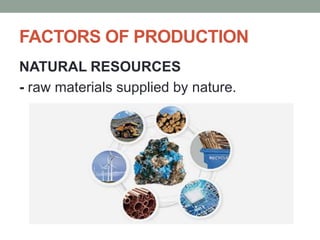
NATURAL RESOURCES
- raw materials supplied by nature.
FACTORS OF PRODUCTION
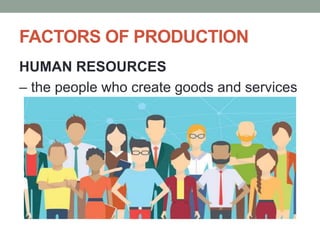
HUMAN RESOURCES
– the people who create goods and services
To increase the productivity of human resources,
business owners may use specialization and
division of labor.
SPECIALIZATION – occurs when individual
workers focus on single tasks, enabling each
worker to become more efficient and productive.
DIVISION OF LABOR – divides the production
process into seperate tasks carried out by workers
who specialize in those specific tasks.
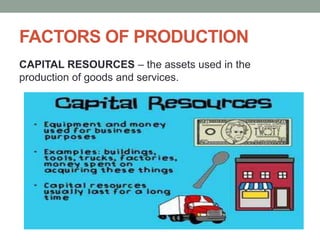
FACTORS OF PRODUCTION
CAPITAL RESOURCES – the assets used in the
production of goods and services.
LIMITED RESOURCES
All economic resources have a limited supply.
Most resources can be used to produce several
different products and services. If resources are
used to produce one type of product, they may not
be available for the production of another product.
Individuals, businesses and countries compete for
access to and ownership of economic resources.
Those resources that are in very high demand or
that have a limited supply will command high
prices.
LIMITED RESOURCES
Control of oil fields in the Middle East has been an
ongoing issue for many years. The United States
has a large demand for oil but a limited supply of
oil, so it is important to United States to have
access to oil from Middle East. This high demand
contributes to high gasoline prices.
LAW OF DIMINISHING RETURNS
To make the most efficient use of their resources,
businesses should consider the law of diminishing
return.
LAW OF DIMINISHING RETURNS – states that if
one factor of production is increase while other
stay the same, the resulting increase in
output(product produced) will stay level off after
some time and then will decline.
LAW OF DIMINISHING RETURNS
This means that extra workers, extra capital, extra
machinery, or extra land may not neccesarily raise output
as much as expected.
For example, increasing the number of workers(human
resource) may allow additional output to be produced by
using any spare capacity workers have, such as unused
workspace or machinery(capital resources). Once this
capacity is fully used, however continually increasing the
number of workers without increasing the workspace or
number of machines will not result in an increase of output.
Think about it...
1. What role do needs and wants play
in determining what is produced in an
economy.
2. How does the availability of
economic resources affect an
entrepreneur’s decisions?

Economic Resources

  • 1.
  • 2.
    ECONOMIC RESOURCES ECONOMIC RESOURCES- Are the means through which goods and service are produced. GOODS – are products you can see and touch. SERVICES – are activities that are consumed as they produced.
  • 3.
    ECONOMIC RESOURCES Entrepreneurs usedeconomic resources to create the goods and services consumers use. Consumers satisfy needs and by purchasing and consuming goods and services.
  • 4.
    ECONOMIC RESOURCES Goods -are products you can purchase. Ex: pair of shoes, a jacket, and cars are all examples of goods. Services – must be be provided to you the time you need them, they cannot be stored. Ex: haircut, a manicure, lawn mowing, and car detailing are all examples of services.
  • 5.
    FACTORS OF PRODUCTION Inorder to create useful goods and services, an entrepreneur may use three types of economic resources this are called: Factors of Production 1. NATURAL RESOURCES 2. HUMAN RESOURCES 3. CAPITAL RESOURCES
  • 6.
    FACTORS OF PRODUCTION NATURALRESOURCES - raw materials supplied by nature.
  • 7.
    FACTORS OF PRODUCTION HUMANRESOURCES – the people who create goods and services
  • 8.
    To increase theproductivity of human resources, business owners may use specialization and division of labor. SPECIALIZATION – occurs when individual workers focus on single tasks, enabling each worker to become more efficient and productive. DIVISION OF LABOR – divides the production process into seperate tasks carried out by workers who specialize in those specific tasks.
  • 9.
    FACTORS OF PRODUCTION CAPITALRESOURCES – the assets used in the production of goods and services.
  • 10.
    LIMITED RESOURCES All economicresources have a limited supply. Most resources can be used to produce several different products and services. If resources are used to produce one type of product, they may not be available for the production of another product. Individuals, businesses and countries compete for access to and ownership of economic resources. Those resources that are in very high demand or that have a limited supply will command high prices.
  • 11.
    LIMITED RESOURCES Control ofoil fields in the Middle East has been an ongoing issue for many years. The United States has a large demand for oil but a limited supply of oil, so it is important to United States to have access to oil from Middle East. This high demand contributes to high gasoline prices.
  • 12.
    LAW OF DIMINISHINGRETURNS To make the most efficient use of their resources, businesses should consider the law of diminishing return. LAW OF DIMINISHING RETURNS – states that if one factor of production is increase while other stay the same, the resulting increase in output(product produced) will stay level off after some time and then will decline.
  • 13.
    LAW OF DIMINISHINGRETURNS This means that extra workers, extra capital, extra machinery, or extra land may not neccesarily raise output as much as expected. For example, increasing the number of workers(human resource) may allow additional output to be produced by using any spare capacity workers have, such as unused workspace or machinery(capital resources). Once this capacity is fully used, however continually increasing the number of workers without increasing the workspace or number of machines will not result in an increase of output.
  • 14.
    Think about it... 1.What role do needs and wants play in determining what is produced in an economy. 2. How does the availability of economic resources affect an entrepreneur’s decisions?