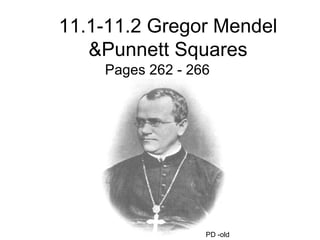
11.1-11.2 Gregor Mendel &Punnett Squares Pages 262 - 266 PD -old
Goal 1 Describe how Mendel Studied inheritance in peas
Austrian Monk 1800’s Taught High School Managed monastery gardens
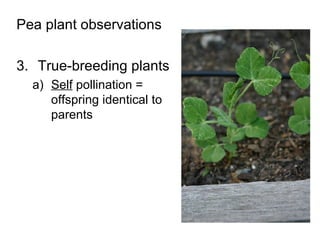
Pea plant observations True-breeding plants Self  pollination = offspring identical to parents
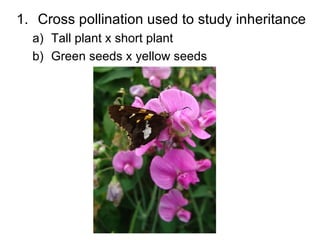
Cross pollination used to study inheritance Tall plant x short plant Green seeds x yellow seeds
Goal 2 Summarize Mendel’s conclusions about inheritance
Results of Mendel’s experiment Cross pollination of true breeding parents (P) Offspring (F1) only show one trait No “blending” of traits Tall plant  x  short plant  =  all tall plants P  P  F1
Mendel’s 1 st  conclusions about inheritance Inheritance determined by factors passed from one generation to the next Each  trait  determined by  one   gene   that occurs in  two different forms ( alleles ) Trait of height located on one gene as either short or tall alleles
Goal 3 Explain the principle of dominance
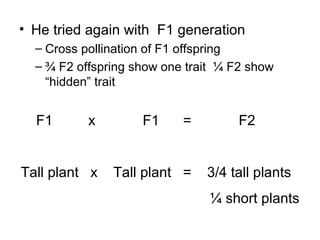
He tried again with  F1 generation Cross pollination of F1 offspring ¾ F2 offspring show one trait  ¼ F2 show “hidden” trait F1  x  F1  =  F2 Tall plant  x  Tall plant  =  3/4 tall plants ¼ short plants
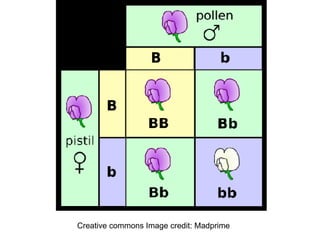
Creative commons Image credit: Madprime
Principle of dominance states:  some alleles are dominant and others are recessive If  dominant allele  present, it  will be expressed Recessive alleles only  expressed if  NO dominant  allele present
Goal 4 Describe what happens to alleles during segregation in meiosis
Alleles separate during meiosis Alleles segregate into  one allele per gamete Two types of gametes can be produced Alleles pair up randomly when gametes unite during fertilization
Example on the board…
Goal 5 Use  Punnett Squares  to:  determine  genotypic and phenotypic ratios of a cross to   Predict outcomes
Phenotype = the expressed physical trait What can be seen (brown hair) Dependent on genotype Genotype = the alleles of a genetic code Genetic code (one maternal, one paternal) Homozygous = alleles are the same (BB or bb) Heterozygous = alleles are different (Bb)
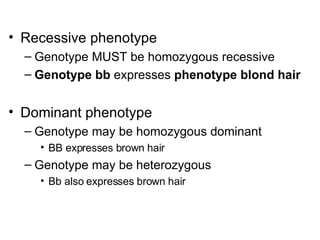
Recessive phenotype Genotype MUST be homozygous recessive Genotype bb  expresses  phenotype blond hair Dominant phenotype Genotype may be homozygous dominant BB expresses brown hair Genotype may be heterozygous Bb also expresses brown hair
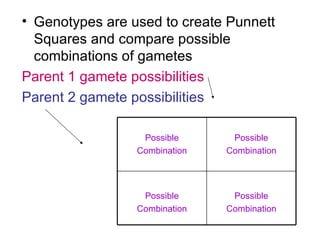
Genotypes are used to create Punnett Squares and compare possible combinations of gametes Parent 1 gamete possibilities Parent 2 gamete possibilities Possible Combination Possible Combination Possible Combination Possible Combination
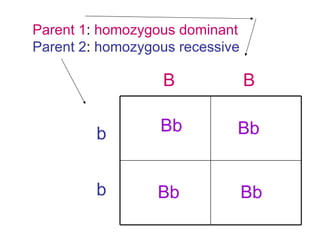
B b b B Parent 1 :  homozygous dominant Parent 2 :  homozygous recessive Bb Bb Bb Bb
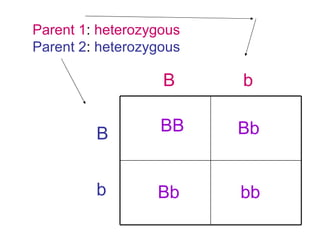
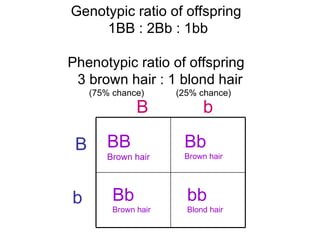
B b B b Parent 1 :  heterozygous Parent 2 :  heterozygous bb Bb BB Bb
B b B b Genotypic ratio of offspring  1BB : 2Bb : 1bb  Phenotypic ratio of offspring  3 brown hair : 1 blond hair (75% chance)  (25% chance) bb Blond hair Bb Brown hair BB Brown hair Bb Brown hair
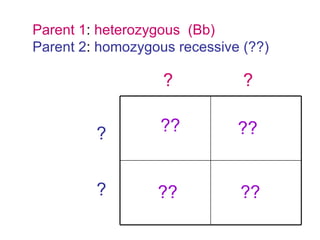
? ? ? ? Parent 1 :  heterozygous  (Bb) Parent 2 :  homozygous recessive (??) ?? ?? ?? ??
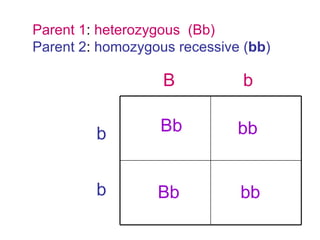
B b b b Parent 1 :  heterozygous  (Bb) Parent 2 :  homozygous recessive ( bb ) bb Bb Bb bb
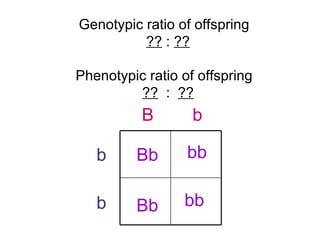
B b b b bb Bb Bb bb Genotypic ratio of offspring  ??  :  ?? Phenotypic ratio of offspring  ??   :  ??
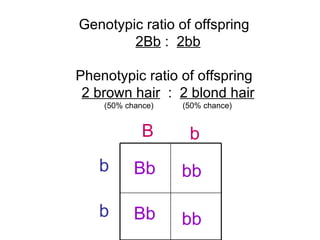
B b b b bb Bb Bb bb Genotypic ratio of offspring  2Bb  :  2bb Phenotypic ratio of offspring  2 brown hair   :  2 blond hair (50% chance)  (50% chance)
Thanks to the following people who have generously shared images on Flickr creative commons: Unertlkm… pea plant Z e n… butterfly and pea bloom

Gregor Mendel & Punnett Squares

  • 1.
    11.1-11.2 Gregor Mendel&Punnett Squares Pages 262 - 266 PD -old
  • 2.
    Goal 1 Describehow Mendel Studied inheritance in peas
  • 3.
    Austrian Monk 1800’sTaught High School Managed monastery gardens
  • 4.
    Pea plant observationsTrue-breeding plants Self pollination = offspring identical to parents
  • 5.
    Cross pollination usedto study inheritance Tall plant x short plant Green seeds x yellow seeds
  • 6.
    Goal 2 SummarizeMendel’s conclusions about inheritance
  • 7.
    Results of Mendel’sexperiment Cross pollination of true breeding parents (P) Offspring (F1) only show one trait No “blending” of traits Tall plant x short plant = all tall plants P P F1
  • 8.
    Mendel’s 1 st conclusions about inheritance Inheritance determined by factors passed from one generation to the next Each trait determined by one gene that occurs in two different forms ( alleles ) Trait of height located on one gene as either short or tall alleles
  • 9.
    Goal 3 Explainthe principle of dominance
  • 10.
    He tried againwith F1 generation Cross pollination of F1 offspring ¾ F2 offspring show one trait ¼ F2 show “hidden” trait F1 x F1 = F2 Tall plant x Tall plant = 3/4 tall plants ¼ short plants
  • 11.
    Creative commons Imagecredit: Madprime
  • 12.
    Principle of dominancestates: some alleles are dominant and others are recessive If dominant allele present, it will be expressed Recessive alleles only expressed if NO dominant allele present
  • 13.
    Goal 4 Describewhat happens to alleles during segregation in meiosis
  • 14.
    Alleles separate duringmeiosis Alleles segregate into one allele per gamete Two types of gametes can be produced Alleles pair up randomly when gametes unite during fertilization
  • 15.
  • 16.
    Goal 5 Use Punnett Squares to: determine genotypic and phenotypic ratios of a cross to Predict outcomes
  • 17.
    Phenotype = theexpressed physical trait What can be seen (brown hair) Dependent on genotype Genotype = the alleles of a genetic code Genetic code (one maternal, one paternal) Homozygous = alleles are the same (BB or bb) Heterozygous = alleles are different (Bb)
  • 18.
    Recessive phenotype GenotypeMUST be homozygous recessive Genotype bb expresses phenotype blond hair Dominant phenotype Genotype may be homozygous dominant BB expresses brown hair Genotype may be heterozygous Bb also expresses brown hair
  • 19.
    Genotypes are usedto create Punnett Squares and compare possible combinations of gametes Parent 1 gamete possibilities Parent 2 gamete possibilities Possible Combination Possible Combination Possible Combination Possible Combination
  • 20.
    B b bB Parent 1 : homozygous dominant Parent 2 : homozygous recessive Bb Bb Bb Bb
  • 21.
    B b Bb Parent 1 : heterozygous Parent 2 : heterozygous bb Bb BB Bb
  • 22.
    B b Bb Genotypic ratio of offspring 1BB : 2Bb : 1bb Phenotypic ratio of offspring 3 brown hair : 1 blond hair (75% chance) (25% chance) bb Blond hair Bb Brown hair BB Brown hair Bb Brown hair
  • 23.
    ? ? ?? Parent 1 : heterozygous (Bb) Parent 2 : homozygous recessive (??) ?? ?? ?? ??
  • 24.
    B b bb Parent 1 : heterozygous (Bb) Parent 2 : homozygous recessive ( bb ) bb Bb Bb bb
  • 25.
    B b bb bb Bb Bb bb Genotypic ratio of offspring ?? : ?? Phenotypic ratio of offspring ?? : ??
  • 26.
    B b bb bb Bb Bb bb Genotypic ratio of offspring 2Bb : 2bb Phenotypic ratio of offspring 2 brown hair : 2 blond hair (50% chance) (50% chance)
  • 27.
    Thanks to thefollowing people who have generously shared images on Flickr creative commons: Unertlkm… pea plant Z e n… butterfly and pea bloom