Presented To:
Reeta Chauhan,mam
12/15/2015
Presented by:
1.Anil Chauhan
2.Siddharth Gupta
3.Vishnu Sharma
probability,terminologies of probability,utility of
probability
In decision making
1.What is Probability?
2.Problem where uses of probability?
3 Types of probability?
4.Terminologies of Probability?
5.Utility of probability?
12/15/2015 2
Contents
1. To check the occurences or chances of any event drawn from the
sample space is called probability.
Laplace
How to Interpret Probability
The probability that an event will occur is expressed as a number
between 0 and 1. Notationally, the probability of event A is represented
by P(A).
1. If P(A) equals zero, event A will almost definitely not occur.
2. If P(A) is close to zero, there is only a small chance that event A will
occur.
12/15/2015 3
Probability

3. If P(A) equals 0.5, there is a 50-50 chance that event A will occur.
4. If P(A) is close to one, there is a strong chance that event A will
occur.
5. If P(A) equals one, event A will almost definitely occur.
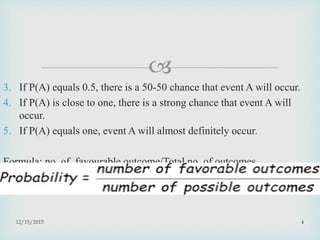
Formula: no. of favourable outcome/Total no. of outcomes
12/15/2015 4

12/15/2015 5
Problem,Solution
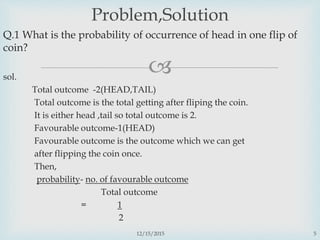
Q.1 What is the probability of occurrence of head in one flip of
coin?
sol.
Total outcome -2(HEAD,TAIL)
Total outcome is the total getting after fliping the coin.
It is either head ,tail so total outcome is 2.
Favourable outcome-1(HEAD)
Favourable outcome is the outcome which we can get
after flipping the coin once.
Then,
probability- no. of favourable outcome
Total outcome
= 1
2
1. Mathematical Probability-If the probability of an event can be
calculated even before the actual happening of the event, that is, even
before conducting the experiment, it is called Mathematical
probability.For example tossing of coin,throwing of dice we can
predict the answer in advance. Mathematical probability is often
called priori probability or classical probability.
2. Statistical Probability- If the probability of an event can be
determined only after the actual happening of the event, it is called
statistical probability .The Statistical probability calculated by
conducting an actual experiment is also called a posterior probability.
12/15/2015 6
Types of probability
3. Subjective approach-This probability is based on the past
evidence is available.This is computing by taking the past
evidence of any thing.
For ex.- If a teacher wants to find out the probability of a
student getting first position in the class which is based on such
factors past academic performance, attendance record, performance in
periodic performance etc.
4. Axiomatic probability-The modern approach of probability is
purely axiomatic in nature it is derived by A.N. Kolmogorov in
1933.
12/15/2015 7
Types of probability

1. Sample space: When a statistical experiment is conducted,
there are a number of possible outcomes. These are called
sample space and are often denoted by S.
Example: A coin is tossed. The sample space is:
S = {head, tail}.
2. Random Experiment: Those experiments whose result depend on
chance such as tossing of a coin etc.
3. Trial : One specific instance of an experiment.
4. Outcome: The result of a single trial.
12/15/2015 8
Terminologies

6. Event Space/or Sample Space: The set of all possible
outcomes of an experiment.
7. Experiment: The term experiment refers to describe an
act which can be repeated under some given condition.
8. Equally likely events: Two or more events are said to be
equally likely if each one of outcome has an equal chance
of occurring.
9. Independent Events:if a coin is tossed twice, the
results of the second throw would in no way be
affected by the results of the first throw.
12/15/2015 9
Terminologies

9. Exhaustive events-Events are said to exhaustive when there totality
include all the possible outcomes of a random experiment.
10. Mutually exclusive events-Two events are said to be mutually
exclusive when both can not occur in a single trial.Like head ,tail
cannot occur in a single trial.
11. Event: A selected outcome, such as getting 6 from rolling two dice.
12. Complementry event-In any event A if the chances if happening of it is ½
then the chances of not happening it is also ½ .This ½ is the complementry
of event A.It is denoted by A
12/15/2015 10
Terminologies
1. Probability theory is being applied in the solution of
social, buisness,economic problems.
2. In buisness probability theory is used to determine
calculation of short term gains and long term gains
3. Risk Evaluation-If the company want to open new
buisness and wants to generate the revenue of
500000$,their probability distribution tells them
there is 10 percent chances that revenue will be less
than 500000$,the company know what level of risk it
is facing.
12/15/2015 11
Utility of probability

4. To determine probability of demand of product at particular
time. For example the demand of gun is high at the time of
war then in daily.
5. To make certain assumption about the prediction in capital
market.
12/15/2015 12
Utility of probability

1. Which probability is called posterior probability?
Statistical probability.
2. When two events can not occur in a single time called?
Mutually exclusive event.
3. Which probability is called classical probability?
Mathematical probability.
4. What is the event name where both the event have equal
chances of occuring.
Equally likely events.
12/15/2015 13
QUIZ

12/15/2015 14

probability ,and its terminologies full description

  • 1.
    Presented To: Reeta Chauhan,mam 12/15/2015 Presentedby: 1.Anil Chauhan 2.Siddharth Gupta 3.Vishnu Sharma probability,terminologies of probability,utility of probability In decision making
  • 2.
    1.What is Probability? 2.Problemwhere uses of probability? 3 Types of probability? 4.Terminologies of Probability? 5.Utility of probability? 12/15/2015 2 Contents
  • 3.
    1. To checkthe occurences or chances of any event drawn from the sample space is called probability. Laplace How to Interpret Probability The probability that an event will occur is expressed as a number between 0 and 1. Notationally, the probability of event A is represented by P(A). 1. If P(A) equals zero, event A will almost definitely not occur. 2. If P(A) is close to zero, there is only a small chance that event A will occur. 12/15/2015 3 Probability
  • 4.
     3. If P(A)equals 0.5, there is a 50-50 chance that event A will occur. 4. If P(A) is close to one, there is a strong chance that event A will occur. 5. If P(A) equals one, event A will almost definitely occur. Formula: no. of favourable outcome/Total no. of outcomes 12/15/2015 4
  • 5.
     12/15/2015 5 Problem,Solution Q.1 Whatis the probability of occurrence of head in one flip of coin? sol. Total outcome -2(HEAD,TAIL) Total outcome is the total getting after fliping the coin. It is either head ,tail so total outcome is 2. Favourable outcome-1(HEAD) Favourable outcome is the outcome which we can get after flipping the coin once. Then, probability- no. of favourable outcome Total outcome = 1 2
  • 6.
    1. Mathematical Probability-Ifthe probability of an event can be calculated even before the actual happening of the event, that is, even before conducting the experiment, it is called Mathematical probability.For example tossing of coin,throwing of dice we can predict the answer in advance. Mathematical probability is often called priori probability or classical probability. 2. Statistical Probability- If the probability of an event can be determined only after the actual happening of the event, it is called statistical probability .The Statistical probability calculated by conducting an actual experiment is also called a posterior probability. 12/15/2015 6 Types of probability
  • 7.
    3. Subjective approach-Thisprobability is based on the past evidence is available.This is computing by taking the past evidence of any thing. For ex.- If a teacher wants to find out the probability of a student getting first position in the class which is based on such factors past academic performance, attendance record, performance in periodic performance etc. 4. Axiomatic probability-The modern approach of probability is purely axiomatic in nature it is derived by A.N. Kolmogorov in 1933. 12/15/2015 7 Types of probability
  • 8.
     1. Sample space:When a statistical experiment is conducted, there are a number of possible outcomes. These are called sample space and are often denoted by S. Example: A coin is tossed. The sample space is: S = {head, tail}. 2. Random Experiment: Those experiments whose result depend on chance such as tossing of a coin etc. 3. Trial : One specific instance of an experiment. 4. Outcome: The result of a single trial. 12/15/2015 8 Terminologies
  • 9.
     6. Event Space/orSample Space: The set of all possible outcomes of an experiment. 7. Experiment: The term experiment refers to describe an act which can be repeated under some given condition. 8. Equally likely events: Two or more events are said to be equally likely if each one of outcome has an equal chance of occurring. 9. Independent Events:if a coin is tossed twice, the results of the second throw would in no way be affected by the results of the first throw. 12/15/2015 9 Terminologies
  • 10.
     9. Exhaustive events-Eventsare said to exhaustive when there totality include all the possible outcomes of a random experiment. 10. Mutually exclusive events-Two events are said to be mutually exclusive when both can not occur in a single trial.Like head ,tail cannot occur in a single trial. 11. Event: A selected outcome, such as getting 6 from rolling two dice. 12. Complementry event-In any event A if the chances if happening of it is ½ then the chances of not happening it is also ½ .This ½ is the complementry of event A.It is denoted by A 12/15/2015 10 Terminologies
  • 11.
    1. Probability theoryis being applied in the solution of social, buisness,economic problems. 2. In buisness probability theory is used to determine calculation of short term gains and long term gains 3. Risk Evaluation-If the company want to open new buisness and wants to generate the revenue of 500000$,their probability distribution tells them there is 10 percent chances that revenue will be less than 500000$,the company know what level of risk it is facing. 12/15/2015 11 Utility of probability
  • 12.
     4. To determineprobability of demand of product at particular time. For example the demand of gun is high at the time of war then in daily. 5. To make certain assumption about the prediction in capital market. 12/15/2015 12 Utility of probability
  • 13.
     1. Which probabilityis called posterior probability? Statistical probability. 2. When two events can not occur in a single time called? Mutually exclusive event. 3. Which probability is called classical probability? Mathematical probability. 4. What is the event name where both the event have equal chances of occuring. Equally likely events. 12/15/2015 13 QUIZ
  • 14.