PROBABILITY AND
STATISTICS–18UCSA21
I B.Sc Computer Science (SF)
Ms. M. Indira Devi, M.Sc., M.Phil.,
Central Moments
• The average of all the deviations of all observations in a
dataset from the mean of the observations raised to the
power r
• In mean moments, the deviations are taken from the
mean
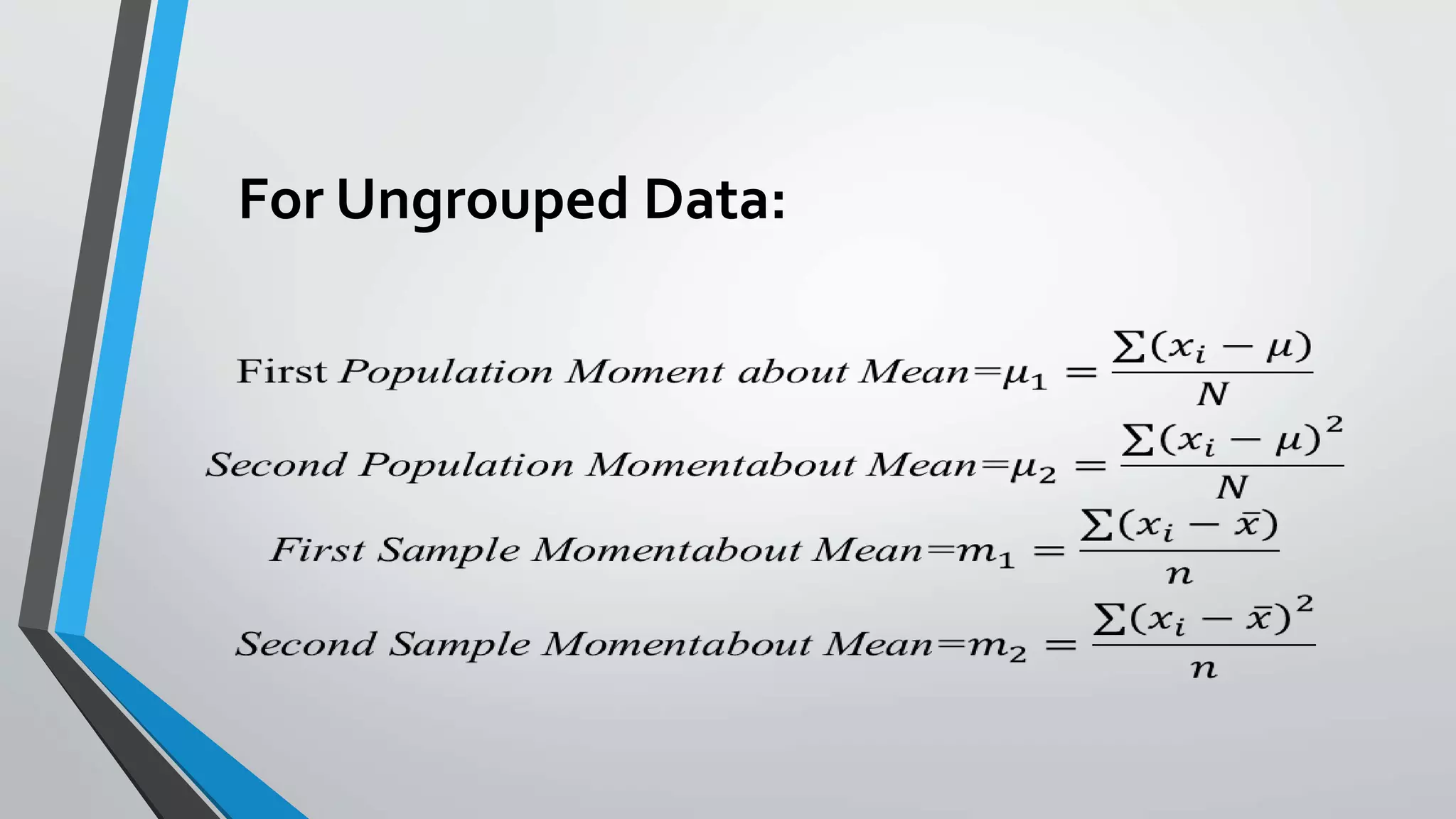
For Ungrouped Data:
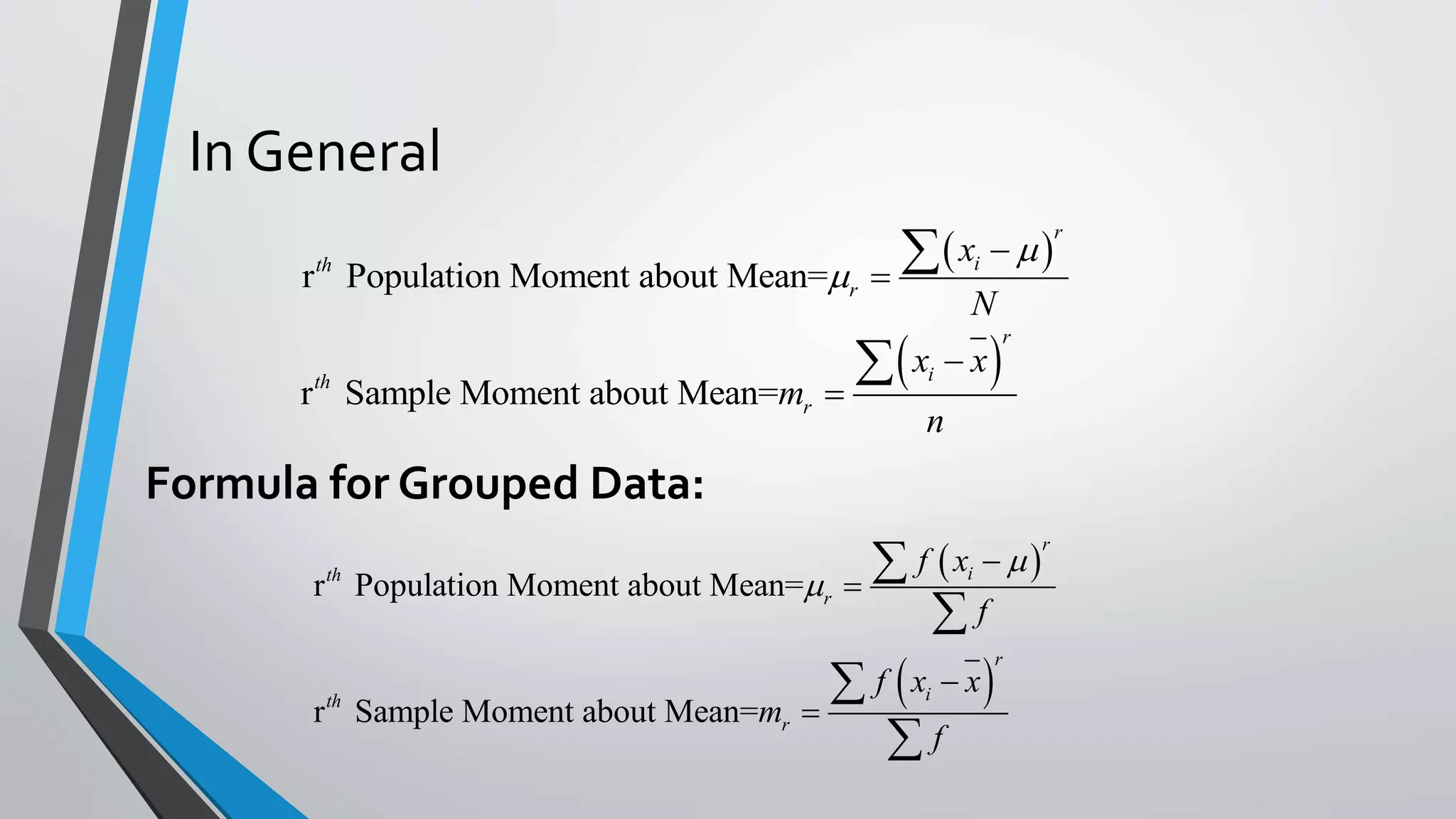
In General
 
r Population Moment about Mean=
r
ith
r
x
N





 r Sample Moment about Mean=
r
ith
r
x x
m
n



Formula for Grouped Data:
 
 
r Population Moment about Mean=
r Sample Moment about Mean=
r
ith
r
r
ith
r
f x
f
f x x
m
f










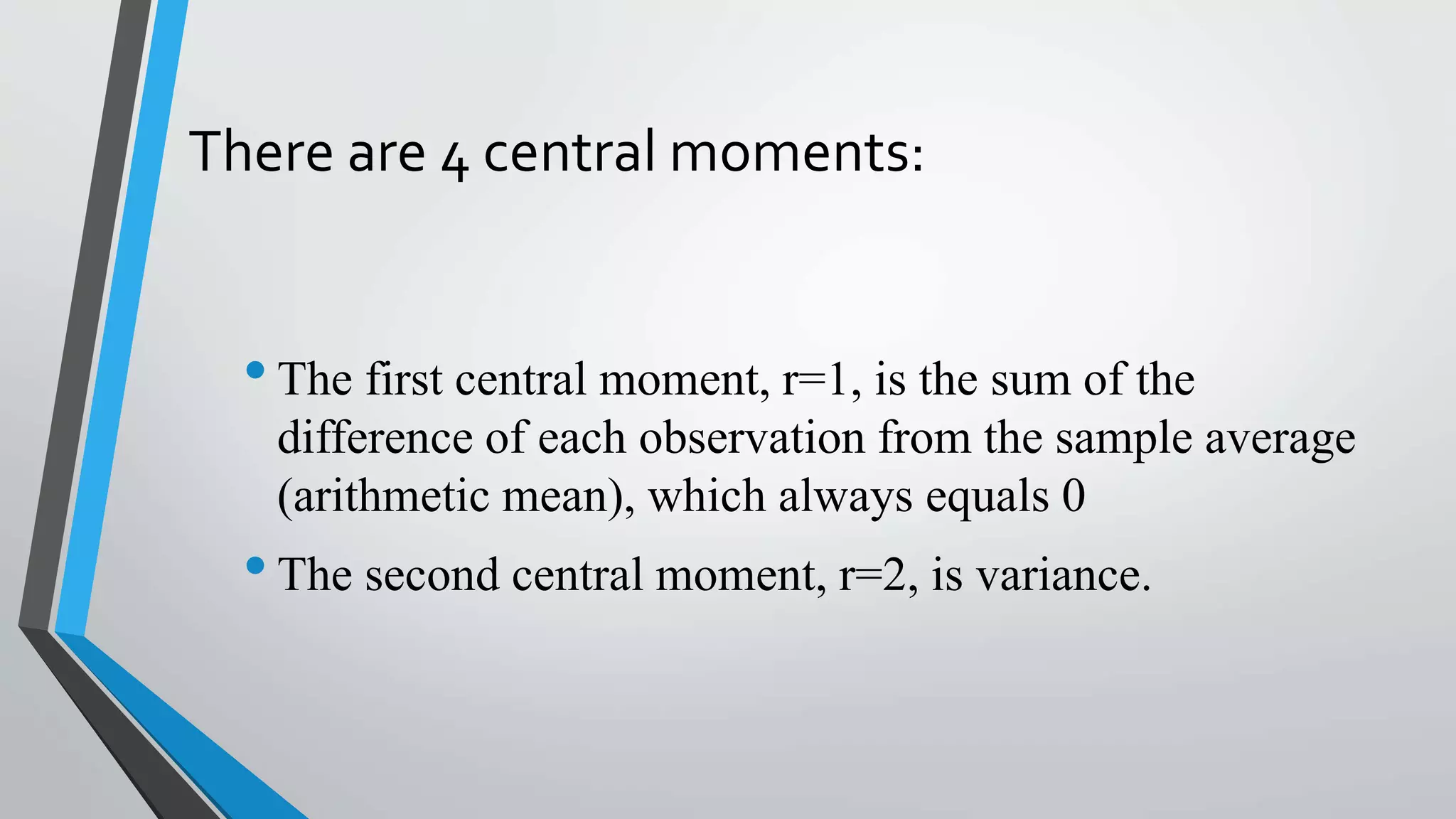
There are 4 central moments:
•The first central moment, r=1, is the sum of the
difference of each observation from the sample average
(arithmetic mean), which always equals 0
•The second central moment, r=2, is variance.
Continued…
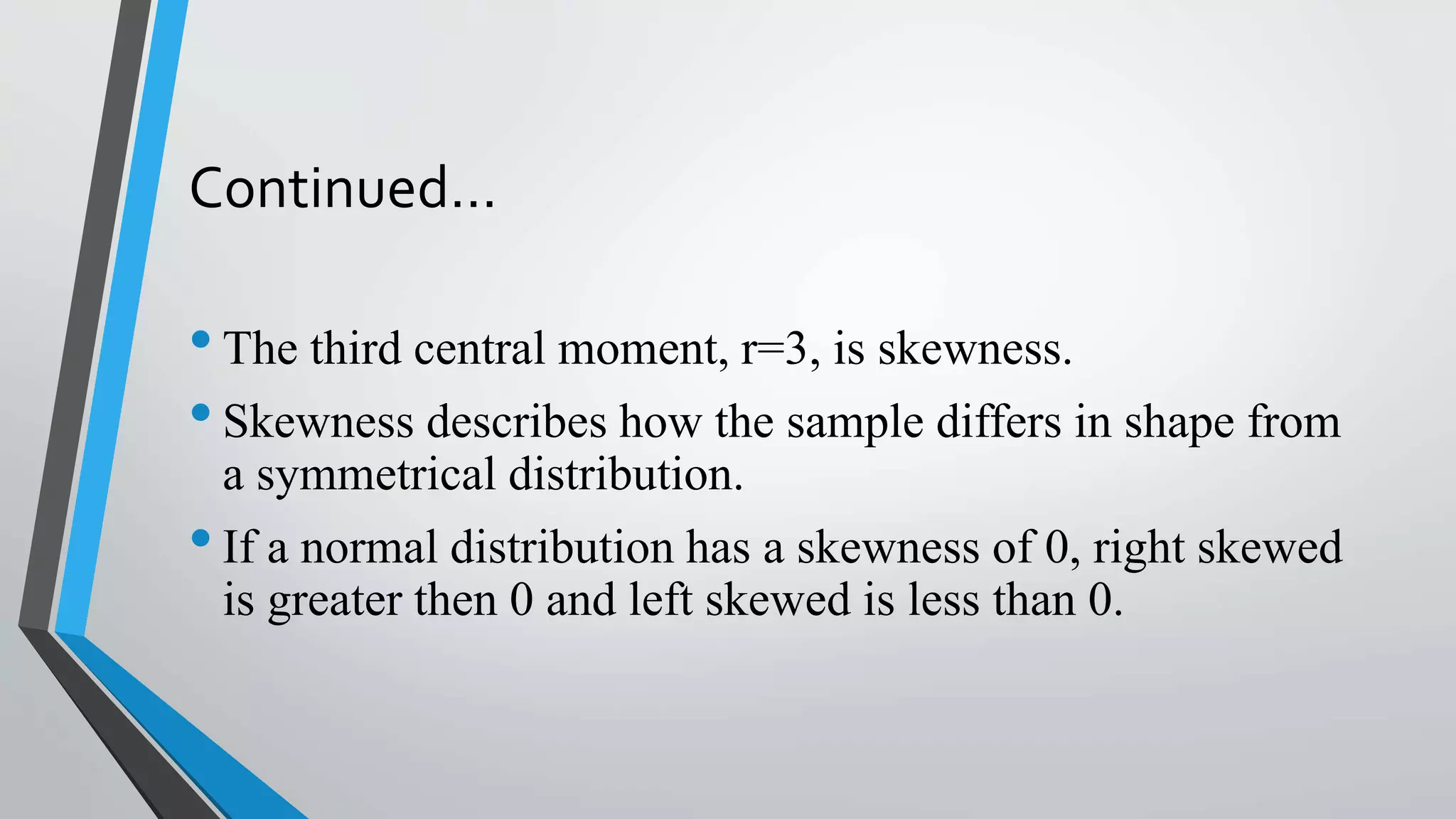
•The third central moment, r=3, is skewness.
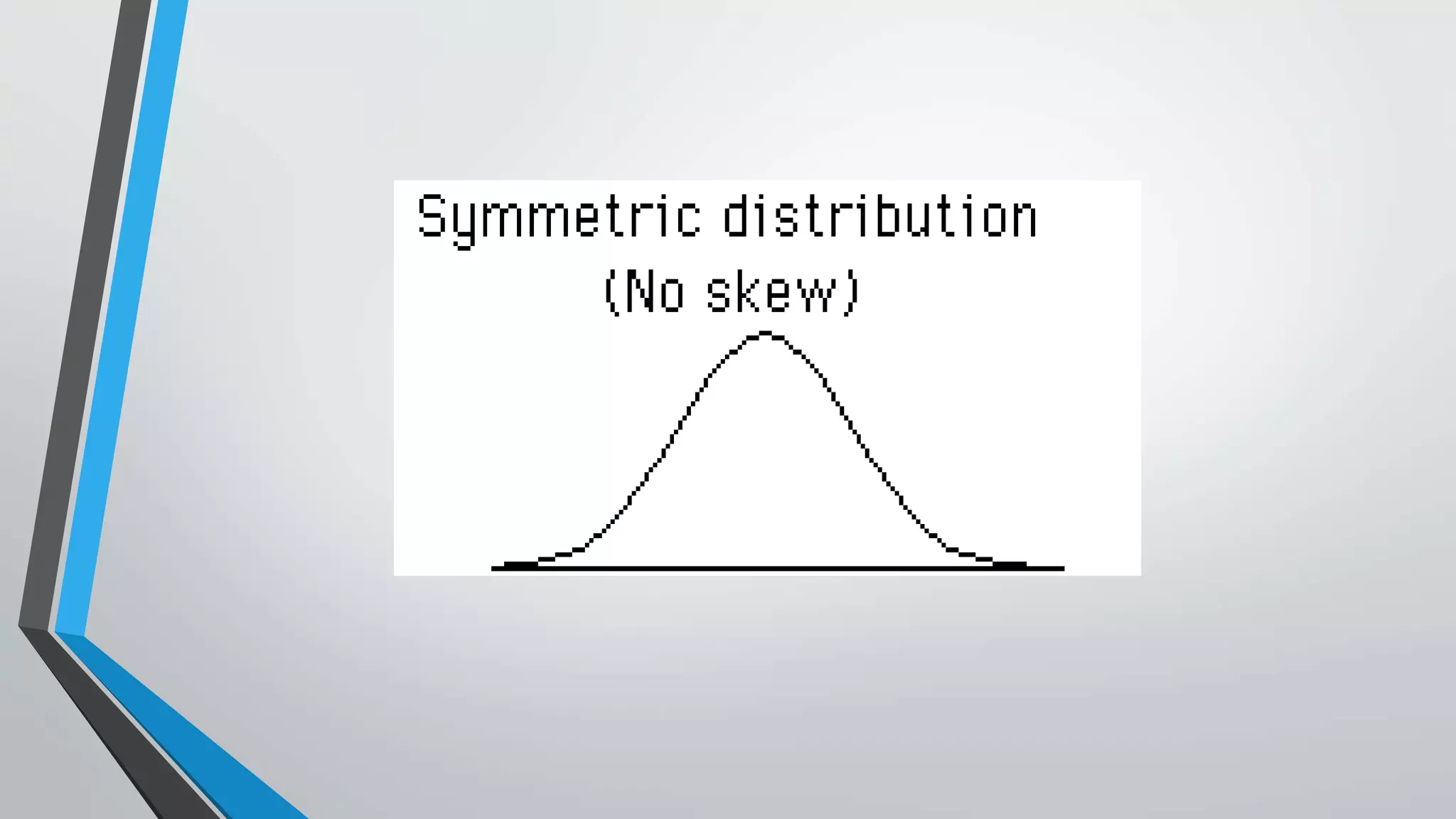
•Skewness describes how the sample differs in shape from
a symmetrical distribution.
•If a normal distribution has a skewness of 0, right skewed
is greater then 0 and left skewed is less than 0.
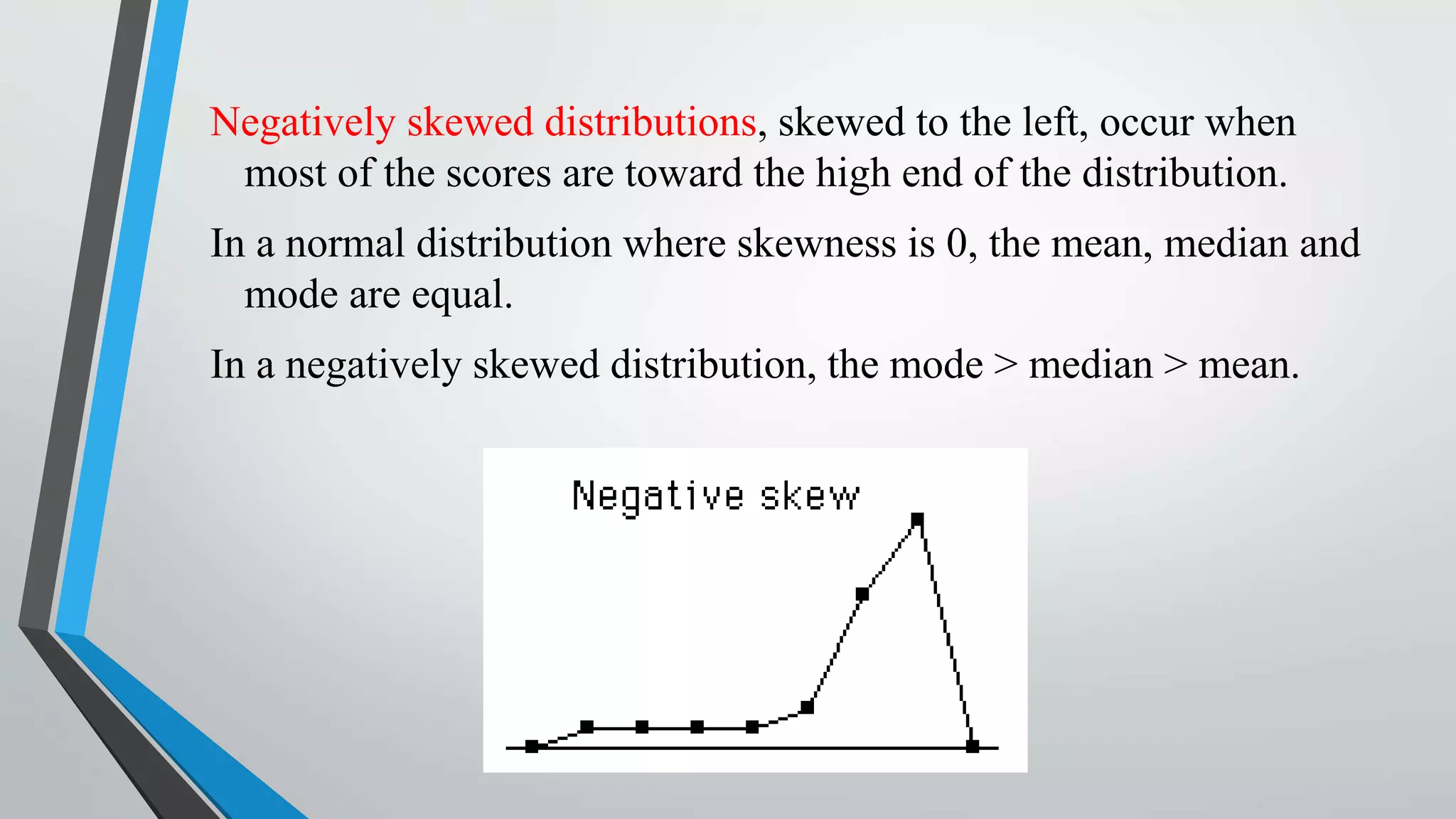
Negatively skewed distributions, skewed to the left, occur when
most of the scores are toward the high end of the distribution.
In a normal distribution where skewness is 0, the mean, median and
mode are equal.
In a negatively skewed distribution, the mode > median > mean.
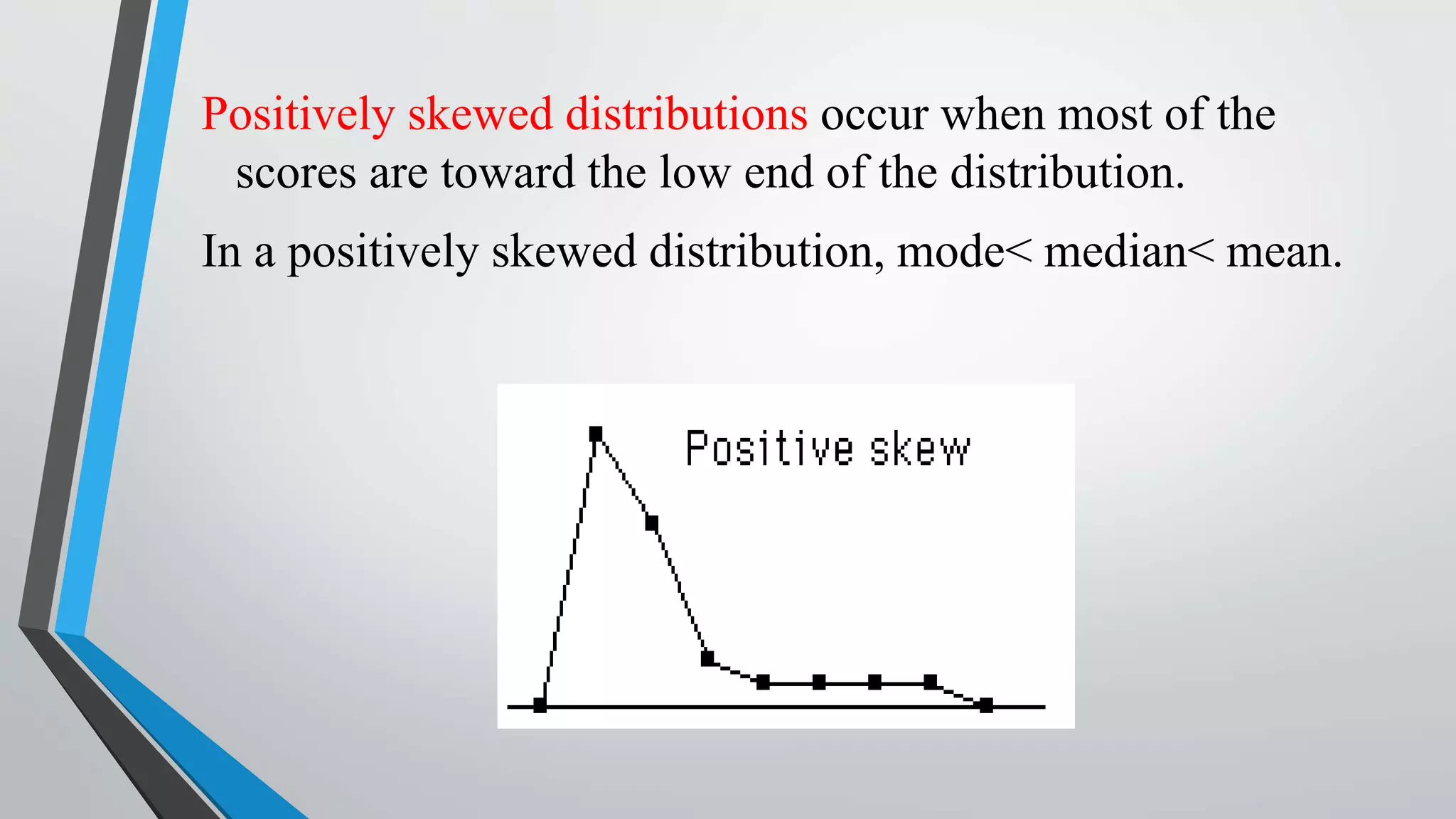
Positively skewed distributions occur when most of the
scores are toward the low end of the distribution.
In a positively skewed distribution, mode< median< mean.
Kurtosis
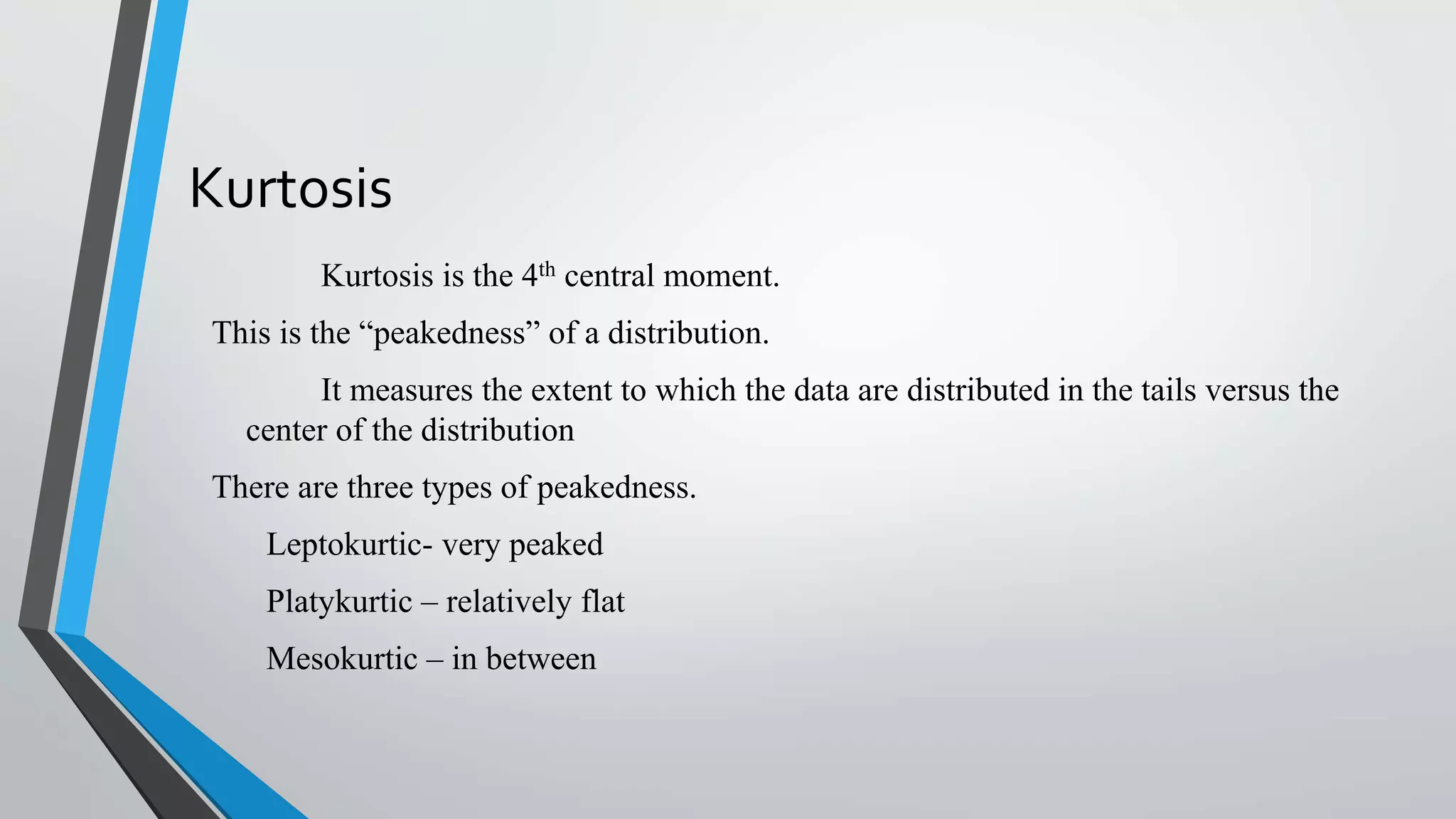
Kurtosis is the 4th central moment.
This is the “peakedness” of a distribution.
It measures the extent to which the data are distributed in the tails versus the
center of the distribution
There are three types of peakedness.
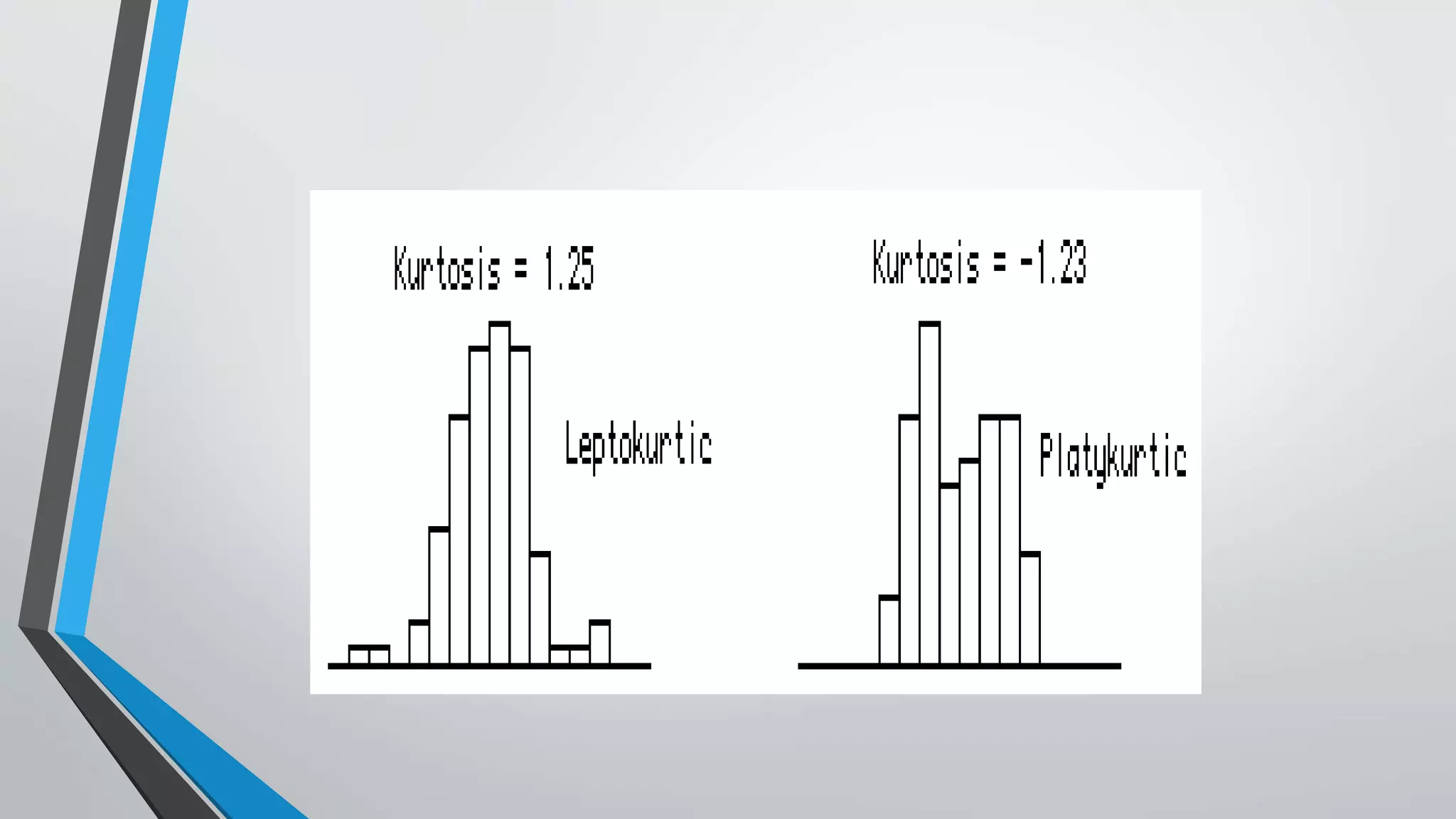
Leptokurtic- very peaked
Platykurtic – relatively flat
Mesokurtic – in between
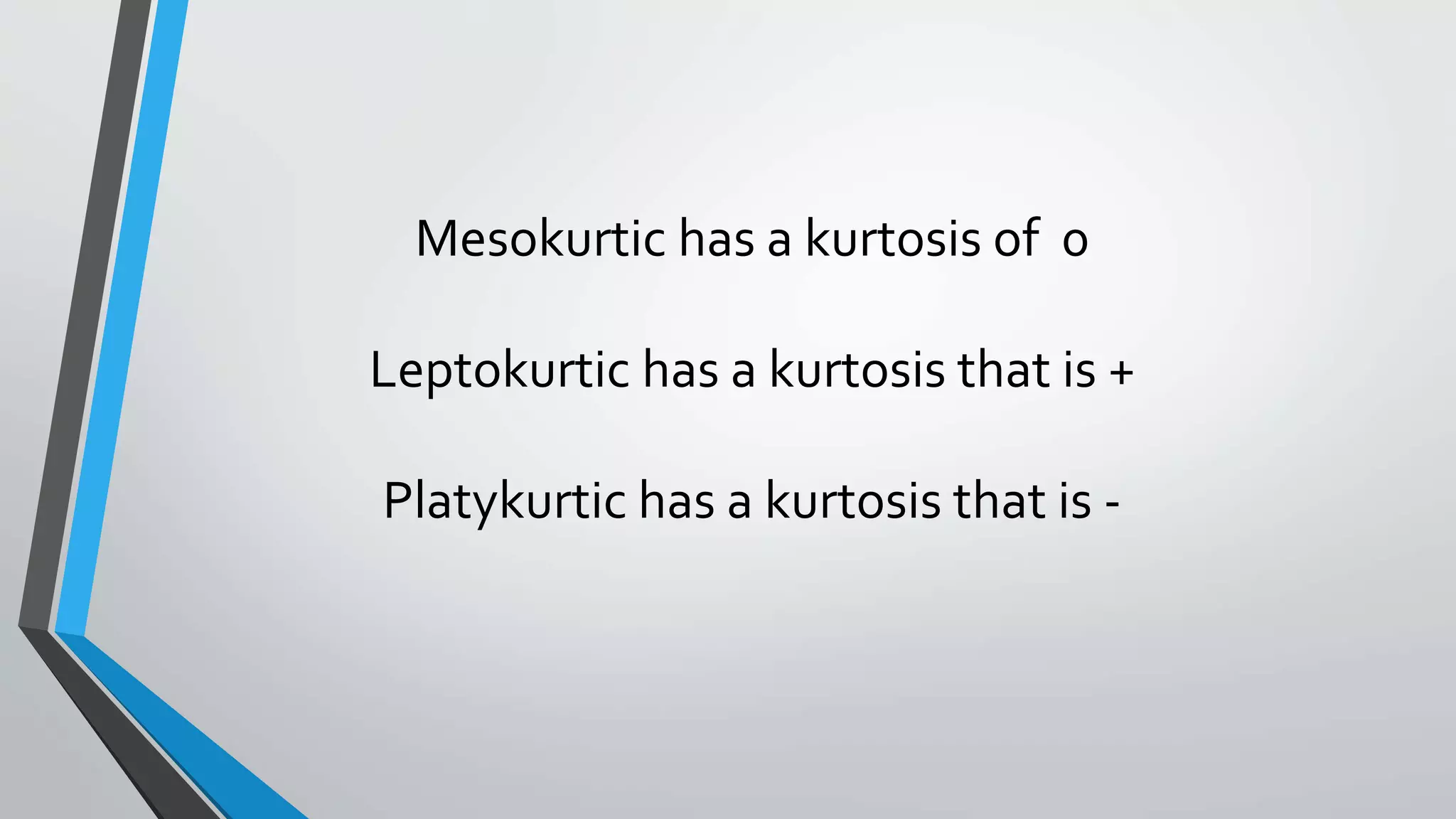
Mesokurtic has a kurtosis of 0
Leptokurtic has a kurtosis that is +
Platykurtic has a kurtosis that is -
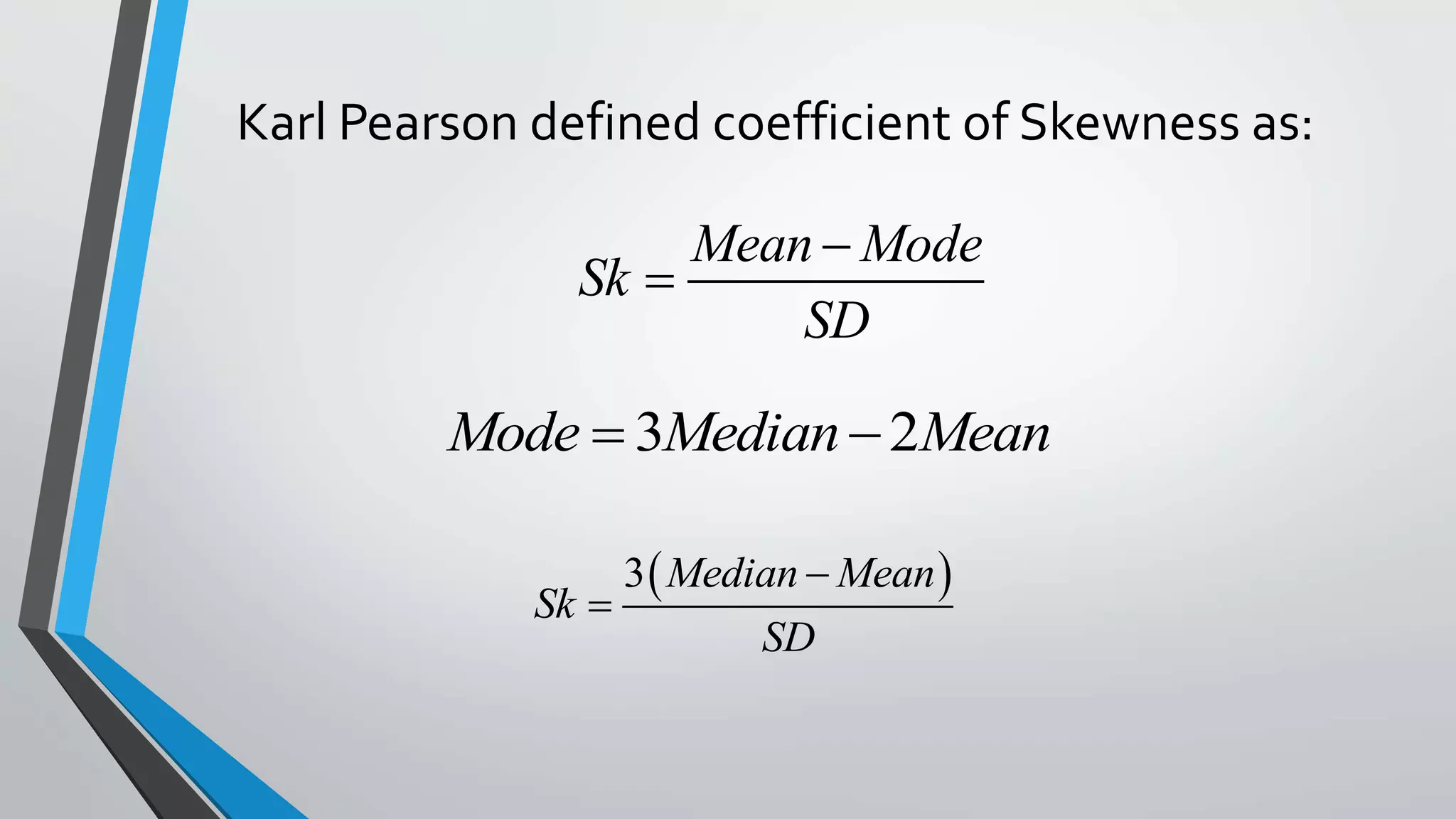
Karl Pearson defined coefficient of Skewness as:
Mean Mode
Sk
SD


3 2Mode Median Mean 
 3 Median Mean
Sk
SD


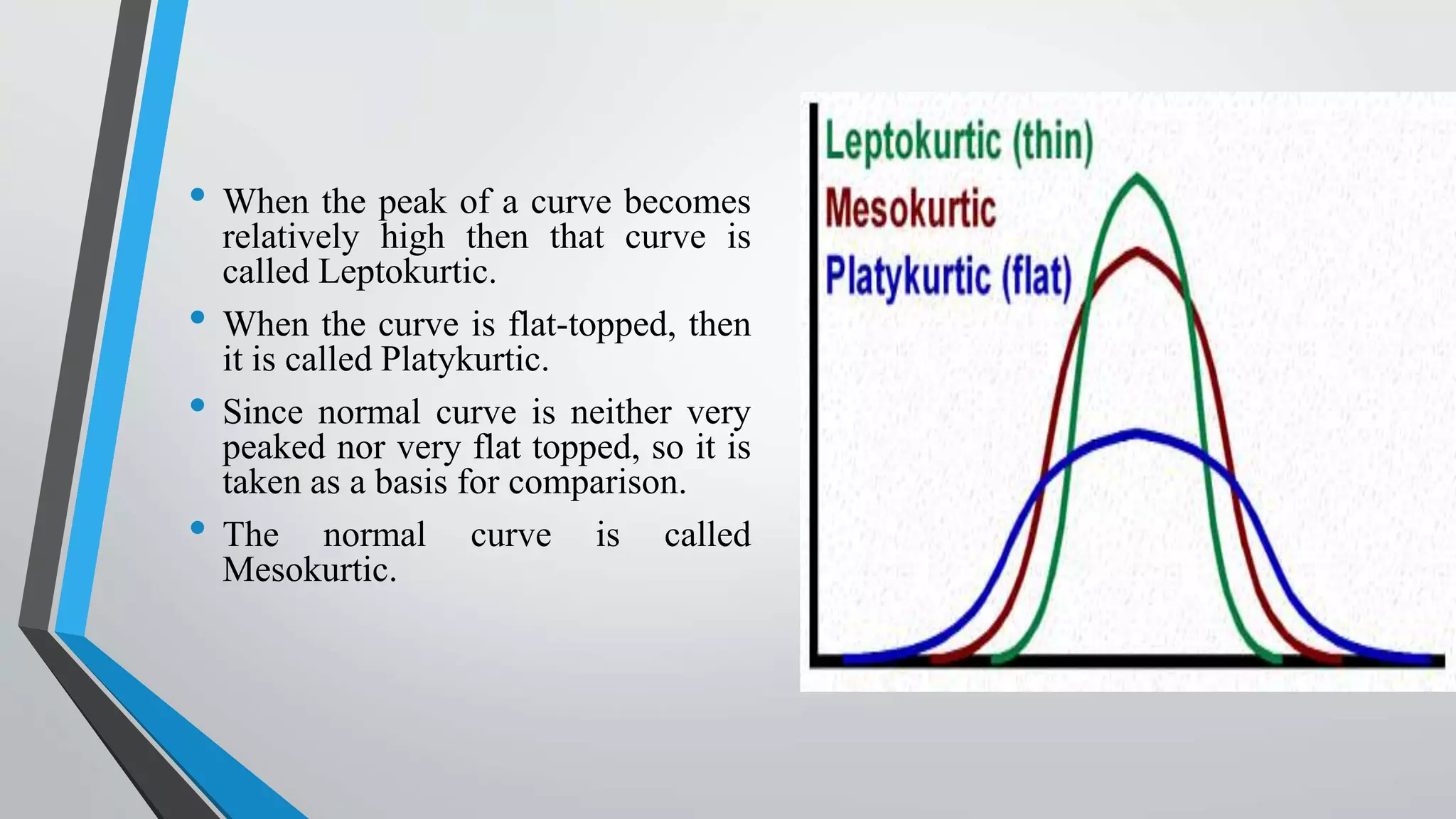
• When the peak of a curve becomes
relatively high then that curve is
called Leptokurtic.
• When the curve is flat-topped, then
it is called Platykurtic.
• Since normal curve is neither very
peaked nor very flat topped, so it is
taken as a basis for comparison.
• The normal curve is called
Mesokurtic.
Continued..
• For a normal distribution, kurtosis is equal to 3.
• When is greater than 3, the curve is more sharply peaked and has narrower
tails than the normal curve and is said to be leptokurtic.
• When it is less than 3, the curve has a flatter top and relatively wider tails than
the normal curve and is said to be platykurtic.
Thank you…

Probability and statistics

  • 1.
    PROBABILITY AND STATISTICS–18UCSA21 I B.ScComputer Science (SF) Ms. M. Indira Devi, M.Sc., M.Phil.,
  • 2.
    Central Moments • Theaverage of all the deviations of all observations in a dataset from the mean of the observations raised to the power r • In mean moments, the deviations are taken from the mean
  • 3.
  • 4.
    In General   rPopulation Moment about Mean= r ith r x N       r Sample Moment about Mean= r ith r x x m n    Formula for Grouped Data:     r Population Moment about Mean= r Sample Moment about Mean= r ith r r ith r f x f f x x m f          
  • 5.
    There are 4central moments: •The first central moment, r=1, is the sum of the difference of each observation from the sample average (arithmetic mean), which always equals 0 •The second central moment, r=2, is variance.
  • 6.
    Continued… •The third centralmoment, r=3, is skewness. •Skewness describes how the sample differs in shape from a symmetrical distribution. •If a normal distribution has a skewness of 0, right skewed is greater then 0 and left skewed is less than 0.
  • 7.
    Negatively skewed distributions,skewed to the left, occur when most of the scores are toward the high end of the distribution. In a normal distribution where skewness is 0, the mean, median and mode are equal. In a negatively skewed distribution, the mode > median > mean.
  • 8.
    Positively skewed distributionsoccur when most of the scores are toward the low end of the distribution. In a positively skewed distribution, mode< median< mean.
  • 10.
    Kurtosis Kurtosis is the4th central moment. This is the “peakedness” of a distribution. It measures the extent to which the data are distributed in the tails versus the center of the distribution There are three types of peakedness. Leptokurtic- very peaked Platykurtic – relatively flat Mesokurtic – in between
  • 11.
    Mesokurtic has akurtosis of 0 Leptokurtic has a kurtosis that is + Platykurtic has a kurtosis that is -
  • 13.
    Karl Pearson definedcoefficient of Skewness as: Mean Mode Sk SD   3 2Mode Median Mean   3 Median Mean Sk SD  
  • 14.
    • When thepeak of a curve becomes relatively high then that curve is called Leptokurtic. • When the curve is flat-topped, then it is called Platykurtic. • Since normal curve is neither very peaked nor very flat topped, so it is taken as a basis for comparison. • The normal curve is called Mesokurtic.
  • 15.
    Continued.. • For anormal distribution, kurtosis is equal to 3. • When is greater than 3, the curve is more sharply peaked and has narrower tails than the normal curve and is said to be leptokurtic. • When it is less than 3, the curve has a flatter top and relatively wider tails than the normal curve and is said to be platykurtic.
  • 16.