Probabilistic Reasoning


                           Tameem Ahmad
                                          Student
                                          M.Tech.
                                        Z.H.C.E.T.
                                    A.M.U.,Aligarh


  Copyright, 1996 © Dale Carnegie & Associates, Inc.
References:
 NPTEL           National Programme on Technology Enhanced Learning (NPTEL) is
 a Government of India sponsored collaborative educational programme. By developing
 curriculum-based video and web courses the programme aims to enhance the quality of
 engineering education in India. It is being jointly carried out by 7 IITS and IISc Bangalore,
 and is funded by the Ministry of Human Resources Development of the Governament of
 India.

 Computer Based Numerical & Statistical
 Techniques by M.Goyal Laxmi Publications, Ltd., 01-Jan-2008


                                                                                                 2
Probabilistic Reasoning
What???
• Capturing uncertain knowledge
• Probabilistic inference


                                  3
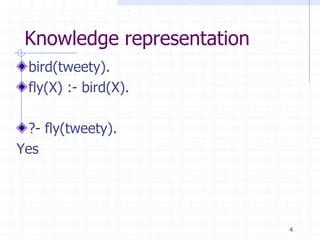
Knowledge representation
  bird(tweety).
  fly(X) :- bird(X).

  ?- fly(tweety).
Yes


                            4
Knowledge representation (Cont.)
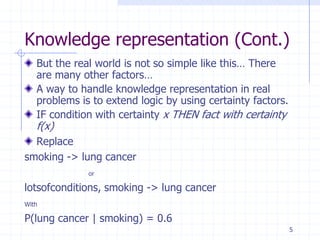
   But the real world is not so simple like this… There
   are many other factors…
   A way to handle knowledge representation in real
   problems is to extend logic by using certainty factors.
   IF condition with certainty x THEN fact with certainty
   f(x)
  Replace
smoking -> lung cancer
              or

lotsofconditions, smoking -> lung cancer
With

P(lung cancer | smoking) = 0.6
                                                             5
probabilistic model
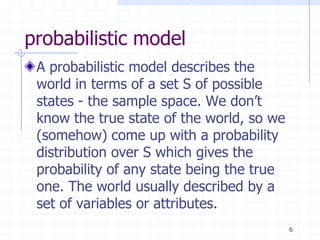
 A probabilistic model describes the
 world in terms of a set S of possible
 states - the sample space. We don’t
 know the true state of the world, so we
 (somehow) come up with a probability
 distribution over S which gives the
 probability of any state being the true
 one. The world usually described by a
 set of variables or attributes.
                                           6
Cont…
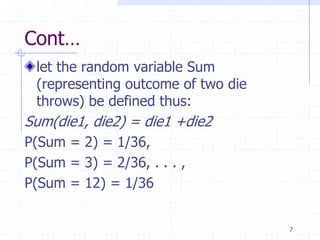
 let the random variable Sum
 (representing outcome of two die
 throws) be defined thus:
Sum(die1, die2) = die1 +die2
P(Sum = 2) = 1/36,
P(Sum = 3) = 2/36, . . . ,
P(Sum = 12) = 1/36


                                    7
Cont…
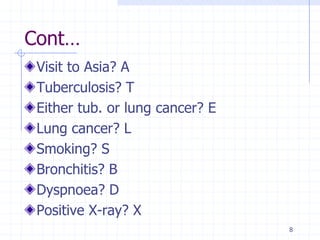
 Visit to Asia? A
 Tuberculosis? T
 Either tub. or lung cancer? E
 Lung cancer? L
 Smoking? S
 Bronchitis? B
 Dyspnoea? D
 Positive X-ray? X
                                 8
Cont…
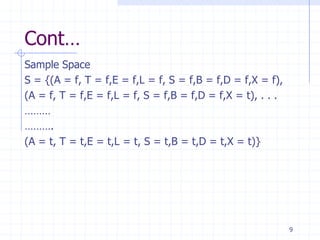
Sample Space
S = {(A = f, T = f,E = f,L = f, S = f,B = f,D = f,X = f),
(A = f, T = f,E = f,L = f, S = f,B = f,D = f,X = t), . . .
………
……….
(A = t, T = t,E = t,L = t, S = t,B = t,D = t,X = t)}


                                                             9
Cont…
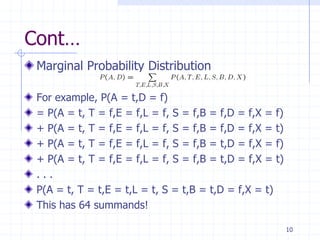
 Marginal Probability Distribution

 For example, P(A = t,D = f)
 = P(A = t, T = f,E = f,L = f, S = f,B = f,D = f,X = f)
 + P(A = t, T = f,E = f,L = f, S = f,B = f,D = f,X = t)
 + P(A = t, T = f,E = f,L = f, S = f,B = t,D = f,X = f)
 + P(A = t, T = f,E = f,L = f, S = f,B = t,D = f,X = t)
 ...
 P(A = t, T = t,E = t,L = t, S = t,B = t,D = f,X = t)
 This has 64 summands!

                                                          10
Cont…
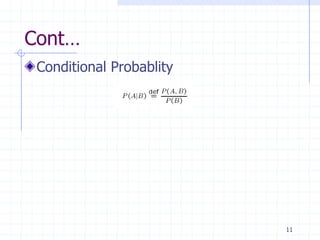
 Conditional Probablity


                          11
Knowledge engineering for
uncertain reasoning
Decide what to talk about
Decide on a vocabulary of random variables
Encode general knowledge about the
dependence
Encode a description of the specific problem
instance
Pose queries to the inference procedure and get
answers


                                             12
Probabilistic Inference Rules
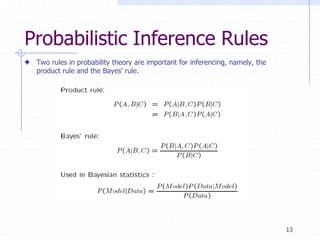
 Two rules in probability theory are important for inferencing, namely, the
 product rule and the Bayes' rule.


                                                                              13
Cont…
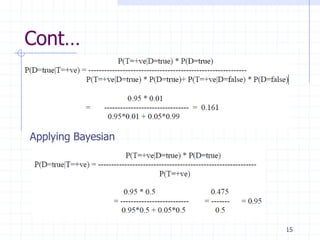
 Suppose one has been tested positive for a disease; what is the
 probability that you actually have the disease?
 It depends on the accuracy and sensitivity of the test, and on
 the background (prior) probability of the disease.
 Let P(Test=+ve | Disease=true) = 0.95 (95%),
 so the true negative rate, P(Test=-ve | Disease=true), is 0.05
 (5%).
 Let P(Test=+ve | Disease=false) = 0.05, so the false positive
 rate is also 5%.
 Suppose the disease is rare: P(Disease=true) = 0.01 (1%).


                                                               14
Cont…


Applying Bayesian


                    15

Probabilistic Reasoning

  • 1.
    Probabilistic Reasoning Tameem Ahmad Student M.Tech. Z.H.C.E.T. A.M.U.,Aligarh Copyright, 1996 © Dale Carnegie & Associates, Inc.
  • 2.
    References: NPTEL National Programme on Technology Enhanced Learning (NPTEL) is a Government of India sponsored collaborative educational programme. By developing curriculum-based video and web courses the programme aims to enhance the quality of engineering education in India. It is being jointly carried out by 7 IITS and IISc Bangalore, and is funded by the Ministry of Human Resources Development of the Governament of India. Computer Based Numerical & Statistical Techniques by M.Goyal Laxmi Publications, Ltd., 01-Jan-2008 2
  • 3.
    Probabilistic Reasoning What??? • Capturinguncertain knowledge • Probabilistic inference 3
  • 4.
    Knowledge representation bird(tweety). fly(X) :- bird(X). ?- fly(tweety). Yes 4
  • 5.
    Knowledge representation (Cont.) But the real world is not so simple like this… There are many other factors… A way to handle knowledge representation in real problems is to extend logic by using certainty factors. IF condition with certainty x THEN fact with certainty f(x) Replace smoking -> lung cancer or lotsofconditions, smoking -> lung cancer With P(lung cancer | smoking) = 0.6 5
  • 6.
    probabilistic model Aprobabilistic model describes the world in terms of a set S of possible states - the sample space. We don’t know the true state of the world, so we (somehow) come up with a probability distribution over S which gives the probability of any state being the true one. The world usually described by a set of variables or attributes. 6
  • 7.
    Cont… let therandom variable Sum (representing outcome of two die throws) be defined thus: Sum(die1, die2) = die1 +die2 P(Sum = 2) = 1/36, P(Sum = 3) = 2/36, . . . , P(Sum = 12) = 1/36 7
  • 8.
    Cont… Visit toAsia? A Tuberculosis? T Either tub. or lung cancer? E Lung cancer? L Smoking? S Bronchitis? B Dyspnoea? D Positive X-ray? X 8
  • 9.
    Cont… Sample Space S ={(A = f, T = f,E = f,L = f, S = f,B = f,D = f,X = f), (A = f, T = f,E = f,L = f, S = f,B = f,D = f,X = t), . . . ……… ………. (A = t, T = t,E = t,L = t, S = t,B = t,D = t,X = t)} 9
  • 10.
    Cont… Marginal ProbabilityDistribution For example, P(A = t,D = f) = P(A = t, T = f,E = f,L = f, S = f,B = f,D = f,X = f) + P(A = t, T = f,E = f,L = f, S = f,B = f,D = f,X = t) + P(A = t, T = f,E = f,L = f, S = f,B = t,D = f,X = f) + P(A = t, T = f,E = f,L = f, S = f,B = t,D = f,X = t) ... P(A = t, T = t,E = t,L = t, S = t,B = t,D = f,X = t) This has 64 summands! 10
  • 11.
  • 12.
    Knowledge engineering for uncertainreasoning Decide what to talk about Decide on a vocabulary of random variables Encode general knowledge about the dependence Encode a description of the specific problem instance Pose queries to the inference procedure and get answers 12
  • 13.
    Probabilistic Inference Rules Two rules in probability theory are important for inferencing, namely, the product rule and the Bayes' rule. 13
  • 14.
    Cont… Suppose onehas been tested positive for a disease; what is the probability that you actually have the disease? It depends on the accuracy and sensitivity of the test, and on the background (prior) probability of the disease. Let P(Test=+ve | Disease=true) = 0.95 (95%), so the true negative rate, P(Test=-ve | Disease=true), is 0.05 (5%). Let P(Test=+ve | Disease=false) = 0.05, so the false positive rate is also 5%. Suppose the disease is rare: P(Disease=true) = 0.01 (1%). 14
  • 15.