PRIVATIZATION
Development Studies
Course Teacher : Muhammad Bilal Khalid
NED UNIVERSITY , KARACHI
Member:
•Ali Mohib
•Sajjad Mehdi
•Tehreem Siraj
•Taliya Salman
•Aruba Khan
•S.M. Ijlal Mehdi
•Hassan Zafar
CONTENTS
• What is privatization ?What is privatization ?
• Reasons for privatizationReasons for privatization
• Privatization in United Kingdom.Privatization in United Kingdom.
• British AirwaysBritish Airways
• Water IndustryWater Industry
• British petroleumBritish petroleum
• British electricityBritish electricity
• British prisonsBritish prisons
What is privatization ?
• Privatization is the opposite of
nationalism .
• The transfer of ownership of
property or businesses from a
government to a privately owned
entity.
• Raising money.
• Making industry more efficient.
• Spreading share ownership.
Reasons for Privatization
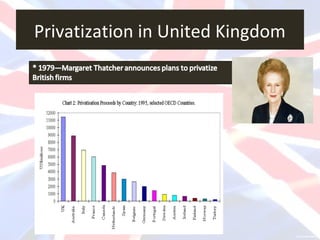
Privatization in United Kingdom
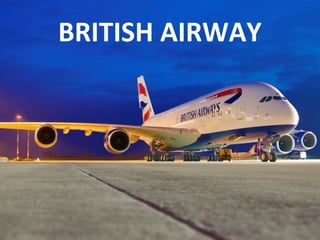
BRITISH AIRWAY
BRITISH AIRWAY
• A British Airways Board was established by
the United Kingdom government in 1972 to
manage the two nationalized airline
corporations.
REASONS BEHIND THE PRIVATIZATION OF
BRITISH AIRWAYS
 Acquisitions, mergers, cases, regulations, and
strikes.
 Aver-employment.
 Productivity was very low compared to its
competitors.
 Earnings of BA were declining.
BEFORE AND AFTER PRIVATIZATION
EFFECTS OF BRITISH AIRWAYS
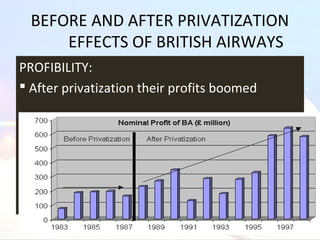
PROFIBILITY:
 After privatization their profits boomed.
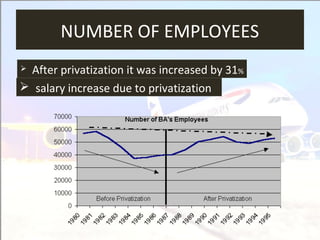
NUMBER OF EMPLOYEES
 salary increase due to privatization.
 After privatization it was increased by 31%
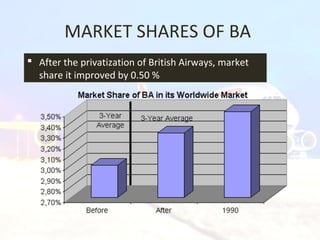
MARKET SHARES OF BA
 After the privatization of British Airways, market
share it improved by 0.50 %
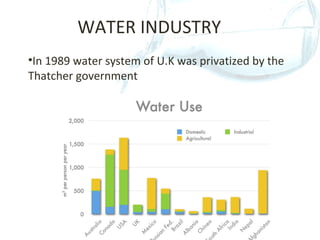
WATER INDUSTRY
•In 1989 water system of U.K was privatized by the
Thatcher government
AFTER PRIVATIZATION EFFECTS OF
WATER INDUSTRY
•Prices increases 50% in the first 4 years
•Pre-tax profits doubled in the first year
of the privatization
•After privatization number of
employees decreased by 21.5%.
•The privatization lead to increase in
fees , salaries & bonuses
AFTER PRIVATIZATION EFFECTS OF
WATER INDUSTRY
•Instead of improving services and
investment , the reduction in staff lead to
deteriorating of rating services in many areas
•The water quality did not improve.
•Public health has deteriorated and the
pollution of environment has increased
•The water industry is no longer a public
service but only business to maximize profits.
BRITISH PETROLEUM:
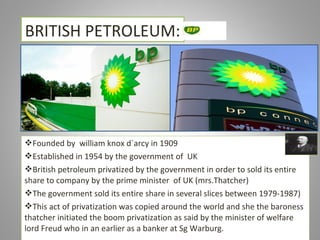
Founded by william knox d`arcy in 1909
Established in 1954 by the government of UK
British petroleum privatized by the government in order to sold its entire
share to company by the prime minister of UK (mrs.Thatcher)
The government sold its entire share in several slices between 1979-1987)
This act of privatization was copied around the world and she the baroness
thatcher initiated the boom privatization as said by the minister of welfare
lord Freud who in an earlier as a banker at Sg Warburg.
19
HISTORY OF BRITISH PETROLEUM
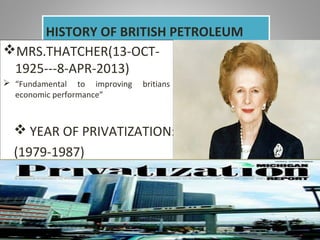
MRS.THATCHER(13-OCT-
1925---8-APR-2013)
 “Fundamental to improving britians
economic performance”
 YEAR OF PRIVATIZATION:
(1979-1987)
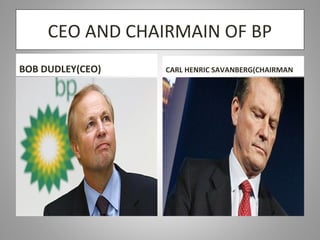
CEO AND CHAIRMAIN OF BP
BOB DUDLEY(CEO) CARL HENRIC SAVANBERG(CHAIRMAN
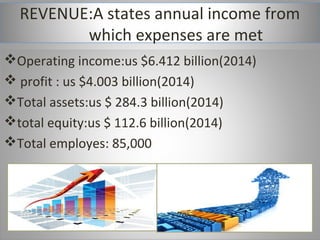
REVENUE:A states annual income from
which expenses are met
Operating income:us $6.412 billion(2014)
 profit : us $4.003 billion(2014)
Total assets:us $ 284.3 billion(2014)
total equity:us $ 112.6 billion(2014)
Total employes: 85,000
07/31/16
07/31/16
PRIVATE PRISONS
The 1st
privately run prison opened for
business on 6th
April 1992.
At present 14 private prisons out of 144 .
The top private companies are 4s justice
services , Serco Custodial services& sudeno.
12.9 % of prisoners population is in private
prisons.
Combined values of contracts is around £ 4
Billions .
07/31/16
HISTORY OF PRIVATE PRISONS
 1980-1990 : Gathering momentum
 1990-1998 : Introducing competition
 .
 1998-2010 : Moving back & forth between
the public and private
 2010-present : Deeping and expandind
competition.
07/31/16
MAIN FACTORS
The cost of private prison is less than the cost
of public prisons
The private prisons are safer , living condition
are good & successful rehabilition of
prisoners into the society
The government dependency on private
prisons should not be increased because it
leads to greater cost
To maintain & ensure the quality &
transparency government should keep check
and balance
07/31/16
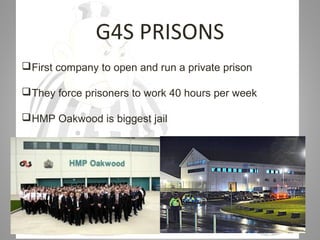
G4S PRISONS
First company to open and run a private prison
They force prisoners to work 40 hours per week
HMP Oakwood is biggest jail
The World Bank Group ▪ Finance, Private Sector, and Infrastructure
Network
THE RESTRUCTING AND
PRIVITIZATION OF THE U.K.
ELECTRICITY SUPPLY
The World Bank Group ▪ Finance, Private Sector, and Infrastructure
Network
Central Electrcity Generating Board (CEGB)
Before Privitization
•Playing monoply
•Low productivity growth
•Low return on Assets
•Very expensive Coal & Nuclear Power
•Emissions of Sulfur dioxide & Nitrogen oxides
causing acid Rain & Global warming
The World Bank Group ▪ Finance, Private Sector, and Infrastructure Network
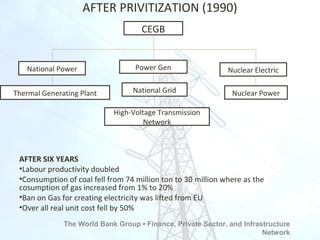
AFTER PRIVITIZATION (1990)
AFTER SIX YEARS
•Labour productivity doubled
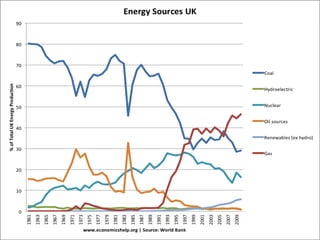
•Consumption of coal fell from 74 million ton to 30 million where as the
cosumption of gas increased from 1% to 20%
•Ban on Gas for creating electricity was lifted from EU
•Over all real unit cost fell by 50%
CEGB
National Power Power Gen Nuclear Electric
Thermal Generating Plant National Grid Nuclear Power
High-Voltage Transmission
Network
The World Bank Group ▪ Finance, Private Sector, and Infrastructure
Network
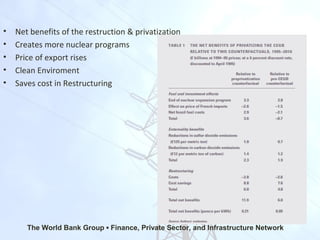
• Net benefits of the restruction & privatization
• Creates more nuclear programs
• Price of export rises
• Clean Enviroment
• Saves cost in Restructuring
The World Bank Group ▪ Finance, Private Sector, and Infrastructure Network
07/31/16

Privatization (sajjad)

  • 1.
  • 2.
    NED UNIVERSITY ,KARACHI Member: •Ali Mohib •Sajjad Mehdi •Tehreem Siraj •Taliya Salman •Aruba Khan •S.M. Ijlal Mehdi •Hassan Zafar
  • 4.
    CONTENTS • What isprivatization ?What is privatization ? • Reasons for privatizationReasons for privatization • Privatization in United Kingdom.Privatization in United Kingdom. • British AirwaysBritish Airways • Water IndustryWater Industry • British petroleumBritish petroleum • British electricityBritish electricity • British prisonsBritish prisons
  • 5.
    What is privatization? • Privatization is the opposite of nationalism . • The transfer of ownership of property or businesses from a government to a privately owned entity.
  • 6.
    • Raising money. •Making industry more efficient. • Spreading share ownership. Reasons for Privatization
  • 7.
  • 8.
  • 9.
    BRITISH AIRWAY • ABritish Airways Board was established by the United Kingdom government in 1972 to manage the two nationalized airline corporations.
  • 10.
    REASONS BEHIND THEPRIVATIZATION OF BRITISH AIRWAYS  Acquisitions, mergers, cases, regulations, and strikes.  Aver-employment.  Productivity was very low compared to its competitors.  Earnings of BA were declining.
  • 11.
    BEFORE AND AFTERPRIVATIZATION EFFECTS OF BRITISH AIRWAYS PROFIBILITY:  After privatization their profits boomed.
  • 12.
    NUMBER OF EMPLOYEES salary increase due to privatization.  After privatization it was increased by 31%
  • 13.
    MARKET SHARES OFBA  After the privatization of British Airways, market share it improved by 0.50 %
  • 15.
    WATER INDUSTRY •In 1989water system of U.K was privatized by the Thatcher government
  • 16.
    AFTER PRIVATIZATION EFFECTSOF WATER INDUSTRY •Prices increases 50% in the first 4 years •Pre-tax profits doubled in the first year of the privatization •After privatization number of employees decreased by 21.5%. •The privatization lead to increase in fees , salaries & bonuses
  • 17.
    AFTER PRIVATIZATION EFFECTSOF WATER INDUSTRY •Instead of improving services and investment , the reduction in staff lead to deteriorating of rating services in many areas •The water quality did not improve. •Public health has deteriorated and the pollution of environment has increased •The water industry is no longer a public service but only business to maximize profits.
  • 18.
    BRITISH PETROLEUM: Founded bywilliam knox d`arcy in 1909 Established in 1954 by the government of UK British petroleum privatized by the government in order to sold its entire share to company by the prime minister of UK (mrs.Thatcher) The government sold its entire share in several slices between 1979-1987) This act of privatization was copied around the world and she the baroness thatcher initiated the boom privatization as said by the minister of welfare lord Freud who in an earlier as a banker at Sg Warburg.
  • 19.
    19 HISTORY OF BRITISHPETROLEUM MRS.THATCHER(13-OCT- 1925---8-APR-2013)  “Fundamental to improving britians economic performance”  YEAR OF PRIVATIZATION: (1979-1987)
  • 20.
    CEO AND CHAIRMAINOF BP BOB DUDLEY(CEO) CARL HENRIC SAVANBERG(CHAIRMAN
  • 21.
    REVENUE:A states annualincome from which expenses are met Operating income:us $6.412 billion(2014)  profit : us $4.003 billion(2014) Total assets:us $ 284.3 billion(2014) total equity:us $ 112.6 billion(2014) Total employes: 85,000
  • 22.
  • 23.
    07/31/16 PRIVATE PRISONS The 1st privatelyrun prison opened for business on 6th April 1992. At present 14 private prisons out of 144 . The top private companies are 4s justice services , Serco Custodial services& sudeno. 12.9 % of prisoners population is in private prisons. Combined values of contracts is around £ 4 Billions .
  • 24.
    07/31/16 HISTORY OF PRIVATEPRISONS  1980-1990 : Gathering momentum  1990-1998 : Introducing competition  .  1998-2010 : Moving back & forth between the public and private  2010-present : Deeping and expandind competition.
  • 25.
    07/31/16 MAIN FACTORS The costof private prison is less than the cost of public prisons The private prisons are safer , living condition are good & successful rehabilition of prisoners into the society The government dependency on private prisons should not be increased because it leads to greater cost To maintain & ensure the quality & transparency government should keep check and balance
  • 26.
    07/31/16 G4S PRISONS First companyto open and run a private prison They force prisoners to work 40 hours per week HMP Oakwood is biggest jail
  • 27.
    The World BankGroup ▪ Finance, Private Sector, and Infrastructure Network
  • 28.
    THE RESTRUCTING AND PRIVITIZATIONOF THE U.K. ELECTRICITY SUPPLY The World Bank Group ▪ Finance, Private Sector, and Infrastructure Network
  • 29.
    Central Electrcity GeneratingBoard (CEGB) Before Privitization •Playing monoply •Low productivity growth •Low return on Assets •Very expensive Coal & Nuclear Power •Emissions of Sulfur dioxide & Nitrogen oxides causing acid Rain & Global warming The World Bank Group ▪ Finance, Private Sector, and Infrastructure Network
  • 30.
    AFTER PRIVITIZATION (1990) AFTERSIX YEARS •Labour productivity doubled •Consumption of coal fell from 74 million ton to 30 million where as the cosumption of gas increased from 1% to 20% •Ban on Gas for creating electricity was lifted from EU •Over all real unit cost fell by 50% CEGB National Power Power Gen Nuclear Electric Thermal Generating Plant National Grid Nuclear Power High-Voltage Transmission Network The World Bank Group ▪ Finance, Private Sector, and Infrastructure Network
  • 32.
    • Net benefitsof the restruction & privatization • Creates more nuclear programs • Price of export rises • Clean Enviroment • Saves cost in Restructuring The World Bank Group ▪ Finance, Private Sector, and Infrastructure Network
  • 33.

Editor's Notes

  • #19 British petroleum privatization began in 1979-1987 under the supervision of mrs thatcher