Presented by:- Tushar Vishnoi (PSIT college of engineering)
PRIVATIZATION
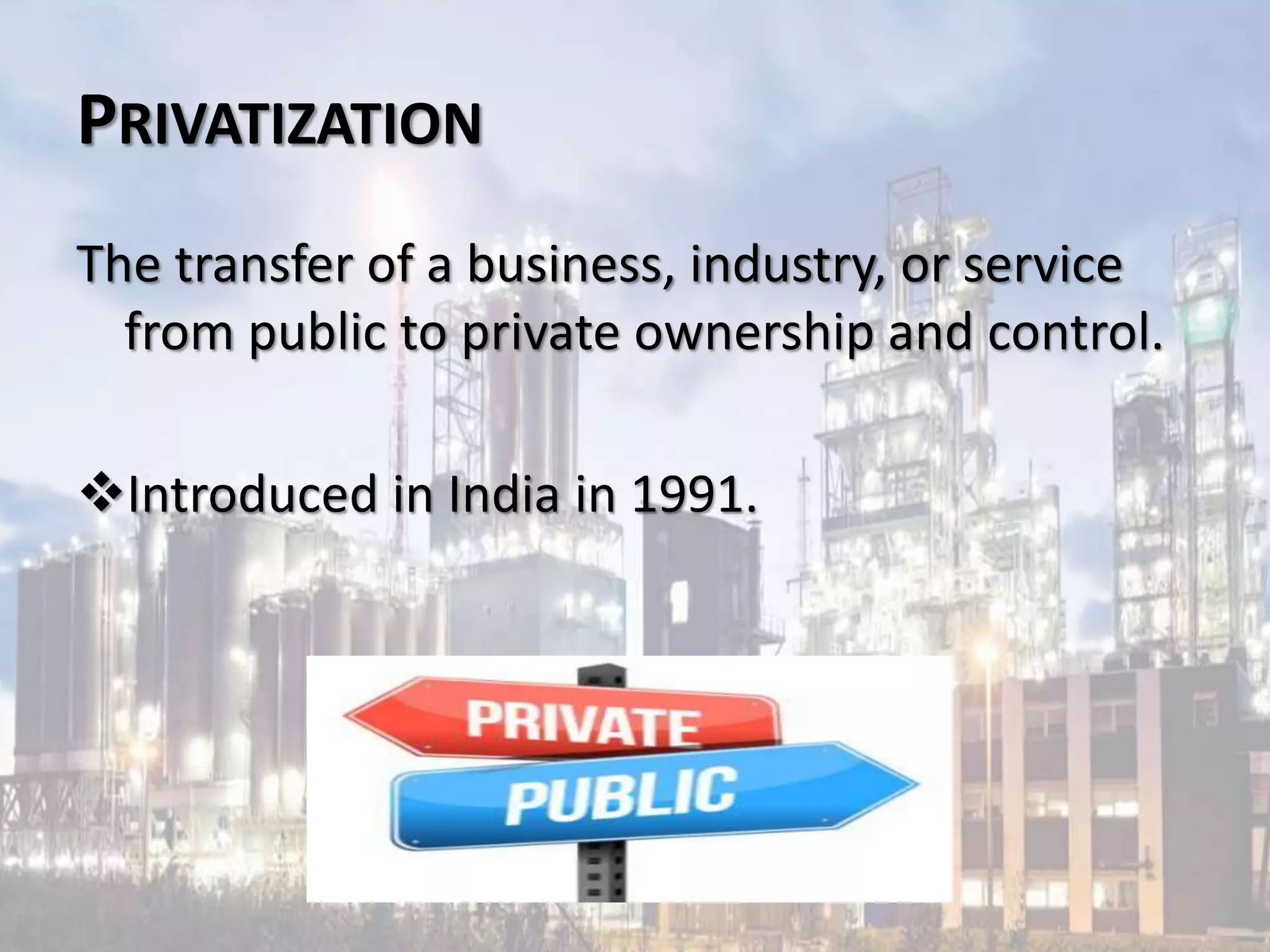
The transfer of a business, industry, or service
from public to private ownership and control.
Introduced in India in 1991.
METHOD OF PRIVATIZATION
Sale of the entire entity
Initial public offering
Management control
OBJECTIVE
 To restructure public sector.
 It creates more jobs.
 Attracts more national and international
investors.
 To make optimum use of resources.
BEFORE & AFTER PRIVATIZATION
 GDP 3.5% - 7.5%
Rupee Devaluation 7.5 – 67
 Licence Raj
 No of bank branches 8,262 – 45,898
Agriculture credit 162cr – 4,46,496cr
FDI PERCENTAGE
100%
Telecom, Single brand retail, Agriculture, Courier service,
Education, Railway infrastructure, Tourism, Pharma,
Food-Products, Civil aviation, Automobile.
49%
Insurance, Stock exchange, Private security, Pension,
Petroleum refining, Power exchanges, Defence(CCS),
0%
Gambling and Betting, Lottery business, atomic energy , Railways,
Real estate business, Manufacturing of tobacco & cigars &
cigarettes.
ADVANTAGES
Improved efficiency.
Reduce the burden on govt.
Industrial growth.
Increased competition.
Increase the FDI & FII
DISADVANTGE
• Natural monopoly.
• Public interest.
• Problem in regulating
private monopolies.
• Ignores the weaker
sections.
Privatization

Privatization

  • 1.
    Presented by:- TusharVishnoi (PSIT college of engineering)
  • 2.
    PRIVATIZATION The transfer ofa business, industry, or service from public to private ownership and control. Introduced in India in 1991.
  • 3.
    METHOD OF PRIVATIZATION Saleof the entire entity Initial public offering Management control
  • 4.
    OBJECTIVE  To restructurepublic sector.  It creates more jobs.  Attracts more national and international investors.  To make optimum use of resources.
  • 5.
    BEFORE & AFTERPRIVATIZATION  GDP 3.5% - 7.5% Rupee Devaluation 7.5 – 67  Licence Raj  No of bank branches 8,262 – 45,898 Agriculture credit 162cr – 4,46,496cr
  • 6.
    FDI PERCENTAGE 100% Telecom, Singlebrand retail, Agriculture, Courier service, Education, Railway infrastructure, Tourism, Pharma, Food-Products, Civil aviation, Automobile. 49% Insurance, Stock exchange, Private security, Pension, Petroleum refining, Power exchanges, Defence(CCS), 0% Gambling and Betting, Lottery business, atomic energy , Railways, Real estate business, Manufacturing of tobacco & cigars & cigarettes.
  • 7.
    ADVANTAGES Improved efficiency. Reduce theburden on govt. Industrial growth. Increased competition. Increase the FDI & FII
  • 8.
    DISADVANTGE • Natural monopoly. •Public interest. • Problem in regulating private monopolies. • Ignores the weaker sections.