ORGANISATION OF DATA
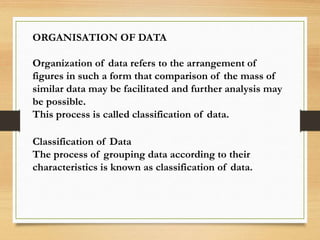
Organization of data refers to the arrangement of
figures in such a form that comparison of the mass of
similar data may be facilitated and further analysis may
be possible.
This process is called classification of data.
Classification of Data
The process of grouping data according to their
characteristics is known as classification of data.
Objectives of Classification:
a] To simplify complex data
b] To facilitate understanding
c] To facilitate comparison
d] To make analysis and interpretation easy.
e] To arrange and put the data according to
their common characteristics.
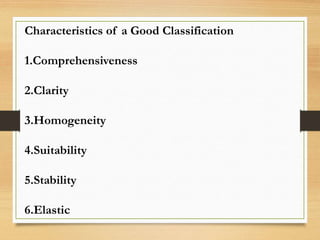
Characteristics of a Good Classification
1.Comprehensiveness
2.Clarity
3.Homogeneity
4.Suitability
5.Stability
6.Elastic
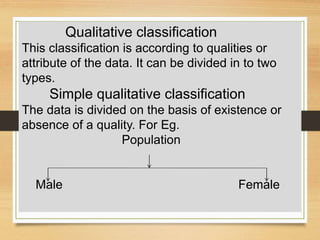
Qualitative classification
This classification is according to qualities or
attribute of the data. It can be divided in to two
types.
Simple qualitative classification
The data is divided on the basis of existence or
absence of a quality. For Eg.
Population
Male Female
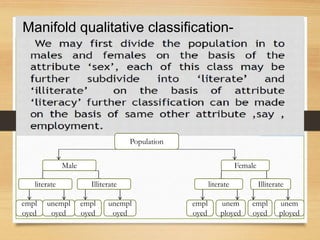
Manifold qualitative classification-
Population
Male Female
literate literateIlliterate Illiterate
empl
oyed
unem
ployed
empl
oyed
unempl
oyed
empl
oyed
empl
oyed
unem
ployed
unempl
oyed
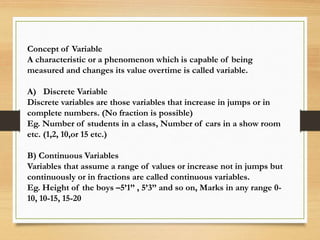
Concept of Variable
A characteristic or a phenomenon which is capable of being
measured and changes its value overtime is called variable.
A) Discrete Variable
Discrete variables are those variables that increase in jumps or in
complete numbers. (No fraction is possible)
Eg. Number of students in a class, Number of cars in a show room
etc. (1,2, 10,or 15 etc.)
B) Continuous Variables
Variables that assume a range of values or increase not in jumps but
continuously or in fractions are called continuous variables.
Eg. Height of the boys –5’1’’ , 5’3’’ and so on, Marks in any range 0-
10, 10-15, 15-20
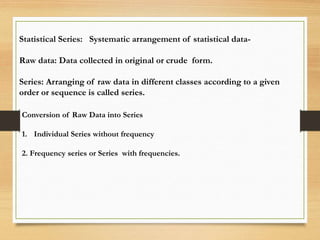
Statistical Series: Systematic arrangement of statistical data-
Raw data: Data collected in original or crude form.
Series: Arranging of raw data in different classes according to a given
order or sequence is called series.
Conversion of Raw Data into Series
1. Individual Series without frequency
2. Frequency series or Series with frequencies.
1] Individual Series: The arrangement of raw data individually
Individual Series can be expressed in two ways.
a] According to Serial Numbers-
Roll Number Marks
1 30
2 25
3 15
4 30
5 25
b] Ascending or descending order.
In ascending order, smallest number is placed first. For Eg. Marks- 30,25,15
In descending order, the highest number is placed first. For Eg. Marks- 15,20,30
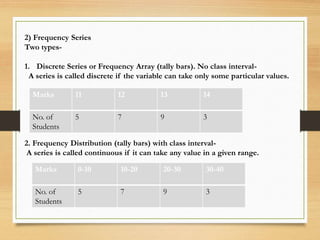
2) Frequency Series
Two types-
1. Discrete Series or Frequency Array (tally bars). No class interval-
A series is called discrete if the variable can take only some particular values.
2. Frequency Distribution (tally bars) with class interval-
A series is called continuous if it can take any value in a given range.
Marks 11 12 13 14
No. of
Students
5 7 9 3
Marks 0-10 10-20 20-30 30-40
No. of
Students
5 7 9 3
In constructing continuous series we come across terms like:
a] Class : Each given internal is called a class e.g., 0-5, 5-10.
b] Class limit: There are two limits upper limit and lower
limit.
c] Class interval: Difference between upper limit and lower
limit.
d] Range: Difference between upper limit and lower limit.
e] Mid-point or Mid Value: Upper limit -Lower limit
2
f] Frequency: Number of items [observations] falling within a
particular class.
Cumulative Frequency Series:
It is obtained by successively adding the frequencies of the values of the classes
according to a certain law.
a] ‘Less than’ Cumulative Frequency Distribution :
The frequencies of each class-internal are added successively starting from the
lowest value of the variable.
b] ‘More than’ Cumulative Frequency Distribution:
The frequencies of each class interval are added successively starting from the
highest value of the variable to the lowest value.
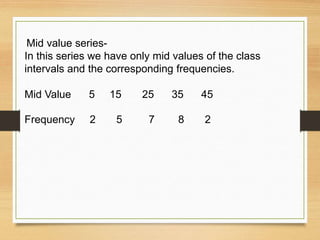
Mid value series-
In this series we have only mid values of the class
intervals and the corresponding frequencies.
Mid Value 5 15 25 35 45
Frequency 2 5 7 8 2

Census & sample methods of collection of data

  • 22.
    ORGANISATION OF DATA Organizationof data refers to the arrangement of figures in such a form that comparison of the mass of similar data may be facilitated and further analysis may be possible. This process is called classification of data. Classification of Data The process of grouping data according to their characteristics is known as classification of data.
  • 23.
    Objectives of Classification: a]To simplify complex data b] To facilitate understanding c] To facilitate comparison d] To make analysis and interpretation easy. e] To arrange and put the data according to their common characteristics.
  • 24.
    Characteristics of aGood Classification 1.Comprehensiveness 2.Clarity 3.Homogeneity 4.Suitability 5.Stability 6.Elastic
  • 29.
    Qualitative classification This classificationis according to qualities or attribute of the data. It can be divided in to two types. Simple qualitative classification The data is divided on the basis of existence or absence of a quality. For Eg. Population Male Female
  • 30.
    Manifold qualitative classification- Population MaleFemale literate literateIlliterate Illiterate empl oyed unem ployed empl oyed unempl oyed empl oyed empl oyed unem ployed unempl oyed
  • 33.
    Concept of Variable Acharacteristic or a phenomenon which is capable of being measured and changes its value overtime is called variable. A) Discrete Variable Discrete variables are those variables that increase in jumps or in complete numbers. (No fraction is possible) Eg. Number of students in a class, Number of cars in a show room etc. (1,2, 10,or 15 etc.) B) Continuous Variables Variables that assume a range of values or increase not in jumps but continuously or in fractions are called continuous variables. Eg. Height of the boys –5’1’’ , 5’3’’ and so on, Marks in any range 0- 10, 10-15, 15-20
  • 34.
    Statistical Series: Systematicarrangement of statistical data- Raw data: Data collected in original or crude form. Series: Arranging of raw data in different classes according to a given order or sequence is called series. Conversion of Raw Data into Series 1. Individual Series without frequency 2. Frequency series or Series with frequencies.
  • 35.
    1] Individual Series:The arrangement of raw data individually Individual Series can be expressed in two ways. a] According to Serial Numbers- Roll Number Marks 1 30 2 25 3 15 4 30 5 25 b] Ascending or descending order. In ascending order, smallest number is placed first. For Eg. Marks- 30,25,15 In descending order, the highest number is placed first. For Eg. Marks- 15,20,30
  • 36.
    2) Frequency Series Twotypes- 1. Discrete Series or Frequency Array (tally bars). No class interval- A series is called discrete if the variable can take only some particular values. 2. Frequency Distribution (tally bars) with class interval- A series is called continuous if it can take any value in a given range. Marks 11 12 13 14 No. of Students 5 7 9 3 Marks 0-10 10-20 20-30 30-40 No. of Students 5 7 9 3
  • 37.
    In constructing continuousseries we come across terms like: a] Class : Each given internal is called a class e.g., 0-5, 5-10. b] Class limit: There are two limits upper limit and lower limit. c] Class interval: Difference between upper limit and lower limit. d] Range: Difference between upper limit and lower limit. e] Mid-point or Mid Value: Upper limit -Lower limit 2 f] Frequency: Number of items [observations] falling within a particular class.
  • 40.
    Cumulative Frequency Series: Itis obtained by successively adding the frequencies of the values of the classes according to a certain law. a] ‘Less than’ Cumulative Frequency Distribution : The frequencies of each class-internal are added successively starting from the lowest value of the variable. b] ‘More than’ Cumulative Frequency Distribution: The frequencies of each class interval are added successively starting from the highest value of the variable to the lowest value.
  • 41.
    Mid value series- Inthis series we have only mid values of the class intervals and the corresponding frequencies. Mid Value 5 15 25 35 45 Frequency 2 5 7 8 2