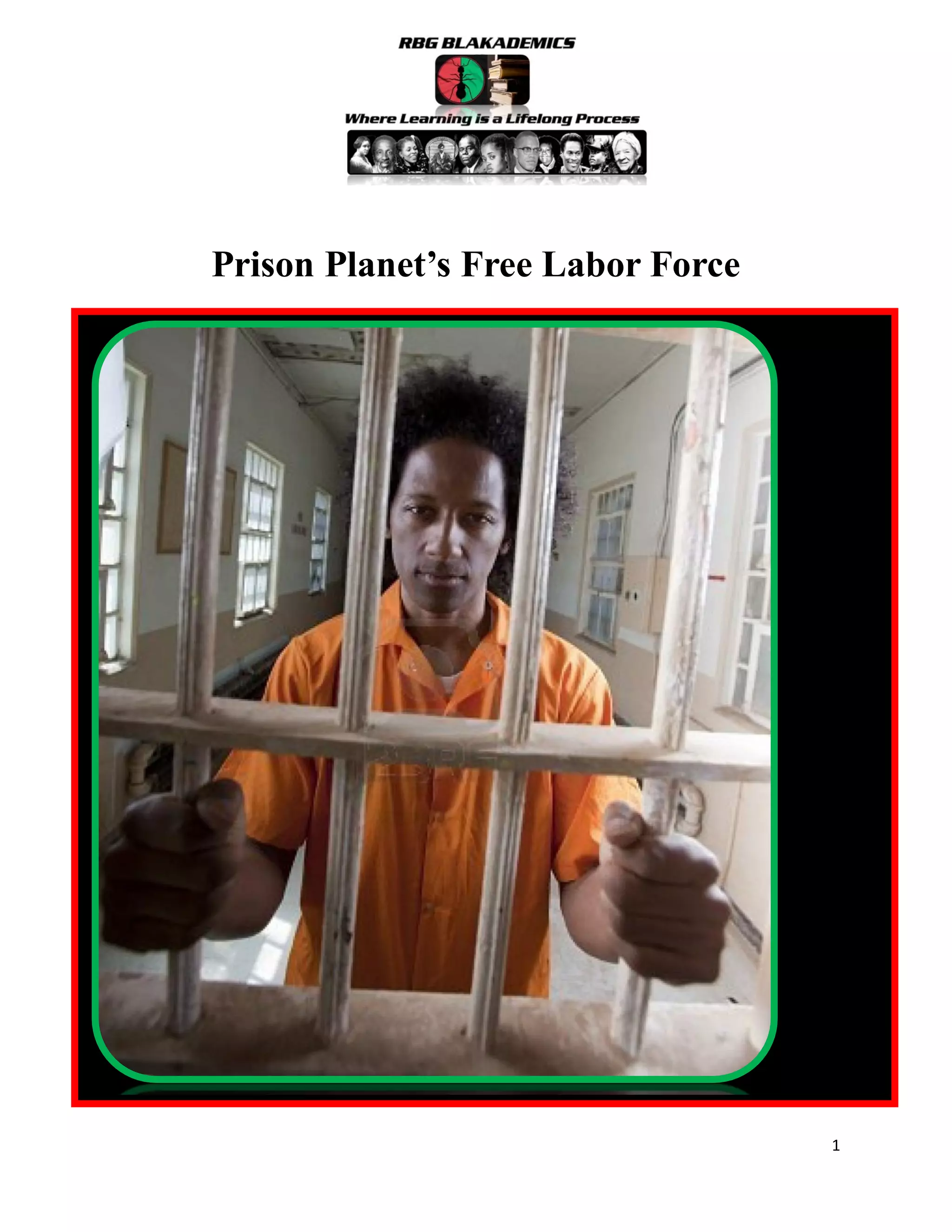
Prison Planet’s Free Labor Force


                                   1
Primary Documents in American History
13th Amendment to the U.S. Constitution
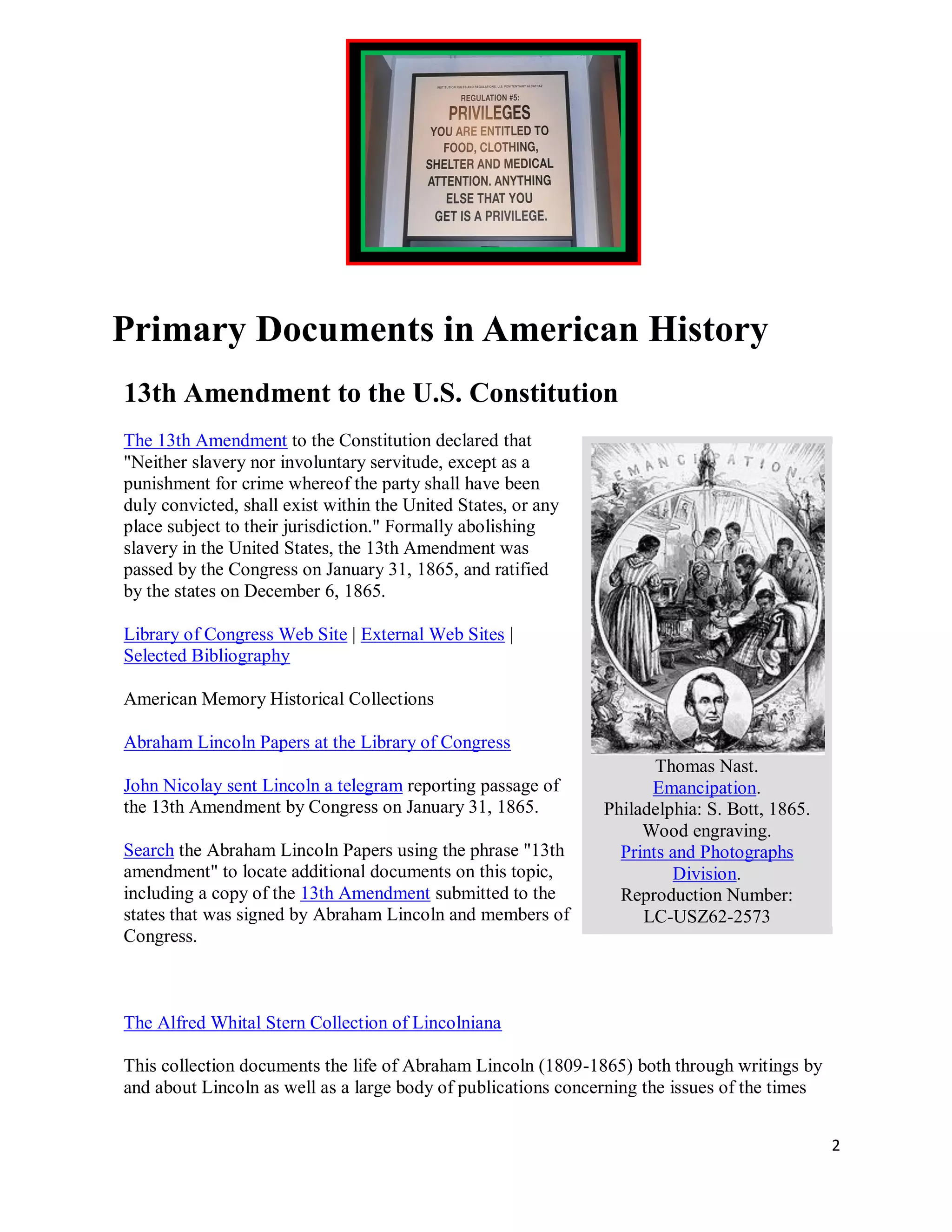
The 13th Amendment to the Constitution declared that
"Neither slavery nor involuntary servitude, except as a
punishment for crime whereof the party shall have been
duly convicted, shall exist within the United States, or any
place subject to their jurisdiction." Formally abolishing
slavery in the United States, the 13th Amendment was
passed by the Congress on January 31, 1865, and ratified
by the states on December 6, 1865.

Library of Congress Web Site | External Web Sites |
Selected Bibliography

American Memory Historical Collections

Abraham Lincoln Papers at the Library of Congress
                                                                      Thomas Nast.
John Nicolay sent Lincoln a telegram reporting passage of            Emancipation.
the 13th Amendment by Congress on January 31, 1865.            Philadelphia: S. Bott, 1865.
                                                                    Wood engraving.
Search the Abraham Lincoln Papers using the phrase "13th         Prints and Photographs
amendment" to locate additional documents on this topic,                Division.
including a copy of the 13th Amendment submitted to the          Reproduction Number:
states that was signed by Abraham Lincoln and members of            LC-USZ62-2573
Congress.


The Alfred Whital Stern Collection of Lincolniana

This collection documents the life of Abraham Lincoln (1809-1865) both through writings by
and about Lincoln as well as a large body of publications concerning the issues of the times


                                                                                               2
including slavery, the Civil War, Reconstruction, and related topics.

Search this collection to find a number of items related to the abolition of slavery, including a
copy of the 13th Amendment.

A Century of Lawmaking for a New Nation

The Senate debated and passed the 13th Amendment on April 8, 1864, by a vote of 38 to 6.
After initially rejecting the legislation, the House of Representatives finally passed the 13th
Amendment on January 31, 1865, by a vote of 119 to 56. On February 1, 1865, President
Abraham Lincoln signed a Joint Resolution submitting the proposed 13th Amendment to the
states. Finally, on December 18, 1865, Secretary of State William Seward issued a statement
verifying the ratification of the 13th Amendment.

Search in the 38th Congress to find additional information on the 13th Amendment.

From Slavery to Freedom: The African-American Pamphlet Collection, 1822-1909

Includes speeches by T.B. Van Buren and Gen. Hiram Walbridge given during the ratification
process of the 13th Amendment in the New York House of Assembly. Also found within this
collection is a report issued by the Union League Club of New York recommending the
approval of the 13th Amendment.

The Nineteenth Century in Print

Contains an article written by John Hay and John Nicolay, Lincoln's private secretaries, that
discusses the history of the 13th Amendment. Also includes an article in the Continental
Monthly that examines the initial rejection of the 13th Amendment by the House of
Representatives in 1864.

Chronicling America

The Chronicling America site allows you to search and view newspaper pages from 1860 to
1922 from the following states: Arizona, California, District of Columbia, Florida, Hawaii,
Illinois, Kansas, Kentucky, Louisiana, Minnesota, Missouri, Montana, Nebraska, New York,
Ohio, Oklahoma, Oregon, Pennsylvania, South Carolina, Texas, Utah, Virginia, and

                                                                                                    3
Washington.

Search this collection to find newspaper articles about the 13th Amendment.

A selection of articles on the 13th Amendment includes:

              "Freedom Triumphant," New-York Daily Tribune. (New-York [N.Y.]),
               February 01, 1865.
              "The Constitutional Amendment," The Daily Phoenix. (Columbia, S.C.),
               December 14, 1865
              "The Official Announcement of the Adoption of the Constitutional Amendment-
               -Opinions of the Leading Press," Daily National Republican. (Washington,
               D.C.), December 21, 1865

Exhibitions

The African-American Mosaic

This exhibit marks the publication of The African-American Mosaic: A Library of Congress
Resource Guide for the Study of Black History and Culture. This exhibit is a sampler of the
kinds of materials and themes covered by this publication. Includes a section on the abolition
movement and the end of slavery.

African American Odyssey: A Quest for Full Citizenship

This exhibition showcases the African American collections of the Library of Congress.
Displays more than 240 items, including books, government documents, manuscripts, maps,
musical scores, plays, films, and recordings. Includes a brochure from an exhibit at the Library
of Congress to mark the 75th Anniversary of the 13th Amendment.

American Treasures of the Library of Congress: Abolition of Slavery

An online exhibit of the engrossed copy of the 13th Amendment as signed by Abraham Lincoln
and members of Congress.

External Web Sites

The Collected Works of Abraham Lincoln, Abraham Lincoln Association

                                                                                                   4
The Constitution of the United States of America: Analysis and Interpretation,

Government Printing Office

Documents from Freedom: A Documentary History of Emancipation, 1861-1867, University of
Maryland

End of Slavery: The Creation of the 13th Amendment, HarpWeek

“I Will Be Heard!” Abolitionism in America, Cornell University Library, Division of Rare and
Manuscript Collections

Mr. Lincoln and Freedom, The Lincoln Institute

Our Documents, 13th Amendment to the U.S. Constitution, National Archives and Records
Administration

Selected Bibliography

Hoemann, George H. What God Hath Wrought: The Embodiment of Freedom in the Thirteenth
Amendment. New York: Garland Pub., 1987. [Catalog Record]

Holzer, Harold, and Sara Vaughn Gabbard, eds. Lincoln and Freedom: Slavery, Emancipation,
and the Thirteenth Amendment. Carbondale: Southern Illinois University Press, 2007. [Catalog
Record]

Maltz, Earl M. Civil Rights, the Constitution, and Congress, 1863-1869. Lawrence, Kan.:
University Press of Kansas, 1990. [Catalog Record]

Tsesis, Alexander. The Thirteenth Amendment and American Freedom: A Legal History. New
York : New York University Press, 2004. [Catalog Record]

Vorenberg, Michael. Final Freedom: The Civil War, the Abolition of Slavery, and the
Thirteenth Amendment. Cambridge; New York: Cambridge University Press, 2001. [Catalog
Record]


                                                                                               5
Younger Readers

 Schleichert, Elizabeth. The Thirteenth Amendment: Ending Slavery. Springfield, N.J.: Enslow
 Publishers, 1998. [Catalog Record]

 Source of this document
http://www.loc.gov/rr/program/bib/ourdocs/13thamendment.html


Black Studies Resources:

    A Brief History Of The New Afrikan Prison Struggle (Parts 1-2)
    Who Are The New Afrikan Political Prisoners and Prisoners Of War
    The Assata Shakur Multi-Media Guide (Intro. By Assata Shakur: We Can Win Our
     Liberation)
    Cointel Pro Revisited: FBI Domestic Intelligence Activities and the Sabotage of
     Legitimate Dissent
    Who is Dr. Mutulu Shakur-A Life Long Activist In The New Afrikan Independence
     Movement
    The RBG Quest For Black Power Reader-A Luta Continua (The Struggle Continues)
    FROLINAN-Front For The Liberation Of The New Afrikan Nation


                                                                                               6

Prison Planet: Free Labor Force

  • 1.
  • 2.
    Primary Documents inAmerican History 13th Amendment to the U.S. Constitution The 13th Amendment to the Constitution declared that "Neither slavery nor involuntary servitude, except as a punishment for crime whereof the party shall have been duly convicted, shall exist within the United States, or any place subject to their jurisdiction." Formally abolishing slavery in the United States, the 13th Amendment was passed by the Congress on January 31, 1865, and ratified by the states on December 6, 1865. Library of Congress Web Site | External Web Sites | Selected Bibliography American Memory Historical Collections Abraham Lincoln Papers at the Library of Congress Thomas Nast. John Nicolay sent Lincoln a telegram reporting passage of Emancipation. the 13th Amendment by Congress on January 31, 1865. Philadelphia: S. Bott, 1865. Wood engraving. Search the Abraham Lincoln Papers using the phrase "13th Prints and Photographs amendment" to locate additional documents on this topic, Division. including a copy of the 13th Amendment submitted to the Reproduction Number: states that was signed by Abraham Lincoln and members of LC-USZ62-2573 Congress. The Alfred Whital Stern Collection of Lincolniana This collection documents the life of Abraham Lincoln (1809-1865) both through writings by and about Lincoln as well as a large body of publications concerning the issues of the times 2
  • 3.
    including slavery, theCivil War, Reconstruction, and related topics. Search this collection to find a number of items related to the abolition of slavery, including a copy of the 13th Amendment. A Century of Lawmaking for a New Nation The Senate debated and passed the 13th Amendment on April 8, 1864, by a vote of 38 to 6. After initially rejecting the legislation, the House of Representatives finally passed the 13th Amendment on January 31, 1865, by a vote of 119 to 56. On February 1, 1865, President Abraham Lincoln signed a Joint Resolution submitting the proposed 13th Amendment to the states. Finally, on December 18, 1865, Secretary of State William Seward issued a statement verifying the ratification of the 13th Amendment. Search in the 38th Congress to find additional information on the 13th Amendment. From Slavery to Freedom: The African-American Pamphlet Collection, 1822-1909 Includes speeches by T.B. Van Buren and Gen. Hiram Walbridge given during the ratification process of the 13th Amendment in the New York House of Assembly. Also found within this collection is a report issued by the Union League Club of New York recommending the approval of the 13th Amendment. The Nineteenth Century in Print Contains an article written by John Hay and John Nicolay, Lincoln's private secretaries, that discusses the history of the 13th Amendment. Also includes an article in the Continental Monthly that examines the initial rejection of the 13th Amendment by the House of Representatives in 1864. Chronicling America The Chronicling America site allows you to search and view newspaper pages from 1860 to 1922 from the following states: Arizona, California, District of Columbia, Florida, Hawaii, Illinois, Kansas, Kentucky, Louisiana, Minnesota, Missouri, Montana, Nebraska, New York, Ohio, Oklahoma, Oregon, Pennsylvania, South Carolina, Texas, Utah, Virginia, and 3
  • 4.
    Washington. Search this collectionto find newspaper articles about the 13th Amendment. A selection of articles on the 13th Amendment includes:  "Freedom Triumphant," New-York Daily Tribune. (New-York [N.Y.]), February 01, 1865.  "The Constitutional Amendment," The Daily Phoenix. (Columbia, S.C.), December 14, 1865  "The Official Announcement of the Adoption of the Constitutional Amendment- -Opinions of the Leading Press," Daily National Republican. (Washington, D.C.), December 21, 1865 Exhibitions The African-American Mosaic This exhibit marks the publication of The African-American Mosaic: A Library of Congress Resource Guide for the Study of Black History and Culture. This exhibit is a sampler of the kinds of materials and themes covered by this publication. Includes a section on the abolition movement and the end of slavery. African American Odyssey: A Quest for Full Citizenship This exhibition showcases the African American collections of the Library of Congress. Displays more than 240 items, including books, government documents, manuscripts, maps, musical scores, plays, films, and recordings. Includes a brochure from an exhibit at the Library of Congress to mark the 75th Anniversary of the 13th Amendment. American Treasures of the Library of Congress: Abolition of Slavery An online exhibit of the engrossed copy of the 13th Amendment as signed by Abraham Lincoln and members of Congress. External Web Sites The Collected Works of Abraham Lincoln, Abraham Lincoln Association 4
  • 5.
    The Constitution ofthe United States of America: Analysis and Interpretation, Government Printing Office Documents from Freedom: A Documentary History of Emancipation, 1861-1867, University of Maryland End of Slavery: The Creation of the 13th Amendment, HarpWeek “I Will Be Heard!” Abolitionism in America, Cornell University Library, Division of Rare and Manuscript Collections Mr. Lincoln and Freedom, The Lincoln Institute Our Documents, 13th Amendment to the U.S. Constitution, National Archives and Records Administration Selected Bibliography Hoemann, George H. What God Hath Wrought: The Embodiment of Freedom in the Thirteenth Amendment. New York: Garland Pub., 1987. [Catalog Record] Holzer, Harold, and Sara Vaughn Gabbard, eds. Lincoln and Freedom: Slavery, Emancipation, and the Thirteenth Amendment. Carbondale: Southern Illinois University Press, 2007. [Catalog Record] Maltz, Earl M. Civil Rights, the Constitution, and Congress, 1863-1869. Lawrence, Kan.: University Press of Kansas, 1990. [Catalog Record] Tsesis, Alexander. The Thirteenth Amendment and American Freedom: A Legal History. New York : New York University Press, 2004. [Catalog Record] Vorenberg, Michael. Final Freedom: The Civil War, the Abolition of Slavery, and the Thirteenth Amendment. Cambridge; New York: Cambridge University Press, 2001. [Catalog Record] 5
  • 6.
    Younger Readers Schleichert,Elizabeth. The Thirteenth Amendment: Ending Slavery. Springfield, N.J.: Enslow Publishers, 1998. [Catalog Record] Source of this document http://www.loc.gov/rr/program/bib/ourdocs/13thamendment.html Black Studies Resources:  A Brief History Of The New Afrikan Prison Struggle (Parts 1-2)  Who Are The New Afrikan Political Prisoners and Prisoners Of War  The Assata Shakur Multi-Media Guide (Intro. By Assata Shakur: We Can Win Our Liberation)  Cointel Pro Revisited: FBI Domestic Intelligence Activities and the Sabotage of Legitimate Dissent  Who is Dr. Mutulu Shakur-A Life Long Activist In The New Afrikan Independence Movement  The RBG Quest For Black Power Reader-A Luta Continua (The Struggle Continues)  FROLINAN-Front For The Liberation Of The New Afrikan Nation 6