Unit 5Unit 5
Educational MethodsEducational Methods
What instructional methodsWhat instructional methods
have you been exposed to??have you been exposed to??
 ……in high school?in high school?
 ……in college?in college?
 ……in non-formal settings?in non-formal settings?
Analogies…Analogies…
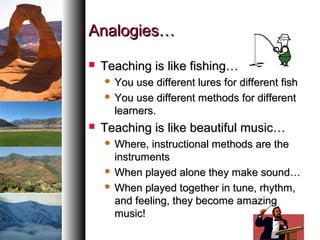
 Teaching is like fishing…Teaching is like fishing…
 You use different lures for different fishYou use different lures for different fish
 You use different methods for differentYou use different methods for different
learners.learners.
 Teaching is like beautiful music…Teaching is like beautiful music…
 Where, instructional methods are theWhere, instructional methods are the
instrumentsinstruments
 When played alone they make sound…When played alone they make sound…
 When played together in tune, rhythm,When played together in tune, rhythm,
and feeling, they become amazingand feeling, they become amazing
music!music!
Analogies…Analogies…
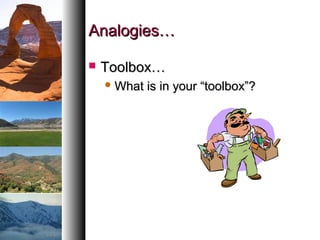
 Toolbox…Toolbox…
 What is in your “toolbox”?What is in your “toolbox”?
Selecting and Using a Variety ofSelecting and Using a Variety of
Instructional MethodsInstructional Methods
 Instructional objectives:Instructional objectives:
 Define method of InstructionDefine method of Instruction
 Discuss factors to consider whenDiscuss factors to consider when
selecting a method of instructionselecting a method of instruction
 Distinguish between methods ofDistinguish between methods of
instruction and instructional aidsinstruction and instructional aids
 Identify & discuss a variety ofIdentify & discuss a variety of
teaching methodsteaching methods
What is a “Method”?What is a “Method”?
 a procedure or process for attaininga procedure or process for attaining
an object: asan object: as
 aa (1)(1) :: a systematic procedure,a systematic procedure,
technique, or mode of inquiry employedtechnique, or mode of inquiry employed
by or proper to a particular discipline orby or proper to a particular discipline or
art (2)art (2) :: a systematic plan followed ina systematic plan followed in
presenting material for instructionpresenting material for instruction
 bb (1)(1) :: a way, technique, or process ofa way, technique, or process of
or for doing somethingor for doing something (2)(2) :: a body ofa body of
skills or techniquesskills or techniques
Teaching MethodTeaching Method
 Objective oriented activities andObjective oriented activities and
flow of information betweenflow of information between
teachers and studentsteachers and students
Methods, Strategy, Aid,Methods, Strategy, Aid,
ApproachApproach
 Teaching Method tend to be synonymousTeaching Method tend to be synonymous
with technique according to Websterwith technique according to Webster
 Teaching Strategy – “careful plan” thatTeaching Strategy – “careful plan” that
serves an important function in achieving aserves an important function in achieving a
specific outcome.specific outcome.
 Instructional aids includes:Instructional aids includes:
 Chalkboard, Flip chart, PowerPointChalkboard, Flip chart, PowerPoint
 Overheads, VCR, Real Objects, etc.Overheads, VCR, Real Objects, etc.
 Teaching Approach is a “holistic process”Teaching Approach is a “holistic process”
 Includes the teaching steps, problem-Includes the teaching steps, problem-
solving strategies, and teachingsolving strategies, and teaching
methods.methods.
TeachingTeaching
MethodsMethods
 Lecture-ExplainingLecture-Explaining
 Resource PeopleResource People
 Case StudyCase Study
 Group DiscussionGroup Discussion
 Brainstorming & Buzz GroupsBrainstorming & Buzz Groups
 Field-trip (tour)Field-trip (tour)
Additional Methods/StrategiesAdditional Methods/Strategies
 OthersOthers
 Directed (supervised) studyDirected (supervised) study
 Role-PlayRole-Play
 Socratic DialogueSocratic Dialogue
 JigsawJigsaw
 Concept Map/SketchConcept Map/Sketch
 DebateDebate
 Cooperative LearningCooperative Learning
 Panel of ExpertsPanel of Experts
WhatWhat FactorsFactors do we considerdo we consider
when selecting an instructionalwhen selecting an instructional
method?method?
 The intended specific outcomeThe intended specific outcome
or purposeor purpose
 Size of groupSize of group
 Learners’Learners’ preferencepreference forfor
learninglearning
 The content sometimes dictatesThe content sometimes dictates
the methodthe method
 Required preparationRequired preparation
Instructional/Teaching MethodsInstructional/Teaching Methods
vs. Instructional Aids?vs. Instructional Aids?
 Assist the teacher in theAssist the teacher in the
teaching/learning processteaching/learning process
 White boardWhite board
 HandoutsHandouts
 PropsProps
 Pictures/VideoPictures/Video
 AudioAudio
 Computer based simulationComputer based simulation
 ModelsModels
 Others?Others?
Tools for your teaching tool boxTools for your teaching tool box
Let’s Try SomeLet’s Try Some
Incorporating Problem-Incorporating Problem-
solving (Decision-making)solving (Decision-making)
Techniques IntoTechniques Into
InstructionInstruction
P-S (Decision-Making)P-S (Decision-Making)
TechniquesTechniques
 Forked-RoadForked-Road
 Possibilities FactorsPossibilities Factors
 Situation to be ImprovedSituation to be Improved
 Effect, Find the CauseEffect, Find the Cause
““Forked-Road” Decision-Forked-Road” Decision-
Making TechniqueMaking Technique
Essential Elements of aEssential Elements of a
Forked-Road Technique are:Forked-Road Technique are:
 A problem where a learner mustA problem where a learner must
decide betweendecide between two possible choicestwo possible choices
of actionof action
 Must haveMust have factorsfactors to considerto consider
 Must make a decision based uponMust make a decision based upon
the factors consideredthe factors considered
Before engaging in aBefore engaging in a
problem-solving (decision-problem-solving (decision-
making)…making)…
 The problem (opportunity) must be defined!The problem (opportunity) must be defined!
 Need to ask yourself,Need to ask yourself, “What is the“What is the
problem?”problem?”
 Usually proposed in question formUsually proposed in question form
 Often, the problem is derived from aOften, the problem is derived from a
situation, or scenario.situation, or scenario.
 case studycase study
 May be real or contrivedMay be real or contrived
Record
forallto
see
Class ExerciseClass Exercise
ScenarioScenario
 You have been hired in a newYou have been hired in a new
position and your supervisor tells youposition and your supervisor tells you
that the company will purchase you athat the company will purchase you a
new computernew computer..
 Your supervisor explains that you canYour supervisor explains that you can
spend up to $2150.00spend up to $2150.00 on a newon a new
desktop computer and software.desktop computer and software.
Furthermore, because of existingFurthermore, because of existing
purchasing agreements you must selectpurchasing agreements you must select
betweenbetween DellDell andand GatewayGateway..
 The choice is yours, however yourThe choice is yours, however your
supervisor has requested a decisionsupervisor has requested a decision
in two days.in two days.
What is the decisionWhat is the decision
you need to make?you need to make?
Should I purchase Dell computer
or a Gateway computer?
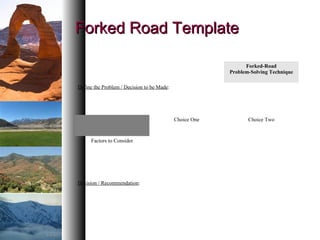
Forked Road TemplateForked Road Template
Forked-Road
Problem-Solving Technique
Define the Problem / Decision to be Made:
Choice One Choice Two
Factors to Consider
Decision / Recommendation:
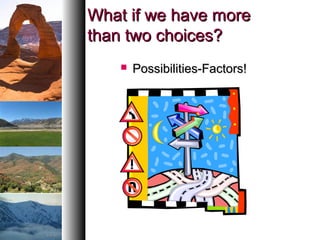
What if we have moreWhat if we have more
than two choices?than two choices?
 Possibilities-Factors!Possibilities-Factors!
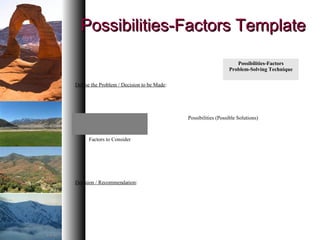
Possibilities-Factors TemplatePossibilities-Factors Template
Possibilities-Factors
Problem-Solving Technique
Define the Problem / Decision to be Made:
Possibilities (Possible Solutions)
Factors to Consider
Decision / Recommendation:
Forked Road or PossibilitiesForked Road or Possibilities
Factors?Factors?
1.1. Selecting between turf grass and naturalSelecting between turf grass and natural
grass.grass.
2.2. Choosing a greenhouse covering.Choosing a greenhouse covering.
3.3. Determining whether to attend theDetermining whether to attend the
National Convention.National Convention.
4.4. Selecting from among seed varieties.Selecting from among seed varieties.
5.5. Determining best pest control.Determining best pest control.
6.6. Selecting a career choice.Selecting a career choice.
7.7. Promoting a management practice.Promoting a management practice.
8.8. Determining whether to invest in newDetermining whether to invest in new
equipment.equipment.
9.9. Selecting lumber types.Selecting lumber types.
10.10. Choosing a “path” of action.Choosing a “path” of action.
Instructional TipsInstructional Tips
1.1. Get learners to define the problem (best)Get learners to define the problem (best)
 Or, you define the problemOr, you define the problem
1.1. Record for all to seeRecord for all to see
2.2. Use the template to facilitate the problem-Use the template to facilitate the problem-
solving (decision-making) effortsolving (decision-making) effort
• Complete the template yourselfComplete the template yourself
1.1. Assist students in identifying the factors toAssist students in identifying the factors to
considerconsider
2.2. Provide the resources for seeking outProvide the resources for seeking out
information on the possibilitiesinformation on the possibilities
3.3. Have students identify a solutionHave students identify a solution
4.4. Allow students to share their solution withAllow students to share their solution with
rationale for their choicerationale for their choice
Integrating reading,Integrating reading,
speaking, listening andspeaking, listening and
writing skillswriting skills
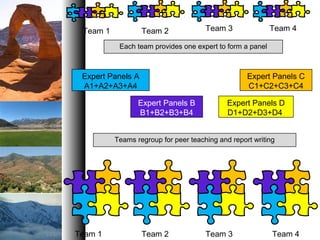
JigsawJigsaw
 Is a teaching technique invented by social psychologistIs a teaching technique invented by social psychologist
Elliot AronsonElliot Aronson in 1971.in 1971.
 Students of a normal-sized class (26 to 33 students) areStudents of a normal-sized class (26 to 33 students) are
divided into competency groups of four to six students,divided into competency groups of four to six students,
each of which is given a list of subtopics to research.each of which is given a list of subtopics to research.
 Individual members of each group then break off to workIndividual members of each group then break off to work
with the "experts" from other groups, researching a part ofwith the "experts" from other groups, researching a part of
the material being studied, after which they return to theirthe material being studied, after which they return to their
starting body in the role of instructor for their subcategory.starting body in the role of instructor for their subcategory.
 The strategy is an efficient teaching method thatThe strategy is an efficient teaching method that
encourages listening, engagement, interaction, peerencourages listening, engagement, interaction, peer
teaching, and cooperation by giving each member of theteaching, and cooperation by giving each member of the
group an essential part to play in the academic activity.group an essential part to play in the academic activity.
 Both individual and group accountability are built into theBoth individual and group accountability are built into the
process.process.
 Jigsaws are a four-skills approach, integrating reading,Jigsaws are a four-skills approach, integrating reading,
speaking, listening and writing.speaking, listening and writing.
Expert Panels A
A1+A2+A3+A4
Expert Panels D
D1+D2+D3+D4
Expert Panels B
B1+B2+B3+B4
Expert Panels C
C1+C2+C3+C4
Team 1 Team 2
Team 1 Team 2
Each team provides one expert to form a panel
Teams regroup for peer teaching and report writing
Team 3 Team 4
Team 3 Team 4
Let’s Try itLet’s Try it
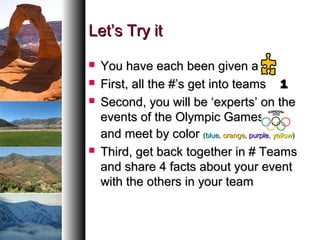
 You have each been given aYou have each been given a
 First, all the #’s get into teamsFirst, all the #’s get into teams 11
 Second, you will be ‘experts’ on theSecond, you will be ‘experts’ on the
events of the Olympic Gamesevents of the Olympic Games
and meet by colorand meet by color ((blueblue,, orangeorange,, purplepurple,, yellowyellow))
 Third, get back together in # TeamsThird, get back together in # Teams
and share 4 facts about your eventand share 4 facts about your event
with the others in your teamwith the others in your team
Closure…Closure…
 Select the right “tool” for theSelect the right “tool” for the
right “job”right “job”
 Variety is valuedVariety is valued
 Method is determined by manyMethod is determined by many
factorsfactors
 Include instructional aids to addInclude instructional aids to add
variety & clarityvariety & clarity
Teaching methods

Teaching methods

  • 1.
    Unit 5Unit 5 EducationalMethodsEducational Methods
  • 2.
    What instructional methodsWhatinstructional methods have you been exposed to??have you been exposed to??  ……in high school?in high school?  ……in college?in college?  ……in non-formal settings?in non-formal settings?
  • 3.
    Analogies…Analogies…  Teaching islike fishing…Teaching is like fishing…  You use different lures for different fishYou use different lures for different fish  You use different methods for differentYou use different methods for different learners.learners.  Teaching is like beautiful music…Teaching is like beautiful music…  Where, instructional methods are theWhere, instructional methods are the instrumentsinstruments  When played alone they make sound…When played alone they make sound…  When played together in tune, rhythm,When played together in tune, rhythm, and feeling, they become amazingand feeling, they become amazing music!music!
  • 4.
    Analogies…Analogies…  Toolbox…Toolbox…  Whatis in your “toolbox”?What is in your “toolbox”?
  • 5.
    Selecting and Usinga Variety ofSelecting and Using a Variety of Instructional MethodsInstructional Methods  Instructional objectives:Instructional objectives:  Define method of InstructionDefine method of Instruction  Discuss factors to consider whenDiscuss factors to consider when selecting a method of instructionselecting a method of instruction  Distinguish between methods ofDistinguish between methods of instruction and instructional aidsinstruction and instructional aids  Identify & discuss a variety ofIdentify & discuss a variety of teaching methodsteaching methods
  • 6.
    What is a“Method”?What is a “Method”?  a procedure or process for attaininga procedure or process for attaining an object: asan object: as  aa (1)(1) :: a systematic procedure,a systematic procedure, technique, or mode of inquiry employedtechnique, or mode of inquiry employed by or proper to a particular discipline orby or proper to a particular discipline or art (2)art (2) :: a systematic plan followed ina systematic plan followed in presenting material for instructionpresenting material for instruction  bb (1)(1) :: a way, technique, or process ofa way, technique, or process of or for doing somethingor for doing something (2)(2) :: a body ofa body of skills or techniquesskills or techniques
  • 7.
    Teaching MethodTeaching Method Objective oriented activities andObjective oriented activities and flow of information betweenflow of information between teachers and studentsteachers and students
  • 8.
    Methods, Strategy, Aid,Methods,Strategy, Aid, ApproachApproach  Teaching Method tend to be synonymousTeaching Method tend to be synonymous with technique according to Websterwith technique according to Webster  Teaching Strategy – “careful plan” thatTeaching Strategy – “careful plan” that serves an important function in achieving aserves an important function in achieving a specific outcome.specific outcome.  Instructional aids includes:Instructional aids includes:  Chalkboard, Flip chart, PowerPointChalkboard, Flip chart, PowerPoint  Overheads, VCR, Real Objects, etc.Overheads, VCR, Real Objects, etc.  Teaching Approach is a “holistic process”Teaching Approach is a “holistic process”  Includes the teaching steps, problem-Includes the teaching steps, problem- solving strategies, and teachingsolving strategies, and teaching methods.methods.
  • 9.
    TeachingTeaching MethodsMethods  Lecture-ExplainingLecture-Explaining  ResourcePeopleResource People  Case StudyCase Study  Group DiscussionGroup Discussion  Brainstorming & Buzz GroupsBrainstorming & Buzz Groups  Field-trip (tour)Field-trip (tour)
  • 10.
    Additional Methods/StrategiesAdditional Methods/Strategies OthersOthers  Directed (supervised) studyDirected (supervised) study  Role-PlayRole-Play  Socratic DialogueSocratic Dialogue  JigsawJigsaw  Concept Map/SketchConcept Map/Sketch  DebateDebate  Cooperative LearningCooperative Learning  Panel of ExpertsPanel of Experts
  • 11.
    WhatWhat FactorsFactors dowe considerdo we consider when selecting an instructionalwhen selecting an instructional method?method?  The intended specific outcomeThe intended specific outcome or purposeor purpose  Size of groupSize of group  Learners’Learners’ preferencepreference forfor learninglearning  The content sometimes dictatesThe content sometimes dictates the methodthe method  Required preparationRequired preparation
  • 12.
    Instructional/Teaching MethodsInstructional/Teaching Methods vs.Instructional Aids?vs. Instructional Aids?  Assist the teacher in theAssist the teacher in the teaching/learning processteaching/learning process  White boardWhite board  HandoutsHandouts  PropsProps  Pictures/VideoPictures/Video  AudioAudio  Computer based simulationComputer based simulation  ModelsModels  Others?Others?
  • 13.
    Tools for yourteaching tool boxTools for your teaching tool box Let’s Try SomeLet’s Try Some
  • 14.
    Incorporating Problem-Incorporating Problem- solving(Decision-making)solving (Decision-making) Techniques IntoTechniques Into InstructionInstruction
  • 15.
    P-S (Decision-Making)P-S (Decision-Making) TechniquesTechniques Forked-RoadForked-Road  Possibilities FactorsPossibilities Factors  Situation to be ImprovedSituation to be Improved  Effect, Find the CauseEffect, Find the Cause
  • 16.
  • 17.
    Essential Elements ofaEssential Elements of a Forked-Road Technique are:Forked-Road Technique are:  A problem where a learner mustA problem where a learner must decide betweendecide between two possible choicestwo possible choices of actionof action  Must haveMust have factorsfactors to considerto consider  Must make a decision based uponMust make a decision based upon the factors consideredthe factors considered
  • 18.
    Before engaging inaBefore engaging in a problem-solving (decision-problem-solving (decision- making)…making)…  The problem (opportunity) must be defined!The problem (opportunity) must be defined!  Need to ask yourself,Need to ask yourself, “What is the“What is the problem?”problem?”  Usually proposed in question formUsually proposed in question form  Often, the problem is derived from aOften, the problem is derived from a situation, or scenario.situation, or scenario.  case studycase study  May be real or contrivedMay be real or contrived Record forallto see
  • 19.
  • 20.
    ScenarioScenario  You havebeen hired in a newYou have been hired in a new position and your supervisor tells youposition and your supervisor tells you that the company will purchase you athat the company will purchase you a new computernew computer..  Your supervisor explains that you canYour supervisor explains that you can spend up to $2150.00spend up to $2150.00 on a newon a new desktop computer and software.desktop computer and software. Furthermore, because of existingFurthermore, because of existing purchasing agreements you must selectpurchasing agreements you must select betweenbetween DellDell andand GatewayGateway..  The choice is yours, however yourThe choice is yours, however your supervisor has requested a decisionsupervisor has requested a decision in two days.in two days.
  • 21.
    What is thedecisionWhat is the decision you need to make?you need to make? Should I purchase Dell computer or a Gateway computer?
  • 22.
    Forked Road TemplateForkedRoad Template Forked-Road Problem-Solving Technique Define the Problem / Decision to be Made: Choice One Choice Two Factors to Consider Decision / Recommendation:
  • 23.
    What if wehave moreWhat if we have more than two choices?than two choices?  Possibilities-Factors!Possibilities-Factors!
  • 24.
    Possibilities-Factors TemplatePossibilities-Factors Template Possibilities-Factors Problem-SolvingTechnique Define the Problem / Decision to be Made: Possibilities (Possible Solutions) Factors to Consider Decision / Recommendation:
  • 25.
    Forked Road orPossibilitiesForked Road or Possibilities Factors?Factors? 1.1. Selecting between turf grass and naturalSelecting between turf grass and natural grass.grass. 2.2. Choosing a greenhouse covering.Choosing a greenhouse covering. 3.3. Determining whether to attend theDetermining whether to attend the National Convention.National Convention. 4.4. Selecting from among seed varieties.Selecting from among seed varieties. 5.5. Determining best pest control.Determining best pest control. 6.6. Selecting a career choice.Selecting a career choice. 7.7. Promoting a management practice.Promoting a management practice. 8.8. Determining whether to invest in newDetermining whether to invest in new equipment.equipment. 9.9. Selecting lumber types.Selecting lumber types. 10.10. Choosing a “path” of action.Choosing a “path” of action.
  • 26.
    Instructional TipsInstructional Tips 1.1.Get learners to define the problem (best)Get learners to define the problem (best)  Or, you define the problemOr, you define the problem 1.1. Record for all to seeRecord for all to see 2.2. Use the template to facilitate the problem-Use the template to facilitate the problem- solving (decision-making) effortsolving (decision-making) effort • Complete the template yourselfComplete the template yourself 1.1. Assist students in identifying the factors toAssist students in identifying the factors to considerconsider 2.2. Provide the resources for seeking outProvide the resources for seeking out information on the possibilitiesinformation on the possibilities 3.3. Have students identify a solutionHave students identify a solution 4.4. Allow students to share their solution withAllow students to share their solution with rationale for their choicerationale for their choice
  • 27.
    Integrating reading,Integrating reading, speaking,listening andspeaking, listening and writing skillswriting skills
  • 28.
    JigsawJigsaw  Is ateaching technique invented by social psychologistIs a teaching technique invented by social psychologist Elliot AronsonElliot Aronson in 1971.in 1971.  Students of a normal-sized class (26 to 33 students) areStudents of a normal-sized class (26 to 33 students) are divided into competency groups of four to six students,divided into competency groups of four to six students, each of which is given a list of subtopics to research.each of which is given a list of subtopics to research.  Individual members of each group then break off to workIndividual members of each group then break off to work with the "experts" from other groups, researching a part ofwith the "experts" from other groups, researching a part of the material being studied, after which they return to theirthe material being studied, after which they return to their starting body in the role of instructor for their subcategory.starting body in the role of instructor for their subcategory.  The strategy is an efficient teaching method thatThe strategy is an efficient teaching method that encourages listening, engagement, interaction, peerencourages listening, engagement, interaction, peer teaching, and cooperation by giving each member of theteaching, and cooperation by giving each member of the group an essential part to play in the academic activity.group an essential part to play in the academic activity.  Both individual and group accountability are built into theBoth individual and group accountability are built into the process.process.  Jigsaws are a four-skills approach, integrating reading,Jigsaws are a four-skills approach, integrating reading, speaking, listening and writing.speaking, listening and writing.
  • 29.
    Expert Panels A A1+A2+A3+A4 ExpertPanels D D1+D2+D3+D4 Expert Panels B B1+B2+B3+B4 Expert Panels C C1+C2+C3+C4 Team 1 Team 2 Team 1 Team 2 Each team provides one expert to form a panel Teams regroup for peer teaching and report writing Team 3 Team 4 Team 3 Team 4
  • 30.
    Let’s Try itLet’sTry it  You have each been given aYou have each been given a  First, all the #’s get into teamsFirst, all the #’s get into teams 11  Second, you will be ‘experts’ on theSecond, you will be ‘experts’ on the events of the Olympic Gamesevents of the Olympic Games and meet by colorand meet by color ((blueblue,, orangeorange,, purplepurple,, yellowyellow))  Third, get back together in # TeamsThird, get back together in # Teams and share 4 facts about your eventand share 4 facts about your event with the others in your teamwith the others in your team
  • 31.
    Closure…Closure…  Select theright “tool” for theSelect the right “tool” for the right “job”right “job”  Variety is valuedVariety is valued  Method is determined by manyMethod is determined by many factorsfactors  Include instructional aids to addInclude instructional aids to add variety & clarityvariety & clarity

Editor's Notes

  • #30 All the #’s get together i.e. A1+ B1+C1+D1 (1 – 6) = teams Expert Panels all the Letters get together i.e. A1+A2+A3+A4+A5+A6 (all blue) Regroup to re-teach by Teams