A B M 0 0 1 . C H A P T E R 2
Application
ofDemandandSupply
More at slideshare.net/RomlaineOlaso1/presentations
Objectives
1. explain the law of supply and demand, and how equilibrium price and quantity are
determined;
2. discuss and explain factors affecting demand and supply;
3. compare the prices of commodities and analyze the impact on consumers;
4. explain market structures (perfect competition, monopoly, oligopoly, and monopolistic
competition).
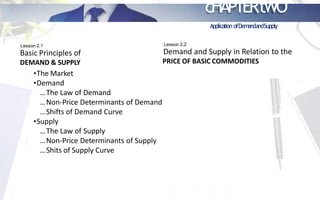
Basic Principles of
DEMAND & SUPPLY
•The Market
•Demand
…The Law of Demand
…Non-Price Determinants of Demand
…Shifts of Demand Curve
•Supply
…The Law of Supply
…Non-Price Determinants of Supply
…Shits of Supply Curve
Lesson 2.1
Application of Demand and Supply
Lesson 2.3
Lesson 2.2
Demand and Supply in Relation to the
PRICE OF BASIC COMMODITIES
•Market Equilibrium
•Application of Demand and Supply in
Relation to Housing Shortage
ELASTICITY of
Demand and Supply
•Elasticity of Demand
…Price Elasticity of demand
…Income Elasticity of Demand
…Cross Price Elasticity of Demand
•Price Elasticity of Supply
cHAPTERtWO
Lesson2.1
• Market
An interaction between buyers and sellers of trading or exchange.
 goods market
 labor market
 finance market
cHAPTERtWO
Basic Principles of
DEMAND & SUPPLY
•The Market
•Demand
…The Law of Demand
…Non-Price Determinants of Demand
…Shifts of Demand Curve
•Supply
…The Law of Supply
…Non-Price Determinants of Supply
…Shits of Supply Curve
Lesson 2.1
Application ofDemandandSupply
Lesson 2.2
Demand and Supply in Relation to the
PRICE OF BASIC COMMODITIES
•Market Equilibrium
•Application of Demand and Supply in
Relation to Housing Shortage
ELASTICITY of
Lesson 2.3
Demand and Supply
•Elasticity of Demand
…Price Elasticity of demand
…Income Elasticity of Demand
…Cross Price Elasticity of Demand
•Price Elasticity of Supply
cHAPTERtWO
able
Lesson2.1 cHAPTERtWO
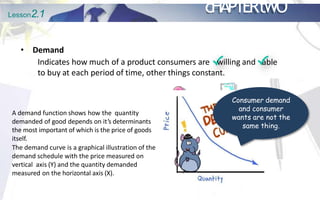
• Demand
Indicates how much of a product consumers are willing and
to buy at each period of time, other things constant.
A demand function shows how the quantity
demanded of good depends on it’s determinants
the most important of which is the price of goods
itself.
The demand curve is a graphical illustration of the
demand schedule with the price measured on
vertical axis (Y) and the quantity demanded
measured on the horizontal axis (X).
Consumer demand
and consumer
wants are not the
same thing.
able
Lesson2.1 cHAPTERtWO
• Demand
Indicates how much of a product consumers are willing and
to buy at each period of time, other things constant.
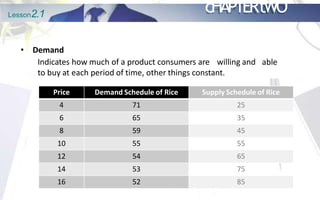
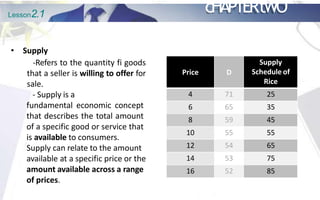
Price Demand Schedule of Rice Supply Schedule of Rice
4 71 25
6 65 35
8 59 45
10 55 55
12 54 65
14 53 75
16 52 85
Lesson2.1 cHAPTERtWO
• Demand
Indicates how much of a product consumers are willing and
able to buy at each period of time, other things constant.
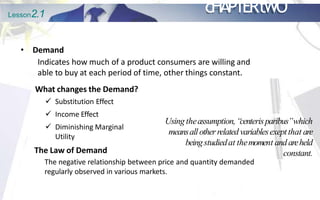
The negative relationship between price and quantity demanded
regularly observed in various markets.
What changes the Demand?
 Substitution Effect
 Income Effect
 Diminishing Marginal
Utility
The Law of Demand
Using theassumption,“
centerisparibus”which
meansallotherrelated variablesexeptthat are
beingstudiedat themoment and areheld
constant.
Lesson2.1 cHAPTERtWO
• Demand
Non-Price Determinants of Demand
D = f ( P
, T
, Y
, E, PR, NC )
..demand for a good is a function of price,
taste, income, expectations, price of related
goods and number of consumers.
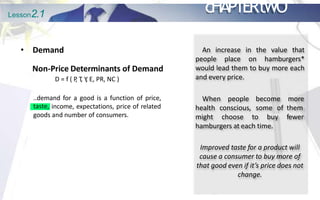
An increase in the value that
people place on hamburgers*
would lead them to buy more each
and every price.
When people become
health conscious, some of
might choose to buy
more
them
fewer
hamburgers at each time.
Improved taste for a product will
cause a consumer to buy more of
that good even if it’s price does not
change.
Lesson2.1 cHAPTERtWO
• Demand
Non-Price Determinants of Demand
D = f ( P
, T
, Y
, E, PR, NC )
..demand for a good is a function of price,
income,
taste, expectations, price of related
goods and number of consumers.
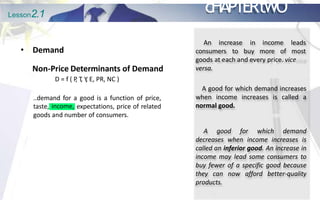
An increase
consumers to
in income leads
buy more of most
goods at each and every price. vice
versa.
A good for which demand increases
when income increases is called a
normal good.
A good for which demand
decreases when income increases is
called an inferior good. An increase in
income may lead some consumers to
buy fewer of a specific good because
they can now afford better-quality
products.
Lesson2.1 cHAPTERtWO
• Demand
Non-Price Determinants of Demand
D = f ( P
, T
, Y
, E, PR, NC )
..demand for a good is a function of price,
taste, income, expectations, price of related
goods and number of consumers.
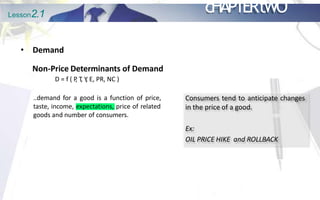
Consumers tend to anticipate changes
in the price of a good.
Ex:
OIL PRICE HIKE and ROLLBACK
Lesson2.1 cHAPTERtWO
• Demand
Non-Price Determinants of Demand
D = f ( P
, T
, Y
, E, PR, NC )
..demand for a good is a function of price,
taste, income, expectations, price of related
goods and number of consumers.
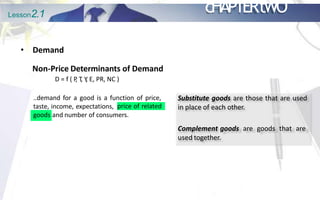
Substitute goods are those that are used
in place of each other.
Complement goods are goods that are
used together.
Lesson2.1 cHAPTERtWO
• Demand
Non-Price Determinants of Demand
D = f ( P
, T
, Y
, E, PR, NC )
..demand for a good is a function of price,
taste, income, expectations, price of related
goods and number of consumers.
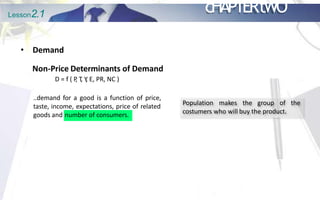
Population makes the group of the
costumers who will buy the product.
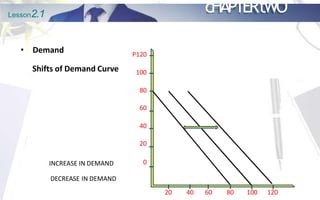
P120
100
80
60
40
20
0
20 40 60 80 100 120
INCREASE IN DEMAND
DECREASE IN DEMAND
• Demand
Shifts of Demand Curve
Lesson2.1 cHAPTERtWO
Surfboards
Qd
10 pcs
2pc7
s pcs
• Demand
Shifts of Demand Curve
P
3,500 php
•Supply
…The Law of Supply
…Non-Price Determinants of Supply
…Shifts of Supply Curve
Basic Principles of
DEMAND & SUPPLY
•The Market
•Demand
…The Law of Demand
…Non-Price Determinants of Demand
…Shifts of Demand Curve
Lesson 2.1
Lesson 2.3
Application ofDemandandSupply
Lesson 2.2
Demand and Supply in Relation to the
PRICE OF BASIC COMMODITIES
•Market Equilibrium
•Application of Demand and Supply in
Relation to Housing Shortage
ELASTICITY of
Demand and Supply
•Elasticity of Demand
…Price Elasticity of demand
…Income Elasticity of Demand
…Cross Price Elasticity of Demand
•Price Elasticity of Supply
cHAPTERtWO
Lesson2.1 cHAPTERtWO
• Supply
-Refers to the quantity fi goods
that a seller is willing to offer for
sale.
- Supply is a
fundamental economic concept
that describes the total amount
of a specific good or service that
is available to consumers.
Supply can relate to the amount
available at a specific price or the
amount available across a range
of prices.
Price D
Supply
Schedule of
Rice
4 71 25
6 65 35
8 59 45
10 55 55
12 54 65
14 53 75
16 52 85
Lesson2.1 cHAPTERtWO
Price D
Supply
Schedule of
Rice
4 71 25
6 65 35
8 59 45
10 55 55
12 54 65
14 53 75
16 52 85
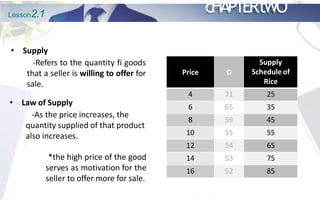
• Supply
-Refers to the quantity fi goods
that a seller is willing to offer for
sale.
• Law of Supply
-As the price increases, the
quantity supplied of that product
also increases.
*the high price of the good
serves as motivation for the
seller to offer more for sale.
Lesson2.1 cHAPTERtWO
• Supply
-Refers to the quantity fi goods
that a seller is willing to offer for
sale.
• Law of Supply
-As the price increases, the
quantity supplied of that product
also increases.
*the high price of the good
serves as motivation for the
seller to offer more for sale.
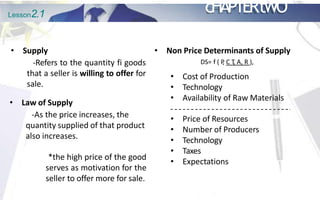
• Non Price Determinants of Supply
DS= f ( P
, C T
, A, R ),
• Cost of Production
• Technology
• Availability of Raw Materials
• Price of Resources
• Number of Producers
• Technology
• Taxes
• Expectations
Lesson 2.1
Basic Principles of
DEMAND & SUPPLY
•The Market
•Demand
…The Law of Demand
…Non-Piece Determinants of Demand
…Shits of Demand Curve
•Supply
…The Law of Supply
…Non-Piece Determinants of Supply
…Shits of Supply Curve
Application ofDemandandSupply
Lesson 2.2
Demand and Supply in Relation to the
PRICE OF BASIC COMMODITIES
Lesson 2.3
ELASTICITY of
Demand and Supply
•Elasticity of Demand
…Price Elasticity of demand
…Income Elasticity of Demand
…Cross Price Elasticity of Demand
•Price Elasticity of Supply
cHAPTERtWO
•The Market
•Demand
…The Law of Demand
…Non-Price Determinants of Demand
…Shifts of Demand Curve
•Supply
…The Law of Supply
…Non-Price Determinants of Supply
…Shits of Supply Curve
Lesson 2.1
Basic Principles of
DEMAND & SUPPLY
A. PRICES OF BASIC COMMODITIES
PRICES OF BSIC COMMODITIES
Commodities are raw materials or primary agricultural
products that can be bought and sold in the market like
corn, wheat, copper, crude oil, etc.
BASIC CONSUMER GOODS IN PHILIPPINES
A. Oil Products like gasoline, diesel, liquefied
petroleum gas (LPG)
B. Processed and Manufactured Commodities
Canned goods, processed milk, instant noodles,
bread, commercial rice, sugar, cooking oil, meat and
poultry, fish vegetables, basic medicines.
WHAT CAUSES COMMODITIES PRICE TO
CHANGE?
1. When supply exceeds demand, prices fall and when demand is greater
than supply prices rise.
2. Natural disasters can also cause prices to change like the El Niño and La
Niña climate phenomenon, volcanic
eruptions, earthquakes, typhoon, and landslide, among others.
3. Production costs can also cause price to rise or fall like the
implementation of Salary Standardization Law and
Minimum Wage Law, and the shifting of production from human to
technology.
B. LABOR SUPPLY, POPULATION
GROWTH AND WAGES
LABOR FORCE – is defined as the people who are willing and able to
work. The labor force population consists of the employed and the
unemployed 15 years old and over. People under the age of 15,
students, retirees, the disabled, homemakers, and the voluntarily idle
are not included in the labor force.
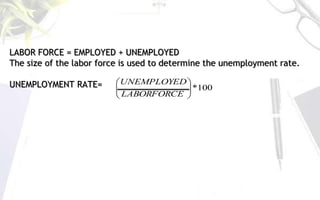
LABOR FORCE = EMPLOYED + UNEMPLOYED
The size of the labor force is used to determine the unemployment rate.
UNEMPLOYMENT RATE= 100
*








LABORFORCE
UNEMPLOYED
DEMAND AND SUPPLY.pptx

DEMAND AND SUPPLY.pptx

  • 1.
    A B M0 0 1 . C H A P T E R 2 Application ofDemandandSupply More at slideshare.net/RomlaineOlaso1/presentations
  • 2.
    Objectives 1. explain thelaw of supply and demand, and how equilibrium price and quantity are determined; 2. discuss and explain factors affecting demand and supply; 3. compare the prices of commodities and analyze the impact on consumers; 4. explain market structures (perfect competition, monopoly, oligopoly, and monopolistic competition).
  • 3.
    Basic Principles of DEMAND& SUPPLY •The Market •Demand …The Law of Demand …Non-Price Determinants of Demand …Shifts of Demand Curve •Supply …The Law of Supply …Non-Price Determinants of Supply …Shits of Supply Curve Lesson 2.1 Application of Demand and Supply Lesson 2.3 Lesson 2.2 Demand and Supply in Relation to the PRICE OF BASIC COMMODITIES •Market Equilibrium •Application of Demand and Supply in Relation to Housing Shortage ELASTICITY of Demand and Supply •Elasticity of Demand …Price Elasticity of demand …Income Elasticity of Demand …Cross Price Elasticity of Demand •Price Elasticity of Supply cHAPTERtWO
  • 4.
    Lesson2.1 • Market An interactionbetween buyers and sellers of trading or exchange.  goods market  labor market  finance market cHAPTERtWO
  • 5.
    Basic Principles of DEMAND& SUPPLY •The Market •Demand …The Law of Demand …Non-Price Determinants of Demand …Shifts of Demand Curve •Supply …The Law of Supply …Non-Price Determinants of Supply …Shits of Supply Curve Lesson 2.1 Application ofDemandandSupply Lesson 2.2 Demand and Supply in Relation to the PRICE OF BASIC COMMODITIES •Market Equilibrium •Application of Demand and Supply in Relation to Housing Shortage ELASTICITY of Lesson 2.3 Demand and Supply •Elasticity of Demand …Price Elasticity of demand …Income Elasticity of Demand …Cross Price Elasticity of Demand •Price Elasticity of Supply cHAPTERtWO
  • 6.
    able Lesson2.1 cHAPTERtWO • Demand Indicateshow much of a product consumers are willing and to buy at each period of time, other things constant. A demand function shows how the quantity demanded of good depends on it’s determinants the most important of which is the price of goods itself. The demand curve is a graphical illustration of the demand schedule with the price measured on vertical axis (Y) and the quantity demanded measured on the horizontal axis (X). Consumer demand and consumer wants are not the same thing.
  • 7.
    able Lesson2.1 cHAPTERtWO • Demand Indicateshow much of a product consumers are willing and to buy at each period of time, other things constant. Price Demand Schedule of Rice Supply Schedule of Rice 4 71 25 6 65 35 8 59 45 10 55 55 12 54 65 14 53 75 16 52 85
  • 8.
    Lesson2.1 cHAPTERtWO • Demand Indicateshow much of a product consumers are willing and able to buy at each period of time, other things constant. The negative relationship between price and quantity demanded regularly observed in various markets. What changes the Demand?  Substitution Effect  Income Effect  Diminishing Marginal Utility The Law of Demand Using theassumption,“ centerisparibus”which meansallotherrelated variablesexeptthat are beingstudiedat themoment and areheld constant.
  • 9.
    Lesson2.1 cHAPTERtWO • Demand Non-PriceDeterminants of Demand D = f ( P , T , Y , E, PR, NC ) ..demand for a good is a function of price, taste, income, expectations, price of related goods and number of consumers. An increase in the value that people place on hamburgers* would lead them to buy more each and every price. When people become health conscious, some of might choose to buy more them fewer hamburgers at each time. Improved taste for a product will cause a consumer to buy more of that good even if it’s price does not change.
  • 10.
    Lesson2.1 cHAPTERtWO • Demand Non-PriceDeterminants of Demand D = f ( P , T , Y , E, PR, NC ) ..demand for a good is a function of price, income, taste, expectations, price of related goods and number of consumers. An increase consumers to in income leads buy more of most goods at each and every price. vice versa. A good for which demand increases when income increases is called a normal good. A good for which demand decreases when income increases is called an inferior good. An increase in income may lead some consumers to buy fewer of a specific good because they can now afford better-quality products.
  • 11.
    Lesson2.1 cHAPTERtWO • Demand Non-PriceDeterminants of Demand D = f ( P , T , Y , E, PR, NC ) ..demand for a good is a function of price, taste, income, expectations, price of related goods and number of consumers. Consumers tend to anticipate changes in the price of a good. Ex: OIL PRICE HIKE and ROLLBACK
  • 12.
    Lesson2.1 cHAPTERtWO • Demand Non-PriceDeterminants of Demand D = f ( P , T , Y , E, PR, NC ) ..demand for a good is a function of price, taste, income, expectations, price of related goods and number of consumers. Substitute goods are those that are used in place of each other. Complement goods are goods that are used together.
  • 13.
    Lesson2.1 cHAPTERtWO • Demand Non-PriceDeterminants of Demand D = f ( P , T , Y , E, PR, NC ) ..demand for a good is a function of price, taste, income, expectations, price of related goods and number of consumers. Population makes the group of the costumers who will buy the product.
  • 14.
    P120 100 80 60 40 20 0 20 40 6080 100 120 INCREASE IN DEMAND DECREASE IN DEMAND • Demand Shifts of Demand Curve Lesson2.1 cHAPTERtWO
  • 15.
    Lesson2.1 cHAPTERtWO Surfboards Qd 10 pcs 2pc7 spcs • Demand Shifts of Demand Curve P 3,500 php
  • 16.
    •Supply …The Law ofSupply …Non-Price Determinants of Supply …Shifts of Supply Curve Basic Principles of DEMAND & SUPPLY •The Market •Demand …The Law of Demand …Non-Price Determinants of Demand …Shifts of Demand Curve Lesson 2.1 Lesson 2.3 Application ofDemandandSupply Lesson 2.2 Demand and Supply in Relation to the PRICE OF BASIC COMMODITIES •Market Equilibrium •Application of Demand and Supply in Relation to Housing Shortage ELASTICITY of Demand and Supply •Elasticity of Demand …Price Elasticity of demand …Income Elasticity of Demand …Cross Price Elasticity of Demand •Price Elasticity of Supply cHAPTERtWO
  • 17.
    Lesson2.1 cHAPTERtWO • Supply -Refersto the quantity fi goods that a seller is willing to offer for sale. - Supply is a fundamental economic concept that describes the total amount of a specific good or service that is available to consumers. Supply can relate to the amount available at a specific price or the amount available across a range of prices. Price D Supply Schedule of Rice 4 71 25 6 65 35 8 59 45 10 55 55 12 54 65 14 53 75 16 52 85
  • 18.
    Lesson2.1 cHAPTERtWO Price D Supply Scheduleof Rice 4 71 25 6 65 35 8 59 45 10 55 55 12 54 65 14 53 75 16 52 85 • Supply -Refers to the quantity fi goods that a seller is willing to offer for sale. • Law of Supply -As the price increases, the quantity supplied of that product also increases. *the high price of the good serves as motivation for the seller to offer more for sale.
  • 19.
    Lesson2.1 cHAPTERtWO • Supply -Refersto the quantity fi goods that a seller is willing to offer for sale. • Law of Supply -As the price increases, the quantity supplied of that product also increases. *the high price of the good serves as motivation for the seller to offer more for sale. • Non Price Determinants of Supply DS= f ( P , C T , A, R ), • Cost of Production • Technology • Availability of Raw Materials • Price of Resources • Number of Producers • Technology • Taxes • Expectations
  • 20.
    Lesson 2.1 Basic Principlesof DEMAND & SUPPLY •The Market •Demand …The Law of Demand …Non-Piece Determinants of Demand …Shits of Demand Curve •Supply …The Law of Supply …Non-Piece Determinants of Supply …Shits of Supply Curve Application ofDemandandSupply Lesson 2.2 Demand and Supply in Relation to the PRICE OF BASIC COMMODITIES Lesson 2.3 ELASTICITY of Demand and Supply •Elasticity of Demand …Price Elasticity of demand …Income Elasticity of Demand …Cross Price Elasticity of Demand •Price Elasticity of Supply cHAPTERtWO •The Market •Demand …The Law of Demand …Non-Price Determinants of Demand …Shifts of Demand Curve •Supply …The Law of Supply …Non-Price Determinants of Supply …Shits of Supply Curve Lesson 2.1 Basic Principles of DEMAND & SUPPLY
  • 21.
    A. PRICES OFBASIC COMMODITIES
  • 22.
    PRICES OF BSICCOMMODITIES Commodities are raw materials or primary agricultural products that can be bought and sold in the market like corn, wheat, copper, crude oil, etc.
  • 23.
    BASIC CONSUMER GOODSIN PHILIPPINES A. Oil Products like gasoline, diesel, liquefied petroleum gas (LPG) B. Processed and Manufactured Commodities Canned goods, processed milk, instant noodles, bread, commercial rice, sugar, cooking oil, meat and poultry, fish vegetables, basic medicines.
  • 24.
    WHAT CAUSES COMMODITIESPRICE TO CHANGE? 1. When supply exceeds demand, prices fall and when demand is greater than supply prices rise. 2. Natural disasters can also cause prices to change like the El Niño and La Niña climate phenomenon, volcanic eruptions, earthquakes, typhoon, and landslide, among others. 3. Production costs can also cause price to rise or fall like the implementation of Salary Standardization Law and Minimum Wage Law, and the shifting of production from human to technology.
  • 25.
    B. LABOR SUPPLY,POPULATION GROWTH AND WAGES
  • 26.
    LABOR FORCE –is defined as the people who are willing and able to work. The labor force population consists of the employed and the unemployed 15 years old and over. People under the age of 15, students, retirees, the disabled, homemakers, and the voluntarily idle are not included in the labor force.
  • 27.
    LABOR FORCE =EMPLOYED + UNEMPLOYED The size of the labor force is used to determine the unemployment rate. UNEMPLOYMENT RATE= 100 *         LABORFORCE UNEMPLOYED