CONTEMPORARY PHILIPPINE
ARTS FROM THE REGIONS
LESSON 5: ARCHITECTURE
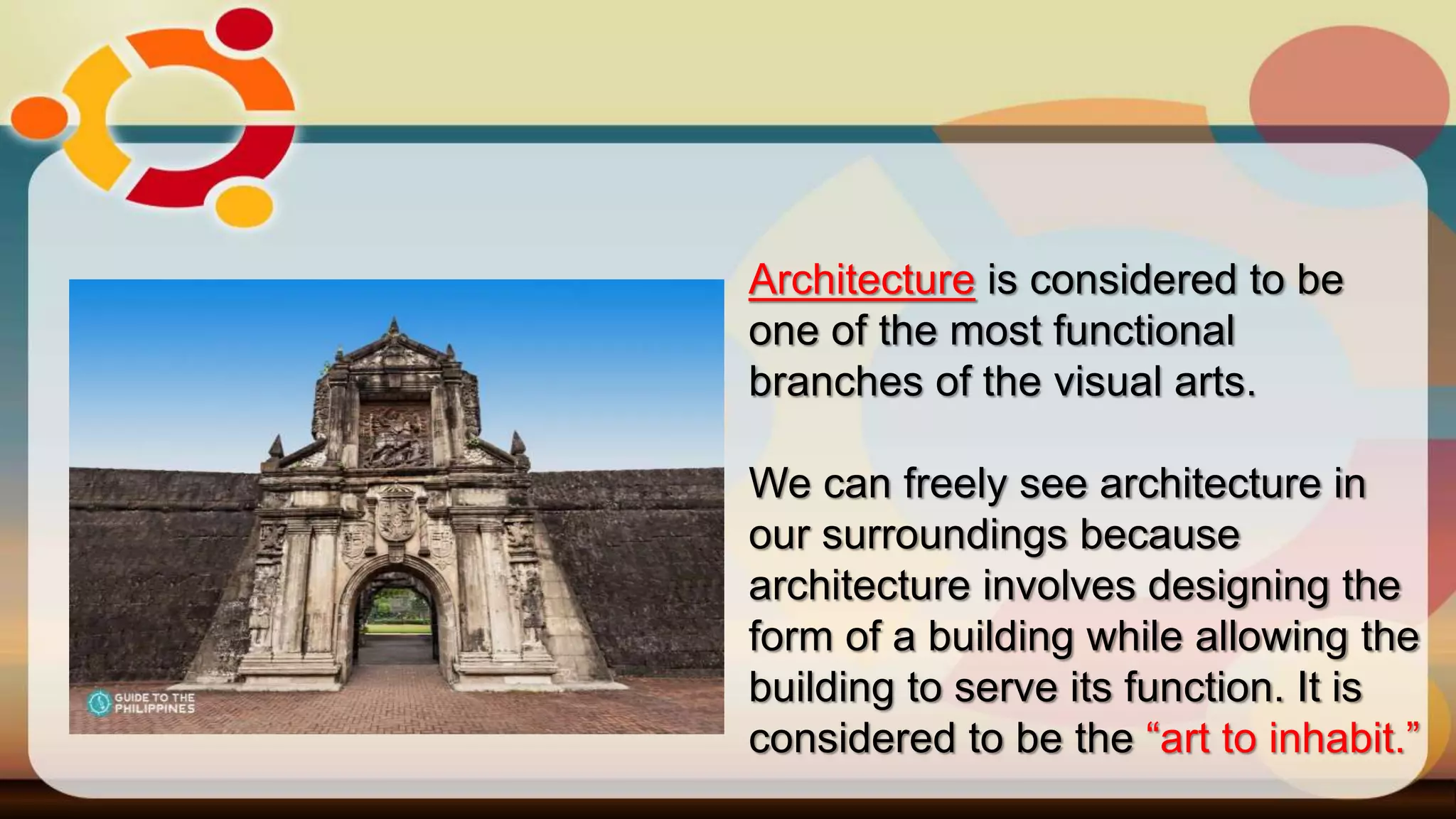
Architecture is considered to be
one of the most functional
branches of the visual arts.
We can freely see architecture in
our surroundings because
architecture involves designing the
form of a building while allowing the
building to serve its function. It is
considered to be the “art to inhabit.”
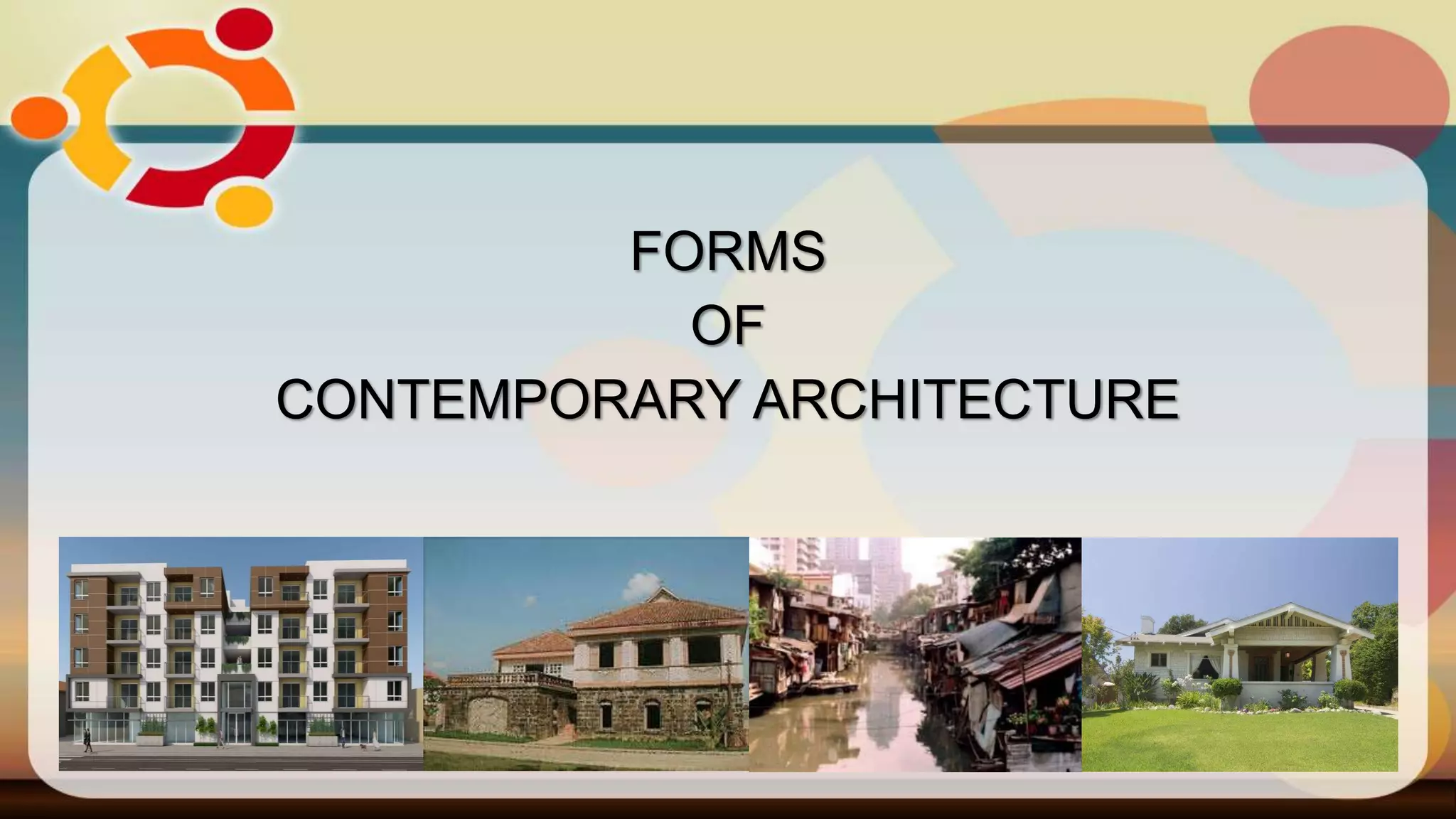
FORMS
OF
CONTEMPORARY ARCHITECTURE
Domestic Buildings and Houses
Apartment
Bahay na Bato
Barong-Barong
Bungalow
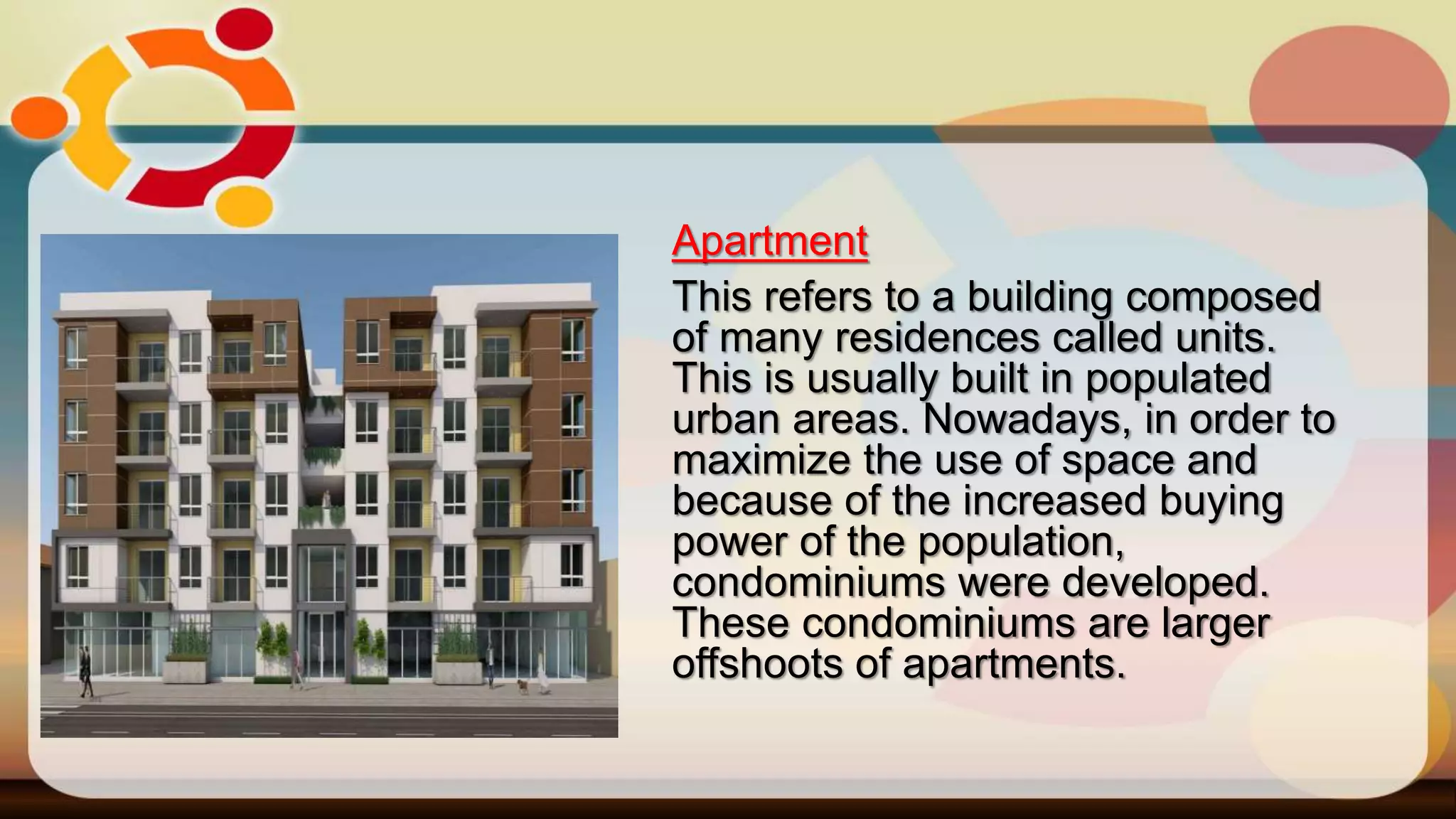
Apartment
This refers to a building composed
of many residences called units.
This is usually built in populated
urban areas. Nowadays, in order to
maximize the use of space and
because of the increased buying
power of the population,
condominiums were developed.
These condominiums are larger
offshoots of apartments.
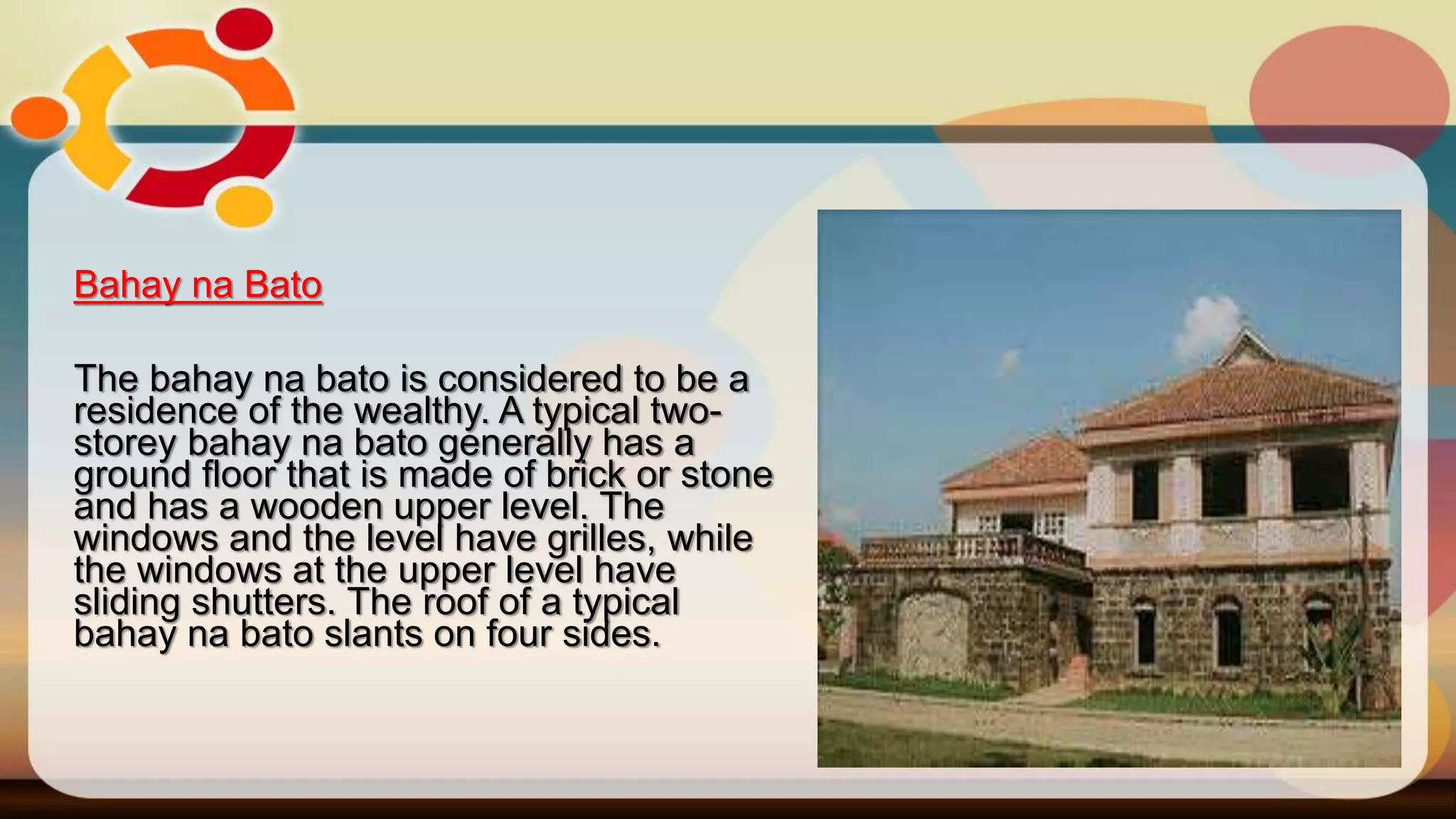
Bahay na Bato
The bahay na bato is considered to be a
residence of the wealthy. A typical two-
storey bahay na bato generally has a
ground floor that is made of brick or stone
and has a wooden upper level. The
windows and the level have grilles, while
the windows at the upper level have
sliding shutters. The roof of a typical
bahay na bato slants on four sides.
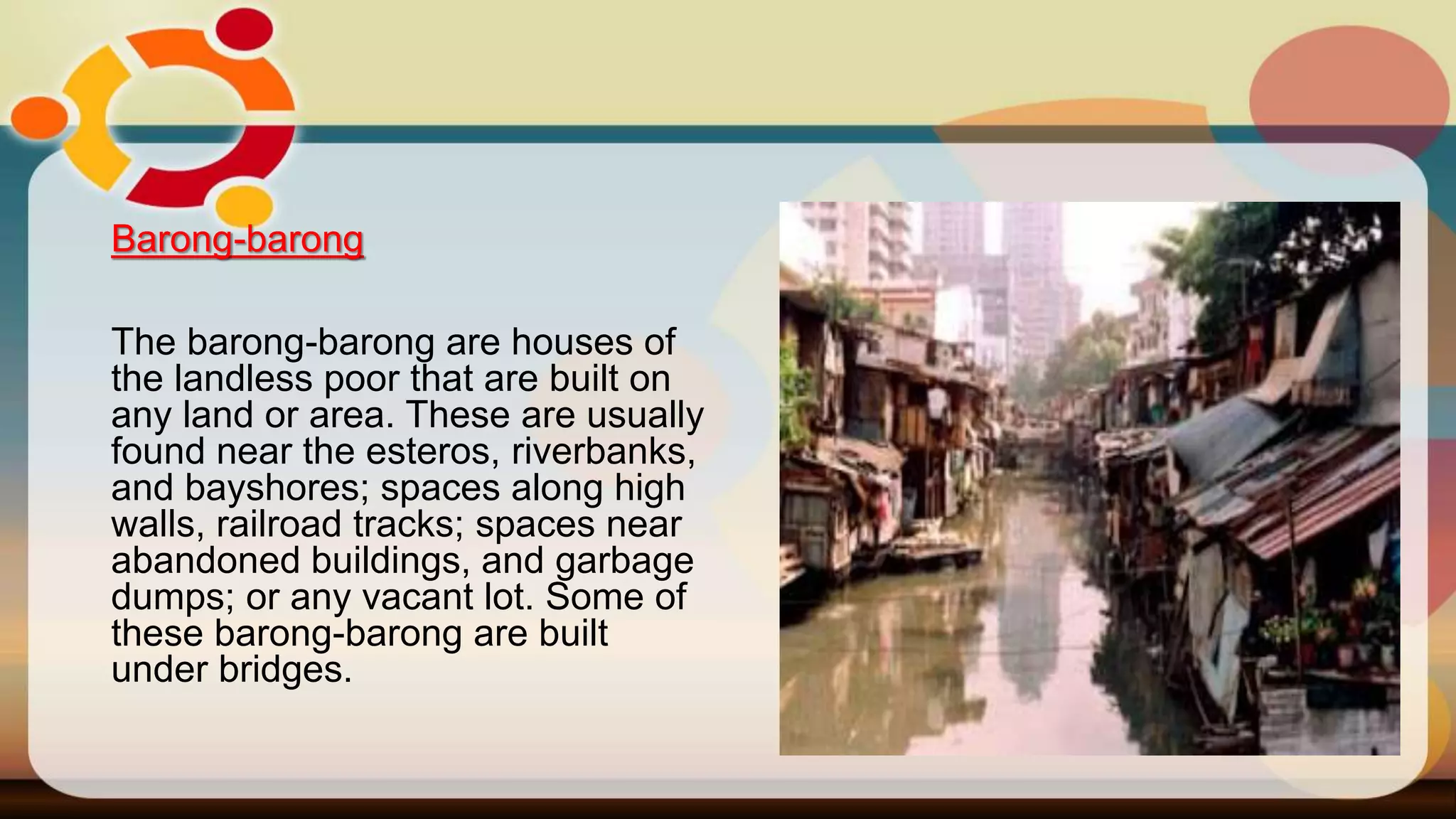
Barong-barong
The barong-barong are houses of
the landless poor that are built on
any land or area. These are usually
found near the esteros, riverbanks,
and bayshores; spaces along high
walls, railroad tracks; spaces near
abandoned buildings, and garbage
dumps; or any vacant lot. Some of
these barong-barong are built
under bridges.
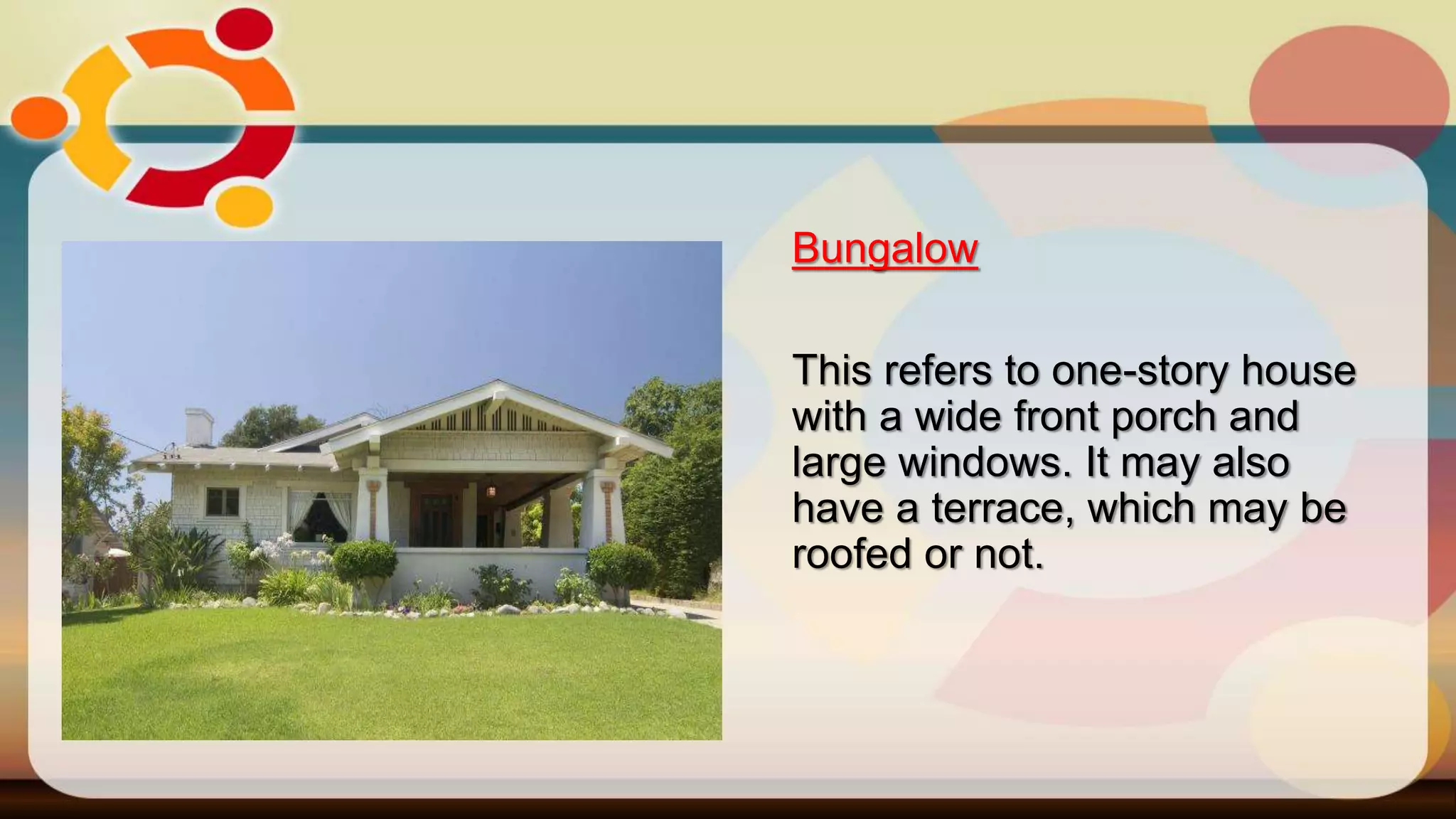
Bungalow
This refers to one-story house
with a wide front porch and
large windows. It may also
have a terrace, which may be
roofed or not.
Ethnic Houses
Bahay Kubo
Houseboat
One-and-a-Half Story House
Split-level House
Tsalet
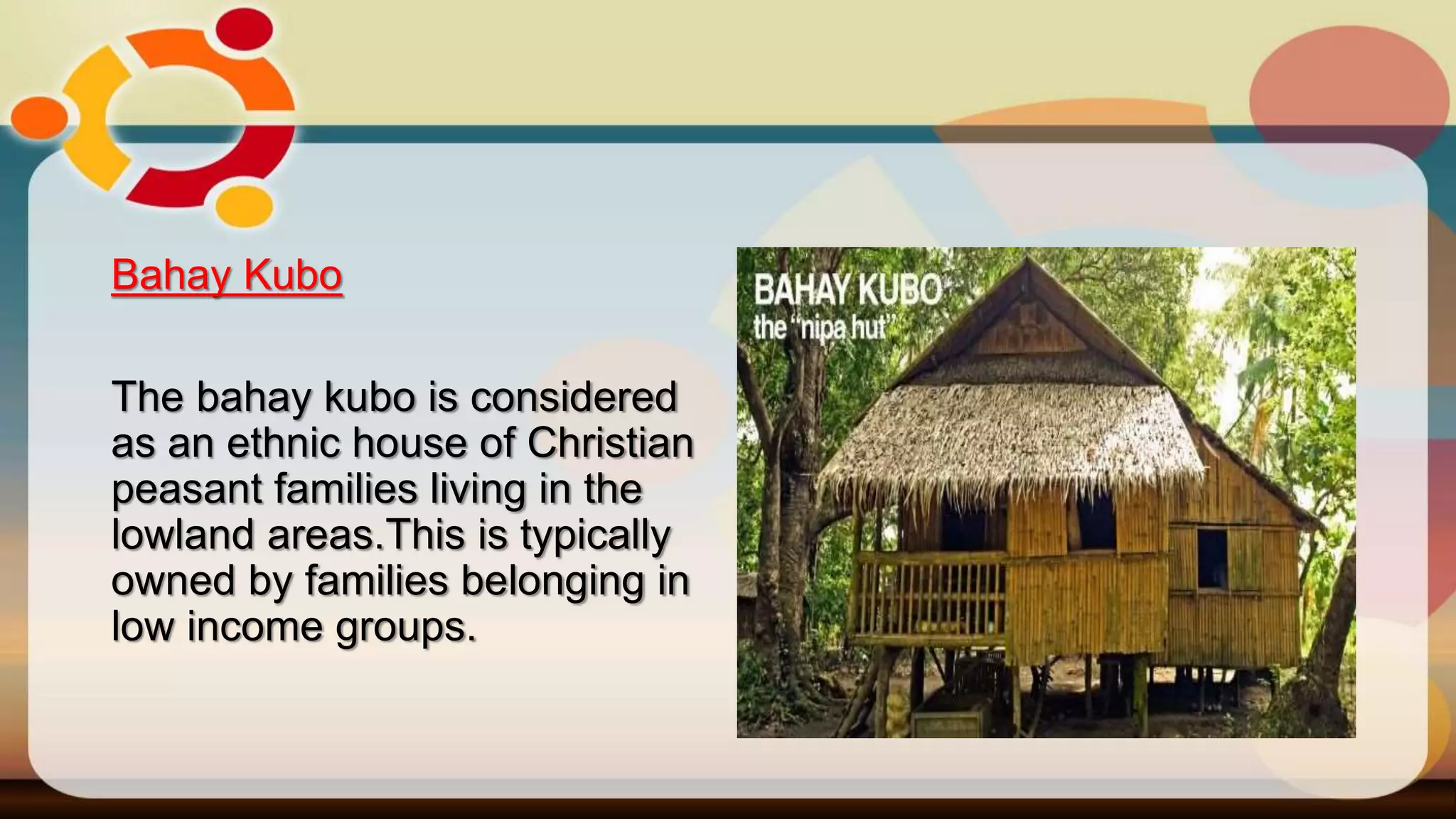
Bahay Kubo
The bahay kubo is considered
as an ethnic house of Christian
peasant families living in the
lowland areas.This is typically
owned by families belonging in
low income groups.
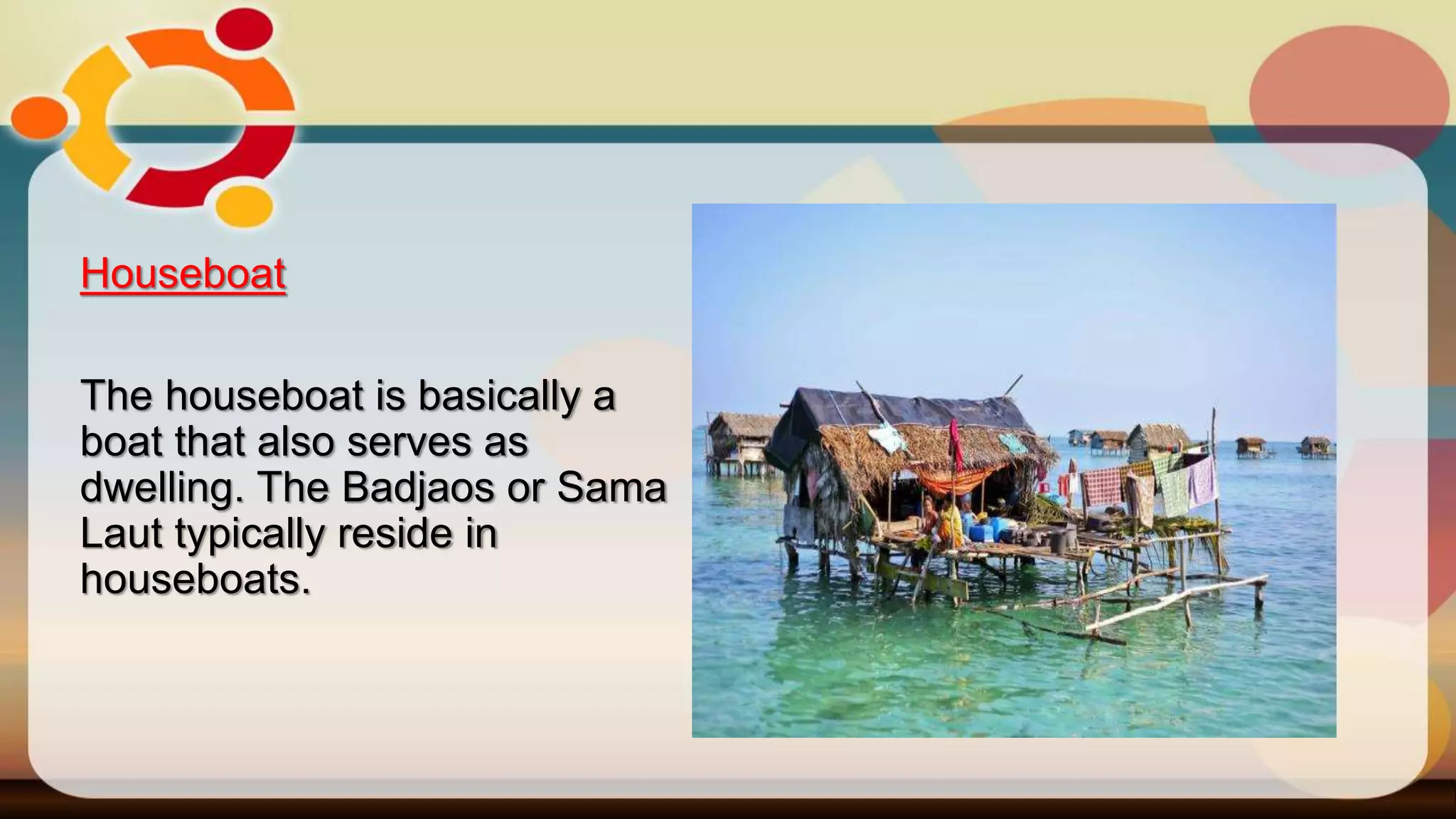
Houseboat
The houseboat is basically a
boat that also serves as
dwelling. The Badjaos or Sama
Laut typically reside in
houseboats.
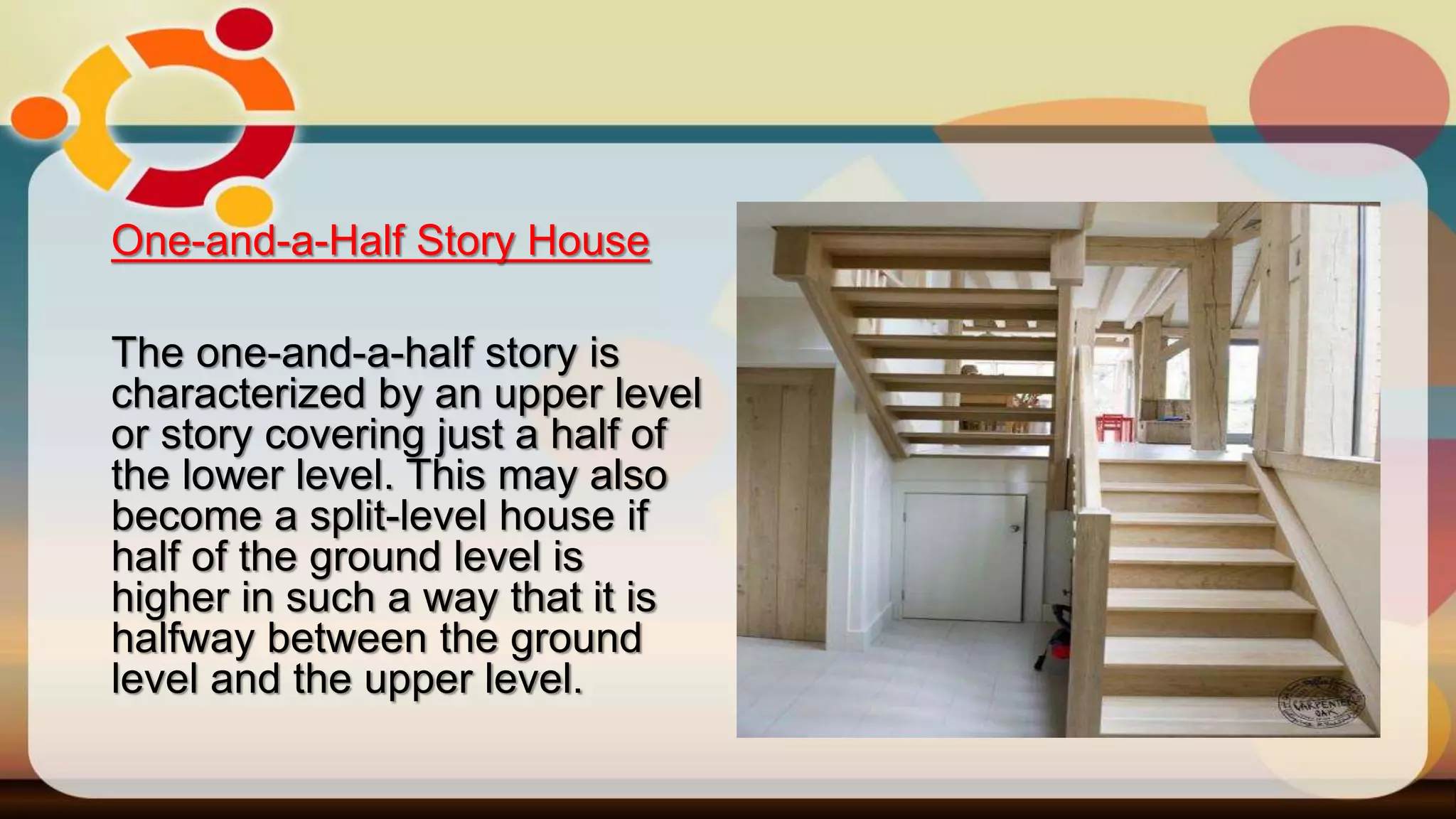
One-and-a-Half Story House
The one-and-a-half story is
characterized by an upper level
or story covering just a half of
the lower level. This may also
become a split-level house if
half of the ground level is
higher in such a way that it is
halfway between the ground
level and the upper level.
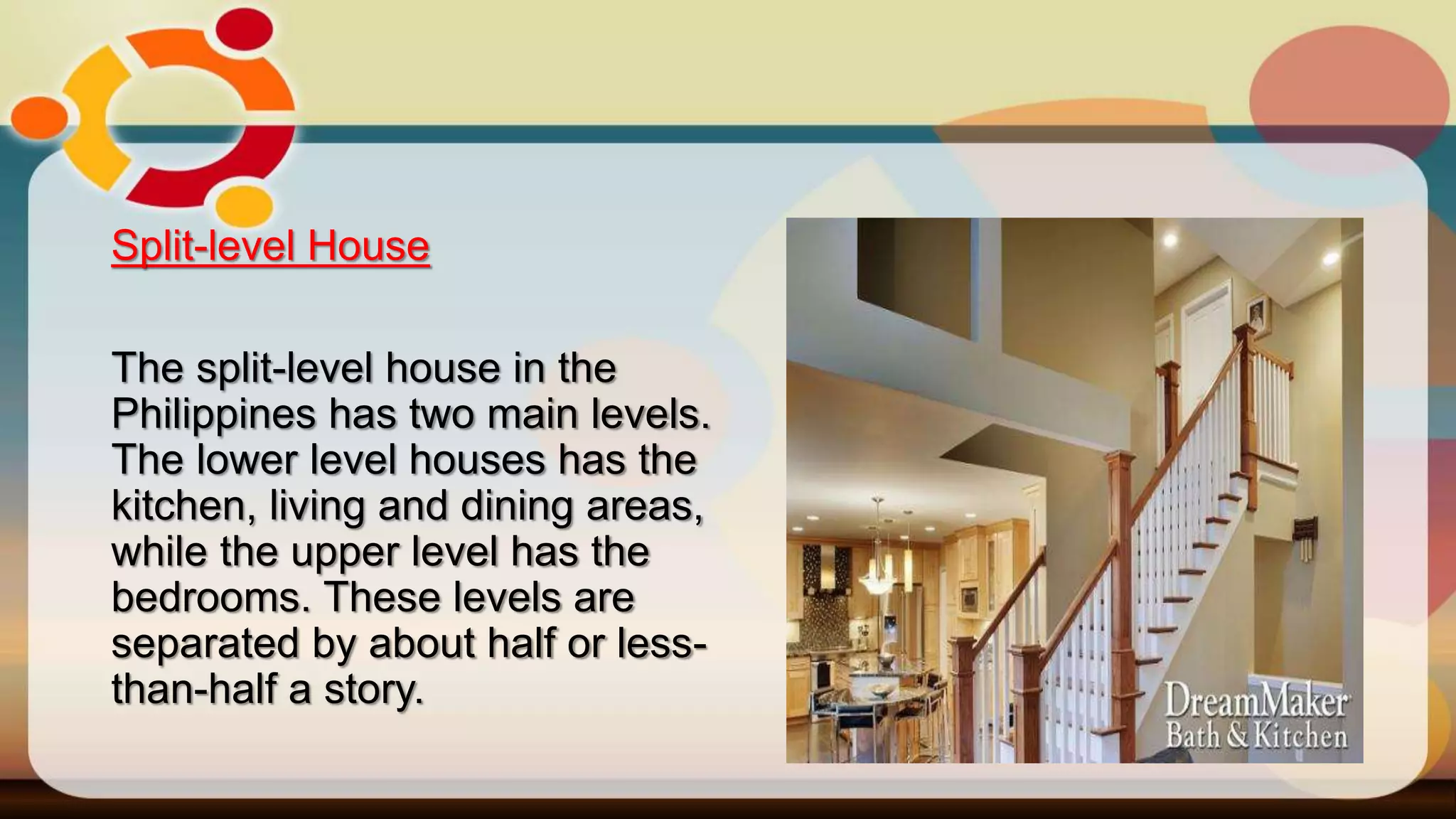
Split-level House
The split-level house in the
Philippines has two main levels.
The lower level houses has the
kitchen, living and dining areas,
while the upper level has the
bedrooms. These levels are
separated by about half or less-
than-half a story.
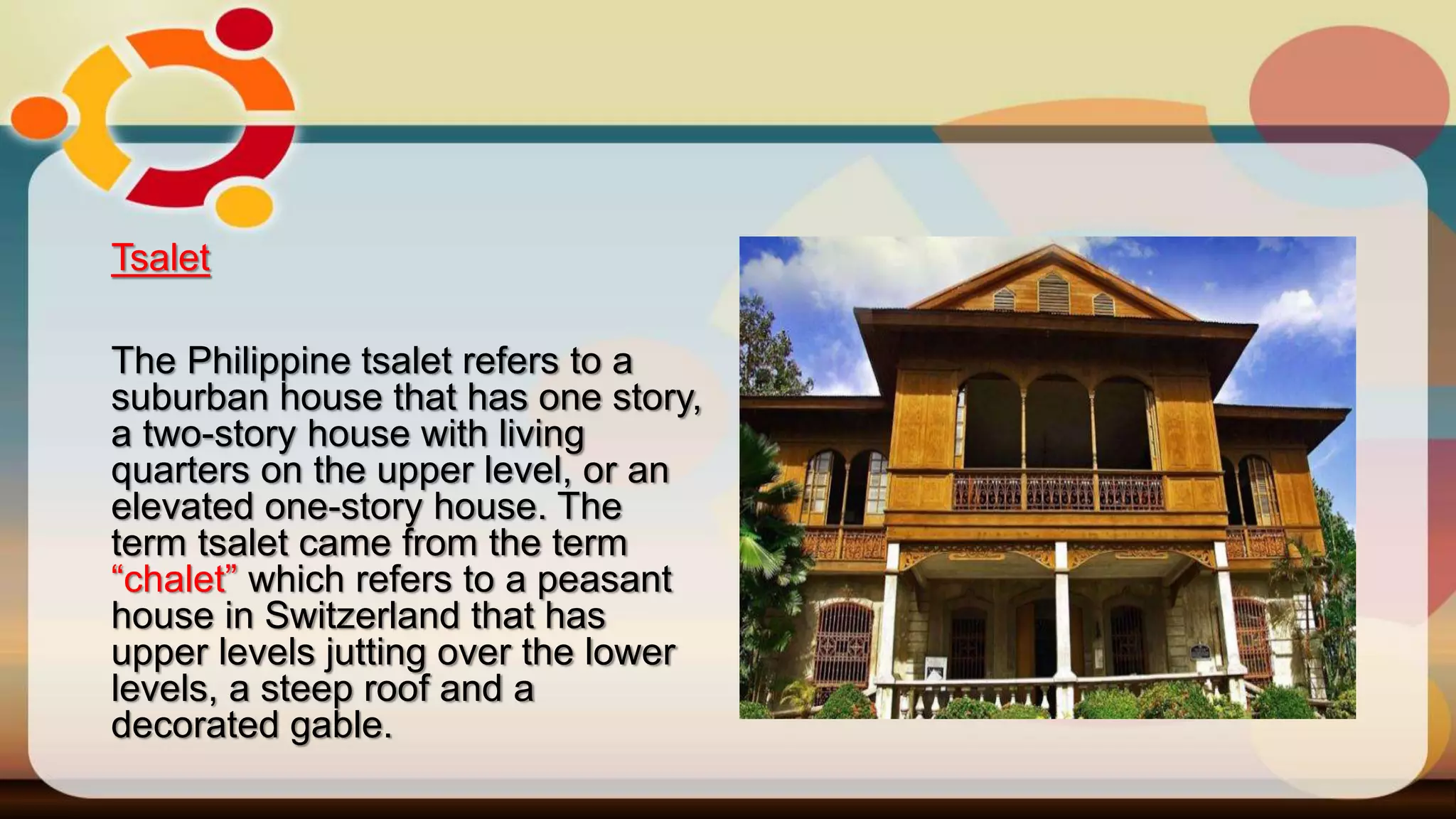
Tsalet
The Philippine tsalet refers to a
suburban house that has one story,
a two-story house with living
quarters on the upper level, or an
elevated one-story house. The
term tsalet came from the term
“chalet” which refers to a peasant
house in Switzerland that has
upper levels jutting over the lower
levels, a steep roof and a
decorated gable.
Commercial Buildings
Market
Buildings that house banks, business offices, and factories
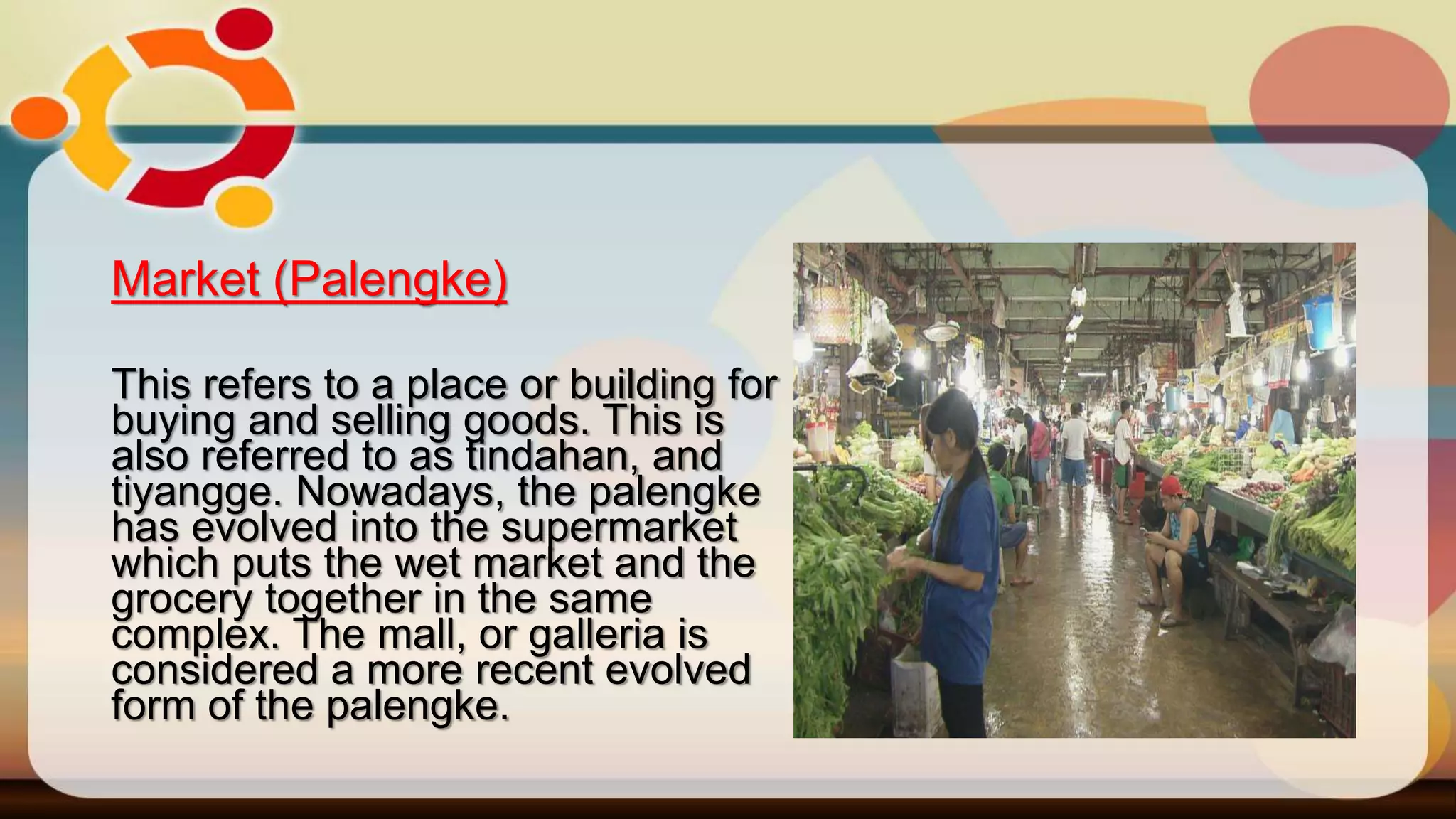
Market (Palengke)
This refers to a place or building for
buying and selling goods. This is
also referred to as tindahan, and
tiyangge. Nowadays, the palengke
has evolved into the supermarket
which puts the wet market and the
grocery together in the same
complex. The mall, or galleria is
considered a more recent evolved
form of the palengke.
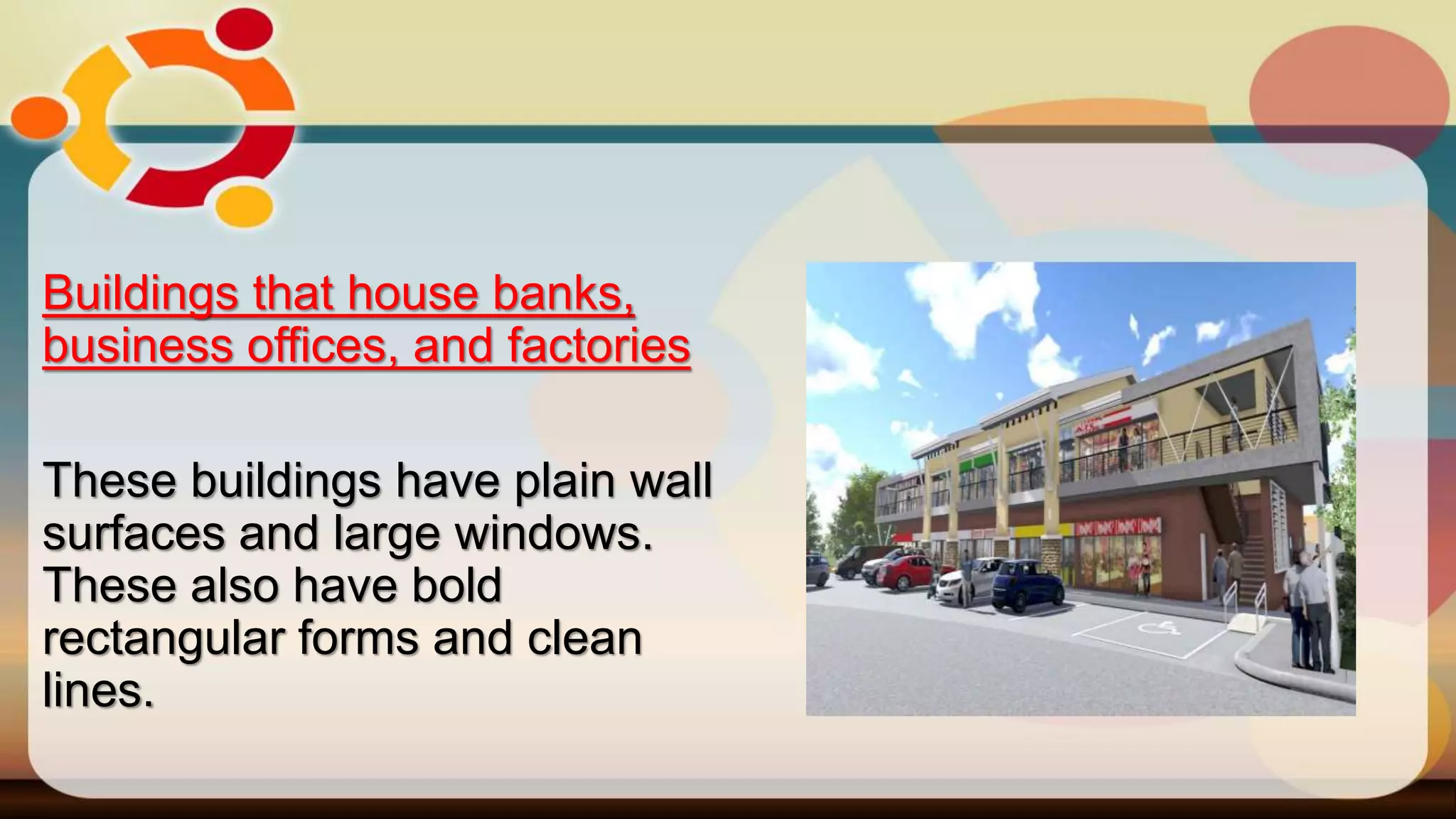
Buildings that house banks,
business offices, and factories
These buildings have plain wall
surfaces and large windows.
These also have bold
rectangular forms and clean
lines.
Government Buildings
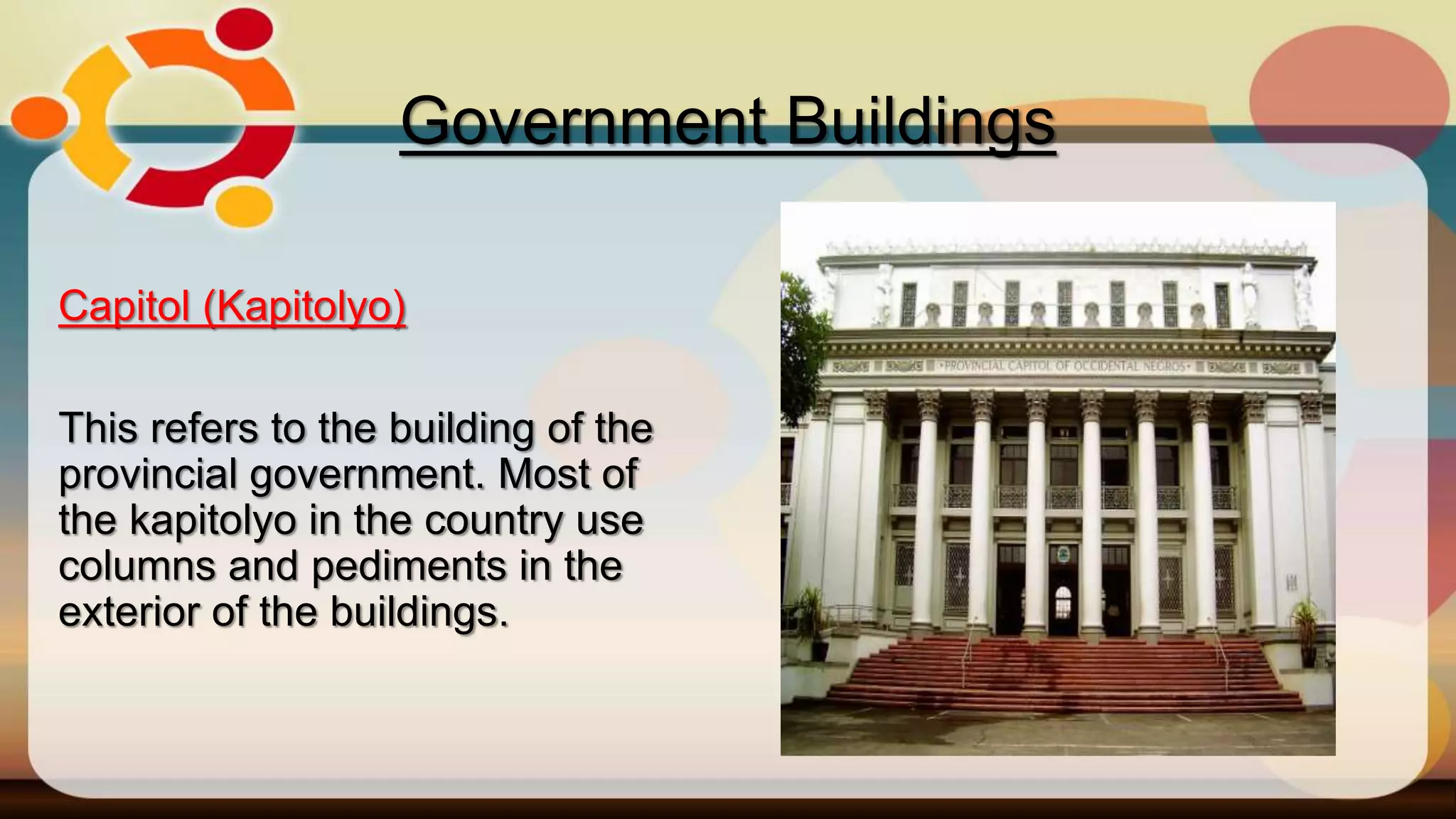
Capitol (Kapitolyo)
This refers to the building of the
provincial government. Most of
the kapitolyo in the country use
columns and pediments in the
exterior of the buildings.
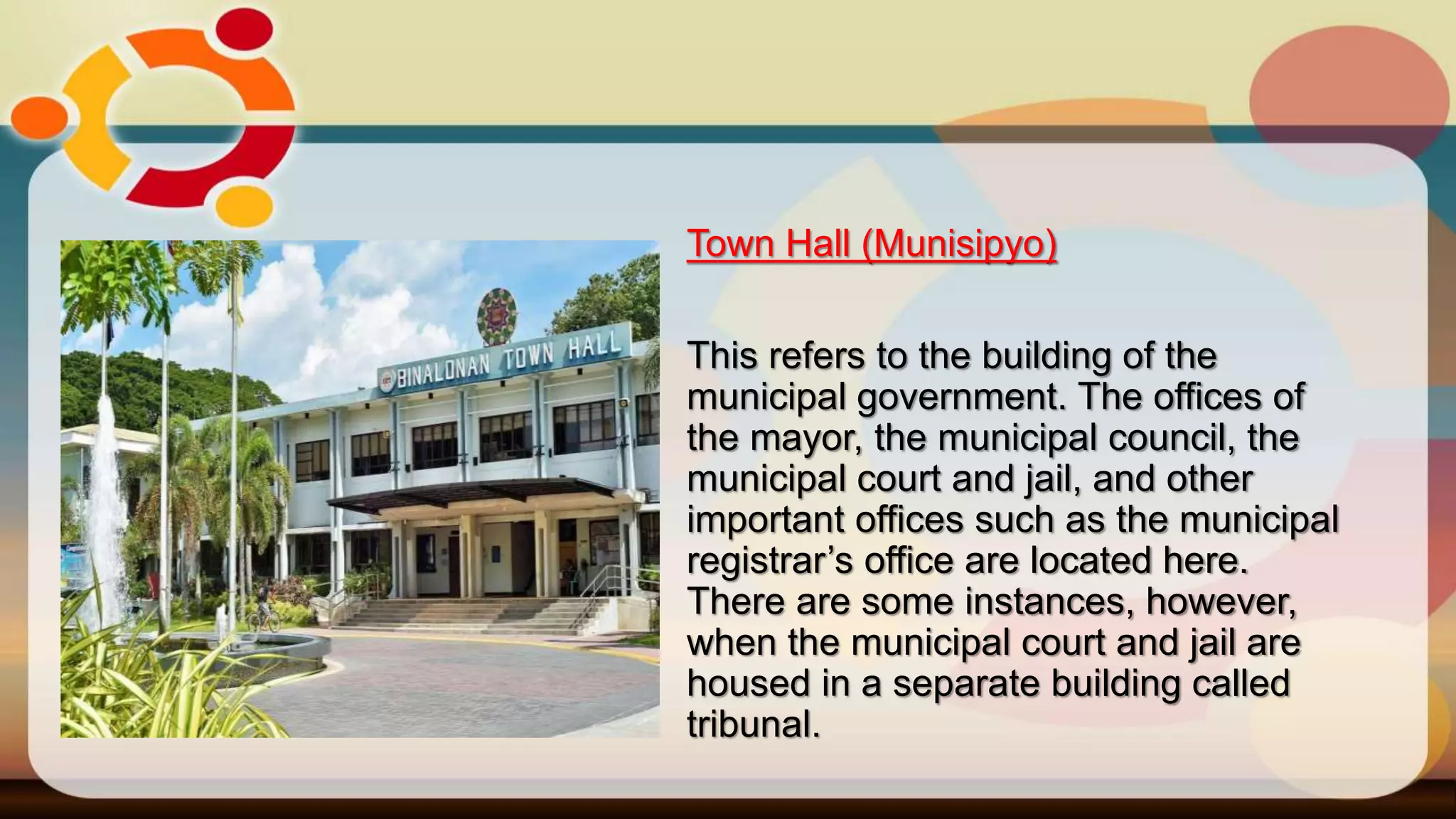
Town Hall (Munisipyo)
This refers to the building of the
municipal government. The offices of
the mayor, the municipal council, the
municipal court and jail, and other
important offices such as the municipal
registrar’s office are located here.
There are some instances, however,
when the municipal court and jail are
housed in a separate building called
tribunal.
Public Buildings and Structures
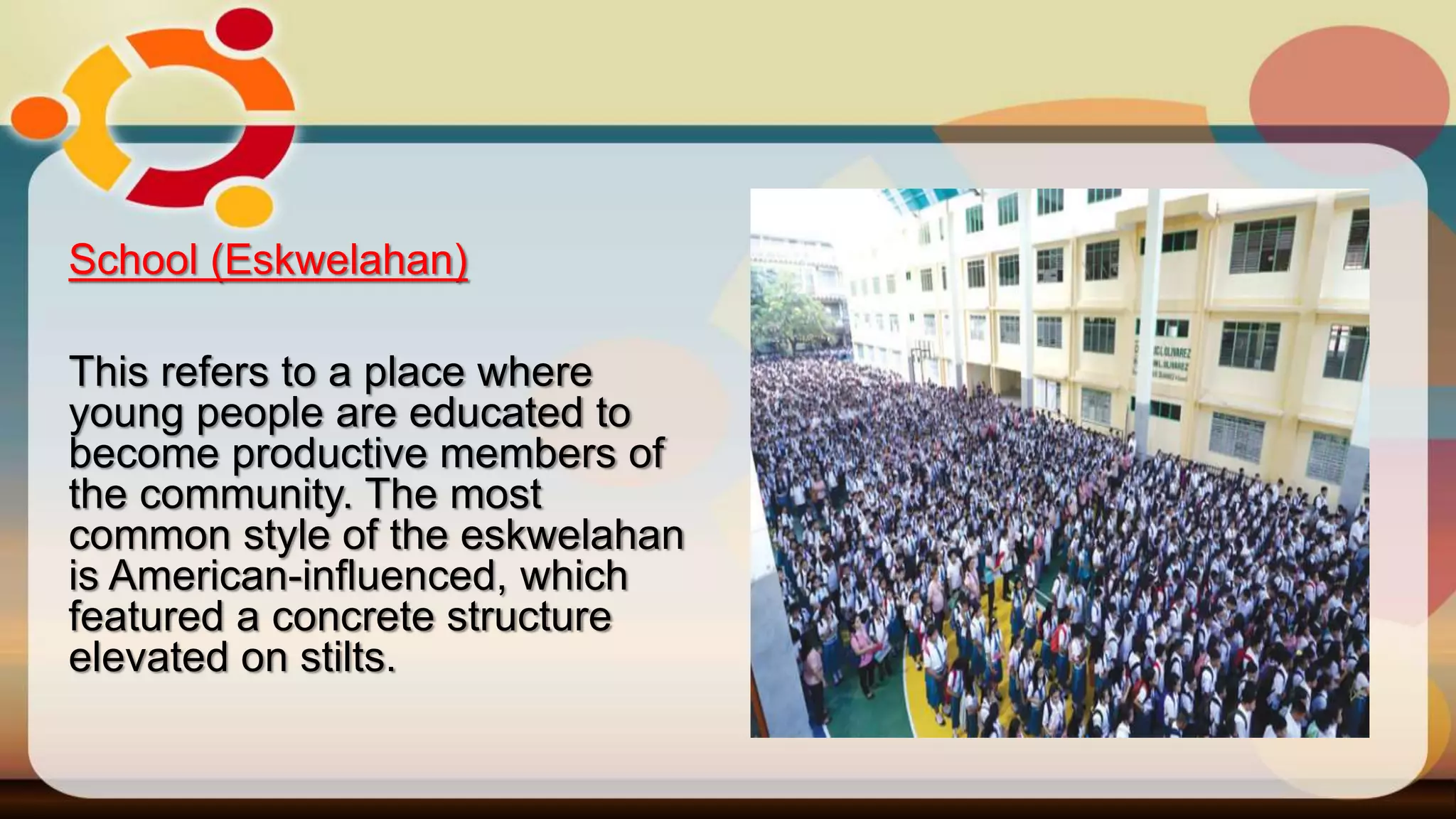
School (Eskwelahan)
This refers to a place where
young people are educated to
become productive members of
the community. The most
common style of the eskwelahan
is American-influenced, which
featured a concrete structure
elevated on stilts.
Kamalig
The Kamalig is the Tagalog term
for a building used for storing
grain. This is considered to be
the most economically significant
structure among the tribes in
Northern Philippines. In some
provinces, especially those in the
lowland areas, the bahay kubo
or nipa hut can be used as a
form of kamalig.
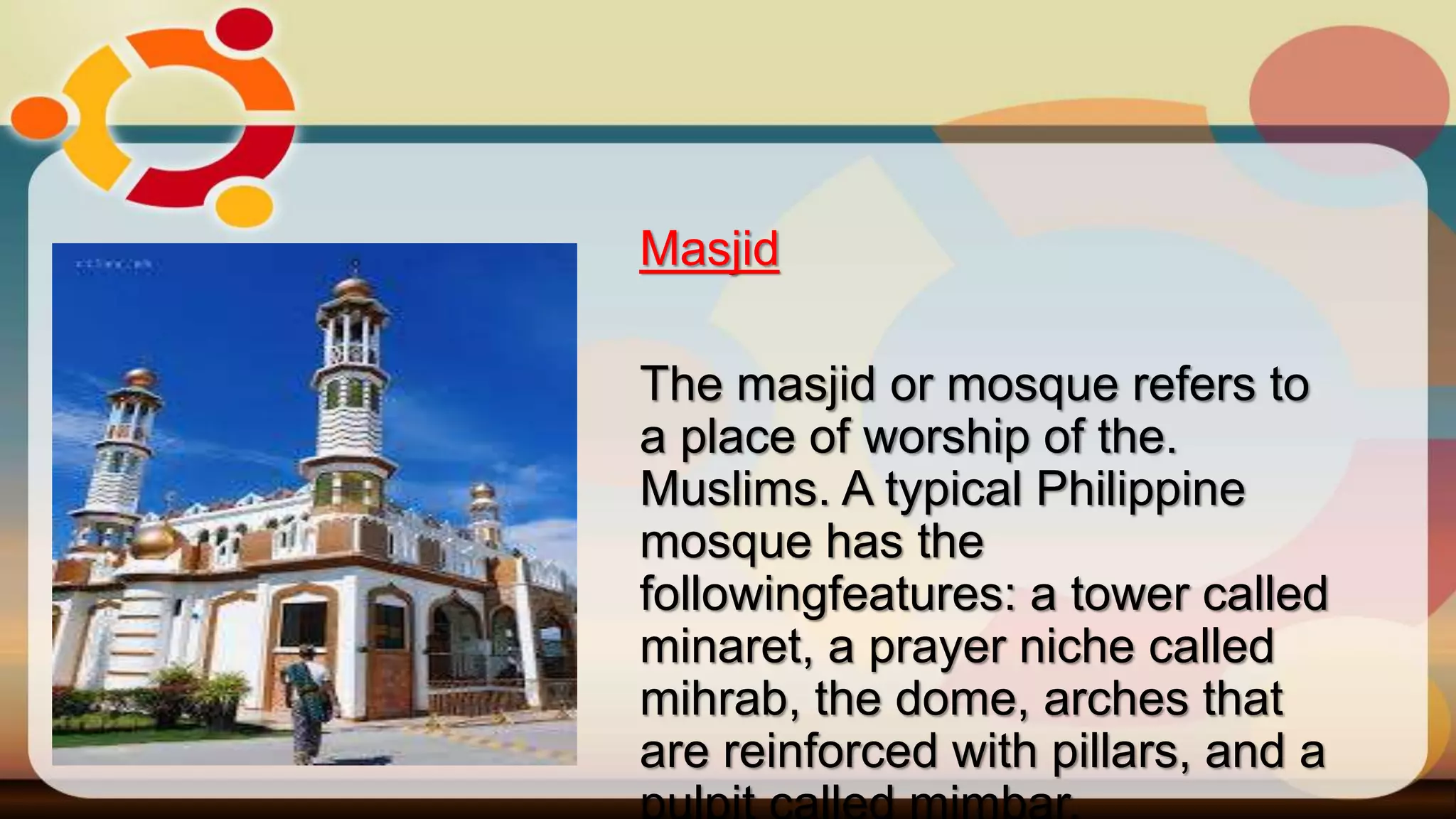
Masjid
The masjid or mosque refers to
a place of worship of the.
Muslims. A typical Philippine
mosque has the
followingfeatures: a tower called
minaret, a prayer niche called
mihrab, the dome, arches that
are reinforced with pillars, and a
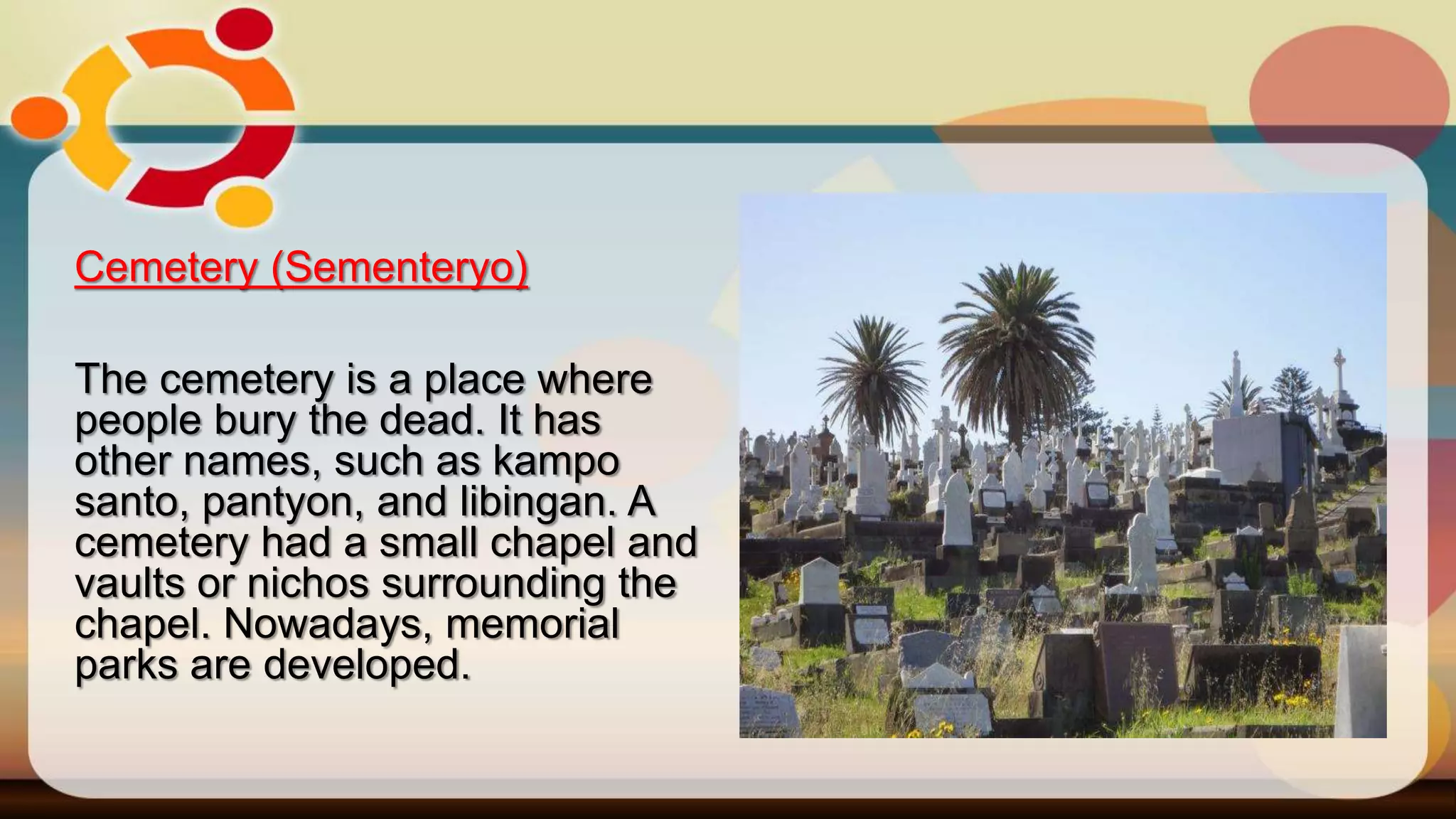
Cemetery (Sementeryo)
The cemetery is a place where
people bury the dead. It has
other names, such as kampo
santo, pantyon, and libingan. A
cemetery had a small chapel and
vaults or nichos surrounding the
chapel. Nowadays, memorial
parks are developed.
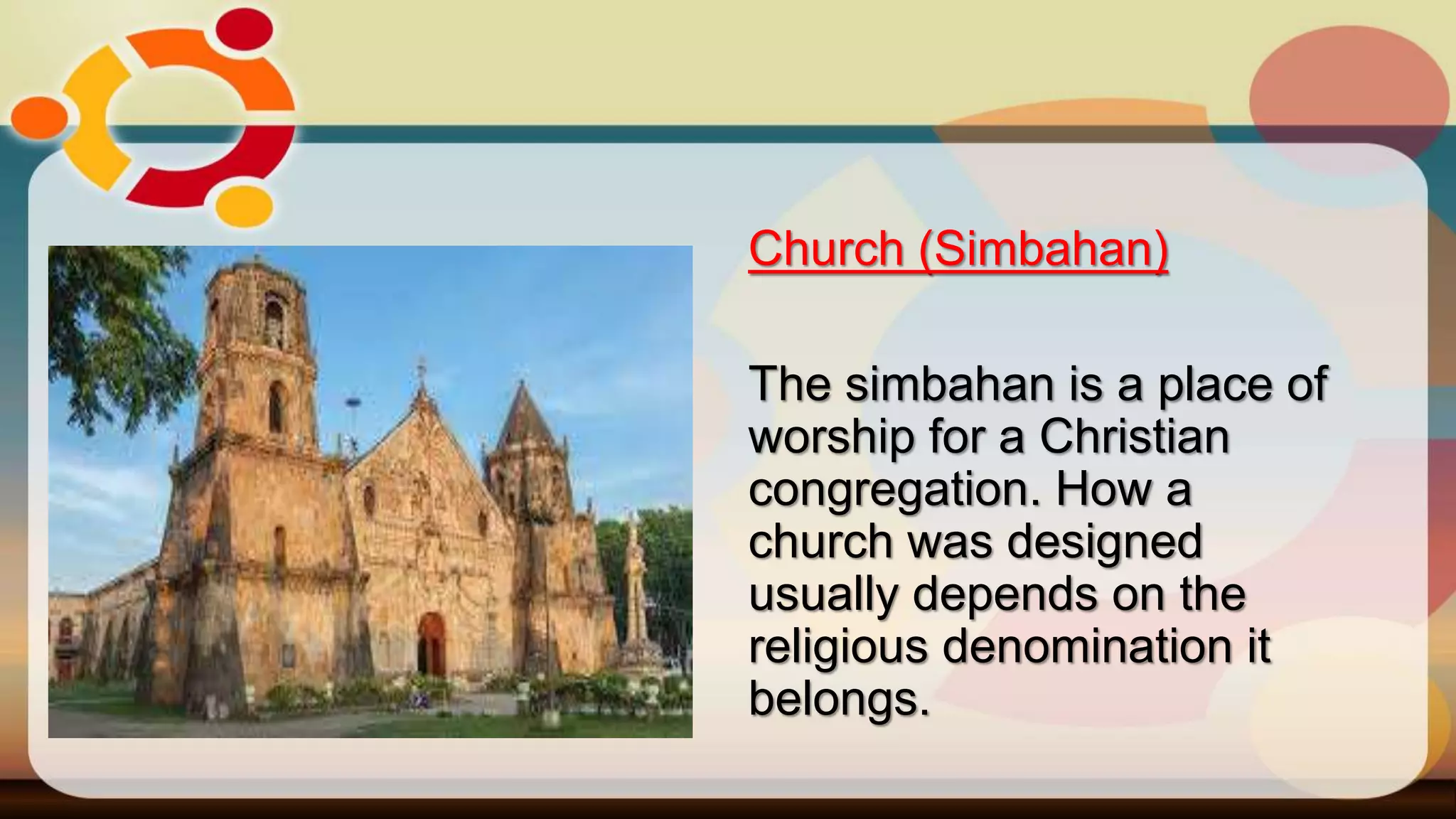
Church (Simbahan)
The simbahan is a place of
worship for a Christian
congregation. How a
church was designed
usually depends on the
religious denomination it
belongs.
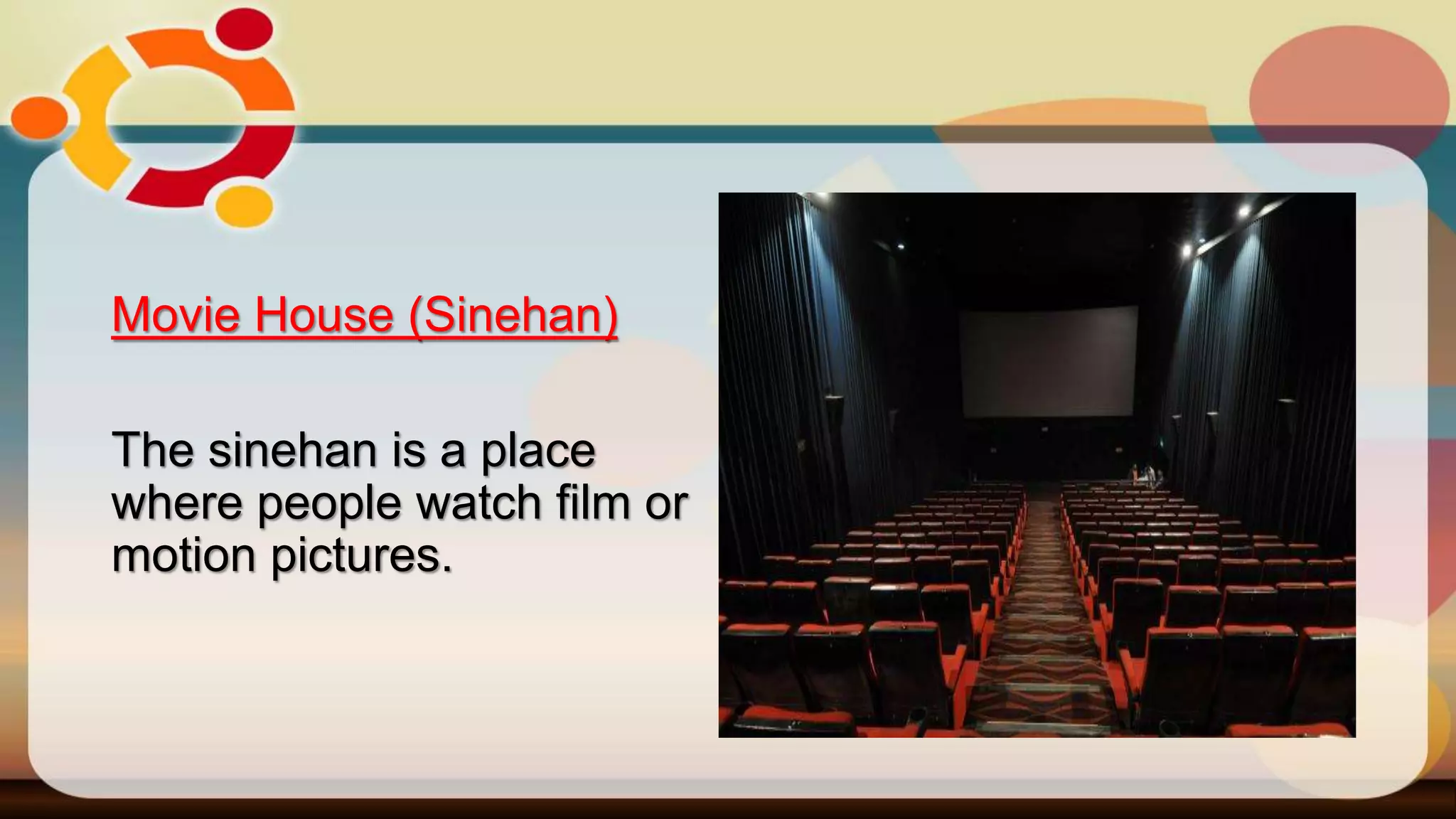
Movie House (Sinehan)
The sinehan is a place
where people watch film or
motion pictures.
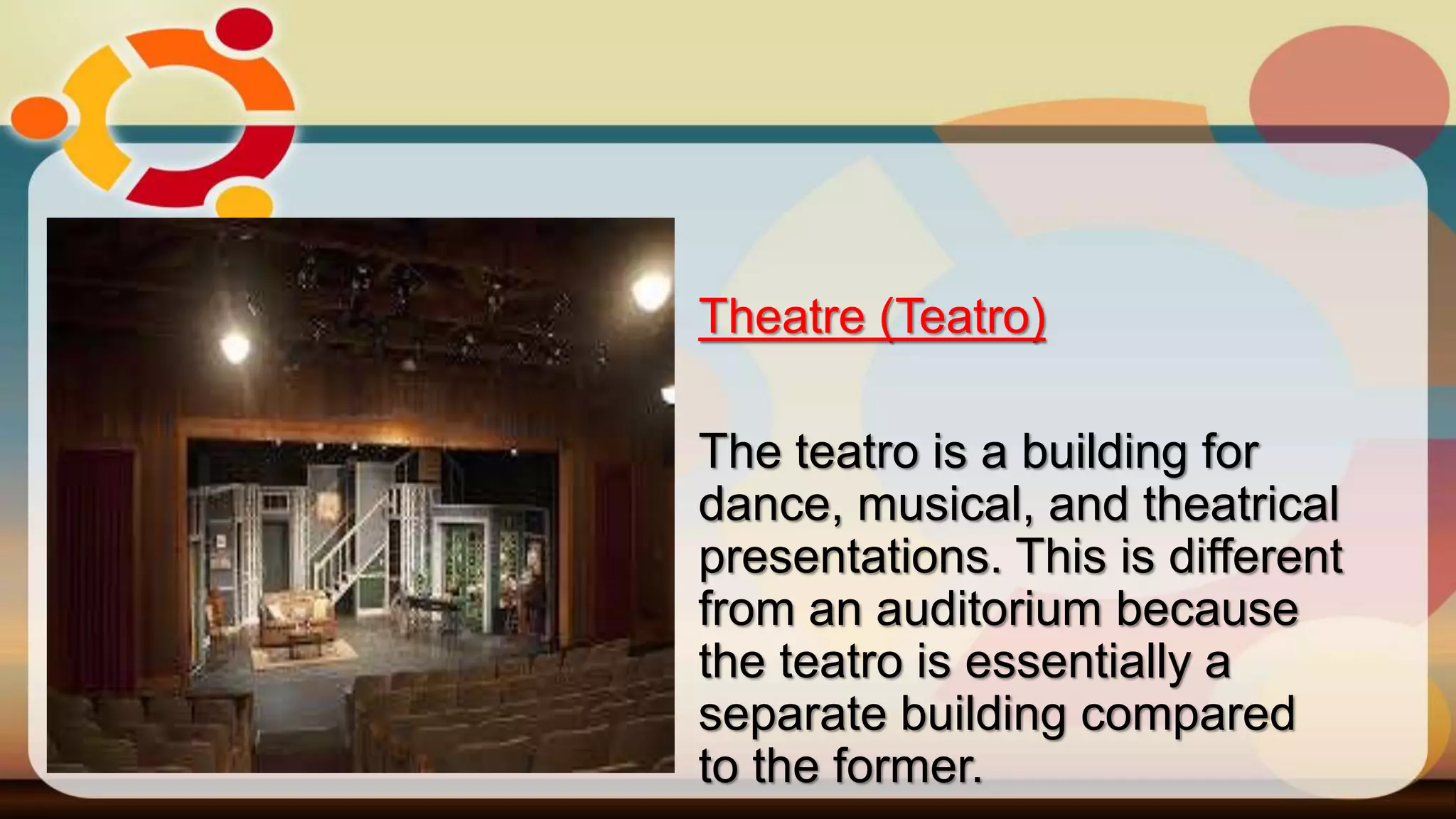
Theatre (Teatro)
The teatro is a building for
dance, musical, and theatrical
presentations. This is different
from an auditorium because
the teatro is essentially a
separate building compared
to the former.
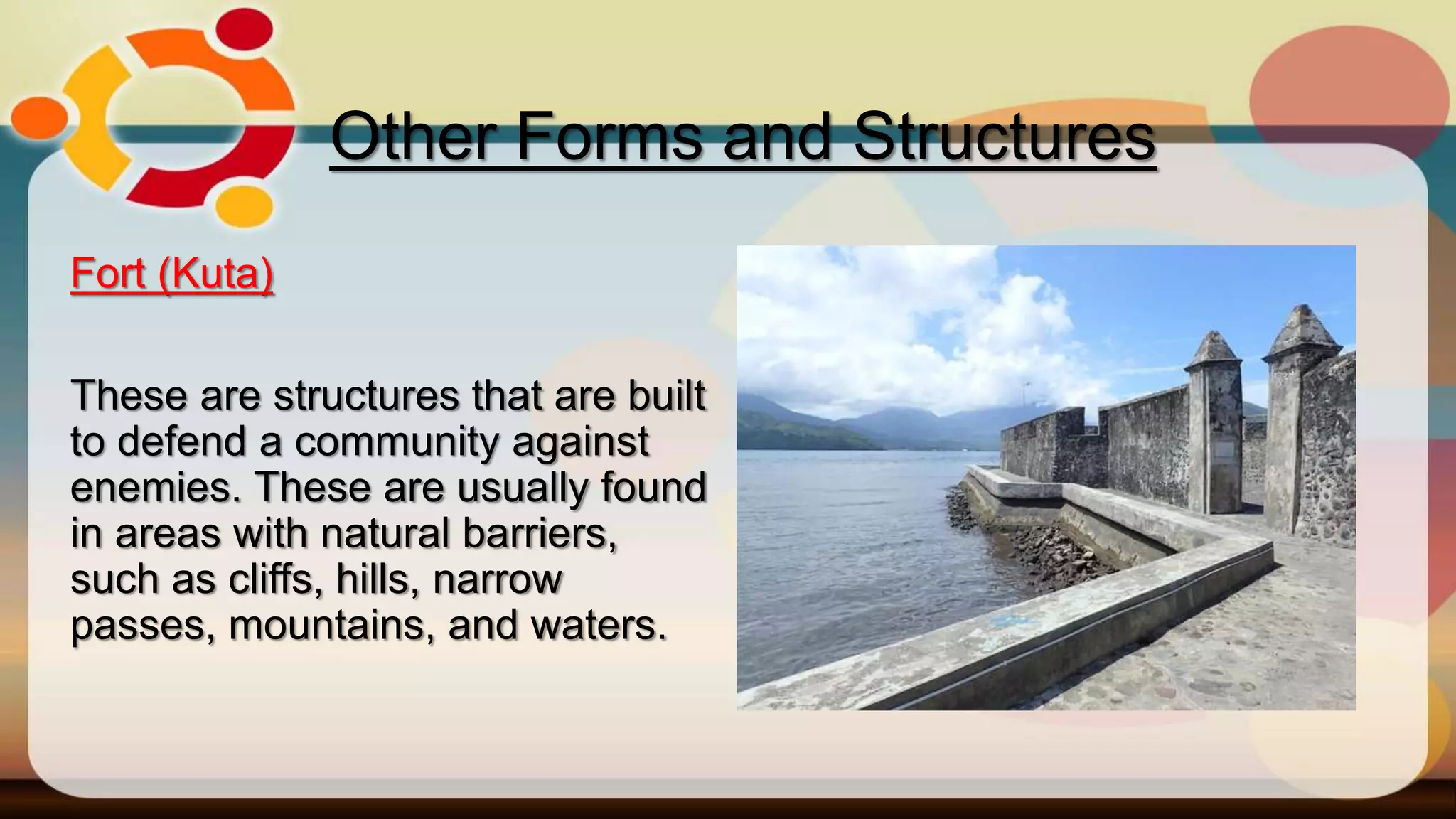
Fort (Kuta)
These are structures that are built
to defend a community against
enemies. These are usually found
in areas with natural barriers,
such as cliffs, hills, narrow
passes, mountains, and waters.
Other Forms and Structures
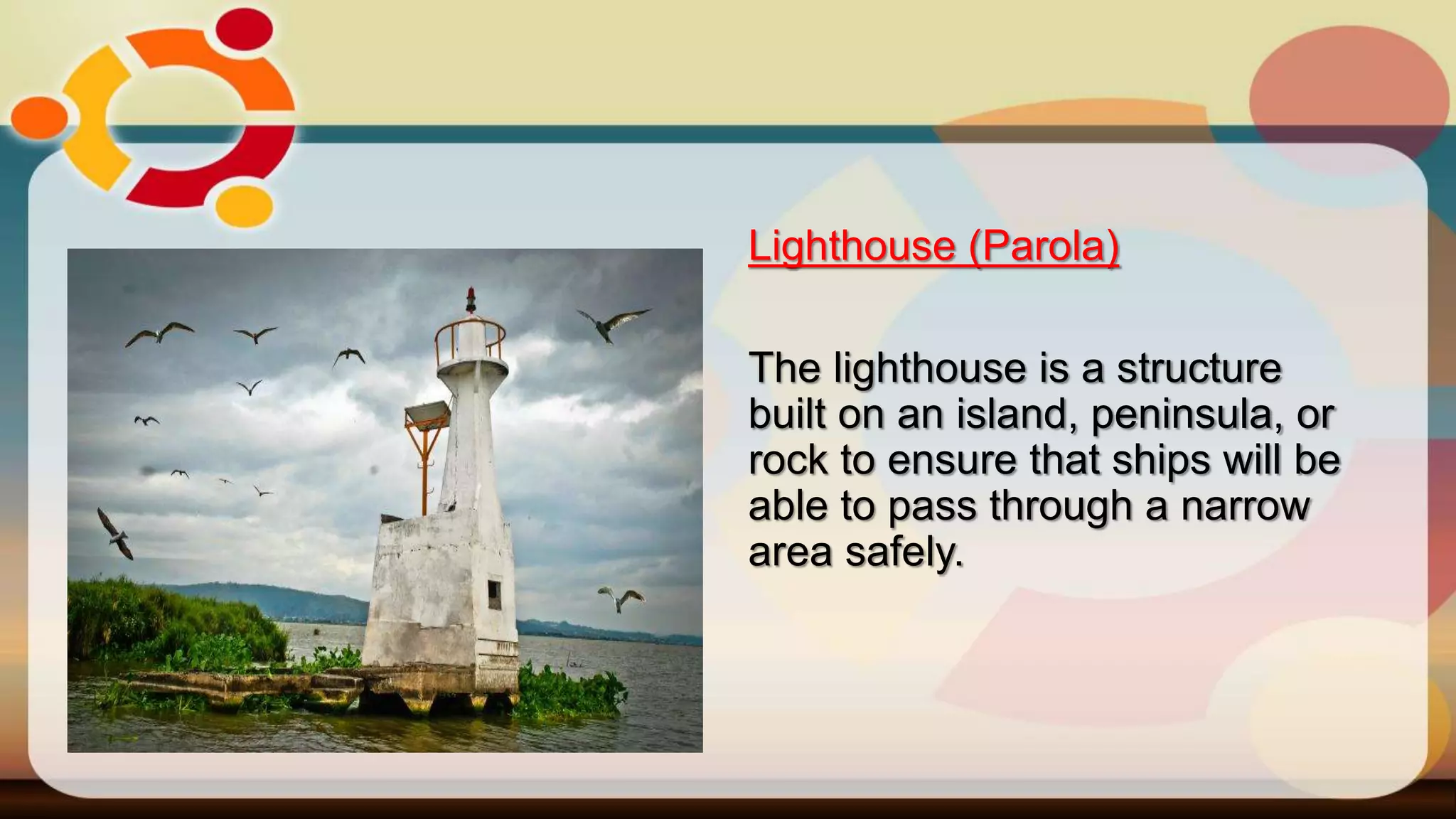
Lighthouse (Parola)
The lighthouse is a structure
built on an island, peninsula, or
rock to ensure that ships will be
able to pass through a narrow
area safely.
Bridge (Tulay)
The tulay is a horizontal structure
that serves as a passageway
between two areas separated by
a body of water, a hollow area, or
a road.

LESSON 5.pptx

  • 1.
    CONTEMPORARY PHILIPPINE ARTS FROMTHE REGIONS LESSON 5: ARCHITECTURE
  • 2.
    Architecture is consideredto be one of the most functional branches of the visual arts. We can freely see architecture in our surroundings because architecture involves designing the form of a building while allowing the building to serve its function. It is considered to be the “art to inhabit.”
  • 3.
  • 4.
    Domestic Buildings andHouses Apartment Bahay na Bato Barong-Barong Bungalow
  • 5.
    Apartment This refers toa building composed of many residences called units. This is usually built in populated urban areas. Nowadays, in order to maximize the use of space and because of the increased buying power of the population, condominiums were developed. These condominiums are larger offshoots of apartments.
  • 6.
    Bahay na Bato Thebahay na bato is considered to be a residence of the wealthy. A typical two- storey bahay na bato generally has a ground floor that is made of brick or stone and has a wooden upper level. The windows and the level have grilles, while the windows at the upper level have sliding shutters. The roof of a typical bahay na bato slants on four sides.
  • 7.
    Barong-barong The barong-barong arehouses of the landless poor that are built on any land or area. These are usually found near the esteros, riverbanks, and bayshores; spaces along high walls, railroad tracks; spaces near abandoned buildings, and garbage dumps; or any vacant lot. Some of these barong-barong are built under bridges.
  • 8.
    Bungalow This refers toone-story house with a wide front porch and large windows. It may also have a terrace, which may be roofed or not.
  • 9.
    Ethnic Houses Bahay Kubo Houseboat One-and-a-HalfStory House Split-level House Tsalet
  • 10.
    Bahay Kubo The bahaykubo is considered as an ethnic house of Christian peasant families living in the lowland areas.This is typically owned by families belonging in low income groups.
  • 11.
    Houseboat The houseboat isbasically a boat that also serves as dwelling. The Badjaos or Sama Laut typically reside in houseboats.
  • 12.
    One-and-a-Half Story House Theone-and-a-half story is characterized by an upper level or story covering just a half of the lower level. This may also become a split-level house if half of the ground level is higher in such a way that it is halfway between the ground level and the upper level.
  • 13.
    Split-level House The split-levelhouse in the Philippines has two main levels. The lower level houses has the kitchen, living and dining areas, while the upper level has the bedrooms. These levels are separated by about half or less- than-half a story.
  • 14.
    Tsalet The Philippine tsaletrefers to a suburban house that has one story, a two-story house with living quarters on the upper level, or an elevated one-story house. The term tsalet came from the term “chalet” which refers to a peasant house in Switzerland that has upper levels jutting over the lower levels, a steep roof and a decorated gable.
  • 15.
    Commercial Buildings Market Buildings thathouse banks, business offices, and factories
  • 16.
    Market (Palengke) This refersto a place or building for buying and selling goods. This is also referred to as tindahan, and tiyangge. Nowadays, the palengke has evolved into the supermarket which puts the wet market and the grocery together in the same complex. The mall, or galleria is considered a more recent evolved form of the palengke.
  • 17.
    Buildings that housebanks, business offices, and factories These buildings have plain wall surfaces and large windows. These also have bold rectangular forms and clean lines.
  • 18.
    Government Buildings Capitol (Kapitolyo) Thisrefers to the building of the provincial government. Most of the kapitolyo in the country use columns and pediments in the exterior of the buildings.
  • 19.
    Town Hall (Munisipyo) Thisrefers to the building of the municipal government. The offices of the mayor, the municipal council, the municipal court and jail, and other important offices such as the municipal registrar’s office are located here. There are some instances, however, when the municipal court and jail are housed in a separate building called tribunal.
  • 20.
  • 21.
    School (Eskwelahan) This refersto a place where young people are educated to become productive members of the community. The most common style of the eskwelahan is American-influenced, which featured a concrete structure elevated on stilts.
  • 22.
    Kamalig The Kamalig isthe Tagalog term for a building used for storing grain. This is considered to be the most economically significant structure among the tribes in Northern Philippines. In some provinces, especially those in the lowland areas, the bahay kubo or nipa hut can be used as a form of kamalig.
  • 23.
    Masjid The masjid ormosque refers to a place of worship of the. Muslims. A typical Philippine mosque has the followingfeatures: a tower called minaret, a prayer niche called mihrab, the dome, arches that are reinforced with pillars, and a
  • 24.
    Cemetery (Sementeryo) The cemeteryis a place where people bury the dead. It has other names, such as kampo santo, pantyon, and libingan. A cemetery had a small chapel and vaults or nichos surrounding the chapel. Nowadays, memorial parks are developed.
  • 25.
    Church (Simbahan) The simbahanis a place of worship for a Christian congregation. How a church was designed usually depends on the religious denomination it belongs.
  • 26.
    Movie House (Sinehan) Thesinehan is a place where people watch film or motion pictures.
  • 27.
    Theatre (Teatro) The teatrois a building for dance, musical, and theatrical presentations. This is different from an auditorium because the teatro is essentially a separate building compared to the former.
  • 28.
    Fort (Kuta) These arestructures that are built to defend a community against enemies. These are usually found in areas with natural barriers, such as cliffs, hills, narrow passes, mountains, and waters. Other Forms and Structures
  • 29.
    Lighthouse (Parola) The lighthouseis a structure built on an island, peninsula, or rock to ensure that ships will be able to pass through a narrow area safely.
  • 30.
    Bridge (Tulay) The tulayis a horizontal structure that serves as a passageway between two areas separated by a body of water, a hollow area, or a road.