Universidad de las Fuerzas Armadas ESPE
Unidad de Educación a Distancia
Nombres: Heydi Lizeth
Apellidos: Quishpe
Imbaquingo
Materia: ASSESSMENT
AND EVALUATION
Docente: Carlos Marcelo
Espín Ortega
Principles of language
assessment
 Assessment terminology
 The practice of assessing learners has
traditionally brought feelings of excitement
and nervousness.
 Apart from that it includes contents and
vocabulary that you definitely don’t know.
 This is just to exemplify the terrible feeling
that a student may experience when test-time
is coming.
 Assessment and Testing
 At the same time, teachers appraise and
judge their performance.
 In other words, assessment is a series of
actions taken by the teacher to measure
students’ responses, actions, performance
and behavior.
 The test is a method: it is a useful tool for
teachers who have to consider that being the
test a method
 The test must measure: valuable information
about the test-taker’s performance can be
taken after the application of a test.
 Measurement and Evaluation
 Measurement and evaluation are usually
confused or considered as synonyms.
However, these processes are different.
 Evaluation is sometimes confused with testing
but, they are not the same, they have different
connotations and uses.
 Formal and Informal Assessment.
 Informal assessment
 Formal assessment
 Formative and Summative Assessment
 Formative assessment helps teachers to
identify weaknesses and
 strengths.
 Summative assessment: evaluates formally
student’s learning, knowledge
Types and purposes of assessment
• Achievement tests.
• Diagnostic tests.
• Placement test.
• Proficiency tests
• Aptitude tests .
• Principles of language assessment .
• Practicality: According to Brown and Douglas practicality deals with the administrative
process involved in assessing an instrument. It includes making, giving, and scoring a test.
It does not surpass the budget limits
• It is taken within the given time
• It has clear instructions
• It used human and material resources appropriately
Reliability
Reliability is a term that deals with the consistency of test results. For instance, same test,
same students on two different dates, the results should be the same.
Learner-Related reliability
It occurs when the test-taker suffers from physical or psychological factors like illness or
anxiety. These factors interfere on the final test results
•
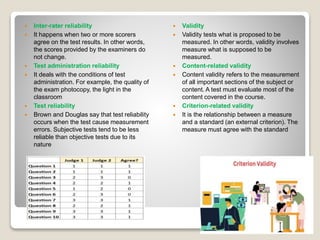
 Inter-rater reliability
 It happens when two or more scorers
agree on the test results. In other words,
the scores provided by the examiners do
not change.
 Test administration reliability
 It deals with the conditions of test
administration. For example, the quality of
the exam photocopy, the light in the
classroom
 Test reliability
 Brown and Douglas say that test reliability
occurs when the test cause measurement
errors. Subjective tests tend to be less
reliable than objective tests due to its
nature
 Validity
 Validity tests what is proposed to be
measured. In other words, validity involves
measure what is supposed to be
measured.
 Content-related validity
 Content validity refers to the measurement
of all important sections of the subject or
content. A test must evaluate most of the
content covered in the course.
 Criterion-related validity
 It is the relationship between a measure
and a standard (an external criterion). The
measure must agree with the standard
 Construct-related validity
 Construct validity determines if a test
assesses what it is supposed to. The test
has to be constructed to measure the
content of a course.
 Autheticity
 A test or assignment is said to have
authenticity when it is designed to apply
knowledge in new situations.
 Problem solving exercises are examples of
authentic evaluation. In these exercises
students need to justify their responses.
 For example, in an oral production lesson
a teacher demands students to role play a
situation.
 Washback effect
 The washback effect exists when a test
has great influence on the way a professor
teaches.

Principles of Language Assessment

  • 1.
    Universidad de lasFuerzas Armadas ESPE Unidad de Educación a Distancia Nombres: Heydi Lizeth Apellidos: Quishpe Imbaquingo Materia: ASSESSMENT AND EVALUATION Docente: Carlos Marcelo Espín Ortega
  • 2.
    Principles of language assessment Assessment terminology  The practice of assessing learners has traditionally brought feelings of excitement and nervousness.  Apart from that it includes contents and vocabulary that you definitely don’t know.  This is just to exemplify the terrible feeling that a student may experience when test-time is coming.  Assessment and Testing  At the same time, teachers appraise and judge their performance.  In other words, assessment is a series of actions taken by the teacher to measure students’ responses, actions, performance and behavior.  The test is a method: it is a useful tool for teachers who have to consider that being the test a method  The test must measure: valuable information about the test-taker’s performance can be taken after the application of a test.  Measurement and Evaluation  Measurement and evaluation are usually confused or considered as synonyms. However, these processes are different.  Evaluation is sometimes confused with testing but, they are not the same, they have different connotations and uses.  Formal and Informal Assessment.  Informal assessment  Formal assessment  Formative and Summative Assessment  Formative assessment helps teachers to identify weaknesses and  strengths.  Summative assessment: evaluates formally student’s learning, knowledge
  • 3.
    Types and purposesof assessment • Achievement tests. • Diagnostic tests. • Placement test. • Proficiency tests • Aptitude tests . • Principles of language assessment . • Practicality: According to Brown and Douglas practicality deals with the administrative process involved in assessing an instrument. It includes making, giving, and scoring a test. It does not surpass the budget limits • It is taken within the given time • It has clear instructions • It used human and material resources appropriately Reliability Reliability is a term that deals with the consistency of test results. For instance, same test, same students on two different dates, the results should be the same. Learner-Related reliability It occurs when the test-taker suffers from physical or psychological factors like illness or anxiety. These factors interfere on the final test results •
  • 4.
     Inter-rater reliability It happens when two or more scorers agree on the test results. In other words, the scores provided by the examiners do not change.  Test administration reliability  It deals with the conditions of test administration. For example, the quality of the exam photocopy, the light in the classroom  Test reliability  Brown and Douglas say that test reliability occurs when the test cause measurement errors. Subjective tests tend to be less reliable than objective tests due to its nature  Validity  Validity tests what is proposed to be measured. In other words, validity involves measure what is supposed to be measured.  Content-related validity  Content validity refers to the measurement of all important sections of the subject or content. A test must evaluate most of the content covered in the course.  Criterion-related validity  It is the relationship between a measure and a standard (an external criterion). The measure must agree with the standard
  • 5.
     Construct-related validity Construct validity determines if a test assesses what it is supposed to. The test has to be constructed to measure the content of a course.  Autheticity  A test or assignment is said to have authenticity when it is designed to apply knowledge in new situations.  Problem solving exercises are examples of authentic evaluation. In these exercises students need to justify their responses.  For example, in an oral production lesson a teacher demands students to role play a situation.  Washback effect  The washback effect exists when a test has great influence on the way a professor teaches.