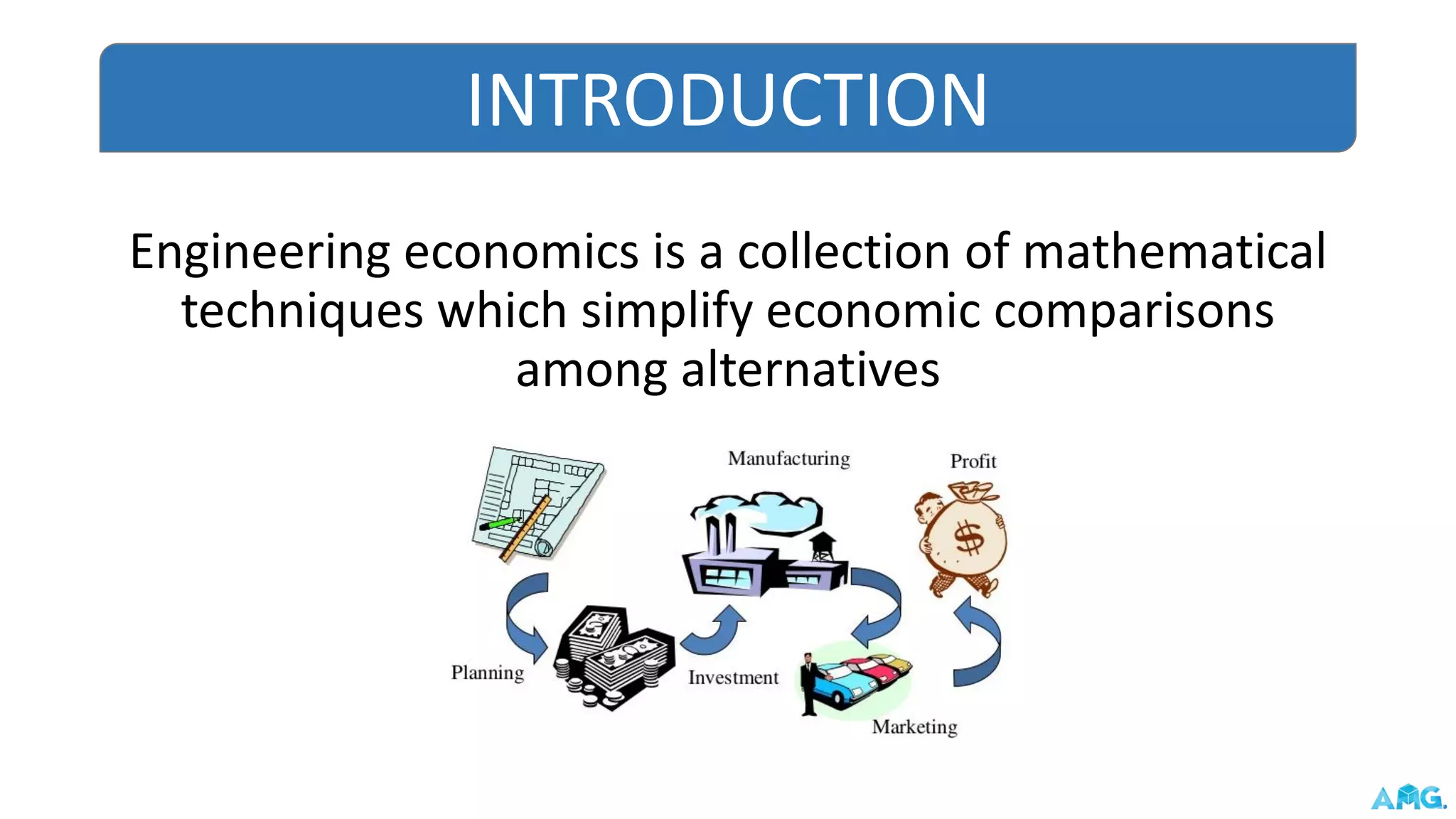
Engineering economics is a collection of mathematical
techniques which simplify economic comparisons
among alternatives
INTRODUCTION
1. Develop the Alternatives
2. Focus on the Differences
3. Use a Consistent Viewpoint
4. Use a Common Unit of Measure
5. Consider All Relevant Criteria
6. Make Uncertainty Explicit
7. Revisit Your Decisions
THE 7 PRINCIPLES
Alternates should be found out before carrying out a task.
They also need to be identified, well defined and analyzed
before finalizing on anything.
1st Principle - Develop the Alternatives
When the alternates are developed, comparison can only be
done based on the differences which is expected in the future
outcomes. If the alternatives have the same outcomes,
irrespective of the method followed, then the comparison is
meaningless. We should eliminate the alternatives which have
the same outcome
2nd Principle - Focus on the difference
All alternatives should be defined from one point of view (one
perspective). That is, the decision maker has to enumerate the
prospective outcomes is his point of view.
3rd Principle - Use a Consistent Viewpoint
A common unit of measurement is very much required to
quantify the different prospective outcomes. This allows
easier analysis and comparison.
4th Principle - Use a common unit of measure
As a for-profit organization/business, the main criterion is the
maximum returns on an investment or profits. However, there
are some other factors to be taken into consideration which
would help the business to grow.
5th Principle - Consider all relevant criteria
Uncertainty is intrinsic in projecting the prospective outcomes
and it should be taken into consideration in the analysis and
comparison of all the listed alternatives.
6th Principle - Make uncertainty explicit
Decision making process is an adaptive process and improves
with time. Initial projected outcomes of the short-listed
alternatives should be subsequently compared with actual
outcomes in order to improve the quality of the decision and
its projections for the future projects.
7th Principle - Revisit your decision
All the above principles are used in a decision making process
that involves alternatives and includes different factors with
engineering knowledge. This type of study is accomplished
using a structured procedure and mathematical modelling
techniques.
Conclusion
THANKS!

Principles of Engineering Economy

  • 2.
    Engineering economics isa collection of mathematical techniques which simplify economic comparisons among alternatives INTRODUCTION
  • 3.
    1. Develop theAlternatives 2. Focus on the Differences 3. Use a Consistent Viewpoint 4. Use a Common Unit of Measure 5. Consider All Relevant Criteria 6. Make Uncertainty Explicit 7. Revisit Your Decisions THE 7 PRINCIPLES
  • 4.
    Alternates should befound out before carrying out a task. They also need to be identified, well defined and analyzed before finalizing on anything. 1st Principle - Develop the Alternatives
  • 5.
    When the alternatesare developed, comparison can only be done based on the differences which is expected in the future outcomes. If the alternatives have the same outcomes, irrespective of the method followed, then the comparison is meaningless. We should eliminate the alternatives which have the same outcome 2nd Principle - Focus on the difference
  • 6.
    All alternatives shouldbe defined from one point of view (one perspective). That is, the decision maker has to enumerate the prospective outcomes is his point of view. 3rd Principle - Use a Consistent Viewpoint
  • 7.
    A common unitof measurement is very much required to quantify the different prospective outcomes. This allows easier analysis and comparison. 4th Principle - Use a common unit of measure
  • 8.
    As a for-profitorganization/business, the main criterion is the maximum returns on an investment or profits. However, there are some other factors to be taken into consideration which would help the business to grow. 5th Principle - Consider all relevant criteria
  • 9.
    Uncertainty is intrinsicin projecting the prospective outcomes and it should be taken into consideration in the analysis and comparison of all the listed alternatives. 6th Principle - Make uncertainty explicit
  • 10.
    Decision making processis an adaptive process and improves with time. Initial projected outcomes of the short-listed alternatives should be subsequently compared with actual outcomes in order to improve the quality of the decision and its projections for the future projects. 7th Principle - Revisit your decision
  • 11.
    All the aboveprinciples are used in a decision making process that involves alternatives and includes different factors with engineering knowledge. This type of study is accomplished using a structured procedure and mathematical modelling techniques. Conclusion
  • 12.