Computer Ethics
INTRODUCTION
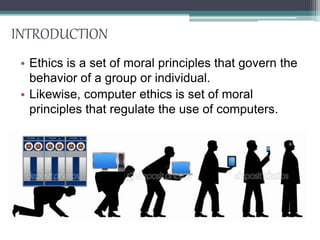
• Ethics is a set of moral principles that govern the
behavior of a group or individual.
• Likewise, computer ethics is set of moral
principles that regulate the use of computers.
ETHICAL ISSUES
• The ethical issues classified into three ways:
 According to the type of technology
 According to the sector in which the
technology is used and
 According to ethical concepts or themes
Common issues of computer ethics
• Some common issues of computer ethics include
intellectual property rights such as copyrighted
electronic content, privacy concerns, and how
computers affect society.
For example, while it is easy to duplicate copyrighted
electronic or digital content, computer ethics would
suggest that it is wrong to do so without the author's
approval.
And while it may be possible to access someone's
personal information on a computer system, computer
ethics would advise that such an action is unethical.
unethical
Intellectual property
• Intellectual property refers to creations of the
intellect (hence, the name): inventions, literary
and artistic works, symbols, names, images, and
designs used in commerce are a part of it.
• Intellectual property is usually divided into two
branches,
• Industrial property and
• Copyright
• Industrial property, which includes
• Inventions (patents)
• Trademarks
• Industrial designs
• Commercial names
• Designations and
• Geographic indications (location specific
brands) etc.
Copy rights
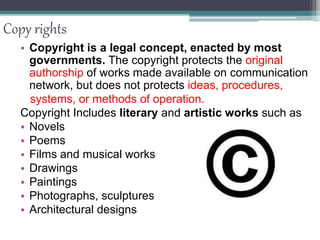
• Copyright is a legal concept, enacted by most
governments. The copyright protects the original
authorship of works made available on communication
network, but does not protects ideas, procedures,
systems, or methods of operation.
Copyright Includes literary and artistic works such as
• Novels
• Poems
• Films and musical works
• Drawings
• Paintings
• Photographs, sculptures
• Architectural designs
COPYRIGHT ON INTERNET
The World Intellectual Property Organization
(WIPO), has established similar guidelines in its
Copyright Law,
It is also generally agreed that the owner of the
copyright and only the owner is authorized to do the
following with the work:
Reproduce it
Prepare derivative works based upon it
Distribute copies of it to the public
 Perform the work publicly (if applicable)
 Display the work publicly.
NETIQUTTES
Netiquette are about the various risks related to using
the Internet and proper ways in which to use a network.
Four important points using internet:
• Think twice before you click on Send button in the
mail/chat window.
• Protect your privacy: Protect your personal
information to keep someone from using it in an
unethical way.
• Avoid spamming: Spamming is sending unsolicited
bulk and/or commercial messages over the Internet.
• Help making network better: Receive helpful
information and report what you learned.
PLAGIARISM
• Plagiarism is copying someone else's work and
then passing it off as one's own. It is morally bad
because it is an act of stealing.
File privacy
• Any computer document produced either by an
individual in his private home or in his office
should remain private.
Thank you

Computer ethics

  • 1.
  • 2.
    INTRODUCTION • Ethics isa set of moral principles that govern the behavior of a group or individual. • Likewise, computer ethics is set of moral principles that regulate the use of computers.
  • 3.
    ETHICAL ISSUES • Theethical issues classified into three ways:  According to the type of technology  According to the sector in which the technology is used and  According to ethical concepts or themes
  • 4.
    Common issues ofcomputer ethics • Some common issues of computer ethics include intellectual property rights such as copyrighted electronic content, privacy concerns, and how computers affect society.
  • 5.
    For example, whileit is easy to duplicate copyrighted electronic or digital content, computer ethics would suggest that it is wrong to do so without the author's approval. And while it may be possible to access someone's personal information on a computer system, computer ethics would advise that such an action is unethical. unethical
  • 6.
    Intellectual property • Intellectualproperty refers to creations of the intellect (hence, the name): inventions, literary and artistic works, symbols, names, images, and designs used in commerce are a part of it. • Intellectual property is usually divided into two branches, • Industrial property and • Copyright
  • 7.
    • Industrial property,which includes • Inventions (patents) • Trademarks • Industrial designs • Commercial names • Designations and • Geographic indications (location specific brands) etc.
  • 8.
    Copy rights • Copyrightis a legal concept, enacted by most governments. The copyright protects the original authorship of works made available on communication network, but does not protects ideas, procedures, systems, or methods of operation. Copyright Includes literary and artistic works such as • Novels • Poems • Films and musical works • Drawings • Paintings • Photographs, sculptures • Architectural designs
  • 9.
    COPYRIGHT ON INTERNET TheWorld Intellectual Property Organization (WIPO), has established similar guidelines in its Copyright Law, It is also generally agreed that the owner of the copyright and only the owner is authorized to do the following with the work: Reproduce it Prepare derivative works based upon it Distribute copies of it to the public  Perform the work publicly (if applicable)  Display the work publicly.
  • 10.
    NETIQUTTES Netiquette are aboutthe various risks related to using the Internet and proper ways in which to use a network. Four important points using internet: • Think twice before you click on Send button in the mail/chat window. • Protect your privacy: Protect your personal information to keep someone from using it in an unethical way. • Avoid spamming: Spamming is sending unsolicited bulk and/or commercial messages over the Internet. • Help making network better: Receive helpful information and report what you learned.
  • 11.
    PLAGIARISM • Plagiarism iscopying someone else's work and then passing it off as one's own. It is morally bad because it is an act of stealing. File privacy • Any computer document produced either by an individual in his private home or in his office should remain private.
  • 13.