Topic 2.2
Info Privacy and
IT Ethics
Jenelyn M, Aranas
A short recap,last time wediscussed about…
 The digital divide.It refers to the inequalities that exist between groups of
people in relation to access,use and knowledge of information and
communication technologies (ICTs).
"digital divide"
 According to study the refers to the growing gap between the
underprivileged members of society,especially the poor,rural,elderly,and
handicapped portion of the population who do not have access to computers
or the internet.
digital divide is a multidimensional phenomenon
 The that encompasses the
following three distinct facets;global,social and democratic divide.
A short recap,last time wediscussed about…
 Causes of digital divide:education,income levels,geographic restrictions,
motivation and general interest,and digital literacy.
 Some of the outcomes generated by the digital divideinclude:impact on
economy,education,social domains,and society.
narrowing the digital gap
 In we need to:
○ increase digital literacy,
○ develop relevant and local content in addition to telecommunications
infrastructure,
○ establish workable partnerships between all information and communication
technology stakeholders, and
○ promote innovations geared towards overcoming the digital divide
Topic 2.2
Info Privacy and
IT Ethics
Discussion Outline
1. What is Computer ethics?
2. Historical Overview of computer ethics
3. Terminologies and Primary
Issues in computer ethics
4. Summary
Intended Learning Outcome
1 define computer ethics;
2
After the discussion the
students will be able to:
3
discuss the historical overview of computer
ethics;
discover the contributions of some computer scientists and
professional organizations who contributed to the
conceptual foundation of computer ethics; and
examine the professional, ethical, and social
responsibilities in Information Technology.
4
Image Source: https://en.wikipedia.org/wiki/Cyberethics
Source: https://keydifferences.com/difference-between-ethics-and-values.html#Conclusion
Ethics
 By the term ‘ethics’ we mean a branch of moral philosophy – a
sense of rightness or wrongness of actions, motives and the
results of these actions.
 It identifies good or evil, just or unjust, fair or unfair practices,
about moral duty.
 It is well-based standards that a person should do, concerning
rights, obligations, fairness, benefits to society and so on.
Moral Values
 Values refer to the important and enduring beliefs or principles,
based on which an individual makes judgements in life.
 It is at the center of our lives which act as a standard of behavior.
 They severely affect the emotional state of mind of an individual.
 They can be personal values, cultural values or corporate values.
Source : https://teachcomputerscience.com/computer-ethics/
Source : https://stanford.library.sydney.edu.au/archives/sum2008/entries/ethics-computer/
Traditional ethical theories…
Jeremy Bentham and John Stuart Mill Immanuel Kant (1724–1804)
Source : https://teachcomputerscience.com/computer-ethics/
Computer Ethics: Basic concept…
• “Cybernetics" - the science of information feedback systems.
• Norbert Wiener published his monumental book, the “The Human Use of Human-
Beings”
• Norbert Wiener perceptively foresaw revolutionary social and ethical consequences.
• In this book, he laid down a comprehensive foundation which remains today a
powerful basis for “Computer Ethics” research and analysis.
Source : https://stanford.library.sydney.edu.au/archives/sum2008/entries/ethics-computer/
Computer Ethics: Historical overview…
1940-1950
• In the mid 1960s, “Donn Parker “ began to examine unethical and illegal uses of
computers by computer professionals.
• He published "Rules of Ethics in Information Processing" in Communications of
the ACM in 1968.
• “Donn Parker” went on to produce books, articles, speeches and workshops that re-
launched the field of computer ethics.
1960
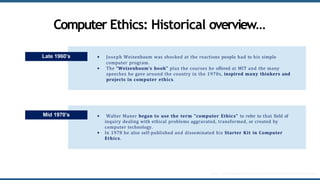
• Joseph Weizenbaum was shocked at the reactions people had to his simple
computer program.
• The “Weizenbaum's book” plus the courses he offered at MIT and the many
speeches he gave around the country in the 1970s, inspired many thinkers and
projects in computer ethics.
Source : https://stanford.library.sydney.edu.au/archives/sum2008/entries/ethics-computer/
Computer Ethics: Historical overview…
Late 1960’s
• Walter Maner began to use the term "computer Ethics" to refer to that field of
inquiry dealing with ethical problems aggravated, transformed, or created by
computer technology.
• In 1978 he also self-published and disseminated his Starter Kit in Computer
Ethics.
Mid 1970’s
• Proliferation of computer-enabled crime, and computer failures
• Major law suits regarding Software ownership, because of the work of Parker,
Weizenbaum, Maner, etc.
• Invasions of privacy via computer databases.
• Books in computer ethics
Source : https://stanford.library.sydney.edu.au/archives/sum2008/entries/ethics-computer/
Computer Ethics: Historical overview…
Mid 1980’s
BOOKS
• Increase in the number of computer professionals organization
Source : https://stanford.library.sydney.edu.au/archives/sum2008/entries/ethics-computer/
Computer Ethics: Historical overview…
Mid 1990’s
ORGANIZATIONS
Image Source: https://en.wikipedia.org/wiki/Cyberethics
PRIVACY
Source : https://stanford.library.sydney.edu.au/archives/sum2008/entries/ethics-computer/
Computer Ethics: Primary issues…
ACCURACY
PROPERTY
CYBERCRIME
ACCESS
PRIVACY
Source :http://www.cse.aucegypt.edu/~rafea/csce491/Spring2015/Ethics/Ethics_Social_Security.pdf
Computer Ethics: Primary issues…
ACCURACY
PROPERTY
CYBERCRIME
ACCESS
responsibility to protect data about individuals.
the responsibility of data collectors to authenticate information and ensure its
accuracy.
Property - who owns information and software and how they can be sold and
exchanged.
Cyber Crime - is a crime that involves a computer and a network.
Access - the responsibility of data collectors to control access and determine what
information a person has the right to obtain about others and how the information can
be used.
Image Source: https://en.wikipedia.org/wiki/Cyberethics
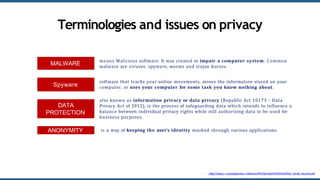
MALWARE
Source :http://www.cse.aucegypt.edu/~rafea/csce491/Spring2015/Ethics/Ethics_Social_Security.pdf
Terminologies and issues on privacy
Spyware
DATA
PROTECTION
means Malicious software. It was created to impair a computer system. Common
malware are viruses, spyware, worms and trojan horses.
software that tracks your online movements, mines the information stored on your
computer, or uses your computer for some task you know nothing about.
also known as information privacy or data privacy (Republic Act 10173 – Data
Privacy Act of 2012), is the process of safeguarding data which intends to influence a
balance between individual privacy rights while still authorizing data to be used for
business purposes.
ANONYMITY is a way of keeping the user's identity masked through various applications.
Image Source: https://en.wikipedia.org/wiki/Cyberethics
Copyright
Terminologies and issues on Intellectual
Property Rights (IPR)
Intellectual
Property
Plagiarism
is a form of intellectual property that gives proprietary publication, distribution, and
usage rights for the author. It means that whatever idea the author created cannot
be employed or disseminated by anyone else without the permission of the author.
creations protected by law.
is an act of copying and publishing another person's work without proper citation.
It's like stealing someone else's work and releasing
it as your own work.
Software License
allows the use of digital material by following the license agreement. Ownership
remains with the original copyright owner, and users are just granted licenses to use
the material based on the agreement.
Source :http://www.cse.aucegypt.edu/~rafea/csce491/Spring2015/Ethics/Ethics_Social_Security.pdf
Infringement
Terminologies and issues on Intellectual
Property Rights (IPR)
Piracy
Trade Secret
copying of copyrighted pictures or text from web pages.
Illegal software copying.
Trade Secret - work or products belonging to a business, not in public domain
Patent - legal document granting owner exclusive monopoly on an invention for 17 yrs.
Four (4) Types of
Software License
1. Public Domain
2. Freeware
3. Shareware
4. All Rights Reserved
Source :http://www.cse.aucegypt.edu/~rafea/csce491/Spring2015/Ethics/Ethics_Social_Security.pdf
Image Source: https://en.wikipedia.org/wiki/Cyberethics
What is
cybercrime?
Terminologies and issues on Cybercrime
Two (2)
Categories:
Cybercrime is defined as a crime where a computer is the object of the crime or is used
as a tool to commit an offense.
1. Crimes that target networks or devices – viruses, malware, dos attacks.
2. Crimes using devices to participate in criminal activities – phishing emails,
cyberstalking, and identity theft.
Source : Types of cybercrime, (2020) Retrieved from https://www.voipshield.com
Source :https://www.pandasecurity.com/mediacenter/panda-security/types-of-cybercrime/
FRAUD
Fraud is a general term used to describe a cybercrime that intends to deceive a
person to gain essential data or information. Fraud can be done by altering,
destroying, stealing, or suppressing any information to secure an unlawful or unfair
gain.
HACKING
Hacking involves the partial or complete acquisition of specific functions within a
system, network, or website. It also aims to access to essential data and information,
breaching privacy—most “hackers” attack corporate and government accounts.
Image Source: https://en.wikipedia.org/wiki/Cyberethics
Identity theft
Most common types of cybercrime acts
Scam
is a specific form of fraud in which cybercriminals steal personal data, including
passwords, data about the bank account, credit cards, debit cards, social security, and
other sensitive information.
can be done by offering computer repair, network troubleshooting, and IT support
services, forcing users to shell out hundreds of money for cyber problems that do
not even exist.
Source : Types of cybercrime, (2020) Retrieved from https://www.voipshield.com
Source :http://www.cse.aucegypt.edu/~rafea/csce491/Spring2015/Ethics/Ethics_Social_Security.pdf
Virus
mostly, highly-skilled programs send viruses, malware, and Trojan, among others, to
infect and destroy computers, networks, and systems.
Ransomware
is one of the most destructive malware-based attacks. It enters your computer network
and encrypts files and information through public-key encryption.
DDOS Attack
Distributed Denial of Service Attack is one of the most popular methods of hacking.
It temporarily or completely interrupts servers and networks that are successfully
running.
Botnet
Most common types of cybercrime acts
Spamming
are controlled by remote attackers called “bot herders” in order to attack computers
by sending spams or malware.
uses electronic messaging systems, most commonly emails in sending messages that
host malware, fake links of websites, and other malicious programs.
Source :http://www.cse.aucegypt.edu/~rafea/csce491/Spring2015/Ethics/Ethics_Social_Security.pdf
Phishing
They use “email spoofing” to extract confidential information such as credit card
numbers, social security numbers, passwords, etc.
Cyberstalking
The stalker will virtually follow the victim, including his or her activities. Most of the
victims of cyberstalking are women and children being followed by men and
pedophiles.
Cyberbullying
Most common types of cybercrime acts
Cyberbullying is one of the most rampant crimes committed in the virtual world. It is a
form of bullying carried over to the internet. On the other hand, global leaders are
aware of this crime and pass laws and acts that prohibit the proliferation of
cyberbullying.
Source :http://www.cse.aucegypt.edu/~rafea/csce491/Spring2015/Ethics/Ethics_Social_Security.pdf
Child
Pornography
Basically, this cybercrime involves the exploitation of children in the porn industry.
Child pornography is a $3-billion-a-year industry. Unfortunately, over 10,000 internet
locations provide access to child porn.
Questions
Summary
Lesson 4: Info Privacy and IT Ethics
 In this lesson, we learned that computer ethics is a set of moral standards that govern the use of computers.
 The term "computer ethics was coined by Norbert Wiener, who published the book entitled "the human use of human
beings" in 1950. In this book, he laid down a comprehensive foundation for "computer ethics".
 The other computer scientists and professionals who contribute to the philosophical foundation of computer ethics are
"Donn Parker, who began to examine unethical and illegal uses of computers by computer professionals.
 Joseph Weizenbaum, who created a computer program called Eliza and wrote a book entitled, computer power and
human reason and Walter Maner, who began to use the term "computer ethics" to refer to that field of inquiry dealing
with ethical problems aggravated, transformed, or created by computer technology.
Summary
Lesson 4: Info Privacy and IT Ethics
 Some of the issues in computer ethics are privacy, which is the responsibility to protect data about individuals—
accuracy, the responsibility of data collectors, to authenticate information and ensure its accuracy.
 Property deals about who owns information and software and how they can be sold and exchanged.
 Cybercrime is a crime that involves a computer and a network and access, the responsibility of data collectors to
control access, and determine what information a person has the right to obtain about others and how the information
can be used.
References
 What is computer ethics (2020) Retrieved from | https://stanford.library.sydney.edu.au/archives/sum2008/entries/ethics-computer/
 Computer Ethics (2020) Retrieved from Ciampa, M. (2014). Security awareness: Applying practical security in your world, 4e / International
edition. Australia : Cengage Learning.
 Types of cybercrime, (2020) Retrieved from | https://www.voipshield.com/the-16-most-common-types-of- cybercrime-acts/
 Definitions of Computer Ethics (2020) Retrieved from | https://www.cs.uct.ac.za
 Computer Ethics Terminologies and Issues(2020) Retrieved from |
http://www.cse.aucegypt.edu/~rafea/csce491/Spring2015/Ethics/Ethics_Social_Security.pdf
Computer crime (2020) Retrieved from | http://www.cse.aucegypt.edu/~rafea/csce491/Spring2015/Ethics/Ethics_Social_Security.pdf
 What is cybercrime? (2020) Retrieved from | https://www.pandasecurity.com/mediacenter/panda-security/types-of-cybercrime/
Assesssment Task
Assessment Task:
Make a Research about the following :
1.Cybercrime Prevention Act of 2012. (12 points)
2.What are the cybercrimes covered under the Cybercrime
Prevention Act – Republic Act 10175? (12 points)
3.Give five legal cases filed in the Philippines under the
Cybercrime Prevention Act – Republic Act 10175. (12 points).
Email your Assessment task here: jaranas@tip.edu.ph

Topic-2.2_InfoPrivacy-IT-Ethics.pptx

  • 1.
    Topic 2.2 Info Privacyand IT Ethics Jenelyn M, Aranas
  • 2.
    A short recap,lasttime wediscussed about…  The digital divide.It refers to the inequalities that exist between groups of people in relation to access,use and knowledge of information and communication technologies (ICTs). "digital divide"  According to study the refers to the growing gap between the underprivileged members of society,especially the poor,rural,elderly,and handicapped portion of the population who do not have access to computers or the internet. digital divide is a multidimensional phenomenon  The that encompasses the following three distinct facets;global,social and democratic divide.
  • 3.
    A short recap,lasttime wediscussed about…  Causes of digital divide:education,income levels,geographic restrictions, motivation and general interest,and digital literacy.  Some of the outcomes generated by the digital divideinclude:impact on economy,education,social domains,and society. narrowing the digital gap  In we need to: ○ increase digital literacy, ○ develop relevant and local content in addition to telecommunications infrastructure, ○ establish workable partnerships between all information and communication technology stakeholders, and ○ promote innovations geared towards overcoming the digital divide
  • 4.
  • 5.
    Discussion Outline 1. Whatis Computer ethics? 2. Historical Overview of computer ethics 3. Terminologies and Primary Issues in computer ethics 4. Summary
  • 6.
    Intended Learning Outcome 1define computer ethics; 2 After the discussion the students will be able to: 3 discuss the historical overview of computer ethics; discover the contributions of some computer scientists and professional organizations who contributed to the conceptual foundation of computer ethics; and examine the professional, ethical, and social responsibilities in Information Technology. 4
  • 7.
  • 8.
    Source: https://keydifferences.com/difference-between-ethics-and-values.html#Conclusion Ethics  Bythe term ‘ethics’ we mean a branch of moral philosophy – a sense of rightness or wrongness of actions, motives and the results of these actions.  It identifies good or evil, just or unjust, fair or unfair practices, about moral duty.  It is well-based standards that a person should do, concerning rights, obligations, fairness, benefits to society and so on. Moral Values  Values refer to the important and enduring beliefs or principles, based on which an individual makes judgements in life.  It is at the center of our lives which act as a standard of behavior.  They severely affect the emotional state of mind of an individual.  They can be personal values, cultural values or corporate values.
  • 9.
  • 10.
    Source : https://stanford.library.sydney.edu.au/archives/sum2008/entries/ethics-computer/ Traditionalethical theories… Jeremy Bentham and John Stuart Mill Immanuel Kant (1724–1804)
  • 11.
  • 12.
    • “Cybernetics" -the science of information feedback systems. • Norbert Wiener published his monumental book, the “The Human Use of Human- Beings” • Norbert Wiener perceptively foresaw revolutionary social and ethical consequences. • In this book, he laid down a comprehensive foundation which remains today a powerful basis for “Computer Ethics” research and analysis. Source : https://stanford.library.sydney.edu.au/archives/sum2008/entries/ethics-computer/ Computer Ethics: Historical overview… 1940-1950 • In the mid 1960s, “Donn Parker “ began to examine unethical and illegal uses of computers by computer professionals. • He published "Rules of Ethics in Information Processing" in Communications of the ACM in 1968. • “Donn Parker” went on to produce books, articles, speeches and workshops that re- launched the field of computer ethics. 1960
  • 13.
    • Joseph Weizenbaumwas shocked at the reactions people had to his simple computer program. • The “Weizenbaum's book” plus the courses he offered at MIT and the many speeches he gave around the country in the 1970s, inspired many thinkers and projects in computer ethics. Source : https://stanford.library.sydney.edu.au/archives/sum2008/entries/ethics-computer/ Computer Ethics: Historical overview… Late 1960’s • Walter Maner began to use the term "computer Ethics" to refer to that field of inquiry dealing with ethical problems aggravated, transformed, or created by computer technology. • In 1978 he also self-published and disseminated his Starter Kit in Computer Ethics. Mid 1970’s
  • 14.
    • Proliferation ofcomputer-enabled crime, and computer failures • Major law suits regarding Software ownership, because of the work of Parker, Weizenbaum, Maner, etc. • Invasions of privacy via computer databases. • Books in computer ethics Source : https://stanford.library.sydney.edu.au/archives/sum2008/entries/ethics-computer/ Computer Ethics: Historical overview… Mid 1980’s BOOKS
  • 15.
    • Increase inthe number of computer professionals organization Source : https://stanford.library.sydney.edu.au/archives/sum2008/entries/ethics-computer/ Computer Ethics: Historical overview… Mid 1990’s ORGANIZATIONS
  • 16.
  • 17.
  • 18.
    PRIVACY Source :http://www.cse.aucegypt.edu/~rafea/csce491/Spring2015/Ethics/Ethics_Social_Security.pdf Computer Ethics:Primary issues… ACCURACY PROPERTY CYBERCRIME ACCESS responsibility to protect data about individuals. the responsibility of data collectors to authenticate information and ensure its accuracy. Property - who owns information and software and how they can be sold and exchanged. Cyber Crime - is a crime that involves a computer and a network. Access - the responsibility of data collectors to control access and determine what information a person has the right to obtain about others and how the information can be used.
  • 19.
  • 20.
    MALWARE Source :http://www.cse.aucegypt.edu/~rafea/csce491/Spring2015/Ethics/Ethics_Social_Security.pdf Terminologies andissues on privacy Spyware DATA PROTECTION means Malicious software. It was created to impair a computer system. Common malware are viruses, spyware, worms and trojan horses. software that tracks your online movements, mines the information stored on your computer, or uses your computer for some task you know nothing about. also known as information privacy or data privacy (Republic Act 10173 – Data Privacy Act of 2012), is the process of safeguarding data which intends to influence a balance between individual privacy rights while still authorizing data to be used for business purposes. ANONYMITY is a way of keeping the user's identity masked through various applications.
  • 21.
  • 22.
    Copyright Terminologies and issueson Intellectual Property Rights (IPR) Intellectual Property Plagiarism is a form of intellectual property that gives proprietary publication, distribution, and usage rights for the author. It means that whatever idea the author created cannot be employed or disseminated by anyone else without the permission of the author. creations protected by law. is an act of copying and publishing another person's work without proper citation. It's like stealing someone else's work and releasing it as your own work. Software License allows the use of digital material by following the license agreement. Ownership remains with the original copyright owner, and users are just granted licenses to use the material based on the agreement. Source :http://www.cse.aucegypt.edu/~rafea/csce491/Spring2015/Ethics/Ethics_Social_Security.pdf
  • 23.
    Infringement Terminologies and issueson Intellectual Property Rights (IPR) Piracy Trade Secret copying of copyrighted pictures or text from web pages. Illegal software copying. Trade Secret - work or products belonging to a business, not in public domain Patent - legal document granting owner exclusive monopoly on an invention for 17 yrs. Four (4) Types of Software License 1. Public Domain 2. Freeware 3. Shareware 4. All Rights Reserved Source :http://www.cse.aucegypt.edu/~rafea/csce491/Spring2015/Ethics/Ethics_Social_Security.pdf
  • 24.
  • 25.
    What is cybercrime? Terminologies andissues on Cybercrime Two (2) Categories: Cybercrime is defined as a crime where a computer is the object of the crime or is used as a tool to commit an offense. 1. Crimes that target networks or devices – viruses, malware, dos attacks. 2. Crimes using devices to participate in criminal activities – phishing emails, cyberstalking, and identity theft. Source : Types of cybercrime, (2020) Retrieved from https://www.voipshield.com Source :https://www.pandasecurity.com/mediacenter/panda-security/types-of-cybercrime/ FRAUD Fraud is a general term used to describe a cybercrime that intends to deceive a person to gain essential data or information. Fraud can be done by altering, destroying, stealing, or suppressing any information to secure an unlawful or unfair gain. HACKING Hacking involves the partial or complete acquisition of specific functions within a system, network, or website. It also aims to access to essential data and information, breaching privacy—most “hackers” attack corporate and government accounts.
  • 26.
  • 27.
    Identity theft Most commontypes of cybercrime acts Scam is a specific form of fraud in which cybercriminals steal personal data, including passwords, data about the bank account, credit cards, debit cards, social security, and other sensitive information. can be done by offering computer repair, network troubleshooting, and IT support services, forcing users to shell out hundreds of money for cyber problems that do not even exist. Source : Types of cybercrime, (2020) Retrieved from https://www.voipshield.com Source :http://www.cse.aucegypt.edu/~rafea/csce491/Spring2015/Ethics/Ethics_Social_Security.pdf Virus mostly, highly-skilled programs send viruses, malware, and Trojan, among others, to infect and destroy computers, networks, and systems. Ransomware is one of the most destructive malware-based attacks. It enters your computer network and encrypts files and information through public-key encryption. DDOS Attack Distributed Denial of Service Attack is one of the most popular methods of hacking. It temporarily or completely interrupts servers and networks that are successfully running.
  • 28.
    Botnet Most common typesof cybercrime acts Spamming are controlled by remote attackers called “bot herders” in order to attack computers by sending spams or malware. uses electronic messaging systems, most commonly emails in sending messages that host malware, fake links of websites, and other malicious programs. Source :http://www.cse.aucegypt.edu/~rafea/csce491/Spring2015/Ethics/Ethics_Social_Security.pdf Phishing They use “email spoofing” to extract confidential information such as credit card numbers, social security numbers, passwords, etc. Cyberstalking The stalker will virtually follow the victim, including his or her activities. Most of the victims of cyberstalking are women and children being followed by men and pedophiles.
  • 29.
    Cyberbullying Most common typesof cybercrime acts Cyberbullying is one of the most rampant crimes committed in the virtual world. It is a form of bullying carried over to the internet. On the other hand, global leaders are aware of this crime and pass laws and acts that prohibit the proliferation of cyberbullying. Source :http://www.cse.aucegypt.edu/~rafea/csce491/Spring2015/Ethics/Ethics_Social_Security.pdf Child Pornography Basically, this cybercrime involves the exploitation of children in the porn industry. Child pornography is a $3-billion-a-year industry. Unfortunately, over 10,000 internet locations provide access to child porn.
  • 30.
  • 31.
    Summary Lesson 4: InfoPrivacy and IT Ethics  In this lesson, we learned that computer ethics is a set of moral standards that govern the use of computers.  The term "computer ethics was coined by Norbert Wiener, who published the book entitled "the human use of human beings" in 1950. In this book, he laid down a comprehensive foundation for "computer ethics".  The other computer scientists and professionals who contribute to the philosophical foundation of computer ethics are "Donn Parker, who began to examine unethical and illegal uses of computers by computer professionals.  Joseph Weizenbaum, who created a computer program called Eliza and wrote a book entitled, computer power and human reason and Walter Maner, who began to use the term "computer ethics" to refer to that field of inquiry dealing with ethical problems aggravated, transformed, or created by computer technology.
  • 32.
    Summary Lesson 4: InfoPrivacy and IT Ethics  Some of the issues in computer ethics are privacy, which is the responsibility to protect data about individuals— accuracy, the responsibility of data collectors, to authenticate information and ensure its accuracy.  Property deals about who owns information and software and how they can be sold and exchanged.  Cybercrime is a crime that involves a computer and a network and access, the responsibility of data collectors to control access, and determine what information a person has the right to obtain about others and how the information can be used.
  • 33.
    References  What iscomputer ethics (2020) Retrieved from | https://stanford.library.sydney.edu.au/archives/sum2008/entries/ethics-computer/  Computer Ethics (2020) Retrieved from Ciampa, M. (2014). Security awareness: Applying practical security in your world, 4e / International edition. Australia : Cengage Learning.  Types of cybercrime, (2020) Retrieved from | https://www.voipshield.com/the-16-most-common-types-of- cybercrime-acts/  Definitions of Computer Ethics (2020) Retrieved from | https://www.cs.uct.ac.za  Computer Ethics Terminologies and Issues(2020) Retrieved from | http://www.cse.aucegypt.edu/~rafea/csce491/Spring2015/Ethics/Ethics_Social_Security.pdf Computer crime (2020) Retrieved from | http://www.cse.aucegypt.edu/~rafea/csce491/Spring2015/Ethics/Ethics_Social_Security.pdf  What is cybercrime? (2020) Retrieved from | https://www.pandasecurity.com/mediacenter/panda-security/types-of-cybercrime/
  • 34.
  • 35.
    Assessment Task: Make aResearch about the following : 1.Cybercrime Prevention Act of 2012. (12 points) 2.What are the cybercrimes covered under the Cybercrime Prevention Act – Republic Act 10175? (12 points) 3.Give five legal cases filed in the Philippines under the Cybercrime Prevention Act – Republic Act 10175. (12 points). Email your Assessment task here: jaranas@tip.edu.ph