Computer ethics and society
By Harshjyot Singh
INTRODUCTION
•Ethics is a set of moral principle that govern
the behavior of a group or an individual .
•Likewise , computer ethics is a set of moral
principles that regulate the use of computer.
Common issues of computer ethics
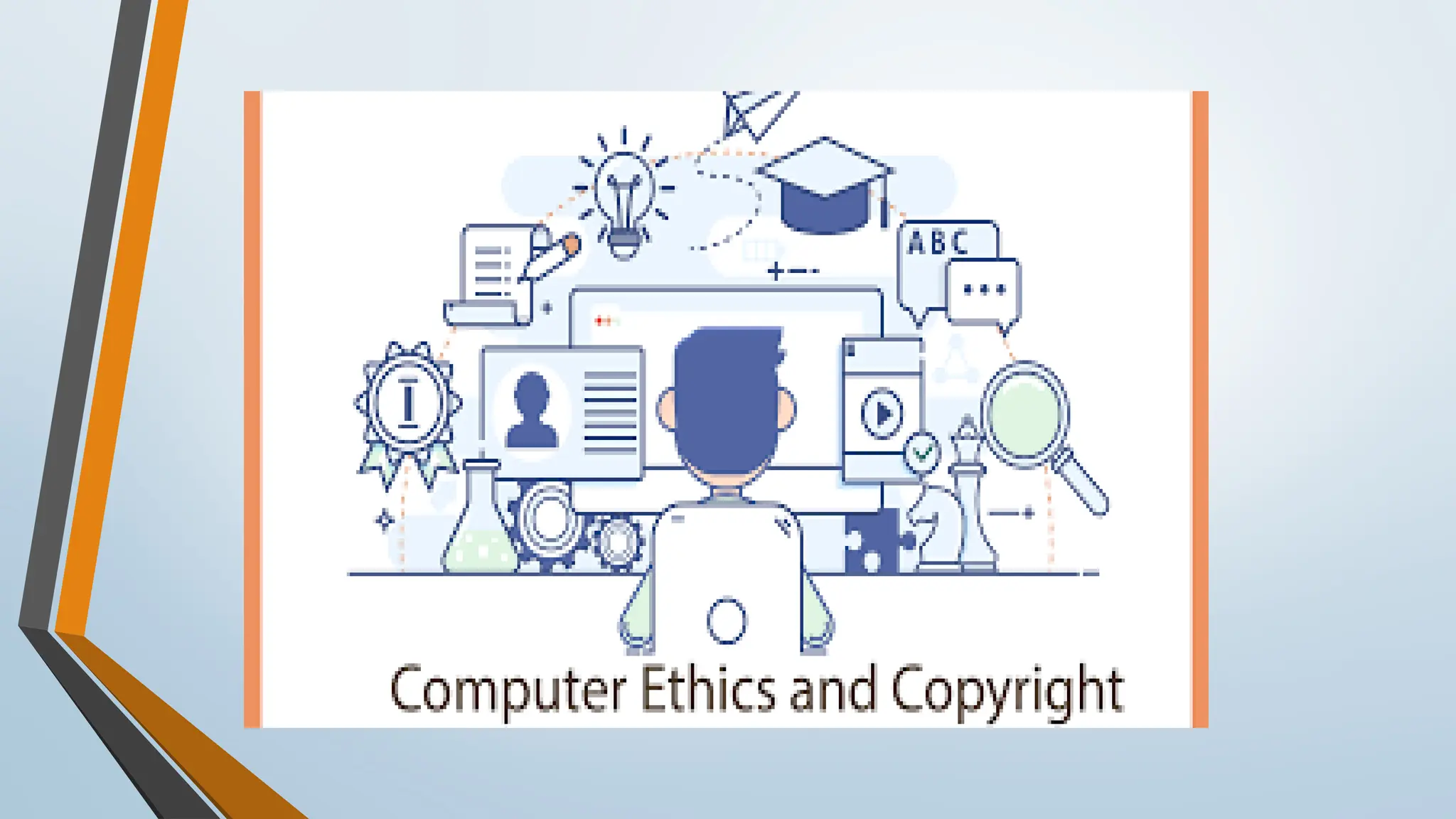
•Some common issues of computer ethics
include intellectual property rights such as
copyrighted electronic content , privacy
concerns and computer effect society.
History of Computer Ethics
Mid 1960s, Donn Parker of SRI
“when people entered the computer center they left their ethics at the door”
Late 1960s, Joseph Weizenbaum (MIT)
inspired many thinkers and projects in computer ethics
Mid 1970s, Walter Maner
inquiry dealing with ethical problems aggravated, transformed or created by
computer technology
INTELLACTUAL
• You have certainly heard the word before : it is generally
used to mean a possession or more specifically to which the
owner have legal rights.
• You might have also encountered the phase intellectual
property . This term has become more commonplace during
past few years especially in the context of computer ethics.
CATEGORISING INTELLACTUAL
PROPERTY
Intellectual property is divided into two categories:
1.Industrial Property : which includes inventions , trademarks,
industrial designs , commercial names and geographical indications.
2.Copyright : which includes literary and artistic works such as novels ,
plays , musics , paintings and films
ETHICS FOR COMPUTER PROFESSIONALS
Computer Professionals :
1. Are experts in their field.
2. Know customers rely on their knowledge , expertise and honesty .
3. Follow good professional standards and practices .
4. Maintain an expected level of competence and are up-to-date on current
knowledge and technology .
5. Educate the non-computer professionals .
COMPUTER CRIME
• Computer is crime is defined as using a computer illegally.
• Who are computer criminals ?
• Employees – disgruntled or dishonest --the largest category
• Outside users - customers or suppliers
• “Hackers” and “crackers” - hackers do it “for fun” but crackers have
malicious intent
• Organized crime - tracking illegal enterprises, forgery, counterfeiting
Types of Computer Crime
• Damage to computers, programs or files
• Viruses - migrate through systems attached to files and programs
• Worms - continuously self-replicate
• Theft
• Of hardware, software, data, computer time
• Software piracy - unauthorized copies of copyrighted material
• View/Manipulation
• “Unauthorized entry” and “harmless message” still illegal
Computer Security
• Computer security involves protecting:
• information, hardware and software
• from unauthorized use and damage and
• from sabotage and natural disasters
Computer Security
• Computer security involves protecting:
• information, hardware and software
• from unauthorized use and damage and
• from sabotage and natural disasters
Measures to Protect Computer Security
• Restricting access both to the hardware locations (physical access) and into the system itself (over the
network) using firewalls
• Implementing a plan to prevent break-ins
• Changing passwords frequently
• Making backup copies
• Using anti-virus software
• Encrypting data to frustrate interception
• Anticipating disasters (disaster recovery plan)
• Hiring trustworthy employees
Computer Ethics
for Computer Professionals
• Competence– Professionals keep up with the latest knowledge in
their field and perform services only in their area of competence.
• Responsibility– Professionals are loyal to their clients or
employees, and they won’t disclose confidential information.
• Integrity– Professionals express their opinions based on facts,
and they are impartial in their judgments.
The ACM Code of Conduct
• According to the Association for Computing Machinery (ACM) code, a computing professional:
• Contributes to society and human well-being
• Avoids harm to others
• Is honest and trustworthy
• Is fair and takes action not to discriminate
• Honors property rights, including copyrights and patents
• Gives proper credit when using the intellectual property of others
• Respects other individuals’ rights to privacy
• Honors confidentiality
Quality of Life Issues
 Rapid Change:
 Reduced response time to competition
 Maintaining Boundaries:
 Family, work, leisure
 Dependence And Vulnerability
 Employment:
 Re-engineering job loss
 Equity & Access:
 Increasing gap between haves and have nots
 Health Issues
Ergonomics
• Ergonomics:
• helps computer users to avoid
• physical and mental health risks
• and to increase
• productivity
Computer Ethics and History Of computer .pptx

Computer Ethics and History Of computer .pptx

  • 1.
    Computer ethics andsociety By Harshjyot Singh
  • 2.
    INTRODUCTION •Ethics is aset of moral principle that govern the behavior of a group or an individual . •Likewise , computer ethics is a set of moral principles that regulate the use of computer.
  • 3.
    Common issues ofcomputer ethics •Some common issues of computer ethics include intellectual property rights such as copyrighted electronic content , privacy concerns and computer effect society.
  • 5.
    History of ComputerEthics Mid 1960s, Donn Parker of SRI “when people entered the computer center they left their ethics at the door” Late 1960s, Joseph Weizenbaum (MIT) inspired many thinkers and projects in computer ethics Mid 1970s, Walter Maner inquiry dealing with ethical problems aggravated, transformed or created by computer technology
  • 6.
    INTELLACTUAL • You havecertainly heard the word before : it is generally used to mean a possession or more specifically to which the owner have legal rights. • You might have also encountered the phase intellectual property . This term has become more commonplace during past few years especially in the context of computer ethics.
  • 7.
    CATEGORISING INTELLACTUAL PROPERTY Intellectual propertyis divided into two categories: 1.Industrial Property : which includes inventions , trademarks, industrial designs , commercial names and geographical indications. 2.Copyright : which includes literary and artistic works such as novels , plays , musics , paintings and films
  • 8.
    ETHICS FOR COMPUTERPROFESSIONALS Computer Professionals : 1. Are experts in their field. 2. Know customers rely on their knowledge , expertise and honesty . 3. Follow good professional standards and practices . 4. Maintain an expected level of competence and are up-to-date on current knowledge and technology . 5. Educate the non-computer professionals .
  • 9.
    COMPUTER CRIME • Computeris crime is defined as using a computer illegally. • Who are computer criminals ? • Employees – disgruntled or dishonest --the largest category • Outside users - customers or suppliers • “Hackers” and “crackers” - hackers do it “for fun” but crackers have malicious intent • Organized crime - tracking illegal enterprises, forgery, counterfeiting
  • 10.
    Types of ComputerCrime • Damage to computers, programs or files • Viruses - migrate through systems attached to files and programs • Worms - continuously self-replicate • Theft • Of hardware, software, data, computer time • Software piracy - unauthorized copies of copyrighted material • View/Manipulation • “Unauthorized entry” and “harmless message” still illegal
  • 11.
    Computer Security • Computersecurity involves protecting: • information, hardware and software • from unauthorized use and damage and • from sabotage and natural disasters
  • 12.
    Computer Security • Computersecurity involves protecting: • information, hardware and software • from unauthorized use and damage and • from sabotage and natural disasters
  • 13.
    Measures to ProtectComputer Security • Restricting access both to the hardware locations (physical access) and into the system itself (over the network) using firewalls • Implementing a plan to prevent break-ins • Changing passwords frequently • Making backup copies • Using anti-virus software • Encrypting data to frustrate interception • Anticipating disasters (disaster recovery plan) • Hiring trustworthy employees
  • 14.
    Computer Ethics for ComputerProfessionals • Competence– Professionals keep up with the latest knowledge in their field and perform services only in their area of competence. • Responsibility– Professionals are loyal to their clients or employees, and they won’t disclose confidential information. • Integrity– Professionals express their opinions based on facts, and they are impartial in their judgments.
  • 15.
    The ACM Codeof Conduct • According to the Association for Computing Machinery (ACM) code, a computing professional: • Contributes to society and human well-being • Avoids harm to others • Is honest and trustworthy • Is fair and takes action not to discriminate • Honors property rights, including copyrights and patents • Gives proper credit when using the intellectual property of others • Respects other individuals’ rights to privacy • Honors confidentiality
  • 16.
    Quality of LifeIssues  Rapid Change:  Reduced response time to competition  Maintaining Boundaries:  Family, work, leisure  Dependence And Vulnerability  Employment:  Re-engineering job loss  Equity & Access:  Increasing gap between haves and have nots  Health Issues
  • 17.
    Ergonomics • Ergonomics: • helpscomputer users to avoid • physical and mental health risks • and to increase • productivity

Editor's Notes