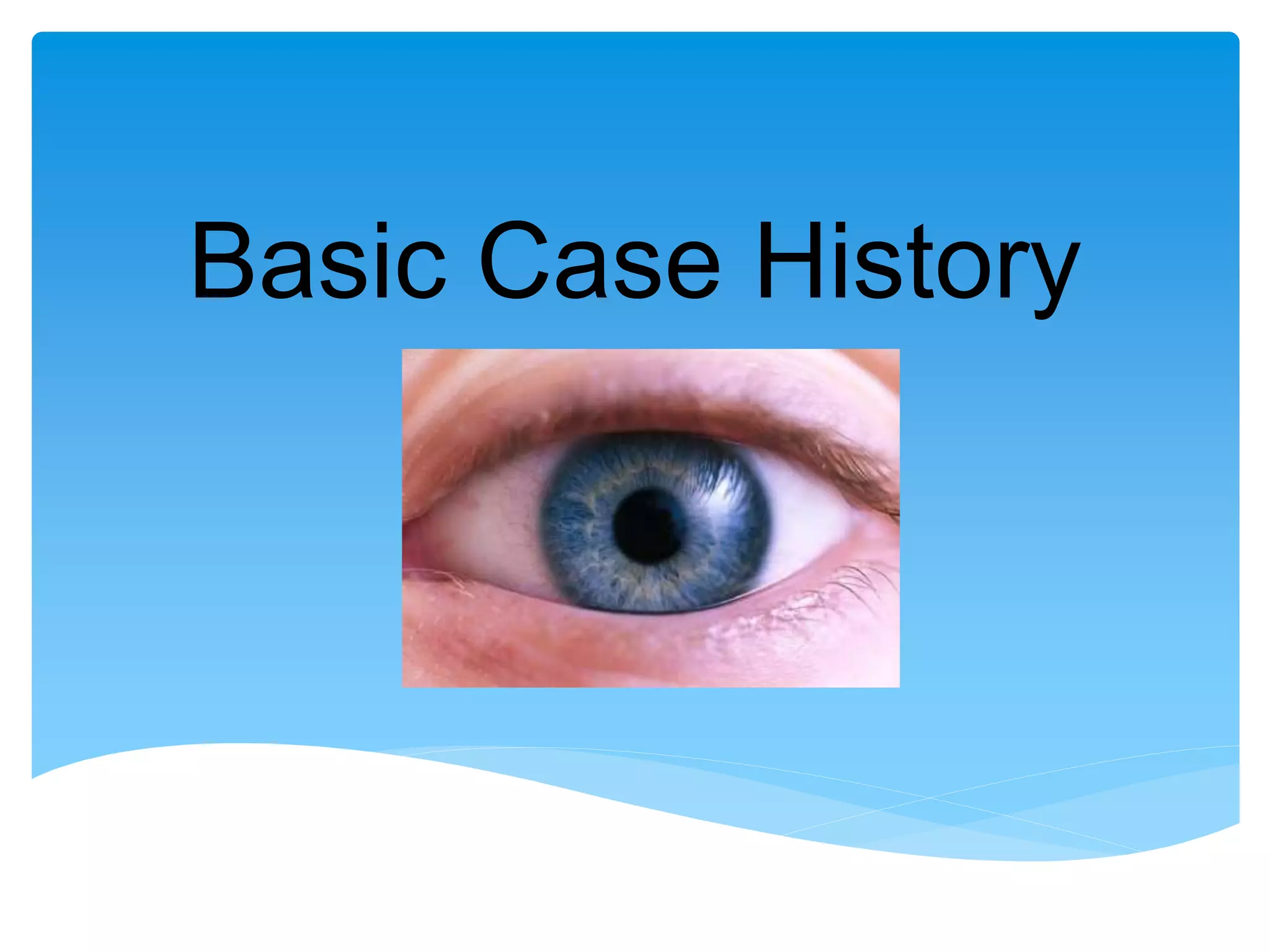


Basic Case History
Primary Eye Care OD-104
Sahibzada Hakim Anjum Nadeem
Departmental Coordinator,
Department of Optometry and Vision Sciences
CEO Anjum Eye Care & Optical Company
Optometrist, Al-Khair Eye Hospital Lahore
Co-Incharge OTTC, Optician, Refractionist, COAVS
Phone:03344496480, Email: shanjum92@gmail.com
It is a gathering information process from the patient guided by
an educated and active mind.
It is a selective guided and progressive elicitation and
recognition of significant information
History by skilled person can arrive at the proper diagnosis in
90% of patients.
It gives vital guidance for:
(a) physical examination
(b) laboratory work
(c) Therapy
Failure to take history can lead to missing vision or life
threatening conditions.
Chief complaint: ’’The patient’s own words’’
‘’she cannot see with the RE’’
You should not come to conclusion that her problem is
nearsightedness and write down “Myopia of RE”.
 The patient needs will not be satisfied until he/she has received
an acceptable explanation of the meaning of the chief
complaint and its proper management.
History of the Present Illness:
Detailed description of the chief complaint to understand the
symptoms and course of the disorder.
Listen and question and then write down in orderly sequence
that make sense to you.
* The time sequence
when, How fast, what order did events occur?
* Frequency, intermittency
* location, Laterality
* Severity
* Associated symptoms *
Documentation (old records, photo)
e.g ptosis, proptosis, VII N palsy.
 gradual painless decrease vision both eyes for 1y.
 Sudden painless decrease vision RE for 10 min.
“cannot see with RE”!!
 ? Only distance vision blurred.
 ? Blind spot is present in the center of VF
 ? Right side of VF of the RE lost
 ? Right VF of both eyes lost
 ? A diffuse haze obscures the entire field of RE
Each of these has different diagnostic implication
Most pt. has difficulty providing precise and concise
description
Disturbances of vision:
 Blurred or decreased central vision
 Decreased peripheral vision. (glaucoma)
 Altered image size.
(micropsia, macropsia, metamorphopsia).
 Diplopia (monocular, binocular)
 Floaters
 Photopsia (flash of light)
 Color vision abnormalities.
 Dark adaptation problems.
 Blindness
(ocular, cortical).
 Oscillopsia
(shaking of images).
Ocular pain or discomfort:
 Foreign body sensation
 Ciliary pain (aching, severe pain in or around the eye, often
radiating to the ipsilateral forehead, molar area)
 Photophobia
 Headache
 Burning
 Dryness
 Itching: patient rub the eye vigorously (allergy)
 Asthenopia (eye strain)
Floaters and flashing lights: These are the classic symptoms of a retinal
detachment and retinal tears, so ask EVERY patient about these
symptoms. Most patients complain of some floaters - see if they’re
actually new or have worsened recently.
Transient vision loss: Think of migraine vessel spasm in the young and
micro-emboli in the elderly. Curtains of darkness might indicate an
ischemic event or a retinal detachment, so explore these symptoms in
detail.
Blurry vision: Is the vision always blurry? Does it worsen when reading
or watching TV? People blink less when watching TV and develop dry
eyes. Is this a glare problem at night that might indicate cataracts? Is this
a patient with poor glycemic control with resulting hyperosmotic
swelling of their lens?
Red, painful eyes: A common complaint. Be sure to ask about the nature
of the pain (is this a scratchy pain, aching pain, or only pain with bright
light). Is there discharge that might indicate an infection?
Chronic itching and tearing: Think about allergies or blepharitis. Is it in
both eyes?
Headaches and scalp tenderness: Think of temporal (giant cell) arteritis
and ask about other collaborating symptoms like jaw claudication,
polymyalgias, weight loss, and night sweats.
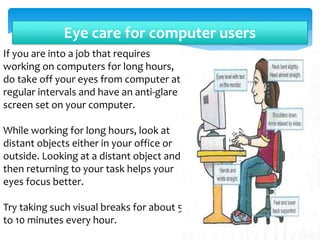
Eye care for computer users
If you are into a job that requires
working on computers for long hours,
do take off your eyes from computer at
regular intervals and have an anti-glare
screen set on your computer.
While working for long hours, look at
distant objects either in your office or
outside. Looking at a distant object and
then returning to your task helps your
eyes focus better.
Try taking such visual breaks for about 5
to 10 minutes every hour.
Have separate towels
Ensure that each member of your family has
separate towels. Eye infections like trachoma
and conjunctivitis are transmitted through
common towels and handkerchiefs.
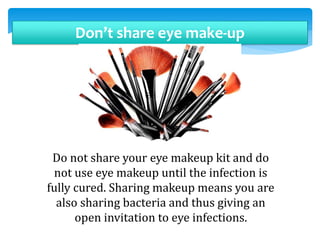
Don’t share eye make-up
Do not share your eye makeup kit and do
not use eye makeup until the infection is
fully cured. Sharing makeup means you are
also sharing bacteria and thus giving an
open invitation to eye infections.
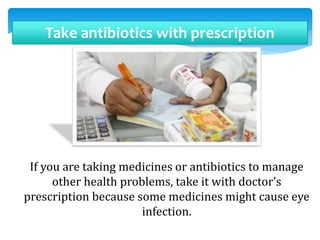
Take antibiotics with prescription
If you are taking medicines or antibiotics to manage
other health problems, take it with doctor’s
prescription because some medicines might cause eye
infection.
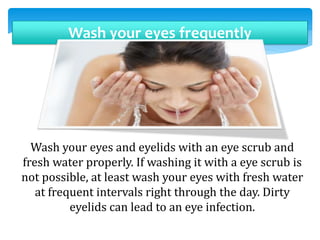
Wash your eyes frequently
Wash your eyes and eyelids with an eye scrub and
fresh water properly. If washing it with a eye scrub is
not possible, at least wash your eyes with fresh water
at frequent intervals right through the day. Dirty
eyelids can lead to an eye infection.
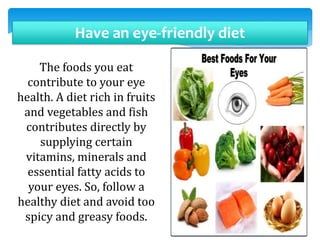
Have an eye-friendly diet
The foods you eat
contribute to your eye
health. A diet rich in fruits
and vegetables and fish
contributes directly by
supplying certain
vitamins, minerals and
essential fatty acids to
your eyes. So, follow a
healthy diet and avoid too
spicy and greasy foods.
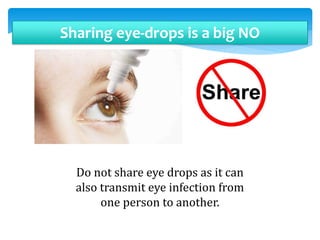
Sharing eye-drops is a big NO
Do not share eye drops as it can
also transmit eye infection from
one person to another.
Protect your eyes
Always wear
sunglasses when in
the sun, wind, or cold
to prevent eye
irritation.
Keep your hands clean
We all touch our eyes many times
a day. It’s best to always wash
your hands before and after
touching your eyes or face.
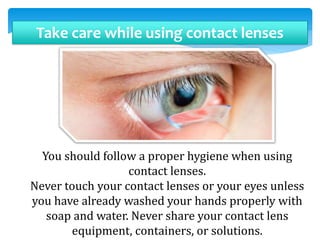
Take care while using contact lenses
You should follow a proper hygiene when using
contact lenses.
Never touch your contact lenses or your eyes unless
you have already washed your hands properly with
soap and water. Never share your contact lens
equipment, containers, or solutions.
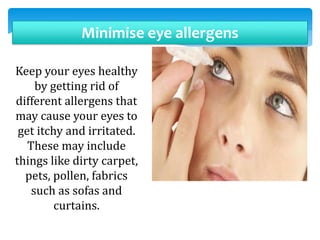
Minimise eye allergens
Keep your eyes healthy
by getting rid of
different allergens that
may cause your eyes to
get itchy and irritated.
These may include
things like dirty carpet,
pets, pollen, fabrics
such as sofas and
curtains.
Questions?

Primery eye care 4,5

  • 1.
  • 2.
    Primary Eye CareOD-104 Sahibzada Hakim Anjum Nadeem Departmental Coordinator, Department of Optometry and Vision Sciences CEO Anjum Eye Care & Optical Company Optometrist, Al-Khair Eye Hospital Lahore Co-Incharge OTTC, Optician, Refractionist, COAVS Phone:03344496480, Email: shanjum92@gmail.com
  • 3.
    It is agathering information process from the patient guided by an educated and active mind. It is a selective guided and progressive elicitation and recognition of significant information History by skilled person can arrive at the proper diagnosis in 90% of patients.
  • 4.
    It gives vitalguidance for: (a) physical examination (b) laboratory work (c) Therapy Failure to take history can lead to missing vision or life threatening conditions.
  • 5.
    Chief complaint: ’’Thepatient’s own words’’ ‘’she cannot see with the RE’’ You should not come to conclusion that her problem is nearsightedness and write down “Myopia of RE”.  The patient needs will not be satisfied until he/she has received an acceptable explanation of the meaning of the chief complaint and its proper management.
  • 6.
    History of thePresent Illness: Detailed description of the chief complaint to understand the symptoms and course of the disorder. Listen and question and then write down in orderly sequence that make sense to you.
  • 7.
    * The timesequence when, How fast, what order did events occur? * Frequency, intermittency * location, Laterality * Severity * Associated symptoms * Documentation (old records, photo) e.g ptosis, proptosis, VII N palsy.  gradual painless decrease vision both eyes for 1y.  Sudden painless decrease vision RE for 10 min.
  • 8.
    “cannot see withRE”!!  ? Only distance vision blurred.  ? Blind spot is present in the center of VF  ? Right side of VF of the RE lost  ? Right VF of both eyes lost  ? A diffuse haze obscures the entire field of RE Each of these has different diagnostic implication Most pt. has difficulty providing precise and concise description
  • 9.
    Disturbances of vision: Blurred or decreased central vision  Decreased peripheral vision. (glaucoma)  Altered image size. (micropsia, macropsia, metamorphopsia).  Diplopia (monocular, binocular)  Floaters  Photopsia (flash of light)
  • 10.
     Color visionabnormalities.  Dark adaptation problems.  Blindness (ocular, cortical).  Oscillopsia (shaking of images).
  • 11.
    Ocular pain ordiscomfort:  Foreign body sensation  Ciliary pain (aching, severe pain in or around the eye, often radiating to the ipsilateral forehead, molar area)  Photophobia  Headache  Burning  Dryness  Itching: patient rub the eye vigorously (allergy)  Asthenopia (eye strain)
  • 12.
    Floaters and flashinglights: These are the classic symptoms of a retinal detachment and retinal tears, so ask EVERY patient about these symptoms. Most patients complain of some floaters - see if they’re actually new or have worsened recently. Transient vision loss: Think of migraine vessel spasm in the young and micro-emboli in the elderly. Curtains of darkness might indicate an ischemic event or a retinal detachment, so explore these symptoms in detail. Blurry vision: Is the vision always blurry? Does it worsen when reading or watching TV? People blink less when watching TV and develop dry eyes. Is this a glare problem at night that might indicate cataracts? Is this a patient with poor glycemic control with resulting hyperosmotic swelling of their lens? Red, painful eyes: A common complaint. Be sure to ask about the nature of the pain (is this a scratchy pain, aching pain, or only pain with bright light). Is there discharge that might indicate an infection? Chronic itching and tearing: Think about allergies or blepharitis. Is it in both eyes? Headaches and scalp tenderness: Think of temporal (giant cell) arteritis and ask about other collaborating symptoms like jaw claudication, polymyalgias, weight loss, and night sweats.
  • 15.
    Eye care forcomputer users If you are into a job that requires working on computers for long hours, do take off your eyes from computer at regular intervals and have an anti-glare screen set on your computer. While working for long hours, look at distant objects either in your office or outside. Looking at a distant object and then returning to your task helps your eyes focus better. Try taking such visual breaks for about 5 to 10 minutes every hour.
  • 16.
    Have separate towels Ensurethat each member of your family has separate towels. Eye infections like trachoma and conjunctivitis are transmitted through common towels and handkerchiefs.
  • 17.
    Don’t share eyemake-up Do not share your eye makeup kit and do not use eye makeup until the infection is fully cured. Sharing makeup means you are also sharing bacteria and thus giving an open invitation to eye infections.
  • 18.
    Take antibiotics withprescription If you are taking medicines or antibiotics to manage other health problems, take it with doctor’s prescription because some medicines might cause eye infection.
  • 19.
    Wash your eyesfrequently Wash your eyes and eyelids with an eye scrub and fresh water properly. If washing it with a eye scrub is not possible, at least wash your eyes with fresh water at frequent intervals right through the day. Dirty eyelids can lead to an eye infection.
  • 20.
    Have an eye-friendlydiet The foods you eat contribute to your eye health. A diet rich in fruits and vegetables and fish contributes directly by supplying certain vitamins, minerals and essential fatty acids to your eyes. So, follow a healthy diet and avoid too spicy and greasy foods.
  • 21.
    Sharing eye-drops isa big NO Do not share eye drops as it can also transmit eye infection from one person to another.
  • 22.
    Protect your eyes Alwayswear sunglasses when in the sun, wind, or cold to prevent eye irritation.
  • 23.
    Keep your handsclean We all touch our eyes many times a day. It’s best to always wash your hands before and after touching your eyes or face.
  • 24.
    Take care whileusing contact lenses You should follow a proper hygiene when using contact lenses. Never touch your contact lenses or your eyes unless you have already washed your hands properly with soap and water. Never share your contact lens equipment, containers, or solutions.
  • 25.
    Minimise eye allergens Keepyour eyes healthy by getting rid of different allergens that may cause your eyes to get itchy and irritated. These may include things like dirty carpet, pets, pollen, fabrics such as sofas and curtains.
  • 26.