UNIDAD EDUCATIVA FISCAL “riobamba”
Riobamba- Ecuador
ANNUAL TEACHING PLAN
1. GENERAL INFORMATION
Area: English Language
School/ high- school: “Riobamba”
School Year: 2013 - 2014
Target group (s): 8th
year EGB
Responsible : English Department Teachers.
Date: 2014
2. OBJECTIVES
2.1. COMMUNICATIVE COMPETENCE OBJECTIVES
By the end of 8th year EGB,students will be able to:
LinguisticComponent SociolinguisticComponent PragmaticComponent
 Have a very basic repertoire of words
and phrases related to their personal21
and educational22 background.
 Have limited control over a few simple
grammatical structures and sentence
patterns in a learned repertoire, which
relates to their personal and educational
background.

 Use basic expressions to impart and
elicit factual information as well as
socialize (e.g. greetings, addressing
forms, introducing oneself and others,
and saying ‘good-bye’, etc.).
 Link words or groups of words with
very basic linear connectors like and
or or.
UNIDAD EDUCATIVA FISCAL “riobamba”
Riobamba- Ecuador
2.2. LANGUAGE SKILLS OBJECTIVES
LISTENING READING SPEAKING WRITING
 In simple spoken texts, understand
expressions, words, and sentences
related to the learner’s personal
and educational background (e.g.
personal information, house, daily
life activities, curricular subjects,
classroom equipment, classroom
commands, etc.).
 Follow speech which is very slow
and carefully articulated, with
long pauses for them to assimilate
meaning within the personal and
educational domains.
 Understand and identify
very simple informational
texts (e.g. labels, messages,
postcards, catalogs, etc.) a
single phrase at a time,
picking up familiar names,
words, and basic phrases and
rereading as required.
 Extract the gist and key
information items from very
simple informational texts.
 Produce slow, hesitant,
planned monologues (i.e.
with frequent pauses to
search for expressions,
backtracking24, errors,
etc.)
 Interact in a simple way
by asking and answering
simple questions about
the learners’ personal and
educational background.
Communication is highly
dependent on repetition at
a slower rate of speech,
rephrasing, and repair25.
 Produce very simple
informational texts that
can have little or no
detail, can have little
variety in sentence
structure, and may have
some usage error.
UNIDAD EDUCATIVA FISCAL “riobamba”
Riobamba- Ecuador
3. CONTENTS
TERM TIME FRAME FUNCTIONS GRAMMAR VOCABULARY
F September -
I October
R November
S December
T January
What’s your name?
 Ask about favorites
 Introduce yourself
Simple present of be: am/
is / are
- Affirmative
statements
- Negative
statements
Subjects pronouns
Questions with be
- Yes / no questions
Information questions:
what? How old? Who?
Cardinal Numbers 21 -
100
END OF TERM EXAMS AND FIRST TERM BREAK (FEBRUARY 1ST
TO 15TH
2013
S February
This is Brian
 Introduce people
Ask where people and
things are: Where is? /
where are?
Prepositions of place: in,
on, above, under, at,
behind, in front of
Possessive adjectives: my,
your, his, her,our, your,
their
Things for teens
E March
Where are you from?
 Talk about where
people are from
 Ask for and give
personal information
Nouns: Singular and plural
forms
This/that; these/those
Articles: a and an
Countries and
nationaties
C April
Can you repeat that,
please?
 Ask about birthdays
 Ask questions: when?
What time? What day?
Can for requests
Question words: When,
what time, what day+
Ordinal numbers
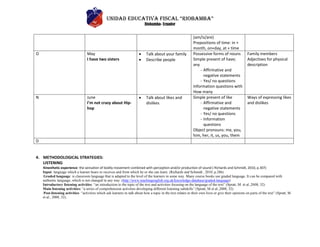
UNIDAD EDUCATIVA FISCAL “riobamba”
Riobamba- Ecuador
(am/is/are)
Prepositions of time: in +
month, on+day, at + time
O May
I have two sisters
 Talk about your family
 Describe people
Possessive forms of nouns
Simple present of have;
any
- Affirmative and
negative statements
- Yes/ no questions
Information questions with
How many
Family members
Adjectives for physical
description
N June
I’m not crazy about Hip-
hop
 Talk about likes and
dislikes
Simple present of like
- Affirmative and
negative statements
- Yes/ no questions
- Information
questions
Object pronouns: me, you,
him, her, it, us, you, them
Ways of expressing likes
and dislikes
D
4. METHODOLOGICAL STRATEGIES:
LISTENING
Kinesthetic experience: the sensation of bodily movement combined with perception and/or production of sound ( Richards and Schmidt, 2010, p.307)
Input: language which a learner hears or receives and from which he or she can learn. (Richards and Schmidt , 2010, p.286)
Graded language: is classroom language that is adapted to the level of the learners in some way. Many course books use graded language. It can be compared with
authentic language, which is not changed in any way. (http://www.teachingenglish.org.uk/knowledge-database/graded-language)
Introductory listening activities: “an introduction to the topic of the text and activities focusing on the language of the text” (Spratt, M. et al.,2008, 32)
Main listening activities: “a series of comprehension activities developing different listening subskills” (Spratt, M et al.,2008, 32)
Post-listening activities: “activities which ask learners to talk about how a topic in the text relates to their own lives or give their opinions on parts of the text” (Spratt, M
et al., 2008, 32).
UNIDAD EDUCATIVA FISCAL “riobamba”
Riobamba- Ecuador
READING
Authentic texts: “texts which are not written especially for language learners, but which are intended for any competent user of the language” (Harmer, 2007, p.100)
Intensive reading: “refers to the detailed focus on the construction of reading texts which takes place usually (but not always) in classrooms” (Harmer, 2007, p.99).
Intensive reading: refers to the type of activities done to make learners more aware of how language is used. Sometimes we use texts to examine language and therefore,
we might ask learners to look for all the words in a text related to a particular topic, or work out the grammar of a particular sentence. (Spratt, et al, 2008)
Extensive reading: means reading in quantity and in order to gain a general understanding of what is read. It is intended to develop good reading habits, to build up
knowledge of vocabulary and structure, and to encourage a liking for reading. (Richards and Schmidt, 2010, p.212). Examples are reading long pieces of text like a story
or an article.
Graded readers: Also simplified reader is a text written for children learning their mother tongue, or for second or foreign language learners, in which the language
content is based on a language grading scheme. A graded reader may use a restricted vocabulary or set of grammatical structures (Richards and Schmidt, 2010, p.251)
SPEAKING
Activate: means that learners put to use all and any language at their disposal or command and which may be appropriate for a given situation or topic. According to
Harmer (2007), “This element describes exercises and activities which are designed to get students using language as freely and communicatively as they can” (p.53).
Automatic: this means that learners will be able to use words and phrases fluently without very much conscious thought (Brown, 2007).
Backtracking: returning to a previous point or subject, as in a discussion or lecture (www.thefreedictionary.com)
Repair: a term for ways in which errors, unintended forms, or misunderstandings are corrected by speakers or others during conversation (Richards and Schmidt, 2010, p.
495)—e.g. I have a, uhm…what do you call it… pencil case (self-initiated repair).
Controlled practice: “activities in which learner output is managed and controlled by the teacher or the materials to avoid the possibility of student errors” (Richards and
Schmidt, 2010, p.448)
Drill: a technique commonly used in older methods of language teaching particularly the audio-lingual method and used for practicing sounds or sentence patterns in a
language, based on guided repetition or practice. A drill which practices some aspect of grammar or sentence formation is often known as pattern practice (Richards and
Schmidt, 2010, p.184)
Modeling: providing a model (e.g. a sentence, a question, a behavior, an action) as an example for someone learning a language to imitate it. (Richards and Schmidt,
2010, p.370)
WRITING
Display question: “a question which is not a real question (i.e. which does not seek information unknown to the teacher) but which serves to elicit language practice—
e.g. Is this a book? Yes, it’s a book.” (Richards and Schmidt, 2010, p. 178).
Writing process: the strategies, procedures and decision- making employed by writers as they write. Writing is viewed as the result of complex processes of planning,
drafting, reviewing and revising and some approaches to the teaching of first and second language writing teach students to use these processes (Richards and Schmidt,
2010, p.640)
Accuracy: refers to the ability to produce grammatically correct sentences but may not include the ability to speak or write fluently (Richards and Schmidt, 2010, p.222)
Portfolio: a purposeful collection of work that provides information about someone’s effort, progress or achievement in a given area. It is a learning as well as
assessment tool (Richards and Schmidt, 2010, p.443)
5. RESOURCES
 Teacher’sbook (Ministerio de Educación)
UNIDAD EDUCATIVA FISCAL “riobamba”
Riobamba- Ecuador
 Student’s book (Ministerio de Educación)
 Class Audio CDs
 Posters
 Television
 Cd player
 Board and markets
 Cards
 Internet
 Videos
 Portfolio
 Magazines
6. EVALUATION
Diagnostic (at the beginning of the school year)
Formative (along the school year)
Summative (at the end of the course)
Assessment
1. Be aware of students’ strengths and weaknesses (diagnostic assessment).
2. Formative assessment (e.g., oral and writing lessons, homework, projects, etc.)
3. Summative assessment (According to the new bylaws of the Law of Education)
4. Assessment tools (e.g. written and oral tests)
_____________________ _______________________
Dp.S. Cecilia Peñafiel Lic. Rosana Moreno
ENGLISH DEPARTMENT/AREA SCHOOL DIRECTOR COORDINATOR

Annual teaching plan octavo

  • 1.
    UNIDAD EDUCATIVA FISCAL“riobamba” Riobamba- Ecuador ANNUAL TEACHING PLAN 1. GENERAL INFORMATION Area: English Language School/ high- school: “Riobamba” School Year: 2013 - 2014 Target group (s): 8th year EGB Responsible : English Department Teachers. Date: 2014 2. OBJECTIVES 2.1. COMMUNICATIVE COMPETENCE OBJECTIVES By the end of 8th year EGB,students will be able to: LinguisticComponent SociolinguisticComponent PragmaticComponent  Have a very basic repertoire of words and phrases related to their personal21 and educational22 background.  Have limited control over a few simple grammatical structures and sentence patterns in a learned repertoire, which relates to their personal and educational background.   Use basic expressions to impart and elicit factual information as well as socialize (e.g. greetings, addressing forms, introducing oneself and others, and saying ‘good-bye’, etc.).  Link words or groups of words with very basic linear connectors like and or or.
  • 2.
    UNIDAD EDUCATIVA FISCAL“riobamba” Riobamba- Ecuador 2.2. LANGUAGE SKILLS OBJECTIVES LISTENING READING SPEAKING WRITING  In simple spoken texts, understand expressions, words, and sentences related to the learner’s personal and educational background (e.g. personal information, house, daily life activities, curricular subjects, classroom equipment, classroom commands, etc.).  Follow speech which is very slow and carefully articulated, with long pauses for them to assimilate meaning within the personal and educational domains.  Understand and identify very simple informational texts (e.g. labels, messages, postcards, catalogs, etc.) a single phrase at a time, picking up familiar names, words, and basic phrases and rereading as required.  Extract the gist and key information items from very simple informational texts.  Produce slow, hesitant, planned monologues (i.e. with frequent pauses to search for expressions, backtracking24, errors, etc.)  Interact in a simple way by asking and answering simple questions about the learners’ personal and educational background. Communication is highly dependent on repetition at a slower rate of speech, rephrasing, and repair25.  Produce very simple informational texts that can have little or no detail, can have little variety in sentence structure, and may have some usage error.
  • 3.
    UNIDAD EDUCATIVA FISCAL“riobamba” Riobamba- Ecuador 3. CONTENTS TERM TIME FRAME FUNCTIONS GRAMMAR VOCABULARY F September - I October R November S December T January What’s your name?  Ask about favorites  Introduce yourself Simple present of be: am/ is / are - Affirmative statements - Negative statements Subjects pronouns Questions with be - Yes / no questions Information questions: what? How old? Who? Cardinal Numbers 21 - 100 END OF TERM EXAMS AND FIRST TERM BREAK (FEBRUARY 1ST TO 15TH 2013 S February This is Brian  Introduce people Ask where people and things are: Where is? / where are? Prepositions of place: in, on, above, under, at, behind, in front of Possessive adjectives: my, your, his, her,our, your, their Things for teens E March Where are you from?  Talk about where people are from  Ask for and give personal information Nouns: Singular and plural forms This/that; these/those Articles: a and an Countries and nationaties C April Can you repeat that, please?  Ask about birthdays  Ask questions: when? What time? What day? Can for requests Question words: When, what time, what day+ Ordinal numbers
  • 4.
    UNIDAD EDUCATIVA FISCAL“riobamba” Riobamba- Ecuador (am/is/are) Prepositions of time: in + month, on+day, at + time O May I have two sisters  Talk about your family  Describe people Possessive forms of nouns Simple present of have; any - Affirmative and negative statements - Yes/ no questions Information questions with How many Family members Adjectives for physical description N June I’m not crazy about Hip- hop  Talk about likes and dislikes Simple present of like - Affirmative and negative statements - Yes/ no questions - Information questions Object pronouns: me, you, him, her, it, us, you, them Ways of expressing likes and dislikes D 4. METHODOLOGICAL STRATEGIES: LISTENING Kinesthetic experience: the sensation of bodily movement combined with perception and/or production of sound ( Richards and Schmidt, 2010, p.307) Input: language which a learner hears or receives and from which he or she can learn. (Richards and Schmidt , 2010, p.286) Graded language: is classroom language that is adapted to the level of the learners in some way. Many course books use graded language. It can be compared with authentic language, which is not changed in any way. (http://www.teachingenglish.org.uk/knowledge-database/graded-language) Introductory listening activities: “an introduction to the topic of the text and activities focusing on the language of the text” (Spratt, M. et al.,2008, 32) Main listening activities: “a series of comprehension activities developing different listening subskills” (Spratt, M et al.,2008, 32) Post-listening activities: “activities which ask learners to talk about how a topic in the text relates to their own lives or give their opinions on parts of the text” (Spratt, M et al., 2008, 32).
  • 5.
    UNIDAD EDUCATIVA FISCAL“riobamba” Riobamba- Ecuador READING Authentic texts: “texts which are not written especially for language learners, but which are intended for any competent user of the language” (Harmer, 2007, p.100) Intensive reading: “refers to the detailed focus on the construction of reading texts which takes place usually (but not always) in classrooms” (Harmer, 2007, p.99). Intensive reading: refers to the type of activities done to make learners more aware of how language is used. Sometimes we use texts to examine language and therefore, we might ask learners to look for all the words in a text related to a particular topic, or work out the grammar of a particular sentence. (Spratt, et al, 2008) Extensive reading: means reading in quantity and in order to gain a general understanding of what is read. It is intended to develop good reading habits, to build up knowledge of vocabulary and structure, and to encourage a liking for reading. (Richards and Schmidt, 2010, p.212). Examples are reading long pieces of text like a story or an article. Graded readers: Also simplified reader is a text written for children learning their mother tongue, or for second or foreign language learners, in which the language content is based on a language grading scheme. A graded reader may use a restricted vocabulary or set of grammatical structures (Richards and Schmidt, 2010, p.251) SPEAKING Activate: means that learners put to use all and any language at their disposal or command and which may be appropriate for a given situation or topic. According to Harmer (2007), “This element describes exercises and activities which are designed to get students using language as freely and communicatively as they can” (p.53). Automatic: this means that learners will be able to use words and phrases fluently without very much conscious thought (Brown, 2007). Backtracking: returning to a previous point or subject, as in a discussion or lecture (www.thefreedictionary.com) Repair: a term for ways in which errors, unintended forms, or misunderstandings are corrected by speakers or others during conversation (Richards and Schmidt, 2010, p. 495)—e.g. I have a, uhm…what do you call it… pencil case (self-initiated repair). Controlled practice: “activities in which learner output is managed and controlled by the teacher or the materials to avoid the possibility of student errors” (Richards and Schmidt, 2010, p.448) Drill: a technique commonly used in older methods of language teaching particularly the audio-lingual method and used for practicing sounds or sentence patterns in a language, based on guided repetition or practice. A drill which practices some aspect of grammar or sentence formation is often known as pattern practice (Richards and Schmidt, 2010, p.184) Modeling: providing a model (e.g. a sentence, a question, a behavior, an action) as an example for someone learning a language to imitate it. (Richards and Schmidt, 2010, p.370) WRITING Display question: “a question which is not a real question (i.e. which does not seek information unknown to the teacher) but which serves to elicit language practice— e.g. Is this a book? Yes, it’s a book.” (Richards and Schmidt, 2010, p. 178). Writing process: the strategies, procedures and decision- making employed by writers as they write. Writing is viewed as the result of complex processes of planning, drafting, reviewing and revising and some approaches to the teaching of first and second language writing teach students to use these processes (Richards and Schmidt, 2010, p.640) Accuracy: refers to the ability to produce grammatically correct sentences but may not include the ability to speak or write fluently (Richards and Schmidt, 2010, p.222) Portfolio: a purposeful collection of work that provides information about someone’s effort, progress or achievement in a given area. It is a learning as well as assessment tool (Richards and Schmidt, 2010, p.443) 5. RESOURCES  Teacher’sbook (Ministerio de Educación)
  • 6.
    UNIDAD EDUCATIVA FISCAL“riobamba” Riobamba- Ecuador  Student’s book (Ministerio de Educación)  Class Audio CDs  Posters  Television  Cd player  Board and markets  Cards  Internet  Videos  Portfolio  Magazines 6. EVALUATION Diagnostic (at the beginning of the school year) Formative (along the school year) Summative (at the end of the course) Assessment 1. Be aware of students’ strengths and weaknesses (diagnostic assessment). 2. Formative assessment (e.g., oral and writing lessons, homework, projects, etc.) 3. Summative assessment (According to the new bylaws of the Law of Education) 4. Assessment tools (e.g. written and oral tests) _____________________ _______________________ Dp.S. Cecilia Peñafiel Lic. Rosana Moreno ENGLISH DEPARTMENT/AREA SCHOOL DIRECTOR COORDINATOR