Pricing and Revenue
Management
What Makes Service Pricing Strategy
Different (and Difficult)?
• No ownership of services--hard for firms to calculate financial
costs of creating an intangible performance
• Variability of inputs and outputs--how can firms define a “unit
of service” and establish basis for pricing?
• Many services hard for customers to evaluate--what are they
getting in return for their money?
• Importance of time factor--same service may have more value
to customers when delivered faster
• Delivery through physical or electronic channels--may create
differences in perceived value
Objectives of Pricing Strategies
• Revenue and profit objectives
– Seek profit
– Cover costs
• Patronage and user base-related
objectives
– Build demand
– Build a user base
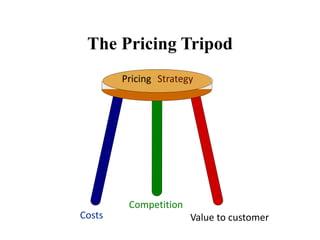
The Pricing Tripod
Pricing Strategy
Costs
Competition
Value to customer
Three Main Approaches to Pricing
• Cost-Based Pricing
– Set prices relative to financial costs (problem: defining
costs)
• Competition-Based Pricing
– Monitor competitors’ pricing strategy (especially if service
lacks differentiation)
– Who is the price leader? (one firm sets the pace)
• Value-Based
– Relate price to value perceived by customer
Activity-Based Costing: Relating Activities to the
Resources They Consume
• Managers need to see costs as an integral part of a firm’s effort to create value
for customers
• When looking at prices, customers care about value to themselves, not what
production costs the firm
• Traditional cost accounting emphasizes expense categories, with arbitrary
allocation of overheads
• ABC management systems examine activities needed to create and deliver
service (do they add value?)
• Must link resource expenses to:
– variety of products produced
– complexity of products
– demands made by individual customers
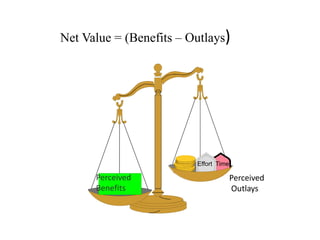
Perceived
Benefits
Time
e
Effort
Net Value = (Benefits – Outlays)
Perceived
Outlays
Enhancing Gross Value
• Pricing Strategies to Reduce Uncertainty
– service guarantees
– benefit-driven (pricing that aspect of service that creates value)
– flat rate (quoting a fixed price in advance)
• Relationship Pricing
– non-price incentives
– discounts for volume purchases
– discounts for purchasing multiple services
• Low-cost Leadership
– Convince customers not to equate price with quality
– Must keep economic costs low to ensure profitability at low price
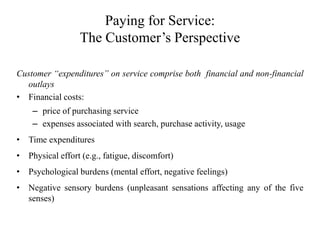
Paying for Service:
The Customer’s Perspective
Customer “expenditures” on service comprise both financial and non-financial
outlays
• Financial costs:
– price of purchasing service
– expenses associated with search, purchase activity, usage
• Time expenditures
• Physical effort (e.g., fatigue, discomfort)
• Psychological burdens (mental effort, negative feelings)
• Negative sensory burdens (unpleasant sensations affecting any of the five
senses)
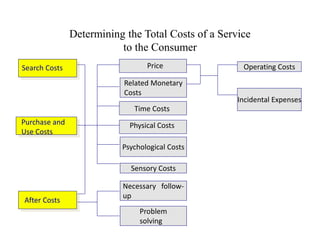
Determining the Total Costs of a Service
to the Consumer
Price
Related Monetary
Costs
Time Costs
Physical Costs
Psychological Costs
Sensory Costs
Necessary follow-
up
Problem
solving
Operating Costs
Incidental Expenses
Purchase and
Use Costs
Search Costs
After Costs

Price value ppt

  • 1.
  • 2.
    What Makes ServicePricing Strategy Different (and Difficult)? • No ownership of services--hard for firms to calculate financial costs of creating an intangible performance • Variability of inputs and outputs--how can firms define a “unit of service” and establish basis for pricing? • Many services hard for customers to evaluate--what are they getting in return for their money? • Importance of time factor--same service may have more value to customers when delivered faster • Delivery through physical or electronic channels--may create differences in perceived value
  • 3.
    Objectives of PricingStrategies • Revenue and profit objectives – Seek profit – Cover costs • Patronage and user base-related objectives – Build demand – Build a user base
  • 4.
    The Pricing Tripod PricingStrategy Costs Competition Value to customer
  • 5.
    Three Main Approachesto Pricing • Cost-Based Pricing – Set prices relative to financial costs (problem: defining costs) • Competition-Based Pricing – Monitor competitors’ pricing strategy (especially if service lacks differentiation) – Who is the price leader? (one firm sets the pace) • Value-Based – Relate price to value perceived by customer
  • 6.
    Activity-Based Costing: RelatingActivities to the Resources They Consume • Managers need to see costs as an integral part of a firm’s effort to create value for customers • When looking at prices, customers care about value to themselves, not what production costs the firm • Traditional cost accounting emphasizes expense categories, with arbitrary allocation of overheads • ABC management systems examine activities needed to create and deliver service (do they add value?) • Must link resource expenses to: – variety of products produced – complexity of products – demands made by individual customers
  • 7.
    Perceived Benefits Time e Effort Net Value =(Benefits – Outlays) Perceived Outlays
  • 8.
    Enhancing Gross Value •Pricing Strategies to Reduce Uncertainty – service guarantees – benefit-driven (pricing that aspect of service that creates value) – flat rate (quoting a fixed price in advance) • Relationship Pricing – non-price incentives – discounts for volume purchases – discounts for purchasing multiple services • Low-cost Leadership – Convince customers not to equate price with quality – Must keep economic costs low to ensure profitability at low price
  • 9.
    Paying for Service: TheCustomer’s Perspective Customer “expenditures” on service comprise both financial and non-financial outlays • Financial costs: – price of purchasing service – expenses associated with search, purchase activity, usage • Time expenditures • Physical effort (e.g., fatigue, discomfort) • Psychological burdens (mental effort, negative feelings) • Negative sensory burdens (unpleasant sensations affecting any of the five senses)
  • 10.
    Determining the TotalCosts of a Service to the Consumer Price Related Monetary Costs Time Costs Physical Costs Psychological Costs Sensory Costs Necessary follow- up Problem solving Operating Costs Incidental Expenses Purchase and Use Costs Search Costs After Costs